Building a Consensus For the
  Electronic Health Record

      Norma Muscella
       Sese Williams
      Thomas Colley
     Theresa Schenfeld
   Jacksonville University
       April 14, 2013
Today's
    Objectives
    & Agenda


2
Definitions
EHR-An electronic health record is defined as a
    systematic collection of electronic health information
    about a patient.
It is a record in digital format that is theoretically capable of
    being shared across different health care settings. In
    some cases this sharing can occur by way of network-
    connected enterprise-wide information systems and
    other information networks or exchanges.
EHRs may include a range of data, including
    demographics, medical history, medication and allergies,
    immunization status, laboratory test results, radiology
    images, vital signs, personal statistics like age, weight,
    and billing information.
Not to be confused with EMR
EMR-a digital version of the paper charts in the clinician’s office. An
   EMR contains the medical and treatment history of the patients in
   one practice. EMRs have advantages over paper records. For
   example, EMRs allow clinicians to:
   Track data over time.
   Easily identify which patients are due for preventive screenings or
   checkups.
   Check how their patients are doing on certain parameters such as
   blood pressure readings or vaccinations.
   Monitor and improve overall quality of care within the practice.
   But the information in EMRs doesn’t travel easily out of the practice.
   In fact, the patient’s record might even have to be printed out and
   delivered by mail to specialists and other members of the care team.
   In that regard, EMRs are not much better than a paper record.
Why Electronic?

“By computerizing health records, we can avoid dangerous medical
   mistakes, reduce costs, and improve care.”

With a subsequent adoption of ten-year plan through the Health
   Information Technology for Economic and Clinical Health
   (HITECH) Act of 2009 (HHS Press Release, 2010; Center for Health
   Statistics, 2005).


--President George W. Bush, State of the Union Address, January 20, 2004.
EHR’S reduce errors

Automatically checks for conflicts when new medications are ordered
Enables clients and providers to have reliable access to patient
  education opportunities
Assist providers with cross check of symptoms and provides probable
  list of diagnosis
Supports evidence based decisions at point of care
Exposes potential safety problems when they occur and can help
  providers quickly and systematically identify and correct operational
  problems
Enhances research, monitoring and benchmarking for improvement in
  clinical quality
With electronic health records, providers
 have the information they need to provide
 the best possible care. Providers will know
 more about their patients and their health
 history before they walk into the
 examination room.
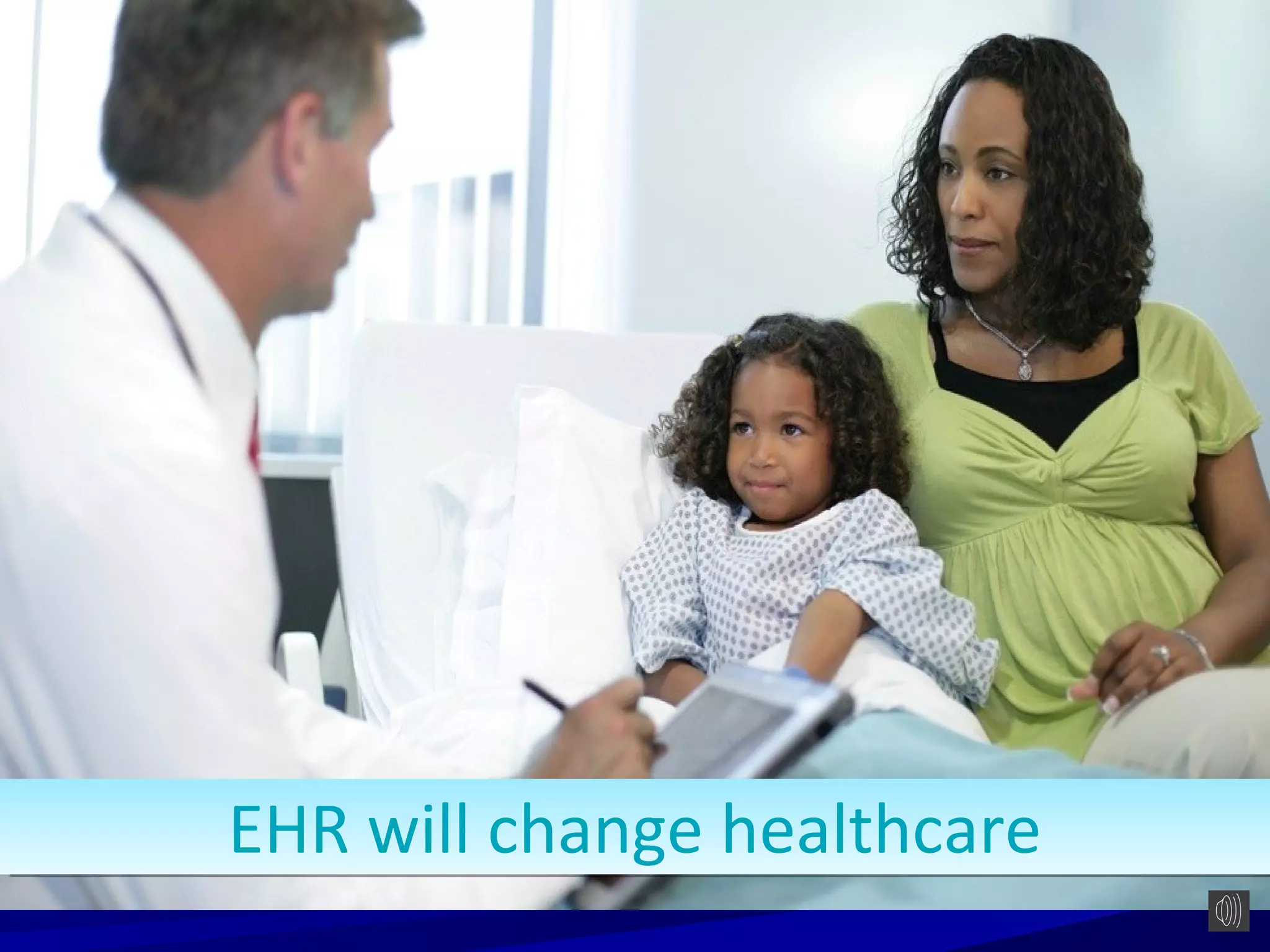
EHR will change healthcare
The information gathered by the primary
 care provider tells the emergency
 department clinician about the patient’s life
 threatening allergy, so that care can be
 adjusted appropriately, even if the patient
 is unconscious.
Improve
     patient safety and
     clinical outcomes


10
Patient Empowerment
A patient can log on to his own record and
  see the trend of the lab results over the
  last year, which can help motivate him to
  take his medications and keep up with the
  lifestyle changes that have improved the
  numbers..
Patients can receive electronic copies of
 their medical records and share their
 health information securely over the
 Internet with their families.
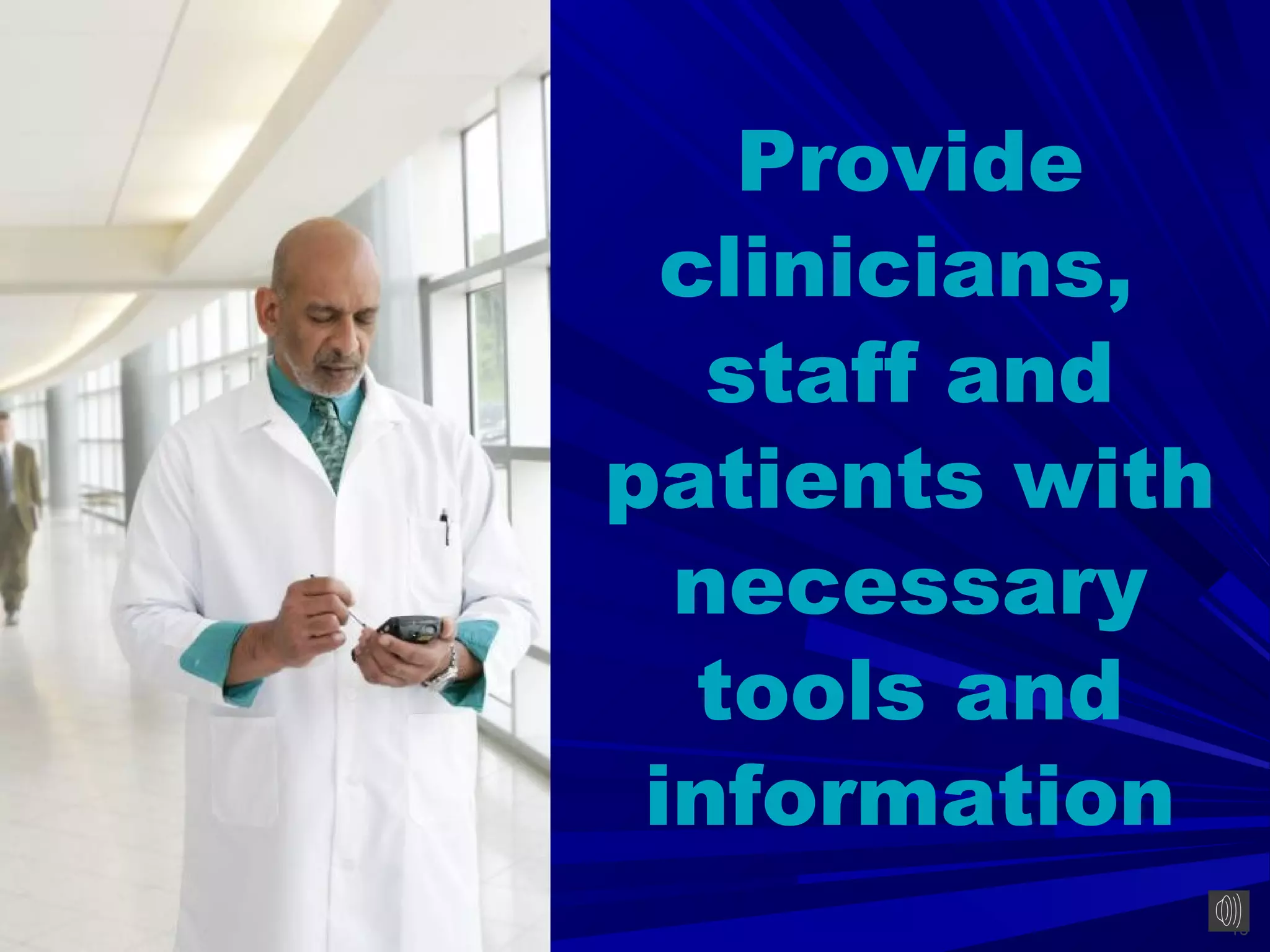
Provide
  clinicians,
   staff and
patients with
  necessary
   tools and
 information
                13
The lab results run last week are already in
 the record to tell the specialist what she
 needs to know without running duplicate
 tests.
Build the electronic
  Build the electronic
   health record with
   health record with
evidence-based content
The clinician’s notes from the patient’s
 hospital stay can help inform the
 discharge instructions and follow-up care
 and enable the patient to move from one
 care setting to another more smoothly.
Benefits
Enhance the patient experience
Provide clinicians and staff with necessary
tools and information across the
healthcare spectrum
Standardize information collected and
saved for the patients’ EHR
Strategically position patients and
clinicians for the future
Why Electronic?

Increase patient safety
Conform to government mandates in
regards to Affordable care act and
meaningful use
What is Meaningful Use?
The set of standards defined by the Centers
 for Medicare & Medicaid Services (CMS)
 Incentive Programs that governs the use
 of electronic health records and allows
 eligible providers and hospitals to earn
 incentive payments by meeting specific
 criteria.
What is involved?
Electronic physician documentation in all patient
care areas
Electronic prescribing
Integration of laboratory results
Nursing documentation
Inpatient computerized physician order entry
(CPOE)
Medication management including bar-coded
medication administration (BCMA)
Clinical reporting
Scanning archive and data repository
More definitions!
CPOE-a process of electronic entry of medical practitioner
  instructions for the treatment of patients (particularly
  hospitalized patients) under his or her care.
These orders are communicated over a computer network
  to the medical staff or to the departments (pharmacy,
  laboratory, or radiology) responsible for fulfilling the
  order.
CPOE decreases delay in order completion, reduces errors
  related to handwriting or transcription, allows order entry
  at the point of care or off-site, provides error-checking for
  duplicate or incorrect doses or tests, and simplifies
  inventory and posting of charges.
CPOE Key Benefits

Saves time by eliminating duplicative processes
and allows the clinician to articulate care from
anywhere, anytime
Reduces medication errors and adverse drug
events
Provides error-checking for duplicate or incorrect
doses or tests
Simplifies posting of charges
Potential to decrease errors related to
handwriting or transcription, decrease
turnaround time, decrease length of stay and
decrease cost of care
Built in alerts!
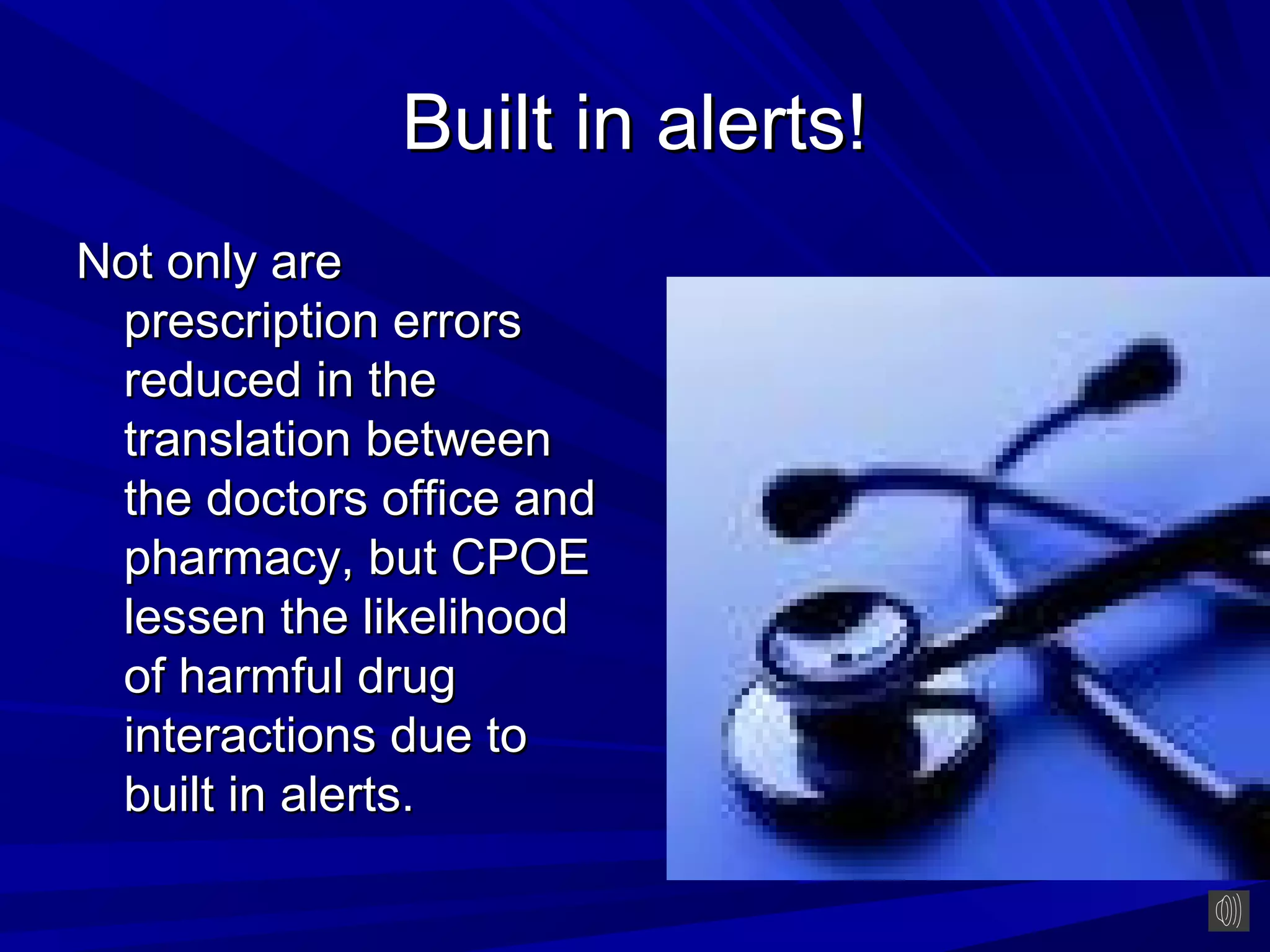
Not only are
 prescription errors
 reduced in the
 translation between
 the doctors office and
 pharmacy, but CPOE
 lessen the likelihood
 of harmful drug
 interactions due to
 built in alerts.
How do we arrive?
Every journey has a
      beginning
The journey begins…..
Investigate:
  What do I want my Electronic Record to
  do for me?
  How much am I willing to spend?
  How long will it take?
  Do I have the infrastructure in place or will
  that be an additional expense?
Assemble Group
Financial officer
Computer literate staff (Informatics
Nurse)
Information Technician
Frontline staff familiar with work flow
Risk management
Patient registration
Financial services
Middle
Define Goals

Assemble lists of “wants” and “musts”.
Invite vendors to demonstrate functionality
Incorporate questions regarding
  “personalizing” applications.
Assess security
Determine down time applications, how
  long, how often and how much of the
  system is affected.
Choose Vendor!
         Begin to build ….

         Flow from admission
             To Discharge
Stop in all departments along the way
               Evaluate
                Modify
Establish a timeline
Define users
Manage hardware and software
purchases
Install servers, cables wireless and wired
networks
Verify that HIPAA privacy, security and
breach notification policies are in place
Develop internal training plan
Develop policies and procedures to
support new technology and vocabulary.
TEST
In the test domain, a patient will be created
  along with a problem list. That patient will
    mimic a typical admission and followed
            through a hospital visit.

                      .
TRAIN
End users will follow a typical patient in
the train domain
Use blended learning strategy
Simulated charts
Small classes with classroom assistants to
help those not comfortable with computers
Questions are validated and answered
Celebration
Go Live
Minimize vacation time
Vendor and super users available real
time.
Anticipate challenges develop an “issues
log”
Celebrate facility achievement
In Conclusion
Successful conversion to EHR will take significant
  energy and resources.
Preparedness assessments must be thorough.
Detailed mapping of workflow with standard
  operating procedures and emergent situations
  studied with the inclusion of clinicians.
All end users must be trained.
Access provided must be tailored to job class
Comprehensive security planning is essential.
References
http://www.physicianspractice.com/ehr-stimulus-comple
http://www.omnimd.com/meaningful-use/emr-vs-ehr
http://georgewbush-whitehouse.archives.gov/infocus/te
Hebda, T. & Czar,P (2005). Handbook of
  Informatics for nurses and healthcare
  professionals. Upper Saddle River, New Jersey:
  Pearson.

Building a consensus for the electronic health record

  • 1.
    Building a ConsensusFor the Electronic Health Record Norma Muscella Sese Williams Thomas Colley Theresa Schenfeld Jacksonville University April 14, 2013
  • 2.
    Today's Objectives & Agenda 2
  • 3.
    Definitions EHR-An electronic healthrecord is defined as a systematic collection of electronic health information about a patient. It is a record in digital format that is theoretically capable of being shared across different health care settings. In some cases this sharing can occur by way of network- connected enterprise-wide information systems and other information networks or exchanges. EHRs may include a range of data, including demographics, medical history, medication and allergies, immunization status, laboratory test results, radiology images, vital signs, personal statistics like age, weight, and billing information.
  • 4.
    Not to beconfused with EMR EMR-a digital version of the paper charts in the clinician’s office. An EMR contains the medical and treatment history of the patients in one practice. EMRs have advantages over paper records. For example, EMRs allow clinicians to: Track data over time. Easily identify which patients are due for preventive screenings or checkups. Check how their patients are doing on certain parameters such as blood pressure readings or vaccinations. Monitor and improve overall quality of care within the practice. But the information in EMRs doesn’t travel easily out of the practice. In fact, the patient’s record might even have to be printed out and delivered by mail to specialists and other members of the care team. In that regard, EMRs are not much better than a paper record.
  • 5.
    Why Electronic? “By computerizinghealth records, we can avoid dangerous medical mistakes, reduce costs, and improve care.” With a subsequent adoption of ten-year plan through the Health Information Technology for Economic and Clinical Health (HITECH) Act of 2009 (HHS Press Release, 2010; Center for Health Statistics, 2005). --President George W. Bush, State of the Union Address, January 20, 2004.
  • 6.
    EHR’S reduce errors Automaticallychecks for conflicts when new medications are ordered Enables clients and providers to have reliable access to patient education opportunities Assist providers with cross check of symptoms and provides probable list of diagnosis Supports evidence based decisions at point of care Exposes potential safety problems when they occur and can help providers quickly and systematically identify and correct operational problems Enhances research, monitoring and benchmarking for improvement in clinical quality
  • 7.
    With electronic healthrecords, providers have the information they need to provide the best possible care. Providers will know more about their patients and their health history before they walk into the examination room.
  • 8.
    EHR will changehealthcare EHR will change healthcare
  • 9.
    The information gatheredby the primary care provider tells the emergency department clinician about the patient’s life threatening allergy, so that care can be adjusted appropriately, even if the patient is unconscious.
  • 10.
    Improve patient safety and clinical outcomes 10
  • 11.
    Patient Empowerment A patientcan log on to his own record and see the trend of the lab results over the last year, which can help motivate him to take his medications and keep up with the lifestyle changes that have improved the numbers..
  • 12.
    Patients can receiveelectronic copies of their medical records and share their health information securely over the Internet with their families.
  • 13.
    Provide clinicians, staff and patients with necessary tools and information 13
  • 14.
    The lab resultsrun last week are already in the record to tell the specialist what she needs to know without running duplicate tests.
  • 15.
    Build the electronic Build the electronic health record with health record with evidence-based content evidence-based content
  • 16.
    The clinician’s notesfrom the patient’s hospital stay can help inform the discharge instructions and follow-up care and enable the patient to move from one care setting to another more smoothly.
  • 17.
    Benefits Enhance the patientexperience Provide clinicians and staff with necessary tools and information across the healthcare spectrum Standardize information collected and saved for the patients’ EHR Strategically position patients and clinicians for the future
  • 18.
    Why Electronic? Increase patientsafety Conform to government mandates in regards to Affordable care act and meaningful use
  • 19.
    What is MeaningfulUse? The set of standards defined by the Centers for Medicare & Medicaid Services (CMS) Incentive Programs that governs the use of electronic health records and allows eligible providers and hospitals to earn incentive payments by meeting specific criteria.
  • 20.
    What is involved? Electronicphysician documentation in all patient care areas Electronic prescribing Integration of laboratory results Nursing documentation Inpatient computerized physician order entry (CPOE) Medication management including bar-coded medication administration (BCMA) Clinical reporting Scanning archive and data repository
  • 21.
    More definitions! CPOE-a processof electronic entry of medical practitioner instructions for the treatment of patients (particularly hospitalized patients) under his or her care. These orders are communicated over a computer network to the medical staff or to the departments (pharmacy, laboratory, or radiology) responsible for fulfilling the order. CPOE decreases delay in order completion, reduces errors related to handwriting or transcription, allows order entry at the point of care or off-site, provides error-checking for duplicate or incorrect doses or tests, and simplifies inventory and posting of charges.
  • 22.
    CPOE Key Benefits Savestime by eliminating duplicative processes and allows the clinician to articulate care from anywhere, anytime Reduces medication errors and adverse drug events Provides error-checking for duplicate or incorrect doses or tests Simplifies posting of charges Potential to decrease errors related to handwriting or transcription, decrease turnaround time, decrease length of stay and decrease cost of care
  • 23.
    Built in alerts! Notonly are prescription errors reduced in the translation between the doctors office and pharmacy, but CPOE lessen the likelihood of harmful drug interactions due to built in alerts.
  • 24.
    How do wearrive? Every journey has a beginning
  • 25.
    The journey begins….. Investigate: What do I want my Electronic Record to do for me? How much am I willing to spend? How long will it take? Do I have the infrastructure in place or will that be an additional expense?
  • 26.
    Assemble Group Financial officer Computerliterate staff (Informatics Nurse) Information Technician Frontline staff familiar with work flow Risk management Patient registration Financial services
  • 27.
  • 28.
    Define Goals Assemble listsof “wants” and “musts”. Invite vendors to demonstrate functionality Incorporate questions regarding “personalizing” applications. Assess security Determine down time applications, how long, how often and how much of the system is affected.
  • 29.
    Choose Vendor! Begin to build …. Flow from admission To Discharge Stop in all departments along the way Evaluate Modify
  • 30.
    Establish a timeline Defineusers Manage hardware and software purchases Install servers, cables wireless and wired networks Verify that HIPAA privacy, security and breach notification policies are in place Develop internal training plan Develop policies and procedures to support new technology and vocabulary.
  • 31.
    TEST In the testdomain, a patient will be created along with a problem list. That patient will mimic a typical admission and followed through a hospital visit. .
  • 32.
    TRAIN End users willfollow a typical patient in the train domain Use blended learning strategy Simulated charts Small classes with classroom assistants to help those not comfortable with computers Questions are validated and answered
  • 33.
  • 34.
    Go Live Minimize vacationtime Vendor and super users available real time. Anticipate challenges develop an “issues log” Celebrate facility achievement
  • 35.
    In Conclusion Successful conversionto EHR will take significant energy and resources. Preparedness assessments must be thorough. Detailed mapping of workflow with standard operating procedures and emergent situations studied with the inclusion of clinicians. All end users must be trained. Access provided must be tailored to job class Comprehensive security planning is essential.
  • 36.
    References http://www.physicianspractice.com/ehr-stimulus-comple http://www.omnimd.com/meaningful-use/emr-vs-ehr http://georgewbush-whitehouse.archives.gov/infocus/te Hebda, T. &Czar,P (2005). Handbook of Informatics for nurses and healthcare professionals. Upper Saddle River, New Jersey: Pearson.

Editor's Notes

  • #9 The OneCare Program is one of the most important priorities we ’ve ever undertaken—it is one of the ways in which we’ll transform health care. We will do this by creating a universal health record for each CHI patient—regardless of where they receive care. This new way of providing care will continue to break down barriers between care sites and providers. It will allow us to provide comprehensive, coordinated care along the continuum. As a result, the OneCare Program will fundamentally change how we deliver care at CHI.
  • #11 More specifically, the OneCare Program will help us to improve patient safety and clinical outcomes. How? First, eliminating handwriting from the system will make the environment much safer for our patients. We’ve all heard the stories about illegible orders or prescriptions. By removing this variable from how we deliver care, we will create a safer environment. Second, the clinical standardization work will result in better overall outcomes. Right now, we are using the collective wisdom of our MBO clinicians to design clinical standards that we will all use. We will also continue to update these standards as time goes on—resulting in continuous clinical improvement. We have seen other health systems embark on similar journeys and they have watched their outcomes improve with this new consistency. What ’s more, these systems have also been able to use the power of the information they’ve gathered to make improvements over time.
  • #14 Once we ’re live with all of the OneCare projects, we will also improve the experience for our staff and clinicians. We know it will take some time, but once we have a complete system that is populated with data, we will greatly improve the speed and effectiveness for our teams. How? It ’s simple really— By having all of the information they need at their fingertips, and By increasing the speed with which we send orders. I know that there will be a time in the future when we will wonder what we did without OneCare.
  • #16 That national build will include evidence-based content. We will ensure that the clinical standards and order sets are the best ones for our patients—that they will produce the best outcomes possible.