Engr.Tehseen Ahsan 
Lecturer, Electrical Engineering Department 
EE-307 Electronic Systems Design 
HITEC University Taxila Cantt, Pakistan 
Amplifier Frequency Response (Part 2)
The Bode Plot 
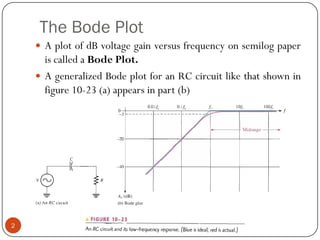
AplotofdBvoltagegainversusfrequencyonsemilogpaperiscalledaBodePlot. 
AgeneralizedBodeplotforanRCcircuitlikethatshowninfigure10-23(a)appearsinpart(b) 
2
The Bode Plot continue… 
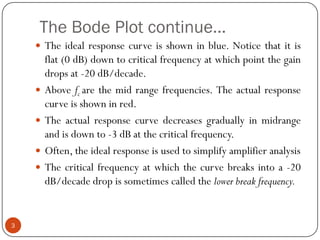
Theidealresponsecurveisshowninblue.Noticethatitisflat(0dB)downtocriticalfrequencyatwhichpointthegaindropsat-20dB/decade. 
Abovefcarethemidrangefrequencies.Theactualresponsecurveisshowninred. 
Theactualresponsecurvedecreasesgraduallyinmidrangeandisdownto-3dBatthecriticalfrequency. 
Often,theidealresponseisusedtosimplifyamplifieranalysis 
Thecriticalfrequencyatwhichthecurvebreaksintoa-20dB/decadedropissometimescalledthelowerbreakfrequency. 
3
Total Low-Frequency Response of an Amplifier 
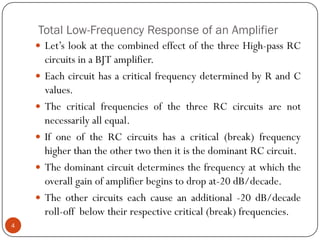
Let’slookatthecombinedeffectofthethreeHigh-passRCcircuitsinaBJTamplifier. 
EachcircuithasacriticalfrequencydeterminedbyRandCvalues. 
ThecriticalfrequenciesofthethreeRCcircuitsarenotnecessarilyallequal. 
IfoneoftheRCcircuitshasacritical(break)frequencyhigherthantheothertwothenitisthedominantRCcircuit. 
Thedominantcircuitdeterminesthefrequencyatwhichtheoverallgainofamplifierbeginstodropat-20dB/decade. 
Theothercircuitseachcauseanadditional-20dB/decaderoll-offbelowtheirrespectivecritical(break)frequencies. 4
Total Low-Frequency Response of an Amplifier continue… 5
Total Low-Frequency Response of an Amplifier continue… 
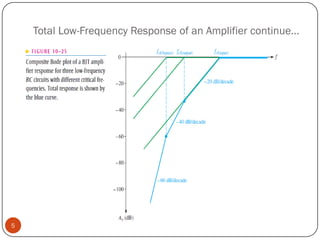
RefertoBodeplotinfigure10-25whichshowsthesuperimposedidealresponsesforthreeRCcircuits(greenLines)ofaBJTamplifier. 
EachRCcircuithasadifferentcriticalfrequency. 
TheinputRCcircuitisdominant(highestfc)inthiscase,andthebypassRCcircuithasthelowestfc.Theoverallresponseisshownastheblueline. 6
Total Low-Frequency Response of an Amplifier continue… 7
Total Low-Frequency Response of an Amplifier continue… 
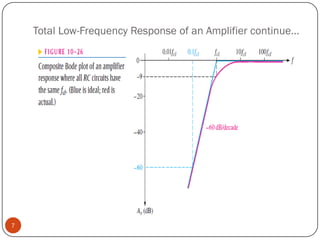
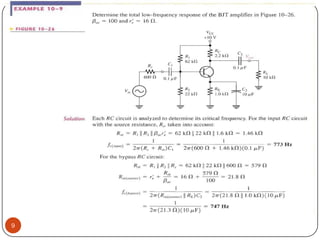
RefertotheBodeplotinfigure10-26allRCcircuitshavethesamecriticalfrequency,theresponsecurvehasonebreakpointatthatvalueoffc,andthevoltagegainrollsoffat-60dB/decadebelowthatvalue. 
Inthiscasethegainisat-9dBbelowthemidrangevoltagegain(-3dBforeachRCcircuit). 8
9
10
11
10-4 High-Frequency Amplifier Response 
Wehaveseenthecouplingandbypasscapacitorsaffectthevoltagegainofanamplifieratlowerfrequencieswherethereactancesofthecouplingandbypasscapacitorsaresignificant. 
Inmidrangeofanamplifier,theeffectsofthecapacitorsareminimalandcanbeneglected. 
Ifthefrequencyisincreasedsufficiently,apointisreachedwherethetransistor’sinternalcapacitancesbegantohaveasignificanteffectonthegain. 
12
BJT Amplifiers 
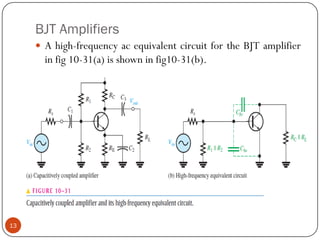
Ahigh-frequencyacequivalentcircuitfortheBJTamplifierinfig10-31(a)isshowninfig10-31(b). 
13
BJT Amplifiers continue… 
Noticethatthecouplingandbypasscapacitorsaretreatedaseffectiveshortsanddon’tappearinequivalentcircuit. 
TheinternalcapacitancesCbeandCbc,whicharesignificantonlyathighfrequencies,doappearinthediagram. 
CbeissometimescalledinputcapacitanceCib,andCbcissometimescalledoutputcapacitanceCob. 
CbeisspecifiedondatasheetsatacertainvalueofVBE. 
OftenthedatasheetwilllistCibasCiboandCobasCobo. 
Theoastheletterinthesubscriptindicatesthecapacitanceismeasuredwiththebaseopen. 14
Miller’s Theorem in High-Frequency Analysis (in BJT Amplifiers) 
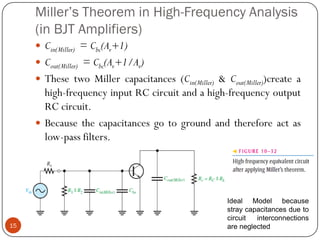
Cin(Miller)=Cbc(Av+1) 
Cout(Miller)=Cbc(Av+1/Av) 
ThesetwoMillercapacitances(Cin(Miller)&Cout(Miller))createahigh-frequencyinputRCcircuitandahigh-frequencyoutputRCcircuit. 
Becausethecapacitancesgotogroundandthereforeactaslow-passfilters. 15IdealModelbecausestraycapacitancesduetocircuitinterconnectionsareneglected
The Input RC Circuit 
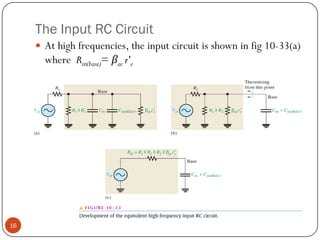
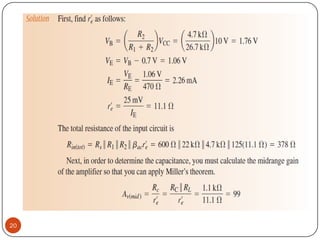
Athighfrequencies,theinputcircuitisshowninfig10-33(a) whereRin(base)=βacr'e16
The Input RC Circuit continue… 
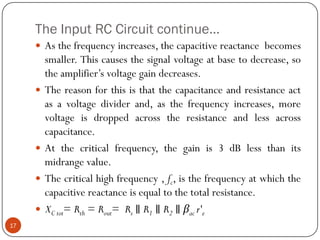
Asthefrequencyincreases,thecapacitivereactancebecomessmaller.Thiscausesthesignalvoltageatbasetodecrease,sotheamplifier’svoltagegaindecreases. 
Thereasonforthisisthatthecapacitanceandresistanceactasavoltagedividerand,asthefrequencyincreases,morevoltageisdroppedacrosstheresistanceandlessacrosscapacitance. 
Atthecriticalfrequency,thegainis3dBlessthanitsmidrangevalue. 
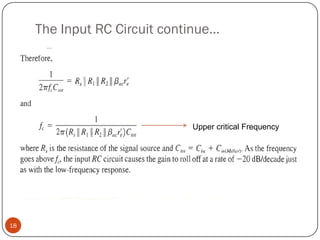
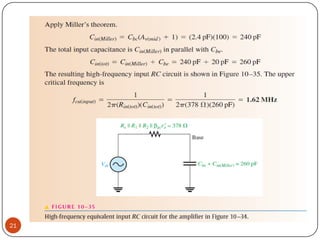
Thecriticalhighfrequency,fc,isthefrequencyatwhichthecapacitivereactanceisequaltothetotalresistance. 
XCtot=Rth=Rout=Rs∥R1∥R2∥βacr'e 
17
The Input RC Circuit continue… 
 18Upper critical Frequency
19
20
21
Phase Shift of the Input RC Circuit 
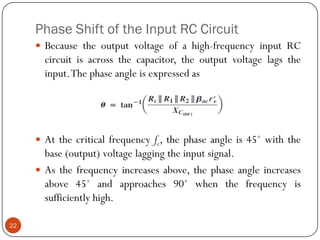
Becausetheoutputvoltageofahigh-frequencyinputRCcircuitisacrossthecapacitor,theoutputvoltagelagstheinput.Thephaseangleisexpressedas 
Atthecriticalfrequencyfc,thephaseangleis45˚withthebase(output)voltagelaggingtheinputsignal. 
Asthefrequencyincreasesabove,thephaseangleincreasesabove45˚andapproaches90˚whenthefrequencyissufficientlyhigh. 22
The Output RC circuit 
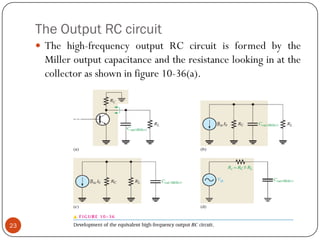
Thehigh-frequencyoutputRCcircuitisformedbytheMilleroutputcapacitanceandtheresistancelookinginatthecollectorasshowninfigure10-36(a). 
23
The Output RC circuit continue… 
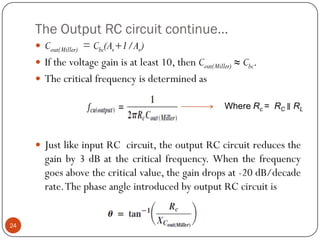
Cout(Miller)=Cbc(Av+1/Av) 
Ifthevoltagegainisatleast10,thenCout(Miller)≈Cbc. 
Thecriticalfrequencyisdeterminedas 
JustlikeinputRCcircuit,theoutputRCcircuitreducesthegainby3dBatthecriticalfrequency.Whenthefrequencygoesabovethecriticalvalue,thegaindropsat-20dB/decaderate.ThephaseangleintroducedbyoutputRCcircuitis 
24Where Rc = RC ∥RL
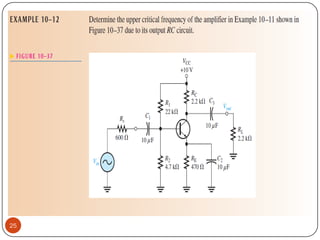
25
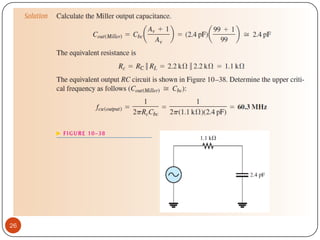
26
FET Amplifiers 
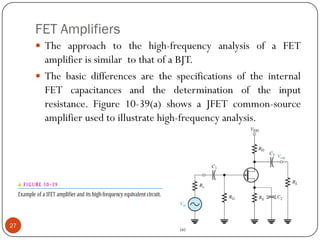
Theapproachtothehigh-frequencyanalysisofaFETamplifierissimilartothatofaBJT. 
ThebasicdifferencesarethespecificationsoftheinternalFETcapacitancesandthedeterminationoftheinputresistance.Figure10-39(a)showsaJFETcommon-sourceamplifierusedtoillustratehigh-frequencyanalysis. 27
FET Amplifiers Continue… 
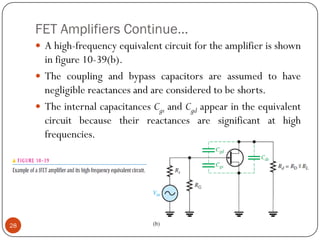
Ahigh-frequencyequivalentcircuitfortheamplifierisshowninfigure10-39(b). 
Thecouplingandbypasscapacitorsareassumedtohavenegligiblereactancesandareconsideredtobeshorts. 
TheinternalcapacitancesCgsandCgdappearintheequivalentcircuitbecausetheirreactancesaresignificantathighfrequencies. 28
Values of Cgs, Cgd, and Cds 
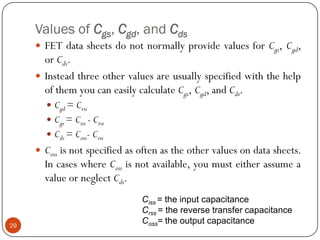
FETdatasheetsdonotnormallyprovidevaluesforCgs,Cgd, orCds. 
InsteadthreeothervaluesareusuallyspecifiedwiththehelpofthemyoucaneasilycalculateCgs,Cgd,andCds. 
Cgd=Crss 
Cgs=Ciss-Crss 
Cds=Coss-Crss 
Cossisnotspecifiedasoftenastheothervaluesondatasheets. IncaseswhereCossisnotavailable,youmusteitherassumeavalueorneglectCds. 29Ciss = the input capacitanceCrss = the reverse transfer capacitanceCoss= the output capacitance
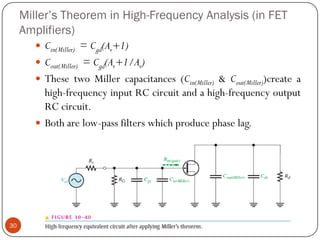
Miller’s Theorem in High-Frequency Analysis (in FET Amplifiers) 
Cin(Miller)=Cgd(Av+1) 
Cout(Miller)=Cgd(Av+1/Av) 
ThesetwoMillercapacitances(Cin(Miller)&Cout(Miller))createahigh-frequencyinputRCcircuitandahigh-frequencyoutputRCcircuit. 
Botharelow-passfilterswhichproducephaselag. 30
The Input RC Circuit 
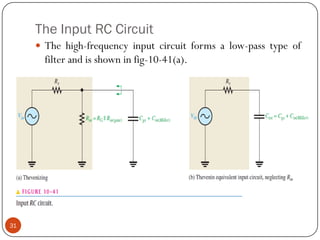
Thehigh-frequencyinputcircuitformsalow-passtypeoffilterandisshowninfig-10-41(a). 
31
The Input RC Circuit Continue… 
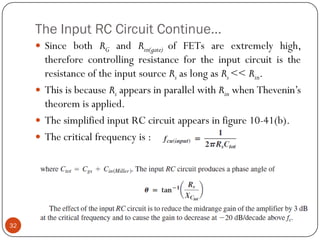
SincebothRGandRin(gate)ofFETsareextremelyhigh, thereforecontrollingresistancefortheinputcircuitistheresistanceoftheinputsourceRsaslongasRs<<Rin. 
ThisisbecauseRsappearsinparallelwithRinwhenThevenin’stheoremisapplied. 
ThesimplifiedinputRCcircuitappearsinfigure10-41(b). 
Thecriticalfrequencyis: 32
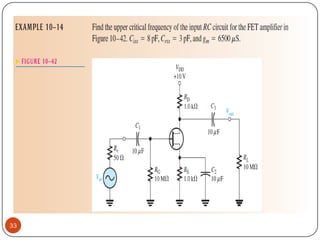
33
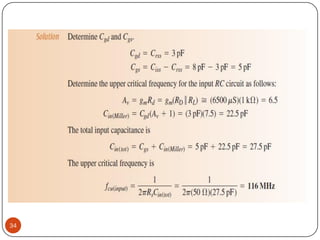
34
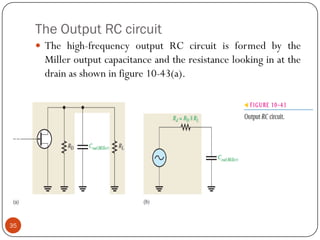
The Output RC circuit 
Thehigh-frequencyoutputRCcircuitisformedbytheMilleroutputcapacitanceandtheresistancelookinginatthedrainasshowninfigure10-43(a). 35
The Output RC circuit continue… 
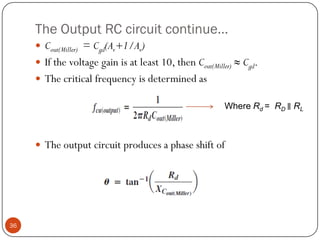
Cout(Miller)=Cgd(Av+1/Av) 
Ifthevoltagegainisatleast10,thenCout(Miller)≈Cgd. 
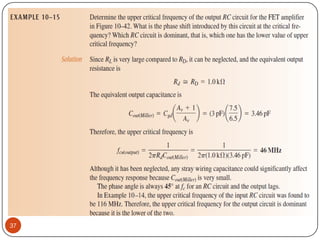
Thecriticalfrequencyisdeterminedas 
Theoutputcircuitproducesaphaseshiftof36Where Rd = RD ∥RL
37
Total High-Frequency Response of an Amplifier 
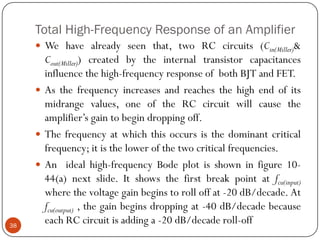
Wehavealreadyseenthat,twoRCcircuits(Cin(Miller)& Cout(Miller))createdbytheinternaltransistorcapacitancesinfluencethehigh-frequencyresponseofbothBJTandFET. 
Asthefrequencyincreasesandreachesthehighendofitsmidrangevalues,oneoftheRCcircuitwillcausetheamplifier’sgaintobegindroppingoff. 
Thefrequencyatwhichthisoccursisthedominantcriticalfrequency;itisthelowerofthetwocriticalfrequencies. 
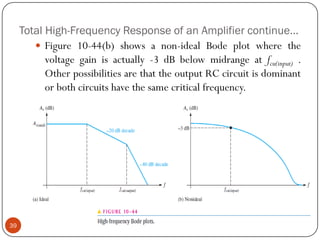
Anidealhigh-frequencyBodeplotisshowninfigure10- 44(a)nextslide.Itshowsthefirstbreakpointatfcu(input) wherethevoltagegainbeginstorolloffat-20dB/decade.Atfcu(output),thegainbeginsdroppingat-40dB/decadebecauseeachRCcircuitisaddinga-20dB/decaderoll-off38
Total High-Frequency Response of an Amplifier continue… 
Figure10-44(b)showsanon-idealBodeplotwherethevoltagegainisactually-3dBbelowmidrangeatfcu(input). OtherpossibilitiesarethattheoutputRCcircuitisdominantorbothcircuitshavethesamecriticalfrequency. 39
10-5 Total Amplifier Frequency Response 
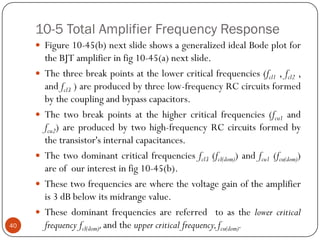
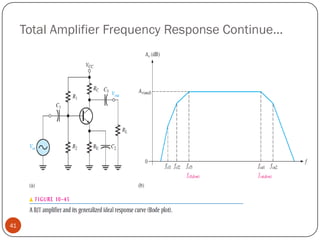
Figure10-45(b)nextslideshowsageneralizedidealBodeplotfortheBJTamplifierinfig10-45(a)nextslide. 
Thethreebreakpointsatthelowercriticalfrequencies(fcl1,fcl2, andfcl3)areproducedbythreelow-frequencyRCcircuitsformedbythecouplingandbypasscapacitors. 
Thetwobreakpointsatthehighercriticalfrequencies(fcu1andfcu2)areproducedbytwohigh-frequencyRCcircuitsformedbythetransistor'sinternalcapacitances. 
Thetwodominantcriticalfrequenciesfcl3(fcl(dom))andfcu1(fcu(dom)) areofourinterestinfig10-45(b). 
Thesetwofrequenciesarewherethevoltagegainoftheamplifieris3dBbelowitsmidrangevalue. 
Thesedominantfrequenciesarereferredtoasthelowercriticalfrequencyfcl(dom),andtheuppercriticalfrequency,fcu(dom).40
Total Amplifier Frequency Response Continue… 41
Total Amplifier Frequency Response Continue… 
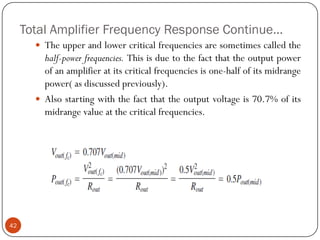
Theupperandlowercriticalfrequenciesaresometimescalledthehalf-powerfrequencies.Thisisduetothefactthattheoutputpowerofanamplifieratitscriticalfrequenciesisone-halfofitsmidrangepower(asdiscussedpreviously). 
Alsostartingwiththefactthattheoutputvoltageis70.7%ofitsmidrangevalueatthecriticalfrequencies. 42
Bandwidth 
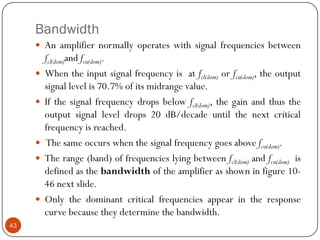
Anamplifiernormallyoperateswithsignalfrequenciesbetweenfcl(dom)andfcu(dom). 
Whentheinputsignalfrequencyisatfcl(dom)orfcu(dom),theoutputsignallevelis70.7%ofitsmidrangevalue. 
Ifthesignalfrequencydropsbelowfcl(dom),thegainandthustheoutputsignalleveldrops20dB/decadeuntilthenextcriticalfrequencyisreached. 
Thesameoccurswhenthesignalfrequencygoesabovefcu(dom). 
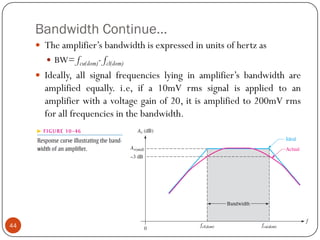
Therange(band)offrequencieslyingbetweenfcl(dom)andfcu(dom)isdefinedasthebandwidthoftheamplifierasshowninfigure10- 46nextslide. 
Onlythedominantcriticalfrequenciesappearintheresponsecurvebecausetheydeterminethebandwidth. 43
Bandwidth Continue… 
Theamplifier’sbandwidthisexpressedinunitsofhertzas 
BW=fcu(dom)-fcl(dom) 
Ideally,allsignalfrequencieslyinginamplifier’sbandwidthareamplifiedequally.i.e,ifa10mVrmssignalisappliedtoanamplifierwithavoltagegainof20,itisamplifiedto200mVrmsforallfrequenciesinthebandwidth. 44
Unity-Bandwidth Product 
Onecharacteristicofamplifiersisthattheproductofvoltagegainandbandwidthisalwaysconstantwhentherollis-20dB/decade. Thischaracteristiciscalledgain-bandwidthproduct. 
Let’sassumethatthelowercriticalfrequencyofaparticularamplifierismuchlessthantheuppercriticalfrequency. 
fcl(dom)<<fcu(dom) 
Thebandwidthcanbeapproximatedas 
BW=fcu(dom)-fcl(dom)≈fcu45
Unity-Gain Frequency 
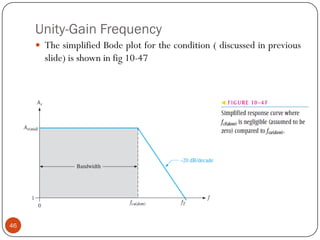
ThesimplifiedBodeplotforthecondition(discussedinpreviousslide)isshowninfig10-4746
Unity-Gain Frequency Continue… 
Noticethatfcl(dom)isneglectedbecauseitissomuchsmallerthanfcu(dom),andthebandwidthapproximatelyequalsfcu(dom). 
Beginningatfcu(dom),thegainrollsoffuntilunitygain(0dB)isreached. 
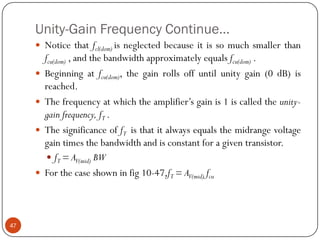
Thefrequencyatwhichtheamplifier’sgainis1iscalledtheunity- gainfrequency,fT. 
ThesignificanceoffTisthatitalwaysequalsthemidrangevoltagegaintimesthebandwidthandisconstantforagiventransistor. 
fT=AV(mid)BW 
Forthecaseshowninfig10-47,fT=AV(mid)fcu47
10-6 Frequency Response of Multistage Amplifiers 
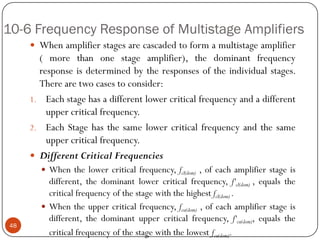
Whenamplifierstagesarecascadedtoformamultistageamplifier(morethanonestageamplifier),thedominantfrequencyresponseisdeterminedbytheresponsesoftheindividualstages. Therearetwocasestoconsider: 
1.Eachstagehasadifferentlowercriticalfrequencyandadifferentuppercriticalfrequency. 
2.EachStagehasthesamelowercriticalfrequencyandthesameuppercriticalfrequency. 
DifferentCriticalFrequencies 
Whenthelowercriticalfrequency,fcl(dom),ofeachamplifierstageisdifferent,thedominantlowercriticalfrequency,f'cl(dom),equalsthecriticalfrequencyofthestagewiththehighestfcl(dom). 
Whentheuppercriticalfrequency,fcu(dom),ofeachamplifierstageisdifferent,thedominantuppercriticalfrequency,f'cu(dom),equalsthecriticalfrequencyofthestagewiththelowestfcu(dom). 48
Frequency Response of Multistage Amplifiers Continue… 
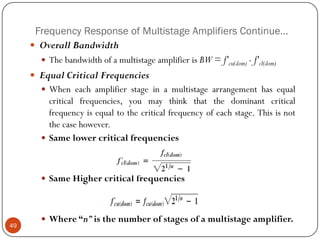
OverallBandwidth 
ThebandwidthofamultistageamplifierisBW=f'cu(dom)-f'cl(dom) 
EqualCriticalFrequencies 
Wheneachamplifierstageinamultistagearrangementhasequalcriticalfrequencies,youmaythinkthatthedominantcriticalfrequencyisequaltothecriticalfrequencyofeachstage.Thisisnotthecasehowever. 
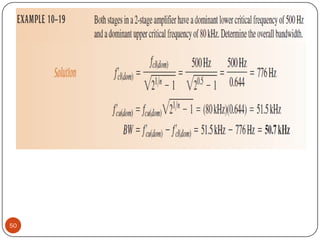
Samelowercriticalfrequencies 
SameHighercriticalfrequencies 
Where“n”isthenumberofstagesofamultistageamplifier. 49
50

Amplifier frequency response (part 2)

  • 1.
    Engr.Tehseen Ahsan Lecturer,Electrical Engineering Department EE-307 Electronic Systems Design HITEC University Taxila Cantt, Pakistan Amplifier Frequency Response (Part 2)
  • 2.
    The Bode Plot AplotofdBvoltagegainversusfrequencyonsemilogpaperiscalledaBodePlot. AgeneralizedBodeplotforanRCcircuitlikethatshowninfigure10-23(a)appearsinpart(b) 2
  • 3.
    The Bode Plotcontinue… Theidealresponsecurveisshowninblue.Noticethatitisflat(0dB)downtocriticalfrequencyatwhichpointthegaindropsat-20dB/decade. Abovefcarethemidrangefrequencies.Theactualresponsecurveisshowninred. Theactualresponsecurvedecreasesgraduallyinmidrangeandisdownto-3dBatthecriticalfrequency. Often,theidealresponseisusedtosimplifyamplifieranalysis Thecriticalfrequencyatwhichthecurvebreaksintoa-20dB/decadedropissometimescalledthelowerbreakfrequency. 3
  • 4.
    Total Low-Frequency Responseof an Amplifier Let’slookatthecombinedeffectofthethreeHigh-passRCcircuitsinaBJTamplifier. EachcircuithasacriticalfrequencydeterminedbyRandCvalues. ThecriticalfrequenciesofthethreeRCcircuitsarenotnecessarilyallequal. IfoneoftheRCcircuitshasacritical(break)frequencyhigherthantheothertwothenitisthedominantRCcircuit. Thedominantcircuitdeterminesthefrequencyatwhichtheoverallgainofamplifierbeginstodropat-20dB/decade. Theothercircuitseachcauseanadditional-20dB/decaderoll-offbelowtheirrespectivecritical(break)frequencies. 4
  • 5.
    Total Low-Frequency Responseof an Amplifier continue… 5
  • 6.
    Total Low-Frequency Responseof an Amplifier continue… RefertoBodeplotinfigure10-25whichshowsthesuperimposedidealresponsesforthreeRCcircuits(greenLines)ofaBJTamplifier. EachRCcircuithasadifferentcriticalfrequency. TheinputRCcircuitisdominant(highestfc)inthiscase,andthebypassRCcircuithasthelowestfc.Theoverallresponseisshownastheblueline. 6
  • 7.
    Total Low-Frequency Responseof an Amplifier continue… 7
  • 8.
    Total Low-Frequency Responseof an Amplifier continue… RefertotheBodeplotinfigure10-26allRCcircuitshavethesamecriticalfrequency,theresponsecurvehasonebreakpointatthatvalueoffc,andthevoltagegainrollsoffat-60dB/decadebelowthatvalue. Inthiscasethegainisat-9dBbelowthemidrangevoltagegain(-3dBforeachRCcircuit). 8
  • 9.
  • 10.
  • 11.
  • 12.
    10-4 High-Frequency AmplifierResponse Wehaveseenthecouplingandbypasscapacitorsaffectthevoltagegainofanamplifieratlowerfrequencieswherethereactancesofthecouplingandbypasscapacitorsaresignificant. Inmidrangeofanamplifier,theeffectsofthecapacitorsareminimalandcanbeneglected. Ifthefrequencyisincreasedsufficiently,apointisreachedwherethetransistor’sinternalcapacitancesbegantohaveasignificanteffectonthegain. 12
  • 13.
  • 14.
    BJT Amplifiers continue… Noticethatthecouplingandbypasscapacitorsaretreatedaseffectiveshortsanddon’tappearinequivalentcircuit. TheinternalcapacitancesCbeandCbc,whicharesignificantonlyathighfrequencies,doappearinthediagram. CbeissometimescalledinputcapacitanceCib,andCbcissometimescalledoutputcapacitanceCob. CbeisspecifiedondatasheetsatacertainvalueofVBE. OftenthedatasheetwilllistCibasCiboandCobasCobo. Theoastheletterinthesubscriptindicatesthecapacitanceismeasuredwiththebaseopen. 14
  • 15.
    Miller’s Theorem inHigh-Frequency Analysis (in BJT Amplifiers) Cin(Miller)=Cbc(Av+1) Cout(Miller)=Cbc(Av+1/Av) ThesetwoMillercapacitances(Cin(Miller)&Cout(Miller))createahigh-frequencyinputRCcircuitandahigh-frequencyoutputRCcircuit. Becausethecapacitancesgotogroundandthereforeactaslow-passfilters. 15IdealModelbecausestraycapacitancesduetocircuitinterconnectionsareneglected
  • 16.
    The Input RCCircuit Athighfrequencies,theinputcircuitisshowninfig10-33(a) whereRin(base)=βacr'e16
  • 17.
    The Input RCCircuit continue… Asthefrequencyincreases,thecapacitivereactancebecomessmaller.Thiscausesthesignalvoltageatbasetodecrease,sotheamplifier’svoltagegaindecreases. Thereasonforthisisthatthecapacitanceandresistanceactasavoltagedividerand,asthefrequencyincreases,morevoltageisdroppedacrosstheresistanceandlessacrosscapacitance. Atthecriticalfrequency,thegainis3dBlessthanitsmidrangevalue. Thecriticalhighfrequency,fc,isthefrequencyatwhichthecapacitivereactanceisequaltothetotalresistance. XCtot=Rth=Rout=Rs∥R1∥R2∥βacr'e 17
  • 18.
    The Input RCCircuit continue…  18Upper critical Frequency
  • 19.
  • 20.
  • 21.
  • 22.
    Phase Shift ofthe Input RC Circuit Becausetheoutputvoltageofahigh-frequencyinputRCcircuitisacrossthecapacitor,theoutputvoltagelagstheinput.Thephaseangleisexpressedas Atthecriticalfrequencyfc,thephaseangleis45˚withthebase(output)voltagelaggingtheinputsignal. Asthefrequencyincreasesabove,thephaseangleincreasesabove45˚andapproaches90˚whenthefrequencyissufficientlyhigh. 22
  • 23.
    The Output RCcircuit Thehigh-frequencyoutputRCcircuitisformedbytheMilleroutputcapacitanceandtheresistancelookinginatthecollectorasshowninfigure10-36(a). 23
  • 24.
    The Output RCcircuit continue… Cout(Miller)=Cbc(Av+1/Av) Ifthevoltagegainisatleast10,thenCout(Miller)≈Cbc. Thecriticalfrequencyisdeterminedas JustlikeinputRCcircuit,theoutputRCcircuitreducesthegainby3dBatthecriticalfrequency.Whenthefrequencygoesabovethecriticalvalue,thegaindropsat-20dB/decaderate.ThephaseangleintroducedbyoutputRCcircuitis 24Where Rc = RC ∥RL
  • 25.
  • 26.
  • 27.
    FET Amplifiers Theapproachtothehigh-frequencyanalysisofaFETamplifierissimilartothatofaBJT. ThebasicdifferencesarethespecificationsoftheinternalFETcapacitancesandthedeterminationoftheinputresistance.Figure10-39(a)showsaJFETcommon-sourceamplifierusedtoillustratehigh-frequencyanalysis. 27
  • 28.
    FET Amplifiers Continue… Ahigh-frequencyequivalentcircuitfortheamplifierisshowninfigure10-39(b). Thecouplingandbypasscapacitorsareassumedtohavenegligiblereactancesandareconsideredtobeshorts. TheinternalcapacitancesCgsandCgdappearintheequivalentcircuitbecausetheirreactancesaresignificantathighfrequencies. 28
  • 29.
    Values of Cgs,Cgd, and Cds FETdatasheetsdonotnormallyprovidevaluesforCgs,Cgd, orCds. InsteadthreeothervaluesareusuallyspecifiedwiththehelpofthemyoucaneasilycalculateCgs,Cgd,andCds. Cgd=Crss Cgs=Ciss-Crss Cds=Coss-Crss Cossisnotspecifiedasoftenastheothervaluesondatasheets. IncaseswhereCossisnotavailable,youmusteitherassumeavalueorneglectCds. 29Ciss = the input capacitanceCrss = the reverse transfer capacitanceCoss= the output capacitance
  • 30.
    Miller’s Theorem inHigh-Frequency Analysis (in FET Amplifiers) Cin(Miller)=Cgd(Av+1) Cout(Miller)=Cgd(Av+1/Av) ThesetwoMillercapacitances(Cin(Miller)&Cout(Miller))createahigh-frequencyinputRCcircuitandahigh-frequencyoutputRCcircuit. Botharelow-passfilterswhichproducephaselag. 30
  • 31.
    The Input RCCircuit Thehigh-frequencyinputcircuitformsalow-passtypeoffilterandisshowninfig-10-41(a). 31
  • 32.
    The Input RCCircuit Continue… SincebothRGandRin(gate)ofFETsareextremelyhigh, thereforecontrollingresistancefortheinputcircuitistheresistanceoftheinputsourceRsaslongasRs<<Rin. ThisisbecauseRsappearsinparallelwithRinwhenThevenin’stheoremisapplied. ThesimplifiedinputRCcircuitappearsinfigure10-41(b). Thecriticalfrequencyis: 32
  • 33.
  • 34.
  • 35.
    The Output RCcircuit Thehigh-frequencyoutputRCcircuitisformedbytheMilleroutputcapacitanceandtheresistancelookinginatthedrainasshowninfigure10-43(a). 35
  • 36.
    The Output RCcircuit continue… Cout(Miller)=Cgd(Av+1/Av) Ifthevoltagegainisatleast10,thenCout(Miller)≈Cgd. Thecriticalfrequencyisdeterminedas Theoutputcircuitproducesaphaseshiftof36Where Rd = RD ∥RL
  • 37.
  • 38.
    Total High-Frequency Responseof an Amplifier Wehavealreadyseenthat,twoRCcircuits(Cin(Miller)& Cout(Miller))createdbytheinternaltransistorcapacitancesinfluencethehigh-frequencyresponseofbothBJTandFET. Asthefrequencyincreasesandreachesthehighendofitsmidrangevalues,oneoftheRCcircuitwillcausetheamplifier’sgaintobegindroppingoff. Thefrequencyatwhichthisoccursisthedominantcriticalfrequency;itisthelowerofthetwocriticalfrequencies. Anidealhigh-frequencyBodeplotisshowninfigure10- 44(a)nextslide.Itshowsthefirstbreakpointatfcu(input) wherethevoltagegainbeginstorolloffat-20dB/decade.Atfcu(output),thegainbeginsdroppingat-40dB/decadebecauseeachRCcircuitisaddinga-20dB/decaderoll-off38
  • 39.
    Total High-Frequency Responseof an Amplifier continue… Figure10-44(b)showsanon-idealBodeplotwherethevoltagegainisactually-3dBbelowmidrangeatfcu(input). OtherpossibilitiesarethattheoutputRCcircuitisdominantorbothcircuitshavethesamecriticalfrequency. 39
  • 40.
    10-5 Total AmplifierFrequency Response Figure10-45(b)nextslideshowsageneralizedidealBodeplotfortheBJTamplifierinfig10-45(a)nextslide. Thethreebreakpointsatthelowercriticalfrequencies(fcl1,fcl2, andfcl3)areproducedbythreelow-frequencyRCcircuitsformedbythecouplingandbypasscapacitors. Thetwobreakpointsatthehighercriticalfrequencies(fcu1andfcu2)areproducedbytwohigh-frequencyRCcircuitsformedbythetransistor'sinternalcapacitances. Thetwodominantcriticalfrequenciesfcl3(fcl(dom))andfcu1(fcu(dom)) areofourinterestinfig10-45(b). Thesetwofrequenciesarewherethevoltagegainoftheamplifieris3dBbelowitsmidrangevalue. Thesedominantfrequenciesarereferredtoasthelowercriticalfrequencyfcl(dom),andtheuppercriticalfrequency,fcu(dom).40
  • 41.
    Total Amplifier FrequencyResponse Continue… 41
  • 42.
    Total Amplifier FrequencyResponse Continue… Theupperandlowercriticalfrequenciesaresometimescalledthehalf-powerfrequencies.Thisisduetothefactthattheoutputpowerofanamplifieratitscriticalfrequenciesisone-halfofitsmidrangepower(asdiscussedpreviously). Alsostartingwiththefactthattheoutputvoltageis70.7%ofitsmidrangevalueatthecriticalfrequencies. 42
  • 43.
    Bandwidth Anamplifiernormallyoperateswithsignalfrequenciesbetweenfcl(dom)andfcu(dom). Whentheinputsignalfrequencyisatfcl(dom)orfcu(dom),theoutputsignallevelis70.7%ofitsmidrangevalue. Ifthesignalfrequencydropsbelowfcl(dom),thegainandthustheoutputsignalleveldrops20dB/decadeuntilthenextcriticalfrequencyisreached. Thesameoccurswhenthesignalfrequencygoesabovefcu(dom). Therange(band)offrequencieslyingbetweenfcl(dom)andfcu(dom)isdefinedasthebandwidthoftheamplifierasshowninfigure10- 46nextslide. Onlythedominantcriticalfrequenciesappearintheresponsecurvebecausetheydeterminethebandwidth. 43
  • 44.
    Bandwidth Continue… Theamplifier’sbandwidthisexpressedinunitsofhertzas BW=fcu(dom)-fcl(dom) Ideally,allsignalfrequencieslyinginamplifier’sbandwidthareamplifiedequally.i.e,ifa10mVrmssignalisappliedtoanamplifierwithavoltagegainof20,itisamplifiedto200mVrmsforallfrequenciesinthebandwidth. 44
  • 45.
    Unity-Bandwidth Product Onecharacteristicofamplifiersisthattheproductofvoltagegainandbandwidthisalwaysconstantwhentherollis-20dB/decade.Thischaracteristiciscalledgain-bandwidthproduct. Let’sassumethatthelowercriticalfrequencyofaparticularamplifierismuchlessthantheuppercriticalfrequency. fcl(dom)<<fcu(dom) Thebandwidthcanbeapproximatedas BW=fcu(dom)-fcl(dom)≈fcu45
  • 46.
  • 47.
    Unity-Gain Frequency Continue… Noticethatfcl(dom)isneglectedbecauseitissomuchsmallerthanfcu(dom),andthebandwidthapproximatelyequalsfcu(dom). Beginningatfcu(dom),thegainrollsoffuntilunitygain(0dB)isreached. Thefrequencyatwhichtheamplifier’sgainis1iscalledtheunity- gainfrequency,fT. ThesignificanceoffTisthatitalwaysequalsthemidrangevoltagegaintimesthebandwidthandisconstantforagiventransistor. fT=AV(mid)BW Forthecaseshowninfig10-47,fT=AV(mid)fcu47
  • 48.
    10-6 Frequency Responseof Multistage Amplifiers Whenamplifierstagesarecascadedtoformamultistageamplifier(morethanonestageamplifier),thedominantfrequencyresponseisdeterminedbytheresponsesoftheindividualstages. Therearetwocasestoconsider: 1.Eachstagehasadifferentlowercriticalfrequencyandadifferentuppercriticalfrequency. 2.EachStagehasthesamelowercriticalfrequencyandthesameuppercriticalfrequency. DifferentCriticalFrequencies Whenthelowercriticalfrequency,fcl(dom),ofeachamplifierstageisdifferent,thedominantlowercriticalfrequency,f'cl(dom),equalsthecriticalfrequencyofthestagewiththehighestfcl(dom). Whentheuppercriticalfrequency,fcu(dom),ofeachamplifierstageisdifferent,thedominantuppercriticalfrequency,f'cu(dom),equalsthecriticalfrequencyofthestagewiththelowestfcu(dom). 48
  • 49.
    Frequency Response ofMultistage Amplifiers Continue… OverallBandwidth ThebandwidthofamultistageamplifierisBW=f'cu(dom)-f'cl(dom) EqualCriticalFrequencies Wheneachamplifierstageinamultistagearrangementhasequalcriticalfrequencies,youmaythinkthatthedominantcriticalfrequencyisequaltothecriticalfrequencyofeachstage.Thisisnotthecasehowever. Samelowercriticalfrequencies SameHighercriticalfrequencies Where“n”isthenumberofstagesofamultistageamplifier. 49
  • 50.