R.V.College of Engineering
Electronics & Instrumentation Engg
Electro Magnetic Flow meter
Submitted by
ABHINAV BIJAPUR
Introduction
• What is this Instrument?
• Necessity
• Working principle
.
Application
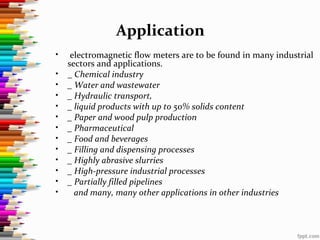
• electromagnetic flow meters are to be found in many industrial
sectors and applications.
• _ Chemical industry
• _ Water and wastewater
• _ Hydraulic transport,
• _ liquid products with up to 50% solids content
• _ Paper and wood pulp production
• _ Pharmaceutical
• _ Food and beverages
• _ Filling and dispensing processes
• _ Highly abrasive slurries
• _ High-pressure industrial processes
• _ Partially filled pipelines
• and many, many other applications in other industries
Literature survey
Study on Fusion of Electromagnetic Flowmeter and ERT System in Slug Flow
Xiang Deng, Zheng Wei, Zengwei Yan
School of Mechanical, Electronic and Control Engineering, Beijing Jiaotong University
Beijing, 100044, China
Digital Simulation of Electromagnetic Flowmeter for Insulating liquids
B. Liang
Manchester Metropolitan University UK
Analog Signal Processing in an AC Electromagnetic Flowmeter
J. Polo’, R. Pallas-Areng and J. P. Martin-Vide3
Barcelona, SPAIN
Analog Signal Processing in an AC Electromagnetic Flowmeter
Jose Polo, Ramon Pallàs-Areny, Fellow, IEEE, and Juan P. Martín-Vide
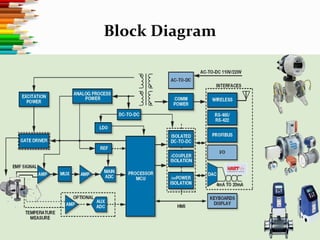
Block Diagram
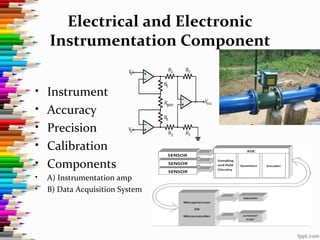
Electrical and Electronic
Instrumentation Component
• Instrument
• Accuracy
• Precision
• Calibration
• Components
• A) Instrumentation amp
• B) Data Acquisition System
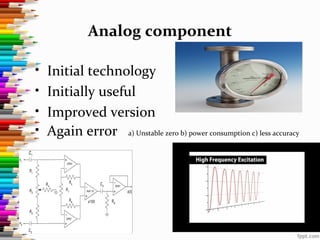
Analog component
• Initial technology
• Initially useful
• Improved version
• Again error a) Unstable zero b) power consumption c) less accuracy
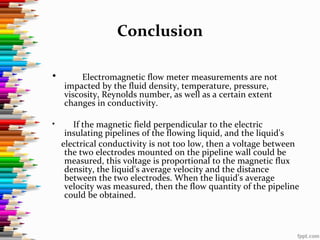
Digital component
• World of digital
• Digital display
 Accuracy
 Quick response
 Stability
 Power consumption
 Temp sensor
 Data storage
 Alarm
.
• Wireless
communication
 In Industry
 Agriculture
Environment Component
• Renewable energy
Solar
• No effect of
Pressure
Temperature
Natural phenomena
• Agriculture
• Recycling
Conclusion
• Electromagnetic flow meter measurements are not
impacted by the fluid density, temperature, pressure,
viscosity, Reynolds number, as well as a certain extent
changes in conductivity.
• If the magnetic field perpendicular to the electric
insulating pipelines of the flowing liquid, and the liquid's
electrical conductivity is not too low, then a voltage between
the two electrodes mounted on the pipeline wall could be
measured, this voltage is proportional to the magnetic flux
density, the liquid's average velocity and the distance
between the two electrodes. When the liquid's average
velocity was measured, then the flow quantity of the pipeline
could be obtained.
Reference
• M. Faraday, "Bakerian lecture," Phil. Trans. Roy. Soc. (London),
• vol. 122, pp. 163-194; January, 1832.
• M. K. Bevir,"The theory of induced voltage electromagnetic
• flowmeters," Journal of Fluid Mechanics, vol. 43, 1970, pp. 577-590,
• doi:10.1017/S0022112070002586.
• C. E. Colebrook, “Turbulent flow in pipes with particular reference to the
transition region between smooth and rough pipe laws,” Journal of
• the Institute of Civil Engineers, vol. 11, 1939, pp. 133–156.
• S. K. Mishra, P.K. Senapati, and D. Panda, “Rheological behavior of
• coal-water slurry,” Fuel, vol. 74, 1995, pp.1220–1225.
• Hiromoto Usui, “A thixotropy model for coal-water slurrys,” Journal of
• Non-Newtonian Fluid Mechanics, vol. 60, 1995, pp.259–275
• W. Maciejewski, E. Lord, et al, “Pipeline transport of large ablatingp articles
in a non-Newtonian carrier,” Powder Technology, vol. 94, 1997, pp.
223–228.
.
• D. R. Kaushal, Yuji Tomita, “Solids concentration profiles and pressure drop in pipeline
flow of multi sized particulate slurries,” International
• Journal of Multiphase Flow, vol. 28(10), 2002, pp. 1697–1717.
• Shercliff, J.A.: ‘The theory of electromagnetic flow measurement’ (Cambridge
University Press, London, Cambridge, UK, 1962),pp. 10–35
• Liang, B.: ‘Digital simulation of electromagnetic flowmeter forin sulating liquids’. IEEE
Proc. 14th Int. Conf. on Dielectric Liquids, Graz, Australia, July 2002, pp. 309–311 9
Cushing
• Proceedings of 14" International Conference on Dielectric Liquids (ICDL 2002), Graz
(Austria), July 7-12, 2002
• Digital Simulation of Electromagnetic Flowmeter for Insulating liquid
• Manchester Metropolitan University
• Manchester M1 5GD, UK
• Deok Hong Kang, Yeh-Chan Ahn, Byung Do Oh and Moo Hwan Kim,
• “Advanced electromagnetic flowmetry for slug flow: numerical signal pr .
and calibration,International Journal of Multiphase 585–614, 2004
• Xu Lijun, Wang Ya, Jiang Yinping, Xu Ling’an. Analysis on
• Electrical Homeostasis Process on Electrode Plane of
• Electromagnetic Flowmeter, Chinese Journal of Scientific
Electro magnetic flow meter

Electro magnetic flow meter

  • 1.
    R.V.College of Engineering Electronics& Instrumentation Engg Electro Magnetic Flow meter Submitted by ABHINAV BIJAPUR
  • 2.
    Introduction • What isthis Instrument? • Necessity • Working principle
  • 3.
  • 4.
    Application • electromagnetic flowmeters are to be found in many industrial sectors and applications. • _ Chemical industry • _ Water and wastewater • _ Hydraulic transport, • _ liquid products with up to 50% solids content • _ Paper and wood pulp production • _ Pharmaceutical • _ Food and beverages • _ Filling and dispensing processes • _ Highly abrasive slurries • _ High-pressure industrial processes • _ Partially filled pipelines • and many, many other applications in other industries
  • 5.
    Literature survey Study onFusion of Electromagnetic Flowmeter and ERT System in Slug Flow Xiang Deng, Zheng Wei, Zengwei Yan School of Mechanical, Electronic and Control Engineering, Beijing Jiaotong University Beijing, 100044, China Digital Simulation of Electromagnetic Flowmeter for Insulating liquids B. Liang Manchester Metropolitan University UK Analog Signal Processing in an AC Electromagnetic Flowmeter J. Polo’, R. Pallas-Areng and J. P. Martin-Vide3 Barcelona, SPAIN Analog Signal Processing in an AC Electromagnetic Flowmeter Jose Polo, Ramon Pallàs-Areny, Fellow, IEEE, and Juan P. Martín-Vide
  • 6.
  • 7.
    Electrical and Electronic InstrumentationComponent • Instrument • Accuracy • Precision • Calibration • Components • A) Instrumentation amp • B) Data Acquisition System
  • 8.
    Analog component • Initialtechnology • Initially useful • Improved version • Again error a) Unstable zero b) power consumption c) less accuracy
  • 10.
    Digital component • Worldof digital • Digital display  Accuracy  Quick response  Stability  Power consumption  Temp sensor  Data storage  Alarm
  • 11.
    . • Wireless communication  InIndustry  Agriculture
  • 12.
    Environment Component • Renewableenergy Solar • No effect of Pressure Temperature Natural phenomena • Agriculture • Recycling
  • 14.
    Conclusion • Electromagnetic flowmeter measurements are not impacted by the fluid density, temperature, pressure, viscosity, Reynolds number, as well as a certain extent changes in conductivity. • If the magnetic field perpendicular to the electric insulating pipelines of the flowing liquid, and the liquid's electrical conductivity is not too low, then a voltage between the two electrodes mounted on the pipeline wall could be measured, this voltage is proportional to the magnetic flux density, the liquid's average velocity and the distance between the two electrodes. When the liquid's average velocity was measured, then the flow quantity of the pipeline could be obtained.
  • 15.
    Reference • M. Faraday,"Bakerian lecture," Phil. Trans. Roy. Soc. (London), • vol. 122, pp. 163-194; January, 1832. • M. K. Bevir,"The theory of induced voltage electromagnetic • flowmeters," Journal of Fluid Mechanics, vol. 43, 1970, pp. 577-590, • doi:10.1017/S0022112070002586. • C. E. Colebrook, “Turbulent flow in pipes with particular reference to the transition region between smooth and rough pipe laws,” Journal of • the Institute of Civil Engineers, vol. 11, 1939, pp. 133–156. • S. K. Mishra, P.K. Senapati, and D. Panda, “Rheological behavior of • coal-water slurry,” Fuel, vol. 74, 1995, pp.1220–1225. • Hiromoto Usui, “A thixotropy model for coal-water slurrys,” Journal of • Non-Newtonian Fluid Mechanics, vol. 60, 1995, pp.259–275 • W. Maciejewski, E. Lord, et al, “Pipeline transport of large ablatingp articles in a non-Newtonian carrier,” Powder Technology, vol. 94, 1997, pp. 223–228.
  • 16.
    . • D. R.Kaushal, Yuji Tomita, “Solids concentration profiles and pressure drop in pipeline flow of multi sized particulate slurries,” International • Journal of Multiphase Flow, vol. 28(10), 2002, pp. 1697–1717. • Shercliff, J.A.: ‘The theory of electromagnetic flow measurement’ (Cambridge University Press, London, Cambridge, UK, 1962),pp. 10–35 • Liang, B.: ‘Digital simulation of electromagnetic flowmeter forin sulating liquids’. IEEE Proc. 14th Int. Conf. on Dielectric Liquids, Graz, Australia, July 2002, pp. 309–311 9 Cushing • Proceedings of 14" International Conference on Dielectric Liquids (ICDL 2002), Graz (Austria), July 7-12, 2002 • Digital Simulation of Electromagnetic Flowmeter for Insulating liquid • Manchester Metropolitan University • Manchester M1 5GD, UK • Deok Hong Kang, Yeh-Chan Ahn, Byung Do Oh and Moo Hwan Kim, • “Advanced electromagnetic flowmetry for slug flow: numerical signal pr . and calibration,International Journal of Multiphase 585–614, 2004 • Xu Lijun, Wang Ya, Jiang Yinping, Xu Ling’an. Analysis on • Electrical Homeostasis Process on Electrode Plane of • Electromagnetic Flowmeter, Chinese Journal of Scientific