Electrocardiogram
What is an Electrocardiogram ? 
 An electrocardiogram is a simple, painless test that records the 
heart's electrical activity. 
 It is a low-cost, noninvasive, and effective test for arrhythmia 
analysis and has become the standard diagnostic tool. 
 With each heartbeat, an electrical signal spreads from the top of 
the heart to the bottom. As it travels, the signal causes the heart 
to contract and pump blood.
Other names for ECG? 
 An electrocardiogram also called an EKG or ECG. 
 Sometimes the ECG test is called a 12-lead EKG or 12-lead ECG, 
this is because the heart's electrical activity most often is 
recorded from 12 different places on the body at the same time.
What an ECG Shows? 
 How fast your heart is beating. 
 Whether the rhythm of your heartbeat is steady or irregular. 
 The strength and timing of electrical signals as they pass through 
each part of your heart
How ECG is useful? 
 Doctors use ECGs to detect and study many heart problems, such 
as heart attacks, arrhythmias (ah-RITH-me-ahs), and heart 
failure. 
 An EKG translates the heart's electrical activity into line tracings 
on paper. 
 The test measures how electrical impulses move through the 
heart muscle as it contracts and relaxes.
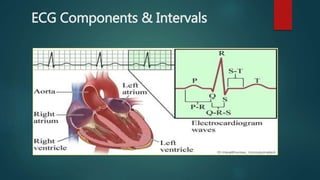
ECG Components & Intervals
Thank you 
Presented by: Ch. Satya Pranav, 
KL University.

Electrocardiogram

  • 1.
  • 2.
    What is anElectrocardiogram ?  An electrocardiogram is a simple, painless test that records the heart's electrical activity.  It is a low-cost, noninvasive, and effective test for arrhythmia analysis and has become the standard diagnostic tool.  With each heartbeat, an electrical signal spreads from the top of the heart to the bottom. As it travels, the signal causes the heart to contract and pump blood.
  • 3.
    Other names forECG?  An electrocardiogram also called an EKG or ECG.  Sometimes the ECG test is called a 12-lead EKG or 12-lead ECG, this is because the heart's electrical activity most often is recorded from 12 different places on the body at the same time.
  • 4.
    What an ECGShows?  How fast your heart is beating.  Whether the rhythm of your heartbeat is steady or irregular.  The strength and timing of electrical signals as they pass through each part of your heart
  • 5.
    How ECG isuseful?  Doctors use ECGs to detect and study many heart problems, such as heart attacks, arrhythmias (ah-RITH-me-ahs), and heart failure.  An EKG translates the heart's electrical activity into line tracings on paper.  The test measures how electrical impulses move through the heart muscle as it contracts and relaxes.
  • 6.
  • 7.
    Thank you Presentedby: Ch. Satya Pranav, KL University.

Editor's Notes

  • #5 Slow heartbeat (heart rate), is a disorder of the heart’s rhythm. Each day, a normal heart beats about 100,000 times, at a rate any­where from 60 to 100 times a minute. 
  • #7 The P wave is a record of the electrical activity through the upper heart chambers (atria). The QRS complex is a record of the movement of electrical impulses through the lower heart chambers (ventricles). The ST segment shows when the ventricle is contracting but no electricity is flowing through it. The T wave shows when the lower heart chambers are resetting electrically and preparing for their next muscle contraction.