Geology 2312: Petrology Name________________________
CONTINENTAL ARC VOLCANISM IN THE PACIFIC NORTHWEST:
DETERMINING THE TYPE OF VOLCANIC DEPOSIT
Objective: In class you learned about the continental arc volcanism of the Pacific Northwest. In
this diverse environment pyroclastic and lava flows deposits are observed throughout. The
objective of this lab is to discriminate between these two main groups of volcanic deposits and
then further sub-classify based on the group in which the sample falls. In the continental arc
environment, most lava flow deposits will be porphyritic with a fine-grained, homogenous
groundmass while pyroclastic deposits exhibit characteristic fragmental texture, flow banding,
and commonly a glassy matrix. For a pyroclastic deposit, determine the type of tuff based on
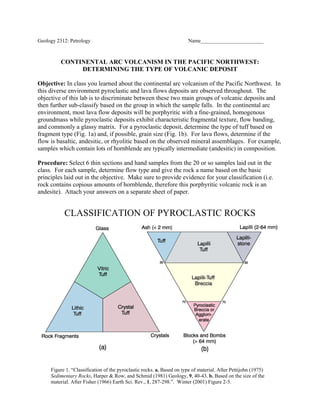
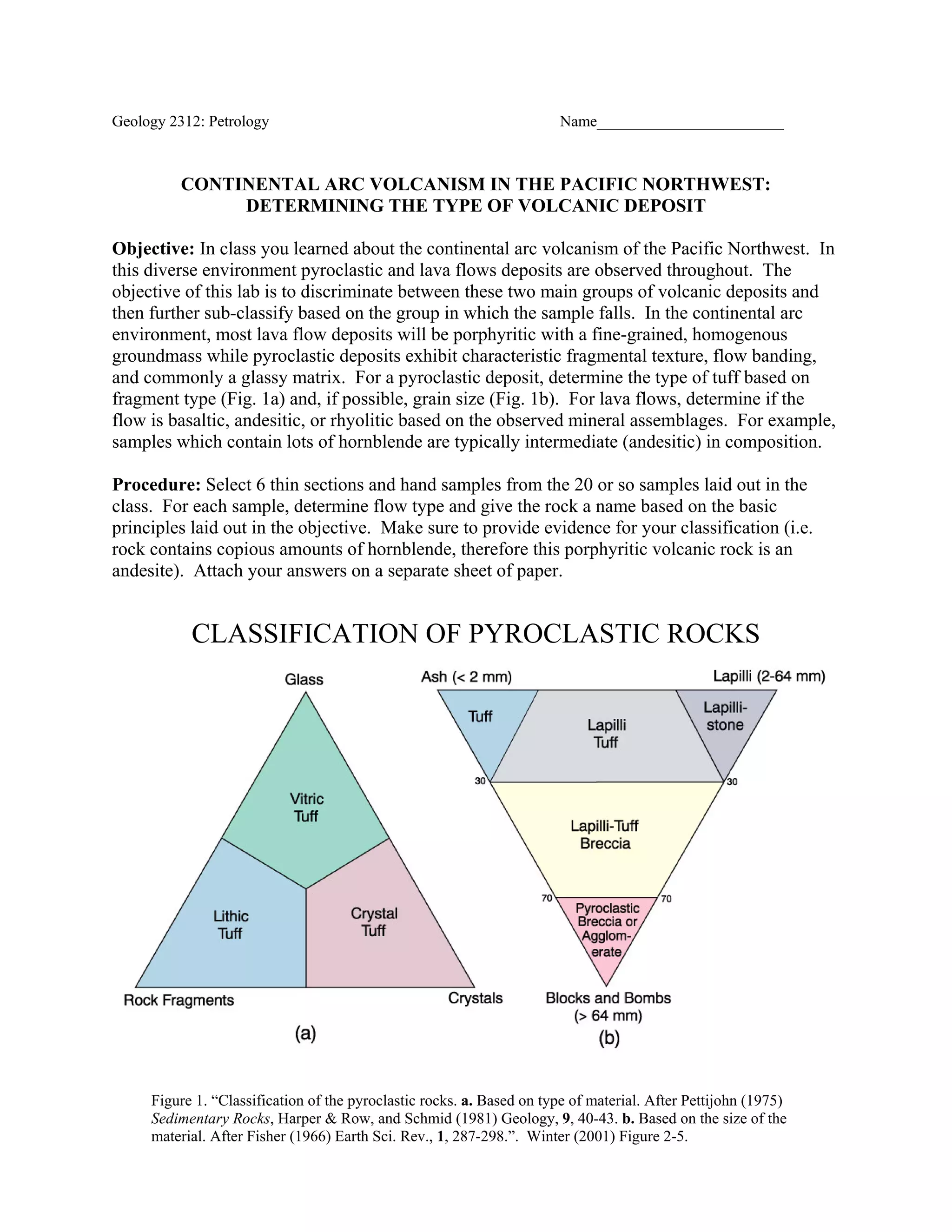
fragment type (Fig. 1a) and, if possible, grain size (Fig. 1b). For lava flows, determine if the
flow is basaltic, andesitic, or rhyolitic based on the observed mineral assemblages. For example,
samples which contain lots of hornblende are typically intermediate (andesitic) in composition.
Procedure: Select 6 thin sections and hand samples from the 20 or so samples laid out in the
class. For each sample, determine flow type and give the rock a name based on the basic
principles laid out in the objective. Make sure to provide evidence for your classification (i.e.
rock contains copious amounts of hornblende, therefore this porphyritic volcanic rock is an
andesite). Attach your answers on a separate sheet of paper.
CLASSIFICATION OF PYROCLASTIC ROCKS
Figure 1. “Classification of the pyroclastic rocks. a. Based on type of material. After Pettijohn (1975)
Sedimentary Rocks, Harper & Row, and Schmid (1981) Geology, 9, 40-43. b. Based on the size of the
material. After Fisher (1966) Earth Sci. Rev., 1, 287-298.”. Winter (2001) Figure 2-5.
Classification of pettijohn 1975

Classification of pettijohn 1975

  • 1.
    Geology 2312: PetrologyName________________________ CONTINENTAL ARC VOLCANISM IN THE PACIFIC NORTHWEST: DETERMINING THE TYPE OF VOLCANIC DEPOSIT Objective: In class you learned about the continental arc volcanism of the Pacific Northwest. In this diverse environment pyroclastic and lava flows deposits are observed throughout. The objective of this lab is to discriminate between these two main groups of volcanic deposits and then further sub-classify based on the group in which the sample falls. In the continental arc environment, most lava flow deposits will be porphyritic with a fine-grained, homogenous groundmass while pyroclastic deposits exhibit characteristic fragmental texture, flow banding, and commonly a glassy matrix. For a pyroclastic deposit, determine the type of tuff based on fragment type (Fig. 1a) and, if possible, grain size (Fig. 1b). For lava flows, determine if the flow is basaltic, andesitic, or rhyolitic based on the observed mineral assemblages. For example, samples which contain lots of hornblende are typically intermediate (andesitic) in composition. Procedure: Select 6 thin sections and hand samples from the 20 or so samples laid out in the class. For each sample, determine flow type and give the rock a name based on the basic principles laid out in the objective. Make sure to provide evidence for your classification (i.e. rock contains copious amounts of hornblende, therefore this porphyritic volcanic rock is an andesite). Attach your answers on a separate sheet of paper. CLASSIFICATION OF PYROCLASTIC ROCKS Figure 1. “Classification of the pyroclastic rocks. a. Based on type of material. After Pettijohn (1975) Sedimentary Rocks, Harper & Row, and Schmid (1981) Geology, 9, 40-43. b. Based on the size of the material. After Fisher (1966) Earth Sci. Rev., 1, 287-298.”. Winter (2001) Figure 2-5.