ELECTRO CONVULSIVE
THERAPY
PREPARED BY
MRS.AKILA.A; M.Sc (N), M.Sc(PSY),
ASSOCIATE PROFESSOR
INTRODUCTION
Somatic therapies are treatment approaches
that use physiological or physical interventions to
effect behavior change. The most common form of
somatic therapy is Electro Convulsive Therapy.
Electro convulsive therapy (ECT) was first used as a
treatment modality in 1934 to "cure" psychotic
disorders by inducing convulsions. ECT is one of the
most potent and sometimes life saving treatment in
psychiatry.
HISTORY
• ECT was first introduced by Italian psychiatrist Ugo Cerletti and
Lucio Bini in April 1938.
• Insulin coma therapy and pharmacoconvulsive therapy were
replaced by ECT.
• Insulin coma therapy was introduced by the German psychiatrist
Manfred Sakel in 1933.German psychiatrist Manfred Sakel in
1933.
• Pharmacoconvulsive therapy was introduced in Budapest in 1934
by Ladislas Meduna.
• In 1974, the APA’s council on research and development
appointed a task force on ECT.
• The APA task force on ECT, in 1976, gave its report which
provided clear guidelines for use of ECT.
DEFINITION OF ECT
• Electroconvulsive therapy is a type of
somatic treatment in which electric current
is applied to the brain through electrodes
placed on the temples of the patient. The
passage of an electrical stimulus of 70 to
150 volts to the brain for 0.1 to 0.5 second
to produce a grand mal seizure.
PARAMETERS OF ELECTRICAL
CURRENT APPLIED
Standard dose according to American
Psychiatric Association, 1978:
1. Voltage-70-120 volts
2. Duration-0.7-1.5 seconds
MECHANISM OF ACTION
The exact mechanism of action is not known.
One hypothesis states that ECT possibly affects the
catecholamine pathways between diencephalon
(from where seizure generalization occurs) and
limbic system (which may be responsible for mood
disorders), also involving the hypothalamus.
INDICATIONS OF ECT
a. Major depression with suicidal risk; stupor poor
intake of food and fluids; melancholia, with
psychotic features of unsatisfactory response to
drugs or where drugs are contraindicated or have
serious side effects.
b. Severe catatonia (functional): With stupor; poor
intake of food and fluids; unsatisfactory response
to drug therapy, or when drugs are contraindicated
or have serious side effects.
c. Severe psychosis (schizophrenia or mania): With
risk of suicide, homicide or danger of physical assault;
depressive features; unsatisfactory response to drug
therapy, or when drugs are contraindicated or have
serious side effects.
d. Organic mental disorders:
1. Organic mood disorders
2. Organic psychosis
Other indications:
ECT is preferred to antidepressant
therapy in some cases, such as for
- patients with cardiac disease; when TCA
are contraindicated because of the
potential for dysarrhythmias and
congestive heart failure;
- pregnant women, in whom
antidepressants place the fetus at risk for
congenital defects.
CONTRAINDICATIONS
A. Absolute
Raised ICP (intracranial pressure)
B. Relative
1. Cerebral aneurysm
2. Cerebral hemorrhage
3. Brain tumor
4. Acute myocardial infarction
5. Congestive heart failure
6. Pneumonia or aortic aneurysm
7. Retinal detachment
TYPE OF SEIZURE PRODUCED
1. Grand Mal seizure-tonic phase
lasting for 10-15 seconds.
2. Clonic phase lasting for 30-60
seconds
TYPES OF ECT
Direct ECT: ECT is given in the absence of
anesthesia and muscular relaxation. This is not a
commonly used method now.
Modified ECT: Here ECT is modified by drug
induced muscular relaxation and general
anesthesia.
APPLICATION OF ELECTRODES
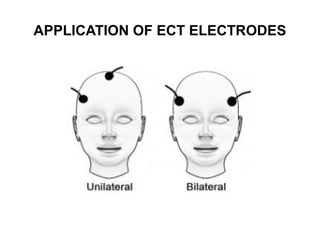
Bilateral ECT: Each electrode is placed 2.5-4 cm (1-
12 inch) above the midpoint, on a line joining the
tragus of the ear and the lateral canthus of the eye.
Unilateral ECT: Electrodes are placed only on one
side of head, usually non-dominant side bright side of
head in a right-handed individual)
Unilateral ECT is safe, with much fewer side-effects,
particularly those of memory impairment.
APPLICATION OF ECT ELECTRODES
FREQUENCY AND TOTAL NUMBER OF ECT
Frequency: Three times per week or as indicated.
Total Number: (6 Total number: 6 to 10; up to 25 may
be preferred as indicated.
ECT TEAM
Psychiatrist
Anesthesiologist
Trained nurses and Aides
TREATMENT FACILITIES
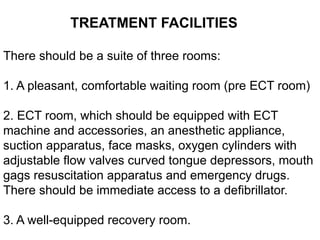
There should be a suite of three rooms:
1. A pleasant, comfortable waiting room (pre ECT room)
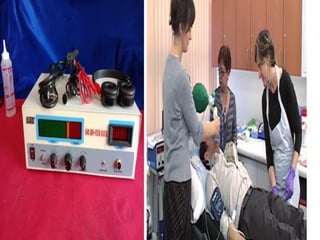
2. ECT room, which should be equipped with ECT
machine and accessories, an anesthetic appliance,
suction apparatus, face masks, oxygen cylinders with
adjustable flow valves curved tongue depressors, mouth
gags resuscitation apparatus and emergency drugs.
There should be immediate access to a defibrillator.
3. A well-equipped recovery room.
SIDE EFFECTS OF ECT
1. Memory impairment
2. Drowsiness, confusion and restlessness
3. Poor concentration, Anxiety, Headache,
4. Weakness/fatigue, backache.
5. Muscle aches
6. Dryness of mouth, palpitations, nausea,
vomiting
7. Unsteady gait
8. Tongue bite and incontinence
COMPLICATIONS OF ECT
Life-threatening complications of ECT are
rare.
• ECT does not cause any brain damage.
• Fractures can sometimes occur in elderly
patients with osteoporosis.
• In patients with a history of heart disease,
dysrhythmias and respiratory arrest may occur.
ROLE OF NURSE IN ECT:
I. PRETREATMENT EVALUATION
1. Detailed medical and psychiatric history, including
history of allergies.
2. Assessment of patients and families knowledge of
indications, side-effects, therapeutic effects and risks
associated with ECT.
3. An informed consent should be taken. Allay any
unfounded fears and anxieties regarding the
procedure.
8. Head shampooing in the morning since oil
causes impedance of passage of electricity to
brain.
9. Jewellery, prosthesis, dentures, contact lens,
metallic objects and tight clothing should be
removed from the patient's body.
10. Empty bladder and bowel just before ECT
11.Administration of 0.6 mg atropine IM or SC 30
minutes before ECT, or IV just before ECT.
B. INTRA-PROCEDURE CARE
1. Place the patient comfortably on the ECT table
in supine position.
2. Stay with the patient to allay anxiety and fear.
3. Assist in administering the anesthetic agent
(thiopental sodium 3-5 mg/kg body weight) and
muscle relaxant (1 mg/ kg body weight of
succinylcholine).
4. Since the muscle relaxant paralyzes all muscles
including respiratory muscles, patent airway
should be ensured and ventilatory support should
be started.
5. Mouth gag should be inserted to prevent
possible tongue bite.
6. The place(s) of electrode placement should be
cleaned with normal saline or 25 percent
bicarbonate solution, or a conducting gel applied.
7. Monitor voltage, intensity and duration of
electrical stimulus given.
8. Monitor seizure activity using cuff method
100 percent oxygen should be provided
9. During seizure monitor vital signs, ECG, oxygen
saturation, EEG, etc.
10. Record the findings and medicines given in the
patient's chart.
POST-PROCEDURE CARE
1. Monitor vital signs.
2. Continue oxygenation till spontaneous respiration
starts.
3. Assess for post-ictal confusion and restlessness.
4. Take safety precautions to prevent injury (side-
lying position and suctioning to prevent aspiration of
secretions, use of side rails to prevent falls).
5. If there is severe post-ictal confusion and
restlessness, IV diazepam may be administered.
6. Reorient the patient after recovery and stay with
him until fully oriented.
7. Document any findings as relevant in the patient's
record.
Documentation
• Document using flow sheets or progress notes.
• Record the patient's vital signs and responses
during the treatment sequence, recovery, and
post-recovery.
• Document medications, stimulus parameter,
seizure response and vital signs
• Assess and document the patient's physical and
mental status and any behavioral changes or
lack of such changes
THANK YOU

MHN , V (U), VI PPT.pptx (Electro convulsive therapy)

  • 1.
    ELECTRO CONVULSIVE THERAPY PREPARED BY MRS.AKILA.A;M.Sc (N), M.Sc(PSY), ASSOCIATE PROFESSOR
  • 2.
    INTRODUCTION Somatic therapies aretreatment approaches that use physiological or physical interventions to effect behavior change. The most common form of somatic therapy is Electro Convulsive Therapy. Electro convulsive therapy (ECT) was first used as a treatment modality in 1934 to "cure" psychotic disorders by inducing convulsions. ECT is one of the most potent and sometimes life saving treatment in psychiatry.
  • 3.
    HISTORY • ECT wasfirst introduced by Italian psychiatrist Ugo Cerletti and Lucio Bini in April 1938. • Insulin coma therapy and pharmacoconvulsive therapy were replaced by ECT. • Insulin coma therapy was introduced by the German psychiatrist Manfred Sakel in 1933.German psychiatrist Manfred Sakel in 1933. • Pharmacoconvulsive therapy was introduced in Budapest in 1934 by Ladislas Meduna. • In 1974, the APA’s council on research and development appointed a task force on ECT. • The APA task force on ECT, in 1976, gave its report which provided clear guidelines for use of ECT.
  • 4.
    DEFINITION OF ECT •Electroconvulsive therapy is a type of somatic treatment in which electric current is applied to the brain through electrodes placed on the temples of the patient. The passage of an electrical stimulus of 70 to 150 volts to the brain for 0.1 to 0.5 second to produce a grand mal seizure.
  • 5.
    PARAMETERS OF ELECTRICAL CURRENTAPPLIED Standard dose according to American Psychiatric Association, 1978: 1. Voltage-70-120 volts 2. Duration-0.7-1.5 seconds
  • 6.
    MECHANISM OF ACTION Theexact mechanism of action is not known. One hypothesis states that ECT possibly affects the catecholamine pathways between diencephalon (from where seizure generalization occurs) and limbic system (which may be responsible for mood disorders), also involving the hypothalamus.
  • 7.
    INDICATIONS OF ECT a.Major depression with suicidal risk; stupor poor intake of food and fluids; melancholia, with psychotic features of unsatisfactory response to drugs or where drugs are contraindicated or have serious side effects. b. Severe catatonia (functional): With stupor; poor intake of food and fluids; unsatisfactory response to drug therapy, or when drugs are contraindicated or have serious side effects.
  • 8.
    c. Severe psychosis(schizophrenia or mania): With risk of suicide, homicide or danger of physical assault; depressive features; unsatisfactory response to drug therapy, or when drugs are contraindicated or have serious side effects. d. Organic mental disorders: 1. Organic mood disorders 2. Organic psychosis
  • 9.
    Other indications: ECT ispreferred to antidepressant therapy in some cases, such as for - patients with cardiac disease; when TCA are contraindicated because of the potential for dysarrhythmias and congestive heart failure; - pregnant women, in whom antidepressants place the fetus at risk for congenital defects.
  • 10.
    CONTRAINDICATIONS A. Absolute Raised ICP(intracranial pressure) B. Relative 1. Cerebral aneurysm 2. Cerebral hemorrhage 3. Brain tumor 4. Acute myocardial infarction 5. Congestive heart failure 6. Pneumonia or aortic aneurysm 7. Retinal detachment
  • 11.
    TYPE OF SEIZUREPRODUCED 1. Grand Mal seizure-tonic phase lasting for 10-15 seconds. 2. Clonic phase lasting for 30-60 seconds
  • 12.
    TYPES OF ECT DirectECT: ECT is given in the absence of anesthesia and muscular relaxation. This is not a commonly used method now. Modified ECT: Here ECT is modified by drug induced muscular relaxation and general anesthesia.
  • 13.
    APPLICATION OF ELECTRODES BilateralECT: Each electrode is placed 2.5-4 cm (1- 12 inch) above the midpoint, on a line joining the tragus of the ear and the lateral canthus of the eye. Unilateral ECT: Electrodes are placed only on one side of head, usually non-dominant side bright side of head in a right-handed individual) Unilateral ECT is safe, with much fewer side-effects, particularly those of memory impairment.
  • 14.
  • 15.
    FREQUENCY AND TOTALNUMBER OF ECT Frequency: Three times per week or as indicated. Total Number: (6 Total number: 6 to 10; up to 25 may be preferred as indicated.
  • 16.
  • 17.
    TREATMENT FACILITIES There shouldbe a suite of three rooms: 1. A pleasant, comfortable waiting room (pre ECT room) 2. ECT room, which should be equipped with ECT machine and accessories, an anesthetic appliance, suction apparatus, face masks, oxygen cylinders with adjustable flow valves curved tongue depressors, mouth gags resuscitation apparatus and emergency drugs. There should be immediate access to a defibrillator. 3. A well-equipped recovery room.
  • 20.
    SIDE EFFECTS OFECT 1. Memory impairment 2. Drowsiness, confusion and restlessness 3. Poor concentration, Anxiety, Headache, 4. Weakness/fatigue, backache. 5. Muscle aches 6. Dryness of mouth, palpitations, nausea, vomiting 7. Unsteady gait 8. Tongue bite and incontinence
  • 21.
    COMPLICATIONS OF ECT Life-threateningcomplications of ECT are rare. • ECT does not cause any brain damage. • Fractures can sometimes occur in elderly patients with osteoporosis. • In patients with a history of heart disease, dysrhythmias and respiratory arrest may occur.
  • 22.
    ROLE OF NURSEIN ECT: I. PRETREATMENT EVALUATION 1. Detailed medical and psychiatric history, including history of allergies. 2. Assessment of patients and families knowledge of indications, side-effects, therapeutic effects and risks associated with ECT. 3. An informed consent should be taken. Allay any unfounded fears and anxieties regarding the procedure.
  • 23.
    8. Head shampooingin the morning since oil causes impedance of passage of electricity to brain. 9. Jewellery, prosthesis, dentures, contact lens, metallic objects and tight clothing should be removed from the patient's body. 10. Empty bladder and bowel just before ECT 11.Administration of 0.6 mg atropine IM or SC 30 minutes before ECT, or IV just before ECT.
  • 24.
    B. INTRA-PROCEDURE CARE 1.Place the patient comfortably on the ECT table in supine position. 2. Stay with the patient to allay anxiety and fear. 3. Assist in administering the anesthetic agent (thiopental sodium 3-5 mg/kg body weight) and muscle relaxant (1 mg/ kg body weight of succinylcholine). 4. Since the muscle relaxant paralyzes all muscles including respiratory muscles, patent airway should be ensured and ventilatory support should be started.
  • 25.
    5. Mouth gagshould be inserted to prevent possible tongue bite. 6. The place(s) of electrode placement should be cleaned with normal saline or 25 percent bicarbonate solution, or a conducting gel applied. 7. Monitor voltage, intensity and duration of electrical stimulus given. 8. Monitor seizure activity using cuff method 100 percent oxygen should be provided
  • 26.
    9. During seizuremonitor vital signs, ECG, oxygen saturation, EEG, etc. 10. Record the findings and medicines given in the patient's chart.
  • 27.
    POST-PROCEDURE CARE 1. Monitorvital signs. 2. Continue oxygenation till spontaneous respiration starts. 3. Assess for post-ictal confusion and restlessness. 4. Take safety precautions to prevent injury (side- lying position and suctioning to prevent aspiration of secretions, use of side rails to prevent falls). 5. If there is severe post-ictal confusion and restlessness, IV diazepam may be administered. 6. Reorient the patient after recovery and stay with him until fully oriented. 7. Document any findings as relevant in the patient's record.
  • 28.
    Documentation • Document usingflow sheets or progress notes. • Record the patient's vital signs and responses during the treatment sequence, recovery, and post-recovery. • Document medications, stimulus parameter, seizure response and vital signs • Assess and document the patient's physical and mental status and any behavioral changes or lack of such changes
  • 29.