




GUIDED BY: PRESENTED BY:
Dr.Jesinda, Ph.D(N)., N.Dhivya Priya
HOD of Psychiatric Department, M.Sc(N)., II Year
SHNC, Madurai SHNC, Madurai
INTRODUCTION
Electroconvulsive therapy (ECT), also
known as Electroshock or Electroplexy is a
well established, albeit controversial
psychiatric treatment in which seizures are
electrically induced in anesthetized patients
for therapeutic effects.
ECT was first introduced by Italian psychiatrist
Ugo Cerletti and Lucio Bini in April 1938.
Insulin coma therapy and pharmacoconvulsive
therapy were replaced by ECT.
Insulin coma therapy was introduced by the
German psychiatrist Manfred Sakel in 1933.
Pharmacoconvulsive therapy was introduced in
Budapest in 1934 by Ladislas Meduna.
In 1974, the APA’s council on research
and development appointed a task force on ECT.
The APA task force on ECT, in 1976, gave its report
which provided clear guidelines for use of ECT.
1.“ Artificial induction of a grand mal seizure
(tonic phase 10-15 sec, clonic phase 30-60 sec
through the application of electrical current
to the brain, the stimulus is applied through
electrodes which are placed either bilaterally in
fronto-temporal region or unilaterally on the
non dominant side.”
or
2.ECT is a physical/somatic therapy in which the
help of two electrodes, current is passed
through the temporal region in between the two
hemispheres of the brain, to produce a grand
mal type of seizure.
DEFINITION
: 70-120 volts of current
(The usual amount passed
in ECT is 200-1600mA)
: 0.7-1.5 sec
ECT relief very severe depressive illnesses
when other treatments have failed.
ECT has saved patient’s live because 15% of
people with severe depression will kill
themselves.
ECT works faster than all antidepressants
drugs.
-
Major Depression w/ or w/o psychotic
features. Bipolar disorder manic or
depressed phase.
Acute or Catatonic Schizophrenia.
Some studies have shown efficacy in
treating OCD, Delirium, Chronic pain
syndromes, and intractable seizure
disorders.
Absolute
Increased ICP
Relative
1. Cardiovascular
problems
Coronary artery Arrhythmias
disease, HTN, Aneurysms,
2. Cerebro vascular effects
Recentstrokes, Aneurysms Space occupying lesions,
3.Severepulmonarydisease
TB, Pneumonia, Asthma
The exact mechanism of action is notknown.
One hypothesis states that ECT possibly
affects the catecholamine pathways between
diencephalon (from where seizure
generalization occurs) and limbic systems
(which may be responsible for mood
disorders), also involving the hypothalamus.
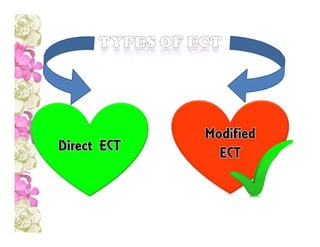
DIRECT ECT
In this, ECT is given in the absence
of anesthesia and muscular
relaxation.
This is not a commonly
usedmethod now.
Electrodes are placed on the side of a
patient’s head just above the temples.
The patient is given anesthetic
injections and a muscle relaxant to
stop muscle contractions that can lead
to broken bones.
A small electric current is passed
through the brain.
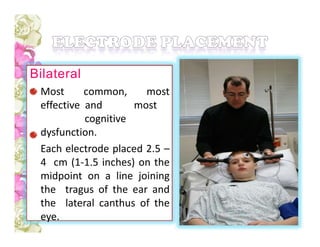
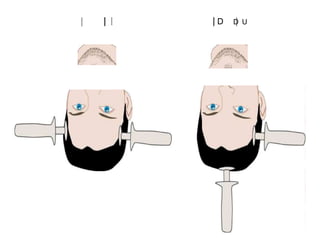
Bilateral
Most common, most
effective and most
cognitive
dysfunction.
Each electrode placed 2.5 –
4 cm (1-1.5 inches) on the
midpoint on a line joining
the tragus of the ear and
the lateral canthus of the
eye.
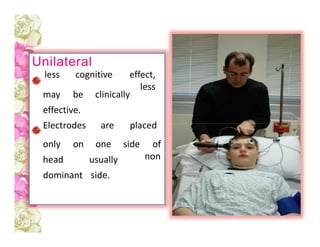
Unilateral
may be clinically
less cognitive effect,
less
effective.
Electrodes are placed
only on one
head usually
side of
non
dominant side.
D D U
ECT is usually given 3 times a week, reduced
to twice a week or once a week once symptoms
begin to respond. This limits cognitive problems.
Treatmentof depressionusually consists of 6-12
treatments.
Psychosis and mania upto (or sometimes more
than) 20 treatments.
Catatonia usually resolves in 3-5 treatments.
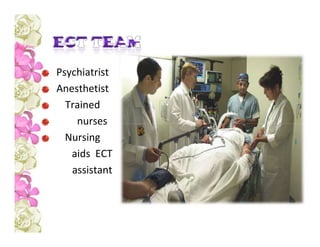
Psychiatrist
Anesthetist
Trained
nurses
Nursing
aids ECT
assistant
Inj. Atropine (0.6mg to 1mg)
Inj. Succinylecholine (1mg/kg/b.wt)
Inj. Sodium thiopendothal (3-5mg/kg/b.wt)
A pretreatment medication such as atropine
sulfate, glycopyrolate is administered IM
30 min before treatment, (to decrease
secretion and counteract the effect of vagal
stimulation induced by ECT).
A short acting anesthesia (the patient should
be unconscious when the ECT is given).
Muscle relaxant (to prevent muscle contraction
during the seizure reduction of possibility of
fracture or dislocated bone).
Pure oxygen before and after treatment
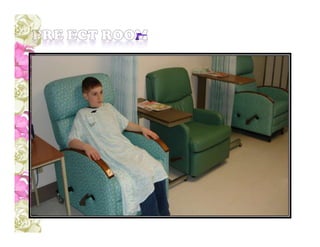
3 rooms
1. Waiting room
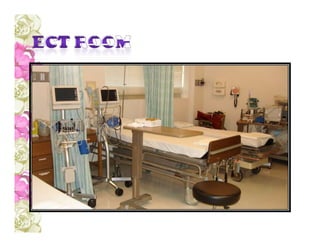
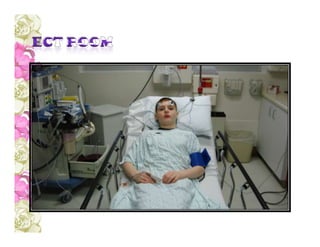
2. ECT room
3. Recovery room
Articles for anesthesia Suction
apparatus Face mask
Oxygen cylinder Tongue
depressor Mouth gag
Resuscitation apparatus
Fullset of emergency drugs,
ECTdrugs Defibrillator
Description of the procedure.
Explain why the procedure is
recommended.
➢Alternative treatment
➢Benefits may be transient
➢Behavioral restrictions
➢Voluntarytreatment
➢Implies consent for emergency
treatment
➢Risks major and minor
Time10-15mit (or more time preparation and
recovery)
Intravenous (IV) catheter Oxygen mask may be
given
Electrodes are placed on the head either
unilateral or bilateral
Anesthetic is injectedinto IV Unconscious and
unaware of procedure Muscle relaxant is injected
into IV Prevent violent convulsions
BP cuff placed around forearm or
ankle. To Prevents muscle relaxant
from paralyzing, so doctor can
confirm seizure with movement of
hand/foot.
Electric current is sent through
electrodes to brain.
Seizure lasts 30-60 seconds.
Few min later, anesthetic and muscle
relaxant wear off.
• Pre ECT care
• Intra procedure care
• Post procedure care
Informed consent
Fully explain therisks and benefits of procedure
and answer questions from patients or relatives.
Information sheets.
Reduce patients anxiety and help establish
good relationship (nurse-patient, doctor
patient).
Administration of drugs. Check patient record.
Cont…
Explainprocedure.
Keep patient on NPO 6-8hours before ECT.
Discourage smoking just before ECT. Remove
artificial dentures andarticles.
Vital signs.
Ensure emergency articles are accessible.
Emotional support.
Transfer patient to ECT room with necessary
records.
Checks patients identity.
Check patient is NPO and has emptied their bowels
and bladder prior to coming to treatment room.
Check patient is not wearing restrictive clothing and
treatments(including
jewellery/dentures have been
removed. Consult ECT record of
previous anesthetic problems).
or reduce
Ensureconsent form is signed appropriately. Check
no medication that might increase seizure
threshold has been recently given.
Check ECT machine is functioning correctly.
Reassurance & support.
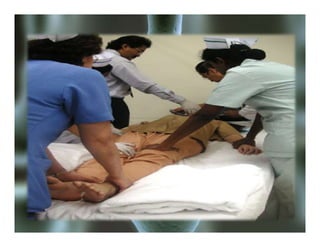
Place patient in supine position.
Necessary drug administration.
Mouth gag.
Apply upward pressure to mandible.
Oxygen administration.
Clean the scalp with normal saline.
Prevent fall, fracture, dislocation
Remove the mouth gag after seizure
occurred Suck the oral secretion &
apply O2 mask
Shift client post – procedure room. Check vital
signs every 15 min.
Administer drugs if patient is aggressive/
violated/ confused.
If respiratory difficulty continue oxygen. Provide
side rails.
Be with the patient. Documentation.
Reorient the client after recovery.
Impairment of cognition
Period of confusion immediately after ECT May
not know where you are or why you are there
Generally lasts few minutes toseveral hours
Memory loss
May forget weeks/months before treatment,
during treatment or after treatment has
stopped
Usually improves within couple of months
Permanent in relatively rare cases
Medical complications
Heart problems Small
risk of death
Physical symptoms Nausea
Vomiting Headache
Muscle ache Jaw
pain
People with serious mental illness who are at
risk of self harm or are thought to be risk to
other people can be sectioned under the
mental health act.
This means they can be taken to a place of
safety, usually a secure psychiatric unit, and
given treatment against their will.
They may not consent to the treatment they
are given and may be held against their will.
Clinical teaching on electro convulsive therapy

Clinical teaching on electro convulsive therapy

  • 1.
    GUIDED BY: PRESENTEDBY: Dr.Jesinda, Ph.D(N)., N.Dhivya Priya HOD of Psychiatric Department, M.Sc(N)., II Year SHNC, Madurai SHNC, Madurai
  • 2.
    INTRODUCTION Electroconvulsive therapy (ECT),also known as Electroshock or Electroplexy is a well established, albeit controversial psychiatric treatment in which seizures are electrically induced in anesthetized patients for therapeutic effects.
  • 3.
    ECT was firstintroduced by Italian psychiatrist Ugo Cerletti and Lucio Bini in April 1938. Insulin coma therapy and pharmacoconvulsive therapy were replaced by ECT. Insulin coma therapy was introduced by the German psychiatrist Manfred Sakel in 1933. Pharmacoconvulsive therapy was introduced in Budapest in 1934 by Ladislas Meduna. In 1974, the APA’s council on research and development appointed a task force on ECT. The APA task force on ECT, in 1976, gave its report which provided clear guidelines for use of ECT.
  • 4.
    1.“ Artificial inductionof a grand mal seizure (tonic phase 10-15 sec, clonic phase 30-60 sec through the application of electrical current to the brain, the stimulus is applied through electrodes which are placed either bilaterally in fronto-temporal region or unilaterally on the non dominant side.” or 2.ECT is a physical/somatic therapy in which the help of two electrodes, current is passed through the temporal region in between the two hemispheres of the brain, to produce a grand mal type of seizure. DEFINITION
  • 5.
    : 70-120 voltsof current (The usual amount passed in ECT is 200-1600mA) : 0.7-1.5 sec
  • 6.
    ECT relief verysevere depressive illnesses when other treatments have failed. ECT has saved patient’s live because 15% of people with severe depression will kill themselves. ECT works faster than all antidepressants drugs.
  • 7.
    - Major Depression w/or w/o psychotic features. Bipolar disorder manic or depressed phase. Acute or Catatonic Schizophrenia. Some studies have shown efficacy in treating OCD, Delirium, Chronic pain syndromes, and intractable seizure disorders.
  • 8.
    Absolute Increased ICP Relative 1. Cardiovascular problems Coronaryartery Arrhythmias disease, HTN, Aneurysms, 2. Cerebro vascular effects Recentstrokes, Aneurysms Space occupying lesions, 3.Severepulmonarydisease TB, Pneumonia, Asthma
  • 9.
    The exact mechanismof action is notknown. One hypothesis states that ECT possibly affects the catecholamine pathways between diencephalon (from where seizure generalization occurs) and limbic systems (which may be responsible for mood disorders), also involving the hypothalamus.
  • 11.
    DIRECT ECT In this,ECT is given in the absence of anesthesia and muscular relaxation. This is not a commonly usedmethod now.
  • 12.
    Electrodes are placedon the side of a patient’s head just above the temples. The patient is given anesthetic injections and a muscle relaxant to stop muscle contractions that can lead to broken bones. A small electric current is passed through the brain.
  • 13.
    Bilateral Most common, most effectiveand most cognitive dysfunction. Each electrode placed 2.5 – 4 cm (1-1.5 inches) on the midpoint on a line joining the tragus of the ear and the lateral canthus of the eye.
  • 14.
    Unilateral may be clinically lesscognitive effect, less effective. Electrodes are placed only on one head usually side of non dominant side.
  • 15.
  • 16.
    ECT is usuallygiven 3 times a week, reduced to twice a week or once a week once symptoms begin to respond. This limits cognitive problems. Treatmentof depressionusually consists of 6-12 treatments. Psychosis and mania upto (or sometimes more than) 20 treatments. Catatonia usually resolves in 3-5 treatments.
  • 17.
  • 18.
    Inj. Atropine (0.6mgto 1mg) Inj. Succinylecholine (1mg/kg/b.wt) Inj. Sodium thiopendothal (3-5mg/kg/b.wt)
  • 19.
    A pretreatment medicationsuch as atropine sulfate, glycopyrolate is administered IM 30 min before treatment, (to decrease secretion and counteract the effect of vagal stimulation induced by ECT). A short acting anesthesia (the patient should be unconscious when the ECT is given). Muscle relaxant (to prevent muscle contraction during the seizure reduction of possibility of fracture or dislocated bone). Pure oxygen before and after treatment
  • 20.
    3 rooms 1. Waitingroom 2. ECT room 3. Recovery room
  • 24.
    Articles for anesthesiaSuction apparatus Face mask Oxygen cylinder Tongue depressor Mouth gag Resuscitation apparatus Fullset of emergency drugs, ECTdrugs Defibrillator
  • 25.
    Description of theprocedure. Explain why the procedure is recommended. ➢Alternative treatment ➢Benefits may be transient ➢Behavioral restrictions ➢Voluntarytreatment ➢Implies consent for emergency treatment ➢Risks major and minor
  • 26.
    Time10-15mit (or moretime preparation and recovery) Intravenous (IV) catheter Oxygen mask may be given Electrodes are placed on the head either unilateral or bilateral Anesthetic is injectedinto IV Unconscious and unaware of procedure Muscle relaxant is injected into IV Prevent violent convulsions
  • 27.
    BP cuff placedaround forearm or ankle. To Prevents muscle relaxant from paralyzing, so doctor can confirm seizure with movement of hand/foot. Electric current is sent through electrodes to brain. Seizure lasts 30-60 seconds. Few min later, anesthetic and muscle relaxant wear off.
  • 28.
    • Pre ECTcare • Intra procedure care • Post procedure care
  • 29.
    Informed consent Fully explaintherisks and benefits of procedure and answer questions from patients or relatives. Information sheets. Reduce patients anxiety and help establish good relationship (nurse-patient, doctor patient). Administration of drugs. Check patient record.
  • 30.
    Cont… Explainprocedure. Keep patient onNPO 6-8hours before ECT. Discourage smoking just before ECT. Remove artificial dentures andarticles. Vital signs. Ensure emergency articles are accessible. Emotional support. Transfer patient to ECT room with necessary records.
  • 31.
    Checks patients identity. Checkpatient is NPO and has emptied their bowels and bladder prior to coming to treatment room. Check patient is not wearing restrictive clothing and treatments(including jewellery/dentures have been removed. Consult ECT record of previous anesthetic problems). or reduce Ensureconsent form is signed appropriately. Check no medication that might increase seizure threshold has been recently given. Check ECT machine is functioning correctly.
  • 32.
    Reassurance & support. Placepatient in supine position. Necessary drug administration. Mouth gag. Apply upward pressure to mandible. Oxygen administration. Clean the scalp with normal saline. Prevent fall, fracture, dislocation Remove the mouth gag after seizure occurred Suck the oral secretion & apply O2 mask
  • 34.
    Shift client post– procedure room. Check vital signs every 15 min. Administer drugs if patient is aggressive/ violated/ confused. If respiratory difficulty continue oxygen. Provide side rails. Be with the patient. Documentation. Reorient the client after recovery.
  • 35.
    Impairment of cognition Periodof confusion immediately after ECT May not know where you are or why you are there Generally lasts few minutes toseveral hours Memory loss May forget weeks/months before treatment, during treatment or after treatment has stopped Usually improves within couple of months Permanent in relatively rare cases
  • 36.
    Medical complications Heart problemsSmall risk of death Physical symptoms Nausea Vomiting Headache Muscle ache Jaw pain
  • 37.
    People with seriousmental illness who are at risk of self harm or are thought to be risk to other people can be sectioned under the mental health act. This means they can be taken to a place of safety, usually a secure psychiatric unit, and given treatment against their will. They may not consent to the treatment they are given and may be held against their will.