CIM 2 Modelica Factory
Automated Equation-Based Cyber-Physical Power System Modelica
Model Generation and Time-Domain Simulation from CIM
Francisco Gomez1, Prof. Luigi Vanfretti1,2, and Svein
H. Olsen2
luigiv@kth.se , fragom@kth.se
Electric Power Systems Dept.
KTH
Stockholm, Sweden
Luigi.Vanfretti@statnett.no
svein.harald.olsen@statnett.no
Research and Development Division
Statnett SF
Oslo, Norway
Overview
Acknowledgments
• This work has been funded in part by the
EU funded FP7 iTesla project:
http://www.itesla-project.eu/ and Statnett
SF, the Norwegian power system operator.
• Work related to the iTesla Modelica power
systems library presented here is a result of
the collaboration between RTE (France),
AIA (Spain) and KTH (Sweden) within the EU
funded FP7 iTesla project:
http://www.itesla-project.eu/
• Special thanks for ‘special training’ and
support from
• Prof. Fritzson and his team at Linköping University
• Prof. Berhard Bachmann and Lennart Ochel, FH
Bielefeld
• Background & Motivation
– Modelica
– CIM
– CIM for Dynamics
• Modelica
– Language Description
– MetaModelica
– CIM/UML to Modelica
• CIM 2 Modelica
– Concept Design
– Mapping
– Simulation Engine
Research
• Development of software architecture
supporting transformation from CIM,
implementing tools for either translating
from CIM to Modelica models
• Development of models of cyber-physical
power systems components,
communication network components, and
other components from other domains
Application
• iTESLA: Innovative Tools for Electrical
System Security within Large Areas
• CIM provides standard format for power
systems data
• Use of data from TSO
– Description of data equipment, power systems
topology and measurements for model validation
Motivation
Modelica
• Modelica is a non-proprietary, object-
oriented, equation based language to
conveniently model complex physical
systems
• Suitable modeling language for
standardization and exchange of
models
• Modelica tools, commercial and free of
charge
• Electric power steering and
controller model
[1] Andreas Deuring, Johannes
Gerl, Harald Wilhelm
“Multi-Domain Vehicle Dynamics
Simulation in Dymola”,
Modelica Conference, Dresden,
2011
• Thermodinamic Network
of the ICE model
[2] L. Morawietz, S. Risse, H.
Zellbeck, H. Reuss, T. Christ
“Modeling an automotive power
train and electrical power supply
for HiL applications using
Modelica”,
Modelica Conference, Hamburg,
2005
TU Dresden, University of
Stuttgart, BMW Group,
Germany.
Background
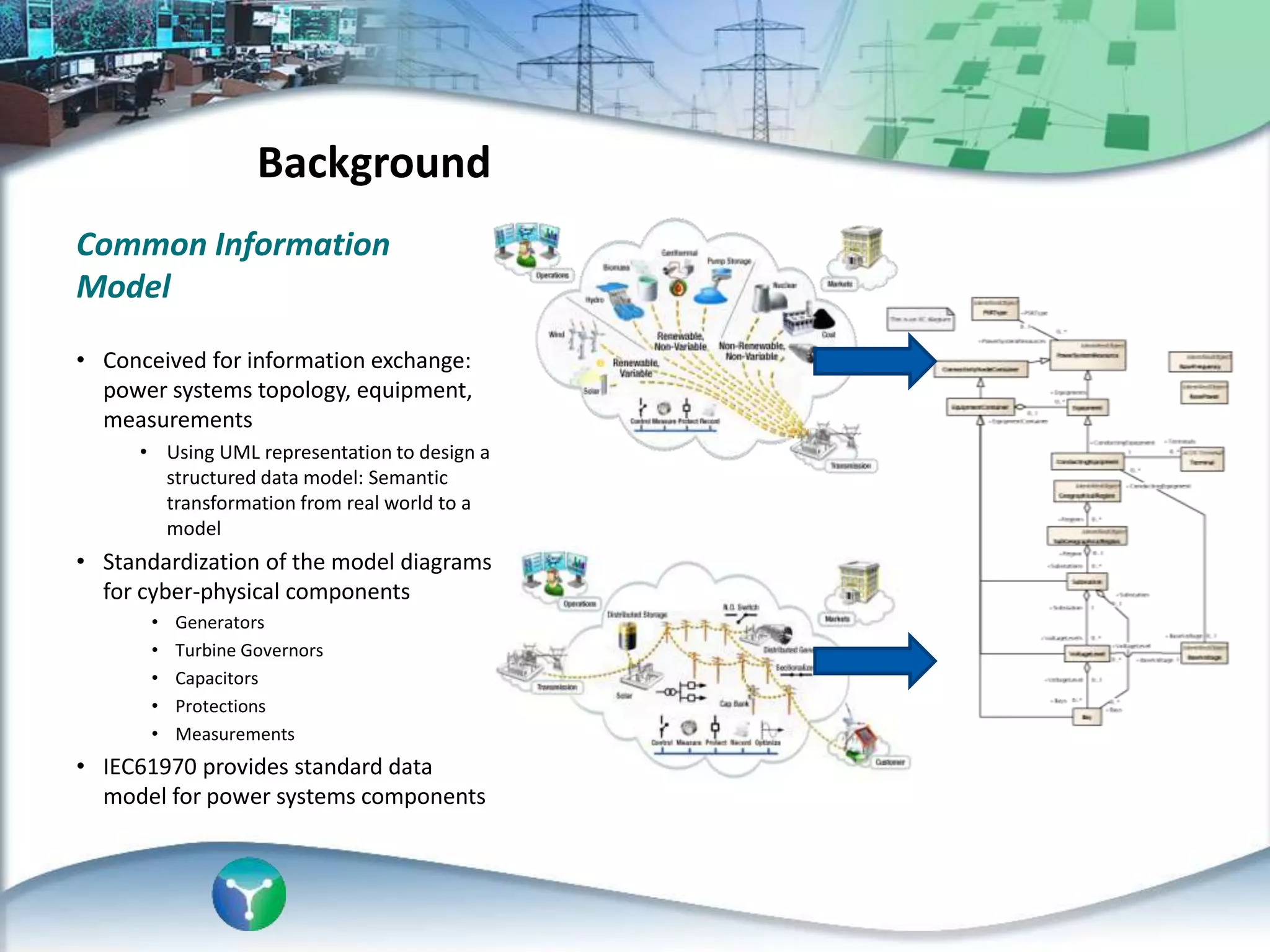
Common Information
Model
• Conceived for information exchange:
power systems topology, equipment,
measurements
• Using UML representation to design a
structured data model: Semantic
transformation from real world to a
model
• Standardization of the model diagrams
for cyber-physical components
• Generators
• Turbine Governors
• Capacitors
• Protections
• Measurements
• IEC61970 provides standard data
model for power systems components
Background
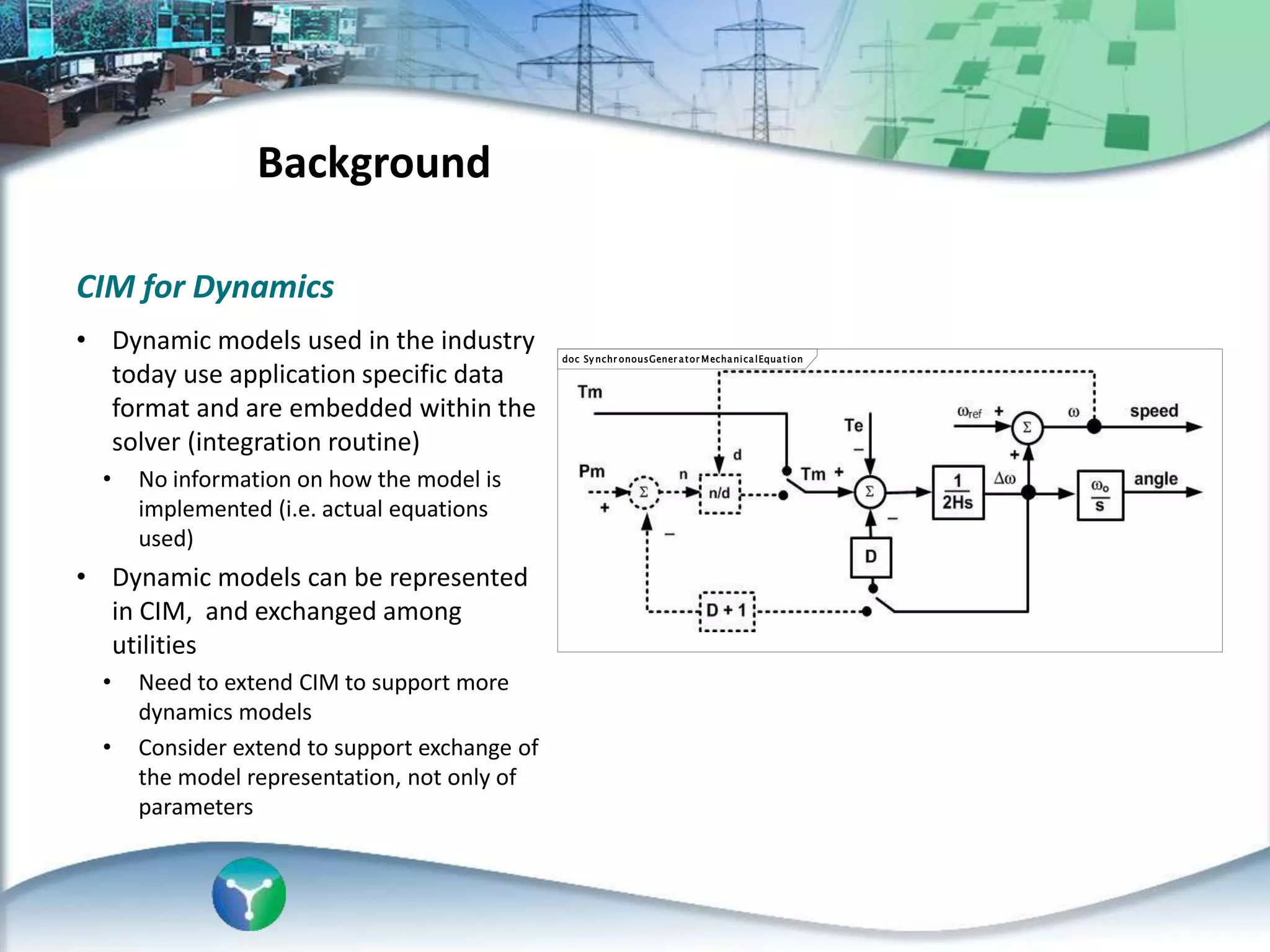
CIM for Dynamics
• Dynamic models used in the industry
today use application specific data
format and are embedded within the
solver (integration routine)
• No information on how the model is
implemented (i.e. actual equations
used)
• Dynamic models can be represented
in CIM, and exchanged among
utilities
• Need to extend CIM to support more
dynamics models
• Consider extend to support exchange of
the model representation, not only of
parameters
Background
doc Sy nchr onousGener ator MechanicalEquation
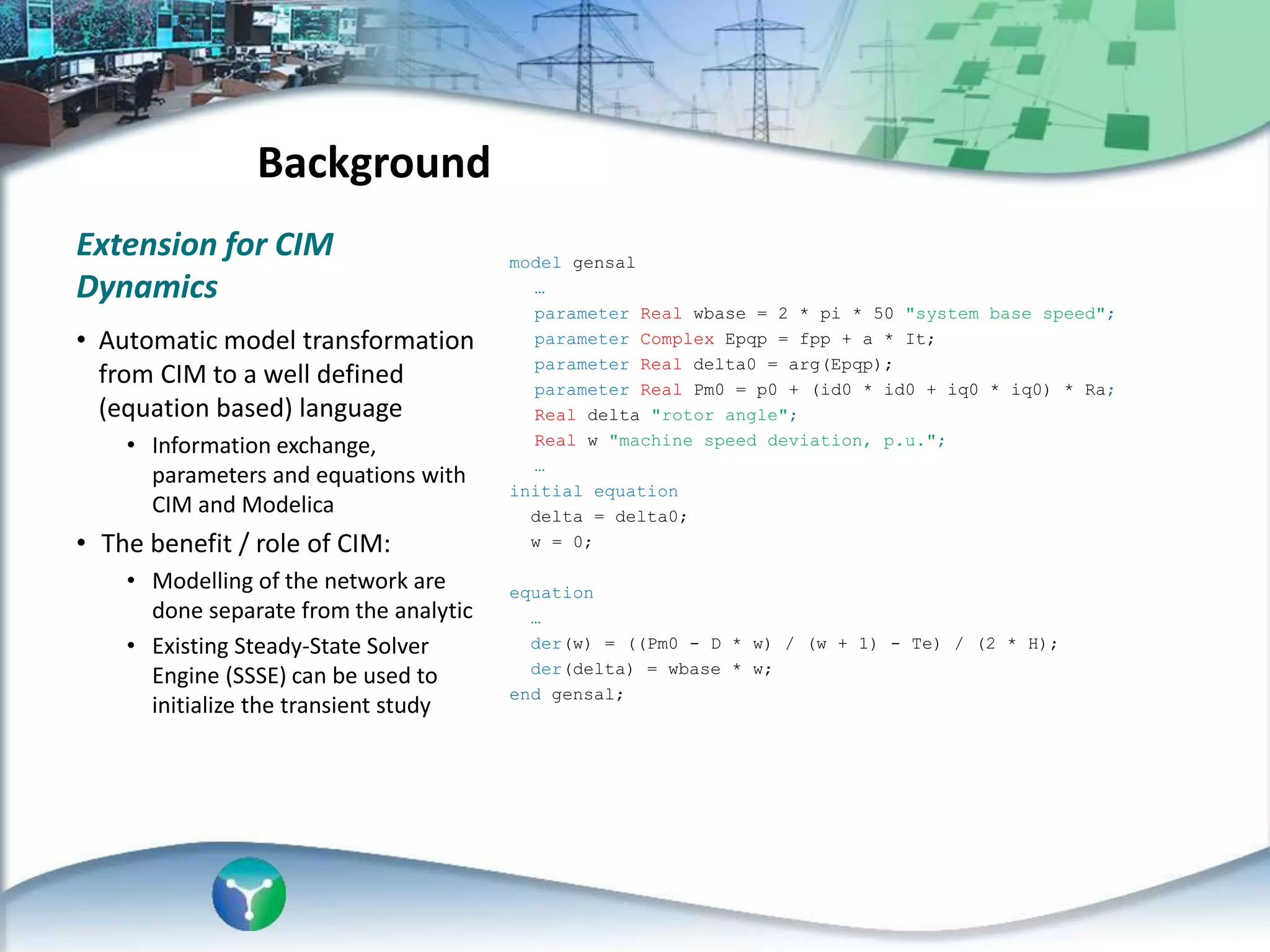
Extension for CIM
Dynamics
• Automatic model transformation
from CIM to a well defined
(equation based) language
• Information exchange,
parameters and equations with
CIM and Modelica
• The benefit / role of CIM:
• Modelling of the network are
done separate from the analytic
• Existing Steady-State Solver
Engine (SSSE) can be used to
initialize the transient study
Background
model gensal
…
parameter Real wbase = 2 * pi * 50 "system base speed";
parameter Complex Epqp = fpp + a * It;
parameter Real delta0 = arg(Epqp);
parameter Real Pm0 = p0 + (id0 * id0 + iq0 * iq0) * Ra;
Real delta "rotor angle";
Real w "machine speed deviation, p.u.";
…
initial equation
delta = delta0;
w = 0;
equation
…
der(w) = ((Pm0 - D * w) / (w + 1) - Te) / (2 * H);
der(delta) = wbase * w;
end gensal;
Overview
• Background & Motivation
– Modelica
– CIM
– CIM for Dynamics
• Modelica
– Language Description
– MetaModelica
– CIM/UML to Modelica
• CIM 2 Modelica
– Concept Design
– Mapping
– Simulation Engine
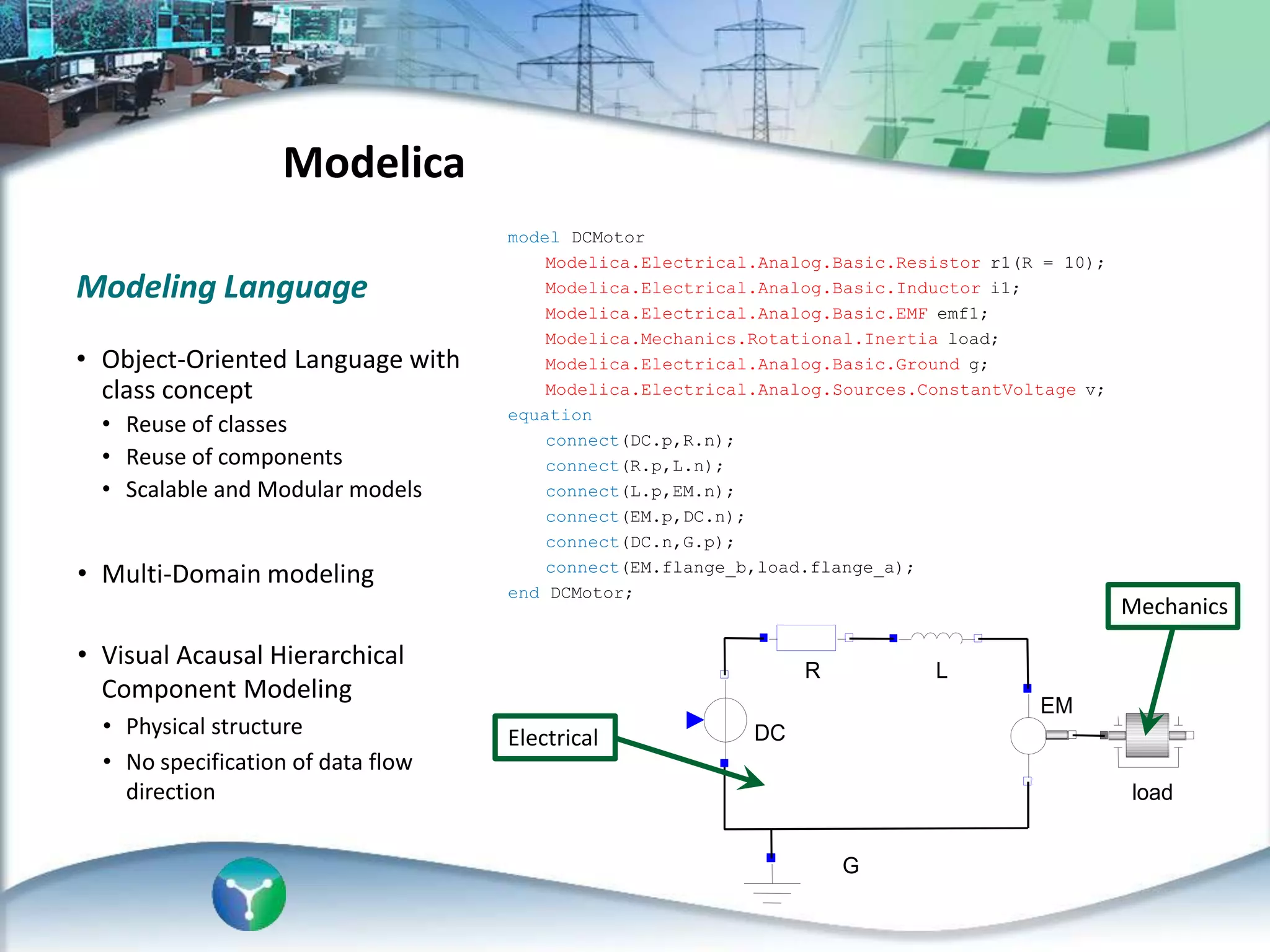
Modeling Language
• Object-Oriented Language with
class concept
• Reuse of classes
• Reuse of components
• Scalable and Modular models
• Multi-Domain modeling
• Visual Acausal Hierarchical
Component Modeling
• Physical structure
• No specification of data flow
direction load
EM
DC
G
R L
Electrical
Mechanics
model DCMotor
Modelica.Electrical.Analog.Basic.Resistor r1(R = 10);
Modelica.Electrical.Analog.Basic.Inductor i1;
Modelica.Electrical.Analog.Basic.EMF emf1;
Modelica.Mechanics.Rotational.Inertia load;
Modelica.Electrical.Analog.Basic.Ground g;
Modelica.Electrical.Analog.Sources.ConstantVoltage v;
equation
connect(DC.p,R.n);
connect(R.p,L.n);
connect(L.p,EM.n);
connect(EM.p,DC.n);
connect(DC.n,G.p);
connect(EM.flange_b,load.flange_a);
end DCMotor;
Modelica
Modeling Language
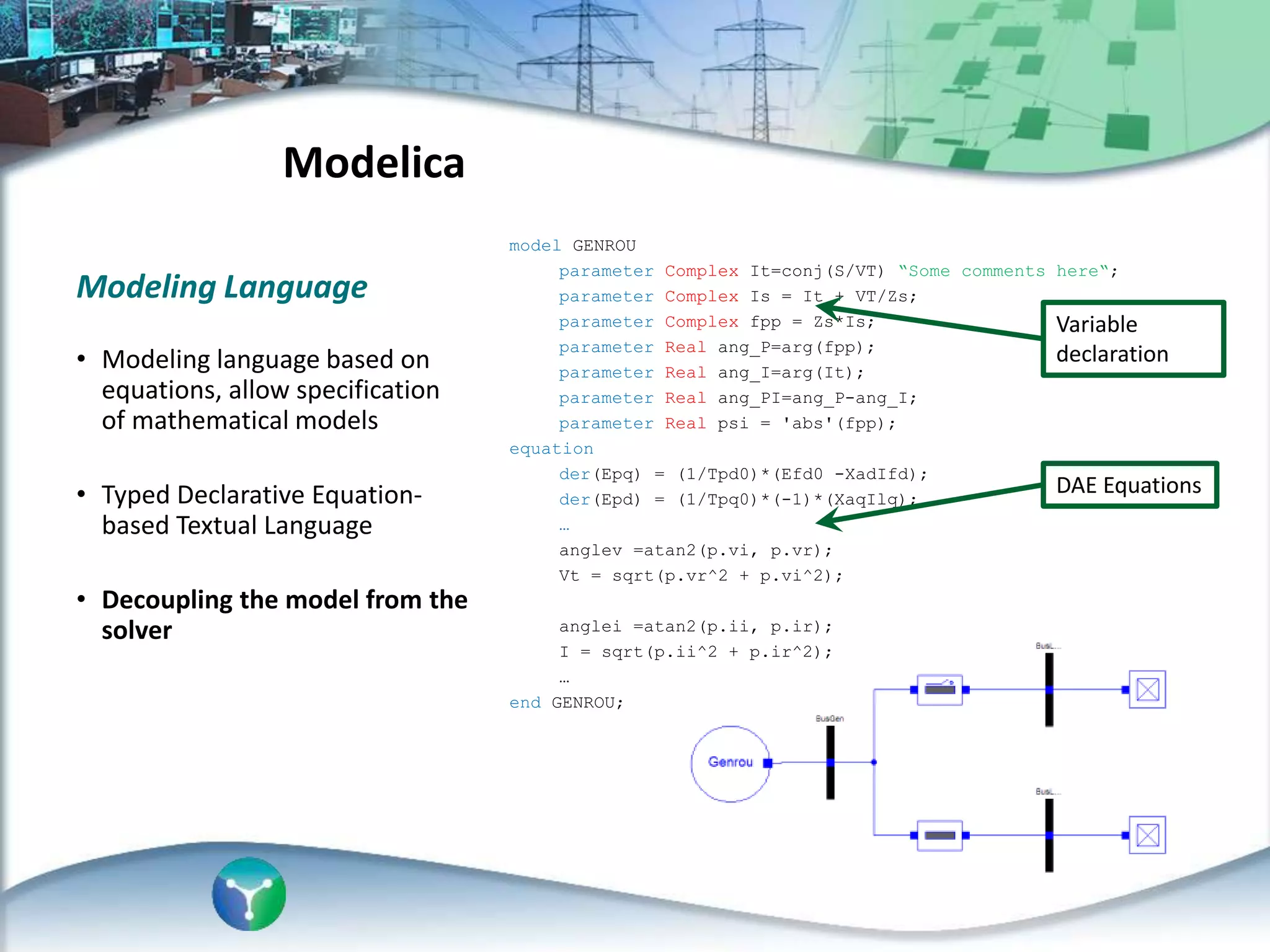
• Modeling language based on
equations, allow specification
of mathematical models
• Typed Declarative Equation-
based Textual Language
• Decoupling the model from the
solver
model GENROU
parameter Complex It=conj(S/VT) “Some comments here“;
parameter Complex Is = It + VT/Zs;
parameter Complex fpp = Zs*Is;
parameter Real ang_P=arg(fpp);
parameter Real ang_I=arg(It);
parameter Real ang_PI=ang_P-ang_I;
parameter Real psi = 'abs'(fpp);
equation
der(Epq) = (1/Tpd0)*(Efd0 -XadIfd);
der(Epd) = (1/Tpq0)*(-1)*(XaqIlq);
…
anglev =atan2(p.vi, p.vr);
Vt = sqrt(p.vr^2 + p.vi^2);
anglei =atan2(p.ii, p.ir);
I = sqrt(p.ii^2 + p.ir^2);
…
end GENROU;
Variable
declaration
DAE Equations
Modelica
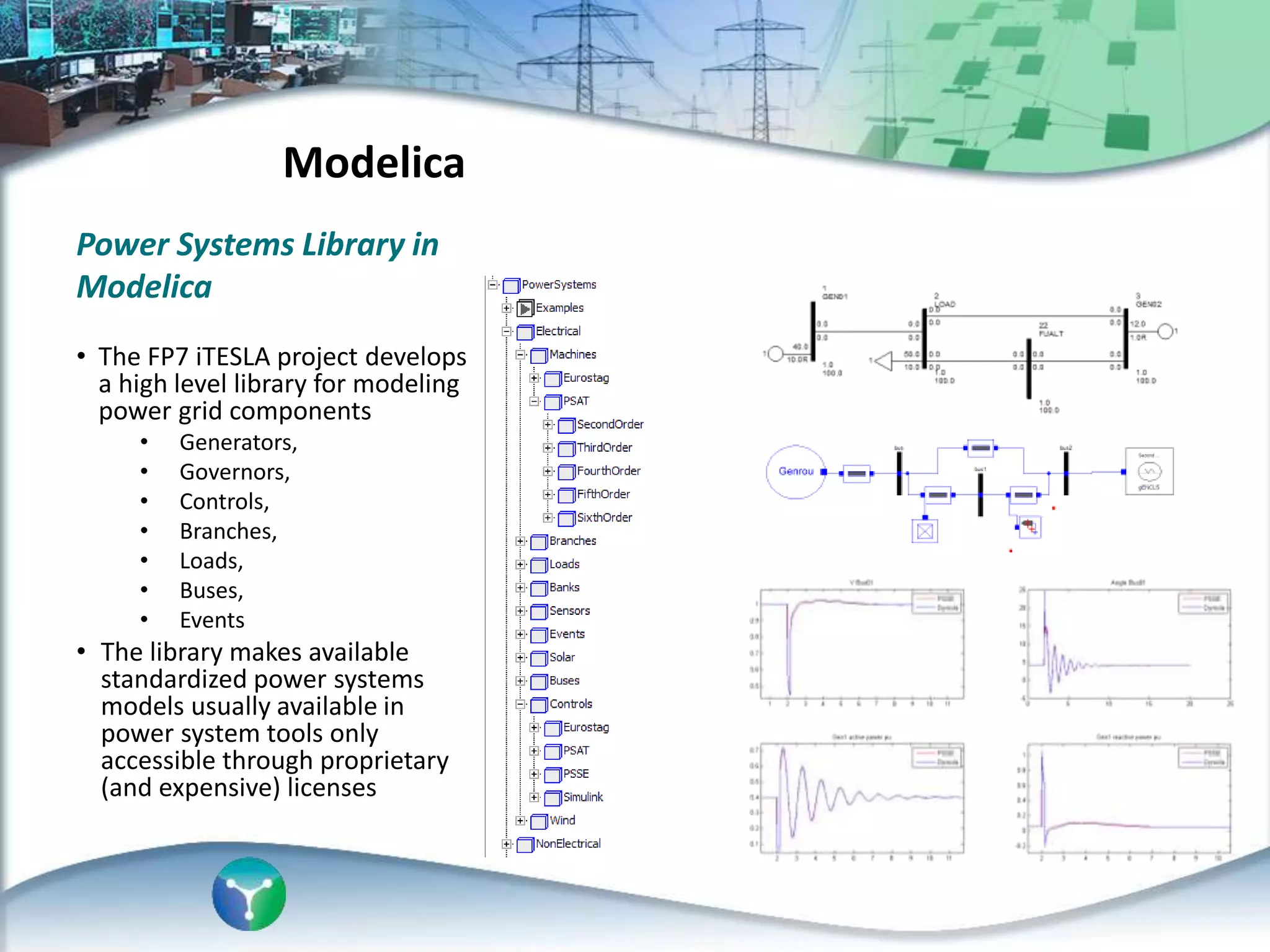
Power Systems Library in
Modelica
• The FP7 iTESLA project develops
a high level library for modeling
power grid components
• Generators,
• Governors,
• Controls,
• Branches,
• Loads,
• Buses,
• Events
• The library makes available
standardized power systems
models usually available in
power system tools only
accessible through proprietary
(and expensive) licenses
Modelica
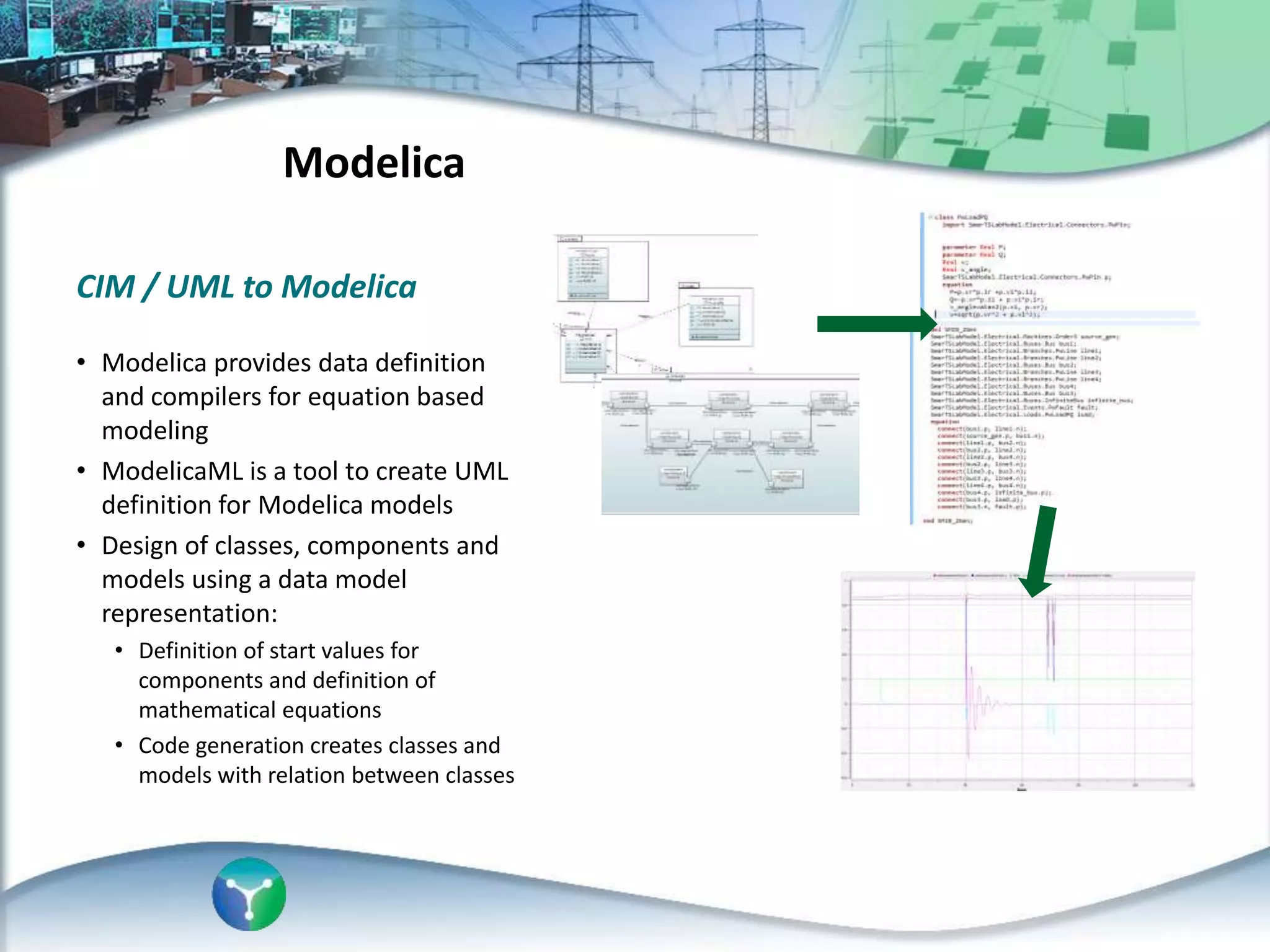
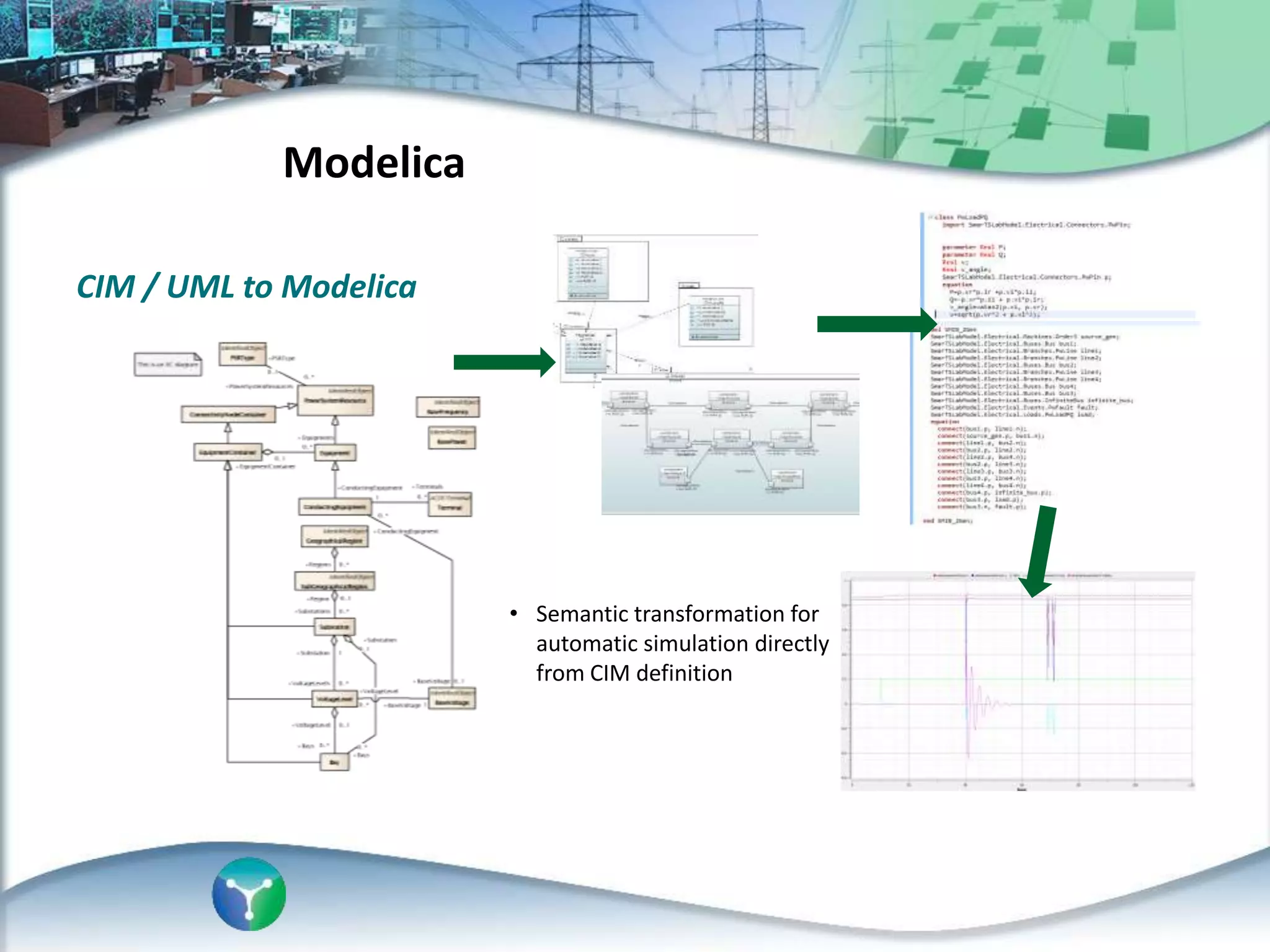
CIM / UML to Modelica
• Modelica provides data definition
and compilers for equation based
modeling
• ModelicaML is a tool to create UML
definition for Modelica models
• Design of classes, components and
models using a data model
representation:
• Definition of start values for
components and definition of
mathematical equations
• Code generation creates classes and
models with relation between classes
Modelica
CIM / UML to Modelica
• Semantic transformation for
automatic simulation directly
from CIM definition
Modelica
• Background & Motivation
– Modelica
– CIM
– CIM for Dynamics
• Modelica
– Language Description
– MetaModelica
– CIM/UML to Modelica
• CIM 2 Modelica
– Concept Design
– Mapping
– Simulation Engine
Overview
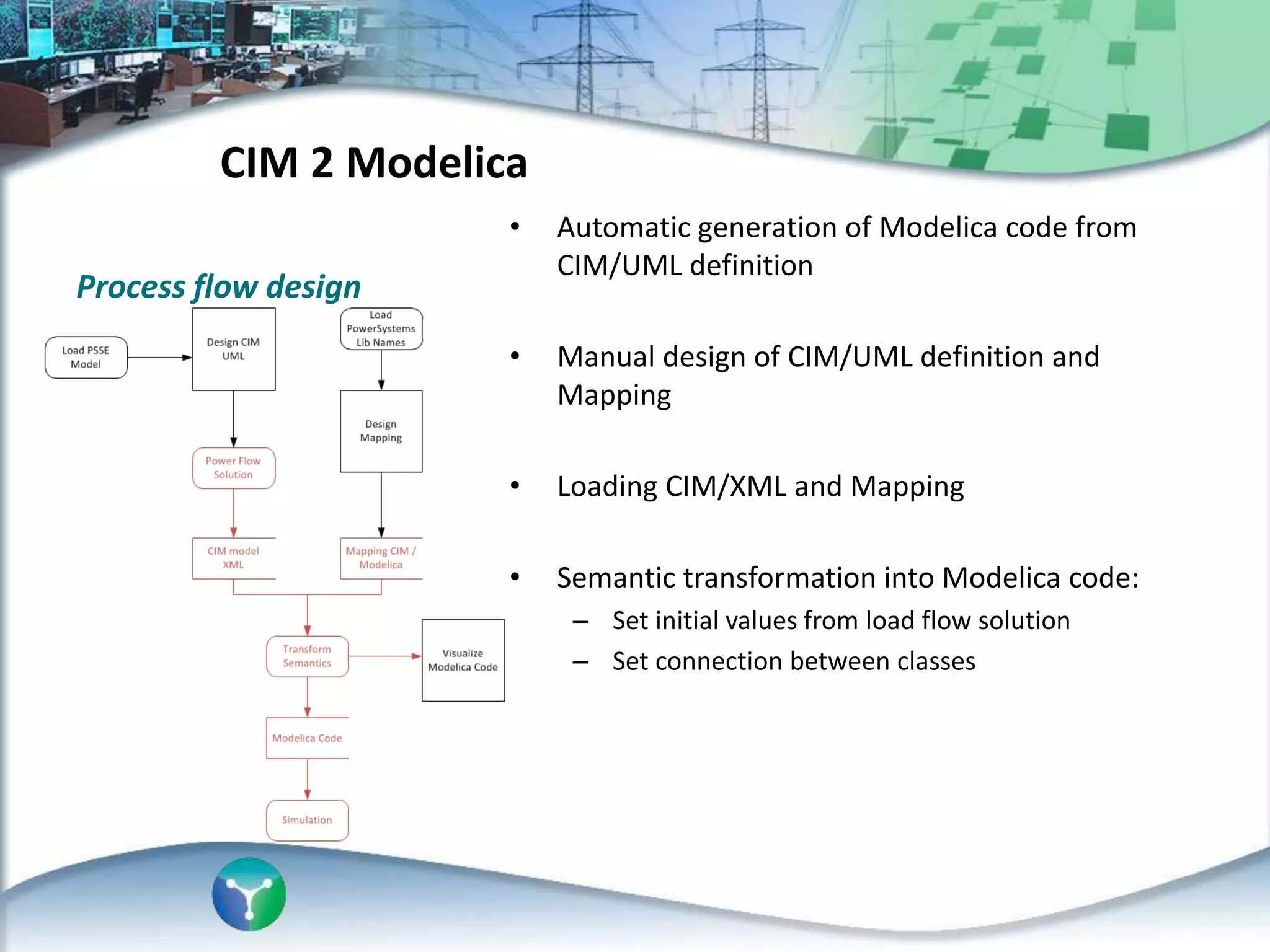
Process flow design
• Automatic generation of Modelica code from
CIM/UML definition
• Manual design of CIM/UML definition and
Mapping
• Loading CIM/XML and Mapping
• Semantic transformation into Modelica code:
– Set initial values from load flow solution
– Set connection between classes
CIM 2 Modelica
CIM 2 Modelica Mapping
• Relation between CIM classes
and Power system library classes
• CIM Attributes and values ->
Modelica Variables and starting
values
• CIM relations between classes ->
Modelica connection between
components
or
• CIM relations between classes ->
Use of Modelica classes as objects
CIM 2 Modelica
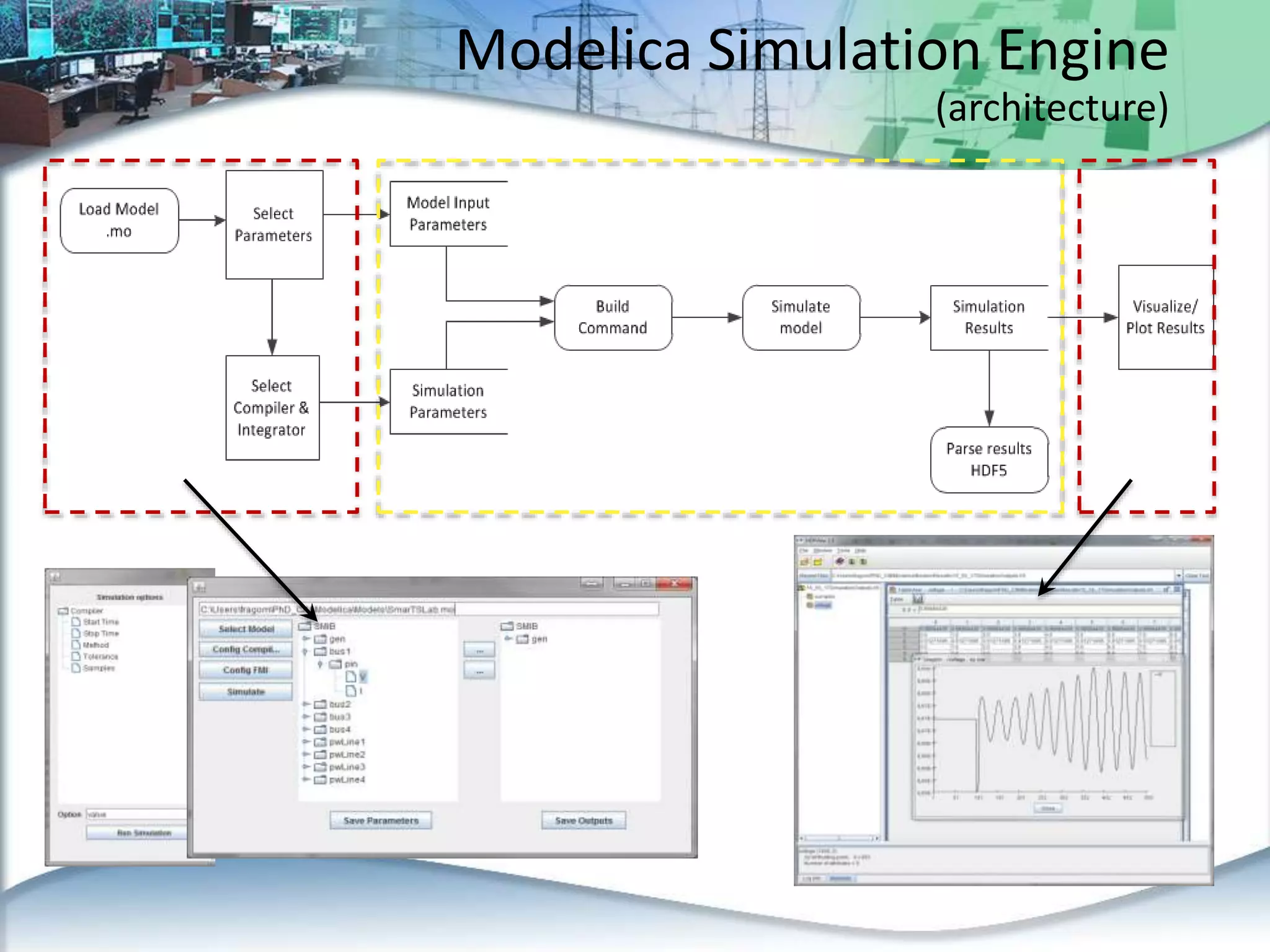
Modelica Simulation Engine
(architecture)
Simulation Engine
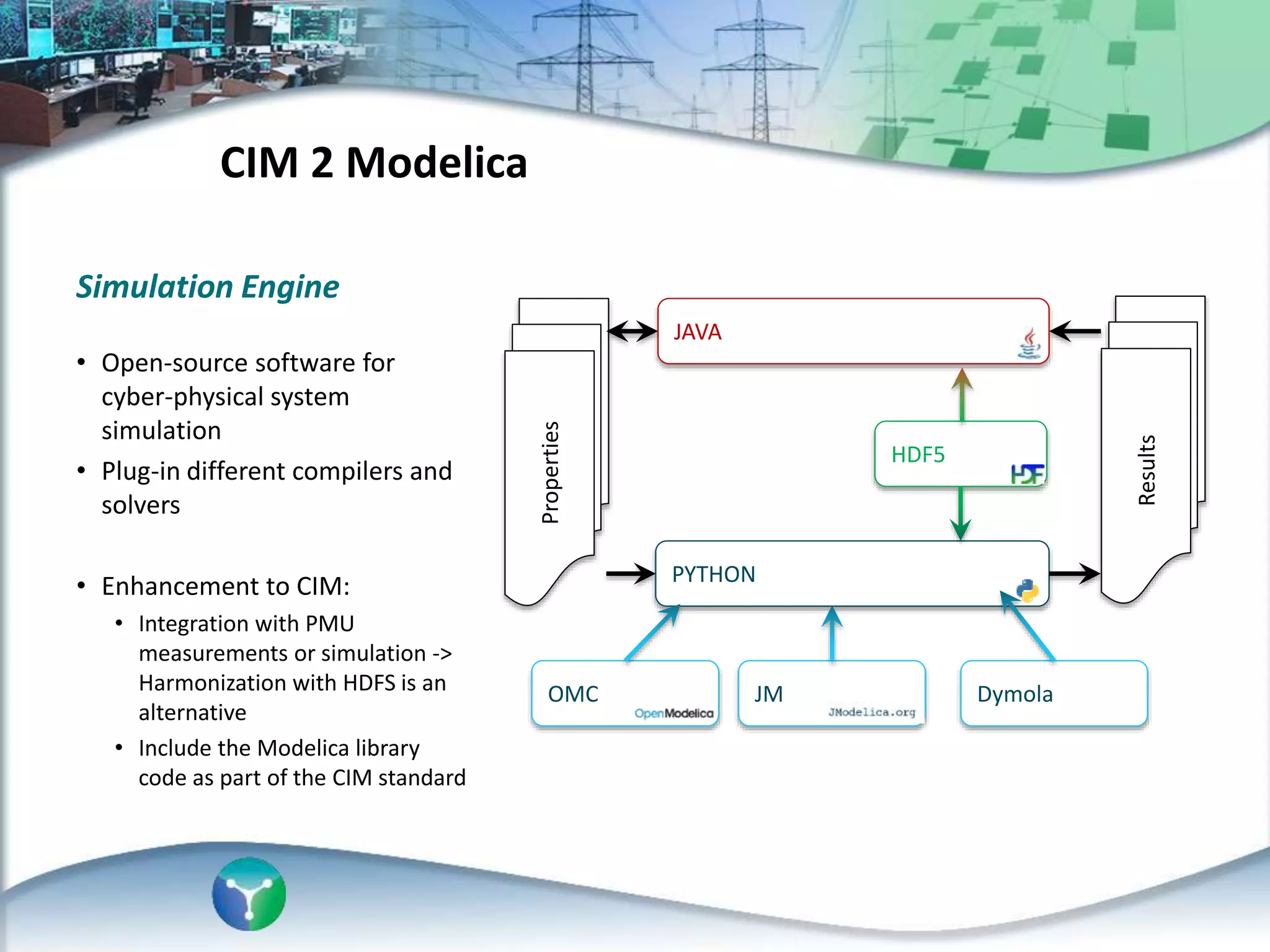
• Open-source software for
cyber-physical system
simulation
• Plug-in different compilers and
solvers
• Enhancement to CIM:
• Integration with PMU
measurements or simulation ->
Harmonization with HDFS is an
alternative
• Include the Modelica library
code as part of the CIM standard
CIM 2 Modelica
Properties
Results
HDF5
JMOMC
PYTHON
JAVA
Dymola
Thank you! Questions?
luigiv@kth.se , fragom@kth.se
Electric Power Systems Dept.
KTH
Stockholm, Sweden
Luigi.Vanfretti@statnett.no
svein.harald.olsen@statnett.no
Research and Development Division
Statnett SF
Oslo, Norway

CIM 2 Modelica

  • 1.
    CIM 2 ModelicaFactory Automated Equation-Based Cyber-Physical Power System Modelica Model Generation and Time-Domain Simulation from CIM Francisco Gomez1, Prof. Luigi Vanfretti1,2, and Svein H. Olsen2 luigiv@kth.se , fragom@kth.se Electric Power Systems Dept. KTH Stockholm, Sweden Luigi.Vanfretti@statnett.no svein.harald.olsen@statnett.no Research and Development Division Statnett SF Oslo, Norway
  • 2.
    Overview Acknowledgments • This workhas been funded in part by the EU funded FP7 iTesla project: http://www.itesla-project.eu/ and Statnett SF, the Norwegian power system operator. • Work related to the iTesla Modelica power systems library presented here is a result of the collaboration between RTE (France), AIA (Spain) and KTH (Sweden) within the EU funded FP7 iTesla project: http://www.itesla-project.eu/ • Special thanks for ‘special training’ and support from • Prof. Fritzson and his team at Linköping University • Prof. Berhard Bachmann and Lennart Ochel, FH Bielefeld • Background & Motivation – Modelica – CIM – CIM for Dynamics • Modelica – Language Description – MetaModelica – CIM/UML to Modelica • CIM 2 Modelica – Concept Design – Mapping – Simulation Engine
  • 3.
    Research • Development ofsoftware architecture supporting transformation from CIM, implementing tools for either translating from CIM to Modelica models • Development of models of cyber-physical power systems components, communication network components, and other components from other domains Application • iTESLA: Innovative Tools for Electrical System Security within Large Areas • CIM provides standard format for power systems data • Use of data from TSO – Description of data equipment, power systems topology and measurements for model validation Motivation
  • 4.
    Modelica • Modelica isa non-proprietary, object- oriented, equation based language to conveniently model complex physical systems • Suitable modeling language for standardization and exchange of models • Modelica tools, commercial and free of charge • Electric power steering and controller model [1] Andreas Deuring, Johannes Gerl, Harald Wilhelm “Multi-Domain Vehicle Dynamics Simulation in Dymola”, Modelica Conference, Dresden, 2011 • Thermodinamic Network of the ICE model [2] L. Morawietz, S. Risse, H. Zellbeck, H. Reuss, T. Christ “Modeling an automotive power train and electrical power supply for HiL applications using Modelica”, Modelica Conference, Hamburg, 2005 TU Dresden, University of Stuttgart, BMW Group, Germany. Background
  • 5.
    Common Information Model • Conceivedfor information exchange: power systems topology, equipment, measurements • Using UML representation to design a structured data model: Semantic transformation from real world to a model • Standardization of the model diagrams for cyber-physical components • Generators • Turbine Governors • Capacitors • Protections • Measurements • IEC61970 provides standard data model for power systems components Background
  • 6.
    CIM for Dynamics •Dynamic models used in the industry today use application specific data format and are embedded within the solver (integration routine) • No information on how the model is implemented (i.e. actual equations used) • Dynamic models can be represented in CIM, and exchanged among utilities • Need to extend CIM to support more dynamics models • Consider extend to support exchange of the model representation, not only of parameters Background doc Sy nchr onousGener ator MechanicalEquation
  • 7.
    Extension for CIM Dynamics •Automatic model transformation from CIM to a well defined (equation based) language • Information exchange, parameters and equations with CIM and Modelica • The benefit / role of CIM: • Modelling of the network are done separate from the analytic • Existing Steady-State Solver Engine (SSSE) can be used to initialize the transient study Background model gensal … parameter Real wbase = 2 * pi * 50 "system base speed"; parameter Complex Epqp = fpp + a * It; parameter Real delta0 = arg(Epqp); parameter Real Pm0 = p0 + (id0 * id0 + iq0 * iq0) * Ra; Real delta "rotor angle"; Real w "machine speed deviation, p.u."; … initial equation delta = delta0; w = 0; equation … der(w) = ((Pm0 - D * w) / (w + 1) - Te) / (2 * H); der(delta) = wbase * w; end gensal;
  • 8.
    Overview • Background &Motivation – Modelica – CIM – CIM for Dynamics • Modelica – Language Description – MetaModelica – CIM/UML to Modelica • CIM 2 Modelica – Concept Design – Mapping – Simulation Engine
  • 9.
    Modeling Language • Object-OrientedLanguage with class concept • Reuse of classes • Reuse of components • Scalable and Modular models • Multi-Domain modeling • Visual Acausal Hierarchical Component Modeling • Physical structure • No specification of data flow direction load EM DC G R L Electrical Mechanics model DCMotor Modelica.Electrical.Analog.Basic.Resistor r1(R = 10); Modelica.Electrical.Analog.Basic.Inductor i1; Modelica.Electrical.Analog.Basic.EMF emf1; Modelica.Mechanics.Rotational.Inertia load; Modelica.Electrical.Analog.Basic.Ground g; Modelica.Electrical.Analog.Sources.ConstantVoltage v; equation connect(DC.p,R.n); connect(R.p,L.n); connect(L.p,EM.n); connect(EM.p,DC.n); connect(DC.n,G.p); connect(EM.flange_b,load.flange_a); end DCMotor; Modelica
  • 10.
    Modeling Language • Modelinglanguage based on equations, allow specification of mathematical models • Typed Declarative Equation- based Textual Language • Decoupling the model from the solver model GENROU parameter Complex It=conj(S/VT) “Some comments here“; parameter Complex Is = It + VT/Zs; parameter Complex fpp = Zs*Is; parameter Real ang_P=arg(fpp); parameter Real ang_I=arg(It); parameter Real ang_PI=ang_P-ang_I; parameter Real psi = 'abs'(fpp); equation der(Epq) = (1/Tpd0)*(Efd0 -XadIfd); der(Epd) = (1/Tpq0)*(-1)*(XaqIlq); … anglev =atan2(p.vi, p.vr); Vt = sqrt(p.vr^2 + p.vi^2); anglei =atan2(p.ii, p.ir); I = sqrt(p.ii^2 + p.ir^2); … end GENROU; Variable declaration DAE Equations Modelica
  • 11.
    Power Systems Libraryin Modelica • The FP7 iTESLA project develops a high level library for modeling power grid components • Generators, • Governors, • Controls, • Branches, • Loads, • Buses, • Events • The library makes available standardized power systems models usually available in power system tools only accessible through proprietary (and expensive) licenses Modelica
  • 12.
    CIM / UMLto Modelica • Modelica provides data definition and compilers for equation based modeling • ModelicaML is a tool to create UML definition for Modelica models • Design of classes, components and models using a data model representation: • Definition of start values for components and definition of mathematical equations • Code generation creates classes and models with relation between classes Modelica
  • 13.
    CIM / UMLto Modelica • Semantic transformation for automatic simulation directly from CIM definition Modelica
  • 14.
    • Background &Motivation – Modelica – CIM – CIM for Dynamics • Modelica – Language Description – MetaModelica – CIM/UML to Modelica • CIM 2 Modelica – Concept Design – Mapping – Simulation Engine Overview
  • 15.
    Process flow design •Automatic generation of Modelica code from CIM/UML definition • Manual design of CIM/UML definition and Mapping • Loading CIM/XML and Mapping • Semantic transformation into Modelica code: – Set initial values from load flow solution – Set connection between classes CIM 2 Modelica
  • 16.
    CIM 2 ModelicaMapping • Relation between CIM classes and Power system library classes • CIM Attributes and values -> Modelica Variables and starting values • CIM relations between classes -> Modelica connection between components or • CIM relations between classes -> Use of Modelica classes as objects CIM 2 Modelica
  • 17.
  • 18.
    Simulation Engine • Open-sourcesoftware for cyber-physical system simulation • Plug-in different compilers and solvers • Enhancement to CIM: • Integration with PMU measurements or simulation -> Harmonization with HDFS is an alternative • Include the Modelica library code as part of the CIM standard CIM 2 Modelica Properties Results HDF5 JMOMC PYTHON JAVA Dymola
  • 19.
    Thank you! Questions? luigiv@kth.se, fragom@kth.se Electric Power Systems Dept. KTH Stockholm, Sweden Luigi.Vanfretti@statnett.no svein.harald.olsen@statnett.no Research and Development Division Statnett SF Oslo, Norway

Editor's Notes

  • #5 Conveniently model complex physical systems
  • #7 Put the dynamics parameters into the equations of the model The model has a specific structure and is embedded within the solver.
  • #8 Put the dynamics parameters into the equations of the model The model has a specific structure and is embedded within the solver.
  • #12 Si preguntan por performance, simulation is better than psse
  • #13  Semantic transformation for automatic simulation directly from CIM definition
  • #16 Gane-Sarson
  • #19 Store values en