ELECTRIC
CIRCUITS
2
BY THE END OF THIS
LESSON
Distinguish resistors in series vs parallel
Define a resistor
Discuss the factors that make a circuit series
Calculate the equivalent resistance of resistors in
series.
Apply this topic’s knowledge to demonstrate series
resistors on real-life scenario
3
4
MOST APPLIANCES AT YOUR HOMES
HAVE ELECTRIC CIRCUITS.
ARE THEY IN SERIES OR PARALLEL
THOUGH
5
A SIMPLE CIRCUIT CONSISTS
OF VARIOUS ELEMENTS THAT
WORK TOGETHER TO
FACILITATE ELECTRICITY FLOW.
6
INCLUDING
WIRES
RESISTOR
SWITCH
AND SOURCE OF ELECTRICITY (JAMES, 2020).
7
WIRES ARE THE CONDUCTORS
THROUGH WHICH CURRENT
FLOWS FREELY (JAMES, 2020) .
8
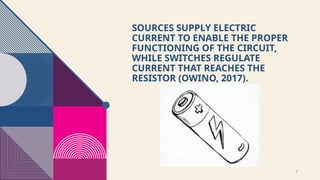
SOURCES SUPPLY ELECTRIC
CURRENT TO ENABLE THE PROPER
FUNCTIONING OF THE CIRCUIT,
WHILE SWITCHES REGULATE
CURRENT THAT REACHES THE
RESISTOR (OWINO, 2017).
9
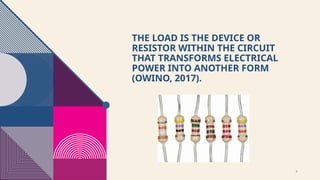
THE LOAD IS THE DEVICE OR
RESISTOR WITHIN THE CIRCUIT
THAT TRANSFORMS ELECTRICAL
POWER INTO ANOTHER FORM
(OWINO, 2017).
RESISTORS IN
SERIES.
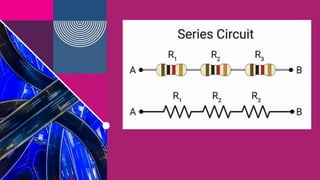
One significant difference between
series and parallel resistors entails
the flow of current through
elements. In a series connection,
resistors follow each other, allowing
current to pass through each
resistor (Thomas, 2010).
When the resistance values of each
element are summed up, we
calculate total resistance in series
resistor (Thomas, 2010).
RESISTORS IN PARALLEL
The total current flows through the resistance by
moving parallel to one another. We add reciprocal
resistance values of each element and then invert
the answer to establish total cable resistance
(Proenca, 2008).
RESISTORS IN PARALLEL
In this case, the resistance power decreases: it is
lower than the resistance values of the smallest
resistor. Therefore, it is more beneficial to connect
wires and other devices in parallel rather than just
connecting complements in series (Proenca, 2008).
17
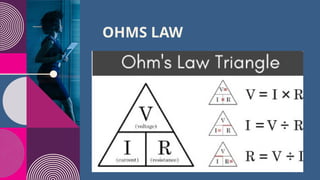
OHMS LAW
18
OHMS LAW
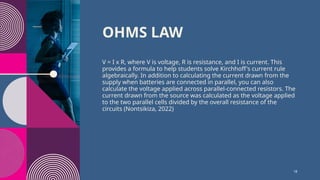
V = I x R, where V is voltage, R is resistance, and I is current. This
provides a formula to help students solve Kirchhoff's current rule
algebraically. In addition to calculating the current drawn from the
supply when batteries are connected in parallel, you can also
calculate the voltage applied across parallel-connected resistors. The
current drawn from the source was calculated as the voltage applied
to the two parallel cells divided by the overall resistance of the
circuits (Nontsikiza, 2022)
19
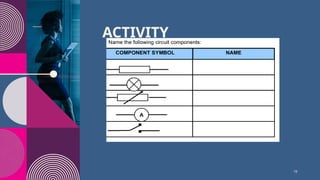
ACTIVITY
20
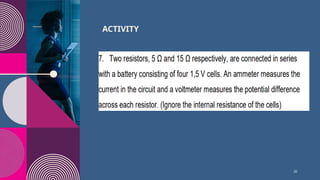
ACTIVITY
.CALCULATE OVERALL RESISTANCE AND CURRENT?
.WHAT IS THE POTENTIAL DIFFERENCE?
REFERENCES
James, A. (2020). 12 simple electrical circuits [PowerPoint slides]. SlideShare.
https://www.slideshare.net/slideshow/12-simple-electrical-circuits/238342671
Owino, D. (2017). Electric circuits [PowerPoint slides]. SlideShare.
https://www.slideshare.net/slideshow/electric-circuits-38340844/38340844
Nontsikiza, S. (2022). Electric circuits [PowerPoint slides]. SlideShare.
https://www.slideshare.net/slideshow/electric-circuitspptx-253889687/253889687
Thomas, S. (2010). 20 Electric Circuits[PowerPoint slides]. SlideShare.
https://www.slideshare.net/slideshow/ch-20-electric-circuits-online/5950181
Proenca P. (2008). P5 Electric Circuits[PowerPoint slides]. SlideShare.
https://www.slideshare.net/slideshow/p5-electric-circuits-presentation/615982

Electric circuits Series and Parallel.pptx

  • 1.
  • 2.
    2 BY THE ENDOF THIS LESSON Distinguish resistors in series vs parallel Define a resistor Discuss the factors that make a circuit series Calculate the equivalent resistance of resistors in series. Apply this topic’s knowledge to demonstrate series resistors on real-life scenario
  • 3.
  • 4.
    4 MOST APPLIANCES ATYOUR HOMES HAVE ELECTRIC CIRCUITS. ARE THEY IN SERIES OR PARALLEL THOUGH
  • 5.
    5 A SIMPLE CIRCUITCONSISTS OF VARIOUS ELEMENTS THAT WORK TOGETHER TO FACILITATE ELECTRICITY FLOW.
  • 6.
  • 7.
    7 WIRES ARE THECONDUCTORS THROUGH WHICH CURRENT FLOWS FREELY (JAMES, 2020) .
  • 8.
    8 SOURCES SUPPLY ELECTRIC CURRENTTO ENABLE THE PROPER FUNCTIONING OF THE CIRCUIT, WHILE SWITCHES REGULATE CURRENT THAT REACHES THE RESISTOR (OWINO, 2017).
  • 9.
    9 THE LOAD ISTHE DEVICE OR RESISTOR WITHIN THE CIRCUIT THAT TRANSFORMS ELECTRICAL POWER INTO ANOTHER FORM (OWINO, 2017).
  • 10.
  • 12.
    One significant differencebetween series and parallel resistors entails the flow of current through elements. In a series connection, resistors follow each other, allowing current to pass through each resistor (Thomas, 2010).
  • 13.
    When the resistancevalues of each element are summed up, we calculate total resistance in series resistor (Thomas, 2010).
  • 14.
  • 15.
    RESISTORS IN PARALLEL Thetotal current flows through the resistance by moving parallel to one another. We add reciprocal resistance values of each element and then invert the answer to establish total cable resistance (Proenca, 2008).
  • 16.
    RESISTORS IN PARALLEL Inthis case, the resistance power decreases: it is lower than the resistance values of the smallest resistor. Therefore, it is more beneficial to connect wires and other devices in parallel rather than just connecting complements in series (Proenca, 2008).
  • 17.
  • 18.
    18 OHMS LAW V =I x R, where V is voltage, R is resistance, and I is current. This provides a formula to help students solve Kirchhoff's current rule algebraically. In addition to calculating the current drawn from the supply when batteries are connected in parallel, you can also calculate the voltage applied across parallel-connected resistors. The current drawn from the source was calculated as the voltage applied to the two parallel cells divided by the overall resistance of the circuits (Nontsikiza, 2022)
  • 19.
  • 20.
    20 ACTIVITY .CALCULATE OVERALL RESISTANCEAND CURRENT? .WHAT IS THE POTENTIAL DIFFERENCE?
  • 21.
    REFERENCES James, A. (2020).12 simple electrical circuits [PowerPoint slides]. SlideShare. https://www.slideshare.net/slideshow/12-simple-electrical-circuits/238342671 Owino, D. (2017). Electric circuits [PowerPoint slides]. SlideShare. https://www.slideshare.net/slideshow/electric-circuits-38340844/38340844 Nontsikiza, S. (2022). Electric circuits [PowerPoint slides]. SlideShare. https://www.slideshare.net/slideshow/electric-circuitspptx-253889687/253889687 Thomas, S. (2010). 20 Electric Circuits[PowerPoint slides]. SlideShare. https://www.slideshare.net/slideshow/ch-20-electric-circuits-online/5950181 Proenca P. (2008). P5 Electric Circuits[PowerPoint slides]. SlideShare. https://www.slideshare.net/slideshow/p5-electric-circuits-presentation/615982