Electricity and magnetism
IGCSE- CHAPTER 4
The law of magnetism
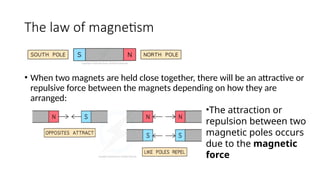
• When two magnets are held close together, there will be an attractive or
repulsive force between the magnets depending on how they are
arranged:
•The attraction or
repulsion between two
magnetic poles occurs
due to the magnetic
force
Characteristic of magnet
• 1. magnets can attract of object
• 2. magnetic field form magnetic force
• 3. it has 2 poles (NS)
• 4. 2 magnets can be attract or repel depend on the pole
• 5. magnet can be made or remove
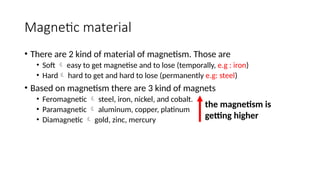
Magnetic material
• There are 2 kind of material of magnetism. Those are
• Soft  easy to get magnetise and to lose (temporally, e.g : iron)
• Hard hard to get and hard to lose (permanently e.g: steel)
• Based on magnetism there are 3 kind of magnets
• Feromagnetic  steel, iron, nickel, and cobalt.
• Paramagnetic  aluminum, copper, platinum
• Diamagnetic  gold, zinc, mercury
the magnetism is
getting higher
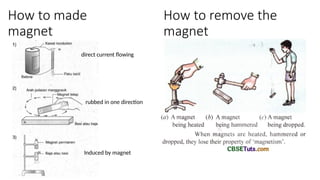
How to made
magnet
direct current flowing
rubbed in one direction
Induced by magnet
How to remove the
magnet
N
N
N
N
Magnetic field
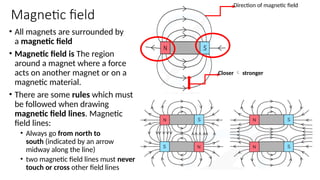
• All magnets are surrounded by
a magnetic field
• Magnetic field is The region
around a magnet where a force
acts on another magnet or on a
magnetic material.
• There are some rules which must
be followed when drawing
magnetic field lines. Magnetic
field lines:
• Always go from north to
south (indicated by an arrow
midway along the line)
• two magnetic field lines must never
touch or cross other field lines
Direction of magnetic field
Closer  stronger
Electric quantities
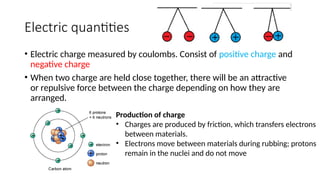
• Electric charge measured by coulombs. Consist of positive charge and
negative charge
• When two charge are held close together, there will be an attractive
or repulsive force between the charge depending on how they are
arranged.
Production of charge
• Charges are produced by friction, which transfers electrons
between materials.
• Electrons move between materials during rubbing; protons
remain in the nuclei and do not move
Electrone, insulators and
conductor
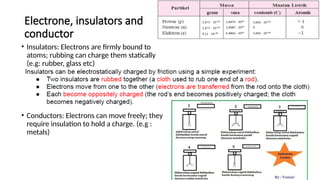
• Insulators: Electrons are firmly bound to
atoms; rubbing can charge them statically
(e.g: rubber, glass etc)
• Conductors: Electrons can move freely; they
require insulation to hold a charge. (e.g :
metals)
Electric Field
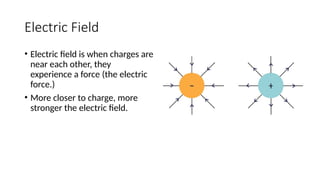
• Electric field is when charges are
near each other, they
experience a force (the electric
force.)
• More closer to charge, more
stronger the electric field.
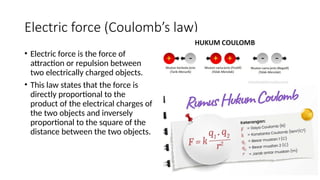
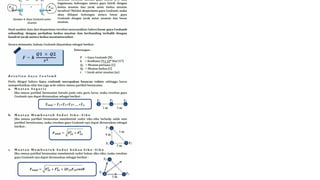
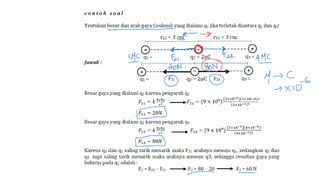
Electric force (Coulomb’s law)
• Electric force is the force of
attraction or repulsion between
two electrically charged objects.
• This law states that the force is
directly proportional to the
product of the electrical charges of
the two objects and inversely
proportional to the square of the
distance between the two objects.
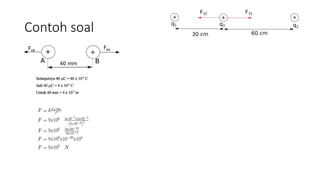
Contoh soal
FBA
FAB
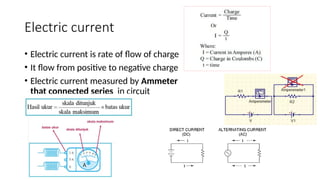
Electric current
• Electric current is rate of flow of charge
• It flow from positive to negative charge
• Electric current measured by Ammeter
that connected series in circuit
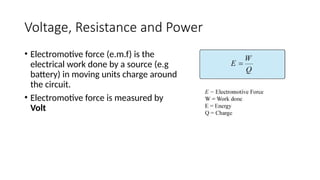
Voltage, Resistance and Power
• Electromotive force (e.m.f) is the
electrical work done by a source (e.g
battery) in moving units charge around
the circuit.
• Electromotive force is measured by
Volt
Potential difference
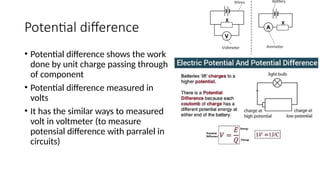
• Potential difference shows the work
done by unit charge passing through
of component
• Potential difference measured in
volts
• It has the similar ways to measured
volt in voltmeter (to measure
potensial difference with parralel in
circuits)
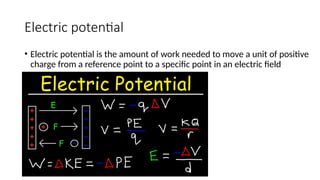
Electric potential
• Electric potential is the amount of work needed to move a unit of positive
charge from a reference point to a specific point in an electric field
Resistance
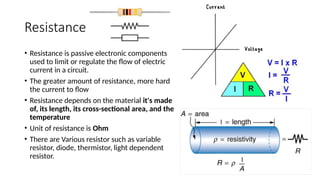
• Resistance is passive electronic components
used to limit or regulate the flow of electric
current in a circuit.
• The greater amount of resistance, more hard
the current to flow
• Resistance depends on the material it's made
of, its length, its cross-sectional area, and the
temperature
• Unit of resistance is Ohm
• There are Various resistor such as variable
resistor, diode, thermistor, light dependent
resistor.
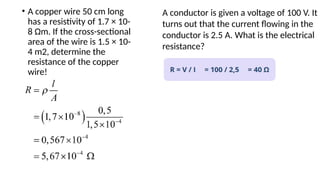
• A copper wire 50 cm long
has a resistivity of 1.7 × 10-
8 Ωm. If the cross-sectional
area of the wire is 1.5 × 10-
4 m2, determine the
resistance of the copper
wire!
A conductor is given a voltage of 100 V. It
turns out that the current flowing in the
conductor is 2.5 A. What is the electrical
resistance?
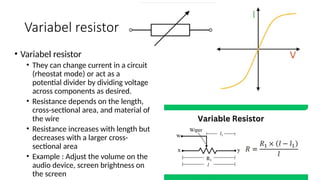
Variabel resistor
• Variabel resistor
• They can change current in a circuit
(rheostat mode) or act as a
potential divider by dividing voltage
across components as desired.
• Resistance depends on the length,
cross-sectional area, and material of
the wire
• Resistance increases with length but
decreases with a larger cross-
sectional area
• Example : Adjust the volume on the
audio device, screen brightness on
the screen
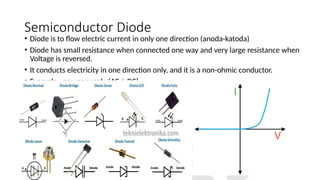
Semiconductor Diode
• Diode is to flow electric current in only one direction (anoda-katoda)
• Diode has small resistance when connected one way and very large resistance when
Voltage is reversed.
• It conducts electricity in one direction only, and it is a non-ohmic conductor.
• Example : power supply (ACDC)
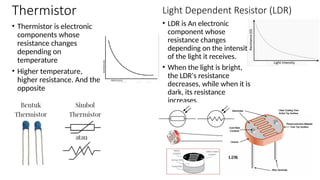
Thermistor
• Thermistor is electronic
components whose
resistance changes
depending on
temperature
• Higher temperature,
higher resistance. And the
opposite
• LDR is An electronic
component whose
resistance changes
depending on the intensity
of the light it receives.
• When the light is bright,
the LDR's resistance
decreases, while when it is
dark, its resistance
increases.
Light Dependent Resistor (LDR)
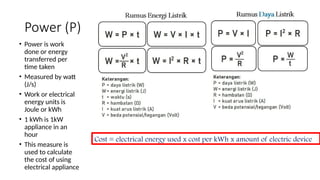
Power (P)
• Power is work
done or energy
transferred per
time taken
• Measured by watt
(J/s)
• Work or electrical
energy units is
Joule or kWh
• 1 kWh is 1kW
appliance in an
hour
• This measure is
used to calculate
the cost of using
electrical appliance
Cost = electrical energy used x cost per kWh x amount of electric device
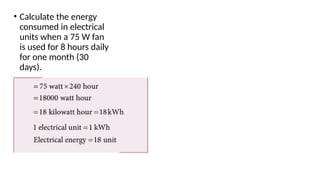
• Calculate the energy
consumed in electrical
units when a 75 W fan
is used for 8 hours daily
for one month (30
days).
Quiz
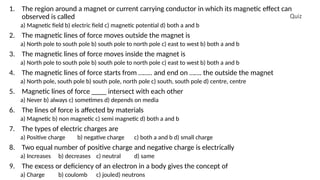
1. The region around a magnet or current carrying conductor in which its magnetic effect can
observed is called
a) Magnetic field b) electric field c) magnetic potential d) both a and b
2. The magnetic lines of force moves outside the magnet is
a) North pole to south pole b) south pole to north pole c) east to west b) both a and b
3. The magnetic lines of force moves inside the magnet is
a) North pole to south pole b) south pole to north pole c) east to west b) both a and b
4. The magnetic lines of force starts from …….. and end on ……. the outside the magnet
a) North pole, south pole b) south pole, north pole c) south, south pole d) centre, centre
5. Magnetic lines of force ____ intersect with each other
a) Never b) always c) sometimes d) depends on media
6. The lines of force is affected by materials
a) Magnetic b) non magnetic c) semi magnetic d) both a and b
7. The types of electric charges are
a) Positive charge b) negative charge c) both a and b d) small charge
8. Two equal number of positive charge and negative charge is electrically
a) Increases b) decreases c) neutral d) same
9. The excess or deficiency of an electron in a body gives the concept of
a) Charge b) coulomb c) jouled) neutrons
Quiz
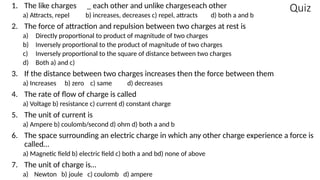
1. The like charges _ each other and unlike chargeseach other
a) Attracts, repel b) increases, decreases c) repel, attracts d) both a and b
2. The force of attraction and repulsion between two charges at rest is
a) Directly proportional to product of magnitude of two charges
b) Inversely proportional to the product of magnitude of two charges
c) Inversely proportional to the square of distance between two charges
d) Both a) and c)
3. If the distance between two charges increases then the force between them
a) Increases b) zero c) same d) decreases
4. The rate of flow of charge is called
a) Voltage b) resistance c) current d) constant charge
5. The unit of current is
a) Ampere b) coulomb/second d) ohm d) both a and b
6. The space surrounding an electric charge in which any other charge experience a force is
called…
a) Magnetic field b) electric field c) both a and bd) none of above
7. The unit of charge is…
a) Newton b) joule c) coulomb d) ampere
Quiz
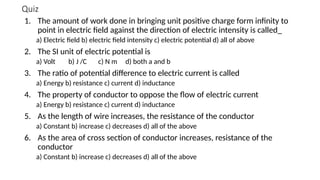
1. The amount of work done in bringing unit positive charge form infinity to
point in electric field against the direction of electric intensity is called_
a) Electric field b) electric field intensity c) electric potential d) all of above
2. The SI unit of electric potential is
a) Volt b) J /C c) N m d) both a and b
3. The ratio of potential difference to electric current is called
a) Energy b) resistance c) current d) inductance
4. The property of conductor to oppose the flow of electric current
a) Energy b) resistance c) current d) inductance
5. As the length of wire increases, the resistance of the conductor
a) Constant b) increase c) decreases d) all of the above
6. As the area of cross section of conductor increases, resistance of the
conductor
a) Constant b) increase c) decreases d) all of the above
essay
1. The current flowing through a
conductor is 2A. Find the potential
difference across the conductor if
its resistance is 3 Ω!
2. The resistance of conductor is 10 Ω
and PD across it is 20 V. Find the
current flowing through it!
3. The 70 C charge are flowing
through the conductor for 7 sec.
The current flowing is….
4. Two wires having length in the
ratio 2:4 radii in ratio 2:1 and
specific resistances in the ratio 4:1.
Find the ratio if their resistances….
Essay
1. Calculate the force of repulsion
between two unit charges placed
unit distance apart in air!
2. The distance between electron
and proton in H-atom is about
5.3 x 10⁻¹¹
m. what is the
magnitude of electric force
between them?
3. A current of 0.5 A is flowing
through bulb for 10 minutes.
Find the charge flowing through
circuit
4. A charge of 600 C is flowing
through a circuit for 5 minutes.
Find the current in the
quiz
1. A 4 m long wire has a diameter of
0.30 mm. if its resistance is 30 Ω,
find its resistivity.
2. Specific resistance of aluminium is
2.65 x 10⁻⁸ Ωm. Find the resistance
of an aluminium wire of length 100
m and diameter 1 mm
3. A wire of 50 cm long and 1 mm2 in
cross section carries a current of 4 A
when connected to 2 V battery. Find
the specific resistance of a wire
4. Find the heat generated in calorie if
a current of 1 A is passed through
coil of resistance 836 Ω for one
minute.
Electric current

chapter 4 about electric and magnetism igcse

  • 1.
  • 2.
    The law ofmagnetism • When two magnets are held close together, there will be an attractive or repulsive force between the magnets depending on how they are arranged: •The attraction or repulsion between two magnetic poles occurs due to the magnetic force
  • 3.
    Characteristic of magnet •1. magnets can attract of object • 2. magnetic field form magnetic force • 3. it has 2 poles (NS) • 4. 2 magnets can be attract or repel depend on the pole • 5. magnet can be made or remove
  • 4.
    Magnetic material • Thereare 2 kind of material of magnetism. Those are • Soft  easy to get magnetise and to lose (temporally, e.g : iron) • Hard hard to get and hard to lose (permanently e.g: steel) • Based on magnetism there are 3 kind of magnets • Feromagnetic  steel, iron, nickel, and cobalt. • Paramagnetic  aluminum, copper, platinum • Diamagnetic  gold, zinc, mercury the magnetism is getting higher
  • 5.
    How to made magnet directcurrent flowing rubbed in one direction Induced by magnet How to remove the magnet N N N N
  • 6.
    Magnetic field • Allmagnets are surrounded by a magnetic field • Magnetic field is The region around a magnet where a force acts on another magnet or on a magnetic material. • There are some rules which must be followed when drawing magnetic field lines. Magnetic field lines: • Always go from north to south (indicated by an arrow midway along the line) • two magnetic field lines must never touch or cross other field lines Direction of magnetic field Closer  stronger
  • 7.
    Electric quantities • Electriccharge measured by coulombs. Consist of positive charge and negative charge • When two charge are held close together, there will be an attractive or repulsive force between the charge depending on how they are arranged. Production of charge • Charges are produced by friction, which transfers electrons between materials. • Electrons move between materials during rubbing; protons remain in the nuclei and do not move
  • 8.
    Electrone, insulators and conductor •Insulators: Electrons are firmly bound to atoms; rubbing can charge them statically (e.g: rubber, glass etc) • Conductors: Electrons can move freely; they require insulation to hold a charge. (e.g : metals)
  • 9.
    Electric Field • Electricfield is when charges are near each other, they experience a force (the electric force.) • More closer to charge, more stronger the electric field.
  • 10.
    Electric force (Coulomb’slaw) • Electric force is the force of attraction or repulsion between two electrically charged objects. • This law states that the force is directly proportional to the product of the electrical charges of the two objects and inversely proportional to the square of the distance between the two objects.
  • 11.
  • 12.
    Electric current • Electriccurrent is rate of flow of charge • It flow from positive to negative charge • Electric current measured by Ammeter that connected series in circuit
  • 13.
    Voltage, Resistance andPower • Electromotive force (e.m.f) is the electrical work done by a source (e.g battery) in moving units charge around the circuit. • Electromotive force is measured by Volt
  • 14.
    Potential difference • Potentialdifference shows the work done by unit charge passing through of component • Potential difference measured in volts • It has the similar ways to measured volt in voltmeter (to measure potensial difference with parralel in circuits)
  • 15.
    Electric potential • Electricpotential is the amount of work needed to move a unit of positive charge from a reference point to a specific point in an electric field
  • 16.
    Resistance • Resistance ispassive electronic components used to limit or regulate the flow of electric current in a circuit. • The greater amount of resistance, more hard the current to flow • Resistance depends on the material it's made of, its length, its cross-sectional area, and the temperature • Unit of resistance is Ohm • There are Various resistor such as variable resistor, diode, thermistor, light dependent resistor.
  • 17.
    • A copperwire 50 cm long has a resistivity of 1.7 × 10- 8 Ωm. If the cross-sectional area of the wire is 1.5 × 10- 4 m2, determine the resistance of the copper wire! A conductor is given a voltage of 100 V. It turns out that the current flowing in the conductor is 2.5 A. What is the electrical resistance?
  • 18.
    Variabel resistor • Variabelresistor • They can change current in a circuit (rheostat mode) or act as a potential divider by dividing voltage across components as desired. • Resistance depends on the length, cross-sectional area, and material of the wire • Resistance increases with length but decreases with a larger cross- sectional area • Example : Adjust the volume on the audio device, screen brightness on the screen
  • 19.
    Semiconductor Diode • Diodeis to flow electric current in only one direction (anoda-katoda) • Diode has small resistance when connected one way and very large resistance when Voltage is reversed. • It conducts electricity in one direction only, and it is a non-ohmic conductor. • Example : power supply (ACDC)
  • 20.
    Thermistor • Thermistor iselectronic components whose resistance changes depending on temperature • Higher temperature, higher resistance. And the opposite • LDR is An electronic component whose resistance changes depending on the intensity of the light it receives. • When the light is bright, the LDR's resistance decreases, while when it is dark, its resistance increases. Light Dependent Resistor (LDR)
  • 21.
    Power (P) • Poweris work done or energy transferred per time taken • Measured by watt (J/s) • Work or electrical energy units is Joule or kWh • 1 kWh is 1kW appliance in an hour • This measure is used to calculate the cost of using electrical appliance Cost = electrical energy used x cost per kWh x amount of electric device
  • 22.
    • Calculate theenergy consumed in electrical units when a 75 W fan is used for 8 hours daily for one month (30 days).
  • 23.
    Quiz 1. The regionaround a magnet or current carrying conductor in which its magnetic effect can observed is called a) Magnetic field b) electric field c) magnetic potential d) both a and b 2. The magnetic lines of force moves outside the magnet is a) North pole to south pole b) south pole to north pole c) east to west b) both a and b 3. The magnetic lines of force moves inside the magnet is a) North pole to south pole b) south pole to north pole c) east to west b) both a and b 4. The magnetic lines of force starts from …….. and end on ……. the outside the magnet a) North pole, south pole b) south pole, north pole c) south, south pole d) centre, centre 5. Magnetic lines of force ____ intersect with each other a) Never b) always c) sometimes d) depends on media 6. The lines of force is affected by materials a) Magnetic b) non magnetic c) semi magnetic d) both a and b 7. The types of electric charges are a) Positive charge b) negative charge c) both a and b d) small charge 8. Two equal number of positive charge and negative charge is electrically a) Increases b) decreases c) neutral d) same 9. The excess or deficiency of an electron in a body gives the concept of a) Charge b) coulomb c) jouled) neutrons
  • 24.
    Quiz 1. The likecharges _ each other and unlike chargeseach other a) Attracts, repel b) increases, decreases c) repel, attracts d) both a and b 2. The force of attraction and repulsion between two charges at rest is a) Directly proportional to product of magnitude of two charges b) Inversely proportional to the product of magnitude of two charges c) Inversely proportional to the square of distance between two charges d) Both a) and c) 3. If the distance between two charges increases then the force between them a) Increases b) zero c) same d) decreases 4. The rate of flow of charge is called a) Voltage b) resistance c) current d) constant charge 5. The unit of current is a) Ampere b) coulomb/second d) ohm d) both a and b 6. The space surrounding an electric charge in which any other charge experience a force is called… a) Magnetic field b) electric field c) both a and bd) none of above 7. The unit of charge is… a) Newton b) joule c) coulomb d) ampere
  • 25.
    Quiz 1. The amountof work done in bringing unit positive charge form infinity to point in electric field against the direction of electric intensity is called_ a) Electric field b) electric field intensity c) electric potential d) all of above 2. The SI unit of electric potential is a) Volt b) J /C c) N m d) both a and b 3. The ratio of potential difference to electric current is called a) Energy b) resistance c) current d) inductance 4. The property of conductor to oppose the flow of electric current a) Energy b) resistance c) current d) inductance 5. As the length of wire increases, the resistance of the conductor a) Constant b) increase c) decreases d) all of the above 6. As the area of cross section of conductor increases, resistance of the conductor a) Constant b) increase c) decreases d) all of the above
  • 26.
    essay 1. The currentflowing through a conductor is 2A. Find the potential difference across the conductor if its resistance is 3 Ω! 2. The resistance of conductor is 10 Ω and PD across it is 20 V. Find the current flowing through it! 3. The 70 C charge are flowing through the conductor for 7 sec. The current flowing is…. 4. Two wires having length in the ratio 2:4 radii in ratio 2:1 and specific resistances in the ratio 4:1. Find the ratio if their resistances….
  • 27.
    Essay 1. Calculate theforce of repulsion between two unit charges placed unit distance apart in air! 2. The distance between electron and proton in H-atom is about 5.3 x 10⁻¹¹ m. what is the magnitude of electric force between them? 3. A current of 0.5 A is flowing through bulb for 10 minutes. Find the charge flowing through circuit 4. A charge of 600 C is flowing through a circuit for 5 minutes. Find the current in the
  • 28.
    quiz 1. A 4m long wire has a diameter of 0.30 mm. if its resistance is 30 Ω, find its resistivity. 2. Specific resistance of aluminium is 2.65 x 10⁻⁸ Ωm. Find the resistance of an aluminium wire of length 100 m and diameter 1 mm 3. A wire of 50 cm long and 1 mm2 in cross section carries a current of 4 A when connected to 2 V battery. Find the specific resistance of a wire 4. Find the heat generated in calorie if a current of 1 A is passed through coil of resistance 836 Ω for one minute.
  • 31.