PRESENTATION
TOPIC NAME: CURRENT
ELECTRICITY CH.8
SUBMITTED TO: SIR EHTISHAM UL HAQ
SUBMITTED BY:
KAMRAN ABDULLAH (ROLL NO 04)
(LEADER)
MUZAMMAL ABBAS (ROLL NO 11)
SABEEN FATIMA (ROLL NO 24)
FARMAN SHER (ROLL NO 31)
SYED M. ALI RAZA SHAH (ROLL NO 41)
INSTITUTE OF EDUCATION
UNIVERSITY OF SARGODHA
STUDENT LEARNING OUTCOMES
1. After reading this chapter you will be able to understand and
learn following topics.
2. Concept of Electric Current
3. Conventional Current.
4. Ohm's Law.
5. What is Resistance.
6. Components of a Circuit,
7. Alternating Current (AC) and Direct Current (DC)
8. Dangers and Precautionary measures for electricity.
9. Electrical Measuring Instruments.
10. Analogue and digital Meters.
Electric Current
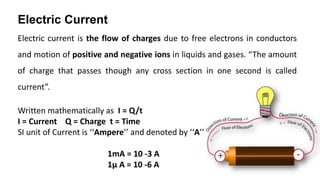
Electric current is the flow of charges due to free electrons in conductors
and motion of positive and negative ions in liquids and gases. “The amount
of charge that passes though any cross section in one second is called
current”.
Written mathematically as I = Q/t
I = Current Q = Charge t = Time
SI unit of Current is ‘‘Ampere’’ and denoted by ‘‘A’’
1mA = 10 -3 A
1μ A = 10 -6 A
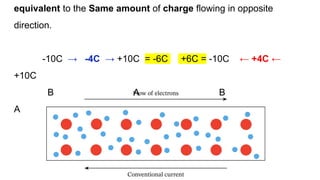
Conventional Current
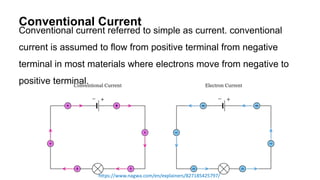
Conventional current referred to simple as current. conventional
current is assumed to flow from positive terminal from negative
terminal in most materials where electrons move from negative to
positive terminal.
https://www.nagwa.com/en/explainers/827185425797/
equivalent to the Same amount of charge flowing in opposite
direction.
-10C → -4C → +10C = -6C +6C = -10C ← +4C ←
+10C
B A B
A
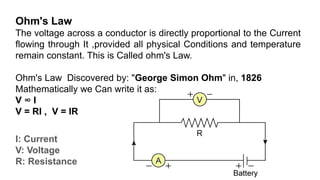
Ohm's Law
The voltage across a conductor is directly proportional to the Current
flowing through It ,provided all physical Conditions and temperature
remain constant. This is Called ohm's Law.
Ohm's Law Discovered by: "George Simon Ohm" in, 1826
Mathematically we Can write it as:
V ∞ I
V = RI , V = IR
I: Current
V: Voltage
R: Resistance
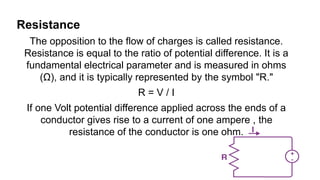
Resistance
The opposition to the flow of charges is called resistance.
Resistance is equal to the ratio of potential difference. It is a
fundamental electrical parameter and is measured in ohms
(Ω), and it is typically represented by the symbol "R."
R = V / I
If one Volt potential difference applied across the ends of a
conductor gives rise to a current of one ampere , the
resistance of the conductor is one ohm.
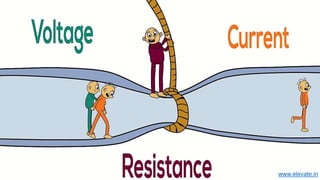
Resistance
The opposition to the flow of charges is called resistance.
Resistance is equal to the ratio of potential difference. It is a
fundamental electrical parameter and is measured in ohms (Ω),
and it is typically represented by the symbol "R."
R = V / I
If one Volt potential difference applied across the ends of a
conductor gives rise to a current of one ampere , the resistance of
the conductor is one ohm.
www.elevate.in
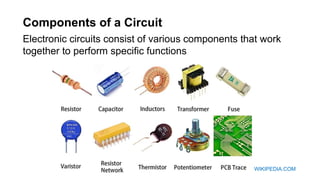
Components of a Circuit
Electronic circuits consist of various components that work
together to perform specific functions
WIKIPEDIA.COM
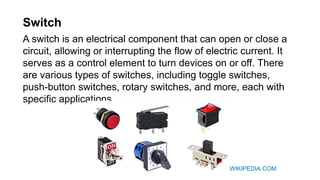
Switch
A switch is an electrical component that can open or close a
circuit, allowing or interrupting the flow of electric current. It
serves as a control element to turn devices on or off. There
are various types of switches, including toggle switches,
push-button switches, rotary switches, and more, each with
specific applications.
WIKIPEDIA.COM
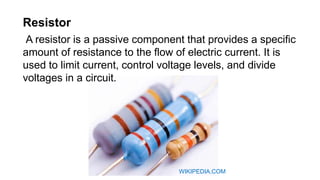
Resistor
A resistor is a passive component that provides a specific
amount of resistance to the flow of electric current. It is
used to limit current, control voltage levels, and divide
voltages in a circuit.
WIKIPEDIA.COM
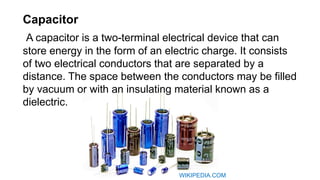
Capacitor
A capacitor is a two-terminal electrical device that can
store energy in the form of an electric charge. It consists
of two electrical conductors that are separated by a
distance. The space between the conductors may be filled
by vacuum or with an insulating material known as a
dielectric.
WIKIPEDIA.COM
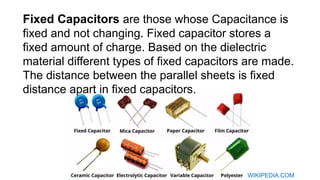
Fixed Capacitors are those whose Capacitance is
fixed and not changing. Fixed capacitor stores a
fixed amount of charge. Based on the dielectric
material different types of fixed capacitors are made.
The distance between the parallel sheets is fixed
distance apart in fixed capacitors.
WIKIPEDIA.COM
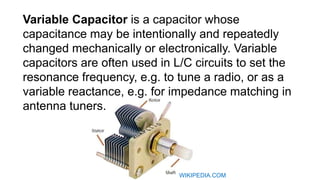
Variable Capacitor is a capacitor whose
capacitance may be intentionally and repeatedly
changed mechanically or electronically. Variable
capacitors are often used in L/C circuits to set the
resonance frequency, e.g. to tune a radio, or as a
variable reactance, e.g. for impedance matching in
antenna tuners.
WIKIPEDIA.COM
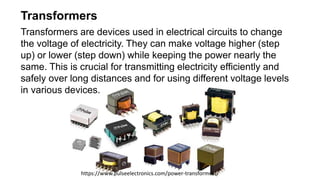
Transformers
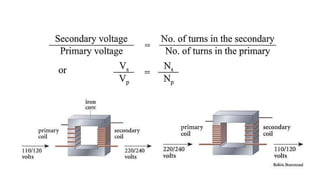
Transformers are devices used in electrical circuits to change
the voltage of electricity. They can make voltage higher (step
up) or lower (step down) while keeping the power nearly the
same. This is crucial for transmitting electricity efficiently and
safely over long distances and for using different voltage levels
in various devices.
https://www.pulseelectronics.com/power-transformers/
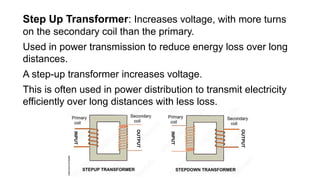
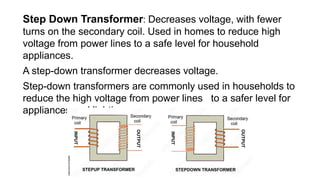
Step Up Transformer: Increases voltage, with more turns
on the secondary coil than the primary.
Used in power transmission to reduce energy loss over long
distances.
A step-up transformer increases voltage.
This is often used in power distribution to transmit electricity
efficiently over long distances with less loss.
Step Down Transformer: Decreases voltage, with fewer
turns on the secondary coil. Used in homes to reduce high
voltage from power lines to a safe level for household
appliances.
A step-down transformer decreases voltage.
Step-down transformers are commonly used in households to
reduce the high voltage from power lines to a safer level for
appliances and lighting.
Direct current and Alternative current
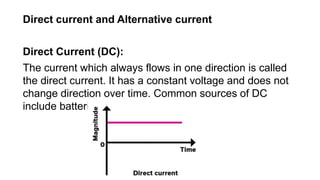
Direct Current (DC):
The current which always flows in one direction is called
the direct current. It has a constant voltage and does not
change direction over time. Common sources of DC
include batteries and solar cells.
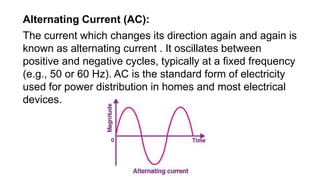
Alternating Current (AC):
The current which changes its direction again and again is
known as alternating current . It oscillates between
positive and negative cycles, typically at a fixed frequency
(e.g., 50 or 60 Hz). AC is the standard form of electricity
used for power distribution in homes and most electrical
devices.
Uses of A.C and D.C
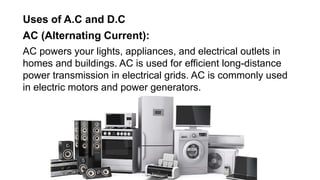
AC (Alternating Current):
AC powers your lights, appliances, and electrical outlets in
homes and buildings. AC is used for efficient long-distance
power transmission in electrical grids. AC is commonly used
in electric motors and power generators.
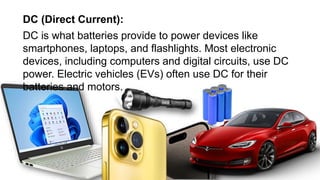
DC (Direct Current):
DC is what batteries provide to power devices like
smartphones, laptops, and flashlights. Most electronic
devices, including computers and digital circuits, use DC
power. Electric vehicles (EVs) often use DC for their
batteries and motors.
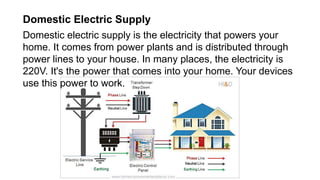
Domestic Electric Supply
Domestic electric supply is the electricity that powers your
home. It comes from power plants and is distributed through
power lines to your house. In many places, the electricity is
220V. It's the power that comes into your home. Your devices
use this power to work.
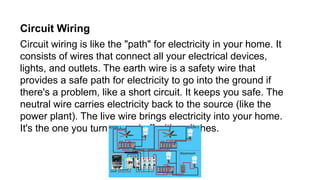
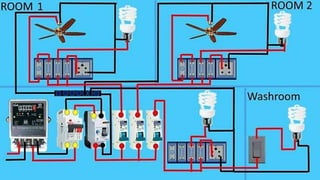
Circuit Wiring
Circuit wiring is like the "path" for electricity in your home. It
consists of wires that connect all your electrical devices,
lights, and outlets. The earth wire is a safety wire that
provides a safe path for electricity to go into the ground if
there's a problem, like a short circuit. It keeps you safe. The
neutral wire carries electricity back to the source (like the
power plant). The live wire brings electricity into your home.
It's the one you turn on and off with switches.
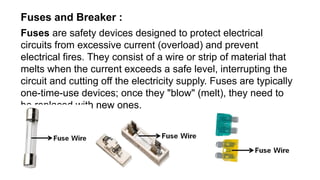
Fuses and Breaker :
Fuses are safety devices designed to protect electrical
circuits from excessive current (overload) and prevent
electrical fires. They consist of a wire or strip of material that
melts when the current exceeds a safe level, interrupting the
circuit and cutting off the electricity supply. Fuses are typically
one-time-use devices; once they "blow" (melt), they need to
be replaced with new ones.
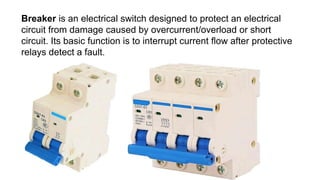
Breaker is an electrical switch designed to protect an electrical
circuit from damage caused by overcurrent/overload or short
circuit. Its basic function is to interrupt current flow after protective
relays detect a fault.
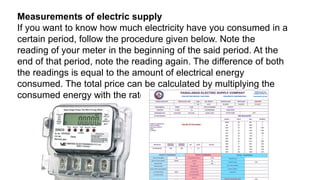
Measurements of electric supply
If you want to know how much electricity have you consumed in a
certain period, follow the procedure given below. Note the
reading of your meter in the beginning of the said period. At the
end of that period, note the reading again. The difference of both
the readings is equal to the amount of electrical energy
consumed. The total price can be calculated by multiplying the
consumed energy with the rate of units of electricity.
Dangers of electric supply
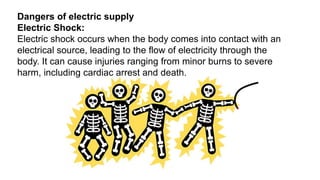
Electric Shock:
Electric shock occurs when the body comes into contact with an
electrical source, leading to the flow of electricity through the
body. It can cause injuries ranging from minor burns to severe
harm, including cardiac arrest and death.
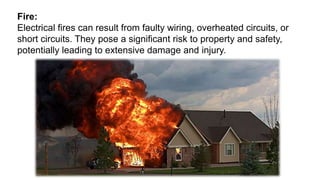
Fire:
Electrical fires can result from faulty wiring, overheated circuits, or
short circuits. They pose a significant risk to property and safety,
potentially leading to extensive damage and injury.
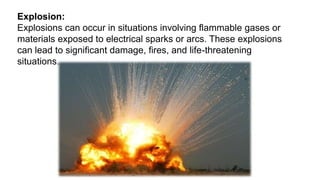
Explosion:
Explosions can occur in situations involving flammable gases or
materials exposed to electrical sparks or arcs. These explosions
can lead to significant damage, fires, and life-threatening
situations.
Precautionary measures for Electricity
1. Ensure proper wiring and installation by qualified
professionals.
2. Regularly inspect and maintain electrical systems for damage
and loose connections.
3. Use circuit breakers and fuses to prevent overloads and short
circuits.
4. Properly ground electrical circuits to prevent electric shock
and fires.
5. Avoid overloading electrical outlets and using damaged cords
and plugs.
6. Pay attention to warning signs and labels on electrical
equipment.
7. Promote education and awareness of electrical safety in
homes and workplaces.
Precautionary measures for Electricity safety first
aid
1. Ensure scene safety and disconnect the electrical source
if possible.
2. Call for emergency help if the accident is severe.
3. Do not touch the victim until the area is safe.
4. Perform CPR if the victim is not breathing or has no
heartbeat.
5. Cover burns and injuries with sterile, non-stick bandages
or clean cloth and keep the victim warm.
Measuring instrument
Different instruments are used for the measurement of
current, voltage and resistance. Basically, galvanometer is an
instrument which detects the current. Different measuring
instruments are made by making modification in the
galvanometer.
You have learnt about electric motor in the lower classes. The
principle of the galvanometer is the same as that of an
electric motor. A coil of wire is placed between the opposite
magnetic poles. An axil passes through the centre of the coil.
When current is passed through the coil, it turns about the
axil. The springs at the ends of the axil are tightened as the
coil rotates. They stop further rotation of the coil.
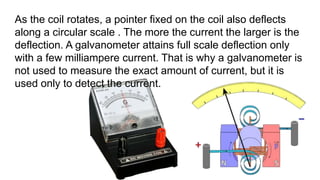
As the coil rotates, a pointer fixed on the coil also deflects
along a circular scale . The more the current the larger is the
deflection. A galvanometer attains full scale deflection only
with a few milliampere current. That is why a galvanometer is
not used to measure the exact amount of current, but it is
used only to detect the current.
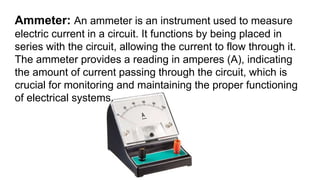
Ammeter: An ammeter is an instrument used to measure
electric current in a circuit. It functions by being placed in
series with the circuit, allowing the current to flow through it.
The ammeter provides a reading in amperes (A), indicating
the amount of current passing through the circuit, which is
crucial for monitoring and maintaining the proper functioning
of electrical systems.
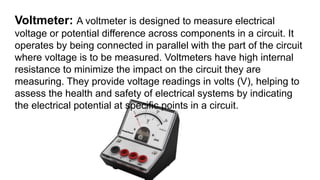
Voltmeter: A voltmeter is designed to measure electrical
voltage or potential difference across components in a circuit. It
operates by being connected in parallel with the part of the circuit
where voltage is to be measured. Voltmeters have high internal
resistance to minimize the impact on the circuit they are
measuring. They provide voltage readings in volts (V), helping to
assess the health and safety of electrical systems by indicating
the electrical potential at specific points in a circuit.
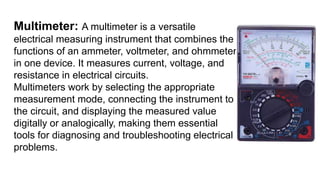
Multimeter: A multimeter is a versatile
electrical measuring instrument that combines the
functions of an ammeter, voltmeter, and ohmmeter
in one device. It measures current, voltage, and
resistance in electrical circuits.
Multimeters work by selecting the appropriate
measurement mode, connecting the instrument to
the circuit, and displaying the measured value
digitally or analogically, making them essential
tools for diagnosing and troubleshooting electrical
problems.
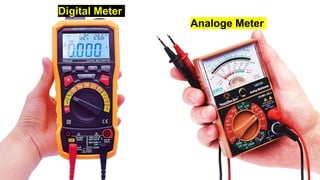
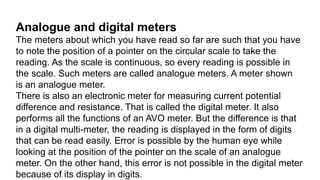
Analogue and digital meters
The meters about which you have read so far are such that you have
to note the position of a pointer on the circular scale to take the
reading. As the scale is continuous, so every reading is possible in
the scale. Such meters are called analogue meters. A meter shown
is an analogue meter.
There is also an electronic meter for measuring current potential
difference and resistance. That is called the digital meter. It also
performs all the functions of an AVO meter. But the difference is that
in a digital multi-meter, the reading is displayed in the form of digits
that can be read easily. Error is possible by the human eye while
looking at the position of the pointer on the scale of an analogue
meter. On the other hand, this error is not possible in the digital meter
because of its display in digits.
Analoge Meter
Digital Meter

Current Electricity Chp-8 General Science 9th 10th

  • 1.
    PRESENTATION TOPIC NAME: CURRENT ELECTRICITYCH.8 SUBMITTED TO: SIR EHTISHAM UL HAQ SUBMITTED BY: KAMRAN ABDULLAH (ROLL NO 04) (LEADER) MUZAMMAL ABBAS (ROLL NO 11) SABEEN FATIMA (ROLL NO 24) FARMAN SHER (ROLL NO 31) SYED M. ALI RAZA SHAH (ROLL NO 41) INSTITUTE OF EDUCATION UNIVERSITY OF SARGODHA
  • 2.
    STUDENT LEARNING OUTCOMES 1.After reading this chapter you will be able to understand and learn following topics. 2. Concept of Electric Current 3. Conventional Current. 4. Ohm's Law. 5. What is Resistance. 6. Components of a Circuit, 7. Alternating Current (AC) and Direct Current (DC) 8. Dangers and Precautionary measures for electricity. 9. Electrical Measuring Instruments. 10. Analogue and digital Meters.
  • 3.
    Electric Current Electric currentis the flow of charges due to free electrons in conductors and motion of positive and negative ions in liquids and gases. “The amount of charge that passes though any cross section in one second is called current”. Written mathematically as I = Q/t I = Current Q = Charge t = Time SI unit of Current is ‘‘Ampere’’ and denoted by ‘‘A’’ 1mA = 10 -3 A 1μ A = 10 -6 A
  • 4.
    Conventional Current Conventional currentreferred to simple as current. conventional current is assumed to flow from positive terminal from negative terminal in most materials where electrons move from negative to positive terminal. https://www.nagwa.com/en/explainers/827185425797/
  • 5.
    equivalent to theSame amount of charge flowing in opposite direction. -10C → -4C → +10C = -6C +6C = -10C ← +4C ← +10C B A B A
  • 6.
    Ohm's Law The voltageacross a conductor is directly proportional to the Current flowing through It ,provided all physical Conditions and temperature remain constant. This is Called ohm's Law. Ohm's Law Discovered by: "George Simon Ohm" in, 1826 Mathematically we Can write it as: V ∞ I V = RI , V = IR I: Current V: Voltage R: Resistance
  • 7.
    Resistance The opposition tothe flow of charges is called resistance. Resistance is equal to the ratio of potential difference. It is a fundamental electrical parameter and is measured in ohms (Ω), and it is typically represented by the symbol "R." R = V / I If one Volt potential difference applied across the ends of a conductor gives rise to a current of one ampere , the resistance of the conductor is one ohm.
  • 8.
    Resistance The opposition tothe flow of charges is called resistance. Resistance is equal to the ratio of potential difference. It is a fundamental electrical parameter and is measured in ohms (Ω), and it is typically represented by the symbol "R." R = V / I If one Volt potential difference applied across the ends of a conductor gives rise to a current of one ampere , the resistance of the conductor is one ohm. www.elevate.in
  • 9.
    Components of aCircuit Electronic circuits consist of various components that work together to perform specific functions WIKIPEDIA.COM
  • 10.
    Switch A switch isan electrical component that can open or close a circuit, allowing or interrupting the flow of electric current. It serves as a control element to turn devices on or off. There are various types of switches, including toggle switches, push-button switches, rotary switches, and more, each with specific applications. WIKIPEDIA.COM
  • 11.
    Resistor A resistor isa passive component that provides a specific amount of resistance to the flow of electric current. It is used to limit current, control voltage levels, and divide voltages in a circuit. WIKIPEDIA.COM
  • 12.
    Capacitor A capacitor isa two-terminal electrical device that can store energy in the form of an electric charge. It consists of two electrical conductors that are separated by a distance. The space between the conductors may be filled by vacuum or with an insulating material known as a dielectric. WIKIPEDIA.COM
  • 13.
    Fixed Capacitors arethose whose Capacitance is fixed and not changing. Fixed capacitor stores a fixed amount of charge. Based on the dielectric material different types of fixed capacitors are made. The distance between the parallel sheets is fixed distance apart in fixed capacitors. WIKIPEDIA.COM
  • 14.
    Variable Capacitor isa capacitor whose capacitance may be intentionally and repeatedly changed mechanically or electronically. Variable capacitors are often used in L/C circuits to set the resonance frequency, e.g. to tune a radio, or as a variable reactance, e.g. for impedance matching in antenna tuners. WIKIPEDIA.COM
  • 15.
    Transformers Transformers are devicesused in electrical circuits to change the voltage of electricity. They can make voltage higher (step up) or lower (step down) while keeping the power nearly the same. This is crucial for transmitting electricity efficiently and safely over long distances and for using different voltage levels in various devices. https://www.pulseelectronics.com/power-transformers/
  • 16.
    Step Up Transformer:Increases voltage, with more turns on the secondary coil than the primary. Used in power transmission to reduce energy loss over long distances. A step-up transformer increases voltage. This is often used in power distribution to transmit electricity efficiently over long distances with less loss.
  • 17.
    Step Down Transformer:Decreases voltage, with fewer turns on the secondary coil. Used in homes to reduce high voltage from power lines to a safe level for household appliances. A step-down transformer decreases voltage. Step-down transformers are commonly used in households to reduce the high voltage from power lines to a safer level for appliances and lighting.
  • 19.
    Direct current andAlternative current Direct Current (DC): The current which always flows in one direction is called the direct current. It has a constant voltage and does not change direction over time. Common sources of DC include batteries and solar cells.
  • 20.
    Alternating Current (AC): Thecurrent which changes its direction again and again is known as alternating current . It oscillates between positive and negative cycles, typically at a fixed frequency (e.g., 50 or 60 Hz). AC is the standard form of electricity used for power distribution in homes and most electrical devices.
  • 21.
    Uses of A.Cand D.C AC (Alternating Current): AC powers your lights, appliances, and electrical outlets in homes and buildings. AC is used for efficient long-distance power transmission in electrical grids. AC is commonly used in electric motors and power generators.
  • 22.
    DC (Direct Current): DCis what batteries provide to power devices like smartphones, laptops, and flashlights. Most electronic devices, including computers and digital circuits, use DC power. Electric vehicles (EVs) often use DC for their batteries and motors.
  • 23.
    Domestic Electric Supply Domesticelectric supply is the electricity that powers your home. It comes from power plants and is distributed through power lines to your house. In many places, the electricity is 220V. It's the power that comes into your home. Your devices use this power to work.
  • 24.
    Circuit Wiring Circuit wiringis like the "path" for electricity in your home. It consists of wires that connect all your electrical devices, lights, and outlets. The earth wire is a safety wire that provides a safe path for electricity to go into the ground if there's a problem, like a short circuit. It keeps you safe. The neutral wire carries electricity back to the source (like the power plant). The live wire brings electricity into your home. It's the one you turn on and off with switches.
  • 26.
    Fuses and Breaker: Fuses are safety devices designed to protect electrical circuits from excessive current (overload) and prevent electrical fires. They consist of a wire or strip of material that melts when the current exceeds a safe level, interrupting the circuit and cutting off the electricity supply. Fuses are typically one-time-use devices; once they "blow" (melt), they need to be replaced with new ones.
  • 27.
    Breaker is anelectrical switch designed to protect an electrical circuit from damage caused by overcurrent/overload or short circuit. Its basic function is to interrupt current flow after protective relays detect a fault.
  • 28.
    Measurements of electricsupply If you want to know how much electricity have you consumed in a certain period, follow the procedure given below. Note the reading of your meter in the beginning of the said period. At the end of that period, note the reading again. The difference of both the readings is equal to the amount of electrical energy consumed. The total price can be calculated by multiplying the consumed energy with the rate of units of electricity.
  • 29.
    Dangers of electricsupply Electric Shock: Electric shock occurs when the body comes into contact with an electrical source, leading to the flow of electricity through the body. It can cause injuries ranging from minor burns to severe harm, including cardiac arrest and death.
  • 30.
    Fire: Electrical fires canresult from faulty wiring, overheated circuits, or short circuits. They pose a significant risk to property and safety, potentially leading to extensive damage and injury.
  • 31.
    Explosion: Explosions can occurin situations involving flammable gases or materials exposed to electrical sparks or arcs. These explosions can lead to significant damage, fires, and life-threatening situations.
  • 32.
    Precautionary measures forElectricity 1. Ensure proper wiring and installation by qualified professionals. 2. Regularly inspect and maintain electrical systems for damage and loose connections. 3. Use circuit breakers and fuses to prevent overloads and short circuits. 4. Properly ground electrical circuits to prevent electric shock and fires. 5. Avoid overloading electrical outlets and using damaged cords and plugs. 6. Pay attention to warning signs and labels on electrical equipment. 7. Promote education and awareness of electrical safety in homes and workplaces.
  • 33.
    Precautionary measures forElectricity safety first aid 1. Ensure scene safety and disconnect the electrical source if possible. 2. Call for emergency help if the accident is severe. 3. Do not touch the victim until the area is safe. 4. Perform CPR if the victim is not breathing or has no heartbeat. 5. Cover burns and injuries with sterile, non-stick bandages or clean cloth and keep the victim warm.
  • 34.
    Measuring instrument Different instrumentsare used for the measurement of current, voltage and resistance. Basically, galvanometer is an instrument which detects the current. Different measuring instruments are made by making modification in the galvanometer. You have learnt about electric motor in the lower classes. The principle of the galvanometer is the same as that of an electric motor. A coil of wire is placed between the opposite magnetic poles. An axil passes through the centre of the coil. When current is passed through the coil, it turns about the axil. The springs at the ends of the axil are tightened as the coil rotates. They stop further rotation of the coil.
  • 35.
    As the coilrotates, a pointer fixed on the coil also deflects along a circular scale . The more the current the larger is the deflection. A galvanometer attains full scale deflection only with a few milliampere current. That is why a galvanometer is not used to measure the exact amount of current, but it is used only to detect the current.
  • 36.
    Ammeter: An ammeteris an instrument used to measure electric current in a circuit. It functions by being placed in series with the circuit, allowing the current to flow through it. The ammeter provides a reading in amperes (A), indicating the amount of current passing through the circuit, which is crucial for monitoring and maintaining the proper functioning of electrical systems.
  • 37.
    Voltmeter: A voltmeteris designed to measure electrical voltage or potential difference across components in a circuit. It operates by being connected in parallel with the part of the circuit where voltage is to be measured. Voltmeters have high internal resistance to minimize the impact on the circuit they are measuring. They provide voltage readings in volts (V), helping to assess the health and safety of electrical systems by indicating the electrical potential at specific points in a circuit.
  • 38.
    Multimeter: A multimeteris a versatile electrical measuring instrument that combines the functions of an ammeter, voltmeter, and ohmmeter in one device. It measures current, voltage, and resistance in electrical circuits. Multimeters work by selecting the appropriate measurement mode, connecting the instrument to the circuit, and displaying the measured value digitally or analogically, making them essential tools for diagnosing and troubleshooting electrical problems.
  • 39.
    Analogue and digitalmeters The meters about which you have read so far are such that you have to note the position of a pointer on the circular scale to take the reading. As the scale is continuous, so every reading is possible in the scale. Such meters are called analogue meters. A meter shown is an analogue meter. There is also an electronic meter for measuring current potential difference and resistance. That is called the digital meter. It also performs all the functions of an AVO meter. But the difference is that in a digital multi-meter, the reading is displayed in the form of digits that can be read easily. Error is possible by the human eye while looking at the position of the pointer on the scale of an analogue meter. On the other hand, this error is not possible in the digital meter because of its display in digits.
  • 40.