ElasticityElasticity
Module: 2 (contd.)Module: 2 (contd.)
What is elasticity ?What is elasticity ?
 Degree ofDegree of responsiveness of demandresponsiveness of demand
to its determinantsto its determinants
– Own priceOwn price
– Cross priceCross price
– IncomeIncome
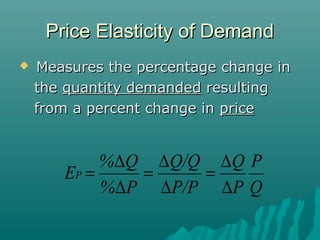
Price Elasticity of DemandPrice Elasticity of Demand
 Measures the percentage change inMeasures the percentage change in
thethe quantity demandedquantity demanded resultingresulting
from a percent change infrom a percent change in priceprice
Q
P
P
Q
P/P
Q/Q
P%
Q%
EP
∆
∆
=
∆
∆
=
∆
∆
=
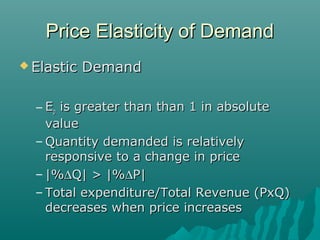
Price Elasticity of DemandPrice Elasticity of Demand
 Elastic DemandElastic Demand
– EEpp is greater than than 1 in absoluteis greater than than 1 in absolute
valuevalue
– Quantity demanded is relativelyQuantity demanded is relatively
responsive to a change in priceresponsive to a change in price
– |%|%∆∆Q| > |%Q| > |%∆∆P|P|
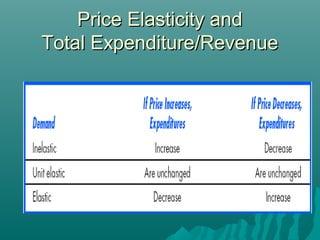
– Total expenditure/Total Revenue (PxQ)Total expenditure/Total Revenue (PxQ)
decreases when price increasesdecreases when price increases
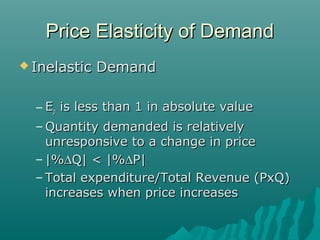
Price Elasticity of DemandPrice Elasticity of Demand
 Inelastic DemandInelastic Demand
– EEpp is less than 1 in absolute valueis less than 1 in absolute value
– Quantity demanded is relativelyQuantity demanded is relatively
unresponsive to a change in priceunresponsive to a change in price
– |%|%∆∆Q| < |%Q| < |%∆∆P|P|
– Total expenditure/Total Revenue (PxQ)Total expenditure/Total Revenue (PxQ)
increases when price increasesincreases when price increases
Price Elasticity andPrice Elasticity and
Total Expenditure/RevenueTotal Expenditure/Revenue
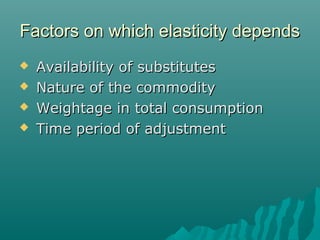
Factors on which elasticity dependsFactors on which elasticity depends
 Availability of substitutesAvailability of substitutes
 Nature of the commodityNature of the commodity
 Weightage in total consumptionWeightage in total consumption
 Time period of adjustmentTime period of adjustment
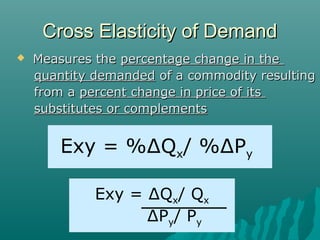
Cross Elasticity of DemandCross Elasticity of Demand
 Measures theMeasures the percentage change in thepercentage change in the
quantity demandedquantity demanded of a commodity resultingof a commodity resulting
from afrom a percent change in price of itspercent change in price of its
substitutes or complementssubstitutes or complements
Exy = %∆Qx/ %∆Py
Exy = ∆Qx/ Qx
∆Py/ Py
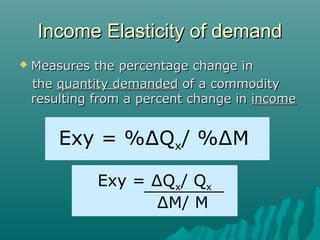
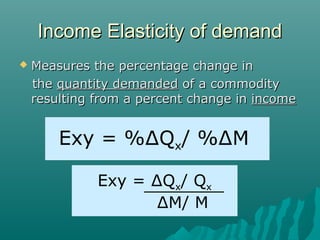
Income Elasticity of demandIncome Elasticity of demand
 Measures the percentage change inMeasures the percentage change in
thethe quantity demandedquantity demanded of a commodityof a commodity
resulting from a percent change inresulting from a percent change in incomeincome
Exy = %∆Qx/ %∆M
Exy = ∆Qx/ Qx
∆M/ M
Income Elasticity of demandIncome Elasticity of demand
 Measures the percentage change inMeasures the percentage change in
thethe quantity demandedquantity demanded of a commodityof a commodity
resulting from a percent change inresulting from a percent change in incomeincome
Exy = %∆Qx/ %∆M
Exy = ∆Qx/ Qx
∆M/ M

Elasticity (Managerial economics)

  • 1.
  • 2.
    What is elasticity?What is elasticity ?  Degree ofDegree of responsiveness of demandresponsiveness of demand to its determinantsto its determinants – Own priceOwn price – Cross priceCross price – IncomeIncome
  • 3.
    Price Elasticity ofDemandPrice Elasticity of Demand  Measures the percentage change inMeasures the percentage change in thethe quantity demandedquantity demanded resultingresulting from a percent change infrom a percent change in priceprice Q P P Q P/P Q/Q P% Q% EP ∆ ∆ = ∆ ∆ = ∆ ∆ =
  • 4.
    Price Elasticity ofDemandPrice Elasticity of Demand  Elastic DemandElastic Demand – EEpp is greater than than 1 in absoluteis greater than than 1 in absolute valuevalue – Quantity demanded is relativelyQuantity demanded is relatively responsive to a change in priceresponsive to a change in price – |%|%∆∆Q| > |%Q| > |%∆∆P|P| – Total expenditure/Total Revenue (PxQ)Total expenditure/Total Revenue (PxQ) decreases when price increasesdecreases when price increases
  • 5.
    Price Elasticity ofDemandPrice Elasticity of Demand  Inelastic DemandInelastic Demand – EEpp is less than 1 in absolute valueis less than 1 in absolute value – Quantity demanded is relativelyQuantity demanded is relatively unresponsive to a change in priceunresponsive to a change in price – |%|%∆∆Q| < |%Q| < |%∆∆P|P| – Total expenditure/Total Revenue (PxQ)Total expenditure/Total Revenue (PxQ) increases when price increasesincreases when price increases
  • 6.
    Price Elasticity andPriceElasticity and Total Expenditure/RevenueTotal Expenditure/Revenue
  • 7.
    Factors on whichelasticity dependsFactors on which elasticity depends  Availability of substitutesAvailability of substitutes  Nature of the commodityNature of the commodity  Weightage in total consumptionWeightage in total consumption  Time period of adjustmentTime period of adjustment
  • 8.
    Cross Elasticity ofDemandCross Elasticity of Demand  Measures theMeasures the percentage change in thepercentage change in the quantity demandedquantity demanded of a commodity resultingof a commodity resulting from afrom a percent change in price of itspercent change in price of its substitutes or complementssubstitutes or complements Exy = %∆Qx/ %∆Py Exy = ∆Qx/ Qx ∆Py/ Py
  • 9.
    Income Elasticity ofdemandIncome Elasticity of demand  Measures the percentage change inMeasures the percentage change in thethe quantity demandedquantity demanded of a commodityof a commodity resulting from a percent change inresulting from a percent change in incomeincome Exy = %∆Qx/ %∆M Exy = ∆Qx/ Qx ∆M/ M
  • 10.
    Income Elasticity ofdemandIncome Elasticity of demand  Measures the percentage change inMeasures the percentage change in thethe quantity demandedquantity demanded of a commodityof a commodity resulting from a percent change inresulting from a percent change in incomeincome Exy = %∆Qx/ %∆M Exy = ∆Qx/ Qx ∆M/ M