15-1
Environmental
Geology
James Reichard
Copyright © The McGraw-Hill Companies, Inc. Permission required for reproduction or display.
15-2
Chapter 15
Pollution and Waste Disposal
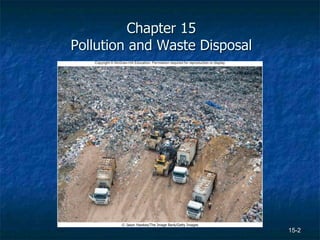
© Jason Hawkes/The Image Bank/Getty Images
15-3
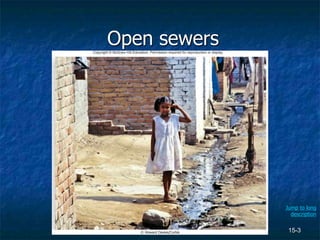
Open sewers
© Howard Davies/Corbis
Jump to long
description
15-4
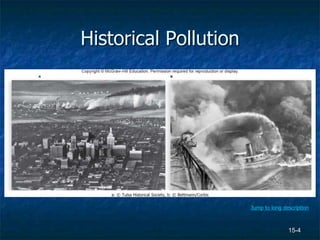
Historical Pollution
a: © Tulsa Historical Society, b: © Bettmann/Corbis
Jump to long description
15-5
Waste Disposal (1)
Historical waste disposal
US Environmental Laws
• NEPA National Environmental Policy Act 1969
• Clean Air Act 1970
• Clean Water Act 1972
• CERCLA Comprehensive Environmental
Response, Compensation &Liability Act 1980
• RCRA Resource Conservation & Recovery Act
1976
15-6
Waste Disposal (2)
Jump to long description
15-7
Pollution & Contamination
Polluted
• Introduced substance reaches harmful
concentrations
Contaminated
• Substance above natural levels
© Digital Vision/Getty/Images
Jump to long description
15-8
Movement of Pollutants
• Point source
• Non point source
(left): © Sinisha Karich/123RF; (right): © Jim Reichard
Jump to long description
15-9
Contaminant Plume
a: US EPA
Jump to long description
15-10
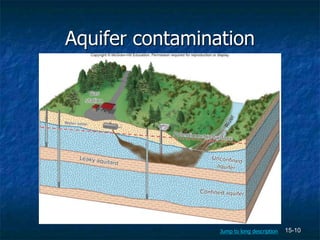
Aquifer contamination
Jump to long description
15-11
Solid Waste
• Municipal solid waste
• Solid waste stream
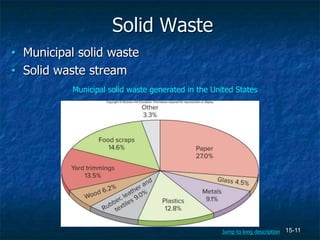
Municipal solid waste generated in the United States
Jump to long description
15-12
Solid Waste Stream
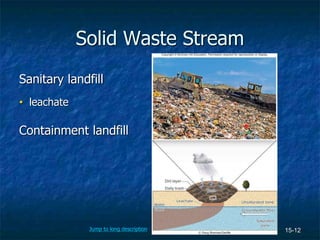
Sanitary landfill
• leachate
Containment landfill
© Doug Sherman/Geofile
Jump to long description
15-13
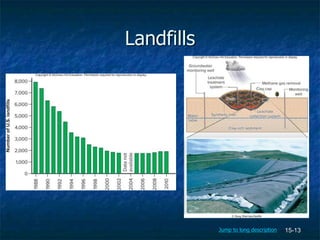
Landfills
© Doug Sherman/Geofile
Jump to long description
15-14
Waste Management
Jump to long description
15-15
Solid waste (1)
Jump to long description
15-16
Solid waste (2)
Jump to long description
15-17
Solid Hazardous Waste
Secured landfills
Hazardous waste incinerators
Electronic waste
• Dry cell batteries
• Wet cell batteries
Tires
a: © Johner Royalty-Free/Getty Images
Jump to long description
15-18
Solid Waste (3)
© Jim Reichard
Government of Saskatchewan
Jump to long description
15-19
Liquid Waste Disposal
Wastewater
• Sewage
Liquid hazardous waste
• Secured landfill
• Deep well injection
Illinois EPA
Jump to long description
15-20
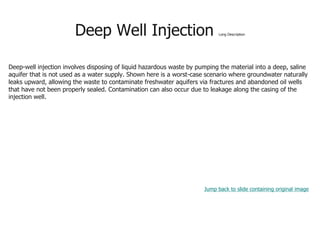
Deep Well Injection
Jump to long description
15-21
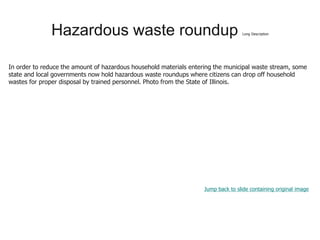
Hazardous waste roundup
Illinois EPA
Jump to long description
15-22
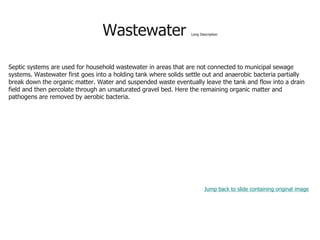
Wastewater
• Human waste
• Septic systems
• Municipal wastewater treatment
Jump to long description
15-23
Municipal Wastewater Treatment
Photo by Lynn Betts, USDA Natural Resources Conservation Service
Jump to long description
15-24
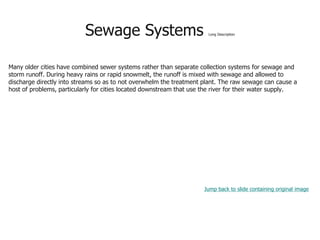
Sewage Systems
Jump to long description
15-25
Agricultural & Urban Actions
• Agricultural chemicals
• Animal waste
• Sediment pollution
© Sylvia Smith-Reynolds
Jump to long description
15-26
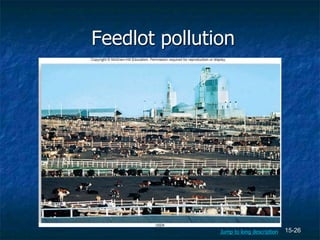
Feedlot pollution
USDA
Jump to long description
15-27
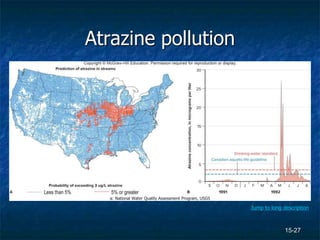
Atrazine pollution
a: National Water Quality Assessment Program, USGS
Jump to long description
15-28
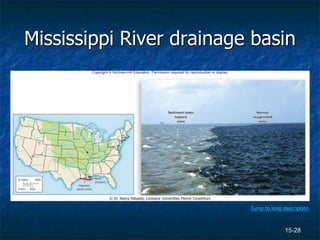
Mississippi River drainage basin
© Dr. Nancy Rabalais, Louisiana Universities Marine Consortium
Jump to long description
15-29
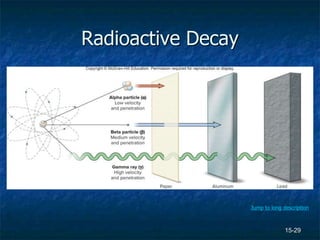
Radioactive Decay
Jump to long description
15-30
Radioactive Waste Disposal
Radiation hazards
Disposal problems
• High level waste
• Low level waste
(both): U.S. Dept. of Energy
Jump to long description
15-31
Air Pollution and Fallout
• Acid rain
• Mercury fallout
• Radon
b: National Atmospheric Deposition Program (NRSP-3). 2009. NADP Program Office, Illinois State Water Survey
Jump to long description
15-32
Acid Rain
(a–b) National Atmospheric Deposition Program/National Trends Network
© Dr. Parvinder Sethi
Jump to long description
15-33
Scrubbers
Jump to long description
15-34
Anthropogenic mercury (1)
Jump to long description
15-35
Anthropogenic mercury (2)
Jump to long description
15-36
Radon
Jump to long description
Appendix of Image Long
Descriptions
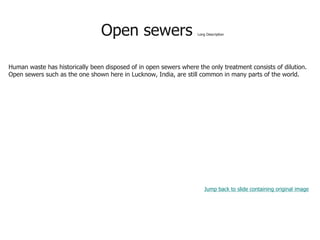
Open sewers Long Description
Human waste has historically been disposed of in open sewers where the only treatment consists of dilution.
Open sewers such as the one shown here in Lucknow, India, are still common in many parts of the world.
Jump back to slide containing original image
Historical Pollution Long Description
Rapid industrialization in the United States resulted in dramatic increases in pollution as wastes were freely
discharged into the nation’s air and water. Pollution eventually became such a problem that citizens
demanded action, prompting Congress to enact a series of environmental laws beginning in the 1970s. Photo
(A) taken in 1947 shows unchecked industrial emissions in Tulsa, Oklahoma. In 1952 the Cuyahoga River (B)
in Cleveland, Ohio, caught fire due to the presence of petrochemicals discharged by industry.
Jump back to slide containing original image
Waste Disposal (2) Long Description
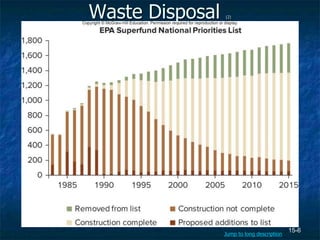
Graph showing the cumulative number and status of Superfund sites on the EPA’s National Priorities List
(NPL). Those sites where construction has been completed have the physical infrastructure needed for
remediation in place. Once final cleanup levels are reached, those sites can be removed from the list.
Jump back to slide containing original image
Pollution & Contamination Long Description
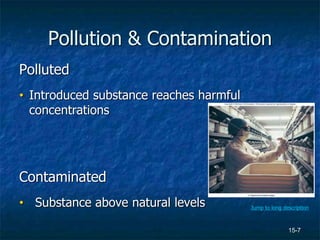
Mice or rats are commonly used to extrapolate the health risk of chemical substances to humans. A major
assumption is that these animals and people respond similarly to the same substance. Although the
extrapolated data may not accurately reflect long-term exposure risks to humans, such testing is the most
practical means available for gathering quantitative information on chemicals with a high-risk potential for
humans.
Jump back to slide containing original image
Movement of Pollutants Long Description
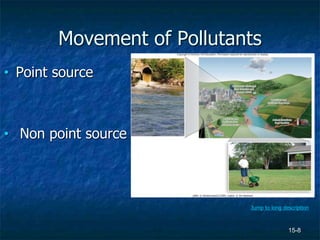
Pollutants entering our water supplies come from two types of sources. Point sources are discrete locations
such as pipes discharging wastewater into streams from factories and sewage plants. Nonpoint sources are
those from which contaminants get picked up by water as it moves across the landscape and then enter
stream tributaries. Examples of contaminants from nonpoint sources include chemicals and animal wastes
from agricultural fields and residential lawns and oil from parking lots and highways.
Jump back to slide containing original image
Contaminant Plume Long Description
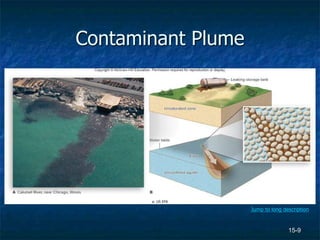
Contaminant plumes form when polluted water enters surface bodies of water like lakes and streams (A) or
subsurface aquifers (B). Contaminants become diluted due to mixing as the plume grows in size, both
laterally and in the direction of flow. Once a contaminant source has been eliminated, surface waters are
generally able to flush themselves of pollutants relatively quickly. Groundwater moves much more slowly and
can remain polluted for decades to thousands of years.
Jump back to slide containing original image
Aquifer contamination Long Description
Unconfined aquifers are highly susceptible to contamination from surface activities, whereas an aquitard
provides a layer of protection for the underlying confined system. In areas where vertical flow is upward,
confined aquifers are virtually immune from surface contamination. Note how human activity can easily
pollute shallow aquifers, which eventually discharge into streams, polluting them as well.
Jump back to slide containing original image
Solid Waste Long Description
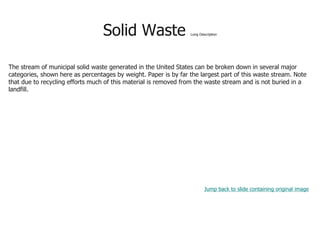
The stream of municipal solid waste generated in the United States can be broken down in several major
categories, shown here as percentages by weight. Paper is by far the largest part of this waste stream. Note
that due to recycling efforts much of this material is removed from the waste stream and is not buried in a
landfill.
Jump back to slide containing original image
Solid Waste Stream Long Description
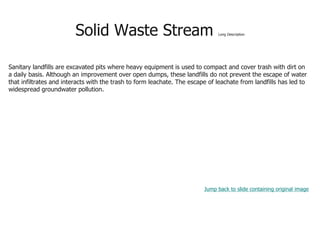
Sanitary landfills are excavated pits where heavy equipment is used to compact and cover trash with dirt on
a daily basis. Although an improvement over open dumps, these landfills do not prevent the escape of water
that infiltrates and interacts with the trash to form leachate. The escape of leachate from landfills has led to
widespread groundwater pollution.
Jump back to slide containing original image
Landfills Long Description
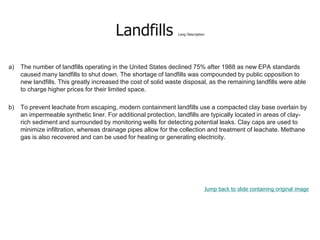
a) The number of landfills operating in the United States declined 75% after 1988 as new EPA standards
caused many landfills to shut down. The shortage of landfills was compounded by public opposition to
new landfills. This greatly increased the cost of solid waste disposal, as the remaining landfills were able
to charge higher prices for their limited space.
b) To prevent leachate from escaping, modern containment landfills use a compacted clay base overlain by
an impermeable synthetic liner. For additional protection, landfills are typically located in areas of clay-
rich sediment and surrounded by monitoring wells for detecting potential leaks. Clay caps are used to
minimize infiltration, whereas drainage pipes allow for the collection and treatment of leachate. Methane
gas is also recovered and can be used for heating or generating electricity.
Jump back to slide containing original image
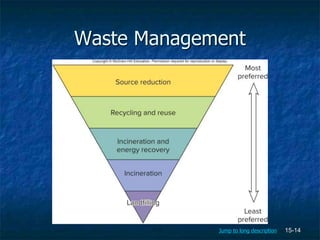
Waste Management Long Description
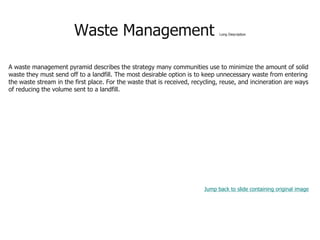
A waste management pyramid describes the strategy many communities use to minimize the amount of solid
waste they must send off to a landfill. The most desirable option is to keep unnecessary waste from entering
the waste stream in the first place. For the waste that is received, recycling, reuse, and incineration are ways
of reducing the volume sent to a landfill.
Jump back to slide containing original image
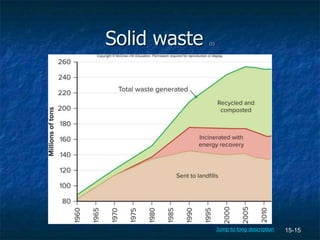
Solid waste (1) Long Description
Despite an overall increase in the amount of solid waste being generated, the combined efforts of recycling,
composting, and incineration have actually reduced the amount of waste being sent to landfills.
Jump back to slide containing original image
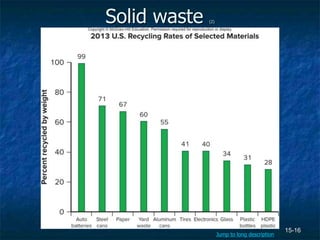
Solid waste (2) Long Description
Percent recycling rates of selected materials in the United States in 2013. The recycling of these materials
not only saves energy and valuable landfill space, but with the exception of yard wastes, also serves as a
source of raw materials that can be used to make new products.
Jump back to slide containing original image
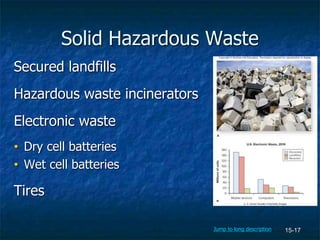
Solid Hazardous Waste Long Description
The volume of electronic waste has grown considerably in recent years (A), creating a disposal problem as
many items contain toxic metals and plastics. To reduce the amount of electronic waste going to landfills,
the EPA and state and local agencies have set up reuse and recycling programs. As indicated in the plot (B),
only relatively small percentages of mobile devices, computers, and televisions are currently being recycled.
Jump back to slide containing original image
Solid Waste (3) Long Description
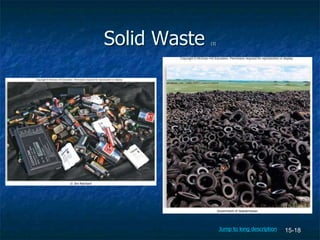
a) This pile of depleted dry-cell batteries, collected in just one year by the author, illustrates the size of the
battery disposal problem. Because batteries contain heavy metals that are highly toxic, many state and
local governments are instituting battery recycling programs to help remove batteries from the municipal
waste stream.
b) In the past, scrap tires have been either placed in landfills or stockpiled on the surface in large open
dumps, such as the one shown here in Saskatchewan, Canada. Such dumps created problems with
mosquito-borne diseases and produced toxic fumes when the tires caught fire. In the United States the
recent market for used tires has greatly reduced the stockpile of discarded tires.
Jump back to slide containing original image
Liquid Waste Disposal Long Description
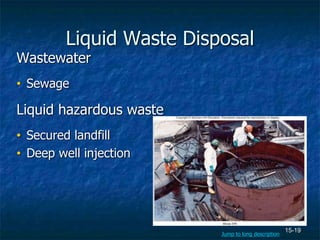
Considerable amounts of liquid hazardous waste stored on-site have been left abandoned by bankrupt
companies, leaving costly cleanup efforts to government agencies, as shown in this photo taken in Illinois.
Jump back to slide containing original image
Deep Well Injection Long Description
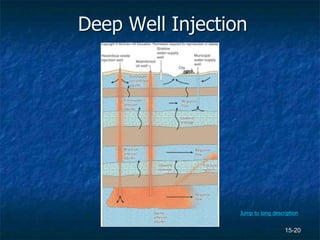
Deep-well injection involves disposing of liquid hazardous waste by pumping the material into a deep, saline
aquifer that is not used as a water supply. Shown here is a worst-case scenario where groundwater naturally
leaks upward, allowing the waste to contaminate freshwater aquifers via fractures and abandoned oil wells
that have not been properly sealed. Contamination can also occur due to leakage along the casing of the
injection well.
Jump back to slide containing original image
Hazardous waste roundup Long Description
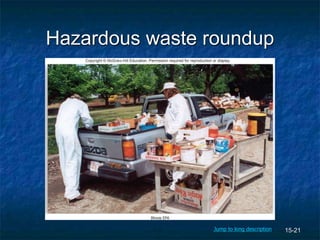
In order to reduce the amount of hazardous household materials entering the municipal waste stream, some
state and local governments now hold hazardous waste roundups where citizens can drop off household
wastes for proper disposal by trained personnel. Photo from the State of Illinois.
Jump back to slide containing original image
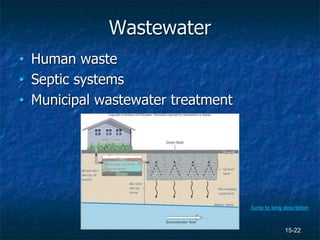
Wastewater Long Description
Septic systems are used for household wastewater in areas that are not connected to municipal sewage
systems. Wastewater first goes into a holding tank where solids settle out and anaerobic bacteria partially
break down the organic matter. Water and suspended waste eventually leave the tank and flow into a drain
field and then percolate through an unsaturated gravel bed. Here the remaining organic matter and
pathogens are removed by aerobic bacteria.
Jump back to slide containing original image
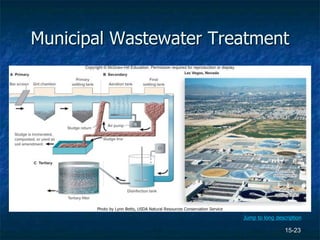
Municipal Wastewater Treatment Long Description
Modern wastewater treatment uses a series of processes to separate out solids and break down oxygen-
demanding organic matter. Primary treatment involves the settling out of solids, and is followed by
secondary treatment where aeration allows aerobic bacteria to break down most of the remaining waste. A
final disinfection step is often used to eliminate any harmful bacteria that may remain. Tertiary treatment is
sometimes included to reduce the amounts of nutrients and certain hazardous compounds.
Jump back to slide containing original image
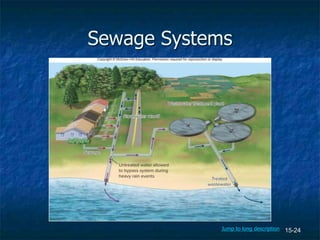
Sewage Systems Long Description
Many older cities have combined sewer systems rather than separate collection systems for sewage and
storm runoff. During heavy rains or rapid snowmelt, the runoff is mixed with sewage and allowed to
discharge directly into streams so as to not overwhelm the treatment plant. The raw sewage can cause a
host of problems, particularly for cities located downstream that use the river for their water supply.
Jump back to slide containing original image
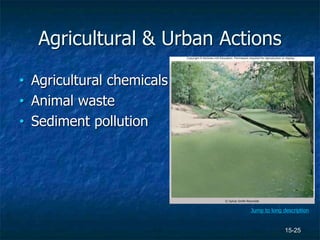
Agricultural & Urban Actions Long Description
Photo showing a section of the Canoochee River in coastal Georgia that is completely covered with algae and
experiencing severe oxygen depletion. The algae are fed by excessive nutrients, then die and fall to the
bottom of the river where aerobic bacteria break down the material and remove oxygen from the water.
Jump back to slide containing original image
Feedlot pollution Long Description
Animal feedlots generate large amounts of manure and urine. To reduce the volume, the waste is put in
holding lagoons where it is partially decomposed by anaerobic bacteria. The remaining waste is normally
applied to fields. However, overapplication commonly leads to pollution and nutrient-loading problems in
shallow aquifers and nearby streams.
Jump back to slide containing original image
Atrazine pollution Long Description
Map (A) showing areas of the U.S. Corn Belt where streams can be expected to contain elevated levels of
the pesticide atrazine. Graph (B) showing how the atrazine concentration in the Platte River in Nebraska
typically spikes in the spring and early summer after the pesticide is applied to farm fields.
Jump back to slide containing original image
Mississippi River drainage basin Long Description
The runoff of agricultural nutrients within the Mississippi River drainage basin has led to a zone of oxygen-
depleted water in the Gulf of Mexico. This hypoxic zone or “dead zone” has been growing in recent years
and is a threat to the marine ecosystem.
Jump back to slide containing original image
Radioactive Decay Long Description
When the nucleus of an unstable isotope undergoes nuclear decay, it emits radiation, consisting of alpha and
beta particles and energy waves called gamma rays. Because gamma rays possess the most energy and are
not particles, they have the greatest ability to penetrate objects and threaten human health.
Jump back to slide containing original image
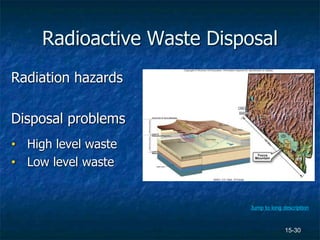
Radioactive Waste Disposal Long Description
Yucca Mountain in Nevada was selected by the U.S. federal government to be a central repository for high-
level nuclear wastes. The waste would be stored in specially designed containers and placed in mined-out
shafts within volcanic rocks approximately 1,000 feet above the water table. Although official scientific
studies have found the site suitable, concerns remain over the possibility of seismic activity and rising water
levels due to future climatic changes.
Jump back to slide containing original image
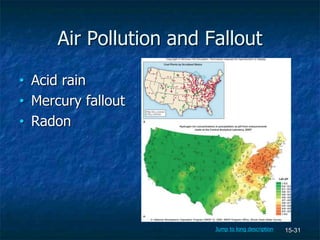
Air Pollution and Fallout Long Description
Map (A) showing the locations of U.S. coal-fired power plants in 2007—those equipped with pollution
controls for removing sulfur dioxide are shown in green. Map (B) shows the average pH of precipitation in
2007. Due to the prevailing winds, acid rain was most severe in the northeast region, which lies downwind of
the major concentration of coal-fired power plants. Acid rain has lessened significantly in recent years due to
emissions reductions.
Jump back to slide containing original image
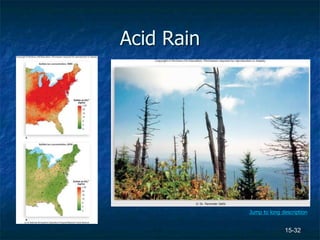
Acid Rain Long Description
a) Maps showing significant improvements in acid rain as reflected by the lower amounts of atmospheric
sulfate (SO4 2–) deposited via precipitation over the eastern United States. The changes are largely the
result of new emission standards for electric power plants.
b) Photo from the Appalachian Mountains in North Carolina showing trees that were killed by acid rain, the
source of which could have been hundreds of miles away upwind.
Jump back to slide containing original image
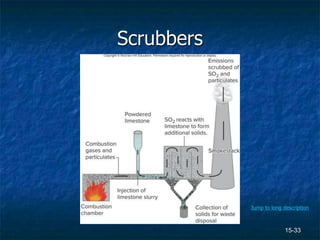
Scrubbers Long Description
Scrubbers are a means of chemically removing pollutants from emission gases. In general, some form of
powdered limestone is injected into the emission gases as they leave the combustion chamber of a
coalburning plant. The limestone then bonds with the SO2 gas to form solids, which fall to the bottom of a
collection chamber, where they are later removed and disposed of in a landfill.
Jump back to slide containing original image
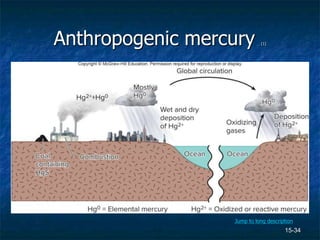
Anthropogenic mercury (1) Long Description
Anthropogenic mercury enters the atmosphere when compounds containing mercury undergo combustion.

During combustion two different forms of gaseous mercury are liberated: elemental (Hg0) and oxidized
(Hg2+). Oxidized mercury is highly reactive and tends to fall out of the atmosphere relatively close to the
emission source as dry particles and in precipitation. Elemental mercury is nonreactive and stays in the
atmosphere, circling the globe until encountering oxidizing gases that convert it into oxidized mercury.
Jump back to slide containing original image
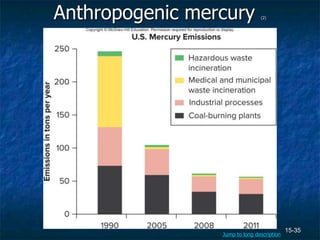
Anthropogenic mercury (2) Long Description
Anthropogenic mercury emissions in the United States have decreased significantly due to EPA regulations
requiring scrubbing systems on medical and municipal waste incinerators. Today the single largest source of
mercury released into the atmosphere is old coal-fired power plants.
Jump back to slide containing original image
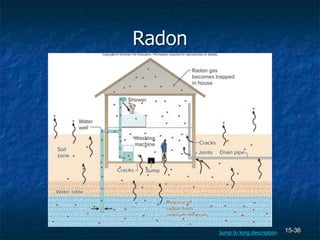
Radon Long Description
Uranium minerals release radioactive radon gas that can enter a house through cracks and joints and in well
water. Once in the house, radon can become trapped and build up to dangerous levels. Radon is easily
inhaled into the lungs, where it decays into radioactive particles of polonium that become trapped and
damage lung tissue. The health risk due to radon can be reduced by eliminating entry points into the home
and installing a ventilation system that prevents the gas from building up.
Jump back to slide containing original image

ENV 101 Ch15 lecture ppt_a

  • 1.
    15-1 Environmental Geology James Reichard Copyright ©The McGraw-Hill Companies, Inc. Permission required for reproduction or display.
  • 2.
    15-2 Chapter 15 Pollution andWaste Disposal © Jason Hawkes/The Image Bank/Getty Images
  • 3.
    15-3 Open sewers © HowardDavies/Corbis Jump to long description
  • 4.
    15-4 Historical Pollution a: ©Tulsa Historical Society, b: © Bettmann/Corbis Jump to long description
  • 5.
    15-5 Waste Disposal (1) Historicalwaste disposal US Environmental Laws • NEPA National Environmental Policy Act 1969 • Clean Air Act 1970 • Clean Water Act 1972 • CERCLA Comprehensive Environmental Response, Compensation &Liability Act 1980 • RCRA Resource Conservation & Recovery Act 1976
  • 6.
    15-6 Waste Disposal (2) Jumpto long description
  • 7.
    15-7 Pollution & Contamination Polluted •Introduced substance reaches harmful concentrations Contaminated • Substance above natural levels © Digital Vision/Getty/Images Jump to long description
  • 8.
    15-8 Movement of Pollutants •Point source • Non point source (left): © Sinisha Karich/123RF; (right): © Jim Reichard Jump to long description
  • 9.
    15-9 Contaminant Plume a: USEPA Jump to long description
  • 10.
  • 11.
    15-11 Solid Waste • Municipalsolid waste • Solid waste stream Municipal solid waste generated in the United States Jump to long description
  • 12.
    15-12 Solid Waste Stream Sanitarylandfill • leachate Containment landfill © Doug Sherman/Geofile Jump to long description
  • 13.
  • 14.
  • 15.
    15-15 Solid waste (1) Jumpto long description
  • 16.
    15-16 Solid waste (2) Jumpto long description
  • 17.
    15-17 Solid Hazardous Waste Securedlandfills Hazardous waste incinerators Electronic waste • Dry cell batteries • Wet cell batteries Tires a: © Johner Royalty-Free/Getty Images Jump to long description
  • 18.
    15-18 Solid Waste (3) ©Jim Reichard Government of Saskatchewan Jump to long description
  • 19.
    15-19 Liquid Waste Disposal Wastewater •Sewage Liquid hazardous waste • Secured landfill • Deep well injection Illinois EPA Jump to long description
  • 20.
    15-20 Deep Well Injection Jumpto long description
  • 21.
    15-21 Hazardous waste roundup IllinoisEPA Jump to long description
  • 22.
    15-22 Wastewater • Human waste •Septic systems • Municipal wastewater treatment Jump to long description
  • 23.
    15-23 Municipal Wastewater Treatment Photoby Lynn Betts, USDA Natural Resources Conservation Service Jump to long description
  • 24.
  • 25.
    15-25 Agricultural & UrbanActions • Agricultural chemicals • Animal waste • Sediment pollution © Sylvia Smith-Reynolds Jump to long description
  • 26.
  • 27.
    15-27 Atrazine pollution a: NationalWater Quality Assessment Program, USGS Jump to long description
  • 28.
    15-28 Mississippi River drainagebasin © Dr. Nancy Rabalais, Louisiana Universities Marine Consortium Jump to long description
  • 29.
  • 30.
    15-30 Radioactive Waste Disposal Radiationhazards Disposal problems • High level waste • Low level waste (both): U.S. Dept. of Energy Jump to long description
  • 31.
    15-31 Air Pollution andFallout • Acid rain • Mercury fallout • Radon b: National Atmospheric Deposition Program (NRSP-3). 2009. NADP Program Office, Illinois State Water Survey Jump to long description
  • 32.
    15-32 Acid Rain (a–b) NationalAtmospheric Deposition Program/National Trends Network © Dr. Parvinder Sethi Jump to long description
  • 33.
  • 34.
  • 35.
  • 36.
  • 37.
    Appendix of ImageLong Descriptions
  • 38.
    Open sewers LongDescription Human waste has historically been disposed of in open sewers where the only treatment consists of dilution. Open sewers such as the one shown here in Lucknow, India, are still common in many parts of the world. Jump back to slide containing original image
  • 39.
    Historical Pollution LongDescription Rapid industrialization in the United States resulted in dramatic increases in pollution as wastes were freely discharged into the nation’s air and water. Pollution eventually became such a problem that citizens demanded action, prompting Congress to enact a series of environmental laws beginning in the 1970s. Photo (A) taken in 1947 shows unchecked industrial emissions in Tulsa, Oklahoma. In 1952 the Cuyahoga River (B) in Cleveland, Ohio, caught fire due to the presence of petrochemicals discharged by industry. Jump back to slide containing original image
  • 40.
    Waste Disposal (2)Long Description Graph showing the cumulative number and status of Superfund sites on the EPA’s National Priorities List (NPL). Those sites where construction has been completed have the physical infrastructure needed for remediation in place. Once final cleanup levels are reached, those sites can be removed from the list. Jump back to slide containing original image
  • 41.
    Pollution & ContaminationLong Description Mice or rats are commonly used to extrapolate the health risk of chemical substances to humans. A major assumption is that these animals and people respond similarly to the same substance. Although the extrapolated data may not accurately reflect long-term exposure risks to humans, such testing is the most practical means available for gathering quantitative information on chemicals with a high-risk potential for humans. Jump back to slide containing original image
  • 42.
    Movement of PollutantsLong Description Pollutants entering our water supplies come from two types of sources. Point sources are discrete locations such as pipes discharging wastewater into streams from factories and sewage plants. Nonpoint sources are those from which contaminants get picked up by water as it moves across the landscape and then enter stream tributaries. Examples of contaminants from nonpoint sources include chemicals and animal wastes from agricultural fields and residential lawns and oil from parking lots and highways. Jump back to slide containing original image
  • 43.
    Contaminant Plume LongDescription Contaminant plumes form when polluted water enters surface bodies of water like lakes and streams (A) or subsurface aquifers (B). Contaminants become diluted due to mixing as the plume grows in size, both laterally and in the direction of flow. Once a contaminant source has been eliminated, surface waters are generally able to flush themselves of pollutants relatively quickly. Groundwater moves much more slowly and can remain polluted for decades to thousands of years. Jump back to slide containing original image
  • 44.
    Aquifer contamination LongDescription Unconfined aquifers are highly susceptible to contamination from surface activities, whereas an aquitard provides a layer of protection for the underlying confined system. In areas where vertical flow is upward, confined aquifers are virtually immune from surface contamination. Note how human activity can easily pollute shallow aquifers, which eventually discharge into streams, polluting them as well. Jump back to slide containing original image
  • 45.
    Solid Waste LongDescription The stream of municipal solid waste generated in the United States can be broken down in several major categories, shown here as percentages by weight. Paper is by far the largest part of this waste stream. Note that due to recycling efforts much of this material is removed from the waste stream and is not buried in a landfill. Jump back to slide containing original image
  • 46.
    Solid Waste StreamLong Description Sanitary landfills are excavated pits where heavy equipment is used to compact and cover trash with dirt on a daily basis. Although an improvement over open dumps, these landfills do not prevent the escape of water that infiltrates and interacts with the trash to form leachate. The escape of leachate from landfills has led to widespread groundwater pollution. Jump back to slide containing original image
  • 47.
    Landfills Long Description a)The number of landfills operating in the United States declined 75% after 1988 as new EPA standards caused many landfills to shut down. The shortage of landfills was compounded by public opposition to new landfills. This greatly increased the cost of solid waste disposal, as the remaining landfills were able to charge higher prices for their limited space. b) To prevent leachate from escaping, modern containment landfills use a compacted clay base overlain by an impermeable synthetic liner. For additional protection, landfills are typically located in areas of clay- rich sediment and surrounded by monitoring wells for detecting potential leaks. Clay caps are used to minimize infiltration, whereas drainage pipes allow for the collection and treatment of leachate. Methane gas is also recovered and can be used for heating or generating electricity. Jump back to slide containing original image
  • 48.
    Waste Management LongDescription A waste management pyramid describes the strategy many communities use to minimize the amount of solid waste they must send off to a landfill. The most desirable option is to keep unnecessary waste from entering the waste stream in the first place. For the waste that is received, recycling, reuse, and incineration are ways of reducing the volume sent to a landfill. Jump back to slide containing original image
  • 49.
    Solid waste (1)Long Description Despite an overall increase in the amount of solid waste being generated, the combined efforts of recycling, composting, and incineration have actually reduced the amount of waste being sent to landfills. Jump back to slide containing original image
  • 50.
    Solid waste (2)Long Description Percent recycling rates of selected materials in the United States in 2013. The recycling of these materials not only saves energy and valuable landfill space, but with the exception of yard wastes, also serves as a source of raw materials that can be used to make new products. Jump back to slide containing original image
  • 51.
    Solid Hazardous WasteLong Description The volume of electronic waste has grown considerably in recent years (A), creating a disposal problem as many items contain toxic metals and plastics. To reduce the amount of electronic waste going to landfills, the EPA and state and local agencies have set up reuse and recycling programs. As indicated in the plot (B), only relatively small percentages of mobile devices, computers, and televisions are currently being recycled. Jump back to slide containing original image
  • 52.
    Solid Waste (3)Long Description a) This pile of depleted dry-cell batteries, collected in just one year by the author, illustrates the size of the battery disposal problem. Because batteries contain heavy metals that are highly toxic, many state and local governments are instituting battery recycling programs to help remove batteries from the municipal waste stream. b) In the past, scrap tires have been either placed in landfills or stockpiled on the surface in large open dumps, such as the one shown here in Saskatchewan, Canada. Such dumps created problems with mosquito-borne diseases and produced toxic fumes when the tires caught fire. In the United States the recent market for used tires has greatly reduced the stockpile of discarded tires. Jump back to slide containing original image
  • 53.
    Liquid Waste DisposalLong Description Considerable amounts of liquid hazardous waste stored on-site have been left abandoned by bankrupt companies, leaving costly cleanup efforts to government agencies, as shown in this photo taken in Illinois. Jump back to slide containing original image
  • 54.
    Deep Well InjectionLong Description Deep-well injection involves disposing of liquid hazardous waste by pumping the material into a deep, saline aquifer that is not used as a water supply. Shown here is a worst-case scenario where groundwater naturally leaks upward, allowing the waste to contaminate freshwater aquifers via fractures and abandoned oil wells that have not been properly sealed. Contamination can also occur due to leakage along the casing of the injection well. Jump back to slide containing original image
  • 55.
    Hazardous waste roundupLong Description In order to reduce the amount of hazardous household materials entering the municipal waste stream, some state and local governments now hold hazardous waste roundups where citizens can drop off household wastes for proper disposal by trained personnel. Photo from the State of Illinois. Jump back to slide containing original image
  • 56.
    Wastewater Long Description Septicsystems are used for household wastewater in areas that are not connected to municipal sewage systems. Wastewater first goes into a holding tank where solids settle out and anaerobic bacteria partially break down the organic matter. Water and suspended waste eventually leave the tank and flow into a drain field and then percolate through an unsaturated gravel bed. Here the remaining organic matter and pathogens are removed by aerobic bacteria. Jump back to slide containing original image
  • 57.
    Municipal Wastewater TreatmentLong Description Modern wastewater treatment uses a series of processes to separate out solids and break down oxygen- demanding organic matter. Primary treatment involves the settling out of solids, and is followed by secondary treatment where aeration allows aerobic bacteria to break down most of the remaining waste. A final disinfection step is often used to eliminate any harmful bacteria that may remain. Tertiary treatment is sometimes included to reduce the amounts of nutrients and certain hazardous compounds. Jump back to slide containing original image
  • 58.
    Sewage Systems LongDescription Many older cities have combined sewer systems rather than separate collection systems for sewage and storm runoff. During heavy rains or rapid snowmelt, the runoff is mixed with sewage and allowed to discharge directly into streams so as to not overwhelm the treatment plant. The raw sewage can cause a host of problems, particularly for cities located downstream that use the river for their water supply. Jump back to slide containing original image
  • 59.
    Agricultural & UrbanActions Long Description Photo showing a section of the Canoochee River in coastal Georgia that is completely covered with algae and experiencing severe oxygen depletion. The algae are fed by excessive nutrients, then die and fall to the bottom of the river where aerobic bacteria break down the material and remove oxygen from the water. Jump back to slide containing original image
  • 60.
    Feedlot pollution LongDescription Animal feedlots generate large amounts of manure and urine. To reduce the volume, the waste is put in holding lagoons where it is partially decomposed by anaerobic bacteria. The remaining waste is normally applied to fields. However, overapplication commonly leads to pollution and nutrient-loading problems in shallow aquifers and nearby streams. Jump back to slide containing original image
  • 61.
    Atrazine pollution LongDescription Map (A) showing areas of the U.S. Corn Belt where streams can be expected to contain elevated levels of the pesticide atrazine. Graph (B) showing how the atrazine concentration in the Platte River in Nebraska typically spikes in the spring and early summer after the pesticide is applied to farm fields. Jump back to slide containing original image
  • 62.
    Mississippi River drainagebasin Long Description The runoff of agricultural nutrients within the Mississippi River drainage basin has led to a zone of oxygen- depleted water in the Gulf of Mexico. This hypoxic zone or “dead zone” has been growing in recent years and is a threat to the marine ecosystem. Jump back to slide containing original image
  • 63.
    Radioactive Decay LongDescription When the nucleus of an unstable isotope undergoes nuclear decay, it emits radiation, consisting of alpha and beta particles and energy waves called gamma rays. Because gamma rays possess the most energy and are not particles, they have the greatest ability to penetrate objects and threaten human health. Jump back to slide containing original image
  • 64.
    Radioactive Waste DisposalLong Description Yucca Mountain in Nevada was selected by the U.S. federal government to be a central repository for high- level nuclear wastes. The waste would be stored in specially designed containers and placed in mined-out shafts within volcanic rocks approximately 1,000 feet above the water table. Although official scientific studies have found the site suitable, concerns remain over the possibility of seismic activity and rising water levels due to future climatic changes. Jump back to slide containing original image
  • 65.
    Air Pollution andFallout Long Description Map (A) showing the locations of U.S. coal-fired power plants in 2007—those equipped with pollution controls for removing sulfur dioxide are shown in green. Map (B) shows the average pH of precipitation in 2007. Due to the prevailing winds, acid rain was most severe in the northeast region, which lies downwind of the major concentration of coal-fired power plants. Acid rain has lessened significantly in recent years due to emissions reductions. Jump back to slide containing original image
  • 66.
    Acid Rain LongDescription a) Maps showing significant improvements in acid rain as reflected by the lower amounts of atmospheric sulfate (SO4 2–) deposited via precipitation over the eastern United States. The changes are largely the result of new emission standards for electric power plants. b) Photo from the Appalachian Mountains in North Carolina showing trees that were killed by acid rain, the source of which could have been hundreds of miles away upwind. Jump back to slide containing original image
  • 67.
    Scrubbers Long Description Scrubbersare a means of chemically removing pollutants from emission gases. In general, some form of powdered limestone is injected into the emission gases as they leave the combustion chamber of a coalburning plant. The limestone then bonds with the SO2 gas to form solids, which fall to the bottom of a collection chamber, where they are later removed and disposed of in a landfill. Jump back to slide containing original image
  • 68.
    Anthropogenic mercury (1)Long Description Anthropogenic mercury enters the atmosphere when compounds containing mercury undergo combustion. During combustion two different forms of gaseous mercury are liberated: elemental (Hg0) and oxidized (Hg2+). Oxidized mercury is highly reactive and tends to fall out of the atmosphere relatively close to the emission source as dry particles and in precipitation. Elemental mercury is nonreactive and stays in the atmosphere, circling the globe until encountering oxidizing gases that convert it into oxidized mercury. Jump back to slide containing original image
  • 69.
    Anthropogenic mercury (2)Long Description Anthropogenic mercury emissions in the United States have decreased significantly due to EPA regulations requiring scrubbing systems on medical and municipal waste incinerators. Today the single largest source of mercury released into the atmosphere is old coal-fired power plants. Jump back to slide containing original image
  • 70.
    Radon Long Description Uraniumminerals release radioactive radon gas that can enter a house through cracks and joints and in well water. Once in the house, radon can become trapped and build up to dangerous levels. Radon is easily inhaled into the lungs, where it decays into radioactive particles of polonium that become trapped and damage lung tissue. The health risk due to radon can be reduced by eliminating entry points into the home and installing a ventilation system that prevents the gas from building up. Jump back to slide containing original image