Communication Networks
Eueung Mulyana
1
Hamburg – 28.02.2006
Efficient Planning and Offline Routing
Approaches for IP Networks
Eueung Mulyana
Hamburg University of Technology (TUHH)
Communication Networks
Eueung Mulyana
2
Motivation
IP Networks:
 The important role of IP technology for the future
communication networks
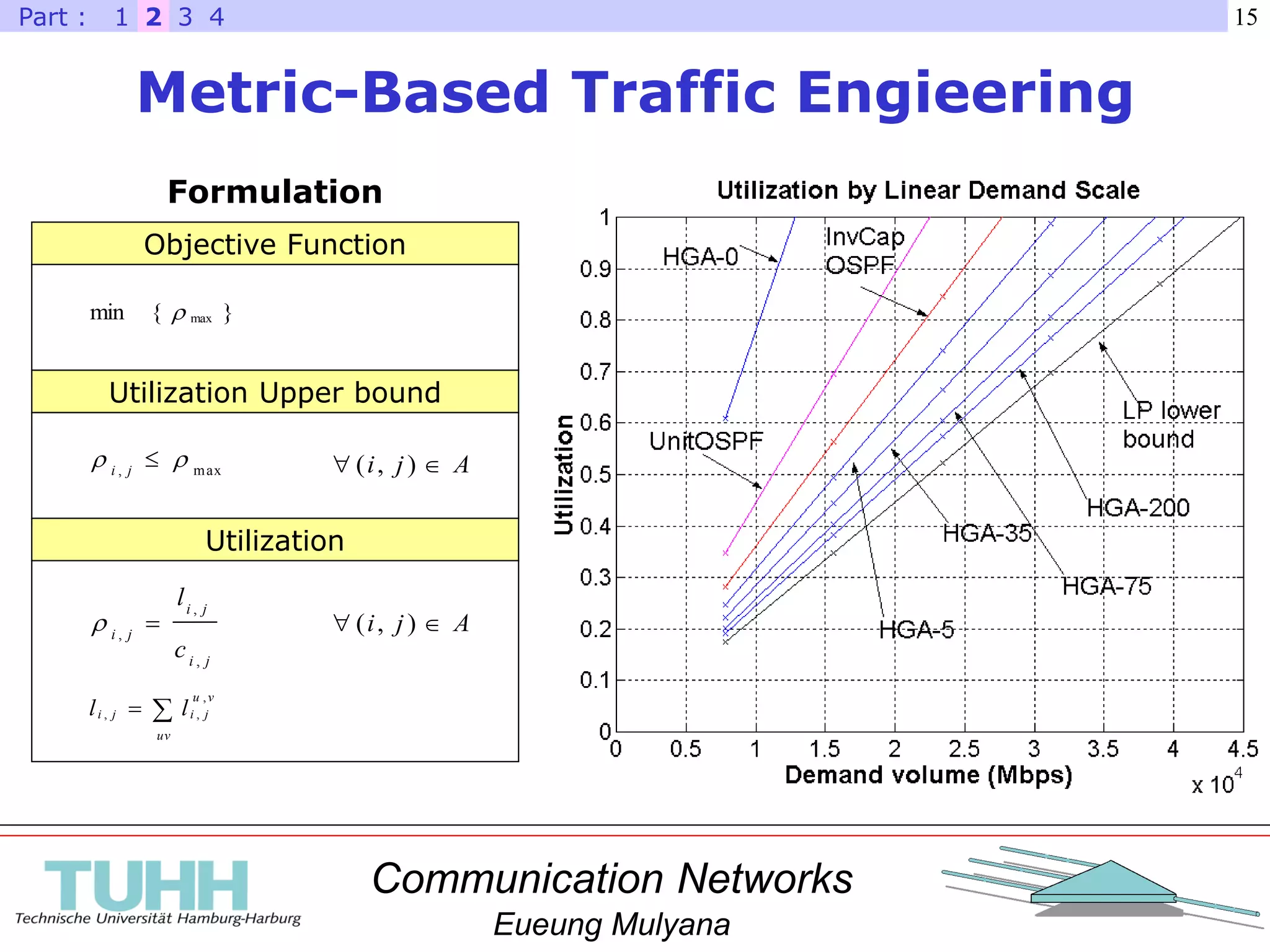
Current and Future Trends:
 Heterogeneous environment
Routing Control:
 Diverse applications with diverse Quality of Service (QoS)
requirements
 Avoiding congestion, increasing network efficiency, matching
routing policies and preferences
Dynamics of IP networks:
 Traffic variation, uncertainty
Communication Networks
Eueung Mulyana
3
Previous Works
„Classical“ IP Networks:
 Traffic engineering: Fortz(2000), Pioro(2001), ...
 Routing and dimensioning: Bley(1998,2002), ...
Multi-Protocol Label Switching (MPLS):
 LSP design: Haßlinger(2002), ...
 Network dimensioning: Arvidsson(2002), ...
Demand Uncertainty:
 Probabilistic assumption: Widjaja(2002), Mitra(2003), ...
 Polyhedral model: Ben-Ameur(2003) ...
Communication Networks
Eueung Mulyana
4
Contributions
Classical IP Networks:
 Metric based traffic engineering using hybrid genetic
algorithms
 Traffic engineering for transitional (IGP/MPLS) networks
 Impact of demand increase on network conditions and re-
optimization approaches
IP/MPLS:
 Hybrid routing schemes using metrics and explicit routes
 Routing and dimensioning for multi-class IP/MPLS networks
with per-class over-provisioning requirements
Demand Uncertainty:
 Several simple demand uncertainty models and the
corresponding traffic engineering approaches
Communication Networks
Eueung Mulyana
5
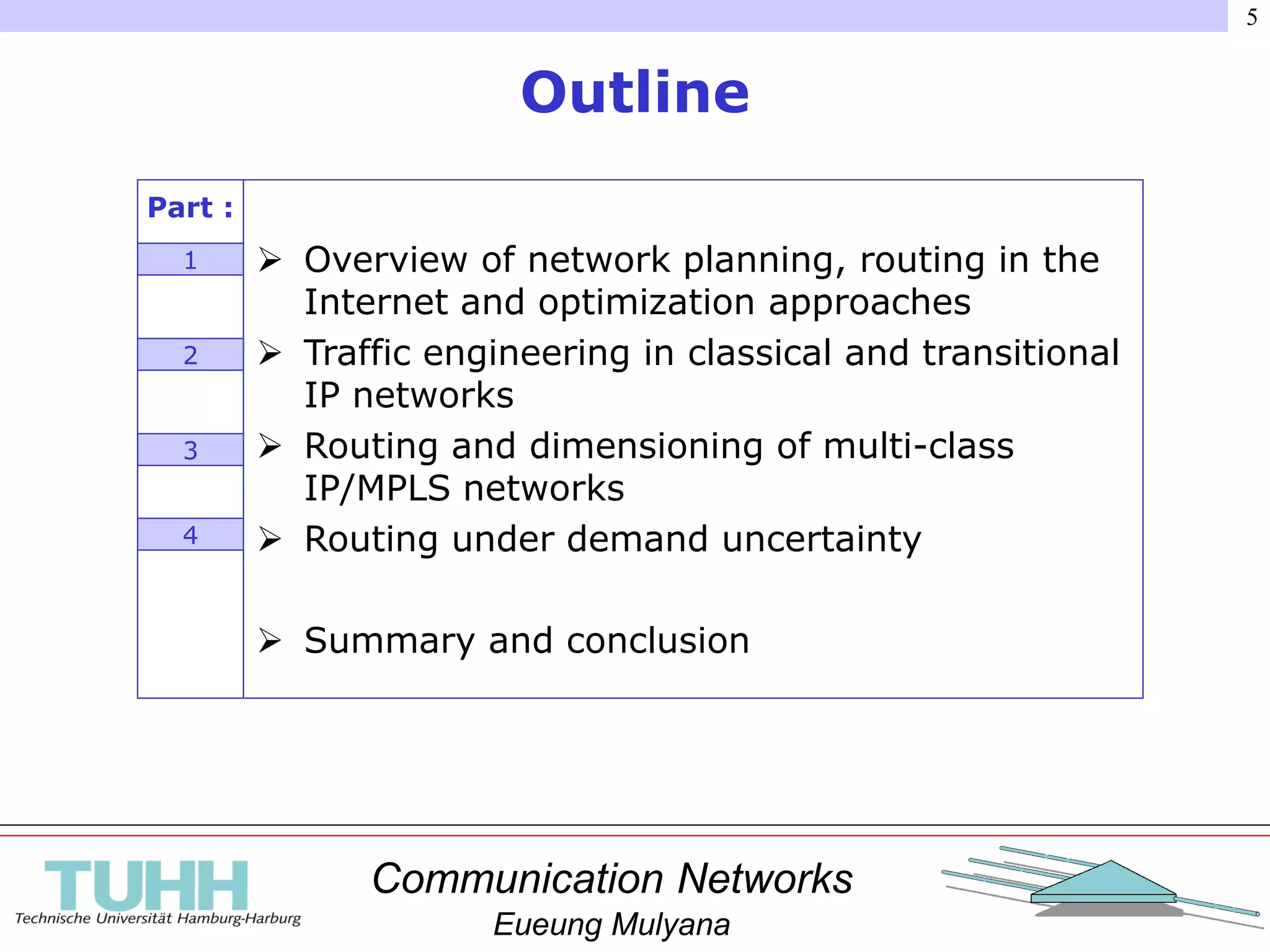
Outline
 Overview of network planning, routing in the
Internet and optimization approaches
 Traffic engineering in classical and transitional
IP networks
 Routing and dimensioning of multi-class
IP/MPLS networks
 Routing under demand uncertainty
 Summary and conclusion
Part :
1
2
3
4
Communication Networks
Eueung Mulyana
6
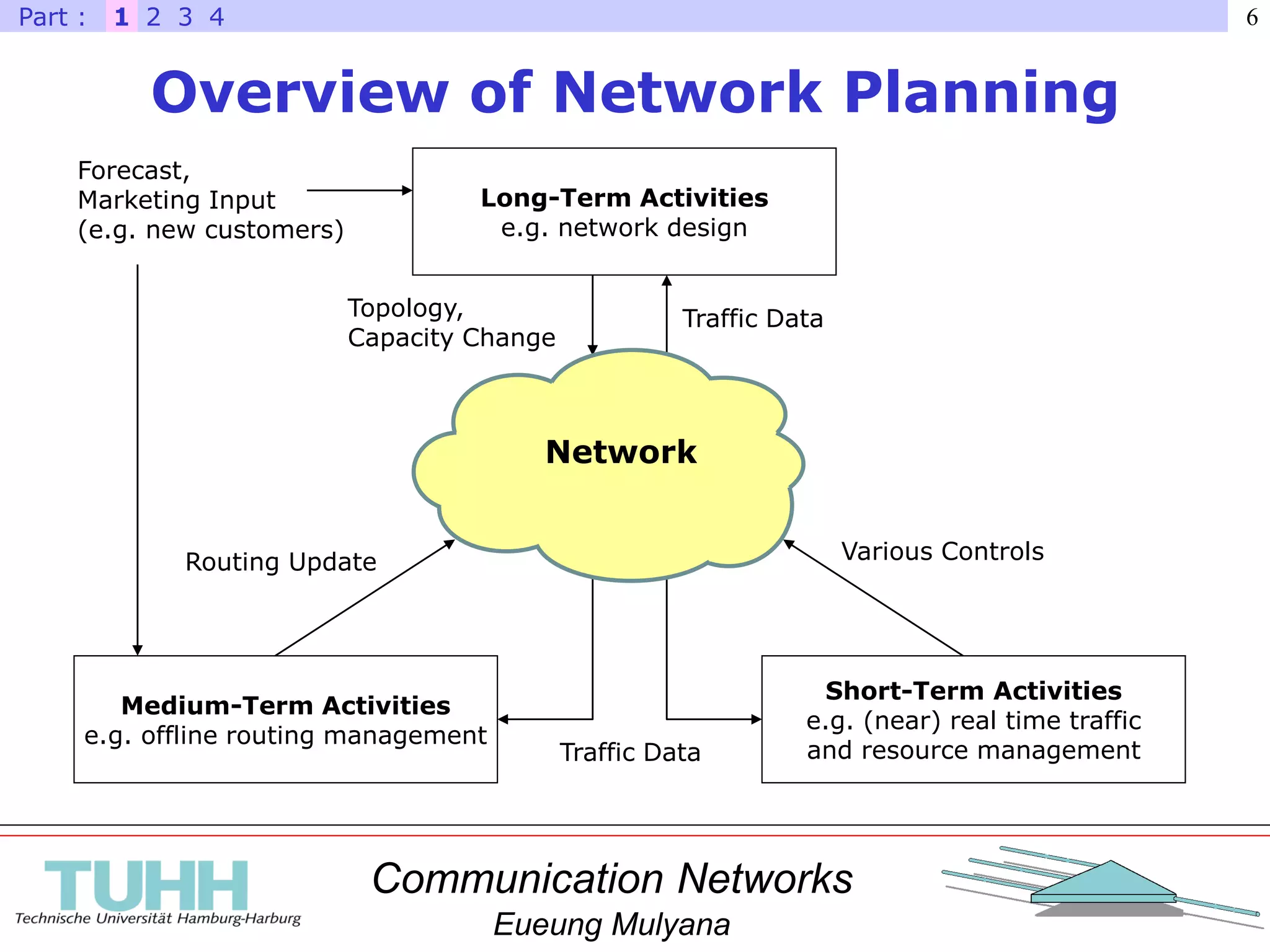
Overview of Network Planning
1 2 3 4Part :
Medium-Term Activities
e.g. offline routing management
Short-Term Activities
e.g. (near) real time traffic
and resource management
Long-Term Activities
e.g. network design
Forecast,
Marketing Input
(e.g. new customers)
Network
Traffic Data
Routing Update Various Controls
Traffic DataTopology,
Capacity Change
Communication Networks
Eueung Mulyana
7
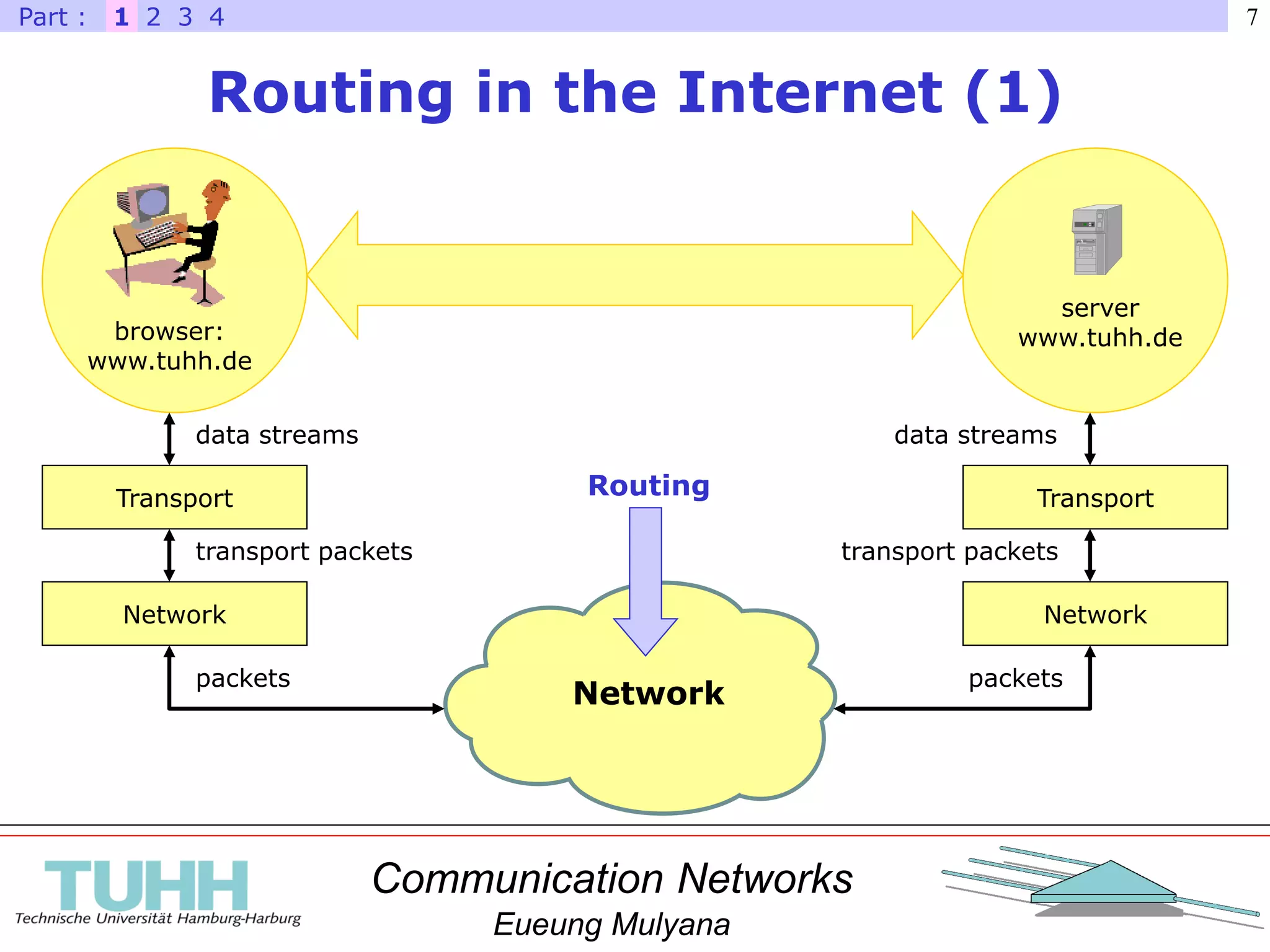
Routing in the Internet (1)
1 2 3 4Part :
server
www.tuhh.debrowser:
www.tuhh.de
Transport
Network
data streams
Transport
Network
data streams
packets
transport packets
Network
transport packets
packets
Routing
Communication Networks
Eueung Mulyana
8
2
1
5
3
4
6
7
8
9
10
server
www.tuhh.de
browser:
www.tuhh.de
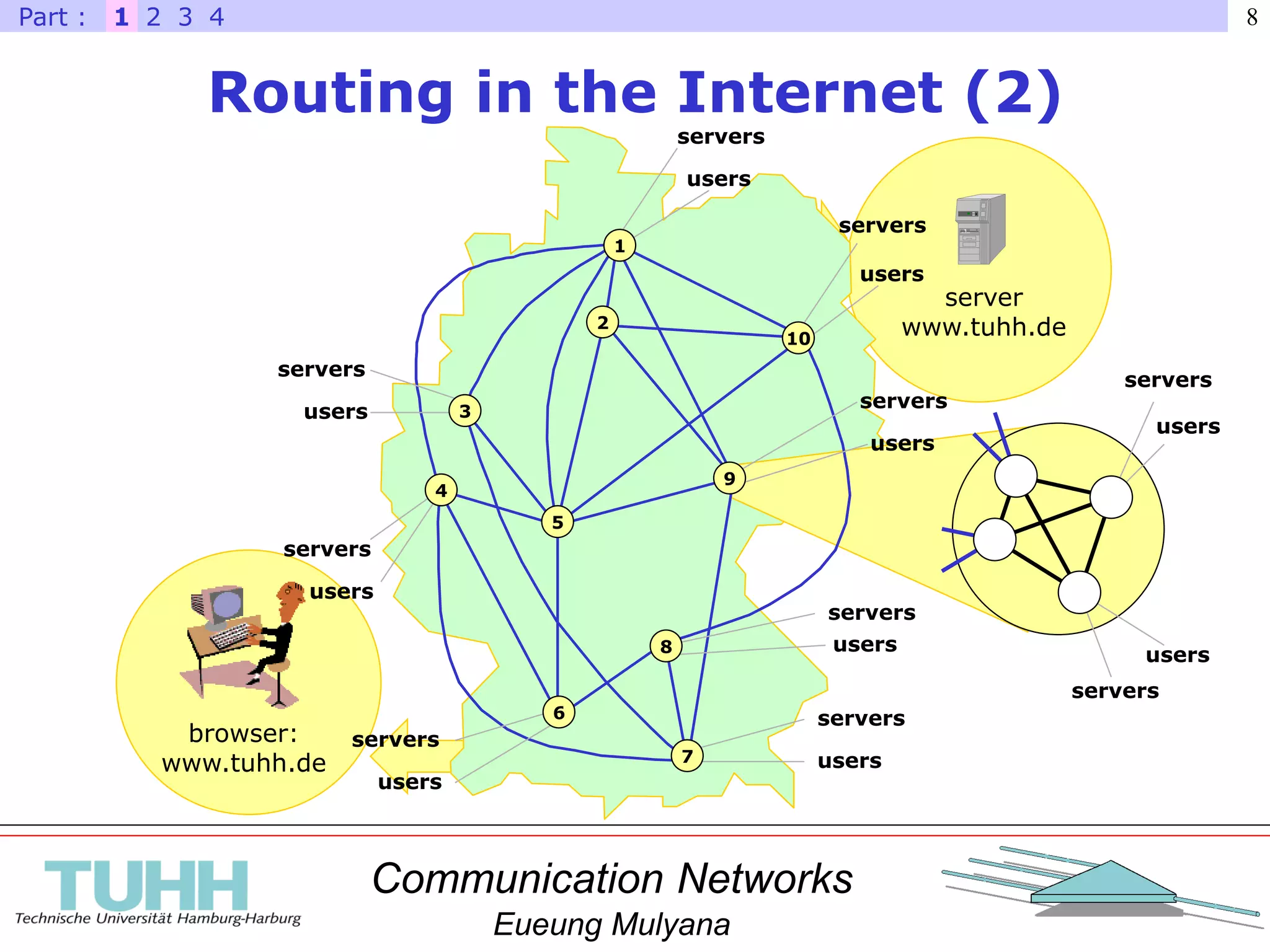
Routing in the Internet (2)
1 2 3 4Part :
servers
2
5
servers
users
1
servers
users
servers
users
10
9
servers
users8
servers
users7
servers
users
servers
users
users 3
4
6
servers
users
users
servers
Communication Networks
Eueung Mulyana
9
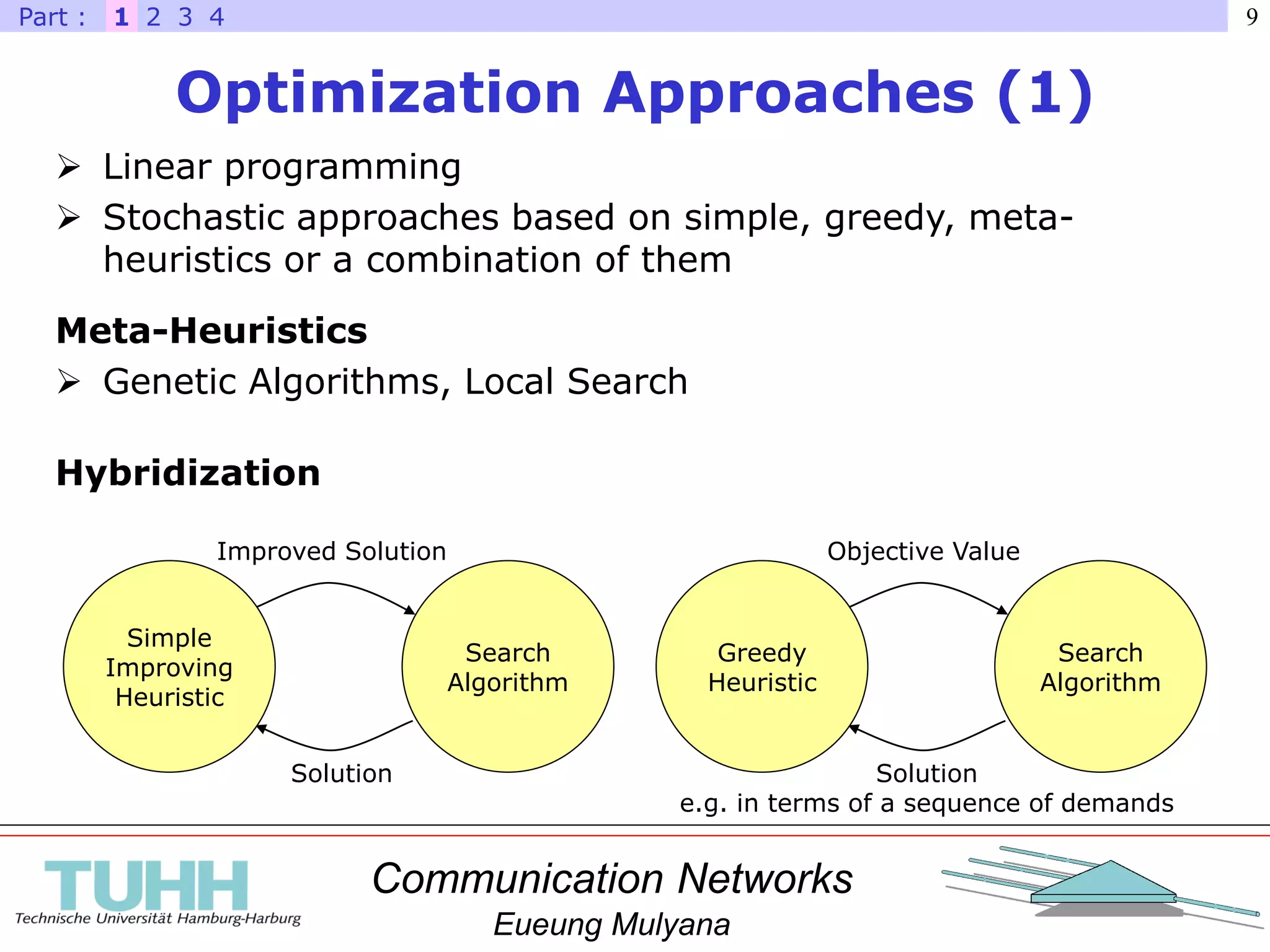
Optimization Approaches (1)
1 2 3 4Part :
 Linear programming
 Stochastic approaches based on simple, greedy, meta-
heuristics or a combination of them
Meta-Heuristics
 Genetic Algorithms, Local Search
Hybridization
Simple
Improving
Heuristic
Search
Algorithm
Solution
Improved Solution
Greedy
Heuristic
Search
Algorithm
Solution
e.g. in terms of a sequence of demands
Objective Value
Communication Networks
Eueung Mulyana
10
Optimization Approaches (2)
1 2 3 4Part :
Linear programming



n
j
jj xcz
1
i
n
j
jij bxa 
1
Minimize
Subject to: ],1[ mi 
 Can be solved by the branch
and bound or directly by the
simplex algorithm (for cases
without integer constraints)
 Commercial solver CPLEX
Meta-Heuristics
 Solution representation
 Exploration strategies („move“ or „genetic“ operators)
 Algorithms‘ specific parameters
Communication Networks
Eueung Mulyana
11
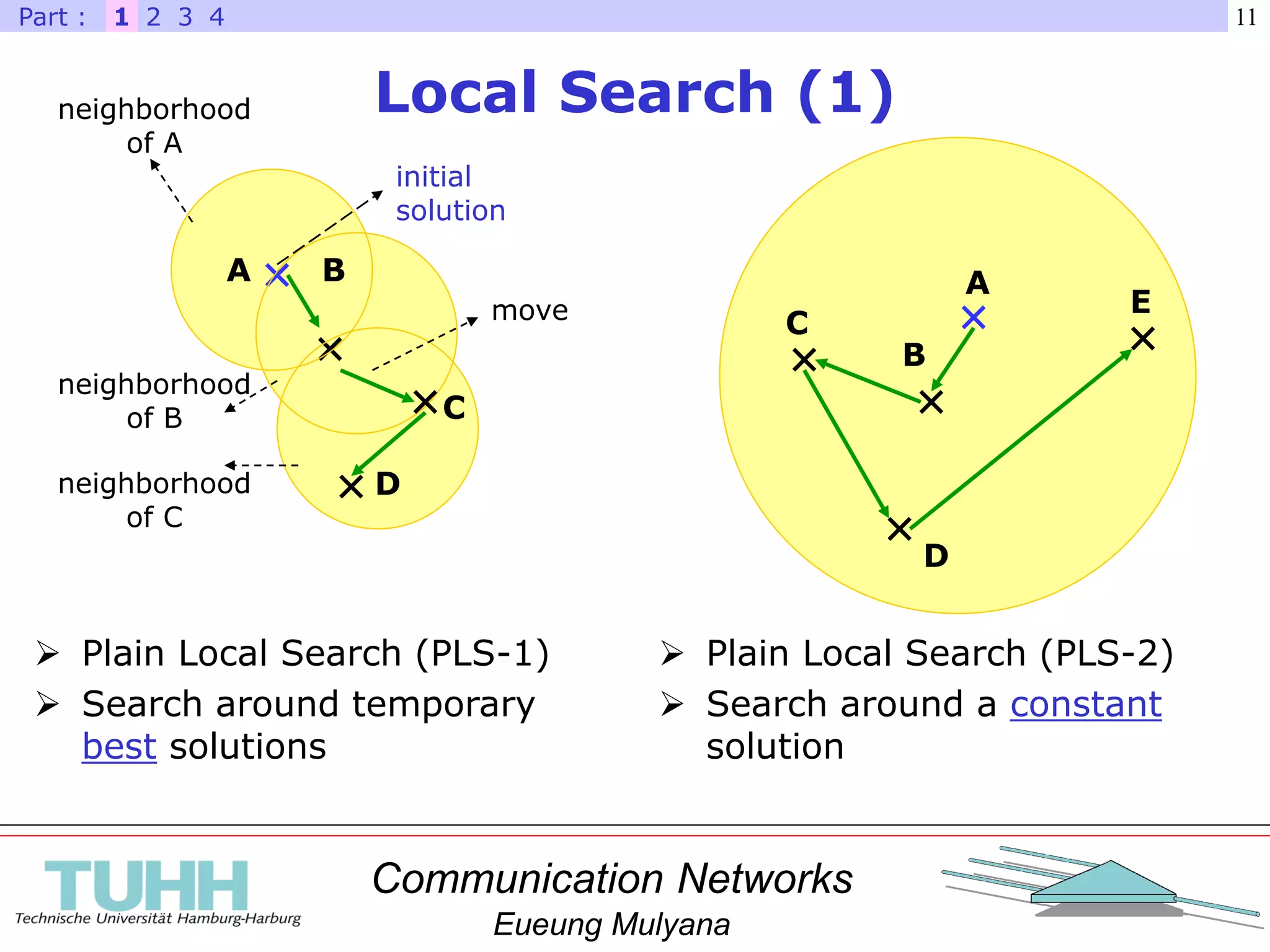
Local Search (1)
A
B
C
D
E
A B
C
D
1 2 3 4Part :
neighborhood
of A
initial
solution
move
 Plain Local Search (PLS-1)
 Search around temporary
best solutions
 Plain Local Search (PLS-2)
 Search around a constant
solution
neighborhood
of B
neighborhood
of C
Communication Networks
Eueung Mulyana
12
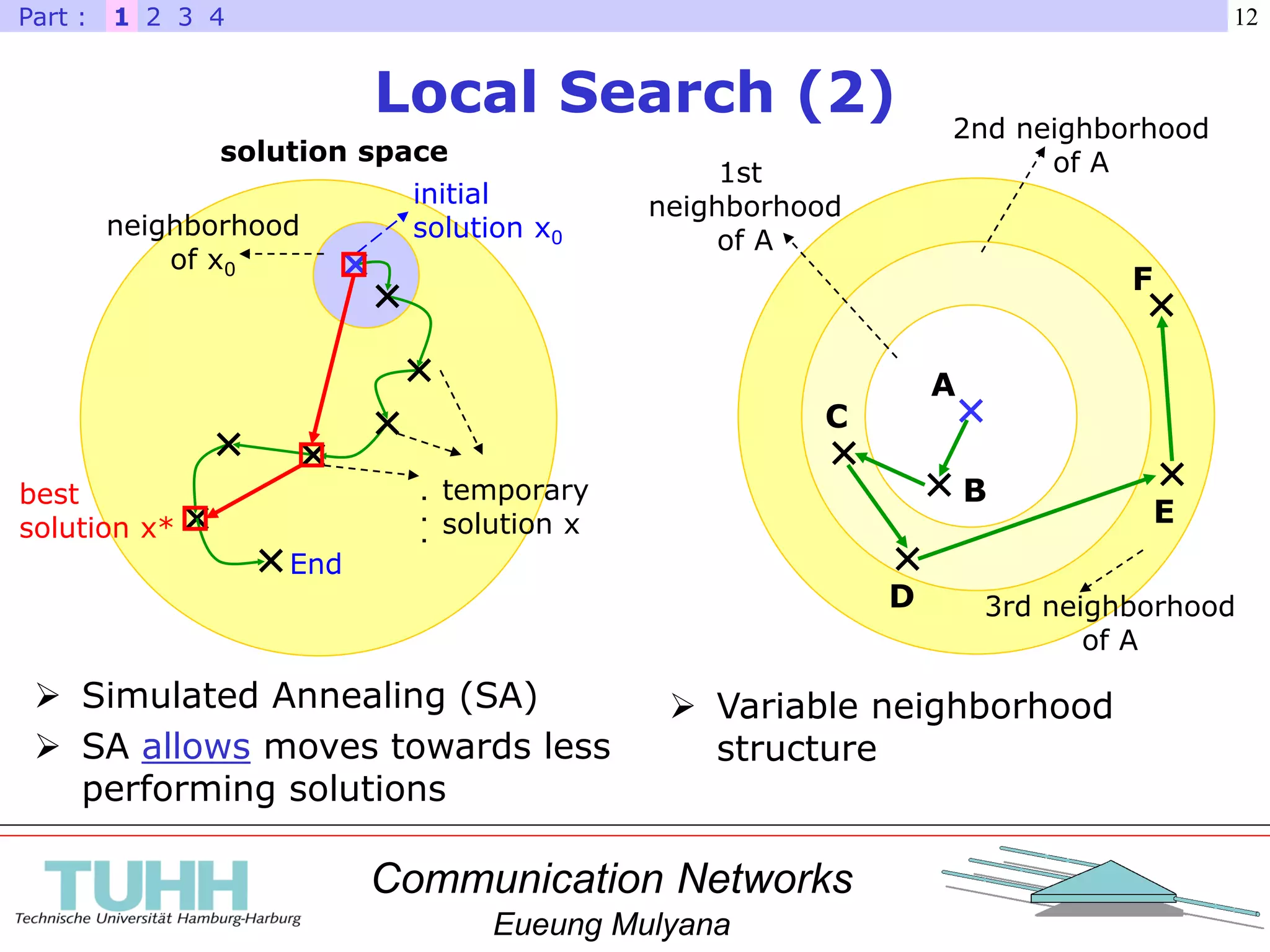
Local Search (2)
1 2 3 4Part :
A
B
C
D
E
F
1st
neighborhood
of A
2nd neighborhood
of A
3rd neighborhood
of A
 Variable neighborhood
structure
solution space
neighborhood
of x0
initial
solution x0
best
solution x*
End
temporary
solution x
.
.
.
 Simulated Annealing (SA)
 SA allows moves towards less
performing solutions
Communication Networks
Eueung Mulyana
13
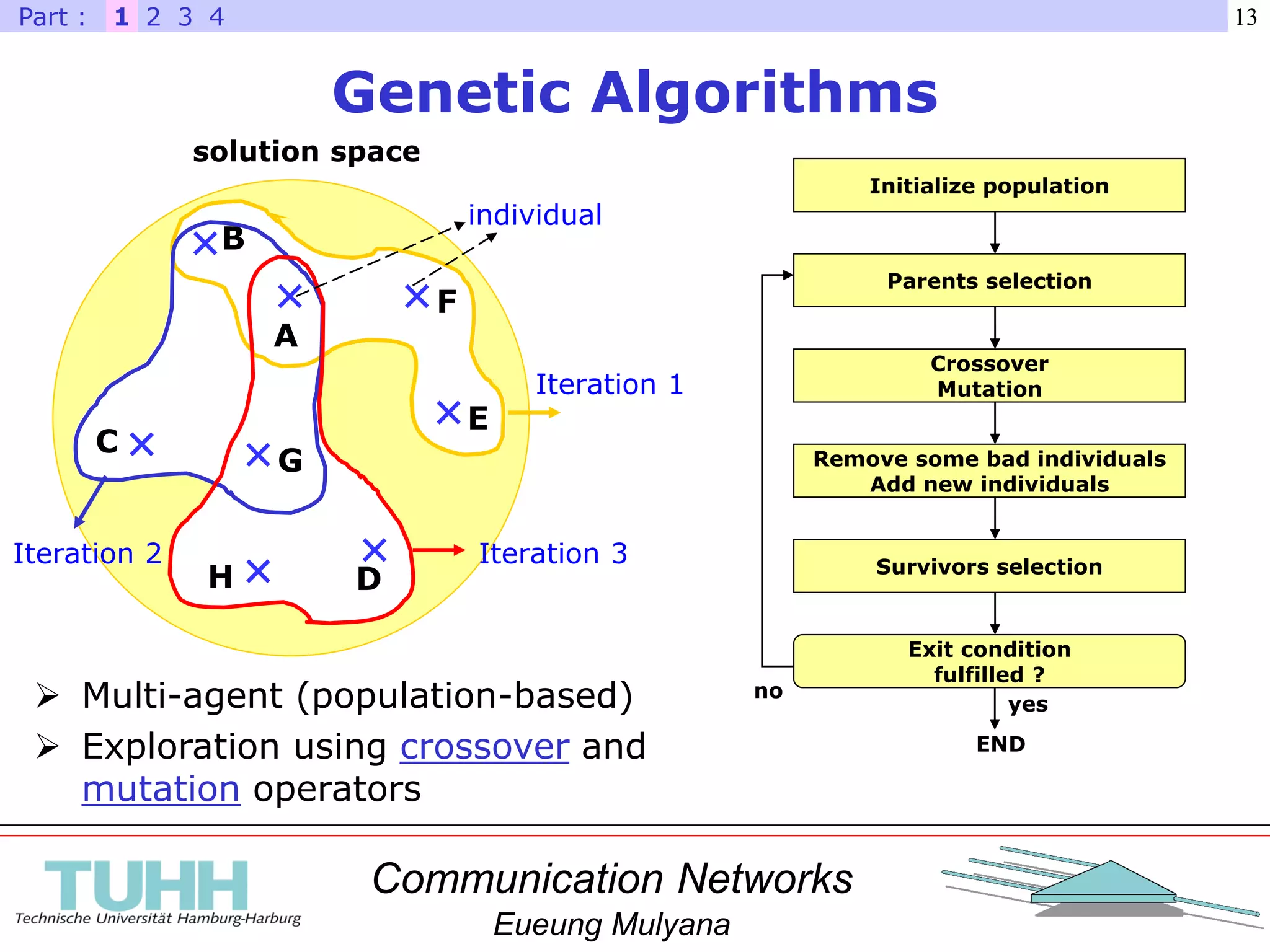
Genetic Algorithms
1 2 3 4Part :
solution space
A
B
C
D
E
F
G
H
Initialize population
Exit condition
fulfilled ?
Parents selection
Crossover
Mutation
Remove some bad individuals
Add new individuals
Survivors selection
END
yes
no
individual
Iteration 1
Iteration 3Iteration 2
 Multi-agent (population-based)
 Exploration using crossover and
mutation operators
Communication Networks
Eueung Mulyana
14
Routing in IP Networks: IGP
(b)(a)
6
11
1
1
1
1
2
21
2
3
5
5
121
3 4
5 6
2
3 4
5 6
1
2
4
6
5
3
1
2 3
4 5
1
 Driven by link metrics (weights/costs)
 Unique shortest path routing vs. Equal-Cost Multi-Path (ECMP)
ECMP e.g.
[1-2-4-6] 50%
[1-3-4-6] 25%
[1-3-5-6] 25%
Unique shortest path routing:
1 unique path for all node pairs
21 3 4Part :
Communication Networks
Eueung Mulyana
15
Metric-Based Traffic Engieering
Utilization Upper bound
Objective Function
}{min max
max,
 ji Aji  ),(
Utilization

uv
vu
jiji ll
,
,,
ji
ji
ji
c
l
,
,
,
 Aji  ),(
21 3 4Part :
Formulation
Communication Networks
Eueung Mulyana
16
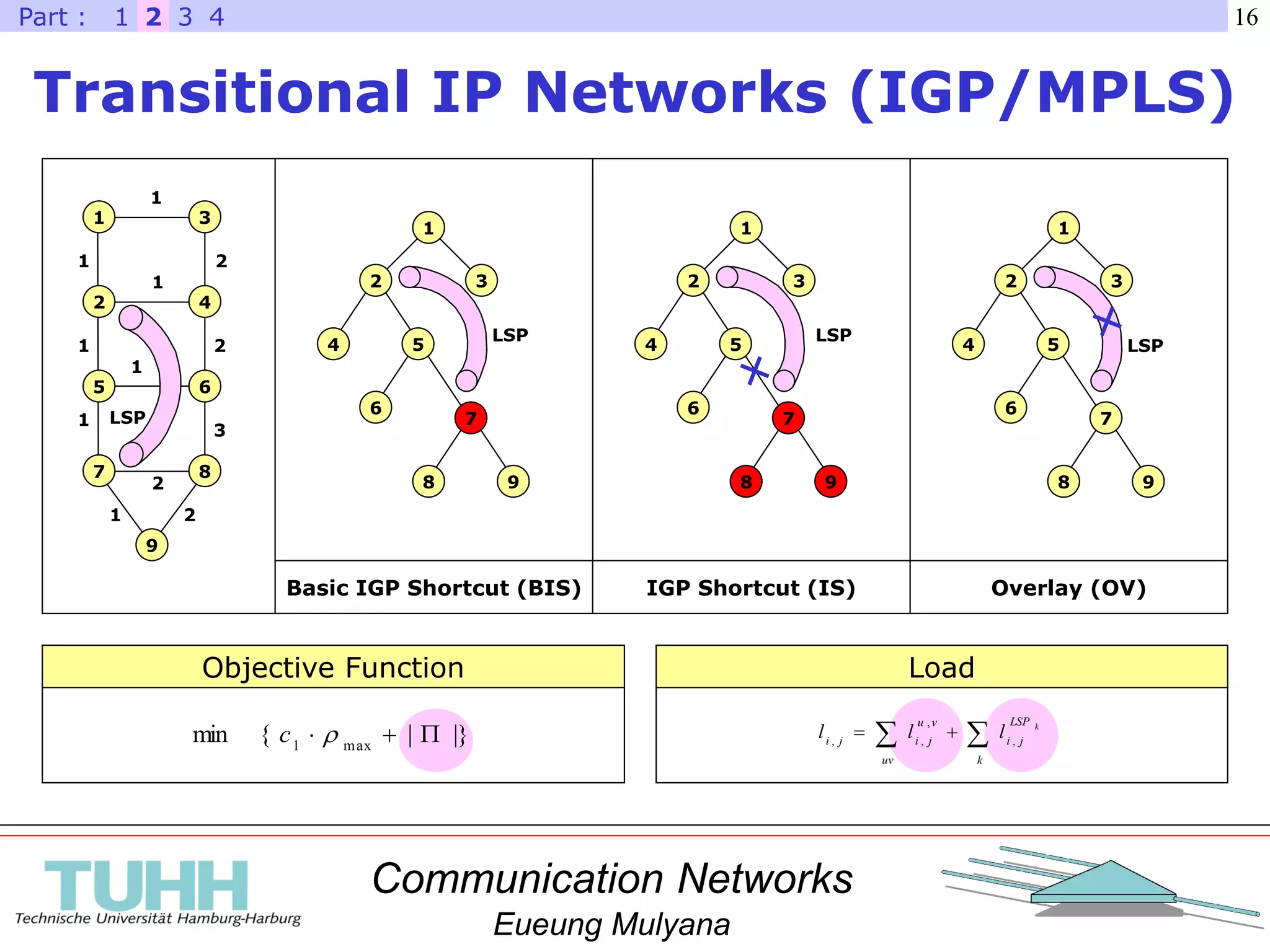
Transitional IP Networks (IGP/MPLS)
1
2 3
4 5
6
7
8 9
LSP
1
2 3
4 5
6
7
8 9
LSP
1
2 3
4 5
6
7
8 9
LSP
1 3
2 4
5 6
7 8
9
1
1
1
1
1
1
1
2
2
3
2
2
LSP
Basic IGP Shortcut (BIS) IGP Shortcut (IS) Overlay (OV)
21 3 4Part :
}||{min max1
 c  
k
LSP
ji
uv
vu
jiji
k
lll ,
,
,,
Objective Function Load
Communication Networks
Eueung Mulyana
17
Network topology
and link capacities
Traffic demand
Partial demand
increase
Re-optimization
Analyze
Policy
not compliant
Weight Changes
Network Upgrade
Set of metric
values
policy compliant
Partial Demand Increase
21 3 4Part :
Mbps]10,5[
,
%2 
vu
f%2
max Mbps]50,5[
,
%2 
vu
f%2
max
Number of traffic-
increase pattern
Communication Networks
Eueung Mulyana
18
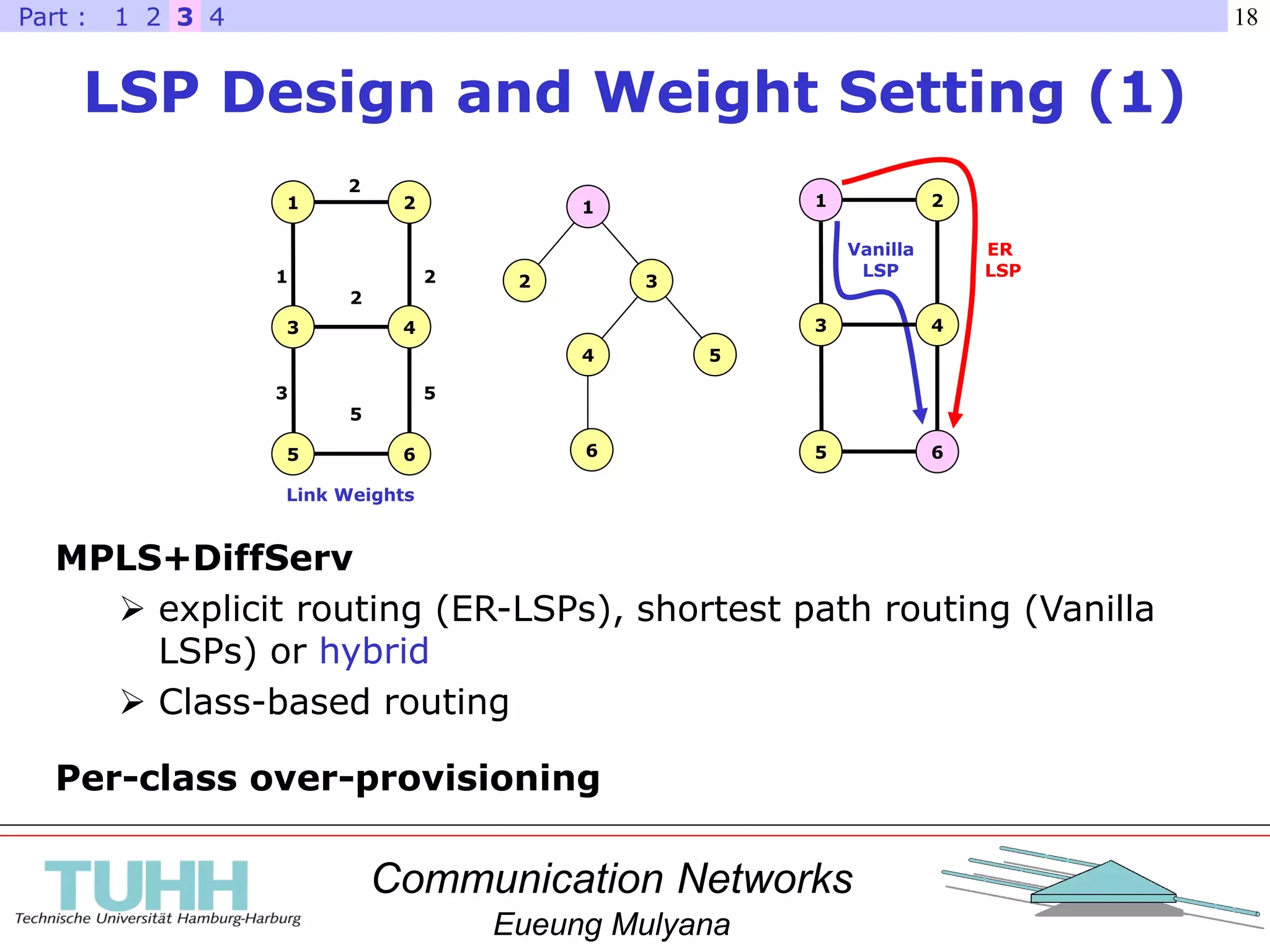
LSP Design and Weight Setting (1)
Vanilla
LSP
ER
LSP
2
1
2
3
5
2
5
1 2
3 4
5 6
Link Weights
1
2 3
4 5
6
1 2
3 4
5 6
MPLS+DiffServ
 explicit routing (ER-LSPs), shortest path routing (Vanilla
LSPs) or hybrid
 Class-based routing
Per-class over-provisioning
321 4Part :
Communication Networks
Eueung Mulyana
19
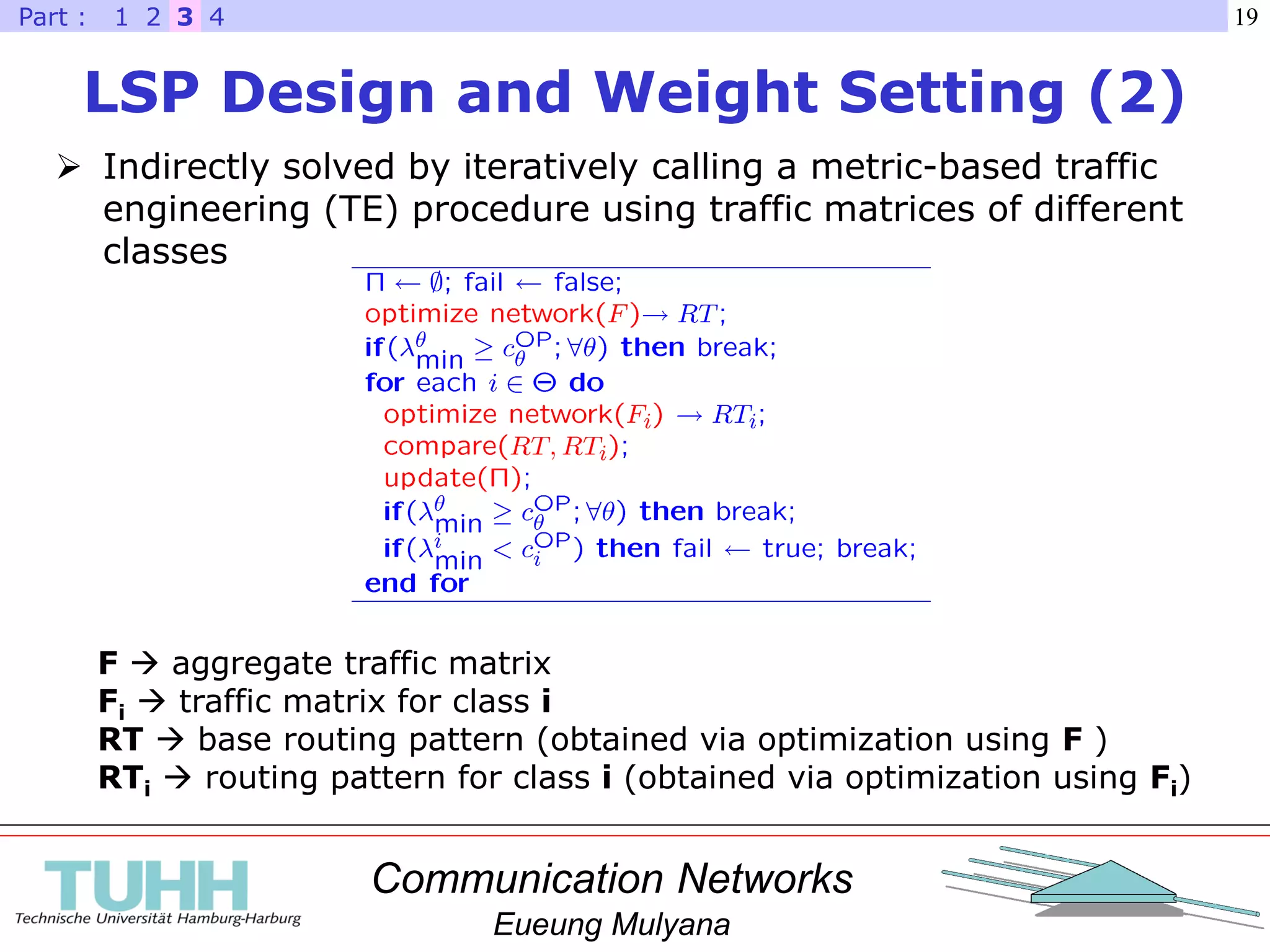
LSP Design and Weight Setting (2)
 Indirectly solved by iteratively calling a metric-based traffic
engineering (TE) procedure using traffic matrices of different
classes
F  aggregate traffic matrix
Fi  traffic matrix for class i
RT  base routing pattern (obtained via optimization using F )
RTi  routing pattern for class i (obtained via optimization using Fi)
321 4Part :
Communication Networks
Eueung Mulyana
20
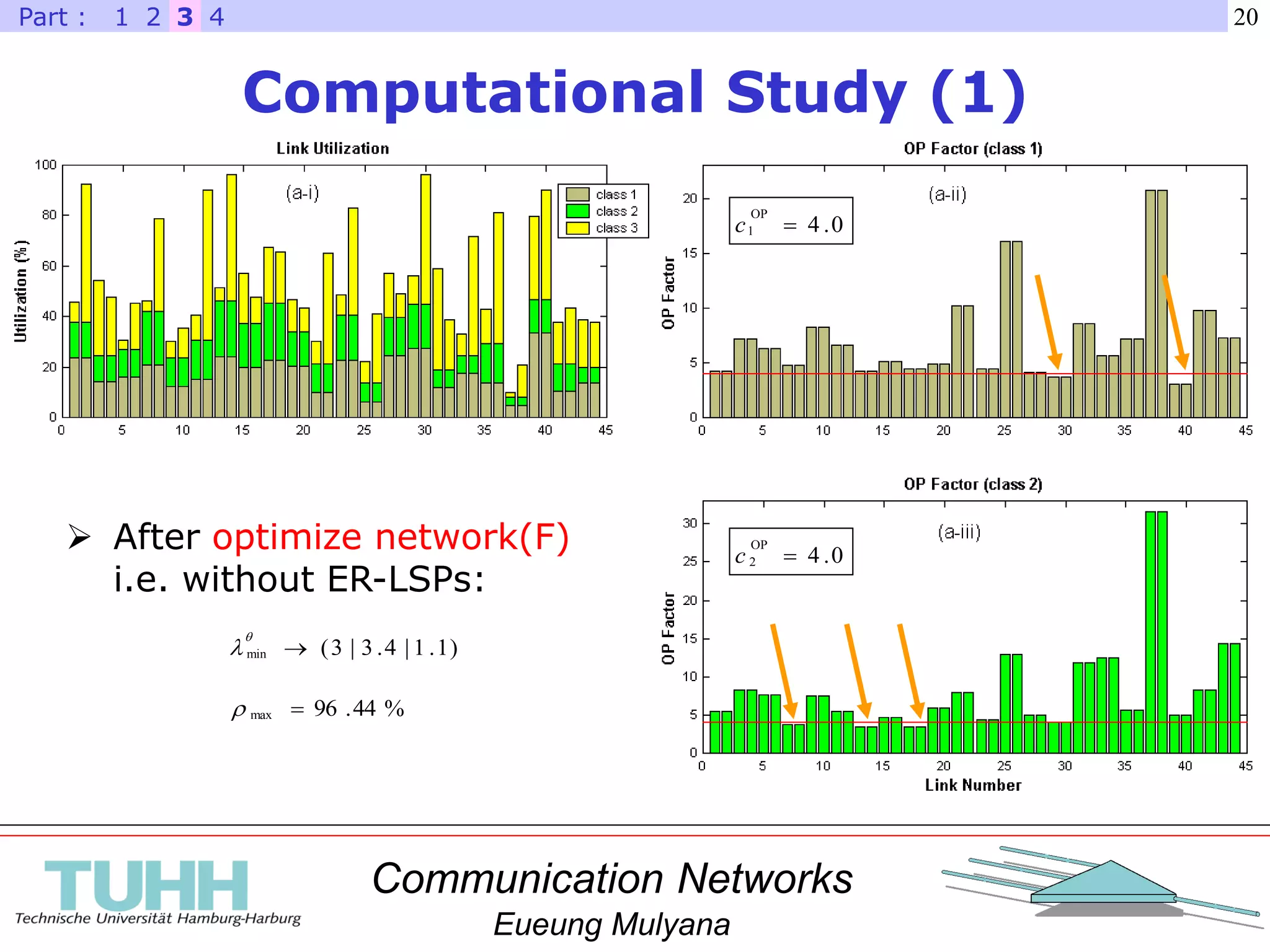
Computational Study (1)
0.4
OP
1 c
0.4
OP
2 c
 After optimize network(F)
i.e. without ER-LSPs:
)1.1|4.3|3(min 


%44.96max 
321 4Part :
Communication Networks
Eueung Mulyana
21
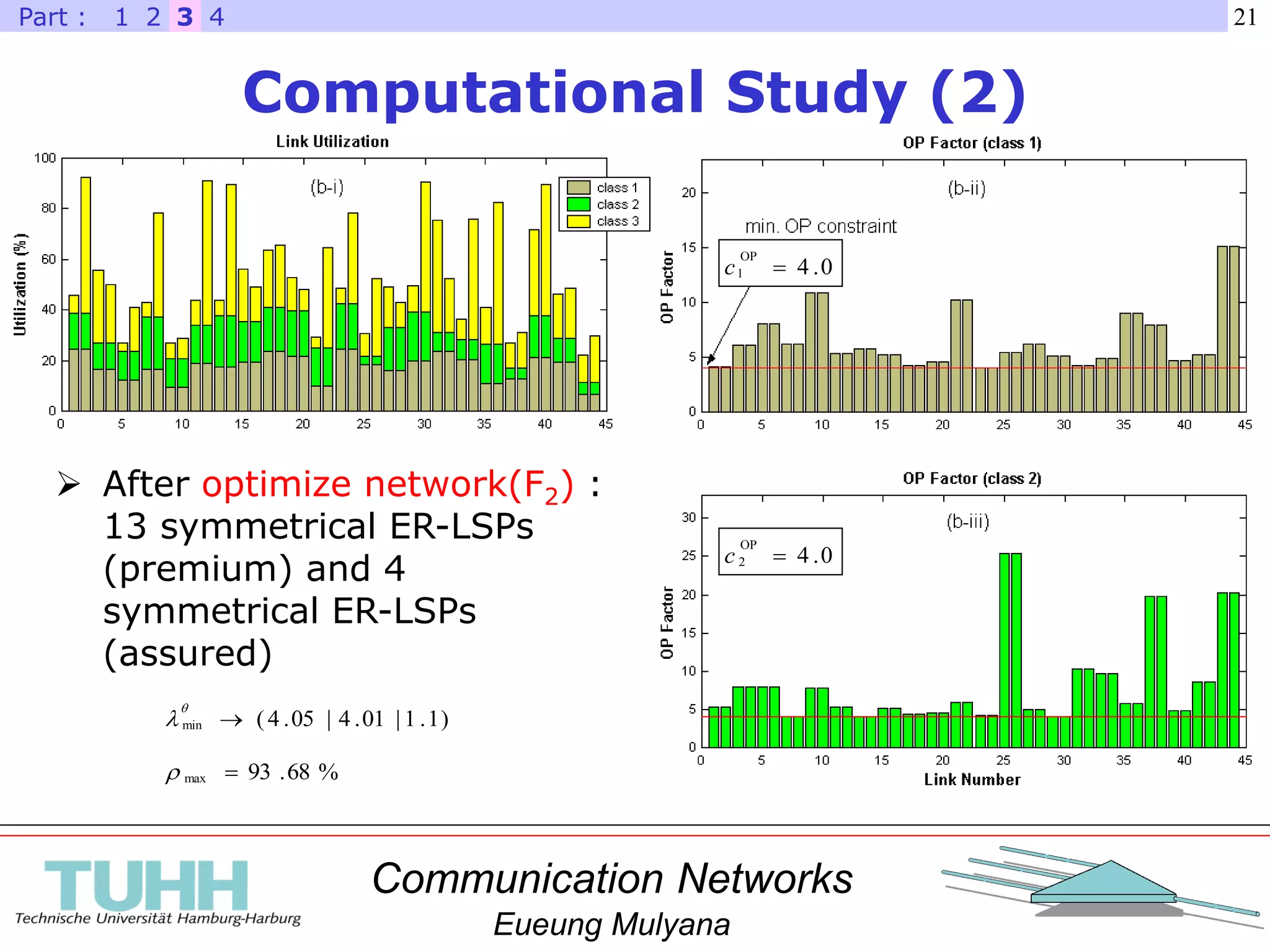
Computational Study (2)
0.4
OP
1 c
0.4
OP
2 c
 After optimize network(F2) :
13 symmetrical ER-LSPs
(premium) and 4
symmetrical ER-LSPs
(assured)
)1.1|01.4|05.4(min 


%68.93max 
321 4Part :
Communication Networks
Eueung Mulyana
22
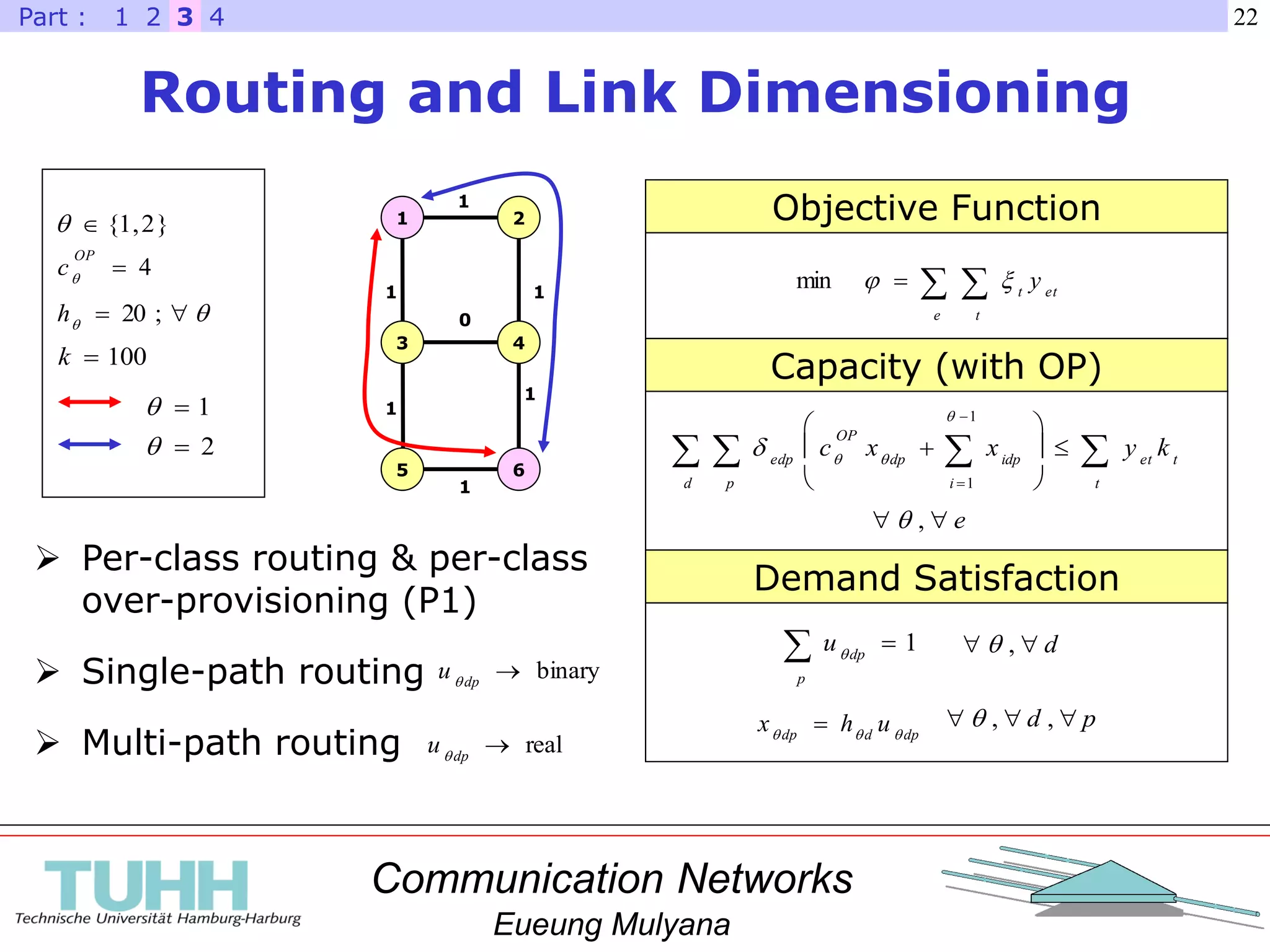
Routing and Link Dimensioning
321 4Part :
1
1
0
1
1
1
1
1 2
3 4
5 6
}2,1{
4
OP
c

 ;20h
100k
1
2
 
e t
ett
ymin
Objective Function
Capacity (with OP)
   







 t
tet
d p i
idpdp
OP
edp
kyxxc
1
1



e ,
Demand Satisfaction
 
p
dp
u 1 d ,
dpddp
uhx 
 pd  ,,
 Per-class routing & per-class
over-provisioning (P1)
 Single-path routing
 Multi-path routing realdp
u
binarydp
u
Communication Networks
Eueung Mulyana
23
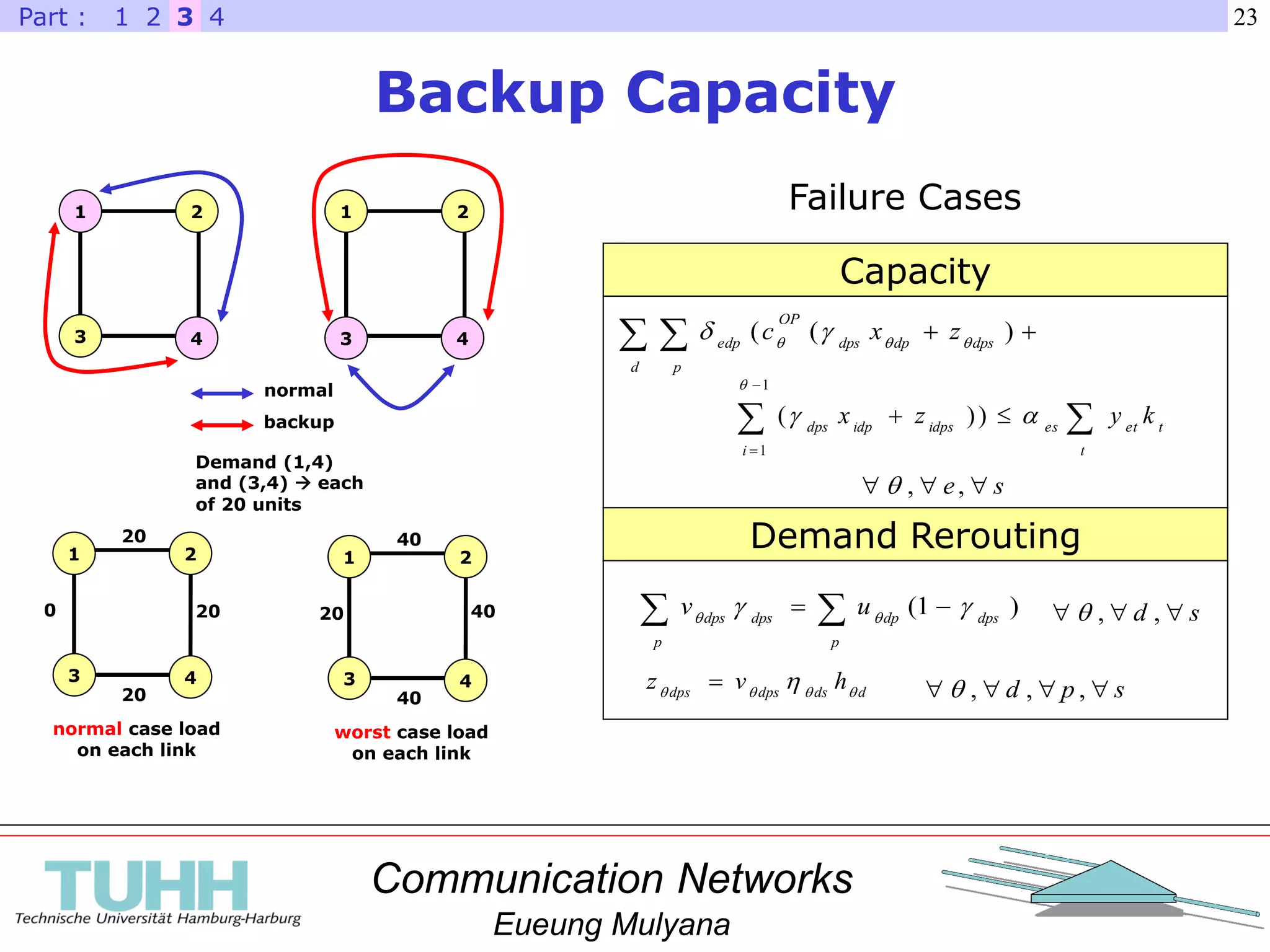
Backup Capacity
321 4Part :
1 2
3 4 3
21
4
normal
backup
Demand (1,4)
and (3,4)  each
of 20 units
1
3
2
4
40
40
4020
worst case load
on each link
 

 t
tetes
i
idpsidpdps
kyzx 

))(
1
1
se  ,,
 
p
dpsdp
p
dpsdps
uv )1(   sd  ,,
ddsdpsdps
hvz 
 spd  ,,,
  )(( dpsdpdps
OP
d p
edp
zxc 

Demand Rerouting
Capacity
Failure Cases
1
3
2
4
20
20
200
normal case load
on each link
Communication Networks
Eueung Mulyana
24
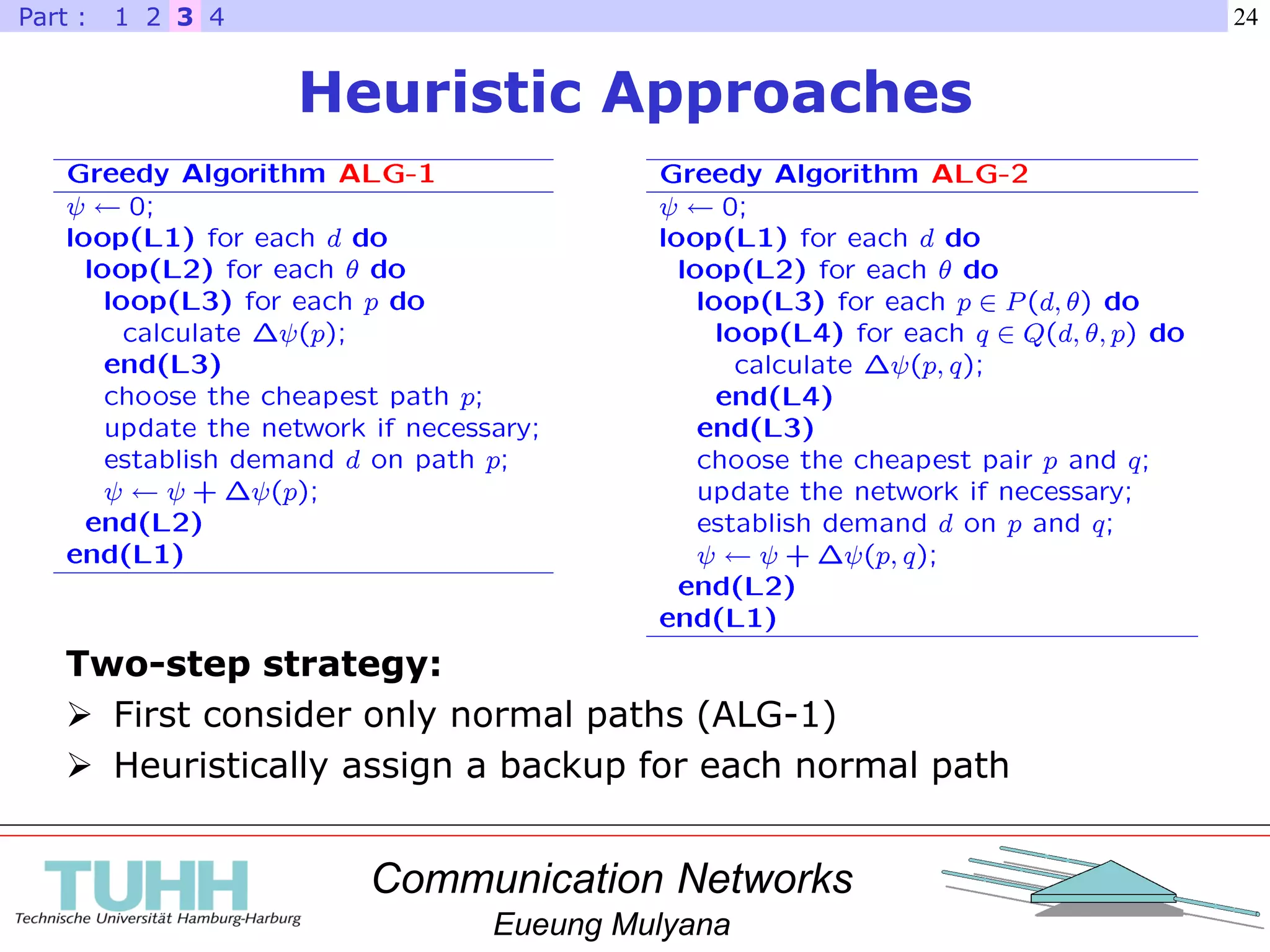
Heuristic Approaches
321 4Part :
Two-step strategy:
 First consider only normal paths (ALG-1)
 Heuristically assign a backup for each normal path
Communication Networks
Eueung Mulyana
25
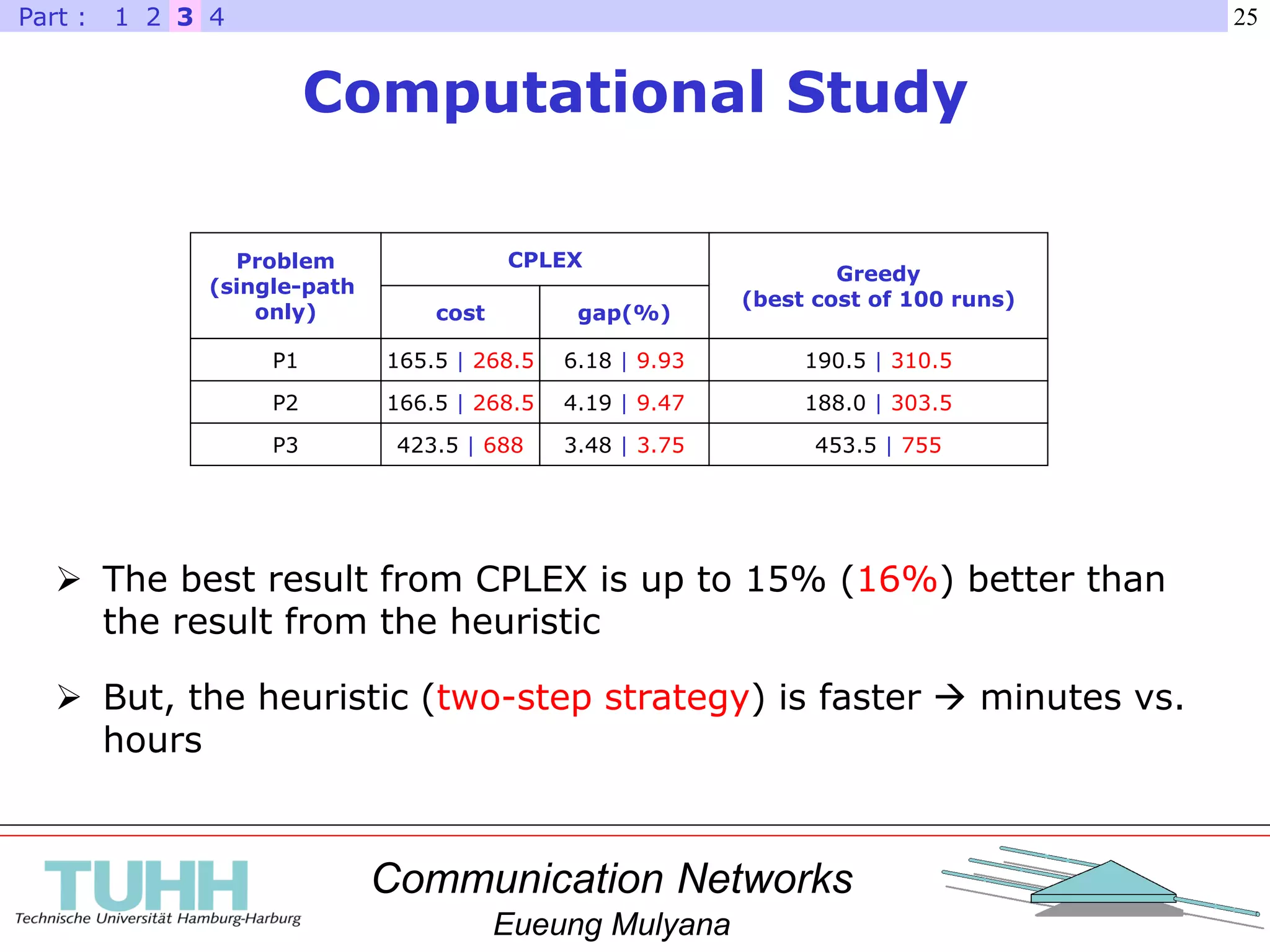
Computational Study
321 4Part :
Problem
(single-path
only)
P1
CPLEX
cost gap(%)
Greedy
(best cost of 100 runs)
P2
P3
165.5 | 268.5
166.5 | 268.5
423.5 | 688
6.18 | 9.93
4.19 | 9.47
3.48 | 3.75
190.5 | 310.5
188.0 | 303.5
453.5 | 755
 The best result from CPLEX is up to 15% (16%) better than
the result from the heuristic
 But, the heuristic (two-step strategy) is faster  minutes vs.
hours
Communication Networks
Eueung Mulyana
26
.
.
.
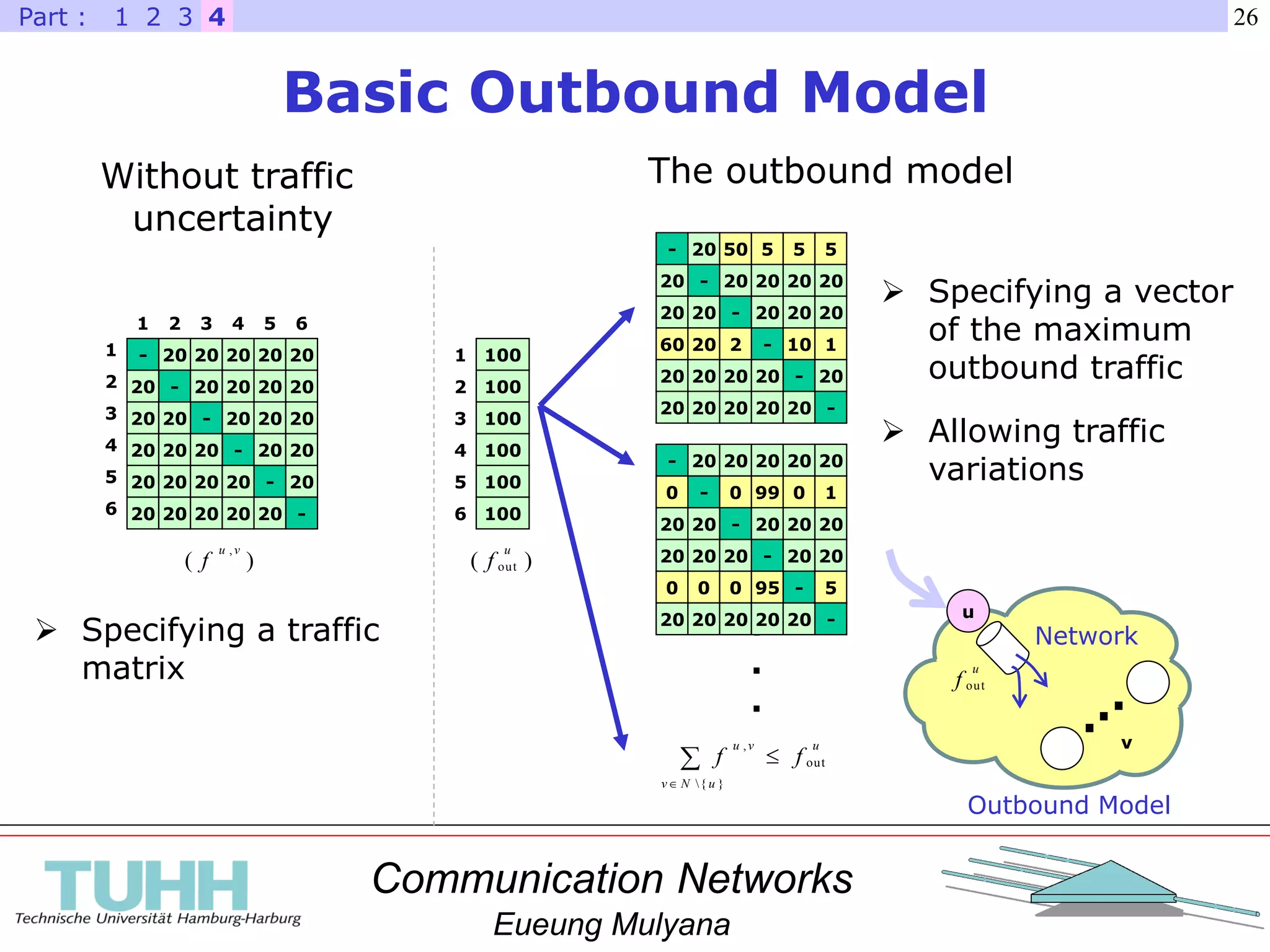
Basic Outbound Model
120-
2
3
4
5
6
100
100
100
100
100
100
1
2
3
4
5
6



}{
out
,
uNv
uvu
ff
)(
, vu
f )( out
u
f
 Specifying a traffic
matrix
 Specifying a vector
of the maximum
outbound traffic
 Allowing traffic
variations
The outbound modelWithout traffic
uncertainty
1 2
20 20 20 20
3 4 5 6
- 20 20 20 20
- 20 20 20
- 20 20
- 20
-
20
20
20
20
20
20
20
20
20
20
20
20
20
20 20
20- 50 5 5 5
- 20 20 20 20
- 20 20 20
- 10 1
- 20
-
20
20
60
20
20
20
20
20
20
2
20
20
20
20 20
20- 20 20 20 20
- 0 99 0 1
- 20 20 20
- 20 20
- 5
-
0
20
20
0
20
20
20
0
20
20
0
20
95
20 20
42 31Part :
u
f out
u
..
. v
Outbound Model
Network
Communication Networks
Eueung Mulyana
27
M1
Constraints
Link load
(Upperbound)
M7
M3
M9
uvu
f out
,




}{
out
,
uNv
uvu
ff



u
rv
u
r
vu
ff out,
,
u
r
vu
f out,
,

 



r v
vu
ji
u
r
vu
ji
v
u
r
u
ji
u
r
u
r
fl );max(min
,
,out,
,
,out,, 
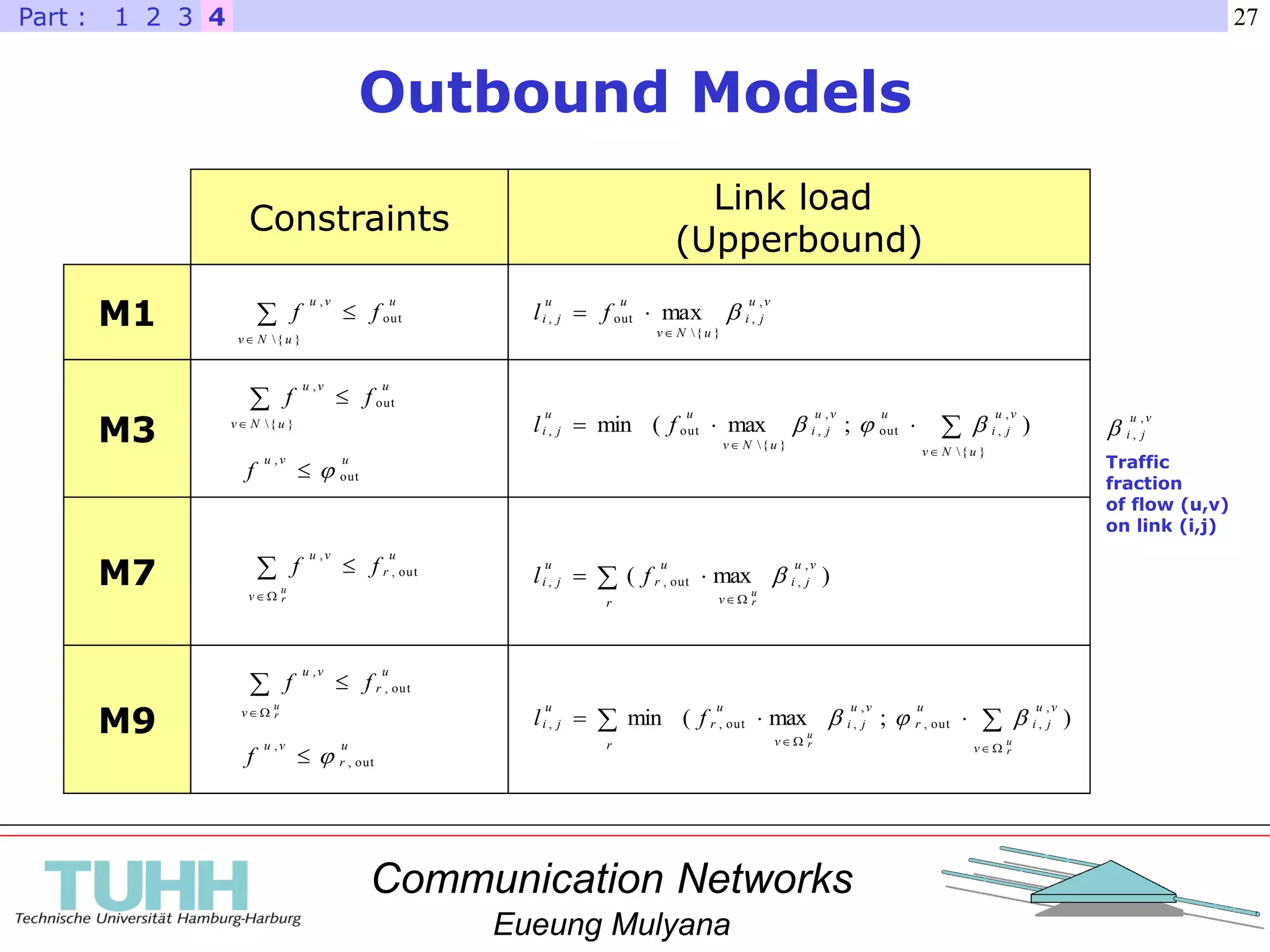
Outbound Models
42 31Part :



}{
out
,
uNv
uvu
ff
);max(min
}{
,
,out
,
,
}{
out, 



uNv
vu
ji
uvu
ji
uNv
uu
ji fl 
vu
ji
uNv
uu
ji fl
,
,
}{
out, max 


vu
ji
,
,
Traffic
fraction
of flow (u,v)
on link (i,j)



u
rv
u
r
vu
ff out,
,



r
vu
ji
v
u
r
u
ji
u
r
fl )max(
,
,out,, 
Communication Networks
Eueung Mulyana
28
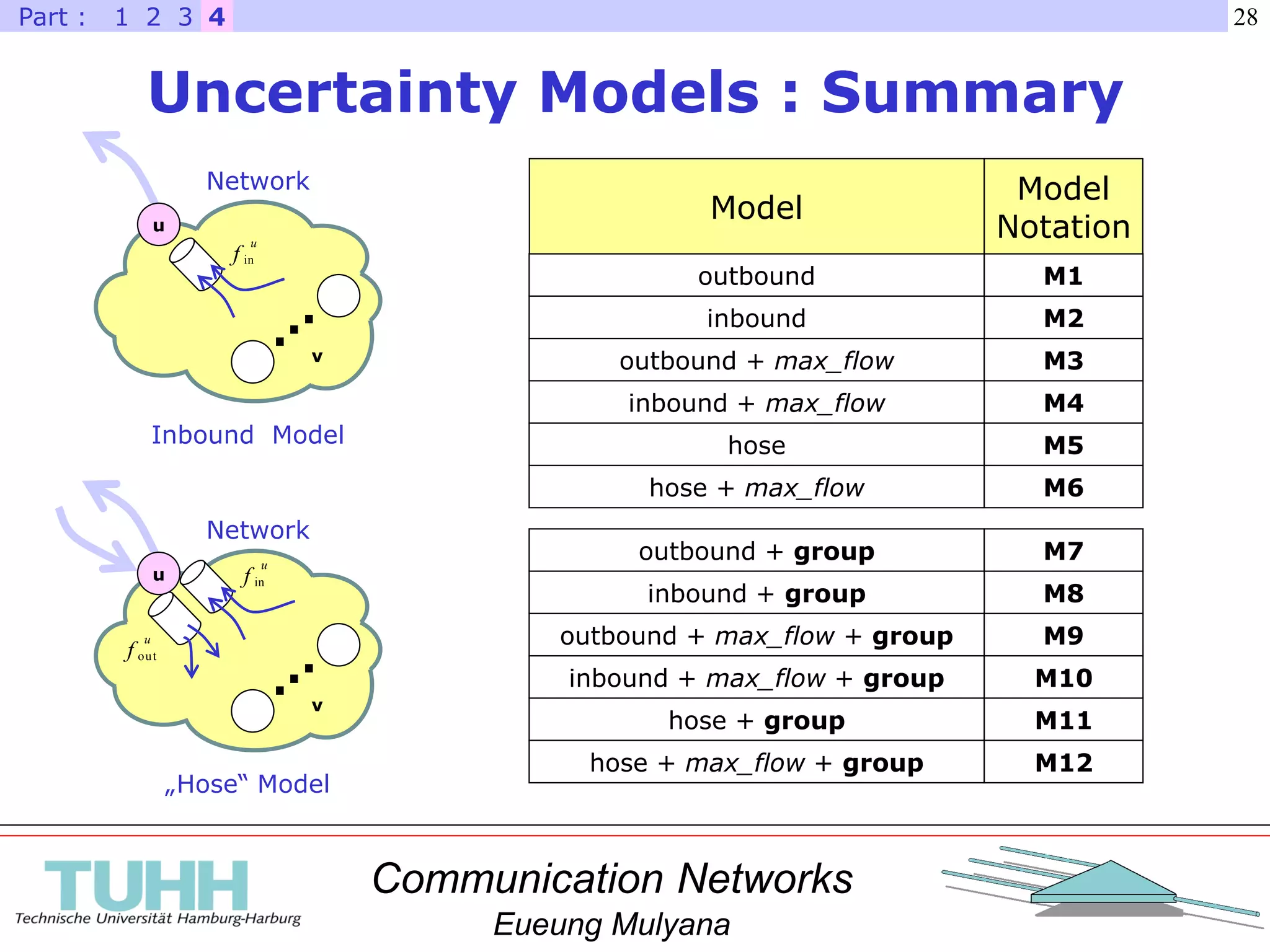
Uncertainty Models : Summary
42 31Part :
u
f out
u
f inu
..
. v
„Hose“ Model
Network
u
f in
u
..
. v
Inbound Model
Network
M2
Model
Model
Notation
outbound
inbound
M1
outbound + max_flow M3
inbound + max_flow M4
hose M5
hose + max_flow M6
M8
outbound + group
inbound + group
M7
outbound + max_flow + group M9
inbound + max_flow + group M10
hose + group M11
hose + max_flow + group M12
Communication Networks
Eueung Mulyana
29
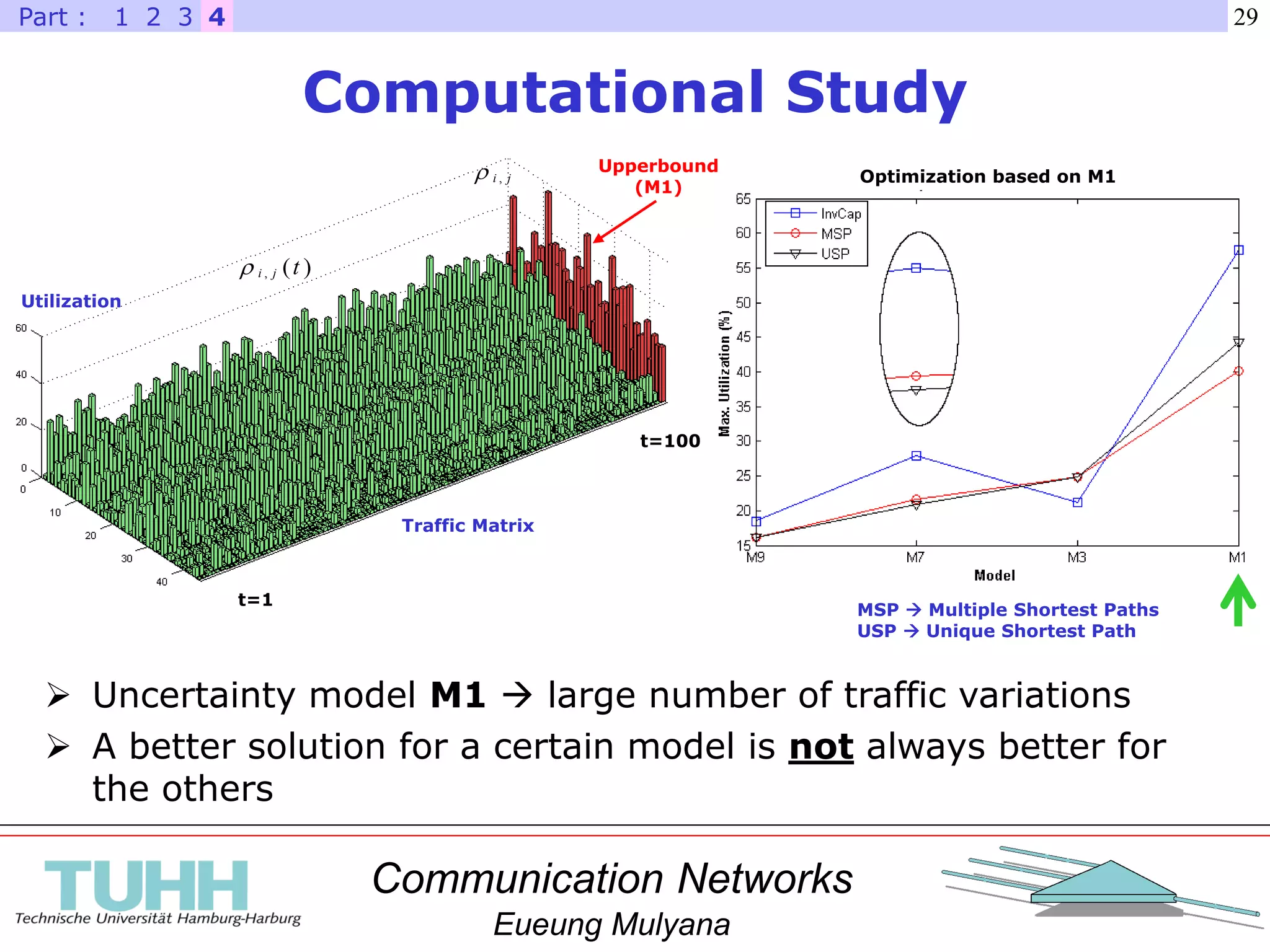
Computational Study
 Uncertainty model M1  large number of traffic variations
 A better solution for a certain model is not always better for
the others
Upperbound
(M1)
Traffic Matrix
Utilization
)(, tji
ji ,
t=1
t=100
42 31Part :
Optimization based on M1
MSP  Multiple Shortest Paths
USP  Unique Shortest Path
Communication Networks
Eueung Mulyana
30
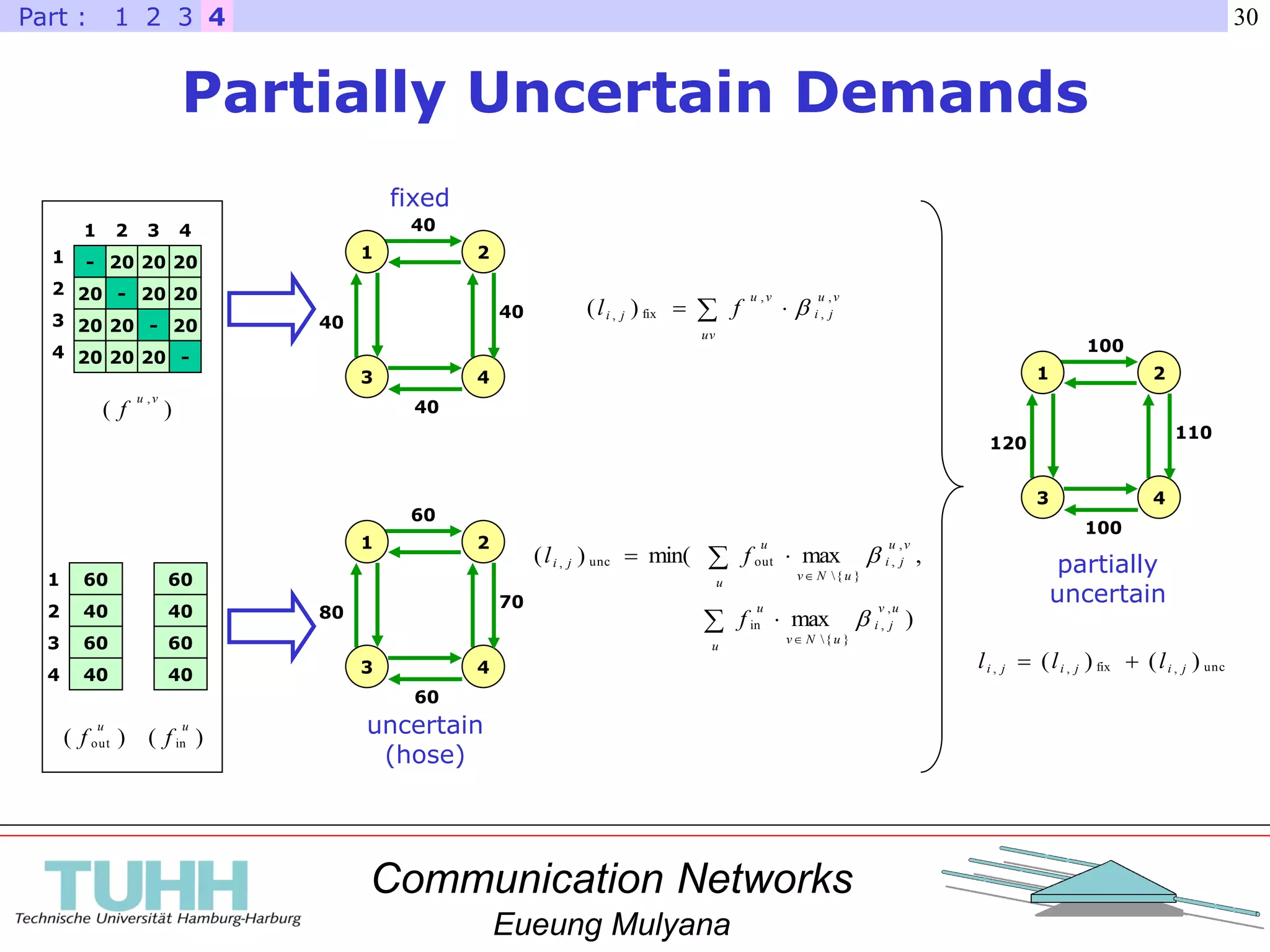
Partially Uncertain Demands
20-1
2
3
4
)(
, vu
f
1 2
20 20
3 4
- 20 20
- 20
-
20
20
20
20
20 20
60
40
60
40
)( in
u
f
1
2
3
4
60
40
60
40
)( out
u
f
,maxmin()(
,
,
}{
outunc,  

u
vu
ji
uNv
u
ji fl 
 
uv
vu
ji
vu
ji fl
,
,
,
fix, )( 
unc,fix,, )()( jijiji lll 
40
1 2
3 4
40
40
40
60
1 2
3 4
80
60
70
100
1 2
3 4
120
100
110
uncertain
(hose)
fixed
partially
uncertain
)max
,
,
}{
in 

u
uv
ji
uNv
u
f 
42 31Part :
Communication Networks
Eueung Mulyana
31
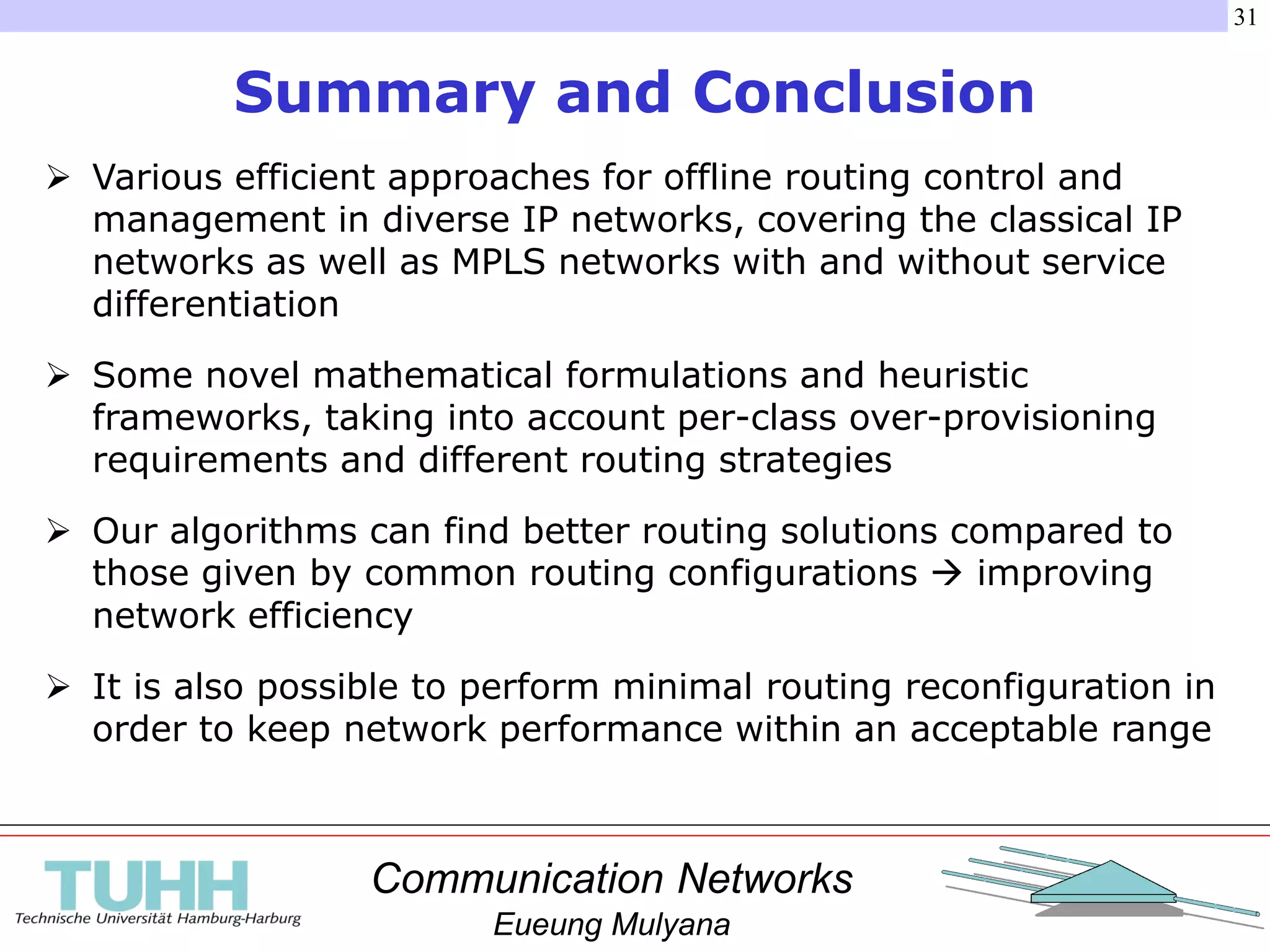
Summary and Conclusion
 Various efficient approaches for offline routing control and
management in diverse IP networks, covering the classical IP
networks as well as MPLS networks with and without service
differentiation
 Some novel mathematical formulations and heuristic
frameworks, taking into account per-class over-provisioning
requirements and different routing strategies
 Our algorithms can find better routing solutions compared to
those given by common routing configurations  improving
network efficiency
 It is also possible to perform minimal routing reconfiguration in
order to keep network performance within an acceptable range
Communication Networks
Eueung Mulyana
32
Summary and Conclusion
 Several simple demand uncertainty models whose impacts on
network performance can easily be determined
 The corresponding traffic engineering approach, including for
the case where traffic is partially uncertain
Outlook
 To address planning and traffic management problems in multi-
layer networks e.g. IP over Optical networks
 Mathematical programming approaches, that exploits the
specific structure of the problem  Branch-and-Cut, Branch-
Cut-and-Price
Communication Networks
Eueung Mulyana
33
Thank You !

Efficient Planning and Offline Routing Approaches for IP Networks

  • 1.
    Communication Networks Eueung Mulyana 1 Hamburg– 28.02.2006 Efficient Planning and Offline Routing Approaches for IP Networks Eueung Mulyana Hamburg University of Technology (TUHH)
  • 2.
    Communication Networks Eueung Mulyana 2 Motivation IPNetworks:  The important role of IP technology for the future communication networks Current and Future Trends:  Heterogeneous environment Routing Control:  Diverse applications with diverse Quality of Service (QoS) requirements  Avoiding congestion, increasing network efficiency, matching routing policies and preferences Dynamics of IP networks:  Traffic variation, uncertainty
  • 3.
    Communication Networks Eueung Mulyana 3 PreviousWorks „Classical“ IP Networks:  Traffic engineering: Fortz(2000), Pioro(2001), ...  Routing and dimensioning: Bley(1998,2002), ... Multi-Protocol Label Switching (MPLS):  LSP design: Haßlinger(2002), ...  Network dimensioning: Arvidsson(2002), ... Demand Uncertainty:  Probabilistic assumption: Widjaja(2002), Mitra(2003), ...  Polyhedral model: Ben-Ameur(2003) ...
  • 4.
    Communication Networks Eueung Mulyana 4 Contributions ClassicalIP Networks:  Metric based traffic engineering using hybrid genetic algorithms  Traffic engineering for transitional (IGP/MPLS) networks  Impact of demand increase on network conditions and re- optimization approaches IP/MPLS:  Hybrid routing schemes using metrics and explicit routes  Routing and dimensioning for multi-class IP/MPLS networks with per-class over-provisioning requirements Demand Uncertainty:  Several simple demand uncertainty models and the corresponding traffic engineering approaches
  • 5.
    Communication Networks Eueung Mulyana 5 Outline Overview of network planning, routing in the Internet and optimization approaches  Traffic engineering in classical and transitional IP networks  Routing and dimensioning of multi-class IP/MPLS networks  Routing under demand uncertainty  Summary and conclusion Part : 1 2 3 4
  • 6.
    Communication Networks Eueung Mulyana 6 Overviewof Network Planning 1 2 3 4Part : Medium-Term Activities e.g. offline routing management Short-Term Activities e.g. (near) real time traffic and resource management Long-Term Activities e.g. network design Forecast, Marketing Input (e.g. new customers) Network Traffic Data Routing Update Various Controls Traffic DataTopology, Capacity Change
  • 7.
    Communication Networks Eueung Mulyana 7 Routingin the Internet (1) 1 2 3 4Part : server www.tuhh.debrowser: www.tuhh.de Transport Network data streams Transport Network data streams packets transport packets Network transport packets packets Routing
  • 8.
    Communication Networks Eueung Mulyana 8 2 1 5 3 4 6 7 8 9 10 server www.tuhh.de browser: www.tuhh.de Routingin the Internet (2) 1 2 3 4Part : servers 2 5 servers users 1 servers users servers users 10 9 servers users8 servers users7 servers users servers users users 3 4 6 servers users users servers
  • 9.
    Communication Networks Eueung Mulyana 9 OptimizationApproaches (1) 1 2 3 4Part :  Linear programming  Stochastic approaches based on simple, greedy, meta- heuristics or a combination of them Meta-Heuristics  Genetic Algorithms, Local Search Hybridization Simple Improving Heuristic Search Algorithm Solution Improved Solution Greedy Heuristic Search Algorithm Solution e.g. in terms of a sequence of demands Objective Value
  • 10.
    Communication Networks Eueung Mulyana 10 OptimizationApproaches (2) 1 2 3 4Part : Linear programming    n j jj xcz 1 i n j jij bxa  1 Minimize Subject to: ],1[ mi   Can be solved by the branch and bound or directly by the simplex algorithm (for cases without integer constraints)  Commercial solver CPLEX Meta-Heuristics  Solution representation  Exploration strategies („move“ or „genetic“ operators)  Algorithms‘ specific parameters
  • 11.
    Communication Networks Eueung Mulyana 11 LocalSearch (1) A B C D E A B C D 1 2 3 4Part : neighborhood of A initial solution move  Plain Local Search (PLS-1)  Search around temporary best solutions  Plain Local Search (PLS-2)  Search around a constant solution neighborhood of B neighborhood of C
  • 12.
    Communication Networks Eueung Mulyana 12 LocalSearch (2) 1 2 3 4Part : A B C D E F 1st neighborhood of A 2nd neighborhood of A 3rd neighborhood of A  Variable neighborhood structure solution space neighborhood of x0 initial solution x0 best solution x* End temporary solution x . . .  Simulated Annealing (SA)  SA allows moves towards less performing solutions
  • 13.
    Communication Networks Eueung Mulyana 13 GeneticAlgorithms 1 2 3 4Part : solution space A B C D E F G H Initialize population Exit condition fulfilled ? Parents selection Crossover Mutation Remove some bad individuals Add new individuals Survivors selection END yes no individual Iteration 1 Iteration 3Iteration 2  Multi-agent (population-based)  Exploration using crossover and mutation operators
  • 14.
    Communication Networks Eueung Mulyana 14 Routingin IP Networks: IGP (b)(a) 6 11 1 1 1 1 2 21 2 3 5 5 121 3 4 5 6 2 3 4 5 6 1 2 4 6 5 3 1 2 3 4 5 1  Driven by link metrics (weights/costs)  Unique shortest path routing vs. Equal-Cost Multi-Path (ECMP) ECMP e.g. [1-2-4-6] 50% [1-3-4-6] 25% [1-3-5-6] 25% Unique shortest path routing: 1 unique path for all node pairs 21 3 4Part :
  • 15.
    Communication Networks Eueung Mulyana 15 Metric-BasedTraffic Engieering Utilization Upper bound Objective Function }{min max max,  ji Aji  ),( Utilization  uv vu jiji ll , ,, ji ji ji c l , , ,  Aji  ),( 21 3 4Part : Formulation
  • 16.
    Communication Networks Eueung Mulyana 16 TransitionalIP Networks (IGP/MPLS) 1 2 3 4 5 6 7 8 9 LSP 1 2 3 4 5 6 7 8 9 LSP 1 2 3 4 5 6 7 8 9 LSP 1 3 2 4 5 6 7 8 9 1 1 1 1 1 1 1 2 2 3 2 2 LSP Basic IGP Shortcut (BIS) IGP Shortcut (IS) Overlay (OV) 21 3 4Part : }||{min max1  c   k LSP ji uv vu jiji k lll , , ,, Objective Function Load
  • 17.
    Communication Networks Eueung Mulyana 17 Networktopology and link capacities Traffic demand Partial demand increase Re-optimization Analyze Policy not compliant Weight Changes Network Upgrade Set of metric values policy compliant Partial Demand Increase 21 3 4Part : Mbps]10,5[ , %2  vu f%2 max Mbps]50,5[ , %2  vu f%2 max Number of traffic- increase pattern
  • 18.
    Communication Networks Eueung Mulyana 18 LSPDesign and Weight Setting (1) Vanilla LSP ER LSP 2 1 2 3 5 2 5 1 2 3 4 5 6 Link Weights 1 2 3 4 5 6 1 2 3 4 5 6 MPLS+DiffServ  explicit routing (ER-LSPs), shortest path routing (Vanilla LSPs) or hybrid  Class-based routing Per-class over-provisioning 321 4Part :
  • 19.
    Communication Networks Eueung Mulyana 19 LSPDesign and Weight Setting (2)  Indirectly solved by iteratively calling a metric-based traffic engineering (TE) procedure using traffic matrices of different classes F  aggregate traffic matrix Fi  traffic matrix for class i RT  base routing pattern (obtained via optimization using F ) RTi  routing pattern for class i (obtained via optimization using Fi) 321 4Part :
  • 20.
    Communication Networks Eueung Mulyana 20 ComputationalStudy (1) 0.4 OP 1 c 0.4 OP 2 c  After optimize network(F) i.e. without ER-LSPs: )1.1|4.3|3(min    %44.96max  321 4Part :
  • 21.
    Communication Networks Eueung Mulyana 21 ComputationalStudy (2) 0.4 OP 1 c 0.4 OP 2 c  After optimize network(F2) : 13 symmetrical ER-LSPs (premium) and 4 symmetrical ER-LSPs (assured) )1.1|01.4|05.4(min    %68.93max  321 4Part :
  • 22.
    Communication Networks Eueung Mulyana 22 Routingand Link Dimensioning 321 4Part : 1 1 0 1 1 1 1 1 2 3 4 5 6 }2,1{ 4 OP c   ;20h 100k 1 2   e t ett ymin Objective Function Capacity (with OP)             t tet d p i idpdp OP edp kyxxc 1 1    e , Demand Satisfaction   p dp u 1 d , dpddp uhx   pd  ,,  Per-class routing & per-class over-provisioning (P1)  Single-path routing  Multi-path routing realdp u binarydp u
  • 23.
    Communication Networks Eueung Mulyana 23 BackupCapacity 321 4Part : 1 2 3 4 3 21 4 normal backup Demand (1,4) and (3,4)  each of 20 units 1 3 2 4 40 40 4020 worst case load on each link     t tetes i idpsidpdps kyzx   ))( 1 1 se  ,,   p dpsdp p dpsdps uv )1(   sd  ,, ddsdpsdps hvz   spd  ,,,   )(( dpsdpdps OP d p edp zxc   Demand Rerouting Capacity Failure Cases 1 3 2 4 20 20 200 normal case load on each link
  • 24.
    Communication Networks Eueung Mulyana 24 HeuristicApproaches 321 4Part : Two-step strategy:  First consider only normal paths (ALG-1)  Heuristically assign a backup for each normal path
  • 25.
    Communication Networks Eueung Mulyana 25 ComputationalStudy 321 4Part : Problem (single-path only) P1 CPLEX cost gap(%) Greedy (best cost of 100 runs) P2 P3 165.5 | 268.5 166.5 | 268.5 423.5 | 688 6.18 | 9.93 4.19 | 9.47 3.48 | 3.75 190.5 | 310.5 188.0 | 303.5 453.5 | 755  The best result from CPLEX is up to 15% (16%) better than the result from the heuristic  But, the heuristic (two-step strategy) is faster  minutes vs. hours
  • 26.
    Communication Networks Eueung Mulyana 26 . . . BasicOutbound Model 120- 2 3 4 5 6 100 100 100 100 100 100 1 2 3 4 5 6    }{ out , uNv uvu ff )( , vu f )( out u f  Specifying a traffic matrix  Specifying a vector of the maximum outbound traffic  Allowing traffic variations The outbound modelWithout traffic uncertainty 1 2 20 20 20 20 3 4 5 6 - 20 20 20 20 - 20 20 20 - 20 20 - 20 - 20 20 20 20 20 20 20 20 20 20 20 20 20 20 20 20- 50 5 5 5 - 20 20 20 20 - 20 20 20 - 10 1 - 20 - 20 20 60 20 20 20 20 20 20 2 20 20 20 20 20 20- 20 20 20 20 - 0 99 0 1 - 20 20 20 - 20 20 - 5 - 0 20 20 0 20 20 20 0 20 20 0 20 95 20 20 42 31Part : u f out u .. . v Outbound Model Network
  • 27.
    Communication Networks Eueung Mulyana 27 M1 Constraints Linkload (Upperbound) M7 M3 M9 uvu f out ,     }{ out , uNv uvu ff    u rv u r vu ff out, , u r vu f out, ,       r v vu ji u r vu ji v u r u ji u r u r fl );max(min , ,out, , ,out,,  Outbound Models 42 31Part :    }{ out , uNv uvu ff );max(min }{ , ,out , , }{ out,     uNv vu ji uvu ji uNv uu ji fl  vu ji uNv uu ji fl , , }{ out, max    vu ji , , Traffic fraction of flow (u,v) on link (i,j)    u rv u r vu ff out, ,    r vu ji v u r u ji u r fl )max( , ,out,, 
  • 28.
    Communication Networks Eueung Mulyana 28 UncertaintyModels : Summary 42 31Part : u f out u f inu .. . v „Hose“ Model Network u f in u .. . v Inbound Model Network M2 Model Model Notation outbound inbound M1 outbound + max_flow M3 inbound + max_flow M4 hose M5 hose + max_flow M6 M8 outbound + group inbound + group M7 outbound + max_flow + group M9 inbound + max_flow + group M10 hose + group M11 hose + max_flow + group M12
  • 29.
    Communication Networks Eueung Mulyana 29 ComputationalStudy  Uncertainty model M1  large number of traffic variations  A better solution for a certain model is not always better for the others Upperbound (M1) Traffic Matrix Utilization )(, tji ji , t=1 t=100 42 31Part : Optimization based on M1 MSP  Multiple Shortest Paths USP  Unique Shortest Path
  • 30.
    Communication Networks Eueung Mulyana 30 PartiallyUncertain Demands 20-1 2 3 4 )( , vu f 1 2 20 20 3 4 - 20 20 - 20 - 20 20 20 20 20 20 60 40 60 40 )( in u f 1 2 3 4 60 40 60 40 )( out u f ,maxmin()( , , }{ outunc,    u vu ji uNv u ji fl    uv vu ji vu ji fl , , , fix, )(  unc,fix,, )()( jijiji lll  40 1 2 3 4 40 40 40 60 1 2 3 4 80 60 70 100 1 2 3 4 120 100 110 uncertain (hose) fixed partially uncertain )max , , }{ in   u uv ji uNv u f  42 31Part :
  • 31.
    Communication Networks Eueung Mulyana 31 Summaryand Conclusion  Various efficient approaches for offline routing control and management in diverse IP networks, covering the classical IP networks as well as MPLS networks with and without service differentiation  Some novel mathematical formulations and heuristic frameworks, taking into account per-class over-provisioning requirements and different routing strategies  Our algorithms can find better routing solutions compared to those given by common routing configurations  improving network efficiency  It is also possible to perform minimal routing reconfiguration in order to keep network performance within an acceptable range
  • 32.
    Communication Networks Eueung Mulyana 32 Summaryand Conclusion  Several simple demand uncertainty models whose impacts on network performance can easily be determined  The corresponding traffic engineering approach, including for the case where traffic is partially uncertain Outlook  To address planning and traffic management problems in multi- layer networks e.g. IP over Optical networks  Mathematical programming approaches, that exploits the specific structure of the problem  Branch-and-Cut, Branch- Cut-and-Price
  • 33.