Student perceptions and attitudes towards the
software factory as a learning environment
Muhammad Ovais Ahmad ,
Kari Liukkunen,
Jouni Markkula
Agenda
• Motivation
• Research problem
• Research Method
• Results and discussion
• Conclusion and future work
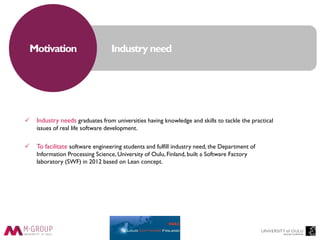
Motivation
 Industry needs graduates from universities having knowledge and skills to tackle the practical
issues of real life software development.
 To facilitate software engineering students and fulfill industry need, the Department of
Information Processing Science, University of Oulu, Finland, built a Software Factory
laboratory (SWF) in 2012 based on Lean concept.
Industry need
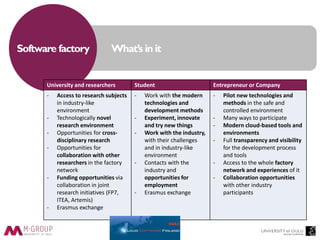
Software factory What’s in it
University and researchers Student Entrepreneur or Company
- Access to research subjects
in industry-like
environment
- Technologically novel
research environment
- Opportunities for cross-
disciplinary research
- Opportunities for
collaboration with other
researchers in the factory
network
- Funding opportunities via
collaboration in joint
research initiatives (FP7,
ITEA, Artemis)
- Erasmus exchange
- Work with the modern
technologies and
development methods
- Experiment, innovate
and try new things
- Work with the industry,
with their challenges
and in industry-like
environment
- Contacts with the
industry and
opportunities for
employment
- Erasmus exchange
- Pilot new technologies and
methods in the safe and
controlled environment
- Many ways to participate
- Modern cloud-based tools and
environments
- Full transparency and visibility
for the development process
and tools
- Access to the whole factory
network and experiences of it
- Collaboration opportunities
with other industry
participants
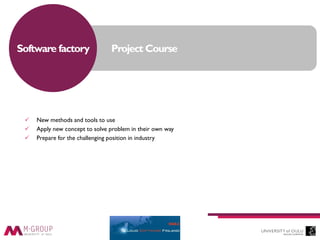
Software factory
 New methods and tools to use
 Apply new concept to solve problem in their own way
 Prepare for the challenging position in industry
Project Course
Research Problem
 To examines factors in software factory learning environment which affect learning of student in
software factory project course.
Theoretical
Framework
 Computer laboratory Environment Inventory (CLEI)
 Attitude towards Computers and Computing Courses Questionnaire instrument
(ACCC)
 Additional constructs:
 Kanban board
 Collaborative learning
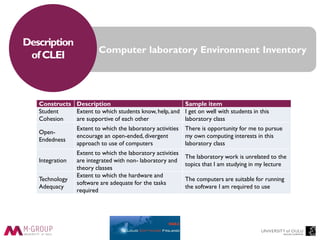
Computer laboratory Environment Inventory
Description
of CLEI
Constructs Description Sample item
Student
Cohesion
Extent to which students know, help, and
are supportive of each other
I get on well with students in this
laboratory class
Open-
Endedness
Extent to which the laboratory activities
encourage an open-ended, divergent
approach to use of computers
There is opportunity for me to pursue
my own computing interests in this
laboratory class
Integration
Extent to which the laboratory activities
are integrated with non- laboratory and
theory classes
The laboratory work is unrelated to the
topics that I am studying in my lecture
Technology
Adequacy
Extent to which the hardware and
software are adequate for the tasks
required
The computers are suitable for running
the software I am required to use
Attitude towards Computers and Computing
Courses Questionnaire instrument
Description of
ACCC
Constructs Description Sample item
Anxiety
Extent to which the student feels
comfortable using a computer
Working with a computer
makes me very nervous.
Enjoyment
Extent to which the student
enjoys working on a computer
I enjoy learning on a computer.
Usefulness of
course
Extent to which the student
found the course useful
I do not think I will use what I
learned in this class.
Kanban and
Collaborative
learning
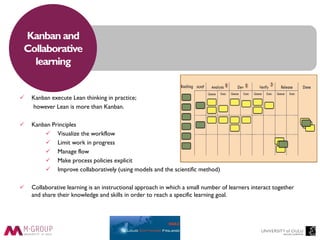
 Kanban execute Lean thinking in practice;
however Lean is more than Kanban.
 Kanban Principles
 Visualize the workflow
 Limit work in progress
 Manage flow
 Make process policies explicit
 Improve collaboratively (using models and the scientific method)
 Collaborative learning is an instructional approach in which a small number of learners interact together
and share their knowledge and skills in order to reach a specific learning goal.
Research method
 Quantitative research approach
 Web survey
 Question were based on the mentioned research instrument
 The measurement was based on five-point Likert-type scale
 Survey population: Masters degree final year students who participate in
software factory project course (7 projects).
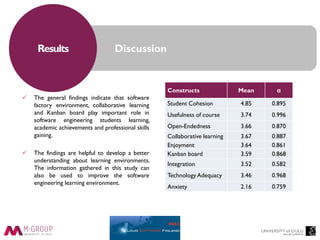
DiscussionResults
 The general findings indicate that software
factory environment, collaborative learning
and Kanban board play important role in
software engineering students learning,
academic achievements and professional skills
gaining.
 The findings are helpful to develop a better
understanding about learning environments.
The information gathered in this study can
also be used to improve the software
engineering learning environment.
Constructs Mean α
Student Cohesion 4.85 0.895
Usefulness of course 3.74 0.996
Open-Endedness 3.66 0.870
Collaborative learning 3.67 0.887
Enjoyment 3.64 0.861
Kanban board 3.59 0.868
Integration 3.52 0.582
Technology Adequacy 3.46 0.968
Anxiety 2.16 0.759
Competencies gained
 Effective task management
 Solving complex problems
 Sharing responsibilities
 Developing a shared
 Building a positive relationships
 Negotiating with other groups
 Use of rational argument to persuade others
 Resolving conflict
Interesting Findings
 In software factory Students
 Feels more confident and supportive of each other while solving problems in different ways.
 Have opportunity to work with a real customer on a real industrial project
 Make a bridge between theoretical knowledge of software engineering and practical software
development and management work
 Kanban board helps in visualizing and prioritizing an entire work project more efficiently.
 One student reported in the open-ended question that
 I believe Kanban board helps me to follow my project procedure when I am lost.
 Students believed that the knowledge obtained in the Software factory project course would help
them in a future job.
Future workConclusion
 Research focused mainly on obtaining a general perception of master’s degree student
learning in project course at software factory environment.
 Factors affecting student learning were explored relying on the well-known CLEI,ACCC,
collaborative learning and Kanban.
 However, the actual strength of the factors affecting the student learning in SWF was
not measured.
 For future work larger sample sizes are required.
 A network has already built with some European software factories and its expansion
is ongoing to other software factories.
Thank you
Muhammad Ovais Ahmad
Doctoral Candidate
Department of Information Processing Science
E-mail: muhammad.ahmad@oulu.fi
Thank you
Thank you
Ahmad Muhammad Ovais, Kari Liukkunen, Jouni Markkula
(2014) Student perceptions and attitudes towards the
software factory as a learning environment. IEEE Global
Engineering Education Conference, 3-5 April 2014, Istanbul,
Turkey
References

Student perceptions and attitudes towards the software factory as a learning environment

  • 1.
    Student perceptions andattitudes towards the software factory as a learning environment Muhammad Ovais Ahmad , Kari Liukkunen, Jouni Markkula
  • 2.
    Agenda • Motivation • Researchproblem • Research Method • Results and discussion • Conclusion and future work
  • 3.
    Motivation  Industry needsgraduates from universities having knowledge and skills to tackle the practical issues of real life software development.  To facilitate software engineering students and fulfill industry need, the Department of Information Processing Science, University of Oulu, Finland, built a Software Factory laboratory (SWF) in 2012 based on Lean concept. Industry need
  • 4.
    Software factory What’sin it University and researchers Student Entrepreneur or Company - Access to research subjects in industry-like environment - Technologically novel research environment - Opportunities for cross- disciplinary research - Opportunities for collaboration with other researchers in the factory network - Funding opportunities via collaboration in joint research initiatives (FP7, ITEA, Artemis) - Erasmus exchange - Work with the modern technologies and development methods - Experiment, innovate and try new things - Work with the industry, with their challenges and in industry-like environment - Contacts with the industry and opportunities for employment - Erasmus exchange - Pilot new technologies and methods in the safe and controlled environment - Many ways to participate - Modern cloud-based tools and environments - Full transparency and visibility for the development process and tools - Access to the whole factory network and experiences of it - Collaboration opportunities with other industry participants
  • 5.
    Software factory  Newmethods and tools to use  Apply new concept to solve problem in their own way  Prepare for the challenging position in industry Project Course
  • 6.
    Research Problem  Toexamines factors in software factory learning environment which affect learning of student in software factory project course.
  • 7.
    Theoretical Framework  Computer laboratoryEnvironment Inventory (CLEI)  Attitude towards Computers and Computing Courses Questionnaire instrument (ACCC)  Additional constructs:  Kanban board  Collaborative learning
  • 8.
    Computer laboratory EnvironmentInventory Description of CLEI Constructs Description Sample item Student Cohesion Extent to which students know, help, and are supportive of each other I get on well with students in this laboratory class Open- Endedness Extent to which the laboratory activities encourage an open-ended, divergent approach to use of computers There is opportunity for me to pursue my own computing interests in this laboratory class Integration Extent to which the laboratory activities are integrated with non- laboratory and theory classes The laboratory work is unrelated to the topics that I am studying in my lecture Technology Adequacy Extent to which the hardware and software are adequate for the tasks required The computers are suitable for running the software I am required to use
  • 9.
    Attitude towards Computersand Computing Courses Questionnaire instrument Description of ACCC Constructs Description Sample item Anxiety Extent to which the student feels comfortable using a computer Working with a computer makes me very nervous. Enjoyment Extent to which the student enjoys working on a computer I enjoy learning on a computer. Usefulness of course Extent to which the student found the course useful I do not think I will use what I learned in this class.
  • 10.
    Kanban and Collaborative learning  Kanbanexecute Lean thinking in practice; however Lean is more than Kanban.  Kanban Principles  Visualize the workflow  Limit work in progress  Manage flow  Make process policies explicit  Improve collaboratively (using models and the scientific method)  Collaborative learning is an instructional approach in which a small number of learners interact together and share their knowledge and skills in order to reach a specific learning goal.
  • 11.
    Research method  Quantitativeresearch approach  Web survey  Question were based on the mentioned research instrument  The measurement was based on five-point Likert-type scale  Survey population: Masters degree final year students who participate in software factory project course (7 projects).
  • 12.
    DiscussionResults  The generalfindings indicate that software factory environment, collaborative learning and Kanban board play important role in software engineering students learning, academic achievements and professional skills gaining.  The findings are helpful to develop a better understanding about learning environments. The information gathered in this study can also be used to improve the software engineering learning environment. Constructs Mean α Student Cohesion 4.85 0.895 Usefulness of course 3.74 0.996 Open-Endedness 3.66 0.870 Collaborative learning 3.67 0.887 Enjoyment 3.64 0.861 Kanban board 3.59 0.868 Integration 3.52 0.582 Technology Adequacy 3.46 0.968 Anxiety 2.16 0.759
  • 13.
    Competencies gained  Effectivetask management  Solving complex problems  Sharing responsibilities  Developing a shared  Building a positive relationships  Negotiating with other groups  Use of rational argument to persuade others  Resolving conflict
  • 14.
    Interesting Findings  Insoftware factory Students  Feels more confident and supportive of each other while solving problems in different ways.  Have opportunity to work with a real customer on a real industrial project  Make a bridge between theoretical knowledge of software engineering and practical software development and management work  Kanban board helps in visualizing and prioritizing an entire work project more efficiently.  One student reported in the open-ended question that  I believe Kanban board helps me to follow my project procedure when I am lost.  Students believed that the knowledge obtained in the Software factory project course would help them in a future job.
  • 15.
    Future workConclusion  Researchfocused mainly on obtaining a general perception of master’s degree student learning in project course at software factory environment.  Factors affecting student learning were explored relying on the well-known CLEI,ACCC, collaborative learning and Kanban.  However, the actual strength of the factors affecting the student learning in SWF was not measured.  For future work larger sample sizes are required.  A network has already built with some European software factories and its expansion is ongoing to other software factories.
  • 16.
    Thank you Muhammad OvaisAhmad Doctoral Candidate Department of Information Processing Science E-mail: muhammad.ahmad@oulu.fi Thank you
  • 17.
    Thank you Ahmad MuhammadOvais, Kari Liukkunen, Jouni Markkula (2014) Student perceptions and attitudes towards the software factory as a learning environment. IEEE Global Engineering Education Conference, 3-5 April 2014, Istanbul, Turkey References