






WebPA - A practical approach to  peer assessing group work Enabling every team member to recognise individual contributions to group work http://www.flickr.com/photos/wmacphail/3382077156/ Adam Crawford engCETL, Loughborough University
“ Some of the best modules during my Engineering degree were group based modules. The combination of the team working and the peer assessment was a great introduction to working in a team within industry.” Alan Curtis  Research Engineer  JCB Power Systems Ltd
Group work is common practice in higher education It can help prepare students for the workplace  Develops transferable skills such as team-working, communication and problem solving It can help reduce assessment load Group work in education
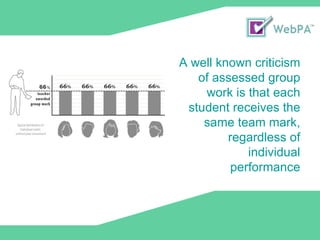
A well known criticism of assessed group work is that each student receives the same team mark, regardless of individual performance
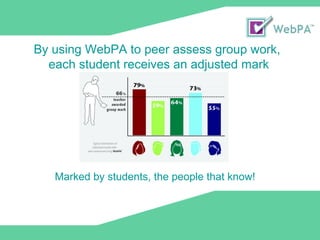
By using WebPA to peer assess group work,  each student receives an adjusted mark Marked by students, the people that know!
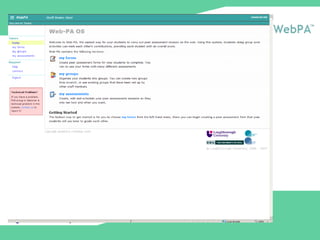
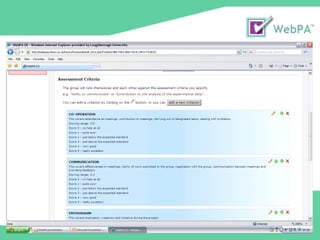
How it works…  creating forms
 
© Loughborough University 2009
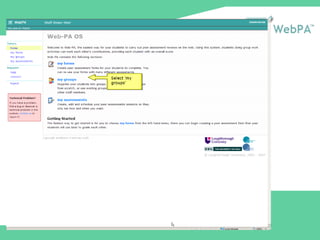
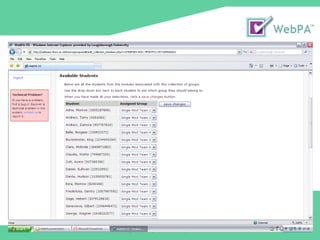
How it works…  creating groups
 
© Loughborough University 2009
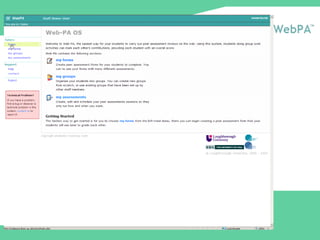
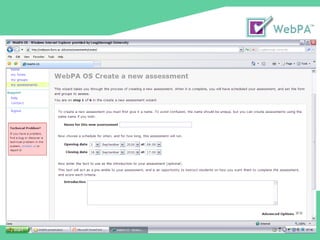
How it works…  setting up an assessment
 
© Loughborough University 2009
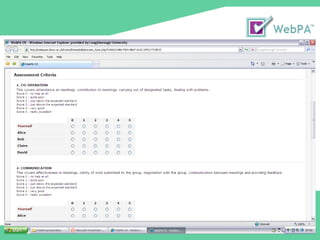
How it works…  Student marking
© Loughborough University 2009
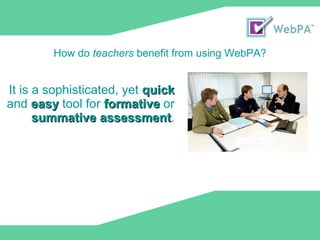
It is a sophisticated, yet  quick  and  easy  tool for  formative  or  summative   assessment . How do  teachers  benefit from using WebPA?
© Loughborough University 2009 Flexibility  to create assessment criteria, scoring ranges and groups to suit the way you teach, in  any subject discipline How do  teachers  benefit from using WebPA?
The generation of individual student marks is automated using a  researched  and  trusted  method. How do  teachers  benefit from using WebPA?
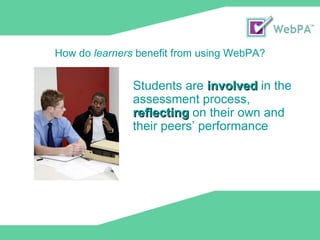
Students are  involved  in the assessment process,  reflecting  on their own and their peers’ performance How do  learners  benefit from using WebPA?
It is a fair and  confidential  way of assessing an individuals’ contribution within group work How do  learners  benefit from using WebPA?
It positively impacts upon individual  performance  and  team dynamics , enriching the overall  learning experience . How do  learners  benefit from using WebPA?
Student Experiences Some would like to leave justification of scores given in the assessment (feature added after research carried out) Enhances deeper reflection A wish to know what their peers feel about them through the tool (feedback mechanism)
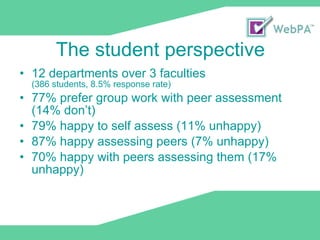
The student perspective 12 departments over 3 faculties  (386 students, 8.5% response rate) 77% prefer group work with peer assessment (14% don’t) 79% happy to self assess (11% unhappy) 87% happy assessing peers (7% unhappy) 70% happy with peers assessing them (17% unhappy)
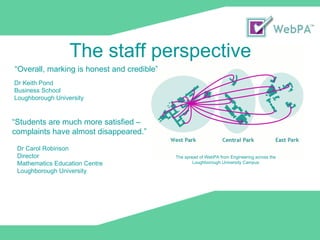
The spread of WebPA from Engineering across the Loughborough University Campus The staff perspective “ Overall, marking is honest and credible” Dr Keith Pond Business School Loughborough University Dr Carol Robinson Director Mathematics Education Centre  Loughborough University “ Students are much more satisfied –  complaints have almost disappeared.”
"WebPA is now embedded in our first year and will be for the next five years. Typically 180-200 students will be subjected to.. [WebPA] ..every year." Dr Bob Cherry  Manchester Metropolitan University “ We are impressed with the success of the  WebPA project and the impact on  group work in higher education.” David Kernohan Programme Manager  eLearning Team  JISC
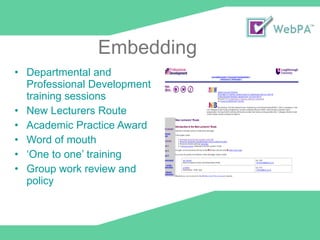
Embedding  Departmental and Professional Development training sessions New Lecturers Route Academic Practice Award Word of mouth ‘ One to one’ training Group work review and policy
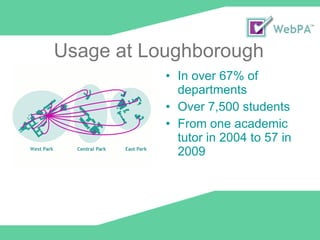
Usage at Loughborough In over 67% of departments  Over 7,500 students From one academic tutor in 2004 to 57 in 2009
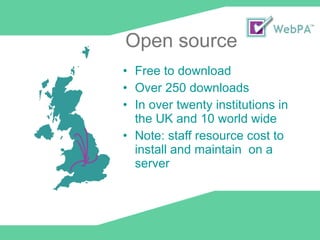
Open source Free to download Over 250 downloads In over twenty institutions in the UK and 10 world wide Note: staff resource cost to install and maintain  on a server
To support those considering adoption of WebPA Sections for Academic tutors Learning Technologists / Educational Developers IT Support Staff  Briefing Papers for senior managers etc. Available online from: http://www.webpa.ac.uk Resource Pack
JISC - WebPA Project Funded under the JISC: e-Learning Capital Programme  Led by the Faculty of Engineering at Loughborough University.  Project partners:  - University of Hull - HE Academy Engineering Subject Centre - HE Academy Physical Sciences Subject Centre Ran from October 2006 to March 2009
Resource pack and other information Project Website:   www.webpa.ac.uk Have a look WebPA Demonstrator:   http://webpaos.lboro.ac.uk  User community WebPA mail list:   http://www.jiscmail.ac.uk/lists/WEBPA.html

WebPA - A Practical Approach to Peer Assessment

  • 1.
    WebPA - Apractical approach to peer assessing group work Enabling every team member to recognise individual contributions to group work http://www.flickr.com/photos/wmacphail/3382077156/ Adam Crawford engCETL, Loughborough University
  • 2.
    “ Some ofthe best modules during my Engineering degree were group based modules. The combination of the team working and the peer assessment was a great introduction to working in a team within industry.” Alan Curtis Research Engineer JCB Power Systems Ltd
  • 3.
    Group work iscommon practice in higher education It can help prepare students for the workplace Develops transferable skills such as team-working, communication and problem solving It can help reduce assessment load Group work in education
  • 4.
    A well knowncriticism of assessed group work is that each student receives the same team mark, regardless of individual performance
  • 5.
    By using WebPAto peer assess group work, each student receives an adjusted mark Marked by students, the people that know!
  • 6.
    How it works… creating forms
  • 7.
  • 8.
  • 9.
    How it works… creating groups
  • 10.
  • 11.
  • 12.
    How it works… setting up an assessment
  • 13.
  • 14.
  • 15.
    How it works… Student marking
  • 16.
  • 17.
    It is asophisticated, yet quick and easy tool for formative or summative assessment . How do teachers benefit from using WebPA?
  • 18.
    © Loughborough University2009 Flexibility to create assessment criteria, scoring ranges and groups to suit the way you teach, in any subject discipline How do teachers benefit from using WebPA?
  • 19.
    The generation ofindividual student marks is automated using a researched and trusted method. How do teachers benefit from using WebPA?
  • 20.
    Students are involved in the assessment process, reflecting on their own and their peers’ performance How do learners benefit from using WebPA?
  • 21.
    It is afair and confidential way of assessing an individuals’ contribution within group work How do learners benefit from using WebPA?
  • 22.
    It positively impactsupon individual performance and team dynamics , enriching the overall learning experience . How do learners benefit from using WebPA?
  • 23.
    Student Experiences Somewould like to leave justification of scores given in the assessment (feature added after research carried out) Enhances deeper reflection A wish to know what their peers feel about them through the tool (feedback mechanism)
  • 24.
    The student perspective12 departments over 3 faculties (386 students, 8.5% response rate) 77% prefer group work with peer assessment (14% don’t) 79% happy to self assess (11% unhappy) 87% happy assessing peers (7% unhappy) 70% happy with peers assessing them (17% unhappy)
  • 25.
    The spread ofWebPA from Engineering across the Loughborough University Campus The staff perspective “ Overall, marking is honest and credible” Dr Keith Pond Business School Loughborough University Dr Carol Robinson Director Mathematics Education Centre Loughborough University “ Students are much more satisfied – complaints have almost disappeared.”
  • 26.
    "WebPA is nowembedded in our first year and will be for the next five years. Typically 180-200 students will be subjected to.. [WebPA] ..every year." Dr Bob Cherry Manchester Metropolitan University “ We are impressed with the success of the WebPA project and the impact on group work in higher education.” David Kernohan Programme Manager eLearning Team JISC
  • 27.
    Embedding Departmentaland Professional Development training sessions New Lecturers Route Academic Practice Award Word of mouth ‘ One to one’ training Group work review and policy
  • 28.
    Usage at LoughboroughIn over 67% of departments Over 7,500 students From one academic tutor in 2004 to 57 in 2009
  • 29.
    Open source Freeto download Over 250 downloads In over twenty institutions in the UK and 10 world wide Note: staff resource cost to install and maintain on a server
  • 30.
    To support thoseconsidering adoption of WebPA Sections for Academic tutors Learning Technologists / Educational Developers IT Support Staff Briefing Papers for senior managers etc. Available online from: http://www.webpa.ac.uk Resource Pack
  • 31.
    JISC - WebPAProject Funded under the JISC: e-Learning Capital Programme Led by the Faculty of Engineering at Loughborough University. Project partners: - University of Hull - HE Academy Engineering Subject Centre - HE Academy Physical Sciences Subject Centre Ran from October 2006 to March 2009
  • 32.
    Resource pack andother information Project Website: www.webpa.ac.uk Have a look WebPA Demonstrator: http://webpaos.lboro.ac.uk User community WebPA mail list: http://www.jiscmail.ac.uk/lists/WEBPA.html

Editor's Notes

  • #2 WebPA project: Led by Faculty of Engineering at Loughborough University. Project partners: - HE Academy Engineering Subject Centre - HE Academy Physical Sciences Subject Centre - University of Hull Funded under the JISC: e-Learning Capital Programme Running from October 2006 to March 2009