Muhammad Ovais Ahmad 
Jouni Markkula 
Markku Oivo 
Pasi Kuvaja 
ICSEA 2014 
Usage of Kanban in Software Companies An empirical study on motivation, benefits and challenges
AGENDA 
Introduction to Kanban 
Motivation 
Research goal and research questions 
Research setting 
Results and discussion 
Conclusion and future work
Introduction to Kanban 
Kanban introduced in the Japanese manufacturing industry in the 1950s. 
Literally means Signboard 
To maintain and improve production. 
Kanban introduced to software development team in 2004, by David Anderson at Microsoft with the aims: 
To provide visibility in software development process, communicate priorities and highlight bottlenecks, 
constant flow of releases, work on specific number of items in given time.
Kanban principles 
Visualise the workflow 
Limit work in progress 
Measure and manage flow 
Kanban promotes continuous collaboration and encourages active, ongoing learning and improving by defining the best possible team workflow.
Motivation 
A strong practitioner-driven movement emerged in supporting Kanban. 
Existing scientific literature shows that it is seldom reported in the context of software development.
Research goal and questions 
The goal is to provide up-to-date results that can be utilised by organisations implementing or planning to implement Kanban in their software development teams. 
RQ1. Why is Kanban used in software companies? 
RQ2. What are the benefits, of using Kanban? 
RQ3. What are the challenges in adopting Kanban and its solutions?
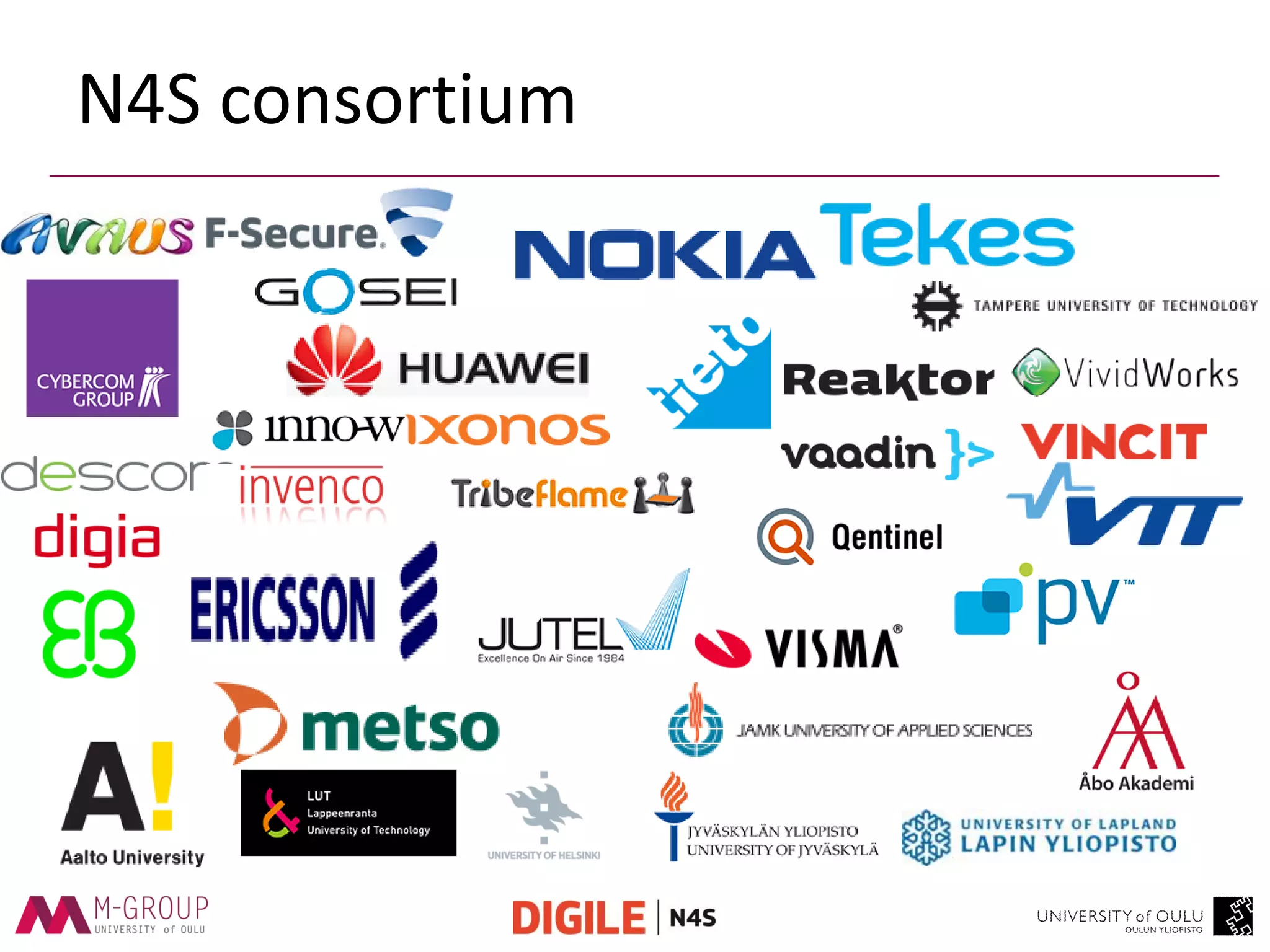
Study carried out in the Need for Speed Research program which involves more than 30 research organizations and enterprises including most of the major Finnish software companies that are actively using and researching Agile and Lean. 
Research setting
N4S consortium
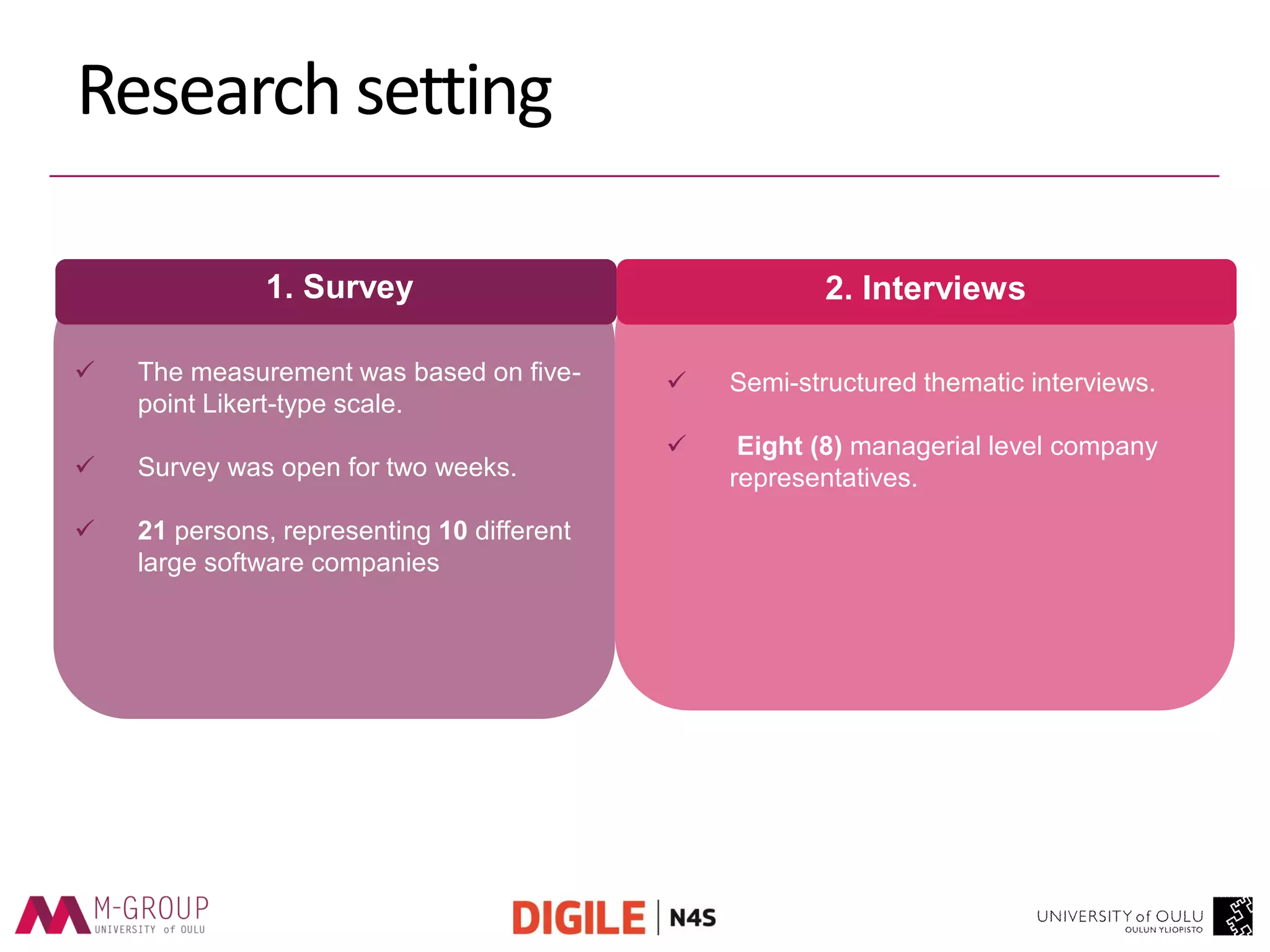
1. Survey 
2. Interviews 
The measurement was based on five- point Likert-type scale. 
Survey was open for two weeks. 
21 persons, representing 10 different large software companies 
Semi-structured thematic interviews. 
 Eight (8) managerial level company representatives. 
Research setting
Results 
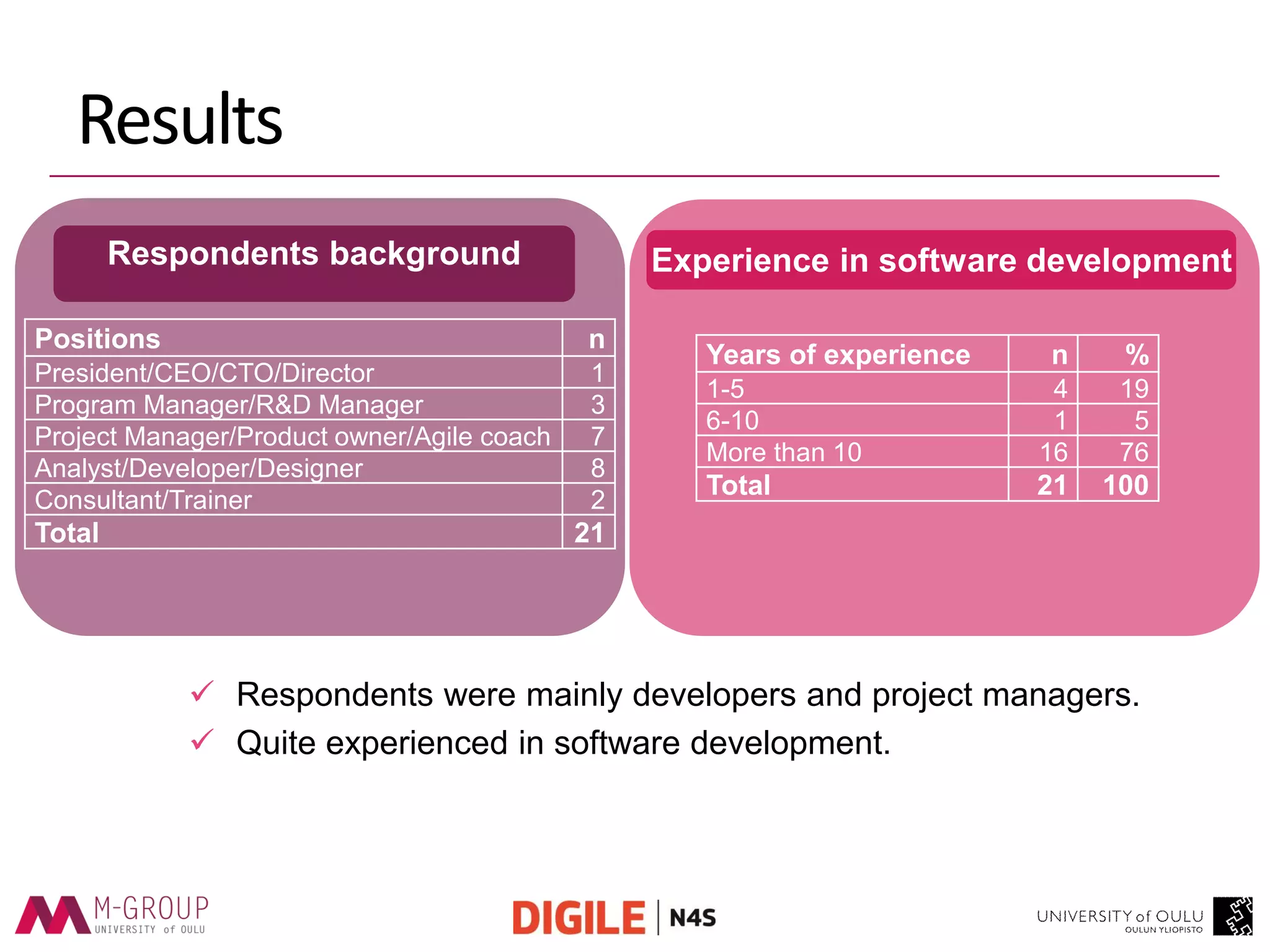
Respondents background 
Experience in software development 
Positions 
n 
President/CEO/CTO/Director 
1 
Program Manager/R&D Manager 
3 
Project Manager/Product owner/Agile coach 
7 
Analyst/Developer/Designer 
8 
Consultant/Trainer 
2 
Total 
21 
Years of experience 
n 
% 
1-5 
4 
19 
6-10 
1 
5 
More than 10 
16 
76 
Total 
21 
100 
Respondents were mainly developers and project managers. 
Quite experienced in software development.
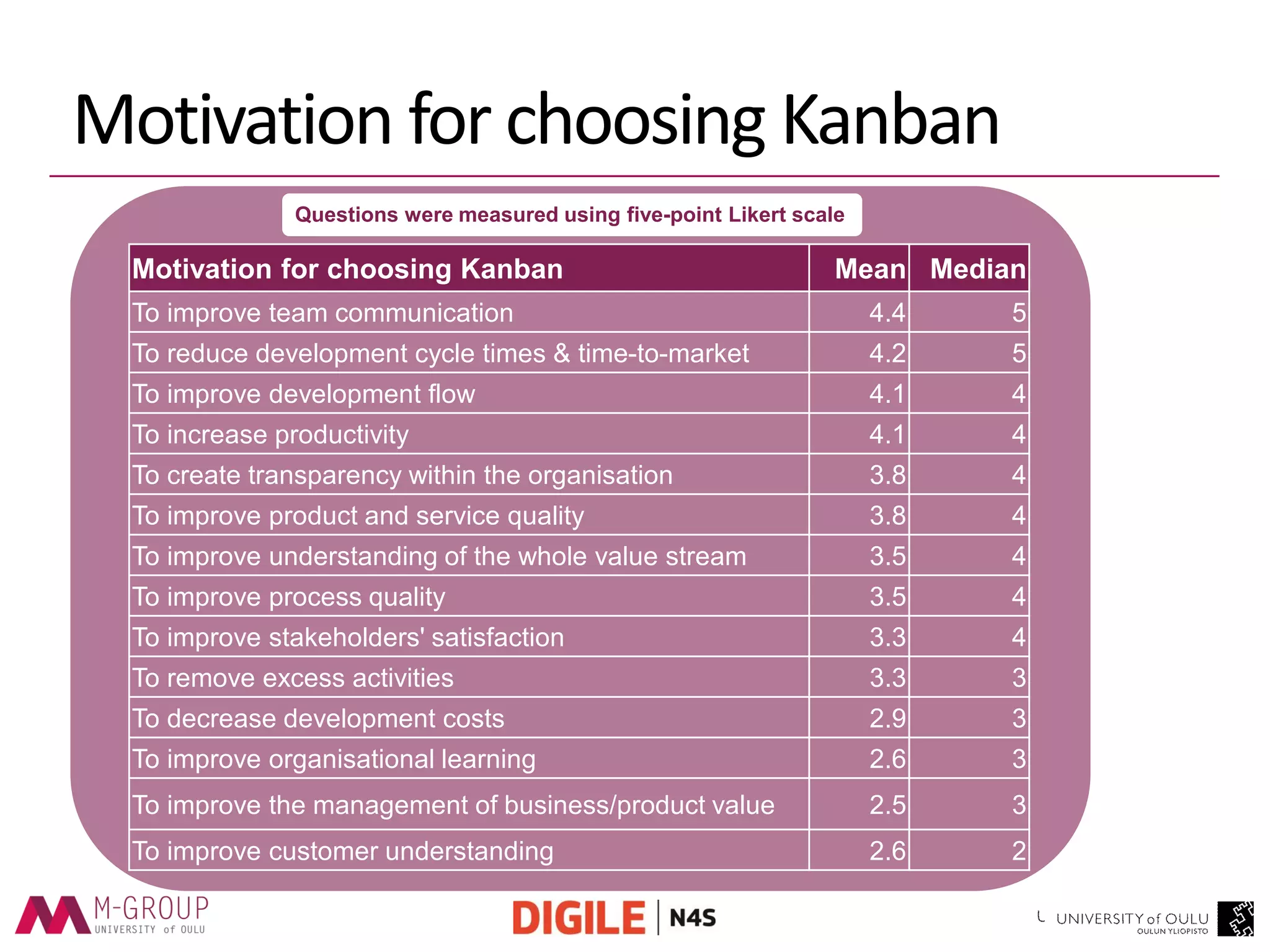
Motivation for choosing Kanban 
Mean 
Median 
To improve team communication 
4.4 
5 
To reduce development cycle times & time-to-market 
4.2 
5 
To improve development flow 
4.1 
4 
To increase productivity 
4.1 
4 
To create transparency within the organisation 
3.8 
4 
To improve product and service quality 
3.8 
4 
To improve understanding of the whole value stream 
3.5 
4 
To improve process quality 
3.5 
4 
To improve stakeholders' satisfaction 
3.3 
4 
To remove excess activities 
3.3 
3 
To decrease development costs 
2.9 
3 
To improve organisational learning 
2.6 
3 
To improve the management of business/product value 
2.5 
3 
To improve customer understanding 
2.6 
2 
Questions were measured using five-point Likert scale
Achieved benefits 
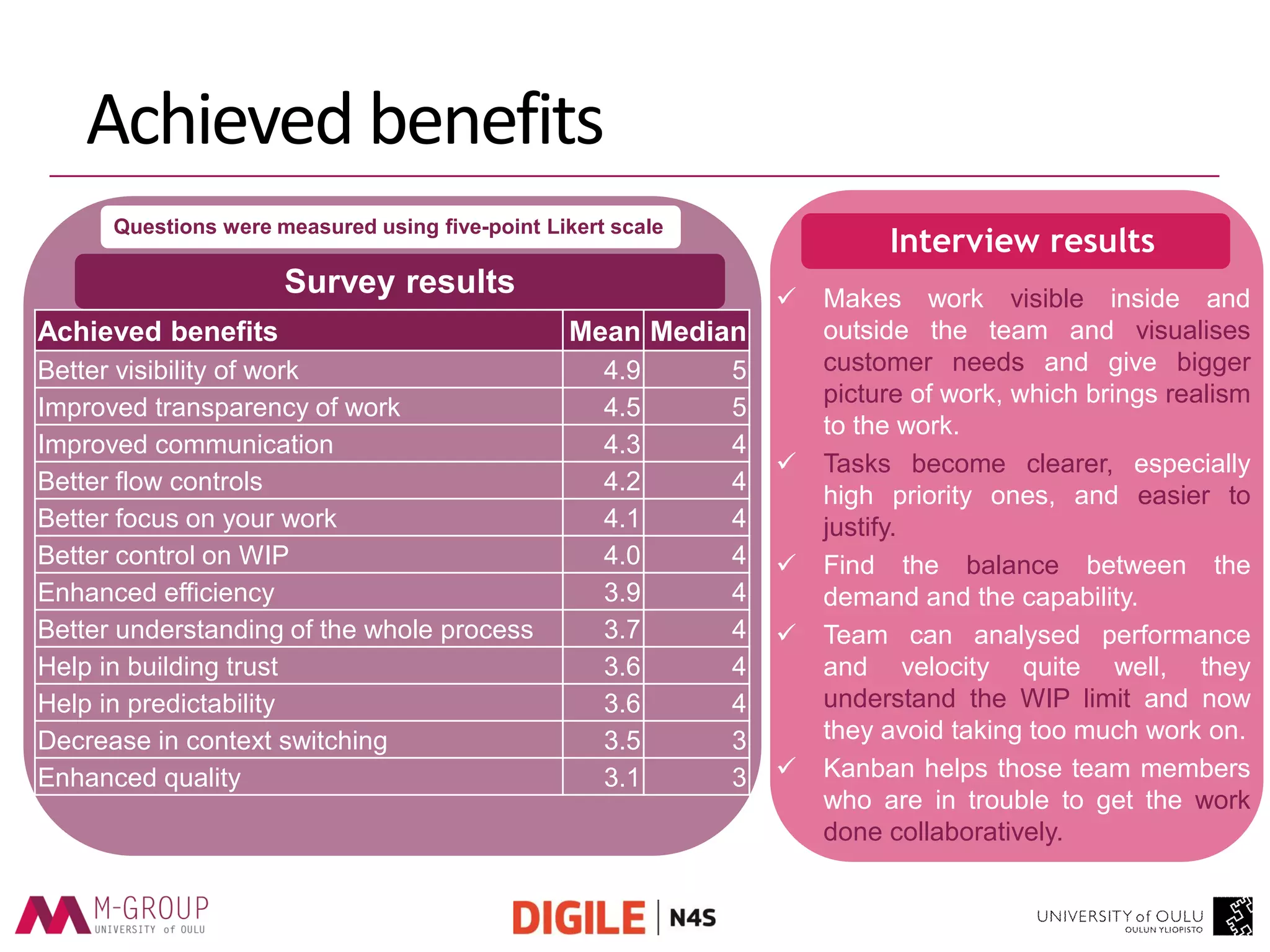
Survey results 
Interview results 
Makes work visible inside and outside the team and visualises customer needs and give bigger picture of work, which brings realism to the work. 
Tasks become clearer, especially high priority ones, and easier to justify. 
Find the balance between the demand and the capability. 
Team can analysed performance and velocity quite well, they understand the WIP limit and now they avoid taking too much work on. 
Kanban helps those team members who are in trouble to get the work done collaboratively. 
Questions were measured using five-point Likert scale 
Achieved benefits 
Mean 
Median 
Better visibility of work 
4.9 
5 
Improved transparency of work 
4.5 
5 
Improved communication 
4.3 
4 
Better flow controls 
4.2 
4 
Better focus on your work 
4.1 
4 
Better control on WIP 
4.0 
4 
Enhanced efficiency 
3.9 
4 
Better understanding of the whole process 
3.7 
4 
Help in building trust 
3.6 
4 
Help in predictability 
3.6 
4 
Decrease in context switching 
3.5 
3 
Enhanced quality 
3.1 
3
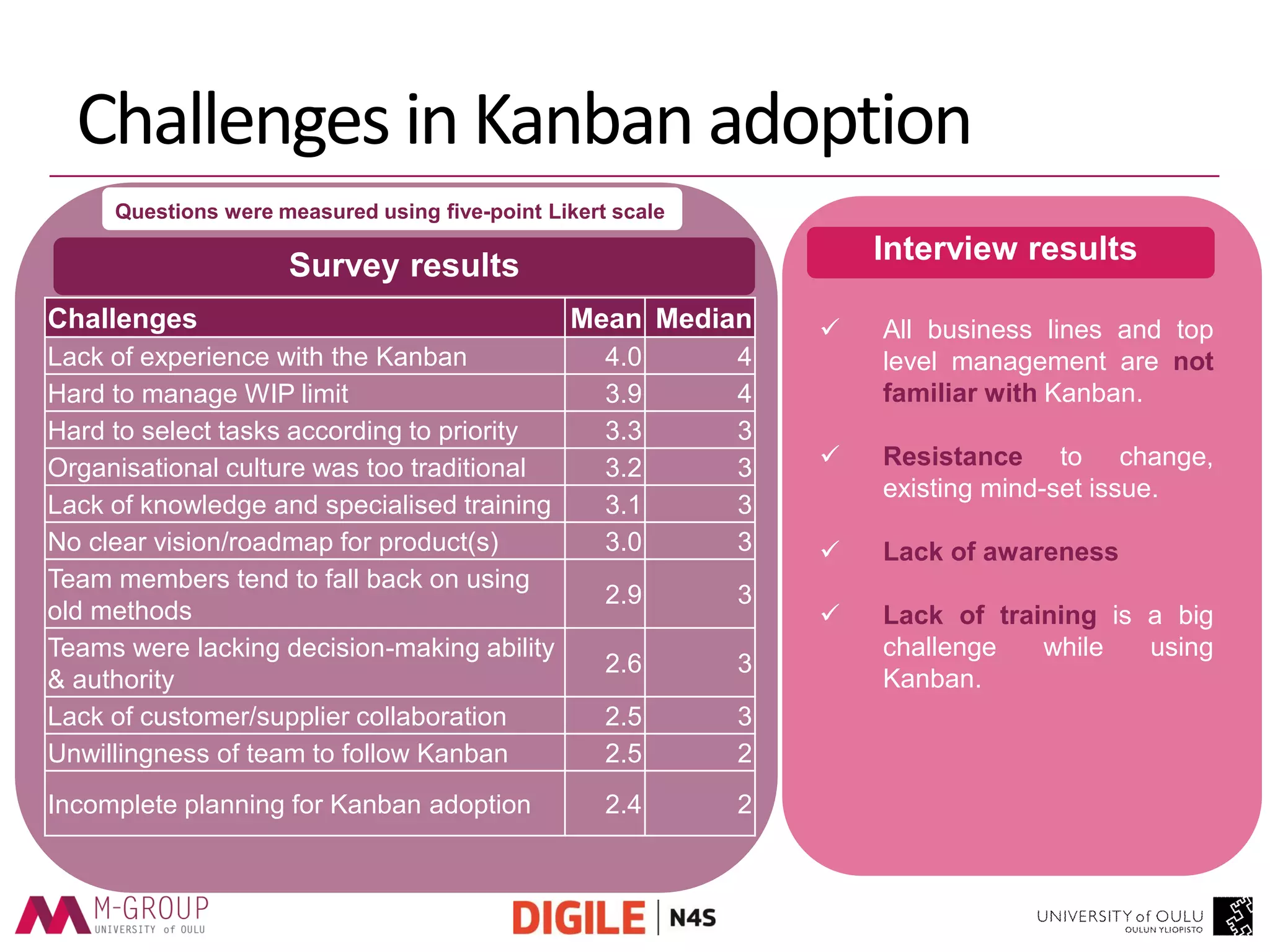
Challenges in Kanban adoption 
Survey results 
Interview results 
All business lines and top level management are not familiar with Kanban. 
Resistance to change, existing mind-set issue. 
Lack of awareness 
Lack of training is a big challenge while using Kanban. 
Challenges 
Mean 
Median 
Lack of experience with the Kanban 
4.0 
4 
Hard to manage WIP limit 
3.9 
4 
Hard to select tasks according to priority 
3.3 
3 
Organisational culture was too traditional 
3.2 
3 
Lack of knowledge and specialised training 
3.1 
3 
No clear vision/roadmap for product(s) 
3.0 
3 
Team members tend to fall back on using old methods 
2.9 
3 
Teams were lacking decision-making ability & authority 
2.6 
3 
Lack of customer/supplier collaboration 
2.5 
3 
Unwillingness of team to follow Kanban 
2.5 
2 
Incomplete planning for Kanban adoption 
2.4 
2 
Questions were measured using five-point Likert scale
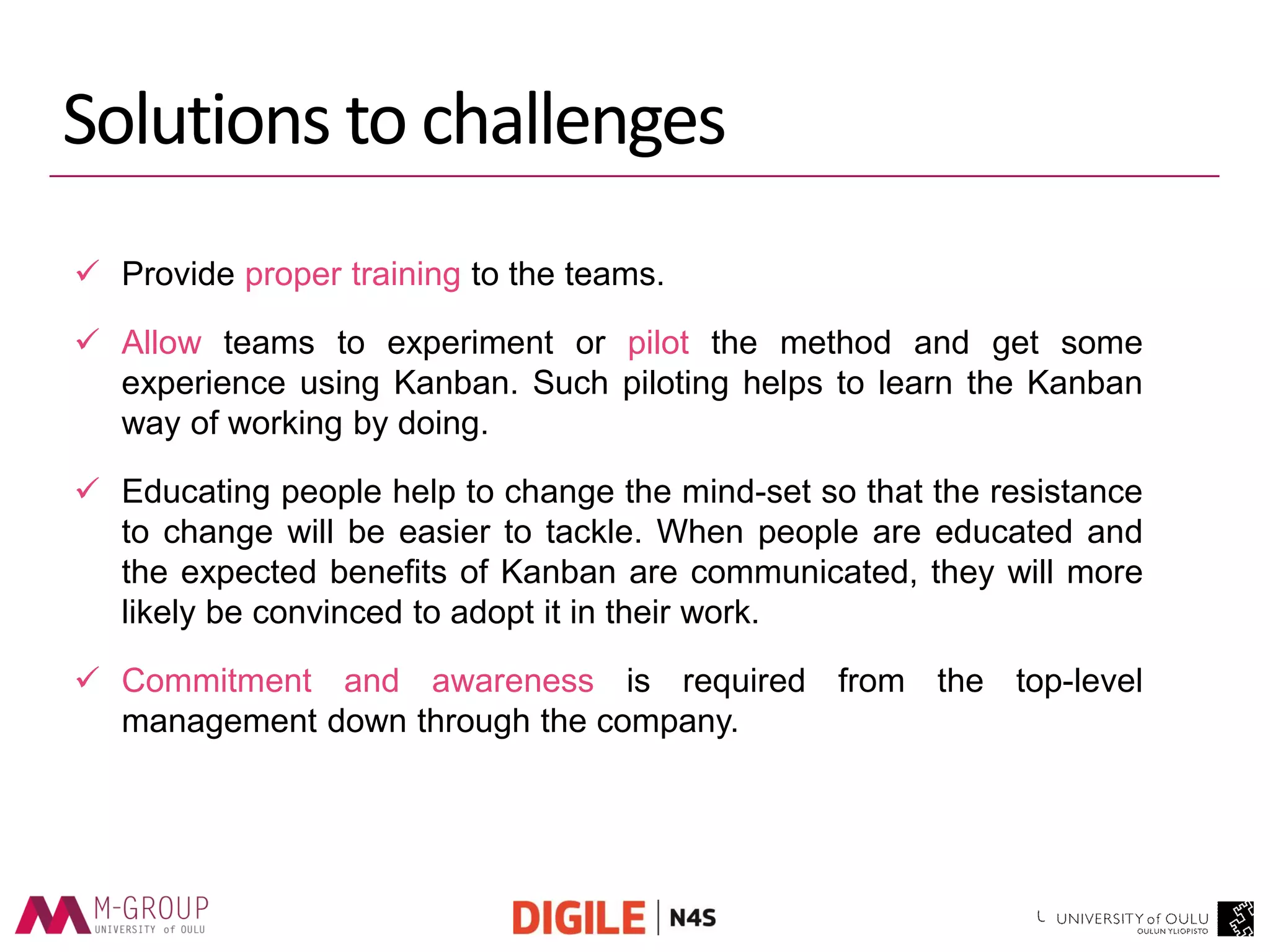
Solutions to challenges 
Provide proper training to the teams. 
Allow teams to experiment or pilot the method and get some experience using Kanban. Such piloting helps to learn the Kanban way of working by doing. 
Educating people help to change the mind-set so that the resistance to change will be easier to tackle. When people are educated and the expected benefits of Kanban are communicated, they will more likely be convinced to adopt it in their work. 
Commitment and awareness is required from the top-level management down through the company.
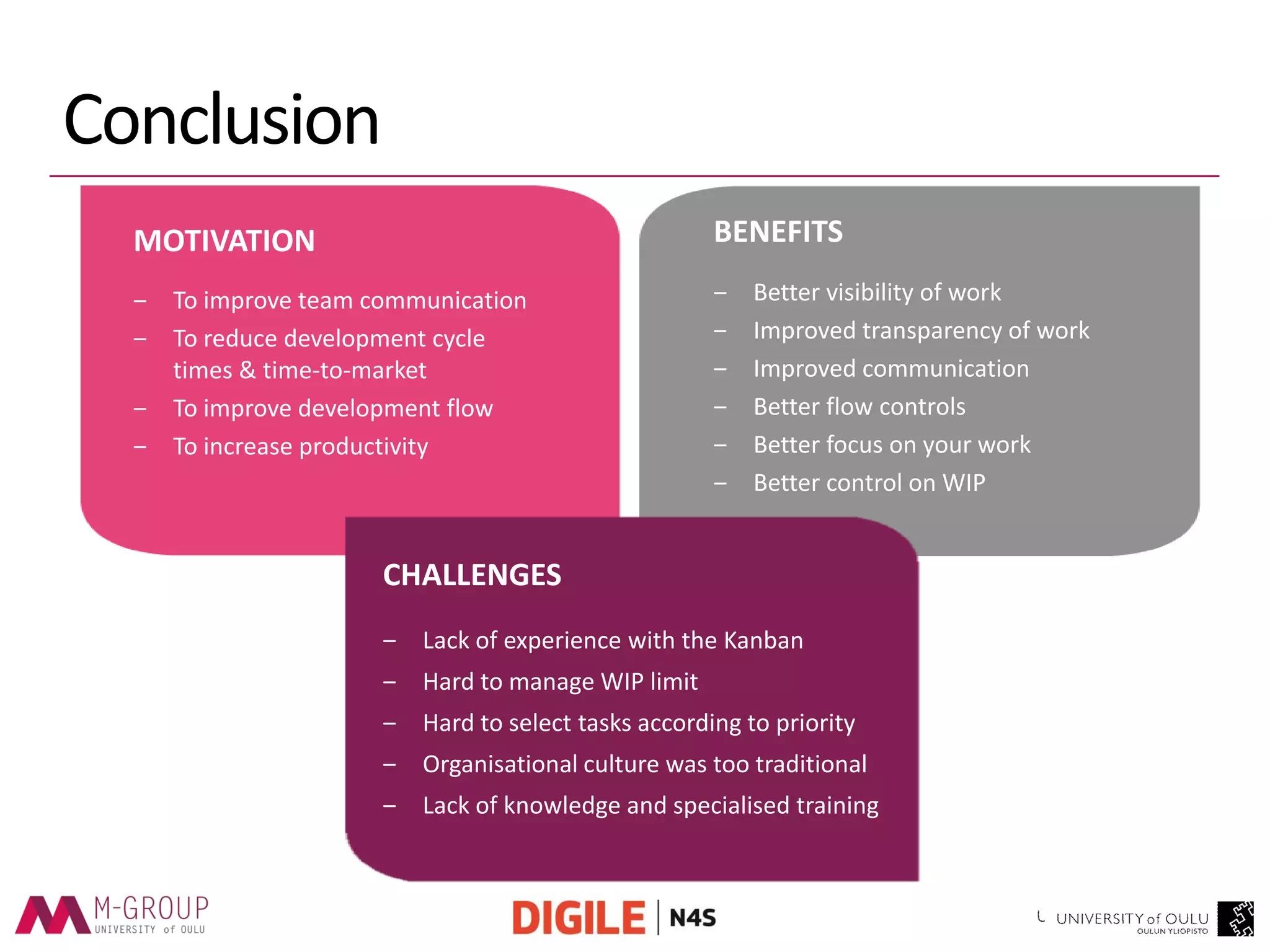
Conclusion 
MOTIVATION 
‒To improve team communication 
‒To reduce development cycle times & time-to-market 
‒To improve development flow 
‒To increase productivity 
BENEFITS 
‒Better visibility of work 
‒Improved transparency of work 
‒Improved communication 
‒Better flow controls 
‒Better focus on your work 
‒Better control on WIP 
CHALLENGES 
‒Lack of experience with the Kanban 
‒Hard to manage WIP limit 
‒Hard to select tasks according to priority 
‒Organisational culture was too traditional 
‒Lack of knowledge and specialised training
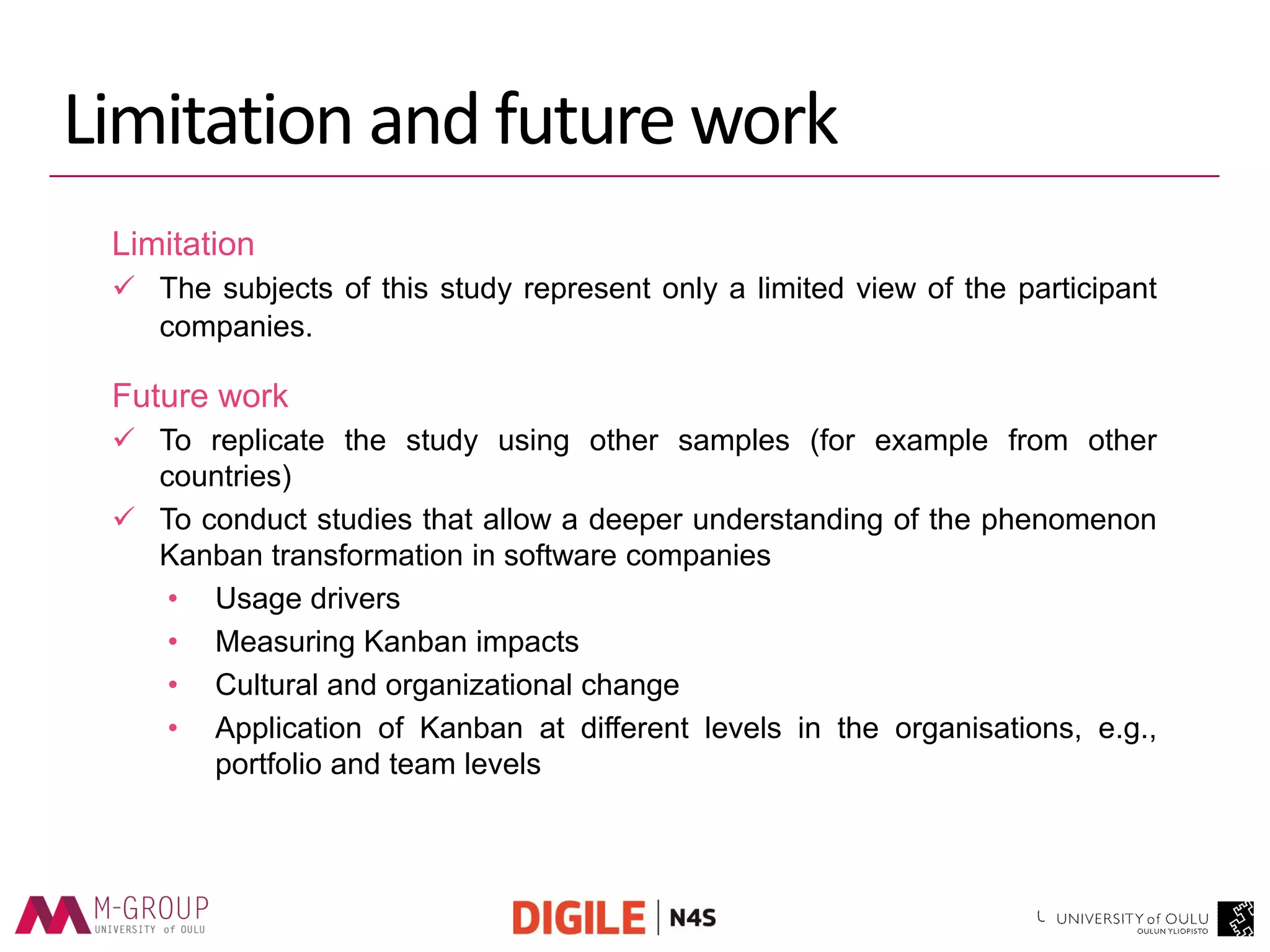
Limitation and future work 
Limitation 
The subjects of this study represent only a limited view of the participant companies. 
Future work 
To replicate the study using other samples (for example from other countries) 
To conduct studies that allow a deeper understanding of the phenomenon Kanban transformation in software companies 
•Usage drivers 
•Measuring Kanban impacts 
•Cultural and organizational change 
•Application of Kanban at different levels in the organisations, e.g., portfolio and team levels
Questions 
?
Muhammad Ovais Ahmad Department of Information Processing Science University of Oulu, Finland Muhammad.ahmad@oulu.fi
Thank you 
Ahmad, M. O., Markkula, J. Oivo, M, and Kuvaja , P (2014) Usage of Kanban in Software Companies - An empirical study on motivation, benefits and challenges. In 9th International Conference on Software Engineering Advances, October 12 - 16, 2014. Nice, France. 
References

Icsea 2014 usage of kanban in software companies

  • 1.
    Muhammad Ovais Ahmad Jouni Markkula Markku Oivo Pasi Kuvaja ICSEA 2014 Usage of Kanban in Software Companies An empirical study on motivation, benefits and challenges
  • 2.
    AGENDA Introduction toKanban Motivation Research goal and research questions Research setting Results and discussion Conclusion and future work
  • 3.
    Introduction to Kanban Kanban introduced in the Japanese manufacturing industry in the 1950s. Literally means Signboard To maintain and improve production. Kanban introduced to software development team in 2004, by David Anderson at Microsoft with the aims: To provide visibility in software development process, communicate priorities and highlight bottlenecks, constant flow of releases, work on specific number of items in given time.
  • 4.
    Kanban principles Visualisethe workflow Limit work in progress Measure and manage flow Kanban promotes continuous collaboration and encourages active, ongoing learning and improving by defining the best possible team workflow.
  • 5.
    Motivation A strongpractitioner-driven movement emerged in supporting Kanban. Existing scientific literature shows that it is seldom reported in the context of software development.
  • 6.
    Research goal andquestions The goal is to provide up-to-date results that can be utilised by organisations implementing or planning to implement Kanban in their software development teams. RQ1. Why is Kanban used in software companies? RQ2. What are the benefits, of using Kanban? RQ3. What are the challenges in adopting Kanban and its solutions?
  • 7.
    Study carried outin the Need for Speed Research program which involves more than 30 research organizations and enterprises including most of the major Finnish software companies that are actively using and researching Agile and Lean. Research setting
  • 8.
  • 9.
    1. Survey 2.Interviews The measurement was based on five- point Likert-type scale. Survey was open for two weeks. 21 persons, representing 10 different large software companies Semi-structured thematic interviews.  Eight (8) managerial level company representatives. Research setting
  • 10.
    Results Respondents background Experience in software development Positions n President/CEO/CTO/Director 1 Program Manager/R&D Manager 3 Project Manager/Product owner/Agile coach 7 Analyst/Developer/Designer 8 Consultant/Trainer 2 Total 21 Years of experience n % 1-5 4 19 6-10 1 5 More than 10 16 76 Total 21 100 Respondents were mainly developers and project managers. Quite experienced in software development.
  • 11.
    Motivation for choosingKanban Motivation for choosing Kanban Mean Median To improve team communication 4.4 5 To reduce development cycle times & time-to-market 4.2 5 To improve development flow 4.1 4 To increase productivity 4.1 4 To create transparency within the organisation 3.8 4 To improve product and service quality 3.8 4 To improve understanding of the whole value stream 3.5 4 To improve process quality 3.5 4 To improve stakeholders' satisfaction 3.3 4 To remove excess activities 3.3 3 To decrease development costs 2.9 3 To improve organisational learning 2.6 3 To improve the management of business/product value 2.5 3 To improve customer understanding 2.6 2 Questions were measured using five-point Likert scale
  • 12.
    Achieved benefits Surveyresults Interview results Makes work visible inside and outside the team and visualises customer needs and give bigger picture of work, which brings realism to the work. Tasks become clearer, especially high priority ones, and easier to justify. Find the balance between the demand and the capability. Team can analysed performance and velocity quite well, they understand the WIP limit and now they avoid taking too much work on. Kanban helps those team members who are in trouble to get the work done collaboratively. Questions were measured using five-point Likert scale Achieved benefits Mean Median Better visibility of work 4.9 5 Improved transparency of work 4.5 5 Improved communication 4.3 4 Better flow controls 4.2 4 Better focus on your work 4.1 4 Better control on WIP 4.0 4 Enhanced efficiency 3.9 4 Better understanding of the whole process 3.7 4 Help in building trust 3.6 4 Help in predictability 3.6 4 Decrease in context switching 3.5 3 Enhanced quality 3.1 3
  • 13.
    Challenges in Kanbanadoption Survey results Interview results All business lines and top level management are not familiar with Kanban. Resistance to change, existing mind-set issue. Lack of awareness Lack of training is a big challenge while using Kanban. Challenges Mean Median Lack of experience with the Kanban 4.0 4 Hard to manage WIP limit 3.9 4 Hard to select tasks according to priority 3.3 3 Organisational culture was too traditional 3.2 3 Lack of knowledge and specialised training 3.1 3 No clear vision/roadmap for product(s) 3.0 3 Team members tend to fall back on using old methods 2.9 3 Teams were lacking decision-making ability & authority 2.6 3 Lack of customer/supplier collaboration 2.5 3 Unwillingness of team to follow Kanban 2.5 2 Incomplete planning for Kanban adoption 2.4 2 Questions were measured using five-point Likert scale
  • 14.
    Solutions to challenges Provide proper training to the teams. Allow teams to experiment or pilot the method and get some experience using Kanban. Such piloting helps to learn the Kanban way of working by doing. Educating people help to change the mind-set so that the resistance to change will be easier to tackle. When people are educated and the expected benefits of Kanban are communicated, they will more likely be convinced to adopt it in their work. Commitment and awareness is required from the top-level management down through the company.
  • 15.
    Conclusion MOTIVATION ‒Toimprove team communication ‒To reduce development cycle times & time-to-market ‒To improve development flow ‒To increase productivity BENEFITS ‒Better visibility of work ‒Improved transparency of work ‒Improved communication ‒Better flow controls ‒Better focus on your work ‒Better control on WIP CHALLENGES ‒Lack of experience with the Kanban ‒Hard to manage WIP limit ‒Hard to select tasks according to priority ‒Organisational culture was too traditional ‒Lack of knowledge and specialised training
  • 16.
    Limitation and futurework Limitation The subjects of this study represent only a limited view of the participant companies. Future work To replicate the study using other samples (for example from other countries) To conduct studies that allow a deeper understanding of the phenomenon Kanban transformation in software companies •Usage drivers •Measuring Kanban impacts •Cultural and organizational change •Application of Kanban at different levels in the organisations, e.g., portfolio and team levels
  • 17.
  • 18.
    Muhammad Ovais AhmadDepartment of Information Processing Science University of Oulu, Finland Muhammad.ahmad@oulu.fi
  • 19.
    Thank you Ahmad,M. O., Markkula, J. Oivo, M, and Kuvaja , P (2014) Usage of Kanban in Software Companies - An empirical study on motivation, benefits and challenges. In 9th International Conference on Software Engineering Advances, October 12 - 16, 2014. Nice, France. References