Educational Service
Contracting
Abraham Felipe
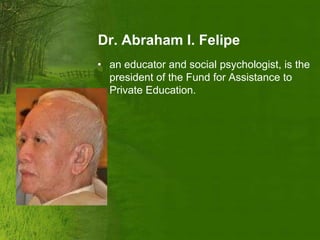
Dr. Abraham I. Felipe
• an educator and social psychologist, is the
  president of the Fund for Assistance to
  Private Education.
Scholarship
• award of financial aid for a student to
  further education.
• awarded on various criteria usually
  reflecting the values and purposes of the
  donor or founder of the award.
Types of Scholarships
• Merit-based
• Need-based
• Student-specific
GASTPE (Government
Assistance to Student and
Teachers in Private Education)
    •
        The Government through the
        Education Service Contracting (ESC)
        Scheme and the Tuition Fee
        Supplement (TFS) has entered into a
        contract with the private schools in
        order to accommodate those who
        otherwise will not be able to avail of
        free public secondary education. As
        of January 15, 1999, the ESC has
        374,918 student beneficiaries in
        1,122 participating schools, while the
        TSF has 162,966 grantees in 638
        participating schools.
What is ESC?
• Unlike other scholarships, there is no
  grade requirement other than the grade
  required to pass in the public schools.
• It is just like when a public school student
  in a private school setting.
• It has 4 regular players:
   • Government- sponsor
   • Student-recipient
   • Public School
   • Private school
Why the need for it?
• Public Schools
   • Congestion
   • Quality
   • Not being cost-effective
• Private Schools
   • Liquidity problem
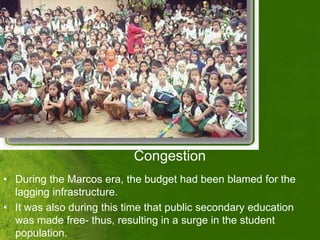
Congestion
• During the Marcos era, the budget had been blamed for the
  lagging infrastructure.
• It was also during this time that public secondary education
  was made free- thus, resulting in a surge in the student
  population.
Quality
• Studies of the NCEE confirmed that
  private schools were academically far
  more superior.
   • They abolished the NCEE instead.
Liquidity of the Private Schools
• The free scheme in the public
  schools, made them vis a vis unable to
  compete with the public schools.
Solution
• The private schools believed they can help
  in the congestion and quality problem.
• Public schools was more than willing to
  decongest classrooms and to uplift quality.
STEPS
1. Curriculum should be certified by the MECS.
2. Public High School Principal should certify that
   his/her school was overcrowded. The applicant
   would “otherwise-have-been-admitted”
3. Private schools must accept the “otherwise-
   have-been-admitted” students without
   additional qualifications. An applicant could
   only be refused admission if the private
   schools is itself overcrowded.
4. An applicant cannot be kicked out. But can be
   retained.
Interegnum
• Soon after the FAPE was designated to
  implement the ESC, many problems
  surfaced, such as:
   • It was unacceptable to many principals.
     The premium was on the size of school
     population. The bigger the school
     was, the more senior principals were
     assigned there, such that it was a post
     of prestige.
   • In due time the DECS took over the
     implementation.
• After three years, the program was
  returned to the FAPE, and it was already
  different.
   • The recipients were of the following
      types:
        • Endorsed by politicians
        • Endorsed by Education officials
        • Endorsed by private school officials
        • Private school students, planning to
          drop out because of the high tuition
          fees.
        • Walk-ins from public schools
At the Present
• The present ESC is suited for a
  scholarship program.
• The GASTPE was implemented-it gave
  the private schools deregulation of tuition
  fees.
• Thus, tuitions substantially increased.
The Preferred Future
1. No evidence that substantial support was
   given by post- Marcos administrations.
   When the lions’ share was given to the
   Education, most of it was for the salaries
   of teachers and State Universities.
2. From the way present recipients are now
   chosen, most do not resemble the
   originally intended recipients of low socio
   economic background.

Educational service contracting

  • 1.
  • 2.
    Dr. Abraham I.Felipe • an educator and social psychologist, is the president of the Fund for Assistance to Private Education.
  • 3.
    Scholarship • award offinancial aid for a student to further education. • awarded on various criteria usually reflecting the values and purposes of the donor or founder of the award.
  • 4.
    Types of Scholarships •Merit-based • Need-based • Student-specific
  • 5.
    GASTPE (Government Assistance toStudent and Teachers in Private Education) • The Government through the Education Service Contracting (ESC) Scheme and the Tuition Fee Supplement (TFS) has entered into a contract with the private schools in order to accommodate those who otherwise will not be able to avail of free public secondary education. As of January 15, 1999, the ESC has 374,918 student beneficiaries in 1,122 participating schools, while the TSF has 162,966 grantees in 638 participating schools.
  • 6.
    What is ESC? •Unlike other scholarships, there is no grade requirement other than the grade required to pass in the public schools. • It is just like when a public school student in a private school setting. • It has 4 regular players: • Government- sponsor • Student-recipient • Public School • Private school
  • 7.
    Why the needfor it? • Public Schools • Congestion • Quality • Not being cost-effective • Private Schools • Liquidity problem
  • 8.
    Congestion • During theMarcos era, the budget had been blamed for the lagging infrastructure. • It was also during this time that public secondary education was made free- thus, resulting in a surge in the student population.
  • 9.
    Quality • Studies ofthe NCEE confirmed that private schools were academically far more superior. • They abolished the NCEE instead.
  • 10.
    Liquidity of thePrivate Schools • The free scheme in the public schools, made them vis a vis unable to compete with the public schools.
  • 11.
    Solution • The privateschools believed they can help in the congestion and quality problem. • Public schools was more than willing to decongest classrooms and to uplift quality.
  • 12.
    STEPS 1. Curriculum shouldbe certified by the MECS. 2. Public High School Principal should certify that his/her school was overcrowded. The applicant would “otherwise-have-been-admitted” 3. Private schools must accept the “otherwise- have-been-admitted” students without additional qualifications. An applicant could only be refused admission if the private schools is itself overcrowded. 4. An applicant cannot be kicked out. But can be retained.
  • 13.
    Interegnum • Soon afterthe FAPE was designated to implement the ESC, many problems surfaced, such as: • It was unacceptable to many principals. The premium was on the size of school population. The bigger the school was, the more senior principals were assigned there, such that it was a post of prestige. • In due time the DECS took over the implementation.
  • 14.
    • After threeyears, the program was returned to the FAPE, and it was already different. • The recipients were of the following types: • Endorsed by politicians • Endorsed by Education officials • Endorsed by private school officials • Private school students, planning to drop out because of the high tuition fees. • Walk-ins from public schools
  • 15.
    At the Present •The present ESC is suited for a scholarship program. • The GASTPE was implemented-it gave the private schools deregulation of tuition fees. • Thus, tuitions substantially increased.
  • 16.
    The Preferred Future 1.No evidence that substantial support was given by post- Marcos administrations. When the lions’ share was given to the Education, most of it was for the salaries of teachers and State Universities. 2. From the way present recipients are now chosen, most do not resemble the originally intended recipients of low socio economic background.