EDUCATIONAL
INSTRUMENTS
INSTRUMENTS…


Instruments: Collections of items or
  questions intended to measure,
  collectively (total score) levels of
  theoretical variables (constructs) not
  easily observable directly.
THE TYPES OF INSTRUMENTS…

1. Cognitive Instruments
2. Affective Instruments
3. Projective Instruments
1. COGNITIVE INSTRUMENTS...


  Measure      an       individual’s
   attainment in academic areas
   typically  used   to    diagnose
   strengths and weaknesses
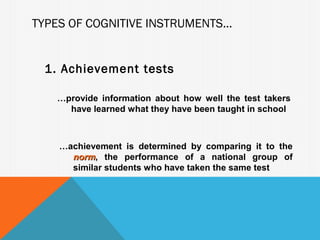
TYPES OF COGNITIVE INSTRUMENTS...


  1. Achievement tests

    …provide information about how well the test takers
      have learned what they have been taught in school


    …achievement is determined by comparing it to the
      norm, the performance of a national group of
      norm
      similar students who have taken the same test
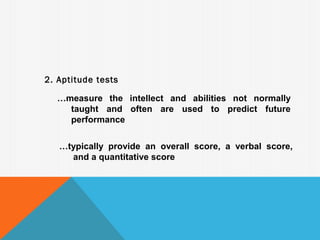
2. Aptitude tests

  …measure the intellect and abilities not normally
    taught and often are used to predict future
    performance


   …typically provide an overall score, a verbal score,
     and a quantitative score
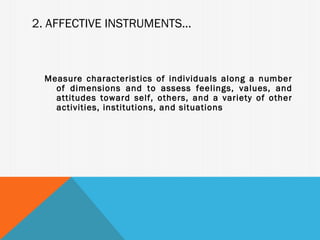
2. AFFECTIVE INSTRUMENTS...


  Measure characteristics of individuals along a number
    of dimensions and to assess feelings, values, and
    attitudes toward self, others, and a variety of other
    activities, institutions, and situations
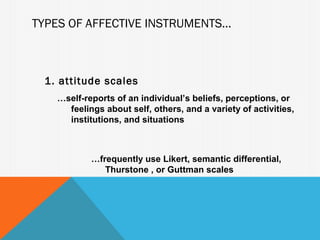
TYPES OF AFFECTIVE INSTRUMENTS...


  1. attitude scales
    …self-reports of an individual’s beliefs, perceptions, or
      feelings about self, others, and a variety of activities,
      institutions, and situations


            …frequently use Likert, semantic differential,
               Thurstone , or Guttman scales
2. values tests

  …measure the relative strength of an individual’s valuing
    of theoretical, economic, aesthetic, social, political, and
    religious values
3. Personality inventories

  …an individual’s self-report measuring how behaviors
    characteristic of defined personality traits describe that
    individual
3. PROJECTIVE INSTRUMENTS...


  Measure a respondent’s feelings or thoughts
   to an ambiguous stimulus
PRIMARY TYPE OF PROJECTIVE TEST...


  1. Associational tests

    …participants react to a stimulus such as a
      picture, inkblot or word onto which they
      project a description
STEPS IN CONSTRUCTING AN INSTRUMENT
1) Determine clearly what it is you want to measure.
2) Generate a pool of possible items (about 60 for a 20 item
   instrument).
3) Decide on question format (yes/no, strongly agree, agree, etc)
4) Decide how to score the instrument (e.g. on an optimism scale,
   all responses that indicate optimism should get higher scores, so
   that the more optimistic you are, the higher your total score).
5) Administer the instrument to a pilot sample of people: 100 - 300.
6) Scale purification: Evaluate each item using the pilot data
RULES GOVERNING THE SELECTION
INSTRUMENTS...
1. The highest validity

2. The highest reliability
3. The greatest ease of administration, scoring, and
    interpretation
4. Test takers’ lack of familiarity with instrument
5. Avoids potentially controversial matters
SELECTING AN INSTRUMENT...

1. Determine precisely the type of
   instrument needed
2. Identify and locate appropriate
   instruments
3. Compare and analyze instruments
4. Select best instrument
ADMINISTERING THE INSTRUMENT...


1. Make arrangements in advance
2. Ensure ideal testing environment
3. Be prepared for all probable
   contingencies
TWO ISSUES IN USING INSTRUMENTS...


1. Validity: the degree to which the
   Validity
   instrument measures what it purports
   to measure
2. Reliability: the degree to which the
   Reliability
   instrument consistently measures
   what it purports to measure
TERMS ASSOCIATED WITH INSTRUMENTS
    1. DATA
    2. CONSTRUCTS
    3. VARIABLE
    4. RAW SCORES
    5. MEASUREMENT SCALES
Data…
Data
…the pieces of information researchers
 collect through instruments to
 examine a topic or hypothesis
Constructs…
Constructs
…abstractions of behavioral factors
 that cannot be observed directly and
 which researchers invent to explain
 behavior
Variable…
Variable
…a construct that can take on two or
  more values or scores
Raw scores…
    scores
…the number of items an individual
 scored on an instrument
Measurement scales…
             scales
…the representation of variables so
 that they can be quantified
MEASUREMENT SCALES...

Qualitative (categorical)
Nominal variables “categorical”: classifies
persons or objects into two or more categories
MEASUREMENT SCALES...
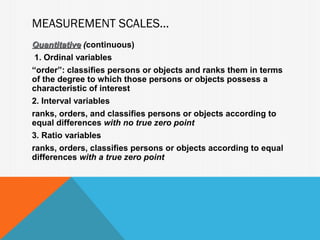
Quantitative (continuous)
              (
 1. Ordinal variables
“order”: classifies persons or objects and ranks them in terms
of the degree to which those persons or objects possess a
characteristic of interest
2. Interval variables
ranks, orders, and classifies persons or objects according to
equal differences with no true zero point
3. Ratio variables
ranks, orders, classifies persons or objects according to equal
differences with a true zero point

Educational Instruments

  • 1.
  • 2.
    INSTRUMENTS… Instruments: Collections ofitems or questions intended to measure, collectively (total score) levels of theoretical variables (constructs) not easily observable directly.
  • 3.
    THE TYPES OFINSTRUMENTS… 1. Cognitive Instruments 2. Affective Instruments 3. Projective Instruments
  • 4.
    1. COGNITIVE INSTRUMENTS... Measure an individual’s attainment in academic areas typically used to diagnose strengths and weaknesses
  • 5.
    TYPES OF COGNITIVEINSTRUMENTS... 1. Achievement tests …provide information about how well the test takers have learned what they have been taught in school …achievement is determined by comparing it to the norm, the performance of a national group of norm similar students who have taken the same test
  • 6.
    2. Aptitude tests …measure the intellect and abilities not normally taught and often are used to predict future performance …typically provide an overall score, a verbal score, and a quantitative score
  • 7.
    2. AFFECTIVE INSTRUMENTS... Measure characteristics of individuals along a number of dimensions and to assess feelings, values, and attitudes toward self, others, and a variety of other activities, institutions, and situations
  • 8.
    TYPES OF AFFECTIVEINSTRUMENTS... 1. attitude scales …self-reports of an individual’s beliefs, perceptions, or feelings about self, others, and a variety of activities, institutions, and situations …frequently use Likert, semantic differential, Thurstone , or Guttman scales
  • 9.
    2. values tests …measure the relative strength of an individual’s valuing of theoretical, economic, aesthetic, social, political, and religious values
  • 10.
    3. Personality inventories …an individual’s self-report measuring how behaviors characteristic of defined personality traits describe that individual
  • 11.
    3. PROJECTIVE INSTRUMENTS... Measure a respondent’s feelings or thoughts to an ambiguous stimulus
  • 12.
    PRIMARY TYPE OFPROJECTIVE TEST... 1. Associational tests …participants react to a stimulus such as a picture, inkblot or word onto which they project a description
  • 13.
    STEPS IN CONSTRUCTINGAN INSTRUMENT 1) Determine clearly what it is you want to measure. 2) Generate a pool of possible items (about 60 for a 20 item instrument). 3) Decide on question format (yes/no, strongly agree, agree, etc) 4) Decide how to score the instrument (e.g. on an optimism scale, all responses that indicate optimism should get higher scores, so that the more optimistic you are, the higher your total score). 5) Administer the instrument to a pilot sample of people: 100 - 300. 6) Scale purification: Evaluate each item using the pilot data
  • 14.
    RULES GOVERNING THESELECTION INSTRUMENTS... 1. The highest validity 2. The highest reliability 3. The greatest ease of administration, scoring, and interpretation 4. Test takers’ lack of familiarity with instrument 5. Avoids potentially controversial matters
  • 15.
    SELECTING AN INSTRUMENT... 1.Determine precisely the type of instrument needed 2. Identify and locate appropriate instruments 3. Compare and analyze instruments 4. Select best instrument
  • 16.
    ADMINISTERING THE INSTRUMENT... 1.Make arrangements in advance 2. Ensure ideal testing environment 3. Be prepared for all probable contingencies
  • 17.
    TWO ISSUES INUSING INSTRUMENTS... 1. Validity: the degree to which the Validity instrument measures what it purports to measure 2. Reliability: the degree to which the Reliability instrument consistently measures what it purports to measure
  • 18.
    TERMS ASSOCIATED WITHINSTRUMENTS 1. DATA 2. CONSTRUCTS 3. VARIABLE 4. RAW SCORES 5. MEASUREMENT SCALES
  • 19.
    Data… Data …the pieces ofinformation researchers collect through instruments to examine a topic or hypothesis
  • 20.
    Constructs… Constructs …abstractions of behavioralfactors that cannot be observed directly and which researchers invent to explain behavior
  • 21.
    Variable… Variable …a construct thatcan take on two or more values or scores
  • 22.
    Raw scores… scores …the number of items an individual scored on an instrument
  • 23.
    Measurement scales… scales …the representation of variables so that they can be quantified
  • 24.
    MEASUREMENT SCALES... Qualitative (categorical) Nominalvariables “categorical”: classifies persons or objects into two or more categories
  • 25.
    MEASUREMENT SCALES... Quantitative (continuous) ( 1. Ordinal variables “order”: classifies persons or objects and ranks them in terms of the degree to which those persons or objects possess a characteristic of interest 2. Interval variables ranks, orders, and classifies persons or objects according to equal differences with no true zero point 3. Ratio variables ranks, orders, classifies persons or objects according to equal differences with a true zero point