+
Governance and
Critical Pedagogy
Robert J. Parkes,PhD
Senior Lecturer in Curriculum Studies
The University of Newcastle,Australia
+
 Understanding the Power of Governance: A Poststructural
Perspective
 A Poststructural Perspective on Curriculum
 Towards a Post-Critical Pedagogy
Overview
+
Understanding the Power of
Governance: A poststructural
perspective
+
 “[Foucault] was forceful in bringing
into prominence the ways in which
marginalization, subjection, and
abjection could take place even in
the most liberal or enlightened
practices.” (p. 16)1
 “[He wanted] to write the history or
trace the archaeology of what they
[the medical, penal, psychiatric or
pedagogical establishment]
silenced, repressed, or excluded in
constituting themselves and the
institutions that house them.” (p.
130)1
Foucault, Genealogy &
Governmentality
1. LaCapra, D. (2000). History and reading: Tocqueville, foucault, french studies. Carlton South: Melbourne University Press.
+
 Response to Structuralism
 The Problem of Fascism
 May 1968 Revolution/s
A brief genealogy of
poststructuralist thought
+
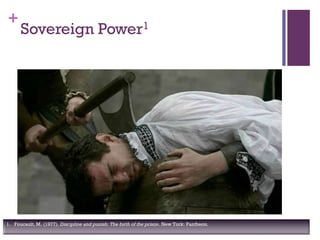
Sovereign Power1
1. Foucault, M. (1977). Discipline and punish: The birth of the prison. New York: Pantheon.
+
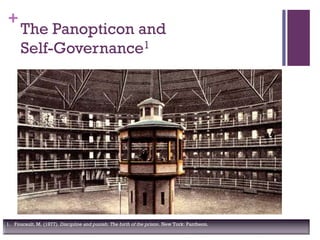
The Panopticon and
Self-Governance1
1. Foucault, M. (1977). Discipline and punish: The birth of the prison. New York: Pantheon.
+
Disciplining the Self
 Self-styling1 (shaping)
 (Self)exclusion
1. Gore, J.M. (1993). The struggle for pedagogies: Critical and feminist discourses as regimes of truth. New York: Routledge.
+
Port Arthur Prison,Tasmania
+
Panoptical Surveillance
 Individuation
 Differentiation
 Normalisation
+
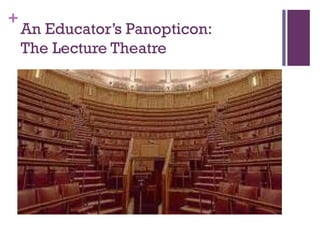
An Educator’s Panopticon:
The Lecture Theatre
+
 Power is productive.
 Power simultaneously constrains and enables.
 The constraining aspects of power are what gives it a
productive force.
 DO NOT confuse ‘productive’ with good,and therefore
constraining with bad.
The Productive Effect of Power
+
 Foucault was concerned with the way a “subject comes into
being … comes to mastery, comes into existence and agency,
through subjection” (Petersen, 2007, p. 477).
 Power is not simply a force that subordinates from the
outside, but must be understood as “what we depend on for
our existence. . . that, paradoxically, initiates and sustains our
agency” (Butler, 1997, p. 2).
 Foucault (1977) has clearly stated that “[t]he chief function of
disciplinary power is to ‘train’. . . it does not link forces
together in order to reduce them; it seeks to bind them
together in such a way as to multiply and use them” (p. 170).
Power and Agency
+
 Discourses are:
 Authoritative statements . . . what experts say when they are
speaking as experts. (Dreyfus & Rabinow, 1982)
 Common-sense statements that have come to take on an
authority in everyday life.
 A series of statements that form the objects of which they speak
(Foucault) . . . Instances of Power/Knowledge – power forming
knowledge / knowledge inciting power.
Discourse as Power
+
 Discourses constitute, construct, incite, and induce, rather
than simply document and describe,‘reality’.
 Crisis of Legitimation: Incredulity towards meta-narratives.
The Crisis of Representation
+
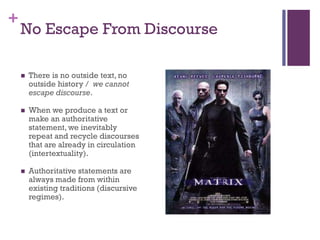
No Escape From Discourse
 There is no outside text, no
outside history / we cannot
escape discourse.
 When we produce a text or
make an authoritative
statement, we inevitably
repeat and recycle discourses
that are already in circulation
(intertextuality).
 Authoritative statements are
always made from within
existing traditions (discursive
regimes).
+
 Radical uncertainty, undecidability, and the call for
democracy.
 Practice of freedom (to be other than who you are now).
How do we judge what is good?
+
 Relativism
 Idealism
 Subjectivism
What have some of the critical
responses been to poststructuralism?
+
A Poststructural Perspective on
Curriculum
+
What is curriculum?
 All of the learning planned and
directed by the school to attain its
educational goals.1
 Refers to the learning experience of
students, as expressed or anticipated
in goals and objectives, plans and
designs, and their implementation.2
1. Tyler, R. W. (1949). Basic principles of curriculum and instruction. Chicago: The University of Chicago Press. Or see: Tyler, R. W.
(2004). Basic principles of curriculum and instruction. In D. J. Flinders & S. J. Thornton (Eds.), The curriculum studies reader (pp.
51-60). New York: Routledge.
2. Skilbeck, M. (1984). School based curriculum development. London: Harper & Row Ltd.
The most common answer to this
question:
The Syllabus as a set of
educational prescriptions
[ Usually a set of official Aims,
Knowledge,Skills,&Values ]
+
So what is the curriculum?
 the collection of all school subjects?
 the Syllabus for a specific school subject or Key
Learning Area?
 a Scope and sequence that maps how the syllabus
prescriptions will be met in an individual school?
 a Unit of Work that outlines the teaching and learning
strategies and goals for a specific set of syllabus topics?
 Lesson Plans for individual lessons that work towards
the achievement of unit goals?
The Explicit,
Planned, or
Official
Curriculum
+
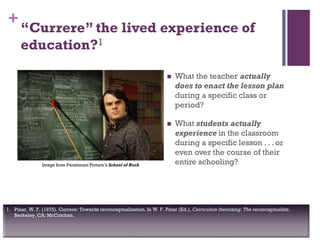
“Currere” the lived experience of
education?1
 What the teacher actually
does to enact the lesson plan
during a specific class or
period?
 What students actually
experience in the classroom
during a specific lesson . . . or
even over the course of their
entire schooling?
1. Pinar, W. F. (1975). Currere: Towards reconceptualization. In W. F. Pinar (Ed.), Curriculum theorizing: The reconceptualists.
Berkeley, CA: McCutchan.
Image from Paramount Picture’s School of Rock
+
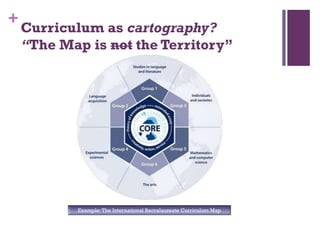
Example:The International Baccalaureate Curriculum Map
Curriculum as cartography?
“The Map is not the Territory”
+
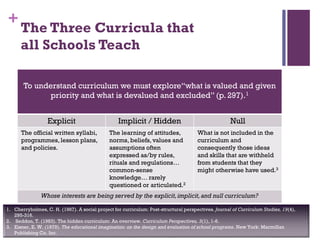
The Three Curricula that
all Schools Teach
To understand curriculum we must explore“what is valued and given
priority and what is devalued and excluded” (p. 297).1
Explicit Implicit / Hidden Null
The official written syllabi,
programmes, lesson plans,
and policies.
The learning of attitudes,
norms, beliefs, values and
assumptions often
expressed as/by rules,
rituals and regulations…
common-sense
knowledge… rarely
questioned or articulated.2
What is not included in the
curriculum and
consequently those ideas
and skills that are withheld
from students that they
might otherwise have used.3
Whose interests are being served by the explicit,implicit,and null curriculum?
1. Cherryholmes, C. H. (1987). A social project for curriculum: Post-structural perspectives. Journal of Curriculum Studies, 19(4),
295-316.
2. Seddon, T. (1983). The hidden curriculum: An overview. Curriculum Perspectives, 3(1), 1-6.
3. Eisner, E. W. (1979). The educational imagination: on the design and evaluation of school programs. New York: Macmillan
Publishing Co. Inc.
+
Curriculum constitutes particular
rationalities at the expense of others
 “Curricula are historically formed within systems of ideas
that inscribe styles of reasoning, standards, and conceptual
distinctions in school practices” (p. 151). [Offering] “an
ensemble of methods and strategies that inscribe principles
for action” (p. 163). . . [and particular] “styles of reasoning”
(p. 151). Curriculum must therefore be understood as “a
practice of governing and an effect of power” (p. 151).1
 Curriculum forms our ways of reasoning about the self and
the world, and the rationalities that emerge from this process
are constituted not only by what it includes, but by what it
implies and neglects.2
1. Popkewitz, T. S. (2001). The production of reason and power: Curriculum history and intellectual traditions. In T. S. Popkewitz, B.
M. Franklin & M. A. Pereyra (Eds.), Cultural history and education: Critical essays on knowledge and schooling (pp. 151-183). New
York: Routledge Falmer.
2. Parkes, R. J. (2011). Interrupting history: Rethinking history curriculum after 'the end of history'. New York: Peter Lang.
+
1. Kemmis, S., & Fitzclarence, L. (1986). Curriculum theorizing: Beyond reproduction theory. Geelong, Victoria: Deakin University.
2. Green, B. (2010). Rethinking the representation problem in curriculum inquiry. Journal of Curriculum Studies, 42(4), 451-469.
What is the function of curriculum?
Lessons from the Deakin School
 The double problem1 of the relationship between:
 theory and practice
[curriculum provides a set of representations of a ‘world outside’]
 education and society
[curriculum operates as a site of cultural reproduction]
 Re-examing the work of Ulf Lundgren and the Deakin School,
Green2 refers to this as the unresolved problem of
representation and reproduction.
+
Constructions of Curriculum
[or Different answers to the double problem of curriculum]
1. Eisner, E. W., & Vallance, E. (Eds.). (1974). Conflicting conceptions of curriculum. Berkley, CA: McCutchan Publishing
Corporation.
2. Schiro, M. S. (2008). Curriculum theory: Conflicting visions and enduring concerns. Los Angeles: SAGE Publications.
Eisner’s Model1 Schiro’s Model2
academic rationalism concerned with
“enabling the young to acquire the tools to
participate in the Western cultural tradition.”(p.
12)
Academic Idealist Curriculum
the development of cognitive processes
concerned with “the refinement of intellectual
operations.” (p. 5)
Techno-Rationalist Curriculum
technology concerned with “finding efficient
means to a set of predefined, unproblematic
ends.” (p. 7)
self-actualization concerned with education
“as an enabling process.” (p. 9)
Learner-Centred Curriculum
social reconstruction concerned with “social
reform and responsibility to the future of
society.” (p. 10)
Social Reconstructionist Curriculum
+
1. Gundem, B. B., & Hopmann, S. (Eds.). (2002). Didaktik and/or curriculum: An international dialogue. New York: Peter Lang.
The Key Curriculum Question/s
 Anglo-American Curriculum Tradition:
What knowledge is of most worth?*
[What should be taught?]
 European Bildung-Influenced Didaktik Tradition:1
What will the student become?
[What should the student become?]
*Whose knowledge is being taught?
+
Towards a Post-Critical Pedagogy
+
 Uses rhetoric that “give[s] the illusion of equality
[empowerment, student voice, dialogue] while leaving the
authoritarian nature of the teacher/student relationship
intact”.1
 Overstates the power of ‘rationality’ to free the subject from
constraining metanarratives.2
 Narrowly identifies power with forces of exploitation and
repression.3
 Can’t get beyond the missionary position!4
The Emancipatory Project of Critical
Pedagogy through a Poststructural Lens
1. Ellsworth, E. (1989). Why doesn't this feel empowering? Working through the repressive myths of critical pedagogy. Harvard
Educational Review, 59(3), 297-324.
2. Yates, L. (1992). Postmodernism, feminism and cultural politics: Or if master naratives have been discredited, what does giroux
think he is doing? Discourse, 13(1), 124-141.
3. Shapiro, S. (1995). The end of radical hope? Postmodernism and the challenge to critical pedagogy. In P. McLaren (Ed.),
Postmodernism, postcolonialism and pedagogy (pp. 187-204). Sydney: James Nicholas Publishers.
4. McWilliam, E. (1997). Beyond the missionary position: Teacher desire and radical pedagogy. In S. Todd (Ed.), Learning desire:
Perspectives on pedagogy, culture, and the unsaid (pp. 217-235). New York: Routledge.
+
 A pedagogy of ‘empowerment’ as it appears to privilege
those doing the ‘empowering’, and thus fails to avoid the
very relations of power it proposes to subvert.1
 Radical pedagogy discourses have tended to hold traditional
[zero-sum] conceptions of power and knowledge” that overly
simplify power relations and lead “to a kind of self
righteousness that claims innocence, and risks the
replacement of one orthodoxy with another” (p. xx).2
 Tendencies to create grand narratives of its own.3
The Emancipatory Project of Critical
Pedagogy through a Poststructural Lens –
Continued
1. Gore, J.M. (1992). What we can do for you! What can "we" do for "you"?: Struggling over empowerment in critical and feminist
pedagogy. In C. Luke & J. Gore (Eds.), Feminisms and critical pedagogy (pp. 54-73). New York: Routledge.
2. Gore, J.M. (1991). Neglected practices: A foucauldian critique of traditional and radical approaches to pedagogy. Paper presented
at the The Liberating Curriculum Conference, University of Adelaide.
3. Gore, J.M. (1993). The struggle for pedagogies: Critical and feminist discourses as regimes of truth. New York: Routledge.
+
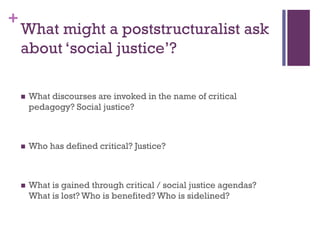
 What discourses are invoked in the name of critical
pedagogy? Social justice?
 Who has defined critical? Justice?
 What is gained through critical / social justice agendas?
What is lost? Who is benefited? Who is sidelined?
What might a poststructuralist ask
about ‘social justice’?
+
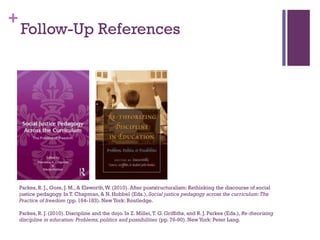
Parkes, R. J., Gore, J. M., & Elsworth,W. (2010). After poststructuralism: Rethinking the discourse of social
justice pedagogy. In T. Chapman, & N. Hobbel (Eds.), Social justice pedagogy across the curriculum:The
Practice of freedom (pp. 164-183). NewYork: Routledge.
Parkes, R. J. (2010). Discipline and the dojo. In Z. Millei,T. G. Griffiths, and R. J. Parkes (Eds.), Re-theorizing
discipline in education: Problems, politics and possibilities (pp.76-90). NewYork: Peter Lang.
Follow-Up References
+
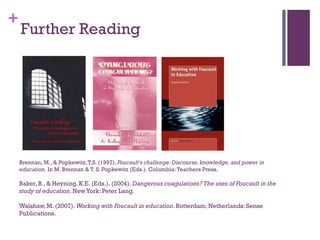
Brennan, M., & Popkewitz,T.S. (1997). Foucault's challenge: Discourse,knowledge, and power in
education. In M. Brennan & T. S. Popkewitz (Eds.). Columbia:Teachers Press.
Baker, B., & Heyning, K.E. (Eds.). (2004). Dangerous coagulations? The uses of Foucault in the
study of education.NewYork: Peter Lang.
Walshaw,M. (2007). Working with Foucault in education. Rotterdam, Netherlands: Sense
Publications.
Further Reading

Governance and Critical Pedagogy

  • 1.
    + Governance and Critical Pedagogy RobertJ. Parkes,PhD Senior Lecturer in Curriculum Studies The University of Newcastle,Australia
  • 2.
    +  Understanding thePower of Governance: A Poststructural Perspective  A Poststructural Perspective on Curriculum  Towards a Post-Critical Pedagogy Overview
  • 3.
    + Understanding the Powerof Governance: A poststructural perspective
  • 4.
    +  “[Foucault] wasforceful in bringing into prominence the ways in which marginalization, subjection, and abjection could take place even in the most liberal or enlightened practices.” (p. 16)1  “[He wanted] to write the history or trace the archaeology of what they [the medical, penal, psychiatric or pedagogical establishment] silenced, repressed, or excluded in constituting themselves and the institutions that house them.” (p. 130)1 Foucault, Genealogy & Governmentality 1. LaCapra, D. (2000). History and reading: Tocqueville, foucault, french studies. Carlton South: Melbourne University Press.
  • 5.
    +  Response toStructuralism  The Problem of Fascism  May 1968 Revolution/s A brief genealogy of poststructuralist thought
  • 6.
    + Sovereign Power1 1. Foucault,M. (1977). Discipline and punish: The birth of the prison. New York: Pantheon.
  • 7.
    + The Panopticon and Self-Governance1 1.Foucault, M. (1977). Discipline and punish: The birth of the prison. New York: Pantheon.
  • 8.
    + Disciplining the Self Self-styling1 (shaping)  (Self)exclusion 1. Gore, J.M. (1993). The struggle for pedagogies: Critical and feminist discourses as regimes of truth. New York: Routledge.
  • 9.
  • 10.
    + Panoptical Surveillance  Individuation Differentiation  Normalisation
  • 11.
  • 12.
    +  Power isproductive.  Power simultaneously constrains and enables.  The constraining aspects of power are what gives it a productive force.  DO NOT confuse ‘productive’ with good,and therefore constraining with bad. The Productive Effect of Power
  • 13.
    +  Foucault wasconcerned with the way a “subject comes into being … comes to mastery, comes into existence and agency, through subjection” (Petersen, 2007, p. 477).  Power is not simply a force that subordinates from the outside, but must be understood as “what we depend on for our existence. . . that, paradoxically, initiates and sustains our agency” (Butler, 1997, p. 2).  Foucault (1977) has clearly stated that “[t]he chief function of disciplinary power is to ‘train’. . . it does not link forces together in order to reduce them; it seeks to bind them together in such a way as to multiply and use them” (p. 170). Power and Agency
  • 14.
    +  Discourses are: Authoritative statements . . . what experts say when they are speaking as experts. (Dreyfus & Rabinow, 1982)  Common-sense statements that have come to take on an authority in everyday life.  A series of statements that form the objects of which they speak (Foucault) . . . Instances of Power/Knowledge – power forming knowledge / knowledge inciting power. Discourse as Power
  • 15.
    +  Discourses constitute,construct, incite, and induce, rather than simply document and describe,‘reality’.  Crisis of Legitimation: Incredulity towards meta-narratives. The Crisis of Representation
  • 16.
    + No Escape FromDiscourse  There is no outside text, no outside history / we cannot escape discourse.  When we produce a text or make an authoritative statement, we inevitably repeat and recycle discourses that are already in circulation (intertextuality).  Authoritative statements are always made from within existing traditions (discursive regimes).
  • 17.
    +  Radical uncertainty,undecidability, and the call for democracy.  Practice of freedom (to be other than who you are now). How do we judge what is good?
  • 18.
    +  Relativism  Idealism Subjectivism What have some of the critical responses been to poststructuralism?
  • 19.
  • 20.
    + What is curriculum? All of the learning planned and directed by the school to attain its educational goals.1  Refers to the learning experience of students, as expressed or anticipated in goals and objectives, plans and designs, and their implementation.2 1. Tyler, R. W. (1949). Basic principles of curriculum and instruction. Chicago: The University of Chicago Press. Or see: Tyler, R. W. (2004). Basic principles of curriculum and instruction. In D. J. Flinders & S. J. Thornton (Eds.), The curriculum studies reader (pp. 51-60). New York: Routledge. 2. Skilbeck, M. (1984). School based curriculum development. London: Harper & Row Ltd. The most common answer to this question: The Syllabus as a set of educational prescriptions [ Usually a set of official Aims, Knowledge,Skills,&Values ]
  • 21.
    + So what isthe curriculum?  the collection of all school subjects?  the Syllabus for a specific school subject or Key Learning Area?  a Scope and sequence that maps how the syllabus prescriptions will be met in an individual school?  a Unit of Work that outlines the teaching and learning strategies and goals for a specific set of syllabus topics?  Lesson Plans for individual lessons that work towards the achievement of unit goals? The Explicit, Planned, or Official Curriculum
  • 22.
    + “Currere” the livedexperience of education?1  What the teacher actually does to enact the lesson plan during a specific class or period?  What students actually experience in the classroom during a specific lesson . . . or even over the course of their entire schooling? 1. Pinar, W. F. (1975). Currere: Towards reconceptualization. In W. F. Pinar (Ed.), Curriculum theorizing: The reconceptualists. Berkeley, CA: McCutchan. Image from Paramount Picture’s School of Rock
  • 23.
    + Example:The International BaccalaureateCurriculum Map Curriculum as cartography? “The Map is not the Territory”
  • 24.
    + The Three Curriculathat all Schools Teach To understand curriculum we must explore“what is valued and given priority and what is devalued and excluded” (p. 297).1 Explicit Implicit / Hidden Null The official written syllabi, programmes, lesson plans, and policies. The learning of attitudes, norms, beliefs, values and assumptions often expressed as/by rules, rituals and regulations… common-sense knowledge… rarely questioned or articulated.2 What is not included in the curriculum and consequently those ideas and skills that are withheld from students that they might otherwise have used.3 Whose interests are being served by the explicit,implicit,and null curriculum? 1. Cherryholmes, C. H. (1987). A social project for curriculum: Post-structural perspectives. Journal of Curriculum Studies, 19(4), 295-316. 2. Seddon, T. (1983). The hidden curriculum: An overview. Curriculum Perspectives, 3(1), 1-6. 3. Eisner, E. W. (1979). The educational imagination: on the design and evaluation of school programs. New York: Macmillan Publishing Co. Inc.
  • 25.
    + Curriculum constitutes particular rationalitiesat the expense of others  “Curricula are historically formed within systems of ideas that inscribe styles of reasoning, standards, and conceptual distinctions in school practices” (p. 151). [Offering] “an ensemble of methods and strategies that inscribe principles for action” (p. 163). . . [and particular] “styles of reasoning” (p. 151). Curriculum must therefore be understood as “a practice of governing and an effect of power” (p. 151).1  Curriculum forms our ways of reasoning about the self and the world, and the rationalities that emerge from this process are constituted not only by what it includes, but by what it implies and neglects.2 1. Popkewitz, T. S. (2001). The production of reason and power: Curriculum history and intellectual traditions. In T. S. Popkewitz, B. M. Franklin & M. A. Pereyra (Eds.), Cultural history and education: Critical essays on knowledge and schooling (pp. 151-183). New York: Routledge Falmer. 2. Parkes, R. J. (2011). Interrupting history: Rethinking history curriculum after 'the end of history'. New York: Peter Lang.
  • 26.
    + 1. Kemmis, S.,& Fitzclarence, L. (1986). Curriculum theorizing: Beyond reproduction theory. Geelong, Victoria: Deakin University. 2. Green, B. (2010). Rethinking the representation problem in curriculum inquiry. Journal of Curriculum Studies, 42(4), 451-469. What is the function of curriculum? Lessons from the Deakin School  The double problem1 of the relationship between:  theory and practice [curriculum provides a set of representations of a ‘world outside’]  education and society [curriculum operates as a site of cultural reproduction]  Re-examing the work of Ulf Lundgren and the Deakin School, Green2 refers to this as the unresolved problem of representation and reproduction.
  • 27.
    + Constructions of Curriculum [orDifferent answers to the double problem of curriculum] 1. Eisner, E. W., & Vallance, E. (Eds.). (1974). Conflicting conceptions of curriculum. Berkley, CA: McCutchan Publishing Corporation. 2. Schiro, M. S. (2008). Curriculum theory: Conflicting visions and enduring concerns. Los Angeles: SAGE Publications. Eisner’s Model1 Schiro’s Model2 academic rationalism concerned with “enabling the young to acquire the tools to participate in the Western cultural tradition.”(p. 12) Academic Idealist Curriculum the development of cognitive processes concerned with “the refinement of intellectual operations.” (p. 5) Techno-Rationalist Curriculum technology concerned with “finding efficient means to a set of predefined, unproblematic ends.” (p. 7) self-actualization concerned with education “as an enabling process.” (p. 9) Learner-Centred Curriculum social reconstruction concerned with “social reform and responsibility to the future of society.” (p. 10) Social Reconstructionist Curriculum
  • 28.
    + 1. Gundem, B.B., & Hopmann, S. (Eds.). (2002). Didaktik and/or curriculum: An international dialogue. New York: Peter Lang. The Key Curriculum Question/s  Anglo-American Curriculum Tradition: What knowledge is of most worth?* [What should be taught?]  European Bildung-Influenced Didaktik Tradition:1 What will the student become? [What should the student become?] *Whose knowledge is being taught?
  • 29.
  • 30.
    +  Uses rhetoricthat “give[s] the illusion of equality [empowerment, student voice, dialogue] while leaving the authoritarian nature of the teacher/student relationship intact”.1  Overstates the power of ‘rationality’ to free the subject from constraining metanarratives.2  Narrowly identifies power with forces of exploitation and repression.3  Can’t get beyond the missionary position!4 The Emancipatory Project of Critical Pedagogy through a Poststructural Lens 1. Ellsworth, E. (1989). Why doesn't this feel empowering? Working through the repressive myths of critical pedagogy. Harvard Educational Review, 59(3), 297-324. 2. Yates, L. (1992). Postmodernism, feminism and cultural politics: Or if master naratives have been discredited, what does giroux think he is doing? Discourse, 13(1), 124-141. 3. Shapiro, S. (1995). The end of radical hope? Postmodernism and the challenge to critical pedagogy. In P. McLaren (Ed.), Postmodernism, postcolonialism and pedagogy (pp. 187-204). Sydney: James Nicholas Publishers. 4. McWilliam, E. (1997). Beyond the missionary position: Teacher desire and radical pedagogy. In S. Todd (Ed.), Learning desire: Perspectives on pedagogy, culture, and the unsaid (pp. 217-235). New York: Routledge.
  • 31.
    +  A pedagogyof ‘empowerment’ as it appears to privilege those doing the ‘empowering’, and thus fails to avoid the very relations of power it proposes to subvert.1  Radical pedagogy discourses have tended to hold traditional [zero-sum] conceptions of power and knowledge” that overly simplify power relations and lead “to a kind of self righteousness that claims innocence, and risks the replacement of one orthodoxy with another” (p. xx).2  Tendencies to create grand narratives of its own.3 The Emancipatory Project of Critical Pedagogy through a Poststructural Lens – Continued 1. Gore, J.M. (1992). What we can do for you! What can "we" do for "you"?: Struggling over empowerment in critical and feminist pedagogy. In C. Luke & J. Gore (Eds.), Feminisms and critical pedagogy (pp. 54-73). New York: Routledge. 2. Gore, J.M. (1991). Neglected practices: A foucauldian critique of traditional and radical approaches to pedagogy. Paper presented at the The Liberating Curriculum Conference, University of Adelaide. 3. Gore, J.M. (1993). The struggle for pedagogies: Critical and feminist discourses as regimes of truth. New York: Routledge.
  • 32.
    +  What discoursesare invoked in the name of critical pedagogy? Social justice?  Who has defined critical? Justice?  What is gained through critical / social justice agendas? What is lost? Who is benefited? Who is sidelined? What might a poststructuralist ask about ‘social justice’?
  • 33.
    + Parkes, R. J.,Gore, J. M., & Elsworth,W. (2010). After poststructuralism: Rethinking the discourse of social justice pedagogy. In T. Chapman, & N. Hobbel (Eds.), Social justice pedagogy across the curriculum:The Practice of freedom (pp. 164-183). NewYork: Routledge. Parkes, R. J. (2010). Discipline and the dojo. In Z. Millei,T. G. Griffiths, and R. J. Parkes (Eds.), Re-theorizing discipline in education: Problems, politics and possibilities (pp.76-90). NewYork: Peter Lang. Follow-Up References
  • 34.
    + Brennan, M., &Popkewitz,T.S. (1997). Foucault's challenge: Discourse,knowledge, and power in education. In M. Brennan & T. S. Popkewitz (Eds.). Columbia:Teachers Press. Baker, B., & Heyning, K.E. (Eds.). (2004). Dangerous coagulations? The uses of Foucault in the study of education.NewYork: Peter Lang. Walshaw,M. (2007). Working with Foucault in education. Rotterdam, Netherlands: Sense Publications. Further Reading