DepEd’s
Basic
Education
Learning
Continuity Plan
(BE-LCP)
ARNULFO S. BAYOS, JR.
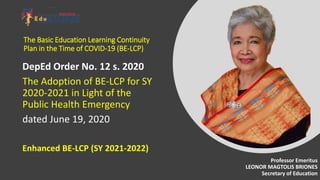
DepEd Order No. 12 s. 2020
The Adoption of BE-LCP for SY
2020-2021 in Light of the
Public Health Emergency
dated June 19, 2020
Enhanced BE-LCP (SY 2021-2022)
The Basic Education Learning Continuity
Plan in the Time of COVID-19 (BE-LCP)
Professor Emeritus
LEONOR MAGTOLIS BRIONES
Secretary of Education
Content:
• Principles and Features of BE-LCP
• BE-LCP Planning & Development
• Learning Strategies & Modalities
• Operationalizing BE-LCP
• Social, Economic, and Security Factors
• Anchoring on Sulong Edukalidad &
Bridging into the Future
• Sample BE-LCP
The Basic Education Learning Continuity
Plan in the Time of COVID-19 (BE-LCP)
LEARNING
OPPORTUNITIES
SHALL BE
AVAILABLE
The Basic Education Learning Continuity
Plan in the Time of COVID-19 (BE-LCP)
• Provided clear guidance to
units, schools, and community
learning centers amidst
pandemic
• Helped engage the internal and
external stakeholders for inputs
in the delivery strategy and
operational direction that
ensures health, safety and well
being of learners, teachers, and
personnel in the department.
The Basic Education Learning Continuity
Plan in the Time of COVID-19 (BE-LCP)
BE-LCP defined as the
package of education
interventions that
responds to basic
education challenges
brought about by COVID-
19
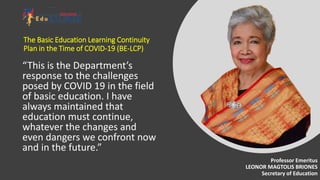
“This is the Department’s
response to the challenges
posed by COVID 19 in the field
of basic education. I have
always maintained that
education must continue,
whatever the changes and
even dangers we confront now
and in the future.”
The Basic Education Learning Continuity
Plan in the Time of COVID-19 (BE-LCP)
Professor Emeritus
LEONOR MAGTOLIS BRIONES
Secretary of Education
The Basic Education Learning Continuity
Plan in the Time of COVID-19 (BE-LCP)
PRINCIPLES &
FEATURES of
BE-LCP
BE-LCP Principles:
1. Protect the health, safety and
well-being of learners, teachers
and personnel, and prevent the
further transmission of COVID-19;
2. Ensure learning continuity through
K-12 curriculum adjustments,
alignment of learning materials,
deployment of multiple learning
delivery modalities, provision of
corresponding training for teachers
and school leaders, and proper
orientation of parents or guardians
of learners;
BE-LCP Principles:
3. Facilitate the safe return of
teaching and non-teaching
personnel and learners to
workplaces and schools, taking into
consideration the scenarios
projected by the DOH and the IATF,
complemented by other credible
sources, and balanced with DepEd’s
own risk assessments;
BE-LCP Principles:
4. Be sensitive to equity
considerations and concerns, and
endeavor to address them the best
we can; and
5. Link and bridge the BE-LCP to
DepEd’s pivot to quality and into the
future of education, under the
framework of Sulong EduKalidad and
Futures Thinking in Education
The Basic Education
Learning Continuity Plan in
the Time of COVID-19
(BE-LCP)
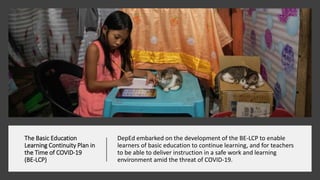
DepEd embarked on the development of the BE-LCP to enable
learners of basic education to continue learning, and for teachers
to be able to deliver instruction in a safe work and learning
environment amid the threat of COVID-19.
The Basic Education
Learning Continuity Plan in
the Time of COVID-19
(BE-LCP)
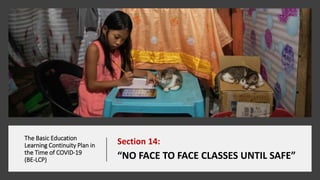
Section 14:
“NO FACE TO FACE CLASSES UNTIL SAFE”
The Basic Education Learning Continuity
Plan in the Time of COVID-19 (BE-LCP)
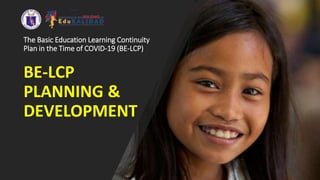
BE-LCP
PLANNING &
DEVELOPMENT
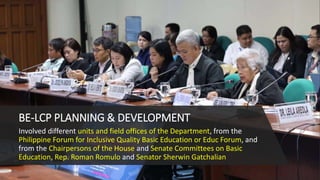
BE-LCP PLANNING & DEVELOPMENT
Involved different units and field offices of the Department, from the
Philippine Forum for Inclusive Quality Basic Education or Educ Forum, and
from the Chairpersons of the House and Senate Committees on Basic
Education, Rep. Roman Romulo and Senator Sherwin Gatchalian
BE-LCP PLANNING & DEVELOPMENT
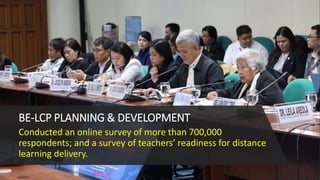
Conducted an online survey of more than 700,000
respondents; and a survey of teachers’ readiness for distance
learning delivery.
BE-LCP PLANNING & DEVELOPMENT
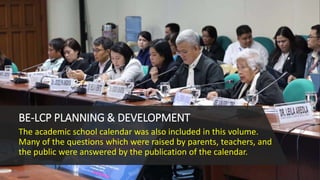
The academic school calendar was also included in this volume.
Many of the questions which were raised by parents, teachers, and
the public were answered by the publication of the calendar.
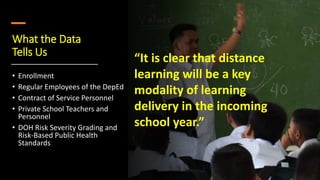
What the Data
Tells Us
• Enrollment
• Regular Employees of the DepEd
• Contract of Service Personnel
• Private School Teachers and
Personnel
• DOH Risk Severity Grading and
Risk-Based Public Health
Standards
“It is clear that distance
learning will be a key
modality of learning
delivery in the incoming
school year.”
The Basic Education Learning Continuity
Plan in the Time of COVID-19 (BE-LCP)
BE-LCP
LEARNING
STRATEGIES &
MODALITIES
Learning Strategies &
Modalities
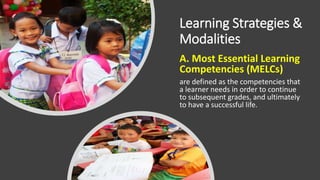
A. Most Essential Learning
Competencies (MELCs)
are defined as the competencies that
a learner needs in order to continue
to subsequent grades, and ultimately
to have a successful life.
Most Essential Learning
Competencies (MELCs)
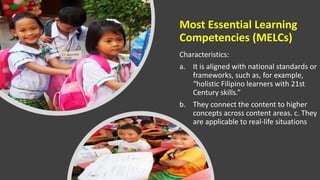
Characteristics:
a. It is aligned with national standards or
frameworks, such as, for example,
“holistic Filipino learners with 21st
Century skills.”
b. They connect the content to higher
concepts across content areas. c. They
are applicable to real-life situations
Most Essential Learning
Competencies (MELCs)
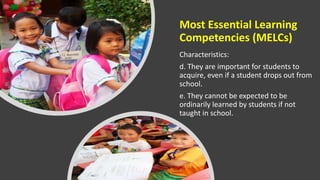
Characteristics:
d. They are important for students to
acquire, even if a student drops out from
school.
e. They cannot be expected to be
ordinarily learned by students if not
taught in school.
B. Learning Delivery
Modalities
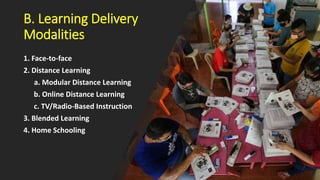
1. Face-to-face
2. Distance Learning
a. Modular Distance Learning
b. Online Distance Learning
c. TV/Radio-Based Instruction
3. Blended Learning
4. Home Schooling
B. Learning Delivery
Modalities
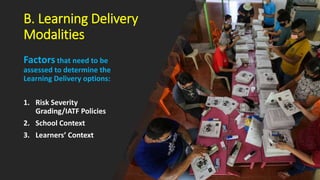
Factors that need to be
assessed to determine the
Learning Delivery options:
1. Risk Severity
Grading/IATF Policies
2. School Context
3. Learners’ Context
B. Learning Delivery
Modalities
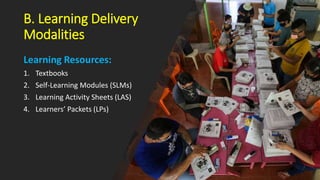
Learning Resources:
1. Textbooks
2. Self-Learning Modules (SLMs)
3. Learning Activity Sheets (LAS)
4. Learners’ Packets (LPs)
ASSESSMENT
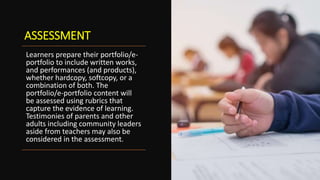
Learners prepare their portfolio/e-
portfolio to include written works,
and performances (and products),
whether hardcopy, softcopy, or a
combination of both. The
portfolio/e-portfolio content will
be assessed using rubrics that
capture the evidence of learning.
Testimonies of parents and other
adults including community leaders
aside from teachers may also be
considered in the assessment.
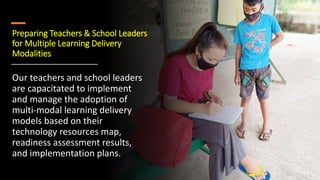
Preparing Teachers & School Leaders
for Multiple Learning Delivery
Modalities
Our teachers and school leaders
are capacitated to implement
and manage the adoption of
multi-modal learning delivery
models based on their
technology resources map,
readiness assessment results,
and implementation plans.
The Basic Education Learning Continuity
Plan in the Time of COVID-19 (BE-LCP)
OPERATIONALIZING
THE BE-LCP
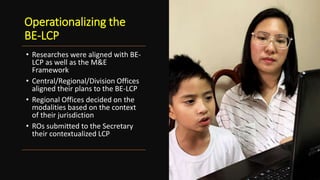
Operationalizing the
BE-LCP
• Researches were aligned with BE-
LCP as well as the M&E
Framework
• Central/Regional/Division Offices
aligned their plans to the BE-LCP
• Regional Offices decided on the
modalities based on the context
of their jurisdiction
• ROs submitted to the Secretary
their contextualized LCP
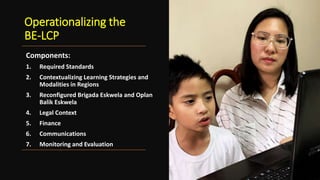
Operationalizing the
BE-LCP
Components:
1. Required Standards
2. Contextualizing Learning Strategies and
Modalities in Regions
3. Reconfigured Brigada Eskwela and Oplan
Balik Eskwela
4. Legal Context
5. Finance
6. Communications
7. Monitoring and Evaluation
Operationalizing the
BE-LCP
2. Contextualizing Learning
Strategies and Modalities in
Regions
• Regional directors shall decide
on the learning delivery
modalities deemed
appropriate in the context of
the local conditions and
consistent with the COVID-19
guidelines and regulations.
Operationalizing the
BE-LCP
3. Reconfigured Brigada Eskwela and
Oplan Balik Eskwela
a.Orientation on the “new
normal”;
b.Investment in education: Giving
new direction in engaging
partners;
c. Discussion of the BE-LCP; Brigada
Eskwela and Oplan Balik Eskwela,
the annual activities of DepEd to
prepare for the school opening,
will be reconfigured to fully assist
the preparation of stakeholders
in the roll-out of the BE-LCP.
Operationalizing the
BE-LCP
3. Reconfigured Brigada Eskwela and
Oplan Balik Eskwela
d. One major Brigada Eskwela
activity to be adopted by RO/SDO;
e. Conduct of psychological first aid
(PFA) and PFA training;
f. Discussion on the basic roles and
responsibilities of different sectors,
including parents; and
g. Debriefing of learners, among
others.
Operationalizing the
BE-LCP
4. Legal Context
The 1987 Constitution provides in Article
XIV, Section 1 that the “State shall protect
and promote the right of all citizens to
quality education at all levels, and shall take
appropriate steps to make such education
accessible to all.” This right must be upheld
at all times, and DepEd is duty-bound to
provide learning opportunities even in the
time of the COVID-19 national emergency.
Under Republic Act (R.A.) No. 9155 or the
“Governance of Basic Education Act of
2001,”
Operationalizing the
BE-LCP
4. Legal Context
DepEd is “vested with
authority, accountability and
responsibility for ensuring
access to, promoting equity
in, and improving the quality
of basic education.”
Operationalizing the
BE-LCP
4. Legal Context
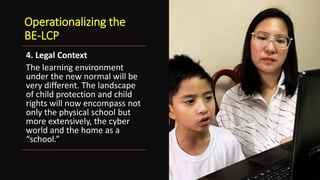
The learning environment
under the new normal will be
very different. The landscape
of child protection and child
rights will now encompass not
only the physical school but
more extensively, the cyber
world and the home as a
“school.”
Operationalizing the
BE-LCP
5. Finance
The Department shall make necessary
adjustments in its operations to meet the
objectives of the LCP. Guided by the
directions set forth by the plan, the
Bureaus, Services and Offices (B/S/Os) are
reviewing and assessing programs,
activities, and projects and their
corresponding budgets to make them
more responsive to the current and post-
COVID-19 scenarios. The available
programmed funds shall be maximized,
reprogrammed, or realigned to those
programs and activities that would require
more funding support.
Operationalizing the
BE-LCP
6. Communications
Communications shall play a major role in
getting the support of stakeholders in
implementing the BE-LCP. In its
communications work on the BE-LCP,
DepEd is guided by its National
Communications Framework (NCF) which
outlines the overarching communications
approaches, including a communications
strategy in the time of a crisis. All
communication efforts shall be directed
from the Central Office to ensure a
common understanding of DepEd’s
programs, while allowing field
communicators to make communications
responsive to localized needs.
Operationalizing the
BE-LCP
7. Monitoring and Evaluation
To further guide the Department in
refining and continuously fleshing out
the BE-LCP, a Monitoring and
Evaluation (M&E) Framework
anchored on the Basic Education
Monitoring and Evaluation Framework
(BEMEF) is being adopted, tailored to
the needs of the learners during this
emergency. This framework shall
animate the planned interventions
and activities, and will show the
desired outcomes as we navigate
through the situation.
The Basic Education Learning Continuity
Plan in the Time of COVID-19 (BE-LCP)
SOCIAL,
ECONOMIC, &
SECURITY FACTORS
Social, Economic,
and Security
Factors
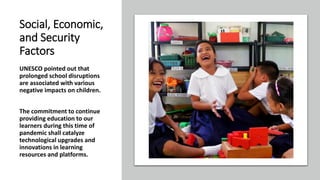
UNESCO pointed out that
prolonged school disruptions
are associated with various
negative impacts on children.
The commitment to continue
providing education to our
learners during this time of
pandemic shall catalyze
technological upgrades and
innovations in learning
resources and platforms.
The Basic Education Learning Continuity
Plan in the Time of COVID-19 (BE-LCP)
ANCHORING ON
SULONG
EDUKALIDAD &
BRIDGING INTO
THE FUTURE
Anchoring on Sulong Edukalidad and
Bridging into the Future
With the BE-LCP, DepEd has
demonstrated three interconnected
capacities that are significantly
linked to the future: INNOVATION,
AGILITY, and SYNERGY.
The BE-LCP is a testament that there
is a huge difference between
formulating a solution the soonest
time possible when it is needed, and
coming up with a near-perfect
solution much later when everyone
has already looked elsewhere.
The Basic Education Learning Continuity
Plan in the Time of COVID-19 (BE-LCP)
SDO Camarines Sur
Division BE-LCP
Enhanced BE-LCP
M&E
District & School
The Basic Education Learning Continuity
Plan in the Time of COVID-19 (BE-LCP)
8 Aspects:
1. Key Performance Indicators and Enrolment
2. Contextualizing Learning Strategies and
Modalities
3. Learning Resources
4. Assessment Strategies
5. Capability Building of Teaching and Non-
teaching
6. Implementation of required health standards
7. Utilization of Fund
8. Partnership and Linkages
References:
DepEd_LCP_July3.pdf
DO_s2020_012
DepEd’s
Basic
Education
Learning
Continuity Plan
(BE-LCP)
ARNULFO S. BAYOS, JR.

Basic Education Learning Continuity Plan (BE-LCP).pptx

  • 1.
  • 2.
    DepEd Order No.12 s. 2020 The Adoption of BE-LCP for SY 2020-2021 in Light of the Public Health Emergency dated June 19, 2020 Enhanced BE-LCP (SY 2021-2022) The Basic Education Learning Continuity Plan in the Time of COVID-19 (BE-LCP) Professor Emeritus LEONOR MAGTOLIS BRIONES Secretary of Education
  • 3.
    Content: • Principles andFeatures of BE-LCP • BE-LCP Planning & Development • Learning Strategies & Modalities • Operationalizing BE-LCP • Social, Economic, and Security Factors • Anchoring on Sulong Edukalidad & Bridging into the Future • Sample BE-LCP
  • 4.
    The Basic EducationLearning Continuity Plan in the Time of COVID-19 (BE-LCP) LEARNING OPPORTUNITIES SHALL BE AVAILABLE
  • 5.
    The Basic EducationLearning Continuity Plan in the Time of COVID-19 (BE-LCP) • Provided clear guidance to units, schools, and community learning centers amidst pandemic • Helped engage the internal and external stakeholders for inputs in the delivery strategy and operational direction that ensures health, safety and well being of learners, teachers, and personnel in the department.
  • 6.
    The Basic EducationLearning Continuity Plan in the Time of COVID-19 (BE-LCP) BE-LCP defined as the package of education interventions that responds to basic education challenges brought about by COVID- 19
  • 7.
    “This is theDepartment’s response to the challenges posed by COVID 19 in the field of basic education. I have always maintained that education must continue, whatever the changes and even dangers we confront now and in the future.” The Basic Education Learning Continuity Plan in the Time of COVID-19 (BE-LCP) Professor Emeritus LEONOR MAGTOLIS BRIONES Secretary of Education
  • 8.
    The Basic EducationLearning Continuity Plan in the Time of COVID-19 (BE-LCP) PRINCIPLES & FEATURES of BE-LCP
  • 9.
    BE-LCP Principles: 1. Protectthe health, safety and well-being of learners, teachers and personnel, and prevent the further transmission of COVID-19; 2. Ensure learning continuity through K-12 curriculum adjustments, alignment of learning materials, deployment of multiple learning delivery modalities, provision of corresponding training for teachers and school leaders, and proper orientation of parents or guardians of learners;
  • 10.
    BE-LCP Principles: 3. Facilitatethe safe return of teaching and non-teaching personnel and learners to workplaces and schools, taking into consideration the scenarios projected by the DOH and the IATF, complemented by other credible sources, and balanced with DepEd’s own risk assessments;
  • 11.
    BE-LCP Principles: 4. Besensitive to equity considerations and concerns, and endeavor to address them the best we can; and 5. Link and bridge the BE-LCP to DepEd’s pivot to quality and into the future of education, under the framework of Sulong EduKalidad and Futures Thinking in Education
  • 12.
    The Basic Education LearningContinuity Plan in the Time of COVID-19 (BE-LCP) DepEd embarked on the development of the BE-LCP to enable learners of basic education to continue learning, and for teachers to be able to deliver instruction in a safe work and learning environment amid the threat of COVID-19.
  • 13.
    The Basic Education LearningContinuity Plan in the Time of COVID-19 (BE-LCP) Section 14: “NO FACE TO FACE CLASSES UNTIL SAFE”
  • 14.
    The Basic EducationLearning Continuity Plan in the Time of COVID-19 (BE-LCP) BE-LCP PLANNING & DEVELOPMENT
  • 15.
    BE-LCP PLANNING &DEVELOPMENT Involved different units and field offices of the Department, from the Philippine Forum for Inclusive Quality Basic Education or Educ Forum, and from the Chairpersons of the House and Senate Committees on Basic Education, Rep. Roman Romulo and Senator Sherwin Gatchalian
  • 16.
    BE-LCP PLANNING &DEVELOPMENT Conducted an online survey of more than 700,000 respondents; and a survey of teachers’ readiness for distance learning delivery.
  • 17.
    BE-LCP PLANNING &DEVELOPMENT The academic school calendar was also included in this volume. Many of the questions which were raised by parents, teachers, and the public were answered by the publication of the calendar.
  • 19.
    What the Data TellsUs • Enrollment • Regular Employees of the DepEd • Contract of Service Personnel • Private School Teachers and Personnel • DOH Risk Severity Grading and Risk-Based Public Health Standards “It is clear that distance learning will be a key modality of learning delivery in the incoming school year.”
  • 20.
    The Basic EducationLearning Continuity Plan in the Time of COVID-19 (BE-LCP) BE-LCP LEARNING STRATEGIES & MODALITIES
  • 21.
    Learning Strategies & Modalities A.Most Essential Learning Competencies (MELCs) are defined as the competencies that a learner needs in order to continue to subsequent grades, and ultimately to have a successful life.
  • 22.
    Most Essential Learning Competencies(MELCs) Characteristics: a. It is aligned with national standards or frameworks, such as, for example, “holistic Filipino learners with 21st Century skills.” b. They connect the content to higher concepts across content areas. c. They are applicable to real-life situations
  • 23.
    Most Essential Learning Competencies(MELCs) Characteristics: d. They are important for students to acquire, even if a student drops out from school. e. They cannot be expected to be ordinarily learned by students if not taught in school.
  • 24.
    B. Learning Delivery Modalities 1.Face-to-face 2. Distance Learning a. Modular Distance Learning b. Online Distance Learning c. TV/Radio-Based Instruction 3. Blended Learning 4. Home Schooling
  • 25.
    B. Learning Delivery Modalities Factorsthat need to be assessed to determine the Learning Delivery options: 1. Risk Severity Grading/IATF Policies 2. School Context 3. Learners’ Context
  • 26.
    B. Learning Delivery Modalities LearningResources: 1. Textbooks 2. Self-Learning Modules (SLMs) 3. Learning Activity Sheets (LAS) 4. Learners’ Packets (LPs)
  • 27.
    ASSESSMENT Learners prepare theirportfolio/e- portfolio to include written works, and performances (and products), whether hardcopy, softcopy, or a combination of both. The portfolio/e-portfolio content will be assessed using rubrics that capture the evidence of learning. Testimonies of parents and other adults including community leaders aside from teachers may also be considered in the assessment.
  • 28.
    Preparing Teachers &School Leaders for Multiple Learning Delivery Modalities Our teachers and school leaders are capacitated to implement and manage the adoption of multi-modal learning delivery models based on their technology resources map, readiness assessment results, and implementation plans.
  • 29.
    The Basic EducationLearning Continuity Plan in the Time of COVID-19 (BE-LCP) OPERATIONALIZING THE BE-LCP
  • 30.
    Operationalizing the BE-LCP • Researcheswere aligned with BE- LCP as well as the M&E Framework • Central/Regional/Division Offices aligned their plans to the BE-LCP • Regional Offices decided on the modalities based on the context of their jurisdiction • ROs submitted to the Secretary their contextualized LCP
  • 31.
    Operationalizing the BE-LCP Components: 1. RequiredStandards 2. Contextualizing Learning Strategies and Modalities in Regions 3. Reconfigured Brigada Eskwela and Oplan Balik Eskwela 4. Legal Context 5. Finance 6. Communications 7. Monitoring and Evaluation
  • 32.
    Operationalizing the BE-LCP 2. ContextualizingLearning Strategies and Modalities in Regions • Regional directors shall decide on the learning delivery modalities deemed appropriate in the context of the local conditions and consistent with the COVID-19 guidelines and regulations.
  • 33.
    Operationalizing the BE-LCP 3. ReconfiguredBrigada Eskwela and Oplan Balik Eskwela a.Orientation on the “new normal”; b.Investment in education: Giving new direction in engaging partners; c. Discussion of the BE-LCP; Brigada Eskwela and Oplan Balik Eskwela, the annual activities of DepEd to prepare for the school opening, will be reconfigured to fully assist the preparation of stakeholders in the roll-out of the BE-LCP.
  • 34.
    Operationalizing the BE-LCP 3. ReconfiguredBrigada Eskwela and Oplan Balik Eskwela d. One major Brigada Eskwela activity to be adopted by RO/SDO; e. Conduct of psychological first aid (PFA) and PFA training; f. Discussion on the basic roles and responsibilities of different sectors, including parents; and g. Debriefing of learners, among others.
  • 35.
    Operationalizing the BE-LCP 4. LegalContext The 1987 Constitution provides in Article XIV, Section 1 that the “State shall protect and promote the right of all citizens to quality education at all levels, and shall take appropriate steps to make such education accessible to all.” This right must be upheld at all times, and DepEd is duty-bound to provide learning opportunities even in the time of the COVID-19 national emergency. Under Republic Act (R.A.) No. 9155 or the “Governance of Basic Education Act of 2001,”
  • 36.
    Operationalizing the BE-LCP 4. LegalContext DepEd is “vested with authority, accountability and responsibility for ensuring access to, promoting equity in, and improving the quality of basic education.”
  • 37.
    Operationalizing the BE-LCP 4. LegalContext The learning environment under the new normal will be very different. The landscape of child protection and child rights will now encompass not only the physical school but more extensively, the cyber world and the home as a “school.”
  • 38.
    Operationalizing the BE-LCP 5. Finance TheDepartment shall make necessary adjustments in its operations to meet the objectives of the LCP. Guided by the directions set forth by the plan, the Bureaus, Services and Offices (B/S/Os) are reviewing and assessing programs, activities, and projects and their corresponding budgets to make them more responsive to the current and post- COVID-19 scenarios. The available programmed funds shall be maximized, reprogrammed, or realigned to those programs and activities that would require more funding support.
  • 39.
    Operationalizing the BE-LCP 6. Communications Communicationsshall play a major role in getting the support of stakeholders in implementing the BE-LCP. In its communications work on the BE-LCP, DepEd is guided by its National Communications Framework (NCF) which outlines the overarching communications approaches, including a communications strategy in the time of a crisis. All communication efforts shall be directed from the Central Office to ensure a common understanding of DepEd’s programs, while allowing field communicators to make communications responsive to localized needs.
  • 40.
    Operationalizing the BE-LCP 7. Monitoringand Evaluation To further guide the Department in refining and continuously fleshing out the BE-LCP, a Monitoring and Evaluation (M&E) Framework anchored on the Basic Education Monitoring and Evaluation Framework (BEMEF) is being adopted, tailored to the needs of the learners during this emergency. This framework shall animate the planned interventions and activities, and will show the desired outcomes as we navigate through the situation.
  • 41.
    The Basic EducationLearning Continuity Plan in the Time of COVID-19 (BE-LCP) SOCIAL, ECONOMIC, & SECURITY FACTORS
  • 42.
    Social, Economic, and Security Factors UNESCOpointed out that prolonged school disruptions are associated with various negative impacts on children. The commitment to continue providing education to our learners during this time of pandemic shall catalyze technological upgrades and innovations in learning resources and platforms.
  • 43.
    The Basic EducationLearning Continuity Plan in the Time of COVID-19 (BE-LCP) ANCHORING ON SULONG EDUKALIDAD & BRIDGING INTO THE FUTURE
  • 44.
    Anchoring on SulongEdukalidad and Bridging into the Future With the BE-LCP, DepEd has demonstrated three interconnected capacities that are significantly linked to the future: INNOVATION, AGILITY, and SYNERGY. The BE-LCP is a testament that there is a huge difference between formulating a solution the soonest time possible when it is needed, and coming up with a near-perfect solution much later when everyone has already looked elsewhere.
  • 45.
    The Basic EducationLearning Continuity Plan in the Time of COVID-19 (BE-LCP) SDO Camarines Sur Division BE-LCP Enhanced BE-LCP M&E District & School
  • 46.
    The Basic EducationLearning Continuity Plan in the Time of COVID-19 (BE-LCP) 8 Aspects: 1. Key Performance Indicators and Enrolment 2. Contextualizing Learning Strategies and Modalities 3. Learning Resources 4. Assessment Strategies 5. Capability Building of Teaching and Non- teaching 6. Implementation of required health standards 7. Utilization of Fund 8. Partnership and Linkages
  • 47.
  • 48.