Ideology
Since ancient times, critics have discussed art as having a
double function: to teach and to provide pleasure (Giannetti, 428).

Since ancient times, critics have discussed art as having a
double function: to teach and to provide pleasure (Giannetti, 428).
Ideology:
Since ancient times, critics have discussed art as having a
double function: to teach and to provide pleasure (Giannetti, 428).
Ideology:
Beliefs, values, ideas that shape the way we think, act,
understand the world
Since ancient times, critics have discussed art as having a
double function: to teach and to provide pleasure (Giannetti, 428).
Ideology:
Beliefs, values, ideas that shape the way we think, act,
understand the world
Virtually everything is is ideological
Since ancient times, critics have discussed art as having a
double function: to teach and to provide pleasure (Giannetti, 428).
Ideology:
Beliefs, values, ideas that shape the way we think, act,
understand the world
Virtually everything is is ideological, our attitudes about,
Since ancient times, critics have discussed art as having a
double function: to teach and to provide pleasure (Giannetti, 428).
Ideology:
Beliefs, values, ideas that shape the way we think, act,
understand the world
Virtually everything is is ideological, our attitudes about,
Sex, work,
Since ancient times, critics have discussed art as having a
double function: to teach and to provide pleasure (Giannetti, 428).
Ideology:
Beliefs, values, ideas that shape the way we think, act,
understand the world
Virtually everything is is ideological, our attitudes about,
Sex, work, power sharing, authority,
Since ancient times, critics have discussed art as having a
double function: to teach and to provide pleasure (Giannetti, 428).
Ideology:
Beliefs, values, ideas that shape the way we think, act,
understand the world
Virtually everything is is ideological, our attitudes about,
Sex, work, power sharing, authority, family and religion
Since ancient times, critics have discussed art as having a
double function: to teach and to provide pleasure (Giannetti, 428).
Ideology:
Beliefs, values, ideas that shape the way we think, act,
understand the world
Virtually everything is is ideological, our attitudes about,
Sex, work, power sharing, authority, family and religion
All of these interactions involve ideological assumptions
within culture
“Entertainment, always functions as part of culture…as part of
an array of cultures, subcultures and counter cultures.”
www.uwec.edu.com
“Entertainment, always functions as part of culture…as part of
an array of cultures, subcultures and counter cultures.”
www.uwec.edu.com
All films have ideological content in varying
degrees
Degrees of ideological explicitness:
Neutral:
Degrees of ideological explicitness:
Neutral:
- no overt ideological statements
Degrees of ideological explicitness:
Neutral:
- no overt ideological statements
- emphasis on entertainment
The Little Mermaid
Degrees of ideological explicitness:
Neutral:
- no overt ideological statements
- emphasis on entertainment
Implicit:
Degrees of ideological explicitness:
Neutral:
- no overt ideological statements
- emphasis on entertainment
Implicit:
-inferred statement of values
Degrees of ideological explicitness:
Neutral:
- no overt ideological statements
- emphasis on entertainment
Implicit:
-inferred statement of values
-most fiction films fit here
Pretty Woman
Degrees of ideological explicitness:
Neutral:
- no overt ideological statements
- emphasis on entertainment
Implicit:
-inferred statement of values
-most fiction films fit here
Explicit:
Degrees of ideological explicitness:
Neutral:
- no overt ideological statements
- emphasis on entertainment
Implicit:
-inferred statement of values
-most fiction films fit here
Explicit:
Degrees of ideological explicitness:
Neutral:
- no overt ideological statements
- emphasis on entertainment
Implicit:
-inferred statement of values
-most fiction films fit here
Explicit:
-aims to persuade the audience of a particular ideology
Degrees of ideological explicitness:
Neutral:
- no overt ideological statements
- emphasis on entertainment
Implicit:
-inferred statement of values
-most fiction films fit here
Explicit:
-aims to persuade the audience of a particular ideology
-patriotic films, many documentaries and political films
A Nazi Propaganda film
Ideology is another language in a film
How do characters speak through ideological subtext?
What attracts the audience’s sympathy?
Favorable traits include:
What attracts the audience’s sympathy?
Favorable traits include:
Idealism
What attracts the audience’s sympathy?
Favorable traits include:
Idealism
courage
What attracts the audience’s sympathy?
Favorable traits include:
Idealism
courage
generosity
What attracts the audience’s sympathy?
Favorable traits include:
Idealism
courage
generosity
loyalty
What attracts the audience’s sympathy?
Favorable traits include:
Idealism
courage
generosity
loyalty
kindness
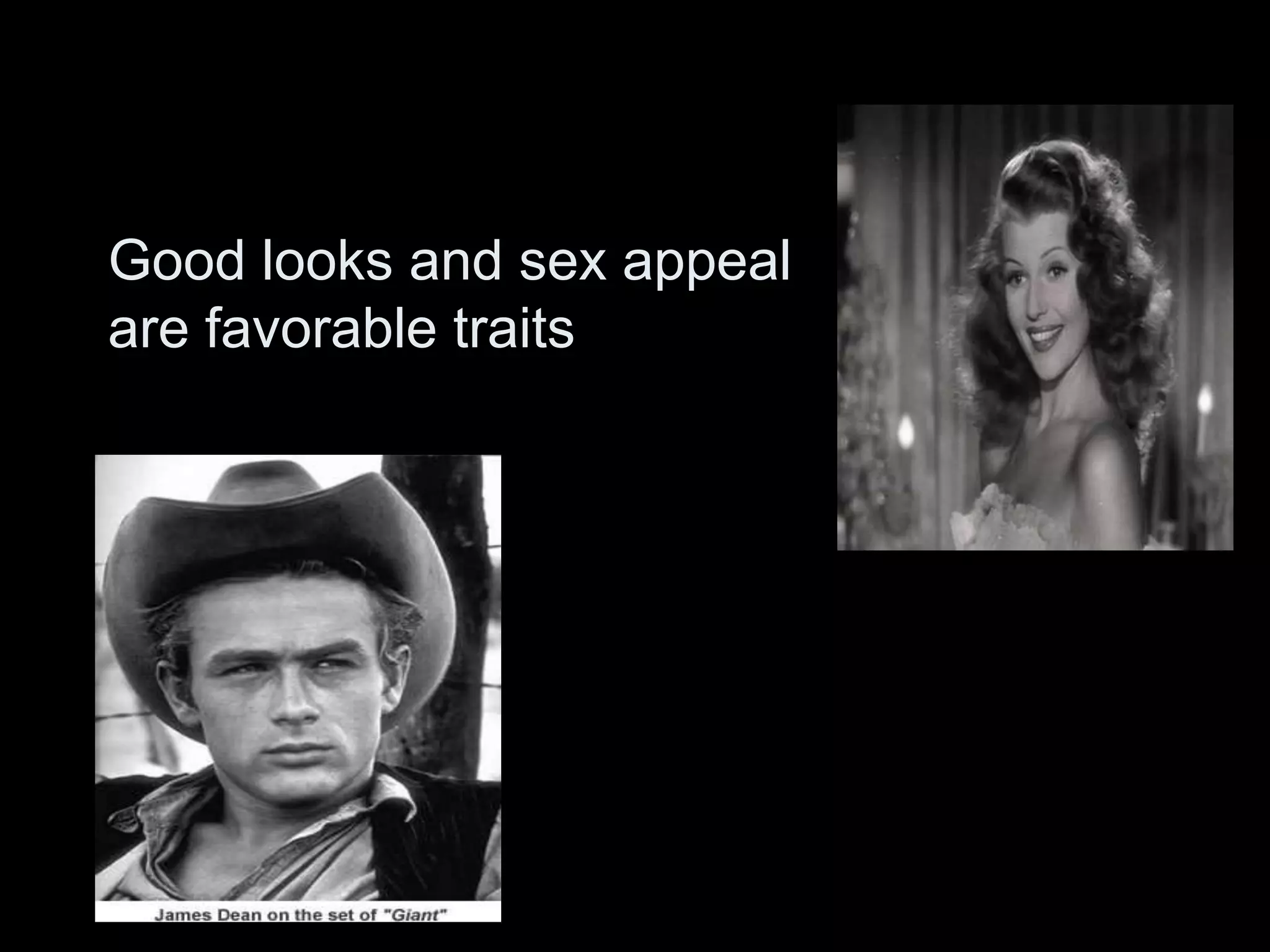
Good looks and sex appeal
are favorable traits
Characters with charm, charisma, and humor
appeal to audiences
Characters with charm, charisma, and humor
appeal to audiences
Even in characters that display less than
idealistic behavior
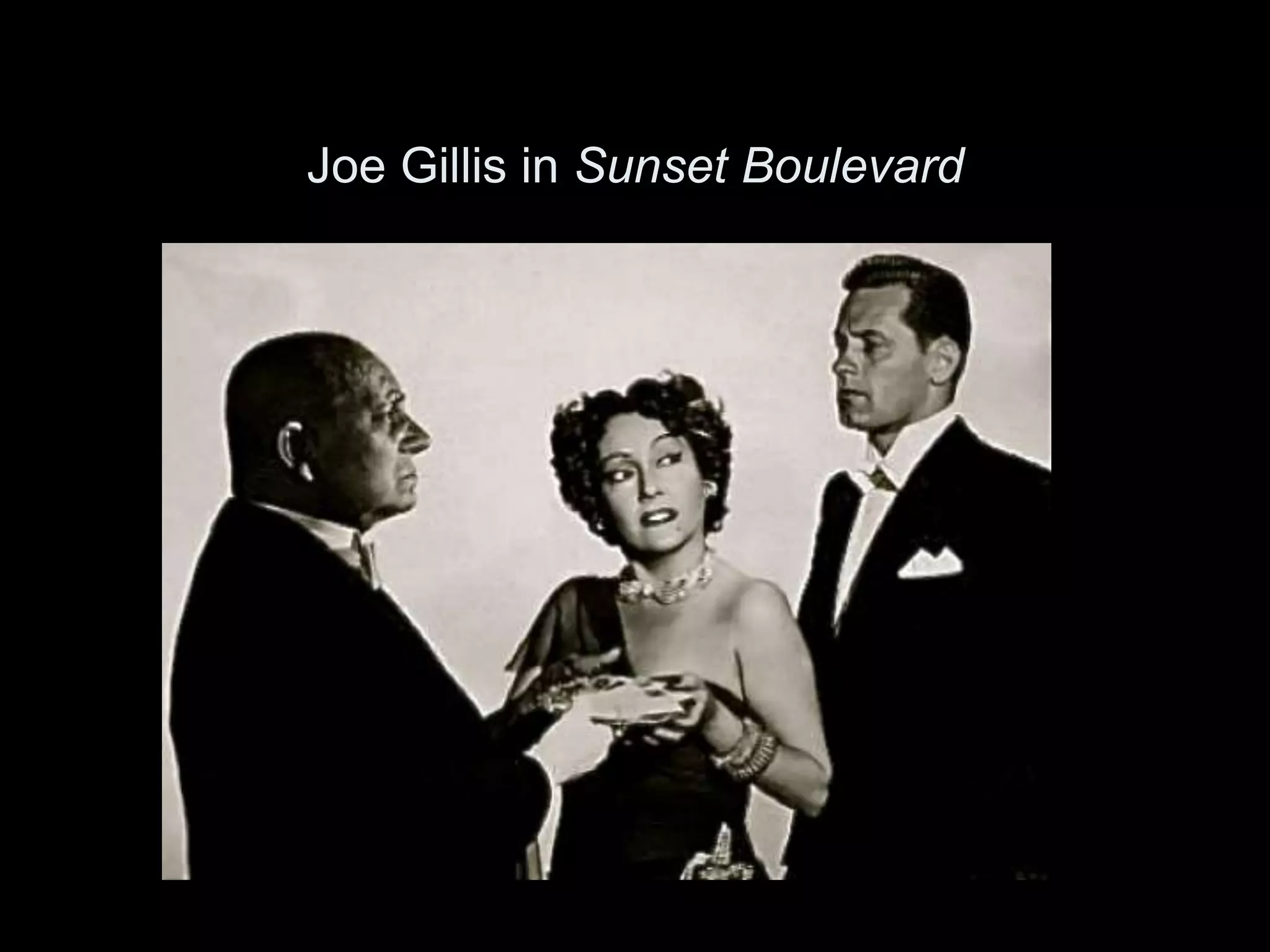
The audience can have sympathy for the villain,
anti-hero and femme fatale even if they dislike
their actions
Joe Gillis in Sunset Boulevard
IF…
IF…
They have at least a few favorable characteristics
Negative traits, such as, selfishness, cruelty,
cowardice, dishonesty are often present in the
antagonist and or villain
Negative traits, such as, selfishness, cruelty,
cowardice, dishonesty are often present in the
antagonist and or villain
Unsympathetic characters are often made to look
unattractive
WHO
IS
THE
VILLAIN?
Disenfranchisement and changing ideologies
Ideology and Representation
How does cinema represent ideology?
Ideology and Representation
How does cinema represent ideology?
Why are some groups favored over others?
Ideology and Representation
How does cinema represent ideology?
Why are some groups favored over others?
How is this reflected in film roles and genres?
How have ideologies changed?
How is this reflected in film roles and genres?
How have representations gender
How have ideologies changed?
How is this reflected in film roles and genres?
How have representations gender, race,
How have ideologies changed?
How is this reflected in film roles and genres?
How have representations gender, race, ethnicity
How have ideologies changed?
How is this reflected in film roles and genres?
How have representations gender, race, ethnicity and
sexual orientation changed?
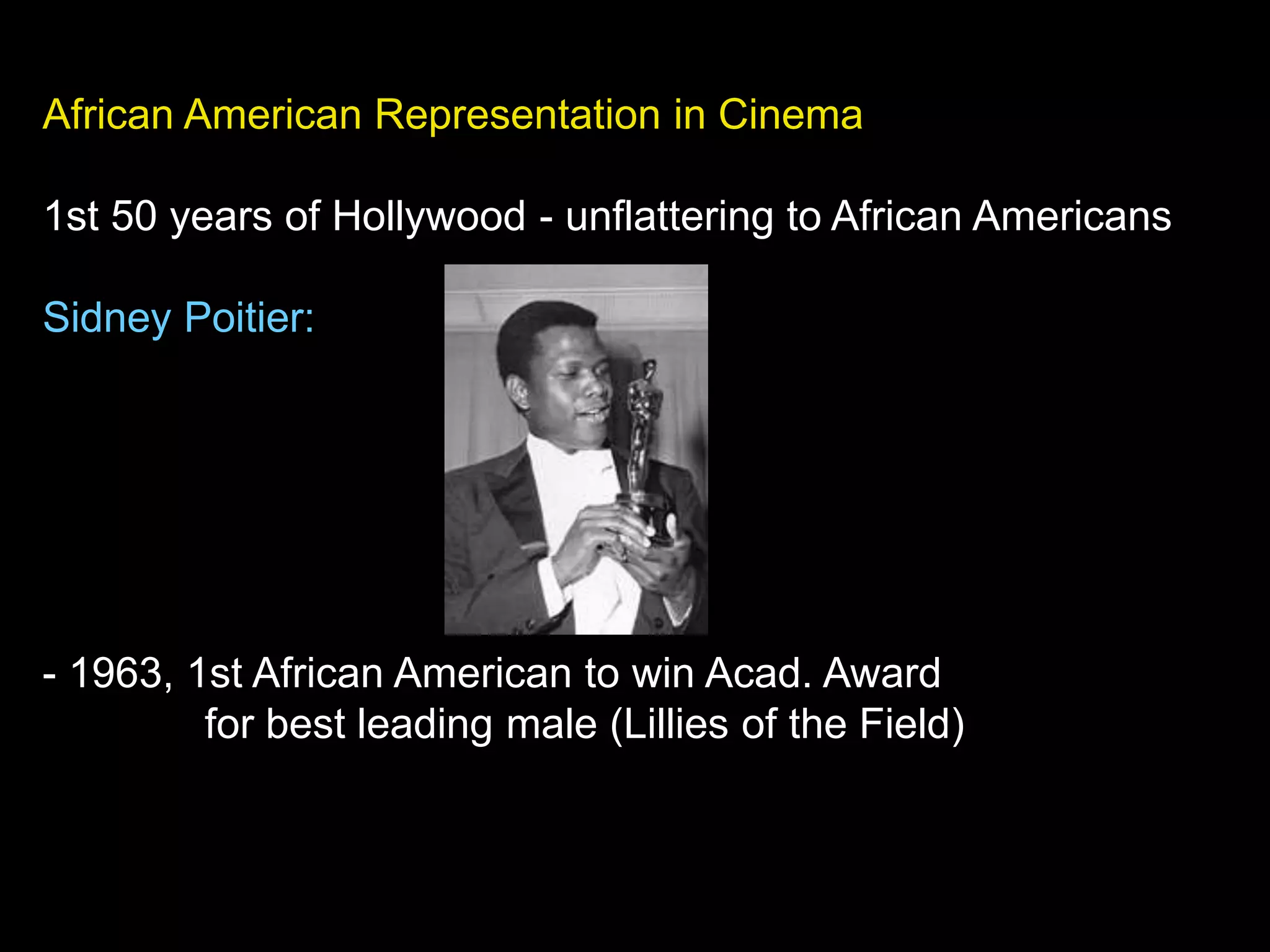
African American Representation in Cinema
1st 50 years of Hollywood - unflattering to African Americans
African American Representation in Cinema
1st 50 years of Hollywood - unflattering to African Americans
African American Representation in Cinema
1st 50 years of Hollywood - unflattering to African Americans
Sidney Poitier:
African American Representation in Cinema
1st 50 years of Hollywood - unflattering to African Americans
Sidney Poitier:
- 1963, 1st African American to win Acad. Award
for best leading male (Lillies of the Field)
African American Representation in Cinema
1st 50 years of Hollywood - unflattering to African Americans
Sidney Poitier:
- 1963, 1st African American to win Acad. Award
for best leading male (Lillies of the Field)
- portrayal of blacks began to improve
Feminism
Feminism
- began in late 1960s
Feminism
- began in late 1960s
- brought attention to role of women in film – on and off screen
Feminism
- began in late 1960s
- brought attention to role of women in film – on and off screen
- women had shorter acting careers than men
Feminism
- began in late 1960s
- brought attention to role of women in film – on and off screen
- women had shorter acting careers than men
- Film scholar Laura Mulvey
Feminism
- began in late 1960s
- brought attention to role of women in film – on and off screen
- women had shorter acting careers than men
- Film scholar Laura Mulvey
- “Male Gaze”
Feminism
- began in late 1960s
- brought attention to role of women in film – on and off screen
- women had shorter acting careers than men
- Film scholar Laura Mulvey
- “Male Gaze”
- point of view we often see in movies is a male point of view
Women photographed as
objects
Camera takes the point of
view of a male
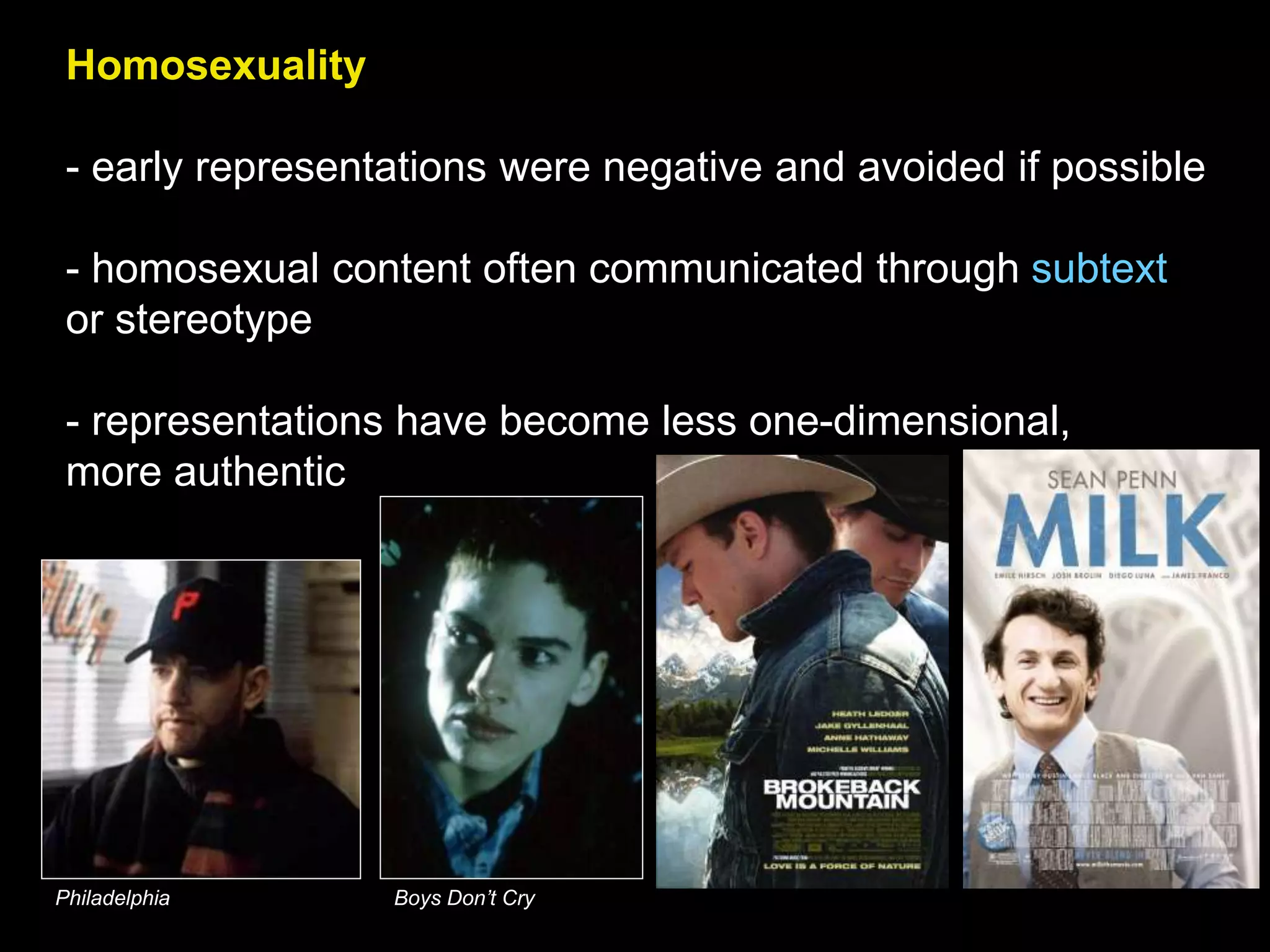
Homosexuality
Homosexuality
- early representations were negative
Homosexuality
- early representations were negative
- homosexual content often communicated through subtext
or stereotype
Homosexuality
- early representations were negative and avoided if possible
- homosexual content often communicated through subtext
or stereotype
- representations have become less one-dimensional,
more authentic
Philadelphia Boys Don’t Cry
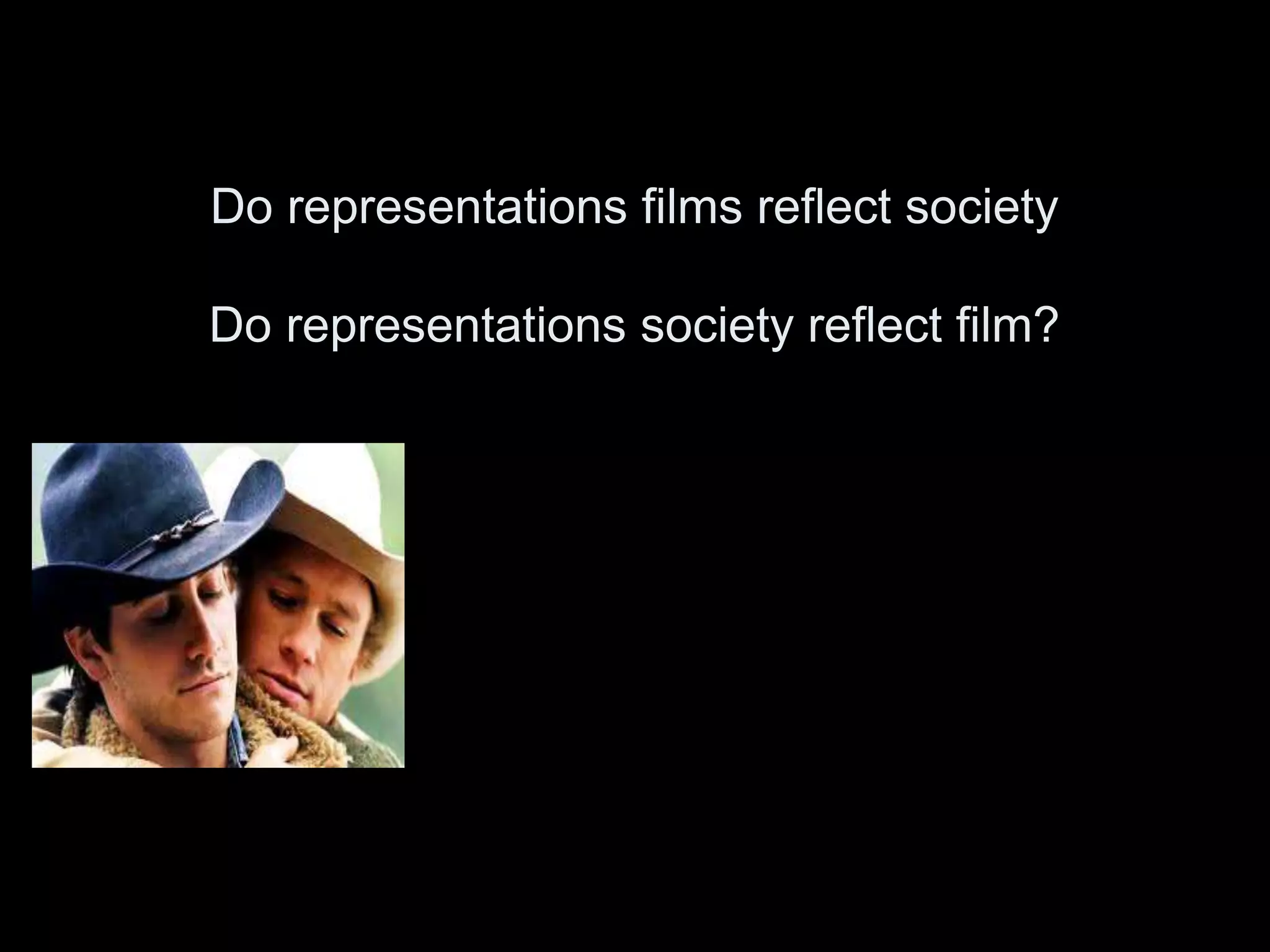
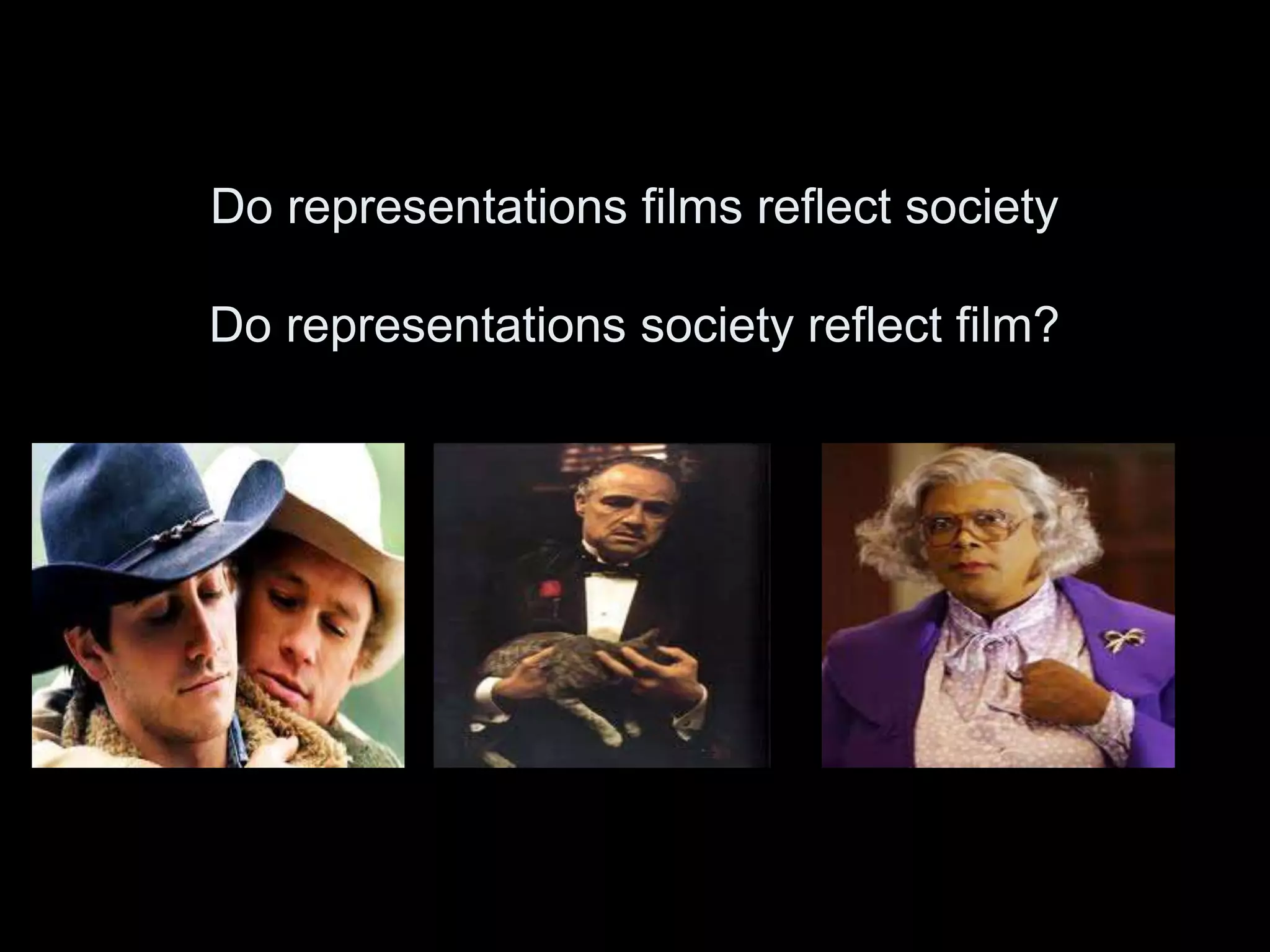
Do representations films reflect society
Do representations society reflect film?
Do representations films reflect society
Do representations society reflect film?
Do representations films reflect society
Do representations society reflect film?
Do representations films reflect society
Do representations society reflect film?
Documentary
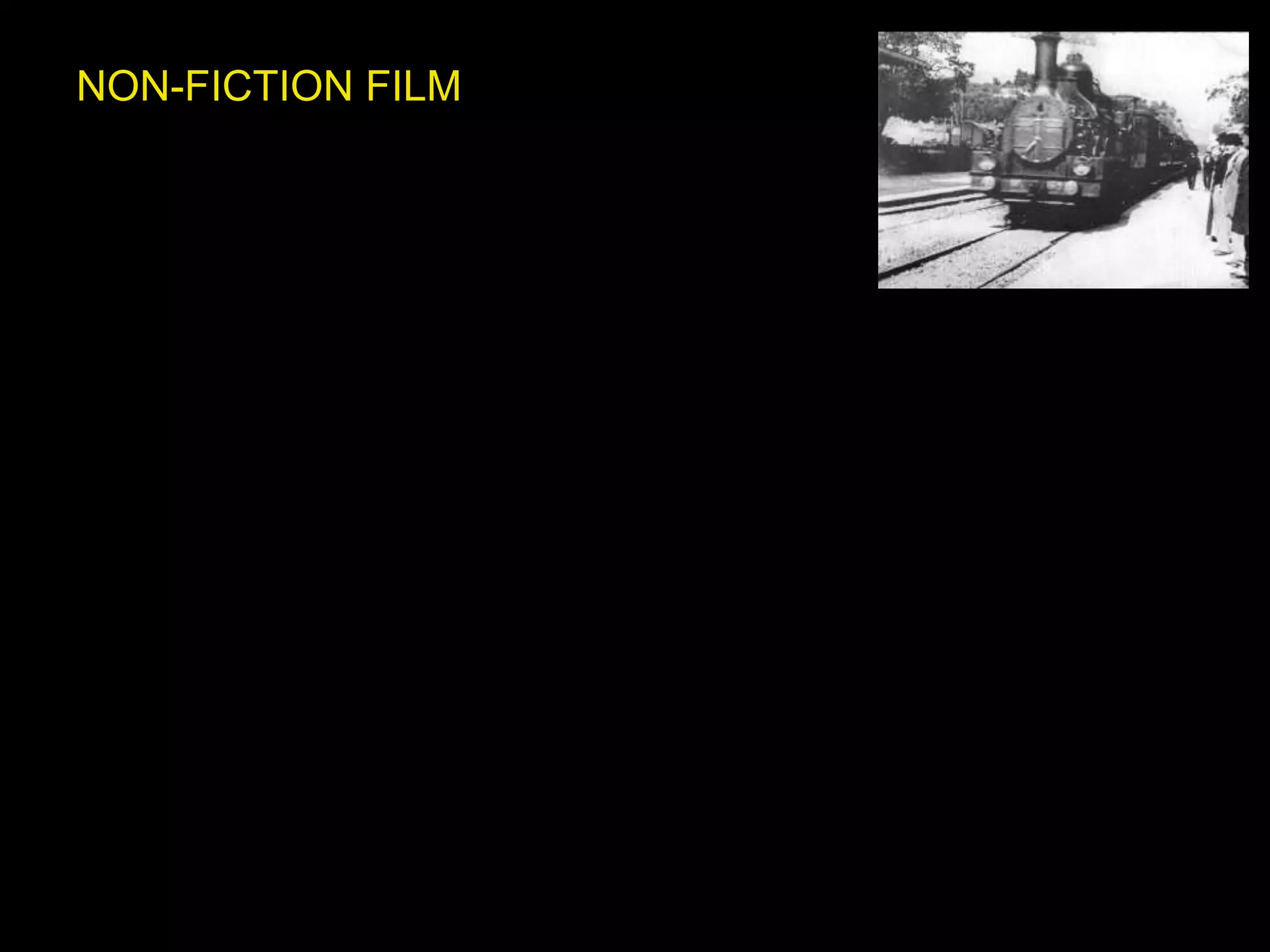
NON-FICTION FILM
NON-FICTION FILM
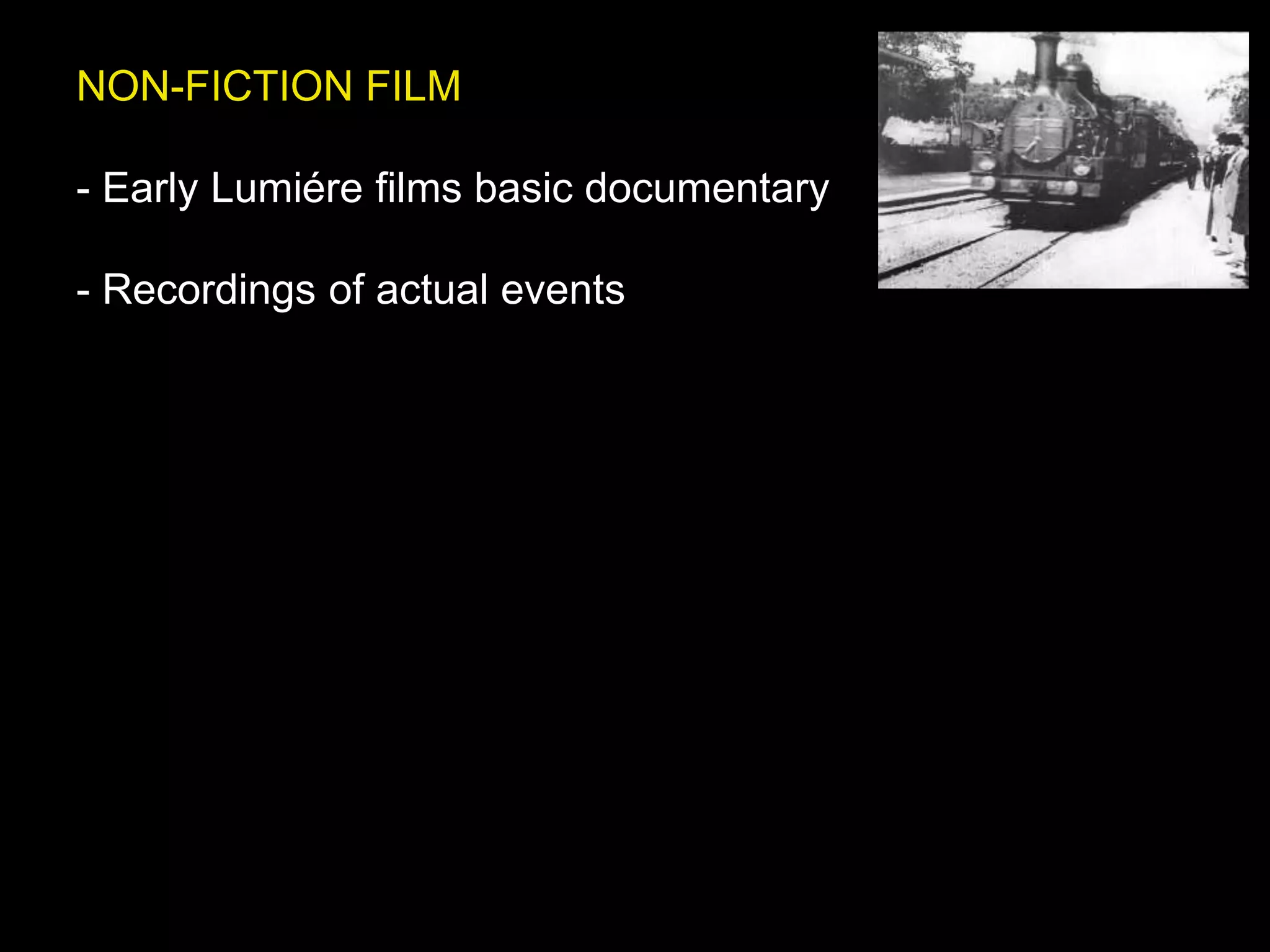
- Early Lumiére films basic documentary
NON-FICTION FILM
- Early Lumiére films basic documentary
- Recordings of actual events
NON-FICTION FILM
- Early Lumiére films basic documentary
- Recordings of actual events
- No actors, no screenplay
NON-FICTION FILM
- Early Lumiére films basic documentary
- Recordings of actual events
- No actors, no screenplay
-However, they lacked any type complex narrative
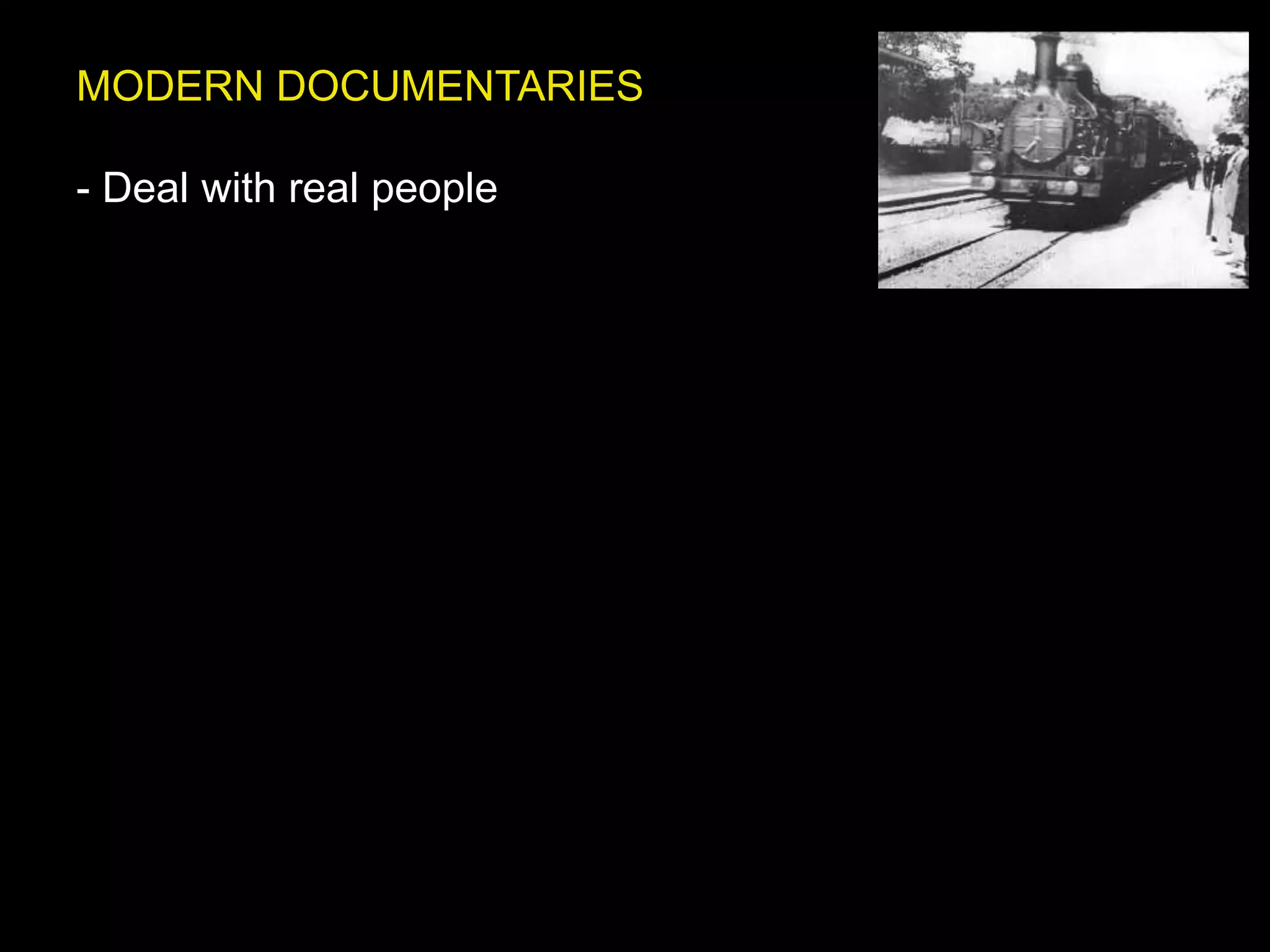
MODERN DOCUMENTARIES
- Deal with real people
MODERN DOCUMENTARIES
- Deal with real people
- Places and events
MODERN DOCUMENTARIES
- Deal with real people
- Places and events
- No actors, no screenplay
MODERN DOCUMENTARIES
- Deal with real people
- Places and events
- No actors, no screenplay
-Documentarians like fiction filmmakers superimpose a
narrative structure over the footage
Can a documentary tell the TRUTH?

Ideology/Documentary

  • 1.
  • 2.
    Since ancient times,critics have discussed art as having a double function: to teach and to provide pleasure (Giannetti, 428).
  • 3.
    Since ancient times,critics have discussed art as having a double function: to teach and to provide pleasure (Giannetti, 428). Ideology:
  • 4.
    Since ancient times,critics have discussed art as having a double function: to teach and to provide pleasure (Giannetti, 428). Ideology: Beliefs, values, ideas that shape the way we think, act, understand the world
  • 5.
    Since ancient times,critics have discussed art as having a double function: to teach and to provide pleasure (Giannetti, 428). Ideology: Beliefs, values, ideas that shape the way we think, act, understand the world Virtually everything is is ideological
  • 6.
    Since ancient times,critics have discussed art as having a double function: to teach and to provide pleasure (Giannetti, 428). Ideology: Beliefs, values, ideas that shape the way we think, act, understand the world Virtually everything is is ideological, our attitudes about,
  • 7.
    Since ancient times,critics have discussed art as having a double function: to teach and to provide pleasure (Giannetti, 428). Ideology: Beliefs, values, ideas that shape the way we think, act, understand the world Virtually everything is is ideological, our attitudes about, Sex, work,
  • 8.
    Since ancient times,critics have discussed art as having a double function: to teach and to provide pleasure (Giannetti, 428). Ideology: Beliefs, values, ideas that shape the way we think, act, understand the world Virtually everything is is ideological, our attitudes about, Sex, work, power sharing, authority,
  • 9.
    Since ancient times,critics have discussed art as having a double function: to teach and to provide pleasure (Giannetti, 428). Ideology: Beliefs, values, ideas that shape the way we think, act, understand the world Virtually everything is is ideological, our attitudes about, Sex, work, power sharing, authority, family and religion
  • 10.
    Since ancient times,critics have discussed art as having a double function: to teach and to provide pleasure (Giannetti, 428). Ideology: Beliefs, values, ideas that shape the way we think, act, understand the world Virtually everything is is ideological, our attitudes about, Sex, work, power sharing, authority, family and religion All of these interactions involve ideological assumptions within culture
  • 11.
    “Entertainment, always functionsas part of culture…as part of an array of cultures, subcultures and counter cultures.” www.uwec.edu.com
  • 12.
    “Entertainment, always functionsas part of culture…as part of an array of cultures, subcultures and counter cultures.” www.uwec.edu.com All films have ideological content in varying degrees
  • 13.
  • 14.
    Degrees of ideologicalexplicitness: Neutral:
  • 15.
    Degrees of ideologicalexplicitness: Neutral: - no overt ideological statements
  • 16.
    Degrees of ideologicalexplicitness: Neutral: - no overt ideological statements - emphasis on entertainment
  • 17.
  • 18.
    Degrees of ideologicalexplicitness: Neutral: - no overt ideological statements - emphasis on entertainment Implicit:
  • 19.
    Degrees of ideologicalexplicitness: Neutral: - no overt ideological statements - emphasis on entertainment Implicit: -inferred statement of values
  • 20.
    Degrees of ideologicalexplicitness: Neutral: - no overt ideological statements - emphasis on entertainment Implicit: -inferred statement of values -most fiction films fit here
  • 21.
  • 22.
    Degrees of ideologicalexplicitness: Neutral: - no overt ideological statements - emphasis on entertainment Implicit: -inferred statement of values -most fiction films fit here Explicit:
  • 23.
    Degrees of ideologicalexplicitness: Neutral: - no overt ideological statements - emphasis on entertainment Implicit: -inferred statement of values -most fiction films fit here Explicit:
  • 24.
    Degrees of ideologicalexplicitness: Neutral: - no overt ideological statements - emphasis on entertainment Implicit: -inferred statement of values -most fiction films fit here Explicit: -aims to persuade the audience of a particular ideology
  • 25.
    Degrees of ideologicalexplicitness: Neutral: - no overt ideological statements - emphasis on entertainment Implicit: -inferred statement of values -most fiction films fit here Explicit: -aims to persuade the audience of a particular ideology -patriotic films, many documentaries and political films
  • 26.
  • 27.
    Ideology is anotherlanguage in a film How do characters speak through ideological subtext?
  • 28.
    What attracts theaudience’s sympathy? Favorable traits include:
  • 29.
    What attracts theaudience’s sympathy? Favorable traits include: Idealism
  • 30.
    What attracts theaudience’s sympathy? Favorable traits include: Idealism courage
  • 31.
    What attracts theaudience’s sympathy? Favorable traits include: Idealism courage generosity
  • 32.
    What attracts theaudience’s sympathy? Favorable traits include: Idealism courage generosity loyalty
  • 33.
    What attracts theaudience’s sympathy? Favorable traits include: Idealism courage generosity loyalty kindness
  • 34.
    Good looks andsex appeal are favorable traits
  • 35.
    Characters with charm,charisma, and humor appeal to audiences
  • 36.
    Characters with charm,charisma, and humor appeal to audiences Even in characters that display less than idealistic behavior
  • 37.
    The audience canhave sympathy for the villain, anti-hero and femme fatale even if they dislike their actions
  • 38.
    Joe Gillis inSunset Boulevard
  • 39.
  • 40.
    IF… They have atleast a few favorable characteristics
  • 41.
    Negative traits, suchas, selfishness, cruelty, cowardice, dishonesty are often present in the antagonist and or villain
  • 42.
    Negative traits, suchas, selfishness, cruelty, cowardice, dishonesty are often present in the antagonist and or villain Unsympathetic characters are often made to look unattractive
  • 43.
  • 44.
  • 45.
    Ideology and Representation Howdoes cinema represent ideology?
  • 46.
    Ideology and Representation Howdoes cinema represent ideology? Why are some groups favored over others?
  • 47.
    Ideology and Representation Howdoes cinema represent ideology? Why are some groups favored over others? How is this reflected in film roles and genres?
  • 48.
  • 49.
    How have ideologieschanged? How is this reflected in film roles and genres? How have representations gender
  • 50.
    How have ideologieschanged? How is this reflected in film roles and genres? How have representations gender, race,
  • 51.
    How have ideologieschanged? How is this reflected in film roles and genres? How have representations gender, race, ethnicity
  • 52.
    How have ideologieschanged? How is this reflected in film roles and genres? How have representations gender, race, ethnicity and sexual orientation changed?
  • 53.
  • 54.
    African American Representationin Cinema 1st 50 years of Hollywood - unflattering to African Americans
  • 55.
    African American Representationin Cinema 1st 50 years of Hollywood - unflattering to African Americans
  • 56.
    African American Representationin Cinema 1st 50 years of Hollywood - unflattering to African Americans Sidney Poitier:
  • 57.
    African American Representationin Cinema 1st 50 years of Hollywood - unflattering to African Americans Sidney Poitier: - 1963, 1st African American to win Acad. Award for best leading male (Lillies of the Field)
  • 58.
    African American Representationin Cinema 1st 50 years of Hollywood - unflattering to African Americans Sidney Poitier: - 1963, 1st African American to win Acad. Award for best leading male (Lillies of the Field) - portrayal of blacks began to improve
  • 59.
  • 60.
  • 61.
    Feminism - began inlate 1960s - brought attention to role of women in film – on and off screen
  • 62.
    Feminism - began inlate 1960s - brought attention to role of women in film – on and off screen - women had shorter acting careers than men
  • 63.
    Feminism - began inlate 1960s - brought attention to role of women in film – on and off screen - women had shorter acting careers than men - Film scholar Laura Mulvey
  • 64.
    Feminism - began inlate 1960s - brought attention to role of women in film – on and off screen - women had shorter acting careers than men - Film scholar Laura Mulvey - “Male Gaze”
  • 65.
    Feminism - began inlate 1960s - brought attention to role of women in film – on and off screen - women had shorter acting careers than men - Film scholar Laura Mulvey - “Male Gaze” - point of view we often see in movies is a male point of view
  • 66.
    Women photographed as objects Cameratakes the point of view of a male
  • 68.
  • 69.
  • 70.
    Homosexuality - early representationswere negative - homosexual content often communicated through subtext or stereotype
  • 71.
    Homosexuality - early representationswere negative and avoided if possible - homosexual content often communicated through subtext or stereotype - representations have become less one-dimensional, more authentic Philadelphia Boys Don’t Cry
  • 72.
    Do representations filmsreflect society Do representations society reflect film?
  • 73.
    Do representations filmsreflect society Do representations society reflect film?
  • 74.
    Do representations filmsreflect society Do representations society reflect film?
  • 75.
    Do representations filmsreflect society Do representations society reflect film?
  • 76.
  • 77.
  • 78.
    NON-FICTION FILM - EarlyLumiére films basic documentary
  • 79.
    NON-FICTION FILM - EarlyLumiére films basic documentary - Recordings of actual events
  • 80.
    NON-FICTION FILM - EarlyLumiére films basic documentary - Recordings of actual events - No actors, no screenplay
  • 81.
    NON-FICTION FILM - EarlyLumiére films basic documentary - Recordings of actual events - No actors, no screenplay -However, they lacked any type complex narrative
  • 82.
  • 83.
    MODERN DOCUMENTARIES - Dealwith real people - Places and events
  • 84.
    MODERN DOCUMENTARIES - Dealwith real people - Places and events - No actors, no screenplay
  • 85.
    MODERN DOCUMENTARIES - Dealwith real people - Places and events - No actors, no screenplay -Documentarians like fiction filmmakers superimpose a narrative structure over the footage Can a documentary tell the TRUTH?