TechnicalTeachingEquipment
www.edibon.com
EDIBON Smart Grid Units
TechnicalTeachingEquipment
www.edibon.com
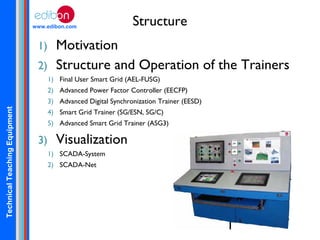
Structure
1) Motivation
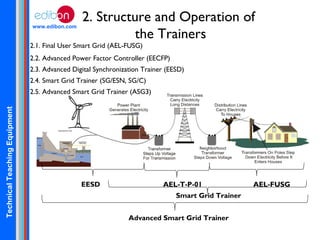
2) Structure and Operation of the Trainers
1) Final User Smart Grid (AEL-FUSG)
2) Advanced Power Factor Controller (EECFP)
3) Advanced Digital Synchronization Trainer (EESD)
4) Smart Grid Trainer (SG/ESN, SG/C)
5) Advanced Smart Grid Trainer (ASG3)
3) Visualization
1) SCADA-System
2) SCADA-Net
TechnicalTeachingEquipment
www.edibon.com
1. Motivation
 Smart-Grid solves one of the biggest Problems of the Future: The supply with
fluctuating Electricity from Renewable Energy Sources
 As the grid can’t store Energy, the Electricity Supply should always be as high as the
Consumption
A regulative Connection between both ends of the Electrical Energy System
is necessary: Smart-Grid
 Our Teaching Units demonstrate the functions and necessity of Smart-Grid, specialized
on the whole Electrical Energy System or on each part of it.
TechnicalTeachingEquipment
www.edibon.com
2. Structure and Operation of
the Trainers
2.1. Final User Smart Grid (AEL-FUSG)
2.2. Advanced Power Factor Controller (EECFP)
2.3. Advanced Digital Synchronization Trainer (EESD)
2.4. Smart Grid Trainer (SG/ESN, SG/C)
2.5. Advanced Smart Grid Trainer (ASG3)
EESD AEL-T-P-01 AEL-FUSG
Smart Grid Trainer
Advanced Smart Grid Trainer
TechnicalTeachingEquipment
www.edibon.com
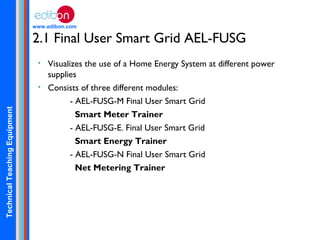
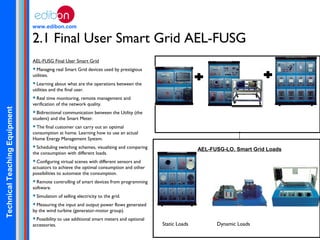
2.1 Final User Smart Grid AEL-FUSG
• Visualizes the use of a Home Energy System at different power
supplies
• Consists of three different modules:
- AEL-FUSG-M Final User Smart Grid
Smart Meter Trainer
- AEL-FUSG-E. Final User Smart Grid
Smart Energy Trainer
- AEL-FUSG-N Final User Smart Grid
Net Metering Trainer
TechnicalTeachingEquipment
www.edibon.com
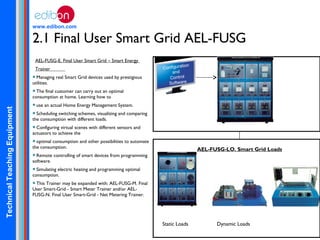
Dynamic LoadsStatic Loads
AEL-FUSG-LO. Smart Grid Loads
Configuration
and
Control
Software
AEL-FUSG-E. Final User Smart Grid – Smart Energy
Trainer
Managing real Smart Grid devices used by prestigious
utilities.
The final customer can carry out an optimal
consumption at home. Learning how to
use an actual Home Energy Management System.
Scheduling switching schemes, visualizing and comparing
the consumption with different loads.
Configuring virtual scenes with different sensors and
actuators to achieve the
optimal consumption and other possibilities to automate
the consumption.
Remote controlling of smart devices from programming
software.
Simulating electric heating and programming optimal
consumption.
This Trainer may be expanded with: AEL-FUSG-M. Final
User Smart-Grid - Smart Meter Trainer and/or AEL-
FUSG-N. Final User Smart-Grid - Net Metering Trainer.
2.1 Final User Smart Grid AEL-FUSG
TechnicalTeachingEquipment
www.edibon.com
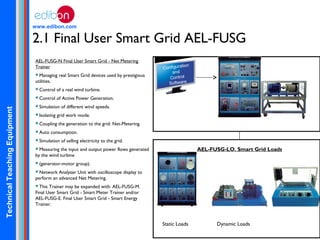
Dynamic LoadsStatic Loads
AEL-FUSG-LO. Smart Grid Loads
Configuration
and
Control
Software
AEL-FUSG-N Final User Smart Grid - Net Metering
Trainer
Managing real Smart Grid devices used by prestigious
utilities.
Control of a real wind turbine.
Control of Active Power Generation.
Simulation of different wind speeds.
Isolating grid work mode.
Coupling the generation to the grid: Net-Metering.
Auto consumption.
Simulation of selling electricity to the grid.
Measuring the input and output power flows generated
by the wind turbine
(generator-motor group).
Network Analyzer Unit with oscilloscope display to
perform an advanced Net Metering.
This Trainer may be expanded with: AEL-FUSG-M.
Final User Smart Grid - Smart Meter Trainer and/or
AEL-FUSG-E. Final User Smart Grid - Smart Energy
Trainer.
2.1 Final User Smart Grid AEL-FUSG
TechnicalTeachingEquipment
www.edibon.com
Dynamic LoadsStatic Loads
AEL-FUSG-LO. Smart Grid Loads
AEL-FUSG Final User Smart Grid
Managing real Smart Grid devices used by prestigious
utilities.
Learning about what are the operations between the
utilities and the final user.
Real time monitoring, remote management and
verification of the network quality.
Bidirectional communication between the Utility (the
student) and the Smart Meter.
The final customer can carry out an optimal
consumption at home. Learning how to use an actual
Home Energy Management System.
Scheduling switching schemes, visualizing and comparing
the consumption with different loads.
Configuring virtual scenes with different sensors and
actuators to achieve the optimal consumption and other
possibilities to automate the consumption.
Remote controlling of smart devices from programming
software.
Simulation of selling electricity to the grid.
Measuring the input and output power flows generated
by the wind turbine (generator-motor group).
Possibility to use additional smart meters and optional
accessories.
2.1 Final User Smart Grid AEL-FUSG
TechnicalTeachingEquipment
www.edibon.com
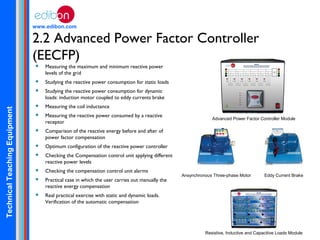
2.2 Advanced Power Factor Controller
(EECFP)
 Measuring the maximum and minimum reactive power
levels of the grid
 Studying the reactive power consumption for static loads
 Studying the reactive power consumption for dynamic
loads: induction motor coupled to eddy currents brake
 Measuring the coil inductance
 Measuring the reactive power consumed by a reactive
receptor
 Comparison of the reactive energy before and after of
power factor compensation
 Optimum configuration of the reactive power controller
 Checking the Compensation control unit applying different
reactive power levels
 Checking the compensation control unit alarms
 Practical case in which the user carries out manually the
reactive energy compensation
 Real practical exercise with static and dynamic loads.
Verification of the automatic compensation
Advanced Power Factor Controller Module
Ansynchronous Three-phase Motor Eddy Current Brake
Resistive, Inductive and Capacitive Loads Module
TechnicalTeachingEquipment
www.edibon.com
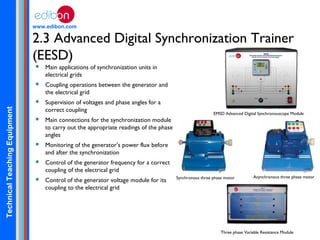
2.3 Advanced Digital Synchronization Trainer
(EESD)
 Main applications of synchronization units in
electrical grids
 Coupling operations between the generator and
the electrical grid
 Supervision of voltages and phase angles for a
correct coupling
 Main connections for the synchronization module
to carry out the appropriate readings of the phase
angles
 Monitoring of the generator’s power flux before
and after the synchronization
 Control of the generator frequency for a correct
coupling of the electrical grid
 Control of the generator voltage module for its
coupling to the electrical grid
EMSD Advanced Digital Synchronouscope Module
Asynchronous three phase motorSynchronous three phase motor
Three phase Variable Resistance Module
TechnicalTeachingEquipment
www.edibon.com
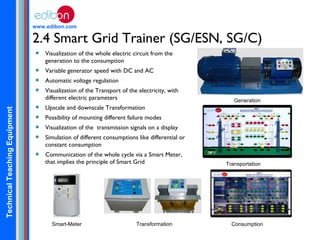
2.4 Smart Grid Trainer (SG/ESN, SG/C)
 Visualization of the whole electric circuit from the
generation to the consumption
 Variable generator speed with DC and AC
 Automatic voltage regulation
 Visualization of the Transport of the electricity, with
different electric parameters
 Upscale and downscale Transformation
 Possibility of mounting different failure modes
 Visualization of the transmission signals on a display
 Simulation of different consumptions like differential or
constant consumption
 Communication of the whole cycle via a Smart Meter,
that implies the principle of Smart Grid
Generation
Transportation
ConsumptionTransformationSmart-Meter
TechnicalTeachingEquipment
www.edibon.com
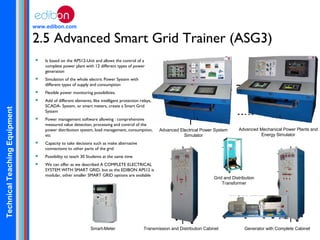
2.5 Advanced Smart Grid Trainer (ASG3)
 Is based on the APS12-Unit and allows the control of a
complete power plant with 12 different types of power
generation
 Simulation of the whole electric Power System with
different types of supply and consumption
 Flexible power monitoring possibilities.
 Add of different elements, like intelligent protection relays,
SCADA- System, or smart meters, create a Smart Grid
System
 Power management software allowing : comprehensive
measured value detection, processing and control of the
power distribution system, load management, consumption,
etc
 Capacity to take decisions such as make alternative
connections to other parts of the grid
 Possibility to teach 30 Students at the same time
 We can offer as we described A COMPLETE ELECTRICAL
SYSTEM WITH SMART GRID, but as the EDIBON APS12 is
modular, other smaller SMART GRID options are available
Advanced Electrical Power System
Simulator
Advanced Mechanical Power Plants and
Energy Simulator
Generator with Complete CabinetTransmission and Distribution CabinetSmart-Meter
Grid and Distribution
Transformer
TechnicalTeachingEquipment
www.edibon.com
3. Visualization and Control
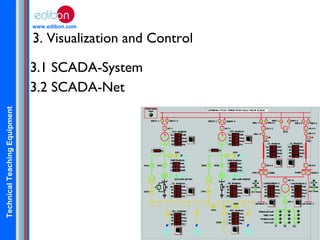
3.1 SCADA-System
3.2 SCADA-Net
TechnicalTeachingEquipment
www.edibon.com
3.1 SCADA-System
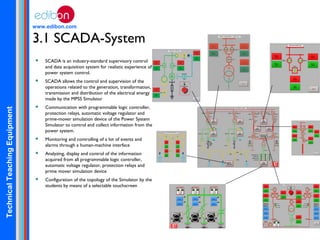
 SCADA is an industry-standard supervisory control
and data acquisition system for realistic experience of
power system control.
 SCADA allows the control and supervision of the
operations related to the generation, transformation,
transmission and distribution of the electrical energy
made by the MPSS Simulator
 Communication with programmable logic controller,
protection relays, automatic voltage regulator and
prime-mover simulation device of the Power System
Simulator to control and collect information from the
power system.
 Monitoring and controlling of a lot of events and
alarms through a human-machine interface
 Analyzing, display and control of the information
acquired from all programmable logic controller,
automatic voltage regulator, protection relays and
prime mover simulation device
 Configuration of the topology of the Simulator by the
students by means of a selectable touchscreen
TechnicalTeachingEquipment
www.edibon.com
3.2 SCADA-Net
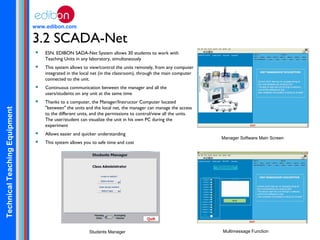
 ESN. EDIBON SADA-Net System allows 30 students to work with
Teaching Units in any laboratory, simultaneously
 This system allows to view/control the units remotely, from any computer
integrated in the local net (in the classroom), through the main computer
connected to the unit.
 Continuous communication between the manager and all the
users/students on any unit at the same time
 Thanks to a computer, the Manager/Instructor Computer located
"between" the units and the local net, the manager can manage the access
to the different units, and the permissions to control/view all the units.
The user/student can visualize the unit in his own PC during the
experiment
 Allows easier and quicker understanding
 This system allows you to safe time and cost
Manager Software Main Screen
Multimessage FunctionStudents Manager
TechnicalTeachingEquipment
www.edibon.com
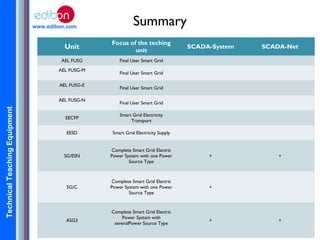
Summary
Unit
Focus of the teching
unit
SCADA-System SCADA-Net
AEL FUSG Final User Smart Grid
AEL FUSG-M
Final User Smart Grid
AEL FUSG-E
Final User Smart Grid
AEL FUSG-N
Final User Smart Grid
EECFP
Smart Grid Electricity
Transport
EESD Smart Grid Electricity Supply
SG/ESN
Complete Smart Grid Electric
Power System with one Power
Source Type
+ +
SG/C
Complete Smart Grid Electric
Power System with one Power
Source Type
+
ASG3
Complete Smart Grid Electric
Power System with
severalPower Source Type
+ +

EDIBON Energy Units

  • 1.
  • 2.
    TechnicalTeachingEquipment www.edibon.com Structure 1) Motivation 2) Structureand Operation of the Trainers 1) Final User Smart Grid (AEL-FUSG) 2) Advanced Power Factor Controller (EECFP) 3) Advanced Digital Synchronization Trainer (EESD) 4) Smart Grid Trainer (SG/ESN, SG/C) 5) Advanced Smart Grid Trainer (ASG3) 3) Visualization 1) SCADA-System 2) SCADA-Net
  • 3.
    TechnicalTeachingEquipment www.edibon.com 1. Motivation  Smart-Gridsolves one of the biggest Problems of the Future: The supply with fluctuating Electricity from Renewable Energy Sources  As the grid can’t store Energy, the Electricity Supply should always be as high as the Consumption A regulative Connection between both ends of the Electrical Energy System is necessary: Smart-Grid  Our Teaching Units demonstrate the functions and necessity of Smart-Grid, specialized on the whole Electrical Energy System or on each part of it.
  • 4.
    TechnicalTeachingEquipment www.edibon.com 2. Structure andOperation of the Trainers 2.1. Final User Smart Grid (AEL-FUSG) 2.2. Advanced Power Factor Controller (EECFP) 2.3. Advanced Digital Synchronization Trainer (EESD) 2.4. Smart Grid Trainer (SG/ESN, SG/C) 2.5. Advanced Smart Grid Trainer (ASG3) EESD AEL-T-P-01 AEL-FUSG Smart Grid Trainer Advanced Smart Grid Trainer
  • 5.
    TechnicalTeachingEquipment www.edibon.com 2.1 Final UserSmart Grid AEL-FUSG • Visualizes the use of a Home Energy System at different power supplies • Consists of three different modules: - AEL-FUSG-M Final User Smart Grid Smart Meter Trainer - AEL-FUSG-E. Final User Smart Grid Smart Energy Trainer - AEL-FUSG-N Final User Smart Grid Net Metering Trainer
  • 6.
    TechnicalTeachingEquipment www.edibon.com Dynamic LoadsStatic Loads AEL-FUSG-LO.Smart Grid Loads Configuration and Control Software AEL-FUSG-E. Final User Smart Grid – Smart Energy Trainer Managing real Smart Grid devices used by prestigious utilities. The final customer can carry out an optimal consumption at home. Learning how to use an actual Home Energy Management System. Scheduling switching schemes, visualizing and comparing the consumption with different loads. Configuring virtual scenes with different sensors and actuators to achieve the optimal consumption and other possibilities to automate the consumption. Remote controlling of smart devices from programming software. Simulating electric heating and programming optimal consumption. This Trainer may be expanded with: AEL-FUSG-M. Final User Smart-Grid - Smart Meter Trainer and/or AEL- FUSG-N. Final User Smart-Grid - Net Metering Trainer. 2.1 Final User Smart Grid AEL-FUSG
  • 7.
    TechnicalTeachingEquipment www.edibon.com Dynamic LoadsStatic Loads AEL-FUSG-LO.Smart Grid Loads Configuration and Control Software AEL-FUSG-N Final User Smart Grid - Net Metering Trainer Managing real Smart Grid devices used by prestigious utilities. Control of a real wind turbine. Control of Active Power Generation. Simulation of different wind speeds. Isolating grid work mode. Coupling the generation to the grid: Net-Metering. Auto consumption. Simulation of selling electricity to the grid. Measuring the input and output power flows generated by the wind turbine (generator-motor group). Network Analyzer Unit with oscilloscope display to perform an advanced Net Metering. This Trainer may be expanded with: AEL-FUSG-M. Final User Smart Grid - Smart Meter Trainer and/or AEL-FUSG-E. Final User Smart Grid - Smart Energy Trainer. 2.1 Final User Smart Grid AEL-FUSG
  • 8.
    TechnicalTeachingEquipment www.edibon.com Dynamic LoadsStatic Loads AEL-FUSG-LO.Smart Grid Loads AEL-FUSG Final User Smart Grid Managing real Smart Grid devices used by prestigious utilities. Learning about what are the operations between the utilities and the final user. Real time monitoring, remote management and verification of the network quality. Bidirectional communication between the Utility (the student) and the Smart Meter. The final customer can carry out an optimal consumption at home. Learning how to use an actual Home Energy Management System. Scheduling switching schemes, visualizing and comparing the consumption with different loads. Configuring virtual scenes with different sensors and actuators to achieve the optimal consumption and other possibilities to automate the consumption. Remote controlling of smart devices from programming software. Simulation of selling electricity to the grid. Measuring the input and output power flows generated by the wind turbine (generator-motor group). Possibility to use additional smart meters and optional accessories. 2.1 Final User Smart Grid AEL-FUSG
  • 9.
    TechnicalTeachingEquipment www.edibon.com 2.2 Advanced PowerFactor Controller (EECFP)  Measuring the maximum and minimum reactive power levels of the grid  Studying the reactive power consumption for static loads  Studying the reactive power consumption for dynamic loads: induction motor coupled to eddy currents brake  Measuring the coil inductance  Measuring the reactive power consumed by a reactive receptor  Comparison of the reactive energy before and after of power factor compensation  Optimum configuration of the reactive power controller  Checking the Compensation control unit applying different reactive power levels  Checking the compensation control unit alarms  Practical case in which the user carries out manually the reactive energy compensation  Real practical exercise with static and dynamic loads. Verification of the automatic compensation Advanced Power Factor Controller Module Ansynchronous Three-phase Motor Eddy Current Brake Resistive, Inductive and Capacitive Loads Module
  • 10.
    TechnicalTeachingEquipment www.edibon.com 2.3 Advanced DigitalSynchronization Trainer (EESD)  Main applications of synchronization units in electrical grids  Coupling operations between the generator and the electrical grid  Supervision of voltages and phase angles for a correct coupling  Main connections for the synchronization module to carry out the appropriate readings of the phase angles  Monitoring of the generator’s power flux before and after the synchronization  Control of the generator frequency for a correct coupling of the electrical grid  Control of the generator voltage module for its coupling to the electrical grid EMSD Advanced Digital Synchronouscope Module Asynchronous three phase motorSynchronous three phase motor Three phase Variable Resistance Module
  • 11.
    TechnicalTeachingEquipment www.edibon.com 2.4 Smart GridTrainer (SG/ESN, SG/C)  Visualization of the whole electric circuit from the generation to the consumption  Variable generator speed with DC and AC  Automatic voltage regulation  Visualization of the Transport of the electricity, with different electric parameters  Upscale and downscale Transformation  Possibility of mounting different failure modes  Visualization of the transmission signals on a display  Simulation of different consumptions like differential or constant consumption  Communication of the whole cycle via a Smart Meter, that implies the principle of Smart Grid Generation Transportation ConsumptionTransformationSmart-Meter
  • 12.
    TechnicalTeachingEquipment www.edibon.com 2.5 Advanced SmartGrid Trainer (ASG3)  Is based on the APS12-Unit and allows the control of a complete power plant with 12 different types of power generation  Simulation of the whole electric Power System with different types of supply and consumption  Flexible power monitoring possibilities.  Add of different elements, like intelligent protection relays, SCADA- System, or smart meters, create a Smart Grid System  Power management software allowing : comprehensive measured value detection, processing and control of the power distribution system, load management, consumption, etc  Capacity to take decisions such as make alternative connections to other parts of the grid  Possibility to teach 30 Students at the same time  We can offer as we described A COMPLETE ELECTRICAL SYSTEM WITH SMART GRID, but as the EDIBON APS12 is modular, other smaller SMART GRID options are available Advanced Electrical Power System Simulator Advanced Mechanical Power Plants and Energy Simulator Generator with Complete CabinetTransmission and Distribution CabinetSmart-Meter Grid and Distribution Transformer
  • 13.
  • 14.
    TechnicalTeachingEquipment www.edibon.com 3.1 SCADA-System  SCADAis an industry-standard supervisory control and data acquisition system for realistic experience of power system control.  SCADA allows the control and supervision of the operations related to the generation, transformation, transmission and distribution of the electrical energy made by the MPSS Simulator  Communication with programmable logic controller, protection relays, automatic voltage regulator and prime-mover simulation device of the Power System Simulator to control and collect information from the power system.  Monitoring and controlling of a lot of events and alarms through a human-machine interface  Analyzing, display and control of the information acquired from all programmable logic controller, automatic voltage regulator, protection relays and prime mover simulation device  Configuration of the topology of the Simulator by the students by means of a selectable touchscreen
  • 15.
    TechnicalTeachingEquipment www.edibon.com 3.2 SCADA-Net  ESN.EDIBON SADA-Net System allows 30 students to work with Teaching Units in any laboratory, simultaneously  This system allows to view/control the units remotely, from any computer integrated in the local net (in the classroom), through the main computer connected to the unit.  Continuous communication between the manager and all the users/students on any unit at the same time  Thanks to a computer, the Manager/Instructor Computer located "between" the units and the local net, the manager can manage the access to the different units, and the permissions to control/view all the units. The user/student can visualize the unit in his own PC during the experiment  Allows easier and quicker understanding  This system allows you to safe time and cost Manager Software Main Screen Multimessage FunctionStudents Manager
  • 16.
    TechnicalTeachingEquipment www.edibon.com Summary Unit Focus of theteching unit SCADA-System SCADA-Net AEL FUSG Final User Smart Grid AEL FUSG-M Final User Smart Grid AEL FUSG-E Final User Smart Grid AEL FUSG-N Final User Smart Grid EECFP Smart Grid Electricity Transport EESD Smart Grid Electricity Supply SG/ESN Complete Smart Grid Electric Power System with one Power Source Type + + SG/C Complete Smart Grid Electric Power System with one Power Source Type + ASG3 Complete Smart Grid Electric Power System with severalPower Source Type + +