MUTHAYAMMAL ENGINEERING COLLEGE
(An Autonomous Institution)
(Approved by AICTE, New Delhi, Accredited by NAAC & Affiliated to Anna University)
Rasipuram - 637 408, Namakkal Dist., Tamil Nadu
SMART GRID ELEMENTS AND TECHNOLOGIES
Department of Electrical and Electronics Engineering
Multidisciplinary lectures (MuDiL 230409)
By
Ms.V.Deepika
Assistant Professor
Department of Electrical and Electronics Engineering
Date: 05.04.2023
What makes the Grid ‘Smart’
The digital technology that allows for two-way communication between the utility
and its customers, and the sensing along the transmission lines is what makes the
grid smart.
Customer prospective
• If you already manage activities such as personal banking from your home computer, imagine managing your
electricity in a similar way. For examples
•
•
•
Customer will no longer have to wait for monthly statement to know how much electricity he use. With a smarter
grid, he can have a clear and timely picture of it. "Smart meters,“
Can able to see how much electricity you use, when you use it, and its cost. Combined with real-time pricing, this
will allow you to save money by using less power when electricity is most expensive.
Smart Grid has the potential to help you save money by helping you to manage your electricity use and choose
the best times to purchase electricity.And you can save even more by generating your own power.
10
Advanced Metering Infrastructure (AMI)
• AMI refers network infrastructure connecting smart meters, Meter Data Management System (MDMS)
and elements supporting communication between the smart meters and the MDMS. [1]
AMI
Utility DCCs
MDMS
Consumer
Smart
Meters
Communications
DCC: Data and Control Center
MDMS : Meter Data Management System
• AMR (Automated Meter Reading) systems allow meters to be read by utility personnel over wireless
links.
• It helps in reducing the cost associated with meter reading and also supports in billing process.
2
Advanced Metering Infrastructure (AMI)
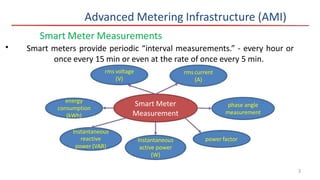
Smart Meter Measurements
Smart meters provide periodic “interval measurements.” - every hour or
once every 15 min or even at the rate of once every 5 min.
•
rms voltage
(V)
rms current
(A)
energy
consumption
(kWh)
Smart Meter
Measurement
phase angle
measurement
Instantaneous
reactive power factor
Instantaneous
active power
(W)
power (VAR)
3
Advanced Metering Infrastructure (AMI)
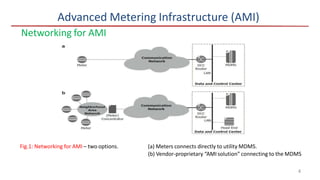
Networking for AMI
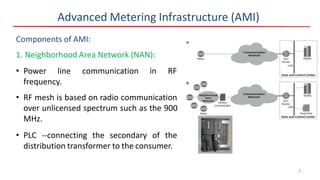
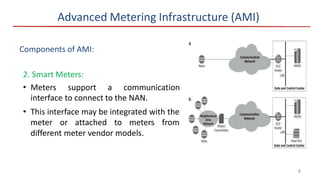
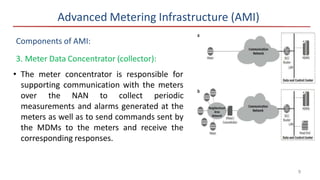
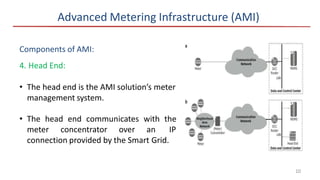
Fig.1: Networking for AMI – two options. (a) Meters connects directly to utility MDMS.
(b) Vendor-proprietary “AMI solution” connecting to the MDMS
4
Advanced Metering Infrastructure (AMI)
Components of AMI:
1. Neighborhood Area Network (NAN):
• Power line communication in RF
frequency.
• RF mesh is based on radio communication
over unlicensed spectrum such as the 900
MHz.
• PLC --connecting the secondary of the
distribution transformer to the consumer.
7
Advanced Metering Infrastructure (AMI)
Components of AMI:
2. Smart Meters:
• Meters support a communication
interface to connect to the NAN.
• This interface may be integrated with the
meter or attached to meters from
different meter vendor models.
8
Advanced Metering Infrastructure (AMI)
Components of AMI:
3. Meter Data Concentrator (collector):
• The meter concentrator is responsible for
supporting communication with the meters
over the NAN to collect periodic
measurements and alarms generated at the
meters as well as to send commands sent by
the MDMs to the meters and receive the
corresponding responses.
9
Advanced Metering Infrastructure (AMI)
Components of AMI:
4. Head End:
• The head end is the AMI solution’s meter
management system.
• The head end communicates with the
meter concentrator over an IP
connection provided by the Smart Grid.
10
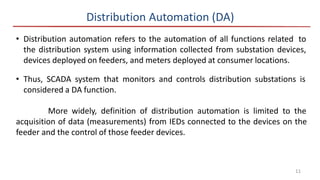
Distribution Automation (DA)
• Distribution automation refers to the automation of all functions related to
the distribution system using information collected from substation devices,
devices deployed on feeders, and meters deployed at consumer locations.
• Thus, SCADA system that monitors and controls distribution substations is
considered a DA function.
More widely, definition of distribution automation is limited to the
acquisition of data (measurements) from IEDs connected to the devices on the
feeder and the control of those feeder devices.
11
Distribution Automation (DA)
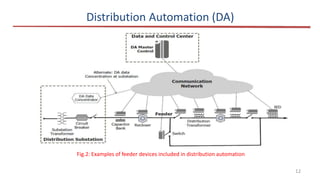
Fig.2: Examples of feeder devices included in distribution automation
12
SCADA (Supervisory control and data acquisition) System [2]
• SCADA refers to a system or a combination of systems that collects data
from various sensors at a plant or in other remote locations and then sends
these data to a central computer system, which then manages and controls
the data and remotely controls devices in the field.
• Components are:
• Master station --- at an energy control center (ECC)
• RTUs (Remote Terminal Units) --- at the power plants, transmission
and distribution substations,
distribution feeder equipment, etc.
• Communications system.
17
SCADA (Supervisory control and data acquisition) System
1. Master Stations
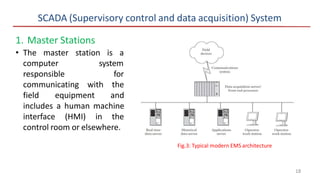
• The master station is a
computer
responsible
system
for
communicating with the
field equipment and
includes a human machine
interface (HMI) in the
control room or elsewhere.
Fig.3: Typical modern EMS architecture
18
SCADA (Supervisory control and data acquisition) System
1. Master Stations
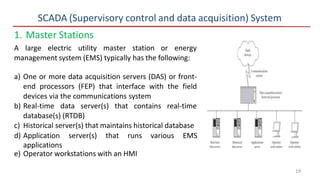
A large electric utility master station or energy
management system (EMS) typically has the following:
a) One or more data acquisition servers (DAS) or front-
end processors (FEP) that interface with the field
devices via the communications system
b) Real-time data server(s) that contains real-time
database(s) (RTDB)
c) Historical server(s) that maintains historical database
d) Application server(s) that runs various EMS
applications
e) Operator workstations with an HMI
19
SCADA (Supervisory control and data acquisition) System
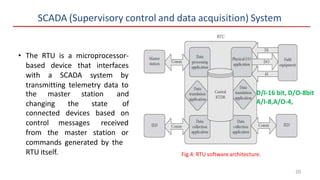
• The RTU is a microprocessor-
based device that interfaces
with a SCADA system by
transmitting telemetry data to
the master station
changing the state
and
of
D/I-16 bit, D/O-8bit
A/I-8,A/O-4,
connected devices based on
control messages received
from the master station or
commands generated by the
RTU itself. Fig.4: RTU software architecture.
20
SCADA (Supervisory control and data acquisition) System
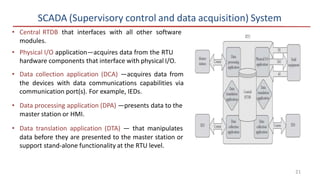
• Central RTDB that interfaces with all other software
modules.
• Physical I/O application—acquires data from the RTU
hardware components that interface with physical I/O.
• Data collection application (DCA) —acquires data from
the devices with data communications capabilities via
communication port(s). For example, IEDs.
• Data processing application (DPA) —presents data to the
master station or HMI.
• Data translation application (DTA) — that manipulates
data before they are presented to the master station or
support stand-alone functionality at the RTU level.
21
SCADA (Supervisory control and data acquisition) System
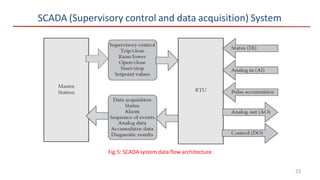
Fig.5: SCADA system data flow architecture.
22
Smart metering
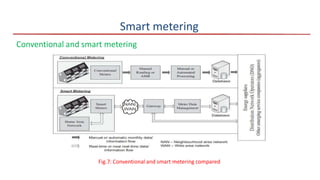
Conventional and smart metering
Fig.7: Conventional and smart metering compared
24
Smart metering
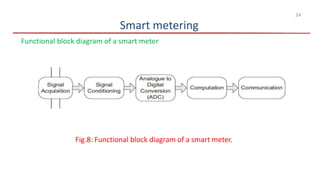
Functional block diagram of a smart meter
Fig.8: Functional block diagram of a smart meter.
Smart metering
a.Signal acquisition
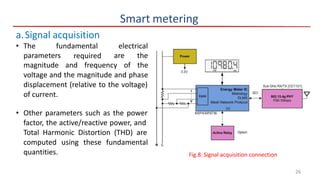
• The fundamental
required
electrical
parameters are the
magnitude and frequency of the
voltage and the magnitude and phase
displacement (relative to the voltage)
of current.
• Other parameters such as the power
factor, the active/reactive power, and
Total Harmonic Distortion (THD) are
computed using these fundamental
quantities. Fig.8: Signal acquisition connection
26
References
1. K.C. Budka et al., “Communication Networks for Smart Grids: Making Smart Grid Real”, Computer
Communications and Networks, DOI 10.1007/978-1-4471-6302-2 5.
2. Stuart Borlase; “Smart Grids: Infrastructure, Technology, and Solutions”, Electric Power and Energy
Engineering.
3. Janaka Ekanayake et al, “Smart Grid Technology and Applications”,AJohn Wiley & Sons, Ltd., Publication.
31
MuDiL.ppt

MuDiL.ppt

  • 1.
    MUTHAYAMMAL ENGINEERING COLLEGE (AnAutonomous Institution) (Approved by AICTE, New Delhi, Accredited by NAAC & Affiliated to Anna University) Rasipuram - 637 408, Namakkal Dist., Tamil Nadu SMART GRID ELEMENTS AND TECHNOLOGIES Department of Electrical and Electronics Engineering Multidisciplinary lectures (MuDiL 230409) By Ms.V.Deepika Assistant Professor Department of Electrical and Electronics Engineering Date: 05.04.2023
  • 2.
    What makes theGrid ‘Smart’ The digital technology that allows for two-way communication between the utility and its customers, and the sensing along the transmission lines is what makes the grid smart. Customer prospective • If you already manage activities such as personal banking from your home computer, imagine managing your electricity in a similar way. For examples • • • Customer will no longer have to wait for monthly statement to know how much electricity he use. With a smarter grid, he can have a clear and timely picture of it. "Smart meters,“ Can able to see how much electricity you use, when you use it, and its cost. Combined with real-time pricing, this will allow you to save money by using less power when electricity is most expensive. Smart Grid has the potential to help you save money by helping you to manage your electricity use and choose the best times to purchase electricity.And you can save even more by generating your own power. 10
  • 3.
    Advanced Metering Infrastructure(AMI) • AMI refers network infrastructure connecting smart meters, Meter Data Management System (MDMS) and elements supporting communication between the smart meters and the MDMS. [1] AMI Utility DCCs MDMS Consumer Smart Meters Communications DCC: Data and Control Center MDMS : Meter Data Management System • AMR (Automated Meter Reading) systems allow meters to be read by utility personnel over wireless links. • It helps in reducing the cost associated with meter reading and also supports in billing process. 2
  • 4.
    Advanced Metering Infrastructure(AMI) Smart Meter Measurements Smart meters provide periodic “interval measurements.” - every hour or once every 15 min or even at the rate of once every 5 min. • rms voltage (V) rms current (A) energy consumption (kWh) Smart Meter Measurement phase angle measurement Instantaneous reactive power factor Instantaneous active power (W) power (VAR) 3
  • 5.
    Advanced Metering Infrastructure(AMI) Networking for AMI Fig.1: Networking for AMI – two options. (a) Meters connects directly to utility MDMS. (b) Vendor-proprietary “AMI solution” connecting to the MDMS 4
  • 6.
    Advanced Metering Infrastructure(AMI) Components of AMI: 1. Neighborhood Area Network (NAN): • Power line communication in RF frequency. • RF mesh is based on radio communication over unlicensed spectrum such as the 900 MHz. • PLC --connecting the secondary of the distribution transformer to the consumer. 7
  • 7.
    Advanced Metering Infrastructure(AMI) Components of AMI: 2. Smart Meters: • Meters support a communication interface to connect to the NAN. • This interface may be integrated with the meter or attached to meters from different meter vendor models. 8
  • 8.
    Advanced Metering Infrastructure(AMI) Components of AMI: 3. Meter Data Concentrator (collector): • The meter concentrator is responsible for supporting communication with the meters over the NAN to collect periodic measurements and alarms generated at the meters as well as to send commands sent by the MDMs to the meters and receive the corresponding responses. 9
  • 9.
    Advanced Metering Infrastructure(AMI) Components of AMI: 4. Head End: • The head end is the AMI solution’s meter management system. • The head end communicates with the meter concentrator over an IP connection provided by the Smart Grid. 10
  • 10.
    Distribution Automation (DA) •Distribution automation refers to the automation of all functions related to the distribution system using information collected from substation devices, devices deployed on feeders, and meters deployed at consumer locations. • Thus, SCADA system that monitors and controls distribution substations is considered a DA function. More widely, definition of distribution automation is limited to the acquisition of data (measurements) from IEDs connected to the devices on the feeder and the control of those feeder devices. 11
  • 11.
    Distribution Automation (DA) Fig.2:Examples of feeder devices included in distribution automation 12
  • 12.
    SCADA (Supervisory controland data acquisition) System [2] • SCADA refers to a system or a combination of systems that collects data from various sensors at a plant or in other remote locations and then sends these data to a central computer system, which then manages and controls the data and remotely controls devices in the field. • Components are: • Master station --- at an energy control center (ECC) • RTUs (Remote Terminal Units) --- at the power plants, transmission and distribution substations, distribution feeder equipment, etc. • Communications system. 17
  • 13.
    SCADA (Supervisory controland data acquisition) System 1. Master Stations • The master station is a computer responsible system for communicating with the field equipment and includes a human machine interface (HMI) in the control room or elsewhere. Fig.3: Typical modern EMS architecture 18
  • 14.
    SCADA (Supervisory controland data acquisition) System 1. Master Stations A large electric utility master station or energy management system (EMS) typically has the following: a) One or more data acquisition servers (DAS) or front- end processors (FEP) that interface with the field devices via the communications system b) Real-time data server(s) that contains real-time database(s) (RTDB) c) Historical server(s) that maintains historical database d) Application server(s) that runs various EMS applications e) Operator workstations with an HMI 19
  • 15.
    SCADA (Supervisory controland data acquisition) System • The RTU is a microprocessor- based device that interfaces with a SCADA system by transmitting telemetry data to the master station changing the state and of D/I-16 bit, D/O-8bit A/I-8,A/O-4, connected devices based on control messages received from the master station or commands generated by the RTU itself. Fig.4: RTU software architecture. 20
  • 16.
    SCADA (Supervisory controland data acquisition) System • Central RTDB that interfaces with all other software modules. • Physical I/O application—acquires data from the RTU hardware components that interface with physical I/O. • Data collection application (DCA) —acquires data from the devices with data communications capabilities via communication port(s). For example, IEDs. • Data processing application (DPA) —presents data to the master station or HMI. • Data translation application (DTA) — that manipulates data before they are presented to the master station or support stand-alone functionality at the RTU level. 21
  • 17.
    SCADA (Supervisory controland data acquisition) System Fig.5: SCADA system data flow architecture. 22
  • 18.
    Smart metering Conventional andsmart metering Fig.7: Conventional and smart metering compared
  • 19.
    24 Smart metering Functional blockdiagram of a smart meter Fig.8: Functional block diagram of a smart meter.
  • 20.
    Smart metering a.Signal acquisition •The fundamental required electrical parameters are the magnitude and frequency of the voltage and the magnitude and phase displacement (relative to the voltage) of current. • Other parameters such as the power factor, the active/reactive power, and Total Harmonic Distortion (THD) are computed using these fundamental quantities. Fig.8: Signal acquisition connection 26
  • 21.
    References 1. K.C. Budkaet al., “Communication Networks for Smart Grids: Making Smart Grid Real”, Computer Communications and Networks, DOI 10.1007/978-1-4471-6302-2 5. 2. Stuart Borlase; “Smart Grids: Infrastructure, Technology, and Solutions”, Electric Power and Energy Engineering. 3. Janaka Ekanayake et al, “Smart Grid Technology and Applications”,AJohn Wiley & Sons, Ltd., Publication. 31