EDGE901 
EMERGING ISSUES IN EDUCATIONAL TECHNOLOGY 
ASSESSMENT 2 
ONLINE PRESENTATION 
By CIBLE DAVIS (student no.4590107) 
Lecturer: Sarah Howard 
Submitted: 12/10/2014
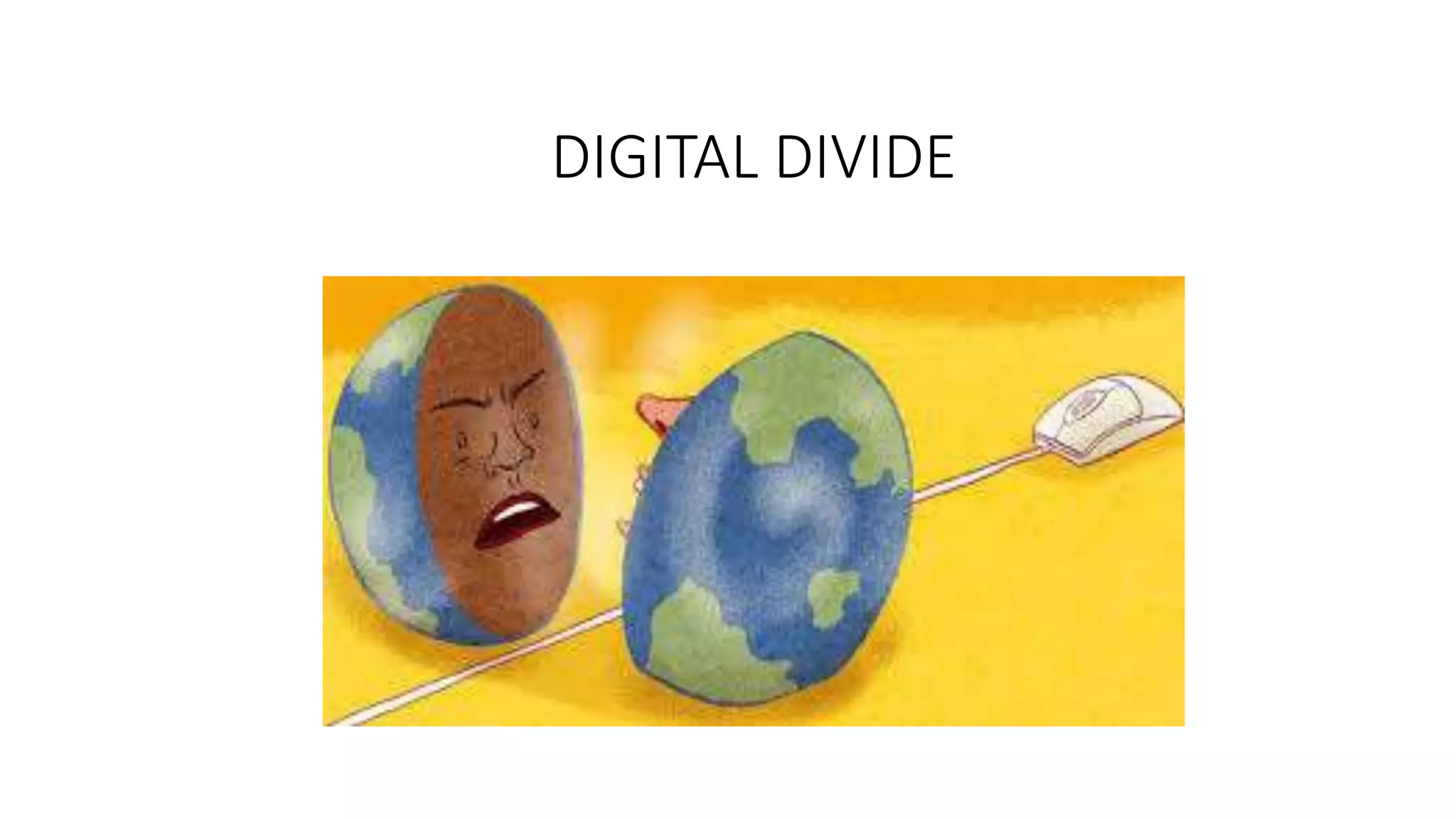
DIGITAL DIVIDE
Summary 
• In this presentation it explains the concept digital divide, difference 
between digital immigrants and digital natives. This also explains the 
reasons of digital divide in various groups.
Introduction 
• Development of technology and science has transformed life and the 
vision of society. Today’s students are born in digital age and 
technology is an important part in their lives. They spend a lot of 
time watching television, playing video games, using mobile phones 
and so on. At the same time learning approaches are also changed. 
But the educators are not aware of this and continue the traditional 
teaching method. This essay will analyse the important issue that the 
Indian educational system is facing today. One of the main issues is 
that the digital immigrant teachers teach traditional method and find 
difficult to teach the digital native students. Lack of training in 
technology makes them digital immigrants.
Digital Natives 
Children are born as digital natives 
so they are more familiar and 
depend on technology. Their lives 
are always related to technology 
like playing video games, using 
mobile phones surfing internet and 
so on (Bennet, Maton & Kervin, 
2008).
Digital immigrant 
Educational researchers 
describe that many teachers 
are digitally disadvantaged 
compared to digital native 
students. Teachers use 
traditional method of 
teaching, lack of interest in 
using technology and 
incompetent to use 
technology in their 
classrooms (Perrotta, 2013).
Digital divide between 
teachers and students 
Prensky (2001 a) points out 
that a distinction between 
learners and teachers is a strong 
issue because learners life has 
changed with the development 
of technology but teachers do 
not like to change their practices 
and their teaching becomes 
ineffective (Cited in Bennett, 
Maton & Kervin, 2008).
continuation 
• Lack of resources and less training in computer feel less confidence in 
using the technology in teaching. In India the following factors have 
to be considered barrier to digital divide. 
• Low literacy rate: 2001 population survey shows that literacy rate of 
India was 65.3%. The male literacy was 75.69% and female literacy 
was 54.28%. As the rate of literacy is increasing, there is a difference 
in urban and rural area. 
• Education system: The main challenge in the educational system is 
the number of drop-outs from school. In order to overcome this issue 
government has to implement information technology and 
infrastructure facilities.
Con’t 
• Language: Lack of English language is a great barrier to use computer 
and internet 
• Though India’s literacy rate is increasing but most people are e-illiterate. 
E-illiteracy includes lack of knowledge in computer skills 
and technological skills. Our former president has implemented 
many educational programs to transform India to a developed 
country by 2020. In 2005 EDUSAT (Education Satellite) was launched 
in various states in India. In 2001 IT @ school project set up in all 
states. However, schools cannot use these facilities because of lack 
of resources and lack of training for teachers.
Schools suffer poor learning environment, lack of effective teachers and 
limited access to technology. The public libraries and school libraries 
have old and obsolete books.
Meaning of digital divide 
• Digital divide shows the difference of people who have knowledge on 
technology and easy access to internet and people who do not have 
computer literacy and less access to internet. OECD (2001) explains 
that digital divide means the difference between households, 
individuals, business and areas at different socio economic levels 
regarding the opportunity to use internet and acquire information 
and communication technology for a wide range of activities (Ayanso, 
Cho & Lertwachara, 2010).
Various groups are included in the digital 
divide 
• Gender differences: In India there is a wide gap between internet users and 
non-users. Males are using more internet than females because of lack of 
awareness, socio-economic status and low literacy (Loan, 2011). 
Researchers argue that during 1990’s women were the late comers to the 
digital age because of male domain and socio-economic differences. In 
2000, many developed countries, women use the internet and mobile 
phones. 2007 statistical data shows in Canada 79% of men and 75% of 
women were using online. The statistical results of some of the developed 
countries are Australia 74% to 71%, New Zealand 78% to77%, UK 68% to 
65% and Sweden 71% to 78% (Hilbert, 2011). However Sharma (2003) 
highlights that in developing countries women have less internet access 
because of time control, financial problems, lack of education and other 
commitments (Hilbert, 2011).
Digital divide among older people and young 
people 
• Recent survey shows that older people are less likely to use internet. For 
Example, in Spain, out of the total population 67% people use internet but 
only 12% older people use internet and 4% in China. Because of the three 
reasons the older people are not using internet. 
1. difficulty in using the appropriate instrument. 
2. lack of skills. 
3. lack of motivation. 
(Olphert & Damodaran, 2013). 
This evidence shows that financial problems, lack of technological education 
and lack of interest give pressure to reduce the use of internet.
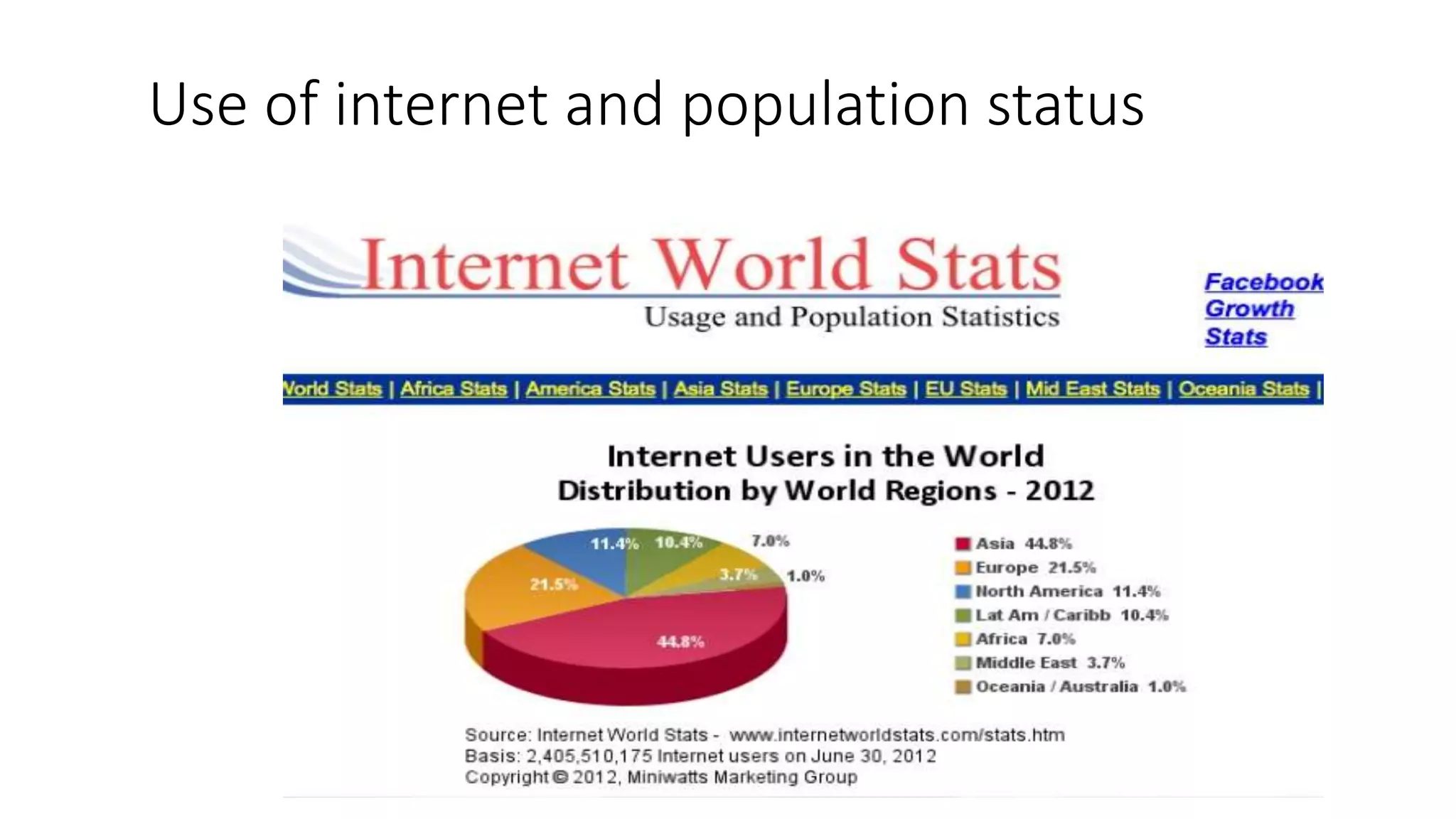
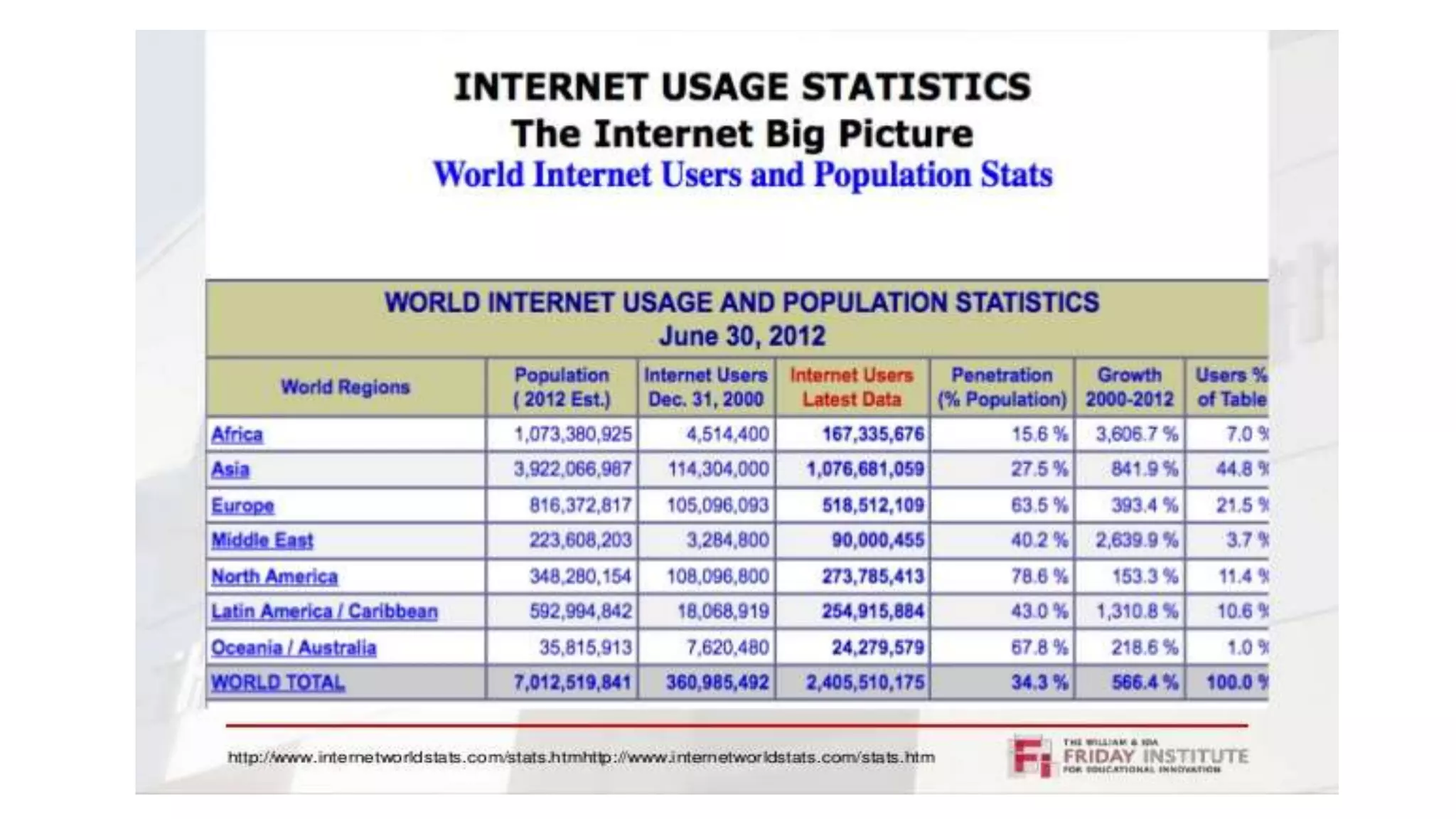
Use of internet and population status
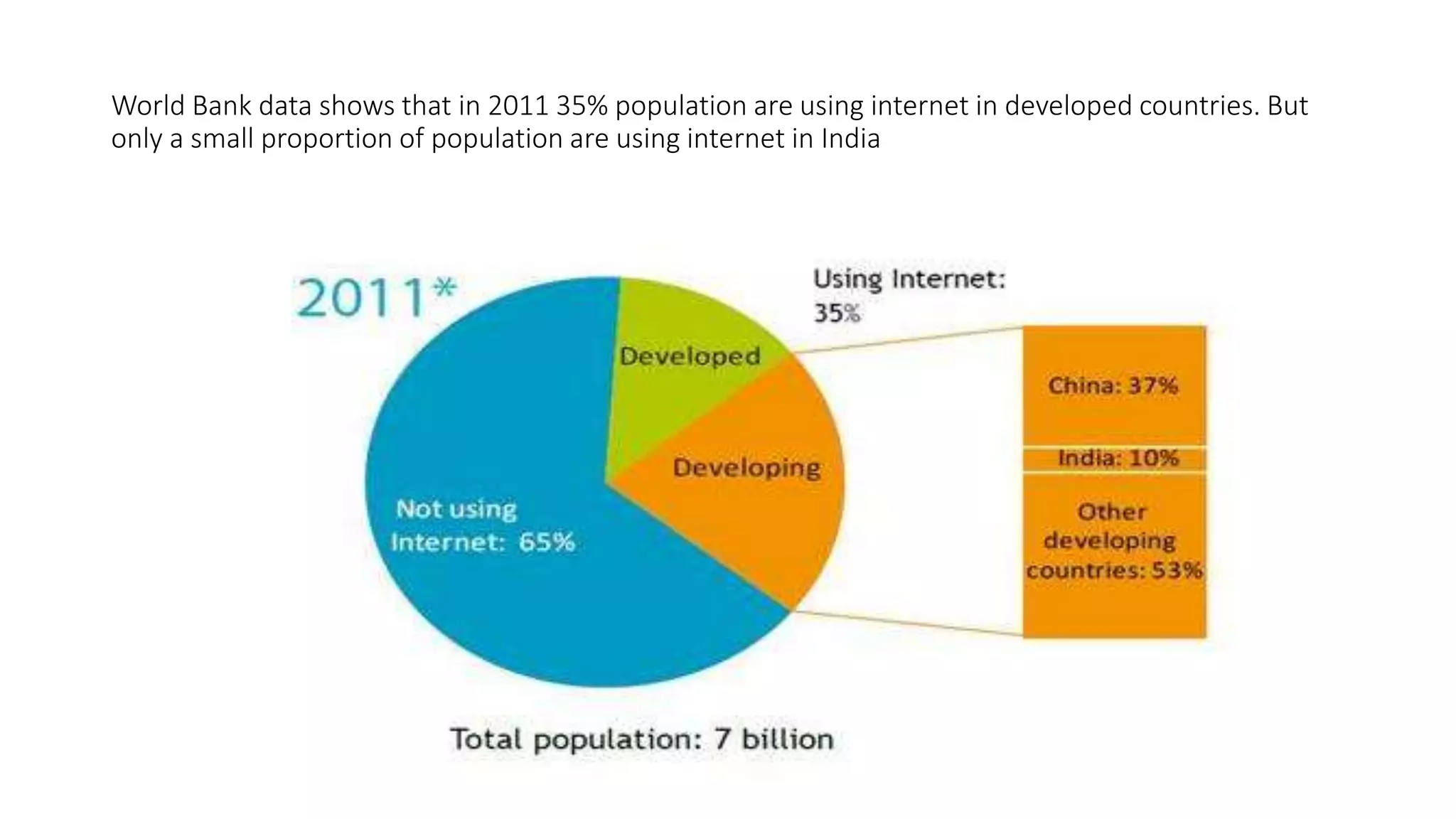
World Bank data shows that in 2011 35% population are using internet in developed countries. But 
only a small proportion of population are using internet in India
Con’t 
• National Telecommunication and Information Administration (NTIA, 
2004) survey reports that in 2003 86.7% people of age group18-24 
use internet in America. In 2004 77% people (18-29) used internet 
and in 2006 it became 88%. Young adults are using more internet 
access compared to older people(Hargittai, Hinnan, 2008).
Socio-economic difference in digital divide 
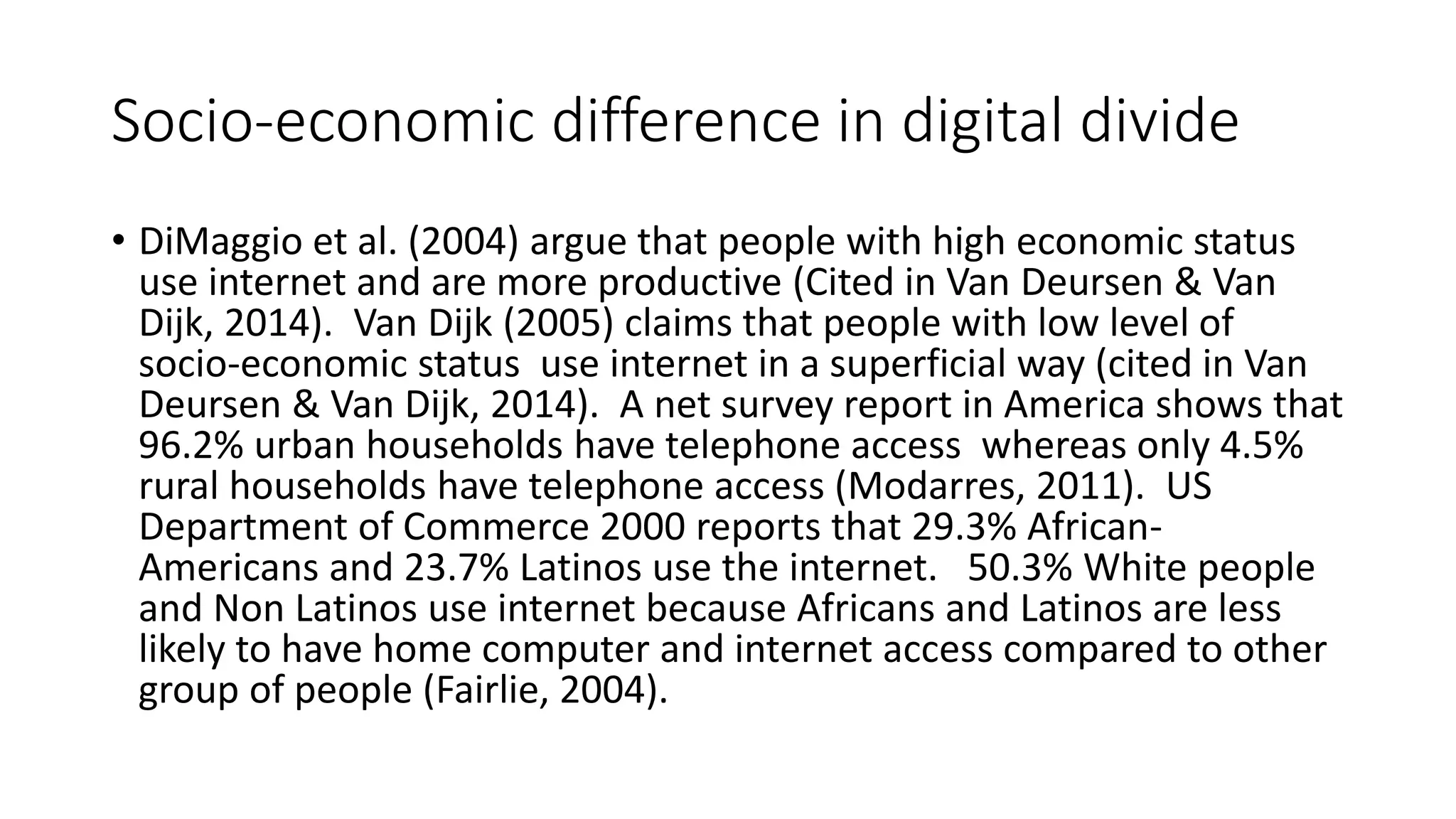
• DiMaggio et al. (2004) argue that people with high economic status 
use internet and are more productive (Cited in Van Deursen & Van 
Dijk, 2014). Van Dijk (2005) claims that people with low level of 
socio-economic status use internet in a superficial way (cited in Van 
Deursen & Van Dijk, 2014). A net survey report in America shows that 
96.2% urban households have telephone access whereas only 4.5% 
rural households have telephone access (Modarres, 2011). US 
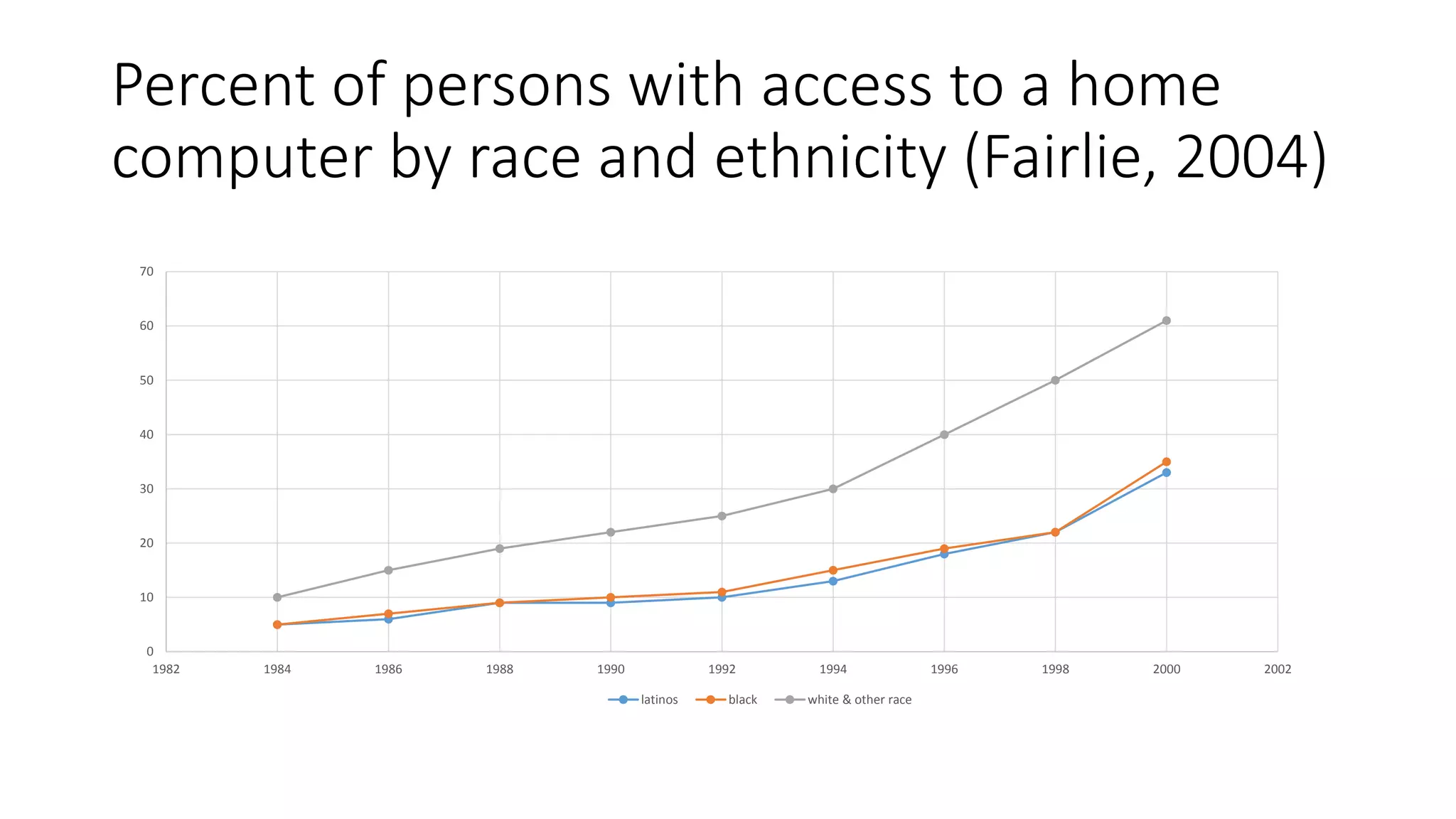
Department of Commerce 2000 reports that 29.3% African- 
Americans and 23.7% Latinos use the internet. 50.3% White people 
and Non Latinos use internet because Africans and Latinos are less 
likely to have home computer and internet access compared to other 
group of people (Fairlie, 2004).
Percent of persons with access to a home 
computer by race and ethnicity (Fairlie, 2004) 
70 
60 
50 
40 
30 
20 
10 
0 
1982 1984 1986 1988 1990 1992 1994 1996 1998 2000 2002 
latinos black white & other race
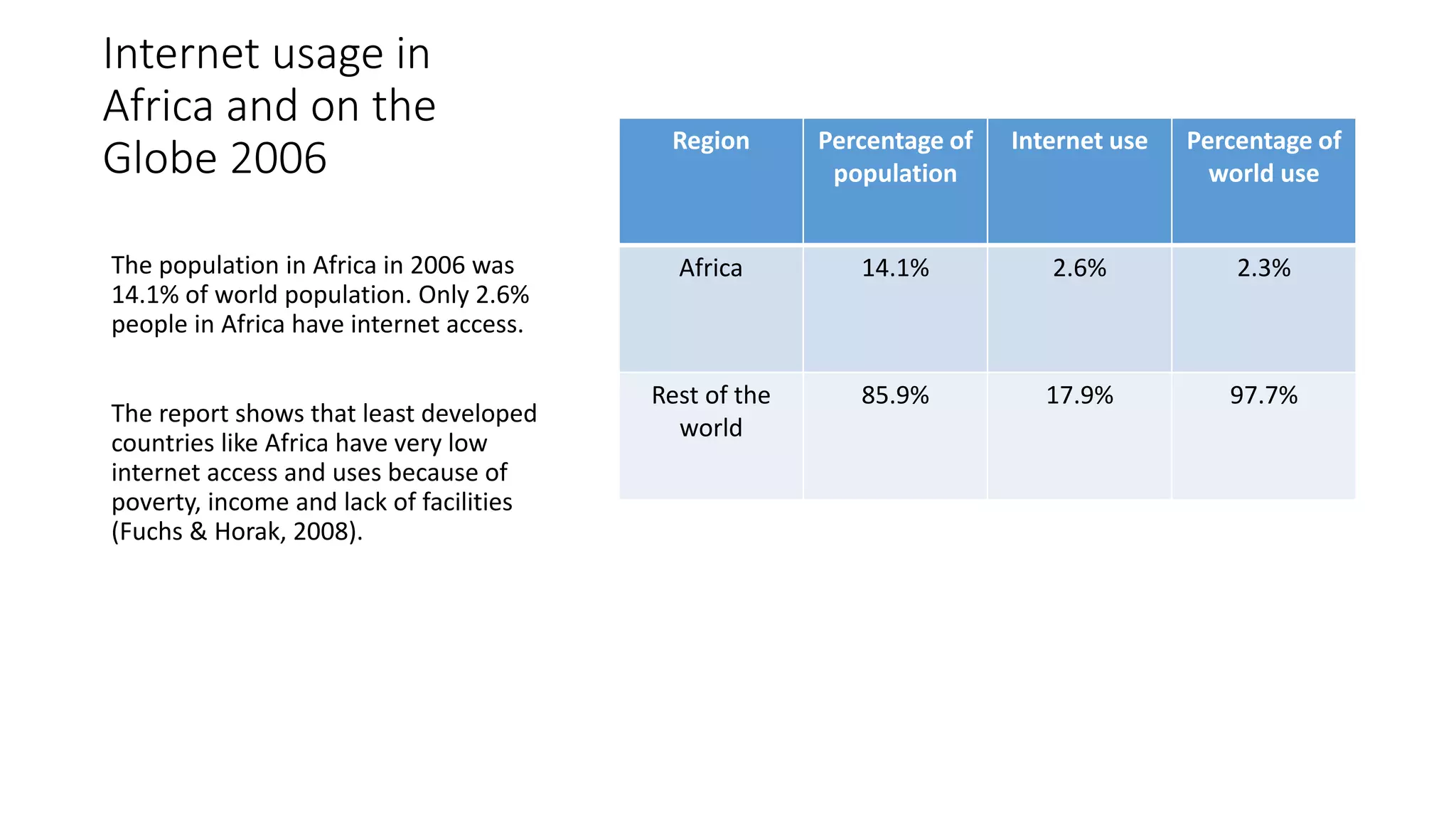
Internet usage in 
Africa and on the 
Globe 2006 Region Percentage of 
population 
Internet use Percentage of 
world use 
Africa 14.1% 2.6% 2.3% 
Rest of the 
world 
85.9% 17.9% 97.7% 
The population in Africa in 2006 was 
14.1% of world population. Only 2.6% 
people in Africa have internet access. 
The report shows that least developed 
countries like Africa have very low 
internet access and uses because of 
poverty, income and lack of facilities 
(Fuchs & Horak, 2008).
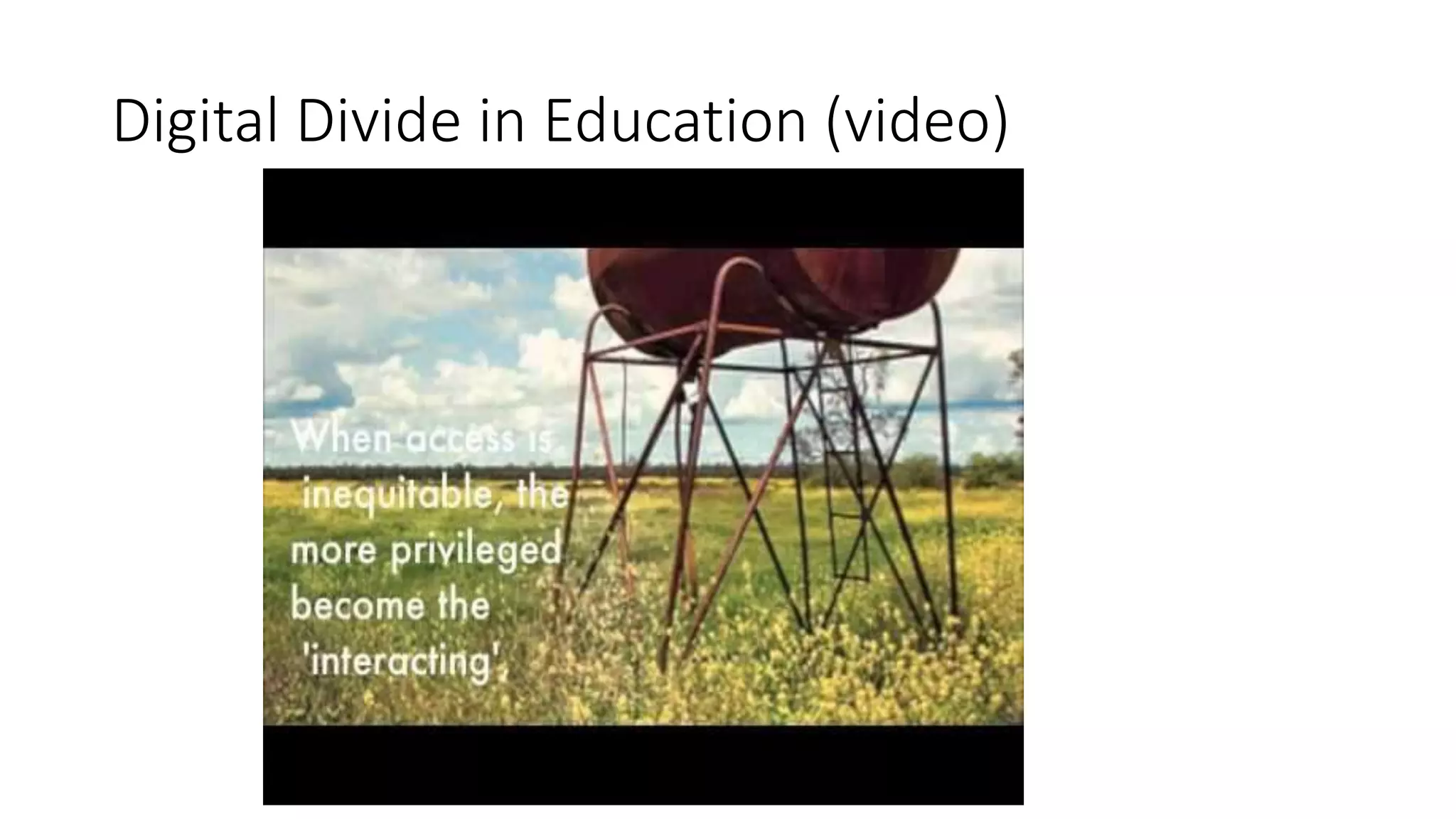
Digital Divide in Education (video)
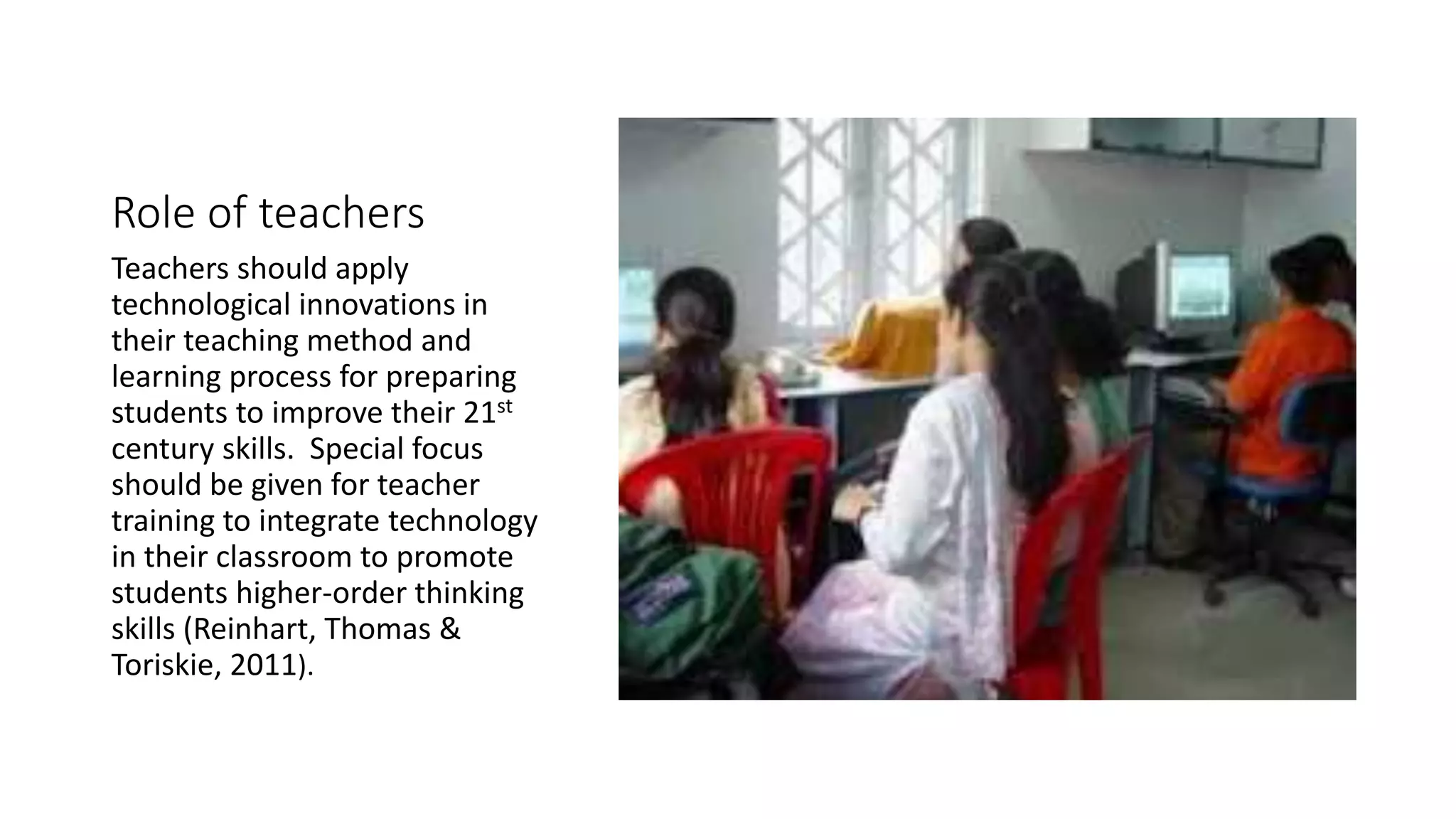
Role of teachers 
Teachers should apply 
technological innovations in 
their teaching method and 
learning process for preparing 
students to improve their 21st 
century skills. Special focus 
should be given for teacher 
training to integrate technology 
in their classroom to promote 
students higher-order thinking 
skills (Reinhart, Thomas & 
Toriskie, 2011).
Conclusion 
In conclusion, digital divide among teachers and students are very 
crucial in India. Lack of resources, technological unawareness and low 
literacy are some of the important factors that India is facing today. By 
comparing digital divide in gender, between age groups, geographical 
area and socio-economic status, some groups are dominant than 
others because of some barriers like language, financial problems, lack 
of education and so on. Schools have to overcome this situation by 
implementing technological education, infrastructure facilities and 
providing training to teachers. These will help students to improve 
their technological skills and benefit in their future studies.
References 
• Ayanso, A, Cho, DI & Lertwachara, K 2010, ‘The Digital Divide: global and regional ICT leaders and followers’, information technology for development, vol. 16, no. 4, 
pp. 304-319. 
• Bennet, S, Maton, K & Kervin, L 2008, ‘The ‘digital natives’ debate: A critical review of the evidence’, British journal of educational technology, vol. 39, no. 5, pp. 
775-786. 
• Fairlie, RW 2004, ‘Race and the digital divide’, Contributions to economic analysis and policy, vol. 3, no. 1, pp. 1-38. 
• Fuchs, C & Horak, E 2008, ‘Africa and the digital divide’, Telematics and informatics, vol. 25, no. 2, pp. 99-116. 
• Hargittai, E & Hinnant, A 2008, ‘Digital inequality differences in young adults’, Use of the internet, vol. 35, no. 5, pp. 602-621. 
• Hilbert, M 2011, ‘Digital gender divide or technologically empowered women in developing countries? A typical case of lies, damned lies and statistics’, Women’s 
studies international forum, vol. 34, no. 6, pp. 479-489. 
• http://youtu.be/x1YLPLOKOWE 
• Loan, FA 2011, ‘The digital divide among the college students of Kashmir, India’, IFLA Journal, vol. 37, no. 3, pp. 211-217. 
• Modarres, A 2011, ‘Beyond the digital divide’, National civic review, vol. 100, no. 3, pp. 4-7. 
• Olphert, W & Damodaran, L 2013, ‘Older people and digital disengagement: a fourth digital divide’, Gerontology, vol. 59, no. 6, pp. 564-570. 
• Perrotta, C 2013, ‘Do school-level factors influence the educational benefits of digital technology? A critical analysis of teachers’ perceptions’, British journal of 
educational technology, vol. 44, no. 2, pp. 314-327. 
• Reinhart, JM, Thomas, E & Toriskie, JM 2011, ‘K-12 Teachers: Technology use and the second level digital divide’, Journal of instructional psychology, vol. 38, no. 3-4, 
pp. 181-193. 
• Van Deursen, AJAM & Van Dijk, JAGM 2014, ‘The digital divide shifts to differences in usage’, New media and society, vol. 16, no. 3, pp. 507-526.

Edge901 assign2cibledavis

  • 1.
    EDGE901 EMERGING ISSUESIN EDUCATIONAL TECHNOLOGY ASSESSMENT 2 ONLINE PRESENTATION By CIBLE DAVIS (student no.4590107) Lecturer: Sarah Howard Submitted: 12/10/2014
  • 2.
  • 3.
    Summary • Inthis presentation it explains the concept digital divide, difference between digital immigrants and digital natives. This also explains the reasons of digital divide in various groups.
  • 4.
    Introduction • Developmentof technology and science has transformed life and the vision of society. Today’s students are born in digital age and technology is an important part in their lives. They spend a lot of time watching television, playing video games, using mobile phones and so on. At the same time learning approaches are also changed. But the educators are not aware of this and continue the traditional teaching method. This essay will analyse the important issue that the Indian educational system is facing today. One of the main issues is that the digital immigrant teachers teach traditional method and find difficult to teach the digital native students. Lack of training in technology makes them digital immigrants.
  • 5.
    Digital Natives Childrenare born as digital natives so they are more familiar and depend on technology. Their lives are always related to technology like playing video games, using mobile phones surfing internet and so on (Bennet, Maton & Kervin, 2008).
  • 6.
    Digital immigrant Educationalresearchers describe that many teachers are digitally disadvantaged compared to digital native students. Teachers use traditional method of teaching, lack of interest in using technology and incompetent to use technology in their classrooms (Perrotta, 2013).
  • 7.
    Digital divide between teachers and students Prensky (2001 a) points out that a distinction between learners and teachers is a strong issue because learners life has changed with the development of technology but teachers do not like to change their practices and their teaching becomes ineffective (Cited in Bennett, Maton & Kervin, 2008).
  • 8.
    continuation • Lackof resources and less training in computer feel less confidence in using the technology in teaching. In India the following factors have to be considered barrier to digital divide. • Low literacy rate: 2001 population survey shows that literacy rate of India was 65.3%. The male literacy was 75.69% and female literacy was 54.28%. As the rate of literacy is increasing, there is a difference in urban and rural area. • Education system: The main challenge in the educational system is the number of drop-outs from school. In order to overcome this issue government has to implement information technology and infrastructure facilities.
  • 9.
    Con’t • Language:Lack of English language is a great barrier to use computer and internet • Though India’s literacy rate is increasing but most people are e-illiterate. E-illiteracy includes lack of knowledge in computer skills and technological skills. Our former president has implemented many educational programs to transform India to a developed country by 2020. In 2005 EDUSAT (Education Satellite) was launched in various states in India. In 2001 IT @ school project set up in all states. However, schools cannot use these facilities because of lack of resources and lack of training for teachers.
  • 10.
    Schools suffer poorlearning environment, lack of effective teachers and limited access to technology. The public libraries and school libraries have old and obsolete books.
  • 11.
    Meaning of digitaldivide • Digital divide shows the difference of people who have knowledge on technology and easy access to internet and people who do not have computer literacy and less access to internet. OECD (2001) explains that digital divide means the difference between households, individuals, business and areas at different socio economic levels regarding the opportunity to use internet and acquire information and communication technology for a wide range of activities (Ayanso, Cho & Lertwachara, 2010).
  • 12.
    Various groups areincluded in the digital divide • Gender differences: In India there is a wide gap between internet users and non-users. Males are using more internet than females because of lack of awareness, socio-economic status and low literacy (Loan, 2011). Researchers argue that during 1990’s women were the late comers to the digital age because of male domain and socio-economic differences. In 2000, many developed countries, women use the internet and mobile phones. 2007 statistical data shows in Canada 79% of men and 75% of women were using online. The statistical results of some of the developed countries are Australia 74% to 71%, New Zealand 78% to77%, UK 68% to 65% and Sweden 71% to 78% (Hilbert, 2011). However Sharma (2003) highlights that in developing countries women have less internet access because of time control, financial problems, lack of education and other commitments (Hilbert, 2011).
  • 13.
    Digital divide amongolder people and young people • Recent survey shows that older people are less likely to use internet. For Example, in Spain, out of the total population 67% people use internet but only 12% older people use internet and 4% in China. Because of the three reasons the older people are not using internet. 1. difficulty in using the appropriate instrument. 2. lack of skills. 3. lack of motivation. (Olphert & Damodaran, 2013). This evidence shows that financial problems, lack of technological education and lack of interest give pressure to reduce the use of internet.
  • 14.
    Use of internetand population status
  • 16.
    World Bank datashows that in 2011 35% population are using internet in developed countries. But only a small proportion of population are using internet in India
  • 17.
    Con’t • NationalTelecommunication and Information Administration (NTIA, 2004) survey reports that in 2003 86.7% people of age group18-24 use internet in America. In 2004 77% people (18-29) used internet and in 2006 it became 88%. Young adults are using more internet access compared to older people(Hargittai, Hinnan, 2008).
  • 18.
    Socio-economic difference indigital divide • DiMaggio et al. (2004) argue that people with high economic status use internet and are more productive (Cited in Van Deursen & Van Dijk, 2014). Van Dijk (2005) claims that people with low level of socio-economic status use internet in a superficial way (cited in Van Deursen & Van Dijk, 2014). A net survey report in America shows that 96.2% urban households have telephone access whereas only 4.5% rural households have telephone access (Modarres, 2011). US Department of Commerce 2000 reports that 29.3% African- Americans and 23.7% Latinos use the internet. 50.3% White people and Non Latinos use internet because Africans and Latinos are less likely to have home computer and internet access compared to other group of people (Fairlie, 2004).
  • 19.
    Percent of personswith access to a home computer by race and ethnicity (Fairlie, 2004) 70 60 50 40 30 20 10 0 1982 1984 1986 1988 1990 1992 1994 1996 1998 2000 2002 latinos black white & other race
  • 20.
    Internet usage in Africa and on the Globe 2006 Region Percentage of population Internet use Percentage of world use Africa 14.1% 2.6% 2.3% Rest of the world 85.9% 17.9% 97.7% The population in Africa in 2006 was 14.1% of world population. Only 2.6% people in Africa have internet access. The report shows that least developed countries like Africa have very low internet access and uses because of poverty, income and lack of facilities (Fuchs & Horak, 2008).
  • 21.
    Digital Divide inEducation (video)
  • 22.
    Role of teachers Teachers should apply technological innovations in their teaching method and learning process for preparing students to improve their 21st century skills. Special focus should be given for teacher training to integrate technology in their classroom to promote students higher-order thinking skills (Reinhart, Thomas & Toriskie, 2011).
  • 23.
    Conclusion In conclusion,digital divide among teachers and students are very crucial in India. Lack of resources, technological unawareness and low literacy are some of the important factors that India is facing today. By comparing digital divide in gender, between age groups, geographical area and socio-economic status, some groups are dominant than others because of some barriers like language, financial problems, lack of education and so on. Schools have to overcome this situation by implementing technological education, infrastructure facilities and providing training to teachers. These will help students to improve their technological skills and benefit in their future studies.
  • 24.
    References • Ayanso,A, Cho, DI & Lertwachara, K 2010, ‘The Digital Divide: global and regional ICT leaders and followers’, information technology for development, vol. 16, no. 4, pp. 304-319. • Bennet, S, Maton, K & Kervin, L 2008, ‘The ‘digital natives’ debate: A critical review of the evidence’, British journal of educational technology, vol. 39, no. 5, pp. 775-786. • Fairlie, RW 2004, ‘Race and the digital divide’, Contributions to economic analysis and policy, vol. 3, no. 1, pp. 1-38. • Fuchs, C & Horak, E 2008, ‘Africa and the digital divide’, Telematics and informatics, vol. 25, no. 2, pp. 99-116. • Hargittai, E & Hinnant, A 2008, ‘Digital inequality differences in young adults’, Use of the internet, vol. 35, no. 5, pp. 602-621. • Hilbert, M 2011, ‘Digital gender divide or technologically empowered women in developing countries? A typical case of lies, damned lies and statistics’, Women’s studies international forum, vol. 34, no. 6, pp. 479-489. • http://youtu.be/x1YLPLOKOWE • Loan, FA 2011, ‘The digital divide among the college students of Kashmir, India’, IFLA Journal, vol. 37, no. 3, pp. 211-217. • Modarres, A 2011, ‘Beyond the digital divide’, National civic review, vol. 100, no. 3, pp. 4-7. • Olphert, W & Damodaran, L 2013, ‘Older people and digital disengagement: a fourth digital divide’, Gerontology, vol. 59, no. 6, pp. 564-570. • Perrotta, C 2013, ‘Do school-level factors influence the educational benefits of digital technology? A critical analysis of teachers’ perceptions’, British journal of educational technology, vol. 44, no. 2, pp. 314-327. • Reinhart, JM, Thomas, E & Toriskie, JM 2011, ‘K-12 Teachers: Technology use and the second level digital divide’, Journal of instructional psychology, vol. 38, no. 3-4, pp. 181-193. • Van Deursen, AJAM & Van Dijk, JAGM 2014, ‘The digital divide shifts to differences in usage’, New media and society, vol. 16, no. 3, pp. 507-526.