ICTS4D AND M4D
CASES IN EDUCATION
LITERATURE SEMINAR III
ALEJANDRA MANCO VEGA
BIJIA ZHANG
MARINA AMÂNCIO
INTRODUCTION
THE COMPANION TO DEVELOPMENT STUDIES
Globalisation/localisation and development
Warwick E. Murray and John Overton
 Globalisation creates gaps and inequalities, but it can be regulated to
optimise its benefits for poorer societies
 Seek to utilise the potential spaces of globalisation for progressive local
development.
Female participation in education
Christopher Colclough
 society participation, affects child education and qualifies for work
The challenge of skill formation and training
Jeemol Unni
 skills, education and technology as routes out of poverty; skill measure by
level of education and abilities; skill training
Development education, global citizenship and international volunteering
Matt Baillie Smith
 development education for more active citizens and as global learning,
INTRODUCTION
THE COMPANION TO DEVELOPMENT STUDIES
the government of Pakistan is supporting the establishment of an infrastructure for
awareness about e-learning in the country
Key player: High Education Comission in Pakistan and the establishment of National
ICT Fund
Virtual University: “Education for all” and lifelong learning at Allama Iqbal Open
University.
The University: the first Open University in Asia, and the biggest university in the
country. Offers a multi-media approach for teaching at a distance, with an Institute of
Educational Technology, who prepares CDs, radio and television programmes for
different courses
CASE 1: ALLAMA IQBAL OPEN UNIVERSITY IN PAKISTAN
Students can learn anywhere and anytime across the country and also out of the country
through the use of ICT tools which include computer, teleconferencing and networking.
 Audio visual (AV) media support/media programmes of 20 to 30 minutes duration for 144
AIOU courses.
 The Internet, audio and video lectures along with correspondence with the instructors are
used as a medium of instruction as well as a source of information.
AIOU in Numbers
more than 70% of students are employed
the rural-urban distribution of the students is 58% and 42% respectively
female enrolments are more than 50 percent.
CASE 1: ALLAMA IQBAL OPEN UNIVERSITY IN PAKISTAN
CASE 2: BBC JANALA IN BANGLADESH
Background
There is a huge demand for English language skills in Bangladesh
– both from employers who want to compete in the global
marketplace, and from families across the country.
Description of the project
By dialing 3000, audiences can choose from a menu of bi-lingual
audio lessons costing 4 cents each. Learners can also test their
English language skill via audio quizzes.
CASE 2: BBC JANALA IN BANGLADESH
Consequence and Impact
Launched in November 2009, the service is less than a
year old, yet more than 1.5 million people have already
used it. One third of users of the service are repeat users.
After three months, the online community at the website
had reached 56, 637 registered users.
(Conectividad Educativa de Informática Básica para el Aprendizaje en Línea [Educational
Connectivity of Basic Informatics for Online Learning])
Plan CEIBAL began in 2007, it works with the one-laptop-per-child (1:1) model
CEIBAL is inspired by the OLPC, but its design and implementation was adapted to the
Uruguayan context, resulting in a slightly different project compared to the original
proposal (Hinostroza, Jara, & Brun, 2011)
Aim: promote the massive use of ICT in society and schools
Purpose: Act as a measure against the existing inequalities regarding access to ICTs
Vision: through the provision of laptops to children, these computers become part of the daily
life of the family, and by doing so, the social impact of the initiative will be increased
(Hinostroza, Jara, & Brun, 2011)
CASE 3: PLAN CEIBAL IN URUGUAY
Initial goals
All students and teachers in public schools have their own portable
computer (362,000 students and 18,000 teachers)
They can access free wireless Internet installed in more than 2,000 schools
and hundreds of public spaces in cities and towns
All primary teachers train and they have access to an educational portal
with resources and communities to support and enrich teaching and
learning.
After accomplishing these goals:
The government is now aiming at providing portable computers to
secondary education students and teachers (Hinostroza, Jara, & Brun, 2011)
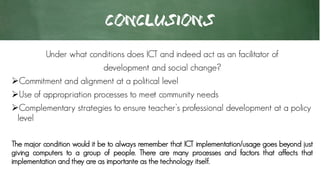
CONCLUSIONS
Under what conditions does ICT and indeed act as an facilitator of
development and social change?
Commitment and alignment at a political level
Use of appropriation processes to meet community needs
Complementary strategies to ensure teacher’s professional development at a policy
level
The major condition would it be to always remember that ICT implementation/usage goes beyond just
giving computers to a group of people. There are many processes and factors that affects that
implementation and they are as importante as the technology itself.
BIBLIOGRAPHY
Ali, A., & Ahmad, I. (2011). Key factors for determining students’ satisfaction in distance learning
courses: A study of Allama Iqbal Open University.Contemporary Educational Technology, 2(2), 118-
134.
Desai, V., & Potter, R. B. (2013). The companion to development studies. Routledge.
Hinostroza, J. Enrique, Jara, Ignacio & Brun, Mario (2011) Case Study: Uruguay. In: Transforming
Education: The Power of ICT Policies, UNESCO, Paris.
Iqbal, M. J., & Ahmad, M. (2010). Enhancing quality of education through e-learning: the case study
of Allama Iqbal Open University. Turkish Online Journal of Distance Education, 11(1).
Pittaluga, Lucía & Rivoir, Ana (2012) One Laptop per Child and Bridging the Digital Divide: The
Case of Plan CEIBAL in Uruguay, Information Technologies & International Development, Volume 8,
Number 4.

Seminar3

  • 1.
    ICTS4D AND M4D CASESIN EDUCATION LITERATURE SEMINAR III ALEJANDRA MANCO VEGA BIJIA ZHANG MARINA AMÂNCIO
  • 2.
    INTRODUCTION THE COMPANION TODEVELOPMENT STUDIES Globalisation/localisation and development Warwick E. Murray and John Overton  Globalisation creates gaps and inequalities, but it can be regulated to optimise its benefits for poorer societies  Seek to utilise the potential spaces of globalisation for progressive local development. Female participation in education Christopher Colclough  society participation, affects child education and qualifies for work
  • 3.
    The challenge ofskill formation and training Jeemol Unni  skills, education and technology as routes out of poverty; skill measure by level of education and abilities; skill training Development education, global citizenship and international volunteering Matt Baillie Smith  development education for more active citizens and as global learning, INTRODUCTION THE COMPANION TO DEVELOPMENT STUDIES
  • 4.
    the government ofPakistan is supporting the establishment of an infrastructure for awareness about e-learning in the country Key player: High Education Comission in Pakistan and the establishment of National ICT Fund Virtual University: “Education for all” and lifelong learning at Allama Iqbal Open University. The University: the first Open University in Asia, and the biggest university in the country. Offers a multi-media approach for teaching at a distance, with an Institute of Educational Technology, who prepares CDs, radio and television programmes for different courses CASE 1: ALLAMA IQBAL OPEN UNIVERSITY IN PAKISTAN
  • 5.
    Students can learnanywhere and anytime across the country and also out of the country through the use of ICT tools which include computer, teleconferencing and networking.  Audio visual (AV) media support/media programmes of 20 to 30 minutes duration for 144 AIOU courses.  The Internet, audio and video lectures along with correspondence with the instructors are used as a medium of instruction as well as a source of information. AIOU in Numbers more than 70% of students are employed the rural-urban distribution of the students is 58% and 42% respectively female enrolments are more than 50 percent. CASE 1: ALLAMA IQBAL OPEN UNIVERSITY IN PAKISTAN
  • 6.
    CASE 2: BBCJANALA IN BANGLADESH Background There is a huge demand for English language skills in Bangladesh – both from employers who want to compete in the global marketplace, and from families across the country. Description of the project By dialing 3000, audiences can choose from a menu of bi-lingual audio lessons costing 4 cents each. Learners can also test their English language skill via audio quizzes.
  • 7.
    CASE 2: BBCJANALA IN BANGLADESH Consequence and Impact Launched in November 2009, the service is less than a year old, yet more than 1.5 million people have already used it. One third of users of the service are repeat users. After three months, the online community at the website had reached 56, 637 registered users.
  • 8.
    (Conectividad Educativa deInformática Básica para el Aprendizaje en Línea [Educational Connectivity of Basic Informatics for Online Learning]) Plan CEIBAL began in 2007, it works with the one-laptop-per-child (1:1) model CEIBAL is inspired by the OLPC, but its design and implementation was adapted to the Uruguayan context, resulting in a slightly different project compared to the original proposal (Hinostroza, Jara, & Brun, 2011) Aim: promote the massive use of ICT in society and schools Purpose: Act as a measure against the existing inequalities regarding access to ICTs Vision: through the provision of laptops to children, these computers become part of the daily life of the family, and by doing so, the social impact of the initiative will be increased (Hinostroza, Jara, & Brun, 2011) CASE 3: PLAN CEIBAL IN URUGUAY
  • 9.
    CASE 3: PLANCEIBAL IN URUGUAY Initial goals All students and teachers in public schools have their own portable computer (362,000 students and 18,000 teachers) They can access free wireless Internet installed in more than 2,000 schools and hundreds of public spaces in cities and towns All primary teachers train and they have access to an educational portal with resources and communities to support and enrich teaching and learning. After accomplishing these goals: The government is now aiming at providing portable computers to secondary education students and teachers (Hinostroza, Jara, & Brun, 2011)
  • 10.
    CONCLUSIONS Under what conditionsdoes ICT and indeed act as an facilitator of development and social change? Commitment and alignment at a political level Use of appropriation processes to meet community needs Complementary strategies to ensure teacher’s professional development at a policy level The major condition would it be to always remember that ICT implementation/usage goes beyond just giving computers to a group of people. There are many processes and factors that affects that implementation and they are as importante as the technology itself.
  • 11.
    BIBLIOGRAPHY Ali, A., &Ahmad, I. (2011). Key factors for determining students’ satisfaction in distance learning courses: A study of Allama Iqbal Open University.Contemporary Educational Technology, 2(2), 118- 134. Desai, V., & Potter, R. B. (2013). The companion to development studies. Routledge. Hinostroza, J. Enrique, Jara, Ignacio & Brun, Mario (2011) Case Study: Uruguay. In: Transforming Education: The Power of ICT Policies, UNESCO, Paris. Iqbal, M. J., & Ahmad, M. (2010). Enhancing quality of education through e-learning: the case study of Allama Iqbal Open University. Turkish Online Journal of Distance Education, 11(1). Pittaluga, Lucía & Rivoir, Ana (2012) One Laptop per Child and Bridging the Digital Divide: The Case of Plan CEIBAL in Uruguay, Information Technologies & International Development, Volume 8, Number 4.