By
Br. Alok Kumar
M.Sc MHN
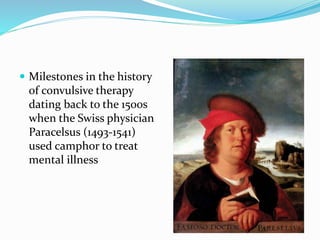
 Milestones in the history
of convulsive therapy
dating back to the 1500s
when the Swiss physician
Paracelsus (1493-1541)
used camphor to treat
mental illness
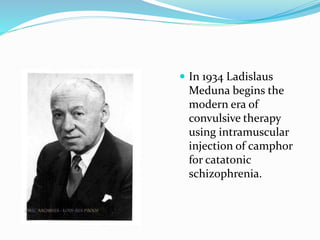
 In 1934 Ladislaus
Meduna begins the
modern era of
convulsive therapy
using intramuscular
injection of camphor
for catatonic
schizophrenia.
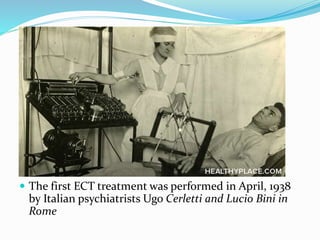
 The first ECT treatment was performed in April, 1938
by Italian psychiatrists Ugo Cerletti and Lucio Bini in
Rome
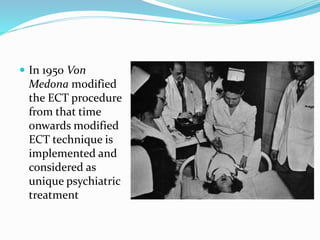
 In 1950 Von
Medona modified
the ECT procedure
from that time
onwards modified
ECT technique is
implemented and
considered as
unique psychiatric
treatment
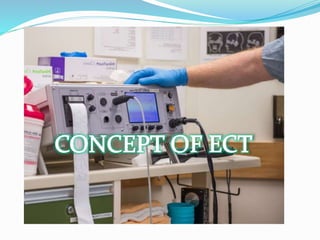
CONCEPT OF ECT
 Electroconvulsive Therapy is a painless form of electric
therapy. It is called as physical/ somatic therapy.
 Patient is anaesthetized or sometimes without an
aesthesis electric current is applied for a fraction of a
second with the help of electrodes placed on the
temporal region.
 Due to this electric current convulsion or seizure (like
Grand Mal Epilepsy) are produced.
DEFINITION
 ‘Artificial induction of a grandmal seizure(tonic
phase:10-15sec; clonic phase:30-60sec) through the
application of electrical current to the brain , the
stimulus is applied through electrodes which are
placed either bilaterally in the frontal- temporal region
or unilaterally on the non –dominant side’
PURPOSE OF ECT
When drugs are not available or not
providing to be very effective for the
patient.
For the quick recovery of the patient.
When patient needs to get back to
work quickly.
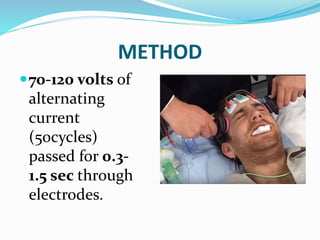
METHOD
70-120 volts of
alternating
current
(50cycles)
passed for 0.3-
1.5 sec through
electrodes.
MECHANISM OF ACTION
 The exact mechanism by which ECT effects a
therapeutic response is unknown. Several theories
exist, but the one to which the most credibility has
been given is the biochemical theory.
 A number of researchers have demonstrated that
electrical stimulation results in significant increases in
the circulating levels of several neurotransmitters.
MECHANISM OF ACTION
 These neurotransmitters include serotonin, nor-
epinephrine, and dopamine, the same biogenic amines
that are affected by antidepressant drugs.
 Additional evidence suggests that ECT may also result
in increases in glutamate and gamma-amino butyric
acid (GABA).
 The results of studies relating to the mechanism
underlying the effectiveness of ECT are still ongoing
and continue to be controversial
TYPES
 Direct ECT
 Absence of anaesthesia
 Absence of muscle relaxation drugs.
 Modified ECT
 Drugs induced muscle relaxation and general
anaesthesia may or may not be used.
APPLICATIONS OF ELECTRODES
 In bilateral ECT, electrodes are placed above the
midpoint, on a line joining the tragus of the ear and
the lateral canthus of the eye.
 In unilateral ECT, electrode is placed on non-
dominant side (one side) of the head.
TECHNIQUE
Injection thiopentone sodium
(anaesthetic agent )3-5mg/kg body
weight through I.V
Muscle relaxants like injections
succinyl scoline 1mg/kg body
weight through I.V
TECHNIQUE
 Injection atropine 1/100 grams subcutaneously or
intra muscularly before electric current stimuli will
be passed
 70-120 volts of 50 cycles of alternating current
passed for 0.3-1.5 second through electrodes.
 If needed artificial respiration has to be given until
client breathes normally
ECT TEAM
Psychiatric
Nurse
Nursing aid
INDICATIONS
 Depression
 Stuporous conditions
 Endogenous depression
 Psychotic depression
 Reaction depression which is not responding to the
other therapies like psychotherapy , casework drugs
 Atypical depression
 Melancholia
INDICATIONS
 Severe Psychosis
 Severe attack of mania
 Destructive , assaultive behaviour
 Delirium
 Schizophrenia
 Catatonic and paranoid type
 Other type of schizophrenia, not responding to other
treatments
 Organic psychosis
 Senile and pre-senile dementia.
CONTRAINDICATIONS:
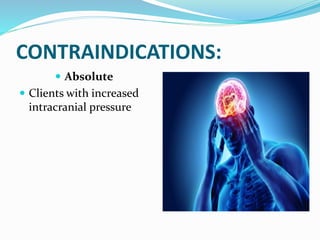
 Absolute
 Clients with increased
intracranial pressure
CONTRAINDICATIONS:
 Relative
 Cerebral disorders, e.g. Aneurysm, haemorrhage
 Brain tumour
 CVS disease like MI, CHF
 Retinal detachment
 Severe systematic diseases involving lungs. Kidney,
heart
 First trimester of pregnancy
 Osteomalacia
 Fractures.
SIDE EFFECTS/COMPLICATIONS
 Amnesia for recent events
 Confusional psychosis
 Memory impairment
 Restlessness
 Anxiety
 Confusion
 Drowsiness
 Poor concentration
 Aches: body ache, painful
masticatory movements
 Tongue bite , apnoea
 Cardiac arrest
 Joint dislocation, e.g.
Tempero-mandibular,
shoulder
 Unsteady gait
 Dryness of the mouth
 Palpitations
 Nausea , vomiting.
FREQUENCY OF ECT
 No fixed regimen
 Based on client’s conditions frequency of treatment
varies, e.g. in severe excitement cases ECT is given2-3
times/day; followed by alternate days ; weekly twice or
ones a week till the completion of remission of
symptoms and up to improvement.
 In schizophrenia clients;12-15 ECTs may be required
 MDP cases 6-8ECTs may be needed
ROLE OF PSYCHIATRIC NURSE IN
ECT PROCEDURE
 Pre ECT care
 The client is instructed to be accompanied by the
relative/friends for ECT procedure
 An informed consent is taken to overcome the fear ,
confusion , and anxieties associated with procedure
 Nurse should explain the risks and complications
related to procedures
 The client is given nothing by mouth (NBM)/Nil per
orally (NPO) for 6-8hrs before treatment.
ROLE OF PSYCHIATRIC NURSE IN
ECT PROCEDURE
 To collect the detail history of the client and recorded
it ,e.g. medial psychiatric , allergies
 Through physical examination is absolute necessary
 Complete neurological check up is carried out
 Fundus examinations of the eye
 Chest X-ray is taken
 Blood , urine analysis are done
ROLE OF PSYCHIATRIC NURSE IN
ECT PROCEDURE
 Check and record the vital signs
 Withhold night doses of drugs like diazepam,
barbiturates, anticonvulsants which increase the
threshold of seizure
 Withhold morning drugs(oral medications)
 Advise head-shampooing as application of hair oil can
result impedance of passage of electricity to the brain
ROLE OF PSYCHIATRIC NURSE IN
ECT PROCEDURE
 Remove the object like jewel, metallic objects ,
prosthesis , dentures contact lens
 Physical restraints may be necessary in acute case to
prevent powerful body jerky movements/ injury/fall
during procedure
 Tongue depressor or mouth gag is placed within the
mouth to prevent tongue bite or lip bite
 Injection atropine 1/100 grams or 0.6mg subcutaneous
or I.M is administered before ECT.
Intra Procedure Care
 Place the client in supine position over the hard bed(as
it facilities the control of body movements)
 Stay with client to overcome the anxiety and fear
 Assist in administering (J.M) the anaesthetic agent
injection pentathol sodium 100-200 mg dissolved in
distilled water and injection succinyl scoline 30-
60mg(I.V)
 Maintain patent airway
 Muscle relaxants will paralyse all the muscles
including respiratory muscles , hence ventilator
support has to be kept ready
 Bladder and bowel are emptied before ECT
 Monitor and record the voltage , intensity
duration of electricity stimuli, seizure pattern
condition of the client and medicines
administered
 Check the vital signs; if required o2 has to be
supplemented
Post Procedure Care
 Client must be shifted to post- procedure room after
the procedure
 Check the vital signs every 15 minutes until client’s
conditions stabilizes
 If client become aggressive/ confused administer 8-
10ml of injection paraldehyde or 50-100mg of
choropromazine or diazepam 5-10mmg I.V to control
clients behaviour
 If any respiratory difficulty , continue o2
supplementation till spontaneous respiration starts
 Use side –rail cot to prevent fall or injury
 Be with the client; if not possible allowed aid or
attender to be with client until recovery
 After recovery , reorient the client
 Relevant findings are documented.
ASSIGNMENT
 Write you role in ECT before & after the therapy.
 Write you role in ECT during the therapy.
BIBLIOGRAPHY
 Mary C. Townsend, “ Psychiatric Mental health Nursing,
concepts of care in evidence-based practice” , Ch-21, ,1st
Indian edition , Jaypee Brothers Medical Publishers (P)
Ltd. New Delhi 2012, Pg 344-350.
 Sreevani R. “A Guide To Mental Health & Psychiatric
Nursing”, Ch 5 3rd Edition, , Jaypee Brothers Medical
Publishers (P) Ltd. New Delhi 2010, Pg 129-131.
 Neeraja KP, “Essentials of mental health and psychiatric
Nursing”, vol.1, Ch-7 1st edition 2008, , Jaypee Brothers
Medical Publishers (P) Ltd. New Delhi 2008,Pg 224-227.
 Ahuja Niraja. “ Short Textbook of Psychiatry”,Ch 16 7th
edition,; Jaypee Brothers Medical Publishers (P) Ltd. New
Delhi 2011, Pg 199-203.

Electro convulsive therapy

  • 1.
  • 2.
     Milestones inthe history of convulsive therapy dating back to the 1500s when the Swiss physician Paracelsus (1493-1541) used camphor to treat mental illness
  • 3.
     In 1934Ladislaus Meduna begins the modern era of convulsive therapy using intramuscular injection of camphor for catatonic schizophrenia.
  • 4.
     The firstECT treatment was performed in April, 1938 by Italian psychiatrists Ugo Cerletti and Lucio Bini in Rome
  • 5.
     In 1950Von Medona modified the ECT procedure from that time onwards modified ECT technique is implemented and considered as unique psychiatric treatment
  • 7.
    CONCEPT OF ECT Electroconvulsive Therapy is a painless form of electric therapy. It is called as physical/ somatic therapy.  Patient is anaesthetized or sometimes without an aesthesis electric current is applied for a fraction of a second with the help of electrodes placed on the temporal region.  Due to this electric current convulsion or seizure (like Grand Mal Epilepsy) are produced.
  • 8.
    DEFINITION  ‘Artificial inductionof a grandmal seizure(tonic phase:10-15sec; clonic phase:30-60sec) through the application of electrical current to the brain , the stimulus is applied through electrodes which are placed either bilaterally in the frontal- temporal region or unilaterally on the non –dominant side’
  • 9.
    PURPOSE OF ECT Whendrugs are not available or not providing to be very effective for the patient. For the quick recovery of the patient. When patient needs to get back to work quickly.
  • 10.
  • 11.
    MECHANISM OF ACTION The exact mechanism by which ECT effects a therapeutic response is unknown. Several theories exist, but the one to which the most credibility has been given is the biochemical theory.  A number of researchers have demonstrated that electrical stimulation results in significant increases in the circulating levels of several neurotransmitters.
  • 12.
    MECHANISM OF ACTION These neurotransmitters include serotonin, nor- epinephrine, and dopamine, the same biogenic amines that are affected by antidepressant drugs.  Additional evidence suggests that ECT may also result in increases in glutamate and gamma-amino butyric acid (GABA).  The results of studies relating to the mechanism underlying the effectiveness of ECT are still ongoing and continue to be controversial
  • 13.
    TYPES  Direct ECT Absence of anaesthesia  Absence of muscle relaxation drugs.  Modified ECT  Drugs induced muscle relaxation and general anaesthesia may or may not be used.
  • 14.
    APPLICATIONS OF ELECTRODES In bilateral ECT, electrodes are placed above the midpoint, on a line joining the tragus of the ear and the lateral canthus of the eye.  In unilateral ECT, electrode is placed on non- dominant side (one side) of the head.
  • 15.
    TECHNIQUE Injection thiopentone sodium (anaestheticagent )3-5mg/kg body weight through I.V Muscle relaxants like injections succinyl scoline 1mg/kg body weight through I.V
  • 16.
    TECHNIQUE  Injection atropine1/100 grams subcutaneously or intra muscularly before electric current stimuli will be passed  70-120 volts of 50 cycles of alternating current passed for 0.3-1.5 second through electrodes.  If needed artificial respiration has to be given until client breathes normally
  • 17.
  • 18.
    INDICATIONS  Depression  Stuporousconditions  Endogenous depression  Psychotic depression  Reaction depression which is not responding to the other therapies like psychotherapy , casework drugs  Atypical depression  Melancholia
  • 19.
    INDICATIONS  Severe Psychosis Severe attack of mania  Destructive , assaultive behaviour  Delirium  Schizophrenia  Catatonic and paranoid type  Other type of schizophrenia, not responding to other treatments  Organic psychosis  Senile and pre-senile dementia.
  • 20.
    CONTRAINDICATIONS:  Absolute  Clientswith increased intracranial pressure
  • 21.
    CONTRAINDICATIONS:  Relative  Cerebraldisorders, e.g. Aneurysm, haemorrhage  Brain tumour  CVS disease like MI, CHF  Retinal detachment  Severe systematic diseases involving lungs. Kidney, heart  First trimester of pregnancy  Osteomalacia  Fractures.
  • 22.
    SIDE EFFECTS/COMPLICATIONS  Amnesiafor recent events  Confusional psychosis  Memory impairment  Restlessness  Anxiety  Confusion  Drowsiness  Poor concentration  Aches: body ache, painful masticatory movements  Tongue bite , apnoea  Cardiac arrest  Joint dislocation, e.g. Tempero-mandibular, shoulder  Unsteady gait  Dryness of the mouth  Palpitations  Nausea , vomiting.
  • 23.
    FREQUENCY OF ECT No fixed regimen  Based on client’s conditions frequency of treatment varies, e.g. in severe excitement cases ECT is given2-3 times/day; followed by alternate days ; weekly twice or ones a week till the completion of remission of symptoms and up to improvement.  In schizophrenia clients;12-15 ECTs may be required  MDP cases 6-8ECTs may be needed
  • 24.
    ROLE OF PSYCHIATRICNURSE IN ECT PROCEDURE  Pre ECT care  The client is instructed to be accompanied by the relative/friends for ECT procedure  An informed consent is taken to overcome the fear , confusion , and anxieties associated with procedure  Nurse should explain the risks and complications related to procedures  The client is given nothing by mouth (NBM)/Nil per orally (NPO) for 6-8hrs before treatment.
  • 25.
    ROLE OF PSYCHIATRICNURSE IN ECT PROCEDURE  To collect the detail history of the client and recorded it ,e.g. medial psychiatric , allergies  Through physical examination is absolute necessary  Complete neurological check up is carried out  Fundus examinations of the eye  Chest X-ray is taken  Blood , urine analysis are done
  • 26.
    ROLE OF PSYCHIATRICNURSE IN ECT PROCEDURE  Check and record the vital signs  Withhold night doses of drugs like diazepam, barbiturates, anticonvulsants which increase the threshold of seizure  Withhold morning drugs(oral medications)  Advise head-shampooing as application of hair oil can result impedance of passage of electricity to the brain
  • 27.
    ROLE OF PSYCHIATRICNURSE IN ECT PROCEDURE  Remove the object like jewel, metallic objects , prosthesis , dentures contact lens  Physical restraints may be necessary in acute case to prevent powerful body jerky movements/ injury/fall during procedure  Tongue depressor or mouth gag is placed within the mouth to prevent tongue bite or lip bite  Injection atropine 1/100 grams or 0.6mg subcutaneous or I.M is administered before ECT.
  • 28.
    Intra Procedure Care Place the client in supine position over the hard bed(as it facilities the control of body movements)  Stay with client to overcome the anxiety and fear  Assist in administering (J.M) the anaesthetic agent injection pentathol sodium 100-200 mg dissolved in distilled water and injection succinyl scoline 30- 60mg(I.V)
  • 29.
     Maintain patentairway  Muscle relaxants will paralyse all the muscles including respiratory muscles , hence ventilator support has to be kept ready  Bladder and bowel are emptied before ECT
  • 30.
     Monitor andrecord the voltage , intensity duration of electricity stimuli, seizure pattern condition of the client and medicines administered  Check the vital signs; if required o2 has to be supplemented
  • 31.
    Post Procedure Care Client must be shifted to post- procedure room after the procedure  Check the vital signs every 15 minutes until client’s conditions stabilizes  If client become aggressive/ confused administer 8- 10ml of injection paraldehyde or 50-100mg of choropromazine or diazepam 5-10mmg I.V to control clients behaviour
  • 32.
     If anyrespiratory difficulty , continue o2 supplementation till spontaneous respiration starts  Use side –rail cot to prevent fall or injury  Be with the client; if not possible allowed aid or attender to be with client until recovery  After recovery , reorient the client  Relevant findings are documented.
  • 33.
    ASSIGNMENT  Write yourole in ECT before & after the therapy.  Write you role in ECT during the therapy.
  • 34.
    BIBLIOGRAPHY  Mary C.Townsend, “ Psychiatric Mental health Nursing, concepts of care in evidence-based practice” , Ch-21, ,1st Indian edition , Jaypee Brothers Medical Publishers (P) Ltd. New Delhi 2012, Pg 344-350.  Sreevani R. “A Guide To Mental Health & Psychiatric Nursing”, Ch 5 3rd Edition, , Jaypee Brothers Medical Publishers (P) Ltd. New Delhi 2010, Pg 129-131.  Neeraja KP, “Essentials of mental health and psychiatric Nursing”, vol.1, Ch-7 1st edition 2008, , Jaypee Brothers Medical Publishers (P) Ltd. New Delhi 2008,Pg 224-227.  Ahuja Niraja. “ Short Textbook of Psychiatry”,Ch 16 7th edition,; Jaypee Brothers Medical Publishers (P) Ltd. New Delhi 2011, Pg 199-203.