1
Introduction to ECOWAS
2
3
Question to answer
 What is the purpose – what does it try to
acheive?
 Is it working – does it reaches its ambitions?
 What is the outlook for the future –
expansion?
 Similarities and differences with the EU?
4
ESTABLISHMENT OF
ECOWAS
 Created on May 28, 1975 with the
adoption of the ECOWAS Treaty
 In 1993, the Treaty was revised to
accelerate the process of integration
 A community of 15 West African states
5
FACTS ABOUT ECOWAS
Benin
Burkina Faso
Cabo-Verde
Côte-d’Ivoire
The Gambia
Ghana
Guinea
Guinea-Bissau
Liberia
Mali
Niger
Nigeria
Senegal
Sierra-Leone
Togo
6
ECOWAS
Surface Area
6,1 millions km²
FACTS ABOUT
ECOWAS
7
 Total Surface Area
6.1 millions de km²
 Total Population
220 millions d ’habitants
 Regional GDP
106.7 milliards $ US
FACTS ABOUT ECOWAS
8
OBJECTIVE
 OVERALL OBJECTIVE
To promote cooperation and
integration, with a view to
establishing an economic and
monetary union as a means of
stimulating economic growth and
development in West Africa
9
BASIC PRINCIPLES
Equality and interdependence of Member
States
Cooperation between Member States
Solidarity and collective autonomy
Policies and programmes harmonisation
Nonagression between Member States
10
Peace keeping, stability and security at
the regional level
Peaceful settlement of conflicts
Respect, promotion and protection of
human rights
Promotion and consolidation of
democracy
Transparency, economic and social
justice
BASIC PRINCIPLES
11
ECOWAS INSTITUTIONS …
The Conference of Heads of State and Government
The Council of Ministers
The Executive Secretariat
The Community Parliament
The Community Court of Justice
The Economic and Social Council ( to be created)
The West African Health Organisation (WAHO)
12
ECOWAS Bank for Investment and Development
(EBID)
ECOWAS Regional Development Fund (ERDF)
ECOWAS Regional Investment Bank (ERIB)
West African Monetary Agency (WAMA)
West African Monetary Institute (WAMI)
Specialized Technical Commissions ]
ECOWAS INSTITUTIONS
13
European Institutions
- European Council
- Council of Ministers
- European Commission
- European Parliament
- European Court of Justice
- European Central Bank
- Ecofin Group
14
Financing of Programmes
Self-financing budgets for the institutions:
Introduction of the Community levy - a
Community tax of 0.5% on goods from third
countries - to generate resources for
financing regional integration.
15
SETTLEMENT OF
DISPUTES
1. Any dispute regarding the interpretation or
the application of the provisions of this
Treaty shall he amicably settled through
direct agreement without prejudice to the
provisions of this Treaty and relevant
Protocols.
2. Failing this, either party or any other
Member States or the Authority may refer
the matter to the Court of the Community
whose decision shall be final and shall not
be subject to appeal.
16
SANCTIONS
1. Where a Member State fails to fulfill its
obligations to the Community, the
Authority may decide to impose sanctions
on that Member State.
2. These sanctions may include:
(i) suspension of new Community loans
or assistance,
(ii) suspension of disbursement on-going
Community projects or assistance
17
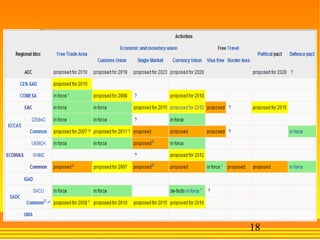
 Free movements of people
 Trade and Customs
 Monetary and financial matters
 Monetary Cooperation
 Transport
 Agricultural and livestock farming
 Protection of the environnement
 Industry and Energy
 NEPAD
 Common issues such as Youth, Sport, Culture and Social
Affairs, Health and Drug Control, Gender Issue, Education,
Regional Peace and security, etc.
ECOWAS ACHIEVEMENTSECOWAS ACHIEVEMENTS
18
19
 West Africa has experienced a notable return of peace,
and security in recent years, and the total number of
victims has steadily declined over twenty-year period
from 1960-1980;
 ECOWAS has over the years gained the confidence of
the international community for its intervention in
Liberia, Sierra-Leone, Togo, and Guinea-Bissau. With
the establishment of the Council of Wise to further
promote peace and prevent conflict, a more proactive
step has been taken to secure peace in the region.
ECOWAS ACHIEVEMENTSECOWAS ACHIEVEMENTS
20
Problems and Weaknesses of ECOWAS
effective coordination of policies throughout the region
coordination of economic planning and economic
policies demand somehow surrender of part of
sovereignty
favouring the more-developed Member States at the
expense of the less-developed ones
elimination of customs duties among the members
might open wider markets for those countries that have
already heavy industries, which means they could
dominate the markets of the less developed ones with
products that are produced at lower costs, with cheaper
raw materials from within the community
21
Problems and Weaknesses of ECOWAS
 Existing material infrastructure of the West African sub-
region, which is hardly developed and thus constitutes a
basic impediment to the growth of intra-regional trade within
the ECOWAS
 The institutional structure of regional organizations are
weak owing to their limited authority. Member-states retain
the right to veto legislation approved by their representatives
at the regional level.
22
THANK YOU FOR
YOUR
ATTENTION !

Ecowas111109202409-phpapp02

  • 1.
  • 2.
  • 3.
    3 Question to answer What is the purpose – what does it try to acheive?  Is it working – does it reaches its ambitions?  What is the outlook for the future – expansion?  Similarities and differences with the EU?
  • 4.
    4 ESTABLISHMENT OF ECOWAS  Createdon May 28, 1975 with the adoption of the ECOWAS Treaty  In 1993, the Treaty was revised to accelerate the process of integration  A community of 15 West African states
  • 5.
    5 FACTS ABOUT ECOWAS Benin BurkinaFaso Cabo-Verde Côte-d’Ivoire The Gambia Ghana Guinea Guinea-Bissau Liberia Mali Niger Nigeria Senegal Sierra-Leone Togo
  • 6.
    6 ECOWAS Surface Area 6,1 millionskm² FACTS ABOUT ECOWAS
  • 7.
    7  Total SurfaceArea 6.1 millions de km²  Total Population 220 millions d ’habitants  Regional GDP 106.7 milliards $ US FACTS ABOUT ECOWAS
  • 8.
    8 OBJECTIVE  OVERALL OBJECTIVE Topromote cooperation and integration, with a view to establishing an economic and monetary union as a means of stimulating economic growth and development in West Africa
  • 9.
    9 BASIC PRINCIPLES Equality andinterdependence of Member States Cooperation between Member States Solidarity and collective autonomy Policies and programmes harmonisation Nonagression between Member States
  • 10.
    10 Peace keeping, stabilityand security at the regional level Peaceful settlement of conflicts Respect, promotion and protection of human rights Promotion and consolidation of democracy Transparency, economic and social justice BASIC PRINCIPLES
  • 11.
    11 ECOWAS INSTITUTIONS … TheConference of Heads of State and Government The Council of Ministers The Executive Secretariat The Community Parliament The Community Court of Justice The Economic and Social Council ( to be created) The West African Health Organisation (WAHO)
  • 12.
    12 ECOWAS Bank forInvestment and Development (EBID) ECOWAS Regional Development Fund (ERDF) ECOWAS Regional Investment Bank (ERIB) West African Monetary Agency (WAMA) West African Monetary Institute (WAMI) Specialized Technical Commissions ] ECOWAS INSTITUTIONS
  • 13.
    13 European Institutions - EuropeanCouncil - Council of Ministers - European Commission - European Parliament - European Court of Justice - European Central Bank - Ecofin Group
  • 14.
    14 Financing of Programmes Self-financingbudgets for the institutions: Introduction of the Community levy - a Community tax of 0.5% on goods from third countries - to generate resources for financing regional integration.
  • 15.
    15 SETTLEMENT OF DISPUTES 1. Anydispute regarding the interpretation or the application of the provisions of this Treaty shall he amicably settled through direct agreement without prejudice to the provisions of this Treaty and relevant Protocols. 2. Failing this, either party or any other Member States or the Authority may refer the matter to the Court of the Community whose decision shall be final and shall not be subject to appeal.
  • 16.
    16 SANCTIONS 1. Where aMember State fails to fulfill its obligations to the Community, the Authority may decide to impose sanctions on that Member State. 2. These sanctions may include: (i) suspension of new Community loans or assistance, (ii) suspension of disbursement on-going Community projects or assistance
  • 17.
    17  Free movementsof people  Trade and Customs  Monetary and financial matters  Monetary Cooperation  Transport  Agricultural and livestock farming  Protection of the environnement  Industry and Energy  NEPAD  Common issues such as Youth, Sport, Culture and Social Affairs, Health and Drug Control, Gender Issue, Education, Regional Peace and security, etc. ECOWAS ACHIEVEMENTSECOWAS ACHIEVEMENTS
  • 18.
  • 19.
    19  West Africahas experienced a notable return of peace, and security in recent years, and the total number of victims has steadily declined over twenty-year period from 1960-1980;  ECOWAS has over the years gained the confidence of the international community for its intervention in Liberia, Sierra-Leone, Togo, and Guinea-Bissau. With the establishment of the Council of Wise to further promote peace and prevent conflict, a more proactive step has been taken to secure peace in the region. ECOWAS ACHIEVEMENTSECOWAS ACHIEVEMENTS
  • 20.
    20 Problems and Weaknessesof ECOWAS effective coordination of policies throughout the region coordination of economic planning and economic policies demand somehow surrender of part of sovereignty favouring the more-developed Member States at the expense of the less-developed ones elimination of customs duties among the members might open wider markets for those countries that have already heavy industries, which means they could dominate the markets of the less developed ones with products that are produced at lower costs, with cheaper raw materials from within the community
  • 21.
    21 Problems and Weaknessesof ECOWAS  Existing material infrastructure of the West African sub- region, which is hardly developed and thus constitutes a basic impediment to the growth of intra-regional trade within the ECOWAS  The institutional structure of regional organizations are weak owing to their limited authority. Member-states retain the right to veto legislation approved by their representatives at the regional level.
  • 22.