Ecotech Systems, Pune (MH) India.
 Waste to Energy
ECOTECH SYSTEMS
All around the globe companies and individuals are starting to produce fuel from waste plastic.
As only 8% of waste plastic is recycled in the U.S., 15% in Western Europe, and much less in
developing countries, this reuse of plastic could potentially keep enormous amounts of plastic
out of landfills and out of the oceans. Over 500 billion pounds of new plastic is manufactured
each year and roughly 33% of that is single use and thrown away. As so little plastic is recycled,
we need to reframe plastic waste as an underused resource vs landfill destined.
If all plastic waste made it into the landfill, it would surely be mined in the future, but currently
all plastic waste does not make it into our landfills. The United Nations estimates plastic
accounts for four-fifths of the accumulated garbage in the world's oceans. We need to stop
polluting our oceans with plastic before it is too late, and start collecting all plastics suitable for
this new fairly simple technology, a technology that is available now. –
Potential option is the conversion of plastics into petroleum by thermal depolymerisation or
pyrolysis process. Such a process would be able to accept almost any polymer or mix of
polymers, including rubber tires. Like natural petroleum, the chemicals produced can be made
into fuels as well as polymers.
This green technology is so far available only in Germany, Japan and the US, while Australia and
the UK are still working on it. The technology converts plastic into gasoline, diesel or aromatics
through the use of a combination of suitable catalysts.
It will also produce LPG as a common by-product.
Preface:
Ecotech Systems, Pune (MH) India.
Pyrolysis is the chemical decomposition of condensed organic substances by heating. The
word is coined from the Greek-derived elements pyro "fire" and lysys "decomposition”.
Pyrolysis process used to produce liquid fuel similar to diesel from plastic waste. The
pyrolysis process for plastic takes the long chain polymer molecules and breaks or cracks
them into shorter chains through heat and pressure. Essentially the process is mimicking
the natural process of the earth to break down carbon into oil which takes million of years in
nature. The pyrolysis process does this with intense heat in a closed system in a short
amount of time.
According to IIP Director M.O. Garg, the fuels obtained (gasoline and diesel) through the
process employed in the technology meet Euro-III standards and are of ultra high-
quality. With almost nil sulphur content, the diesel obtained through the process is said to
be of high quality. It will lead to vastly reduced emissions from engines, officials said.
An engine run on this fuel will enable a vehicle to run for at least two kilometers more per
litre than ordinary diesel.
Technology:
Ecotech Systems, Pune (MH) India.
" Garg told Mail Today. "The current prices of petrol, which is derived from crude
hydrocarbons, range between Rs 70 to Rs 80 per litre. Petrol in this case costs Rs 30 to Rs 40
per litre, inclusive of the cost of plant, operations, manpower and land cost," Garg
said. "There is a mammoth amount of solid waste generated in the country. It could be
procured at a minuscule cost."
The fuel is said to be ideal for captive users like the state road transport corporations, the
defence establishment and railways.
In the absence of effective implementation and enforcement of Hazardous Wastes
(Management and Handling) Rules of 1989, the handling of plastic waste continues to be a
major challenge in the country.
The technology, if commercially implemented, will considerably address India's rising
problem of hazardous plastic waste.
Technology:
Ecotech Systems, Pune (MH) India.
Methodology:
Ecotech Systems, Pune (MH) India.
As this proposal is very profitable & futuristic for the society. Though it resolve the
problem of the garbage of the city & also help to generate power from them. Which
means it will be always a propaganda of “win win situation”. There has been a lot of
efforts which has been taken towards it. We have combined the resolution of the
problem with a profit oriented business proposal.
Business Analysis:
Ecotech Systems, Pune (MH) India.
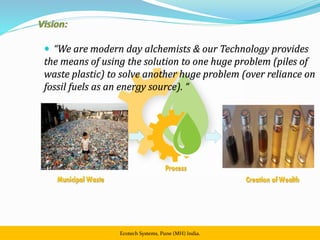
 “We are modern day alchemists & our Technology provides
the means of using the solution to one huge problem (piles of
waste plastic) to solve another huge problem (over reliance on
fossil fuels as an energy source). “
Vision:
Ecotech Systems, Pune (MH) India.
 Daily processing capacity of municipal & industrial waste plastic is 3 ton/day
 756 tons waste plastic/annum will be processed & converted into fuel/electricity
 Waste processing technology is completely environment friendly & no harmful gases are
released in the atmosphere. It’s completely enclosed processing plant.
 450 Kl. Of industrial oil / annum (LDO) will be generated & sold to various industrial
applications OR electricity can be generated.
 Condensed gases will be converted into fuel while uncondensed gases will be used to run
the same plants.
 10 skilled & unskilled man power will be employed at Single Project.
Project Summary:
Ecotech Systems, Pune (MH) India.
 o
Ecotech Systems, Pune (MH) India.

Ecotech systems

  • 1.
    Ecotech Systems, Pune(MH) India.  Waste to Energy ECOTECH SYSTEMS
  • 2.
    All around theglobe companies and individuals are starting to produce fuel from waste plastic. As only 8% of waste plastic is recycled in the U.S., 15% in Western Europe, and much less in developing countries, this reuse of plastic could potentially keep enormous amounts of plastic out of landfills and out of the oceans. Over 500 billion pounds of new plastic is manufactured each year and roughly 33% of that is single use and thrown away. As so little plastic is recycled, we need to reframe plastic waste as an underused resource vs landfill destined. If all plastic waste made it into the landfill, it would surely be mined in the future, but currently all plastic waste does not make it into our landfills. The United Nations estimates plastic accounts for four-fifths of the accumulated garbage in the world's oceans. We need to stop polluting our oceans with plastic before it is too late, and start collecting all plastics suitable for this new fairly simple technology, a technology that is available now. – Potential option is the conversion of plastics into petroleum by thermal depolymerisation or pyrolysis process. Such a process would be able to accept almost any polymer or mix of polymers, including rubber tires. Like natural petroleum, the chemicals produced can be made into fuels as well as polymers. This green technology is so far available only in Germany, Japan and the US, while Australia and the UK are still working on it. The technology converts plastic into gasoline, diesel or aromatics through the use of a combination of suitable catalysts. It will also produce LPG as a common by-product. Preface: Ecotech Systems, Pune (MH) India.
  • 3.
    Pyrolysis is thechemical decomposition of condensed organic substances by heating. The word is coined from the Greek-derived elements pyro "fire" and lysys "decomposition”. Pyrolysis process used to produce liquid fuel similar to diesel from plastic waste. The pyrolysis process for plastic takes the long chain polymer molecules and breaks or cracks them into shorter chains through heat and pressure. Essentially the process is mimicking the natural process of the earth to break down carbon into oil which takes million of years in nature. The pyrolysis process does this with intense heat in a closed system in a short amount of time. According to IIP Director M.O. Garg, the fuels obtained (gasoline and diesel) through the process employed in the technology meet Euro-III standards and are of ultra high- quality. With almost nil sulphur content, the diesel obtained through the process is said to be of high quality. It will lead to vastly reduced emissions from engines, officials said. An engine run on this fuel will enable a vehicle to run for at least two kilometers more per litre than ordinary diesel. Technology: Ecotech Systems, Pune (MH) India.
  • 4.
    " Garg toldMail Today. "The current prices of petrol, which is derived from crude hydrocarbons, range between Rs 70 to Rs 80 per litre. Petrol in this case costs Rs 30 to Rs 40 per litre, inclusive of the cost of plant, operations, manpower and land cost," Garg said. "There is a mammoth amount of solid waste generated in the country. It could be procured at a minuscule cost." The fuel is said to be ideal for captive users like the state road transport corporations, the defence establishment and railways. In the absence of effective implementation and enforcement of Hazardous Wastes (Management and Handling) Rules of 1989, the handling of plastic waste continues to be a major challenge in the country. The technology, if commercially implemented, will considerably address India's rising problem of hazardous plastic waste. Technology: Ecotech Systems, Pune (MH) India.
  • 5.
  • 6.
    As this proposalis very profitable & futuristic for the society. Though it resolve the problem of the garbage of the city & also help to generate power from them. Which means it will be always a propaganda of “win win situation”. There has been a lot of efforts which has been taken towards it. We have combined the resolution of the problem with a profit oriented business proposal. Business Analysis: Ecotech Systems, Pune (MH) India.
  • 7.
     “We aremodern day alchemists & our Technology provides the means of using the solution to one huge problem (piles of waste plastic) to solve another huge problem (over reliance on fossil fuels as an energy source). “ Vision: Ecotech Systems, Pune (MH) India.
  • 8.
     Daily processingcapacity of municipal & industrial waste plastic is 3 ton/day  756 tons waste plastic/annum will be processed & converted into fuel/electricity  Waste processing technology is completely environment friendly & no harmful gases are released in the atmosphere. It’s completely enclosed processing plant.  450 Kl. Of industrial oil / annum (LDO) will be generated & sold to various industrial applications OR electricity can be generated.  Condensed gases will be converted into fuel while uncondensed gases will be used to run the same plants.  10 skilled & unskilled man power will be employed at Single Project. Project Summary: Ecotech Systems, Pune (MH) India.
  • 9.
     o Ecotech Systems,Pune (MH) India.