Units 3 and 4
ECOSYSTEMS
Natural Science
5 Year
Marta
What do I know?
What do I know?
ENVIRONMENT
OUR ENVIRONMENT
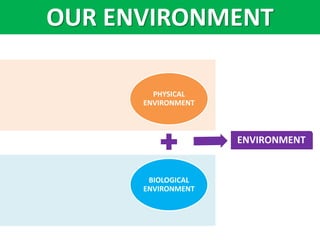
PHYSICAL
ENVIRONMENT
BIOLOGICAL
ENVIRONMENT
ENVIRONMENT
OUR ENVIRONMENT
PHYSICAL
ENVIRONMENT
BIOLOGICAL
ENVIRONMENT
ENVIRONMENT
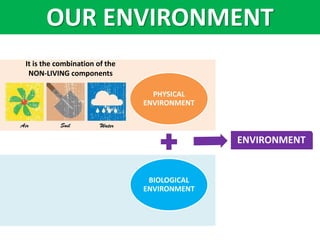
It is the combination of the
NON-LIVING components
OUR ENVIRONMENT
PHYSICAL
ENVIRONMENT
BIOLOGICAL
ENVIRONMENT
ENVIRONMENT
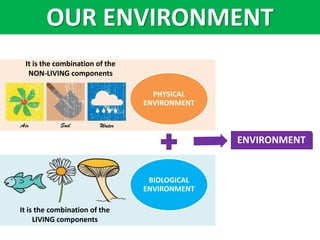
It is the combination of the
LIVING components
It is the combination of the
NON-LIVING components
OUR ENVIRONMENT
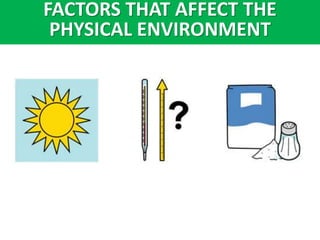
FACTORS THAT AFFECT THE
PHYSICAL ENVIRONMENT
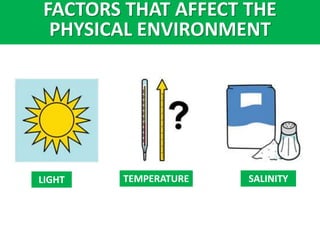
FACTORS THAT AFFECT THE
PHYSICAL ENVIRONMENT
LIGHT TEMPERATURE SALINITY
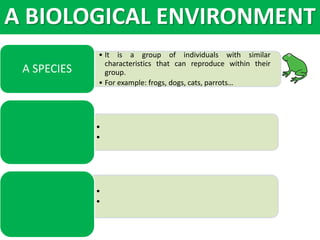
• It is a group of individuals with similar
characteristics that can reproduce within their
group.
• For example: frogs, dogs, cats, parrots…
A SPECIES
•
•
•
•
A BIOLOGICAL ENVIRONMENT
• It is a group of individuals with similar
characteristics that can reproduce within their
group.
• For example: frogs, dogs, cats, parrots…
A SPECIES
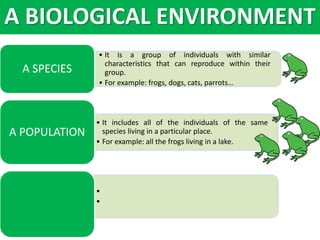
• It includes all of the individuals of the same
species living in a particular place.
• For example: all the frogs living in a lake.
A POPULATION
•
•
A BIOLOGICAL ENVIRONMENT
• It is a group of individuals with similar
characteristics that can reproduce within their
group.
• For example: frogs, dogs, cats, parrots…
A SPECIES
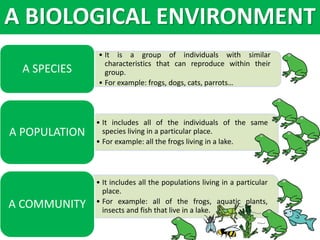
• It includes all of the individuals of the same
species living in a particular place.
• For example: all the frogs living in a lake.
A POPULATION
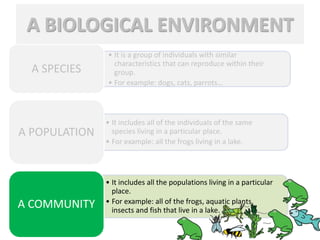
• It includes all the populations living in a particular
place.
• For example: all of the frogs, aquatic plants,
insects and fish that live in a lake.
A COMMUNITY
A BIOLOGICAL ENVIRONMENT
OK, now I know…
-What environment means.
-What biological environment means.
-What physical environment means.
BUT WHAT IS AN
ECOSYSTEM?
A BIOLOGICAL ENVIRONMENT
• It is a group of individuals with similar
characteristics that can reproduce within their
group.
• For example: dogs, cats, parrots…
A SPECIES
• It includes all of the individuals of the same
species living in a particular place.
• For example: all the frogs living in a lake.
A POPULATION
• It includes all the populations living in a particular
place.
• For example: all of the frogs, aquatic plants,
insects and fish that live in a lake.
A COMMUNITY
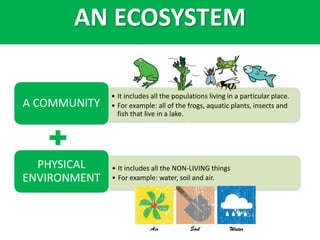
AN ECOSYSTEM
PHYSICAL
ENVIRONMENT
• It includes all the NON-LIVING things
• For example: water, soil and air.
• It includes all the populations living in a particular place.
• For example: all of the frogs, aquatic plants, insects and
fish that live in a lake.
A COMMUNITY
AN ECOSYSTEMAN ECOSYSTEM
1. Define species, habitat, population, community, ecosystem and
ecology
https://www.youtube.com/watch?v=EKIJjFAyAaA
2. Ecology introduction
https://www.youtube.com/watch?v=EdKhQVHc3Ao
A FEW VIDEOS TO HELP YOU
UNDERSTAND THESE CONCEPTS:
•
•
•
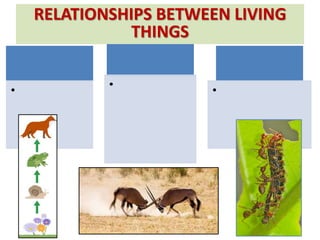
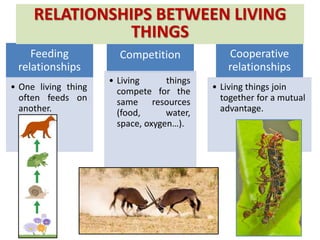
RELATIONSHIPS BETWEEN LIVING
THINGS
Feeding
relationships
• One living thing
often feeds on
another.
Competition
• Living things
compete for the
same resources
(food, water,
space, oxygen…).
Cooperative
relationships
• Living things join
together for a mutual
advantage.
RELATIONSHIPS BETWEEN LIVING
THINGS
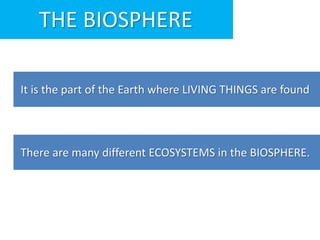
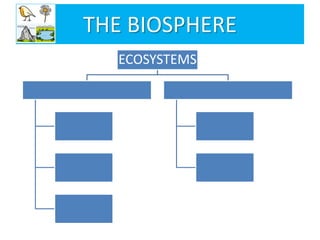
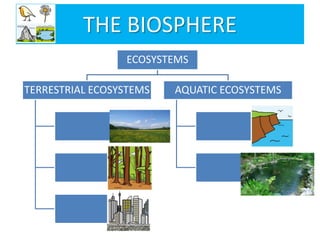
THE BIOSPHERE
It is the part of the Earth where LIVING THINGS are found.
There are many different ECOSYSTEMS in the BIOSPHERE.
It is the part of the Earth where LIVING THINGS are found
THE BIOSPHERE
ECOSYSTEMS
THE BIOSPHERE
ECOSYSTEMS
TERRESTRIAL ECOSYSTEMS AQUATIC ECOSYSTEMS
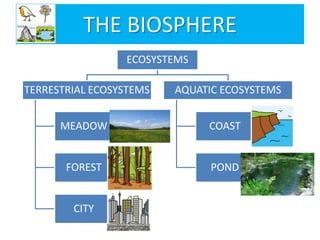
THE BIOSPHERE
ECOSYSTEMS
TERRESTRIAL ECOSYSTEMS
MEADOW
FOREST
CITY
AQUATIC ECOSYSTEMS
COAST
POND
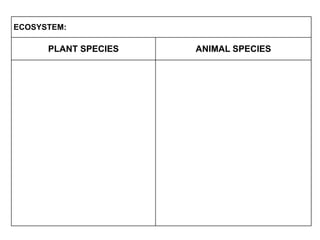
ECOSYSTEM:
PLANT SPECIES ANIMAL SPECIES
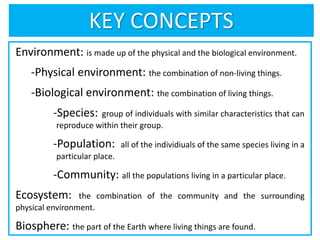
KEY CONCEPTS
Environment: is made up of the physical and the biological environment.
-Physical environment: the combination of non-living things.
-Biological environment: the combination of living things.
-Species: group of individuals with similar characteristics that can
reproduce within their group.
-Population: all of the individiuals of the same species living in a
particular place.
-Community: all the populations living in a particular place.
Ecosystem: the combination of the community and the surrounding
physical environment.
Biosphere: the part of the Earth where living things are found.
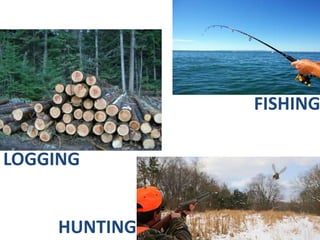
HOW WE ALTER ECOSYSTEMS
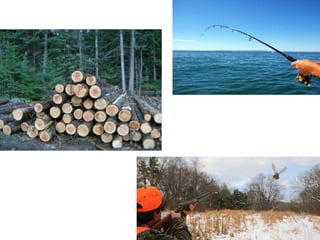
DIRECTLY
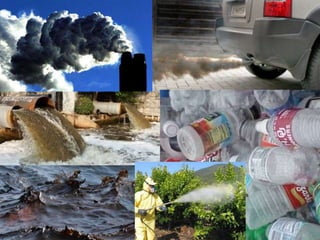
INDIRECTLY
LOGGING
FISHING
HUNTING
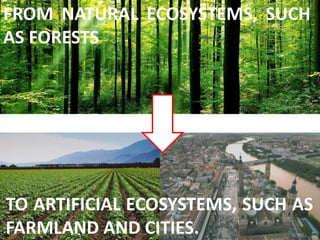
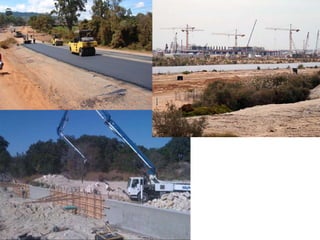
FROM NATURAL ECOSYSTEMS, SUCH
AS FORESTS
TO ARTIFICIAL ECOSYSTEMS, SUCH AS
FARMLAND AND CITIES.
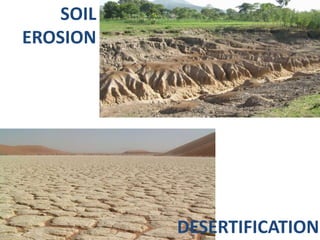
DESERTIFICATION
SOIL
EROSION
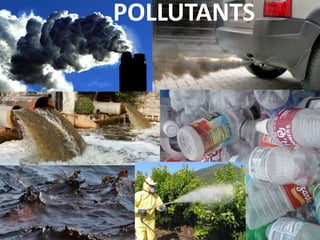
POLLUTANTS
HOW CAN YOU HELP THE
ENVIRONMENT?
It is your responsibility!!
ENDANGERED SPECIES AND
EXTINCTION
CAUSES OF
ANIMAL
EXTINCTION
Ecosystems - Natural Science

Ecosystems - Natural Science

  • 1.
    Units 3 and4 ECOSYSTEMS Natural Science 5 Year Marta
  • 2.
    What do Iknow?
  • 3.
    What do Iknow?
  • 4.
  • 5.
  • 6.
    PHYSICAL ENVIRONMENT BIOLOGICAL ENVIRONMENT ENVIRONMENT It is thecombination of the NON-LIVING components OUR ENVIRONMENT
  • 7.
    PHYSICAL ENVIRONMENT BIOLOGICAL ENVIRONMENT ENVIRONMENT It is thecombination of the LIVING components It is the combination of the NON-LIVING components OUR ENVIRONMENT
  • 8.
    FACTORS THAT AFFECTTHE PHYSICAL ENVIRONMENT
  • 9.
    FACTORS THAT AFFECTTHE PHYSICAL ENVIRONMENT LIGHT TEMPERATURE SALINITY
  • 10.
    • It isa group of individuals with similar characteristics that can reproduce within their group. • For example: frogs, dogs, cats, parrots… A SPECIES • • • • A BIOLOGICAL ENVIRONMENT
  • 11.
    • It isa group of individuals with similar characteristics that can reproduce within their group. • For example: frogs, dogs, cats, parrots… A SPECIES • It includes all of the individuals of the same species living in a particular place. • For example: all the frogs living in a lake. A POPULATION • • A BIOLOGICAL ENVIRONMENT
  • 12.
    • It isa group of individuals with similar characteristics that can reproduce within their group. • For example: frogs, dogs, cats, parrots… A SPECIES • It includes all of the individuals of the same species living in a particular place. • For example: all the frogs living in a lake. A POPULATION • It includes all the populations living in a particular place. • For example: all of the frogs, aquatic plants, insects and fish that live in a lake. A COMMUNITY A BIOLOGICAL ENVIRONMENT
  • 13.
    OK, now Iknow… -What environment means. -What biological environment means. -What physical environment means. BUT WHAT IS AN ECOSYSTEM?
  • 14.
    A BIOLOGICAL ENVIRONMENT •It is a group of individuals with similar characteristics that can reproduce within their group. • For example: dogs, cats, parrots… A SPECIES • It includes all of the individuals of the same species living in a particular place. • For example: all the frogs living in a lake. A POPULATION • It includes all the populations living in a particular place. • For example: all of the frogs, aquatic plants, insects and fish that live in a lake. A COMMUNITY
  • 15.
    AN ECOSYSTEM PHYSICAL ENVIRONMENT • Itincludes all the NON-LIVING things • For example: water, soil and air. • It includes all the populations living in a particular place. • For example: all of the frogs, aquatic plants, insects and fish that live in a lake. A COMMUNITY AN ECOSYSTEMAN ECOSYSTEM
  • 16.
    1. Define species,habitat, population, community, ecosystem and ecology https://www.youtube.com/watch?v=EKIJjFAyAaA 2. Ecology introduction https://www.youtube.com/watch?v=EdKhQVHc3Ao A FEW VIDEOS TO HELP YOU UNDERSTAND THESE CONCEPTS:
  • 17.
  • 18.
    Feeding relationships • One livingthing often feeds on another. Competition • Living things compete for the same resources (food, water, space, oxygen…). Cooperative relationships • Living things join together for a mutual advantage. RELATIONSHIPS BETWEEN LIVING THINGS
  • 19.
    THE BIOSPHERE It isthe part of the Earth where LIVING THINGS are found. There are many different ECOSYSTEMS in the BIOSPHERE. It is the part of the Earth where LIVING THINGS are found
  • 20.
  • 21.
  • 22.
  • 23.
  • 24.
    KEY CONCEPTS Environment: ismade up of the physical and the biological environment. -Physical environment: the combination of non-living things. -Biological environment: the combination of living things. -Species: group of individuals with similar characteristics that can reproduce within their group. -Population: all of the individiuals of the same species living in a particular place. -Community: all the populations living in a particular place. Ecosystem: the combination of the community and the surrounding physical environment. Biosphere: the part of the Earth where living things are found.
  • 25.
    HOW WE ALTERECOSYSTEMS DIRECTLY INDIRECTLY
  • 26.
  • 27.
    FROM NATURAL ECOSYSTEMS,SUCH AS FORESTS TO ARTIFICIAL ECOSYSTEMS, SUCH AS FARMLAND AND CITIES.
  • 28.
  • 29.
  • 30.
    HOW CAN YOUHELP THE ENVIRONMENT? It is your responsibility!!
  • 31.