Unit II: Two of the elements
Lesson One: Ecosystem
Aim of the lesson
At the end of the lesson, you will be able to
comprehend main and specific ideas from an
oral text about what is current bees’ situation
and how this affects in the ecosystem .
Have you ever heard of Ecosystem?
Does it sound familiar to you?
Brainstorm some words you think
are related to this topic.
Before starting
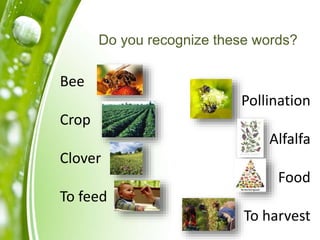
Do you recognize these words?
Bee
Pollination
Crop
Alfalfa
Clover
Food
To feed
To harvest
Your predictions
Are bees the most important pollinators of our fruits, vegetables,
flowers and crops like alfalfa?
Can honeybees be considered a super-organism?
Does bees dying reflect a flowerless landscape and a dysfunctional
food system?
Have bees been in decline since World War II?
Do we need only one type of bees?
Do people access to good nutrition through bees’ pollination
services?
Is it recommended to go plant flowers on your own in order to keep
bees free from insecticides?
Do you know why bees are disappearing?
Is there any fatal consequence?
True or False?
Let’s check your predictions!
Bees are the most important pollinators of our fruits and vegetables
and flowers and crops like alfalfa.
Honeybees can’t be considered a super-organism.
Bees dying reflects a flowerless landscape and a dysfunctional food
system.
Bees in fact have been in decline since World War II.
We need only one type of bees called honeybees.
People have access to good nutrition through bees’ pollination
services.
It is not recommended to go plant flowers on your own in order to
keep bees free from insecticides.
So what is an ecosystem?
An ecosystem includes all of the living
things (plants, animals and organisms) in a
given area, interacting with each other, and
also with their non-living environments
(weather, earth, sun, soil, climate,
atmosphere).
For instance…
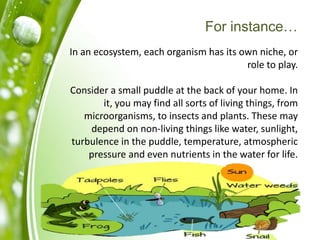
In an ecosystem, each organism has its own niche, or
role to play.
Consider a small puddle at the back of your home. In
it, you may find all sorts of living things, from
microorganisms, to insects and plants. These may
depend on non-living things like water, sunlight,
turbulence in the puddle, temperature, atmospheric
pressure and even nutrients in the water for life.
It’s not the ecosystem itself, but it is the environment
in which living things act. If one of these phases
doesn’t work, then there would be a negative impact
on those living things.
What about if…?
If humans go extinct, it will be from the
monumental screw-ups they made in agriculture.
There’s something in this sentence you should recognize.
Clue: It is related to the previous topic.
“If” sentences.
Remember these sentences aim to a CAUSE and a
CONSEQUENCE.
For instance:
“If humans go extinct, it will be from the monumental screw-
ups they made in agriculture”
Consequence Cause
Task
• Find out what are the levels
of the Upright Pyramid of
biomass in a Terrestrial
Ecosystem.
• Give one example for each
level.

Ecosystem

  • 1.
    Unit II: Twoof the elements Lesson One: Ecosystem
  • 2.
    Aim of thelesson At the end of the lesson, you will be able to comprehend main and specific ideas from an oral text about what is current bees’ situation and how this affects in the ecosystem .
  • 3.
    Have you everheard of Ecosystem? Does it sound familiar to you? Brainstorm some words you think are related to this topic. Before starting
  • 4.
    Do you recognizethese words? Bee Pollination Crop Alfalfa Clover Food To feed To harvest
  • 5.
    Your predictions Are beesthe most important pollinators of our fruits, vegetables, flowers and crops like alfalfa? Can honeybees be considered a super-organism? Does bees dying reflect a flowerless landscape and a dysfunctional food system? Have bees been in decline since World War II? Do we need only one type of bees? Do people access to good nutrition through bees’ pollination services? Is it recommended to go plant flowers on your own in order to keep bees free from insecticides?
  • 6.
    Do you knowwhy bees are disappearing? Is there any fatal consequence?
  • 7.
    True or False? Let’scheck your predictions! Bees are the most important pollinators of our fruits and vegetables and flowers and crops like alfalfa. Honeybees can’t be considered a super-organism. Bees dying reflects a flowerless landscape and a dysfunctional food system. Bees in fact have been in decline since World War II. We need only one type of bees called honeybees. People have access to good nutrition through bees’ pollination services. It is not recommended to go plant flowers on your own in order to keep bees free from insecticides.
  • 8.
    So what isan ecosystem? An ecosystem includes all of the living things (plants, animals and organisms) in a given area, interacting with each other, and also with their non-living environments (weather, earth, sun, soil, climate, atmosphere).
  • 9.
    For instance… In anecosystem, each organism has its own niche, or role to play. Consider a small puddle at the back of your home. In it, you may find all sorts of living things, from microorganisms, to insects and plants. These may depend on non-living things like water, sunlight, turbulence in the puddle, temperature, atmospheric pressure and even nutrients in the water for life.
  • 10.
    It’s not theecosystem itself, but it is the environment in which living things act. If one of these phases doesn’t work, then there would be a negative impact on those living things.
  • 11.
    What about if…? Ifhumans go extinct, it will be from the monumental screw-ups they made in agriculture. There’s something in this sentence you should recognize. Clue: It is related to the previous topic.
  • 12.
    “If” sentences. Remember thesesentences aim to a CAUSE and a CONSEQUENCE. For instance: “If humans go extinct, it will be from the monumental screw- ups they made in agriculture” Consequence Cause
  • 13.
    Task • Find outwhat are the levels of the Upright Pyramid of biomass in a Terrestrial Ecosystem. • Give one example for each level.