Ecosystem
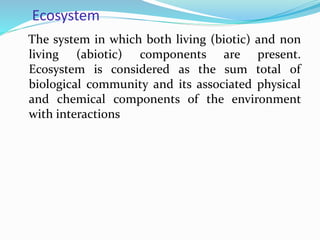
The system in which both living (biotic) and non
living (abiotic) components are present.
Ecosystem is considered as the sum total of
biological community and its associated physical
and chemical components of the environment
with interactions
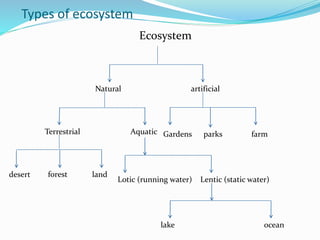
Types of ecosystem
Ecosystem
Natural artificial
Terrestrial Aquatic Gardens parks farm
Lentic (static water)Lotic (running water)
desert forest land
lake ocean
Components of Ecosystem
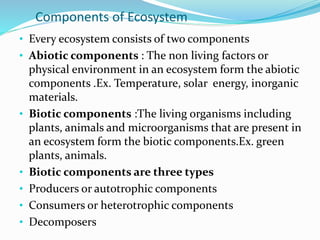
• Every ecosystem consists of two components
• Abiotic components : The non living factors or
physical environment in an ecosystem form the abiotic
components .Ex. Temperature, solar energy, inorganic
materials.
• Biotic components :The living organisms including
plants, animals and microorganisms that are present in
an ecosystem form the biotic components.Ex. green
plants, animals.
• Biotic components are three types
• Producers or autotrophic components
• Consumers or heterotrophic components
• Decomposers
Trophic levels of ecosystem
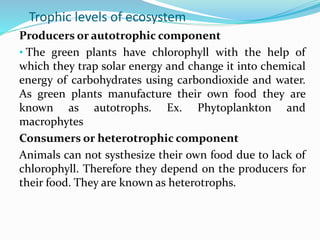
Producers or autotrophic component
• The green plants have chlorophyll with the help of
which they trap solar energy and change it into chemical
energy of carbohydrates using carbondioxide and water.
As green plants manufacture their own food they are
known as autotrophs. Ex. Phytoplankton and
macrophytes
Consumers or heterotrophic component
Animals can not systhesize their own food due to lack of
chlorophyll. Therefore they depend on the producers for
their food. They are known as heterotrophs.
Trophic levels of ecosystem
Consumers are four types
• Primary consumers or hervivores
These are the animals which feed on plants or the
producers. Ex. Rabbit,goat etc.
• Secondary consumers
The animals which feed on the hervivores are called the
secondary consumers. Ex. Cats, fox etc.
Tertiary consumers
The animals which feed on both primary and secondary
consumers are called tertiary consumers Ex. Lion, tigers
Decomposers
Bacteria and fungi belong to this category. They
breakdown the dead organic material of producers and
consumers for their food and release to the environment.
Terrestrial ecosystem
Terrestrial ecosystem is the ecosystem other than
ecosystem of water body.
Ex. Grassland, forest, desert ecosystem
Functions of ecosystem
1. Energy flow
2. Productivity
3. Biogeochemical cycling
Energy flow
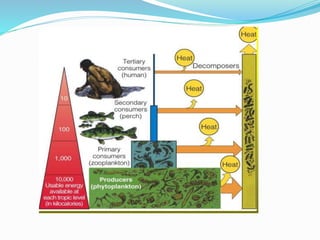
• Energy flow is the flow of energy through an ecosystem from
external environment through a series of organisms and back
to the external environment. On an average, only about 1% of
the total sun’s energy reaching the earth’s surface is utilized
for photosynthesis by plants.
•In the food chains at various trophic levels, there is a loss of
certain amount of energy in the form of heat.
•In the ecosystem energy flows in a unidirectional path and
takes place producers to hervivores to carnivores, it can not
occur in the reverse direction
Energy flow
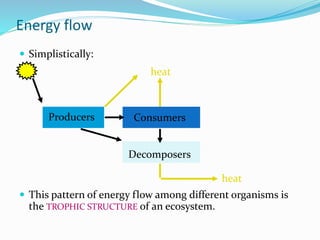
 Simplistically:
 This pattern of energy flow among different organisms is
the TROPHIC STRUCTURE of an ecosystem.
heat
Producers Consumers
Decomposers
heat
Functions of ecosystem
Productivity
Productivity of an ecosystem means that the amount of
organic matter produced or accumulated by plants or
producers per unit area per unit time.
Types of productivity
Primary productivity: It refers to the rate at which radiant
energy is stored by green plants through photosysnthetic
process to produce organic substances. It is the amount of
organic matter produced in a given time by green plants in an
ecosystem.
Net primary productivity: For the synthesis of organic
matter and for functioning of the plant itself, the plant gets
energy from the gross primary production in the process of
respiration. The remaining production called the net primary
production which can be utilized for the growth and
reproduction of the plant
NPP = GPP - respiration
Functions of ecosystem
Gross primary productivity
The total amount of chemical energy stored by plants per
unit area per unit time is called gross primary production
Secondary production: The secondary production is
carried out by the heterotrophic organisms which can not
make their own food but must feed on other living
organisms. The production by heterotrops is called
secondary production.
Secondary production is the rate of energy transferred
and stored at consumer levels over a period of time.

Ecosystem

  • 1.
    Ecosystem The system inwhich both living (biotic) and non living (abiotic) components are present. Ecosystem is considered as the sum total of biological community and its associated physical and chemical components of the environment with interactions
  • 2.
    Types of ecosystem Ecosystem Naturalartificial Terrestrial Aquatic Gardens parks farm Lentic (static water)Lotic (running water) desert forest land lake ocean
  • 3.
    Components of Ecosystem •Every ecosystem consists of two components • Abiotic components : The non living factors or physical environment in an ecosystem form the abiotic components .Ex. Temperature, solar energy, inorganic materials. • Biotic components :The living organisms including plants, animals and microorganisms that are present in an ecosystem form the biotic components.Ex. green plants, animals. • Biotic components are three types • Producers or autotrophic components • Consumers or heterotrophic components • Decomposers
  • 4.
    Trophic levels ofecosystem Producers or autotrophic component • The green plants have chlorophyll with the help of which they trap solar energy and change it into chemical energy of carbohydrates using carbondioxide and water. As green plants manufacture their own food they are known as autotrophs. Ex. Phytoplankton and macrophytes Consumers or heterotrophic component Animals can not systhesize their own food due to lack of chlorophyll. Therefore they depend on the producers for their food. They are known as heterotrophs.
  • 5.
    Trophic levels ofecosystem Consumers are four types • Primary consumers or hervivores These are the animals which feed on plants or the producers. Ex. Rabbit,goat etc. • Secondary consumers The animals which feed on the hervivores are called the secondary consumers. Ex. Cats, fox etc. Tertiary consumers The animals which feed on both primary and secondary consumers are called tertiary consumers Ex. Lion, tigers Decomposers Bacteria and fungi belong to this category. They breakdown the dead organic material of producers and consumers for their food and release to the environment.
  • 6.
    Terrestrial ecosystem Terrestrial ecosystemis the ecosystem other than ecosystem of water body. Ex. Grassland, forest, desert ecosystem
  • 7.
    Functions of ecosystem 1.Energy flow 2. Productivity 3. Biogeochemical cycling Energy flow • Energy flow is the flow of energy through an ecosystem from external environment through a series of organisms and back to the external environment. On an average, only about 1% of the total sun’s energy reaching the earth’s surface is utilized for photosynthesis by plants. •In the food chains at various trophic levels, there is a loss of certain amount of energy in the form of heat. •In the ecosystem energy flows in a unidirectional path and takes place producers to hervivores to carnivores, it can not occur in the reverse direction
  • 9.
    Energy flow  Simplistically: This pattern of energy flow among different organisms is the TROPHIC STRUCTURE of an ecosystem. heat Producers Consumers Decomposers heat
  • 10.
    Functions of ecosystem Productivity Productivityof an ecosystem means that the amount of organic matter produced or accumulated by plants or producers per unit area per unit time. Types of productivity Primary productivity: It refers to the rate at which radiant energy is stored by green plants through photosysnthetic process to produce organic substances. It is the amount of organic matter produced in a given time by green plants in an ecosystem. Net primary productivity: For the synthesis of organic matter and for functioning of the plant itself, the plant gets energy from the gross primary production in the process of respiration. The remaining production called the net primary production which can be utilized for the growth and reproduction of the plant NPP = GPP - respiration
  • 11.
    Functions of ecosystem Grossprimary productivity The total amount of chemical energy stored by plants per unit area per unit time is called gross primary production Secondary production: The secondary production is carried out by the heterotrophic organisms which can not make their own food but must feed on other living organisms. The production by heterotrops is called secondary production. Secondary production is the rate of energy transferred and stored at consumer levels over a period of time.