What is ECoP?
 This is a tool for environmental management of
the World Bank assisted MPRCP project.
 It supports the Environmental Protection Act
(1986).
 It has different section related with the road
requirement.
 It has constituted from Sec. 1 to 20 ECoP
provisions.
 Every provision has provide a specific
management and guidelines.
3
World Bank Safeguard Policies:
Three-Part Format
 Operational Policies (OP) – concise statement
of policy objectives and operational principles
including the roles and obligations of the
Borrower and the Bank
 Bank Procedures (BP)– Mandatory
procedures to be followed by the Borrower and
the Bank
 Good Practice (GP) – Non-mandatory advisory
material
World Bank Safeguard Policies
Safeguard policies are designed to help ensure that programs proposed for
financing are environmentally and socially sustainable, and thus improve
decision-making.
The Bank’s Operational Policies (OP) are meant to ensure that operations of the
Bank do Not lead to adverse impacts or cause any harm. The Safeguard Policies
are lumped into Environment, Rural Development, Social Development and
International Law. These are the purpose of policies:
 Do no harm: protect people and environment from adverse impacts
 Reduce and manage risk for the Client and for the WB
 Do good: enhance social equity and environmental sustainability
 Respond to a world-wide constituency
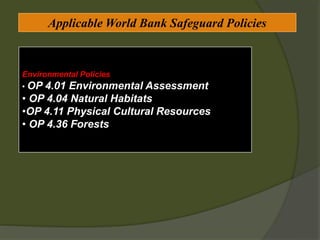
Applicable World Bank Safeguard Policies
Environmental Policies
• OP 4.01 Environmental Assessment
• OP 4.04 Natural Habitats
•OP 4.11 Physical Cultural Resources
• OP 4.36 Forests
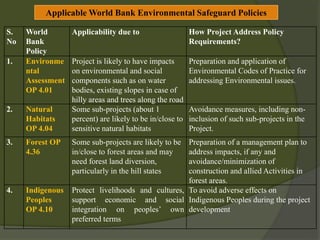
Applicable World Bank Environmental Safeguard Policies
S.
No
World
Bank
Policy
Applicability due to How Project Address Policy
Requirements?
1. Environme
ntal
Assessment
OP 4.01
Project is likely to have impacts
on environmental and social
components such as on water
bodies, existing slopes in case of
hilly areas and trees along the road
Preparation and application of
Environmental Codes of Practice for
addressing Environmental issues.
2. Natural
Habitats
OP 4.04
Some sub-projects (about 1
percent) are likely to be in/close to
sensitive natural habitats
Avoidance measures, including non-
inclusion of such sub-projects in the
Project.
3. Forest OP
4.36
Some sub-projects are likely to be
in/close to forest areas and may
need forest land diversion,
particularly in the hill states
Preparation of a management plan to
address impacts, if any and
avoidance/minimization of
construction and allied Activities in
forest areas.
4. Indigenous
Peoples
OP 4.10
Protect livelihoods and cultures,
support economic and social
integration on peoples’ own
preferred terms
To avoid adverse effects on
Indigenous Peoples during the project
development
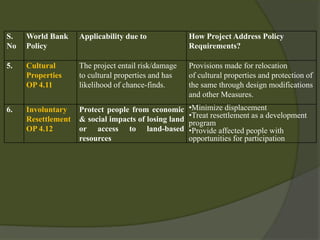
S.
No
World Bank
Policy
Applicability due to How Project Address Policy
Requirements?
5. Cultural
Properties
OP 4.11
The project entail risk/damage
to cultural properties and has
likelihood of chance-finds.
Provisions made for relocation
of cultural properties and protection of
the same through design modifications
and other Measures.
6. Involuntary
Resettlement
OP 4.12
Protect people from economic
& social impacts of losing land
or access to land-based
resources
•Minimize displacement
•Treat resettlement as a development
program
•Provide affected people with
opportunities for participation
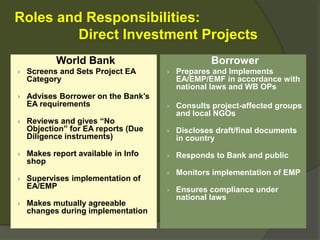
World Bank
 Screens and Sets Project EA
Category
 Advises Borrower on the Bank’s
EA requirements
 Reviews and gives “No
Objection” for EA reports (Due
Diligence instruments)
 Makes report available in Info
shop
 Supervises implementation of
EA/EMP
 Makes mutually agreeable
changes during implementation
Borrower
 Prepares and Implements
EA/EMP/EMF in accordance with
national laws and WB OPs
 Consults project-affected groups
and local NGOs
 Discloses draft/final documents
in country
 Responds to Bank and public
 Monitors implementation of EMP
 Ensures compliance under
national laws
Roles and Responsibilities:
Direct Investment Projects
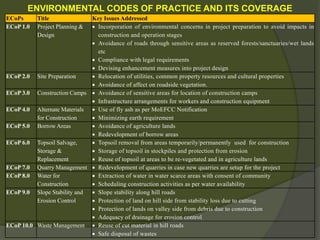
ECoPs Title Key Issues Addressed
ECoP 1.0 Project Planning &
Design
 Incorporation of environmental concerns in project preparation to avoid impacts in
construction and operation stages
 Avoidance of roads through sensitive areas as reserved forests/sanctuaries/wet lands
etc
 Compliance with legal requirements
 Devising enhancement measures into project design
ECoP 2.0 Site Preparation  Relocation of utilities, common property resources and cultural properties
 Avoidance of affect on roadside vegetation.
ECoP 3.0 Construction Camps  Avoidance of sensitive areas for location of construction camps
 Infrastructure arrangements for workers and construction equipment
ECoP 4.0 Alternate Materials
for Construction
 Use of fly ash as per MoEFCC Notification
 Minimizing earth requirement
ECoP 5.0 Borrow Areas  Avoidance of agriculture lands
 Redevelopment of borrow areas
ECoP 6.0 Topsoil Salvage,
Storage &
Replacement
 Topsoil removal from areas temporarily/permanently used for construction
 Storage of topsoil in stockpiles and protection from erosion
 Reuse of topsoil at areas to be re-vegetated and in agriculture lands
ECoP 7.0 Quarry Management  Redevelopment of quarries in case new quarries are setup for the project
ECoP 8.0 Water for
Construction
 Extraction of water in water scarce areas with consent of community
 Scheduling construction activities as per water availability
ECoP 9.0 Slope Stability and
Erosion Control
 Slope stability along hill roads
 Protection of land on hill side from stability loss due to cutting
 Protection of lands on valley side from debris due to construction
 Adequacy of drainage for erosion control
ECoP 10.0 Waste Management  Reuse of cut material in hill roads
 Safe disposal of wastes
ENVIRONMENTAL CODES OF PRACTICE AND ITS COVERAGE
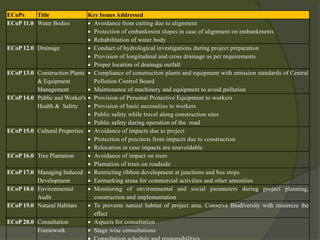
ECoPs Title Key Issues Addressed
ECoP 11.0 Water Bodies  Avoidance from cutting due to alignment
 Protection of embankment slopes in case of alignment on embankments
 Rehabilitation of water body
ECoP 12.0 Drainage  Conduct of hydrological investigations during project preparation
 Provision of longitudinal and cross drainage as per requirements
 Proper location of drainage outfall
ECoP 13.0 Construction Plants
& Equipment
Management
 Compliance of construction plants and equipment with emission standards of Central
Pollution Control Board
 Maintenance of machinery and equipment to avoid pollution
ECoP 14.0 Public and Worker's
Health & Safety
 Provision of Personal Protective Equipment to workers
 Provision of basic necessities to workers
 Public safety while travel along construction sites
 Public safety during operation of the road
ECoP 15.0 Cultural Properties  Avoidance of impacts due to project
 Protection of precincts from impacts due to construction
 Relocation in case impacts are unavoidable
ECoP 16.0 Tree Plantation  Avoidance of impact on trees
 Plantation of trees on roadside
ECoP 17.0 Managing Induced
Development
 Restricting ribbon development at junctions and bus stops
 Earmarking areas for commercial activities and other amenities
ECoP 18.0 Environmental
Audit
 Monitoring of environmental and social parameters during project planning,
construction and implementation
ECoP 19.0 Natural Habitats  To prevents natural habitat of project area. Conserve Biodiversity with minimize the
effect
ECoP 20.0 Consultation
Framework
 Aspects for consultation
 Stage wise consultations
Dos √
DONTs X
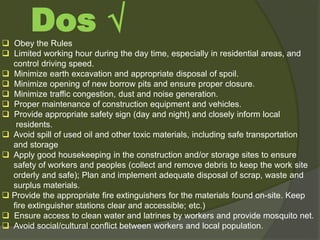
 Obey the Rules
 Limited working hour during the day time, especially in residential areas, and
control driving speed.
 Minimize earth excavation and appropriate disposal of spoil.
 Minimize opening of new borrow pits and ensure proper closure.
 Minimize traffic congestion, dust and noise generation.
 Proper maintenance of construction equipment and vehicles.
 Provide appropriate safety sign (day and night) and closely inform local
residents.
 Avoid spill of used oil and other toxic materials, including safe transportation
and storage
 Apply good housekeeping in the construction and/or storage sites to ensure
safety of workers and peoples (collect and remove debris to keep the work site
orderly and safe); Plan and implement adequate disposal of scrap, waste and
surplus materials.
 Provide the appropriate fire extinguishers for the materials found on-site. Keep
fire extinguisher stations clear and accessible; etc.)
 Ensure access to clean water and latrines by workers and provide mosquito net.
 Avoid social/cultural conflict between workers and local population.
Dos √
 Don’t Break the Rules
 Do not permit rubbish to fall freely from any locations of
the project and/or access by animals (dogs, cats, pigs,
etc.). Use appropriate containers.
 Do not throw tools or other materials.
 Do not raise or lower any tool or equipment by its own
cable or supply hose.
 Use grounding straps equipped with clamps on containers
to prevent static electricity buildup.
 Do not allow hunting of animals by workers in protected
areas.
 Do Not work Child Labour and pregnant women at work
site.
DONTs X
Environmental Codes of
Practice (ECoP)

ECoP provision and applicability

  • 2.
    What is ECoP? This is a tool for environmental management of the World Bank assisted MPRCP project.  It supports the Environmental Protection Act (1986).  It has different section related with the road requirement.  It has constituted from Sec. 1 to 20 ECoP provisions.  Every provision has provide a specific management and guidelines.
  • 3.
    3 World Bank SafeguardPolicies: Three-Part Format  Operational Policies (OP) – concise statement of policy objectives and operational principles including the roles and obligations of the Borrower and the Bank  Bank Procedures (BP)– Mandatory procedures to be followed by the Borrower and the Bank  Good Practice (GP) – Non-mandatory advisory material
  • 4.
    World Bank SafeguardPolicies Safeguard policies are designed to help ensure that programs proposed for financing are environmentally and socially sustainable, and thus improve decision-making. The Bank’s Operational Policies (OP) are meant to ensure that operations of the Bank do Not lead to adverse impacts or cause any harm. The Safeguard Policies are lumped into Environment, Rural Development, Social Development and International Law. These are the purpose of policies:  Do no harm: protect people and environment from adverse impacts  Reduce and manage risk for the Client and for the WB  Do good: enhance social equity and environmental sustainability  Respond to a world-wide constituency
  • 5.
    Applicable World BankSafeguard Policies Environmental Policies • OP 4.01 Environmental Assessment • OP 4.04 Natural Habitats •OP 4.11 Physical Cultural Resources • OP 4.36 Forests
  • 6.
    Applicable World BankEnvironmental Safeguard Policies S. No World Bank Policy Applicability due to How Project Address Policy Requirements? 1. Environme ntal Assessment OP 4.01 Project is likely to have impacts on environmental and social components such as on water bodies, existing slopes in case of hilly areas and trees along the road Preparation and application of Environmental Codes of Practice for addressing Environmental issues. 2. Natural Habitats OP 4.04 Some sub-projects (about 1 percent) are likely to be in/close to sensitive natural habitats Avoidance measures, including non- inclusion of such sub-projects in the Project. 3. Forest OP 4.36 Some sub-projects are likely to be in/close to forest areas and may need forest land diversion, particularly in the hill states Preparation of a management plan to address impacts, if any and avoidance/minimization of construction and allied Activities in forest areas. 4. Indigenous Peoples OP 4.10 Protect livelihoods and cultures, support economic and social integration on peoples’ own preferred terms To avoid adverse effects on Indigenous Peoples during the project development
  • 7.
    S. No World Bank Policy Applicability dueto How Project Address Policy Requirements? 5. Cultural Properties OP 4.11 The project entail risk/damage to cultural properties and has likelihood of chance-finds. Provisions made for relocation of cultural properties and protection of the same through design modifications and other Measures. 6. Involuntary Resettlement OP 4.12 Protect people from economic & social impacts of losing land or access to land-based resources •Minimize displacement •Treat resettlement as a development program •Provide affected people with opportunities for participation
  • 8.
    World Bank  Screensand Sets Project EA Category  Advises Borrower on the Bank’s EA requirements  Reviews and gives “No Objection” for EA reports (Due Diligence instruments)  Makes report available in Info shop  Supervises implementation of EA/EMP  Makes mutually agreeable changes during implementation Borrower  Prepares and Implements EA/EMP/EMF in accordance with national laws and WB OPs  Consults project-affected groups and local NGOs  Discloses draft/final documents in country  Responds to Bank and public  Monitors implementation of EMP  Ensures compliance under national laws Roles and Responsibilities: Direct Investment Projects
  • 9.
    ECoPs Title KeyIssues Addressed ECoP 1.0 Project Planning & Design  Incorporation of environmental concerns in project preparation to avoid impacts in construction and operation stages  Avoidance of roads through sensitive areas as reserved forests/sanctuaries/wet lands etc  Compliance with legal requirements  Devising enhancement measures into project design ECoP 2.0 Site Preparation  Relocation of utilities, common property resources and cultural properties  Avoidance of affect on roadside vegetation. ECoP 3.0 Construction Camps  Avoidance of sensitive areas for location of construction camps  Infrastructure arrangements for workers and construction equipment ECoP 4.0 Alternate Materials for Construction  Use of fly ash as per MoEFCC Notification  Minimizing earth requirement ECoP 5.0 Borrow Areas  Avoidance of agriculture lands  Redevelopment of borrow areas ECoP 6.0 Topsoil Salvage, Storage & Replacement  Topsoil removal from areas temporarily/permanently used for construction  Storage of topsoil in stockpiles and protection from erosion  Reuse of topsoil at areas to be re-vegetated and in agriculture lands ECoP 7.0 Quarry Management  Redevelopment of quarries in case new quarries are setup for the project ECoP 8.0 Water for Construction  Extraction of water in water scarce areas with consent of community  Scheduling construction activities as per water availability ECoP 9.0 Slope Stability and Erosion Control  Slope stability along hill roads  Protection of land on hill side from stability loss due to cutting  Protection of lands on valley side from debris due to construction  Adequacy of drainage for erosion control ECoP 10.0 Waste Management  Reuse of cut material in hill roads  Safe disposal of wastes ENVIRONMENTAL CODES OF PRACTICE AND ITS COVERAGE
  • 10.
    ECoPs Title KeyIssues Addressed ECoP 11.0 Water Bodies  Avoidance from cutting due to alignment  Protection of embankment slopes in case of alignment on embankments  Rehabilitation of water body ECoP 12.0 Drainage  Conduct of hydrological investigations during project preparation  Provision of longitudinal and cross drainage as per requirements  Proper location of drainage outfall ECoP 13.0 Construction Plants & Equipment Management  Compliance of construction plants and equipment with emission standards of Central Pollution Control Board  Maintenance of machinery and equipment to avoid pollution ECoP 14.0 Public and Worker's Health & Safety  Provision of Personal Protective Equipment to workers  Provision of basic necessities to workers  Public safety while travel along construction sites  Public safety during operation of the road ECoP 15.0 Cultural Properties  Avoidance of impacts due to project  Protection of precincts from impacts due to construction  Relocation in case impacts are unavoidable ECoP 16.0 Tree Plantation  Avoidance of impact on trees  Plantation of trees on roadside ECoP 17.0 Managing Induced Development  Restricting ribbon development at junctions and bus stops  Earmarking areas for commercial activities and other amenities ECoP 18.0 Environmental Audit  Monitoring of environmental and social parameters during project planning, construction and implementation ECoP 19.0 Natural Habitats  To prevents natural habitat of project area. Conserve Biodiversity with minimize the effect ECoP 20.0 Consultation Framework  Aspects for consultation  Stage wise consultations
  • 11.
  • 12.
     Obey theRules  Limited working hour during the day time, especially in residential areas, and control driving speed.  Minimize earth excavation and appropriate disposal of spoil.  Minimize opening of new borrow pits and ensure proper closure.  Minimize traffic congestion, dust and noise generation.  Proper maintenance of construction equipment and vehicles.  Provide appropriate safety sign (day and night) and closely inform local residents.  Avoid spill of used oil and other toxic materials, including safe transportation and storage  Apply good housekeeping in the construction and/or storage sites to ensure safety of workers and peoples (collect and remove debris to keep the work site orderly and safe); Plan and implement adequate disposal of scrap, waste and surplus materials.  Provide the appropriate fire extinguishers for the materials found on-site. Keep fire extinguisher stations clear and accessible; etc.)  Ensure access to clean water and latrines by workers and provide mosquito net.  Avoid social/cultural conflict between workers and local population. Dos √
  • 13.
     Don’t Breakthe Rules  Do not permit rubbish to fall freely from any locations of the project and/or access by animals (dogs, cats, pigs, etc.). Use appropriate containers.  Do not throw tools or other materials.  Do not raise or lower any tool or equipment by its own cable or supply hose.  Use grounding straps equipped with clamps on containers to prevent static electricity buildup.  Do not allow hunting of animals by workers in protected areas.  Do Not work Child Labour and pregnant women at work site. DONTs X
  • 14.