
![Gerard Malynes (1585–1641)
• An independent merchant in foreign trade,
• An English commissioner in the Spanish Netherlands,
• A government advisor on trade matters, assay master
of the mint, and commissioner of mint affairs.
• Showed how an outflow of precious metals could lead
to a fall in prices at home and a rise in prices abroad.
• Suggested that higher import tariffs should be levied
and exports of bullion prohibited, because [he
believed] that a country's growth was related to the
accumulation of precious metals.](https://image.slidesharecdn.com/mercantilism2-160803132550/85/Economists-pt-2-31-320.jpg)
![Nine Principles of National Economy
6. Foreign commodities] should be obtained not for gold or silver, but in exchange
for other domestic wares...
7. ...And should be imported in unfinished form, and worked up within the country...
8. (Opportunities should be sought night and day for selling the country's
superfluous goods to these foreigners in manufactured form...
9. (No importation should be allowed under any circumstances of which there is a
sufficient supply of suitable quality at home."[1]
10. Nationalism, self-sufficiency and national power were the basic policies proposed.](https://image.slidesharecdn.com/mercantilism2-160803132550/85/Economists-pt-2-42-320.jpg)
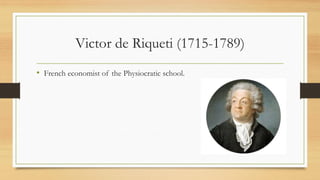
![SIR JAMES STEUART
“[just as] economy in general [is] the art of providing for all the wants of a
family, [so the science of political economy] seeks to secure a certain fund of
subsistence for all the inhabitants, to obviate every circumstance which may
render it precarious; to provide every thing necessary for supplying the wants
of the society, and to employ the inhabitants ... in such manner as naturally to
create reciprocal relations and dependencies between them, so as to supply one
another with reciprocal wants.”](https://image.slidesharecdn.com/mercantilism2-160803132550/85/Economists-pt-2-50-320.jpg)
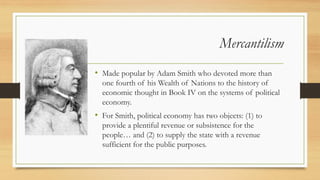
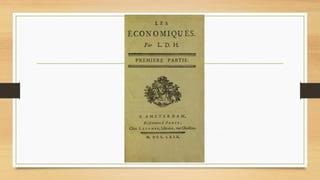

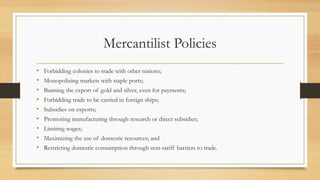
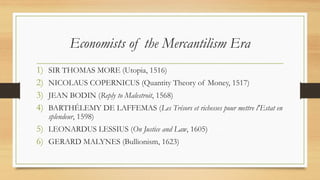
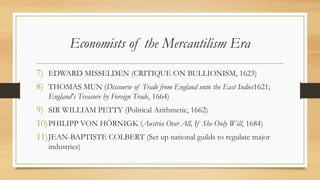
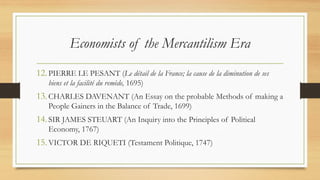
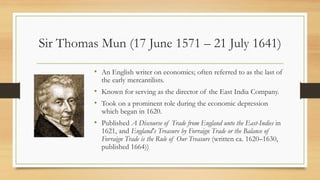
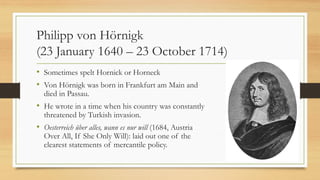
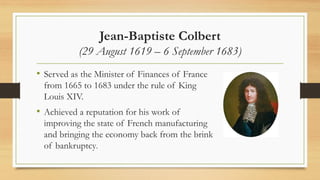
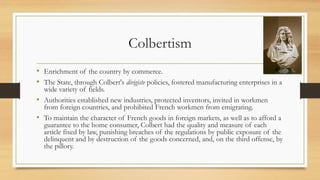
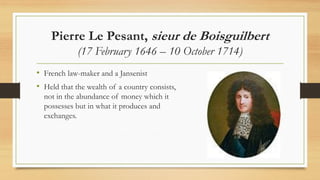
Mercantilism was an economic theory and practice dominant in Europe from the 16th to 18th centuries that promoted governmental regulation of a nation's economy to augment state power over rival nations. Key mercantilist policies included restricting imports, subsidizing exports, limiting domestic consumption, and accumulating monetary reserves through a positive trade balance. Prominent early economists who contributed to mercantilist ideas included Thomas Mun, Jean Bodin, and Colbert, while later critics included Pierre Le Pesant and Adam Smith who helped usher in new economic theories.


