Our Real Worth as a Person
Jesus taught us that our basic dignity as a person lies on the fact that:
We are loved. God loves us unconditionally. Nothing can diminish or
change God’s love for us.
We are called to love. God loves us and calls to do the same. Forgive,
because we are forgiven
God’s love for all human person is our basis of our fundamental human
dignity. God created us with dignity simply because He loves us. So it is
not something that we make. Thus, human dignity can never be
diminished. No one can take it away from anyone.
HOW DEEP IS GOD’S LOVE FOR US?
1. God created us in His image and likeness.
God simply created us with no other reason. He gave us intellect and
free will so that we can love and can freely choose to good for ourselves
and our neighbor. God is Triune-three divine persons forming one loving
communion. We survive and sustain life through relationships.
2. God the Son became human like us.
Our dignity as humans was raised to greater heights through Jesus’
Incarnation and Redemption. God became human to raise us to be His
adopted sons and daughters. Through His life, death, and resurrection, it
is revealed who God is to us and who we are to God. It reveals our
nature and the nature of God.
3. The Triune God dwells within and among us.
After His passion, death and resurrection, together with the Father, The
Risen Christ sent the Holy Spirit. Through the Spirit of the Risen Christ,
God continuously creates, redeems, empowers and sanctifies us toward a
graced life.
4. God destined us for Himself.
Ultimate truth, goodness, peace, love and happiness can only be found in
God alone. We all seek for these things in life. But we only experience
in a limited and temporary condition. Our hearts long for these things,
but we can only find in God. Thus, we are destined for God alone.
LIVING A LIFE OF DIGNITY
1. Relation to Others
a. Fellow Human Persons.
Human person is loving and compassionate. We are loved by God. We
are capable of loving and we are called to love others. This is what it
means to be real human person.
b. Society
Our calling to love others is extended to love our society.
2. Relation to Earthly Goods
As embodied-spirit, we need material things for our survival, human
development and social progress. That is why we are called to take care
of God’s creation. We are called to “subdue” the Earth by:
a. Work – we use our capacity, talents and intelligence to cultivate the
richness of the earth.
b. Being responsible – we work to cultivate the earth in order to enhance
the quality of
3. Relation to Self
Loving and serving others require that we take care of ourselves also.
Just like others, we have dignity and needs to attend to. How we take
care of ourselves presupposes on how we take care of others. We need
time to rest, attend our needs and reflect on those things necessary for
our personal life as human person. “You shall love your neighbor as
yourself” (Mk 12:31)
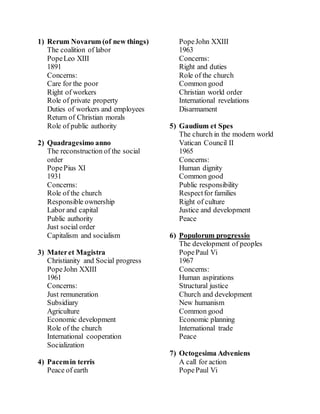
1) Rerum Novarum (of new things)
The coalition of labor
PopeLeo XIII
1891
Concerns:
Care for the poor
Right of workers
Role of private property
Duties of workers and employees
Return of Christian morals
Role of public authority
2) Quadragesimo anno
The reconstruction of the social
order
PopePius XI
1931
Concerns:
Role of the church
Responsible ownership
Labor and capital
Public authority
Just social order
Capitalism and socialism
3) Materet Magistra
Christianity and Social progress
PopeJohn XXIII
1961
Concerns:
Just remuneration
Subsidiary
Agriculture
Economic development
Role of the church
International cooperation
Socialization
4) Pacemin terris
Peace of earth
PopeJohn XXIII
1963
Concerns:
Right and duties
Role of the church
Common good
Christian world order
International revelations
Disarmament
5) Gaudium et Spes
The church in the modern world
Vatican Council II
1965
Concerns:
Human dignity
Common good
Public responsibility
Respectfor families
Right of culture
Justice and development
Peace
6) Populorum progressio
The development of peoples
PopePaul Vi
1967
Concerns:
Human aspirations
Structural justice
Church and development
New humanism
Common good
Economic planning
International trade
Peace
7) Octogesima Adveniens
A call for action
PopePaul Vi
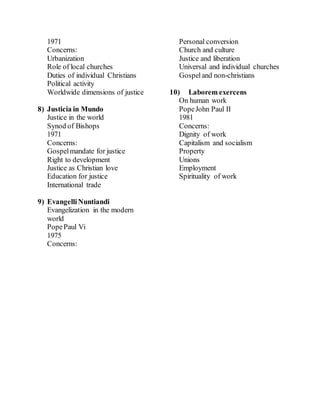
1971
Concerns:
Urbanization
Role of local churches
Duties of individual Christians
Political activity
Worldwide dimensions of justice
8) Justicia in Mundo
Justice in the world
Synod of Bishops
1971
Concerns:
Gospelmandate for justice
Right to development
Justice as Christian love
Education for justice
International trade
9) EvangelliNuntiandi
Evangelization in the modern
world
PopePaul Vi
1975
Concerns:
Personal conversion
Church and culture
Justice and liberation
Universal and individual churches
Gospeland non-christians
10) Laborem exercens
On human work
PopeJohn Paul II
1981
Concerns:
Dignity of work
Capitalism and socialism
Property
Unions
Employment
Spirituality of work

Cst, god's love, human dignity

  • 1.
    Our Real Worthas a Person Jesus taught us that our basic dignity as a person lies on the fact that: We are loved. God loves us unconditionally. Nothing can diminish or change God’s love for us. We are called to love. God loves us and calls to do the same. Forgive, because we are forgiven God’s love for all human person is our basis of our fundamental human dignity. God created us with dignity simply because He loves us. So it is not something that we make. Thus, human dignity can never be diminished. No one can take it away from anyone. HOW DEEP IS GOD’S LOVE FOR US? 1. God created us in His image and likeness. God simply created us with no other reason. He gave us intellect and free will so that we can love and can freely choose to good for ourselves and our neighbor. God is Triune-three divine persons forming one loving communion. We survive and sustain life through relationships. 2. God the Son became human like us. Our dignity as humans was raised to greater heights through Jesus’ Incarnation and Redemption. God became human to raise us to be His adopted sons and daughters. Through His life, death, and resurrection, it is revealed who God is to us and who we are to God. It reveals our nature and the nature of God. 3. The Triune God dwells within and among us. After His passion, death and resurrection, together with the Father, The Risen Christ sent the Holy Spirit. Through the Spirit of the Risen Christ, God continuously creates, redeems, empowers and sanctifies us toward a graced life.
  • 2.
    4. God destinedus for Himself. Ultimate truth, goodness, peace, love and happiness can only be found in God alone. We all seek for these things in life. But we only experience in a limited and temporary condition. Our hearts long for these things, but we can only find in God. Thus, we are destined for God alone. LIVING A LIFE OF DIGNITY 1. Relation to Others a. Fellow Human Persons. Human person is loving and compassionate. We are loved by God. We are capable of loving and we are called to love others. This is what it means to be real human person. b. Society Our calling to love others is extended to love our society. 2. Relation to Earthly Goods As embodied-spirit, we need material things for our survival, human development and social progress. That is why we are called to take care of God’s creation. We are called to “subdue” the Earth by: a. Work – we use our capacity, talents and intelligence to cultivate the richness of the earth. b. Being responsible – we work to cultivate the earth in order to enhance the quality of 3. Relation to Self Loving and serving others require that we take care of ourselves also. Just like others, we have dignity and needs to attend to. How we take care of ourselves presupposes on how we take care of others. We need time to rest, attend our needs and reflect on those things necessary for our personal life as human person. “You shall love your neighbor as yourself” (Mk 12:31)
  • 3.
    1) Rerum Novarum(of new things) The coalition of labor PopeLeo XIII 1891 Concerns: Care for the poor Right of workers Role of private property Duties of workers and employees Return of Christian morals Role of public authority 2) Quadragesimo anno The reconstruction of the social order PopePius XI 1931 Concerns: Role of the church Responsible ownership Labor and capital Public authority Just social order Capitalism and socialism 3) Materet Magistra Christianity and Social progress PopeJohn XXIII 1961 Concerns: Just remuneration Subsidiary Agriculture Economic development Role of the church International cooperation Socialization 4) Pacemin terris Peace of earth PopeJohn XXIII 1963 Concerns: Right and duties Role of the church Common good Christian world order International revelations Disarmament 5) Gaudium et Spes The church in the modern world Vatican Council II 1965 Concerns: Human dignity Common good Public responsibility Respectfor families Right of culture Justice and development Peace 6) Populorum progressio The development of peoples PopePaul Vi 1967 Concerns: Human aspirations Structural justice Church and development New humanism Common good Economic planning International trade Peace 7) Octogesima Adveniens A call for action PopePaul Vi
  • 4.
    1971 Concerns: Urbanization Role of localchurches Duties of individual Christians Political activity Worldwide dimensions of justice 8) Justicia in Mundo Justice in the world Synod of Bishops 1971 Concerns: Gospelmandate for justice Right to development Justice as Christian love Education for justice International trade 9) EvangelliNuntiandi Evangelization in the modern world PopePaul Vi 1975 Concerns: Personal conversion Church and culture Justice and liberation Universal and individual churches Gospeland non-christians 10) Laborem exercens On human work PopeJohn Paul II 1981 Concerns: Dignity of work Capitalism and socialism Property Unions Employment Spirituality of work