PRE-CLASSICAL ERA
 RICHARD CANTILLON
Irish-French economist
Father of enterprise economics
Author of Essai sur la Natura de Commerce en General (Essay on the Nature of Trade in General)
William Stanley Jevons: “cradle of political economy”
o Essai
First complete treatise on economic theory and
Used a distinctive casual methodology
Isolated economic phenomena with simple models, where otherwise uncontrollable variables can be fixed, making
frequent use of the concept of ceteris paribus to neutralize independent variables.
o Contributions
Monetary theories
Market prices are not immediately decided by intrinsic value but from supply and demand
Originated the uniformity of profit principle – changes in the market price of a good may lead changes in supply,
reflecting a rise or fall in profit
Provided an advanced version of John Locke's quantity theory of money, focusing on relative inflation and the
velocity of money.
Suggested that inflation occurs gradually and that the new supply of money has a localized effect on inflation,
effectively originating the concept of non-neutral money.
Entrepreneur as a risk-bearer
Development of spatial economics
Early development of political economy
o Cantillon effect
The original recipients of new money enjoy higher standards of living at the expense of later recipients.
Expansionary monetary policy constitutes a transfer of purchasing power away from those who hold old money to
whoever gets new money.
In the immediate term, as more dollars are created, each one translates to a smaller slice of all goods and services
produced.
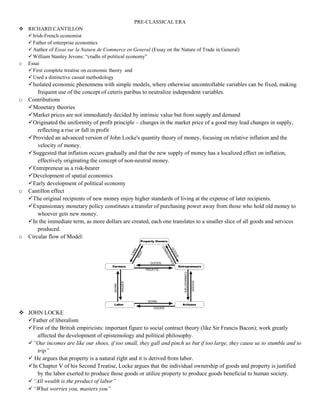
o Circular flow of Model:
 JOHN LOCKE
Father of liberalism
First of the British empiricists: important figure to social contract theory (like Sir Francis Bacon); work greatly
affected the development of epistemology and political philosophy.
“Our incomes are like our shoes, if too small, they gall and pinch us but if too large, they cause us to stumble and to
trip”
 He argues that property is a natural right and it is derived from labor.
In Chapter V of his Second Treatise, Locke argues that the individual ownership of goods and property is justified
by the labor exerted to produce those goods or utilize property to produce goods beneficial to human society.
“All wealth is the product of labor”
“What worries you, masters you”
o Labor theory of Property
Nature provides little of value to society, implying that the labor expended in the creation of goods gives them their
value.
Locke developed a labor theory of property, namely that ownership of property is created by the application of
labor.
 SIR DUDLEY NORTH
 English merchant and landowner, political and economist
Writer on free trade
Strong detractor from most mercantilist policies
Purportedly wrote his “Discourses Upon Trade”
- Argued against assuming a need for a favorable balance of trade
- Trade benefits both sides, promotes specialization, division of labor and wealth for everyone; and that
regulation of trade interferes with these benefits.
o Economic thought
Restrictions on production and trade within a nation were harmful to the interests of everyone concerned –became
increasingly widespread in the late 17th
and early eighteenth18th centuries.
Spokesman for the individualist ethic that was to become the basis for classical liberalism.
All men were motivated primarily by self-interest.
 DAVID HUME
Scottish philosopher, historian, economist, essayist
Best known for his radical philosophical empiricism, skepticism and naturalism
o Economic thought
Hume developed many ideas that are prevalent in the field of economics. This includes ideas on private property,
inflation, and foreign trade. Referring to his essay "Of the Balance of Trade", economist Paul Krugman has
remarked that "David Hume created what I consider the first true economic model."
In contrast to Locke, Hume believes that private property is not a natural right. Hume argues it is justified, because
resources are limited. Private property would be an unjustified, "idle ceremonial", if all goods were unlimited and
available freely. Hume also believed in an unequal distribution of property, because perfect equality would
destroy the ideas of thrift and industry. Perfect equality would thus lead to impoverishment.
 FRANCIS HUTCHESON
Ulster-Scots philosopher
Professor of Adam Smith
THE PHYSIOCRATS
 Physiocracy
- Physiocrats - derived from Greek word meaning “government of nature”
- Economic theory developed by a group of 18th
century Enlightenment French economists
- Wealth of nations was derived solely from the value of land agriculture or land development and that
agricultural products should be highly priced
- David B. Danbom: Physiocrats damned cities for their artificiality and praised more natural styles of living
- Most significant contribution: emphasis on productive work as the source of national wealth
- Vs. Mercantilism - > focused on the ruler’s wealth, accumulation of gold or balance of trade.
 Physiocractic school
- Two founders: François Quesnay and the Marquis de Mirabeau (Victor Riquetti)
- An aftermath of the publication of Richard Cantillon’s Essai sur la Nature du Commerce en Général
 Physiocrats as Social Reformers
- A group of French social reformers who were intellectual disciples of François Quesnay.
- Most of the ideas came from Quesnay’s "Tableau économique" (Economic Table)
- Immediate influence in French economic and political affairs lasted 2 decades, ending with Anne Robert
Jacques Turgot’s term as comptroller general of finances of France in 1776.
 JACQUES CLAUDE MARIE VINCENT DE GOURNAY
- French economist and intendant of commerce
- Cited by some historians of economics to have coined the phrase laissez faire, laissez passer.
- Disciple of François Quesnay, and leader of the Physiocratic School.
- Instrumental in popularizing the work of Richard Cantillon in France
- Known for his opposition to government regulations because of the way they stunted commerce.
- Coined the term bureaucratie to describe the situation (literally "government by desks“)
 FRANÇOIS QUESNAY
 Wrote the "Tableau économique" (Economic Table) in 1758, which provided the foundations of the ideas of the
Physiocrats.
- Basically a model of an economy: processes of production, circulation of money and commodities, and the
distribution of income.
- Production takes place in yearly cycles and that everything produced in one year is either consumed in that
year or becomes the necessary inputs for the next year’s production.
 Agricultural surpluses
- By flowing through the economy in the form of rent, wages, and purchases were the real economic movers.
- Firstly: Regulation impedes the flow of income throughout all social classes and therefore economic
development.
- Secondly: taxes on the productive classes, such as farmers, should be reduced in favor of rises for
unproductive classes, such as landowners, since their luxurious way of life distorts the income flow.
- David Ricardo later showed that taxes on land are non-transferable to tenants in his Law of Rent.
 Agents of production – farmers, landowners, artisans
 THOMAS BAYES
- An English statistician, philosopher and Presbyterian minister who is
known for having formulated a specific case of the theorem that bears his
name: Bayes' theorem.
 ANNE ROBERT JACQUES TURGOT, BARON DE L'AULNE
- Commonly known as Turgot
- French economist and statesman
- Best remembered as an early advocate for economic liberalism
- First economist to have recognized the law of diminishing marginal returns in agriculture
- “Progress covers not simply the arts and sciences but, on their base, the whole of culture – manner, mores,
institutions, legal codes, economy, and society.”

Economists (pt. 3)

  • 1.
    PRE-CLASSICAL ERA  RICHARDCANTILLON Irish-French economist Father of enterprise economics Author of Essai sur la Natura de Commerce en General (Essay on the Nature of Trade in General) William Stanley Jevons: “cradle of political economy” o Essai First complete treatise on economic theory and Used a distinctive casual methodology Isolated economic phenomena with simple models, where otherwise uncontrollable variables can be fixed, making frequent use of the concept of ceteris paribus to neutralize independent variables. o Contributions Monetary theories Market prices are not immediately decided by intrinsic value but from supply and demand Originated the uniformity of profit principle – changes in the market price of a good may lead changes in supply, reflecting a rise or fall in profit Provided an advanced version of John Locke's quantity theory of money, focusing on relative inflation and the velocity of money. Suggested that inflation occurs gradually and that the new supply of money has a localized effect on inflation, effectively originating the concept of non-neutral money. Entrepreneur as a risk-bearer Development of spatial economics Early development of political economy o Cantillon effect The original recipients of new money enjoy higher standards of living at the expense of later recipients. Expansionary monetary policy constitutes a transfer of purchasing power away from those who hold old money to whoever gets new money. In the immediate term, as more dollars are created, each one translates to a smaller slice of all goods and services produced. o Circular flow of Model:  JOHN LOCKE Father of liberalism First of the British empiricists: important figure to social contract theory (like Sir Francis Bacon); work greatly affected the development of epistemology and political philosophy. “Our incomes are like our shoes, if too small, they gall and pinch us but if too large, they cause us to stumble and to trip”  He argues that property is a natural right and it is derived from labor. In Chapter V of his Second Treatise, Locke argues that the individual ownership of goods and property is justified by the labor exerted to produce those goods or utilize property to produce goods beneficial to human society. “All wealth is the product of labor” “What worries you, masters you”
  • 2.
    o Labor theoryof Property Nature provides little of value to society, implying that the labor expended in the creation of goods gives them their value. Locke developed a labor theory of property, namely that ownership of property is created by the application of labor.  SIR DUDLEY NORTH  English merchant and landowner, political and economist Writer on free trade Strong detractor from most mercantilist policies Purportedly wrote his “Discourses Upon Trade” - Argued against assuming a need for a favorable balance of trade - Trade benefits both sides, promotes specialization, division of labor and wealth for everyone; and that regulation of trade interferes with these benefits. o Economic thought Restrictions on production and trade within a nation were harmful to the interests of everyone concerned –became increasingly widespread in the late 17th and early eighteenth18th centuries. Spokesman for the individualist ethic that was to become the basis for classical liberalism. All men were motivated primarily by self-interest.  DAVID HUME Scottish philosopher, historian, economist, essayist Best known for his radical philosophical empiricism, skepticism and naturalism o Economic thought Hume developed many ideas that are prevalent in the field of economics. This includes ideas on private property, inflation, and foreign trade. Referring to his essay "Of the Balance of Trade", economist Paul Krugman has remarked that "David Hume created what I consider the first true economic model." In contrast to Locke, Hume believes that private property is not a natural right. Hume argues it is justified, because resources are limited. Private property would be an unjustified, "idle ceremonial", if all goods were unlimited and available freely. Hume also believed in an unequal distribution of property, because perfect equality would destroy the ideas of thrift and industry. Perfect equality would thus lead to impoverishment.  FRANCIS HUTCHESON Ulster-Scots philosopher Professor of Adam Smith THE PHYSIOCRATS  Physiocracy - Physiocrats - derived from Greek word meaning “government of nature” - Economic theory developed by a group of 18th century Enlightenment French economists - Wealth of nations was derived solely from the value of land agriculture or land development and that agricultural products should be highly priced - David B. Danbom: Physiocrats damned cities for their artificiality and praised more natural styles of living - Most significant contribution: emphasis on productive work as the source of national wealth - Vs. Mercantilism - > focused on the ruler’s wealth, accumulation of gold or balance of trade.
  • 3.
     Physiocractic school -Two founders: François Quesnay and the Marquis de Mirabeau (Victor Riquetti) - An aftermath of the publication of Richard Cantillon’s Essai sur la Nature du Commerce en Général  Physiocrats as Social Reformers - A group of French social reformers who were intellectual disciples of François Quesnay. - Most of the ideas came from Quesnay’s "Tableau économique" (Economic Table) - Immediate influence in French economic and political affairs lasted 2 decades, ending with Anne Robert Jacques Turgot’s term as comptroller general of finances of France in 1776.  JACQUES CLAUDE MARIE VINCENT DE GOURNAY - French economist and intendant of commerce - Cited by some historians of economics to have coined the phrase laissez faire, laissez passer. - Disciple of François Quesnay, and leader of the Physiocratic School. - Instrumental in popularizing the work of Richard Cantillon in France - Known for his opposition to government regulations because of the way they stunted commerce. - Coined the term bureaucratie to describe the situation (literally "government by desks“)  FRANÇOIS QUESNAY  Wrote the "Tableau économique" (Economic Table) in 1758, which provided the foundations of the ideas of the Physiocrats. - Basically a model of an economy: processes of production, circulation of money and commodities, and the distribution of income. - Production takes place in yearly cycles and that everything produced in one year is either consumed in that year or becomes the necessary inputs for the next year’s production.  Agricultural surpluses - By flowing through the economy in the form of rent, wages, and purchases were the real economic movers. - Firstly: Regulation impedes the flow of income throughout all social classes and therefore economic development. - Secondly: taxes on the productive classes, such as farmers, should be reduced in favor of rises for unproductive classes, such as landowners, since their luxurious way of life distorts the income flow. - David Ricardo later showed that taxes on land are non-transferable to tenants in his Law of Rent.  Agents of production – farmers, landowners, artisans  THOMAS BAYES - An English statistician, philosopher and Presbyterian minister who is known for having formulated a specific case of the theorem that bears his name: Bayes' theorem.  ANNE ROBERT JACQUES TURGOT, BARON DE L'AULNE - Commonly known as Turgot - French economist and statesman - Best remembered as an early advocate for economic liberalism - First economist to have recognized the law of diminishing marginal returns in agriculture - “Progress covers not simply the arts and sciences but, on their base, the whole of culture – manner, mores, institutions, legal codes, economy, and society.”