{{
Market structures &Market structures &
CompetitionCompetition
11-1 Notes11-1 Notes
What do you think of when youWhat do you think of when you
hear competition?hear competition?
SportsSports
SchoolSchool
StoresStores
QuestionQuestion
The activities of companiesThe activities of companies
that are trying to be morethat are trying to be more
successful than others.successful than others.
What is competition?What is competition?
 For a perfectly competitive market to exist, fourFor a perfectly competitive market to exist, four
factors must be present:factors must be present:
 Large number ofLarge number of buyers and sellersbuyers and sellers
 Products must haveProducts must have the same qualitythe same quality
 No majorNo major barriers to entering marketbarriers to entering market
 Free exchange ofFree exchange of Price InformationPrice Information
 Consumers must have access to what eachConsumers must have access to what each
producer is charging for their goodsproducer is charging for their goods
Competition in the MarketCompetition in the Market
 For each category write down the name of places thatFor each category write down the name of places that
are in competition with each other.are in competition with each other.
 Food (Groceries)Food (Groceries)
 Food (Restaurants)Food (Restaurants)
 PharmaceuticalPharmaceutical
 ElectronicsElectronics
 GasGas
 ClothesClothes
 ShoesShoes
Mini ActivityMini Activity
 No one company can control the market!No one company can control the market!
 However there are situations where perfectHowever there are situations where perfect
competition does not existcompetition does not exist
 MonopoliesMonopolies
 Market structure under which there is onlyMarket structure under which there is only
one producer of a given good or serviceone producer of a given good or service
and has complete control with NOand has complete control with NO
competitioncompetition
 Must be barriers that prevent otherMust be barriers that prevent other
businesses or companies from enteringbusinesses or companies from entering
the marketthe market
MonopoliesMonopolies
 Because there is no competition, monopolies canBecause there is no competition, monopolies can
dictate prices by controlling productiondictate prices by controlling production
 Characteristics of a MonopolyCharacteristics of a Monopoly
 Charge higher pricesCharge higher prices
 Produce less outputProduce less output
 Provide less qualityProvide less quality
 No Competition!No Competition!
 The monopoly does not have to worry aboutThe monopoly does not have to worry about
satisfying customerssatisfying customers!!
MonopoliesMonopolies
Make a T-Chart and write downMake a T-Chart and write down
and the Pros and Cons of aand the Pros and Cons of a
MonopolyMonopoly
Mini ActivityMini Activity
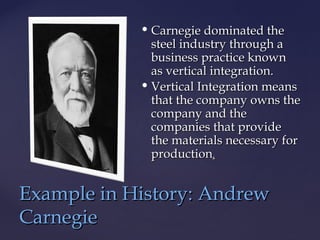
 Carnegie dominated theCarnegie dominated the
steel industry through asteel industry through a
business practice knownbusiness practice known
as vertical integration.as vertical integration.
 Vertical Integration meansVertical Integration means
that the company owns thethat the company owns the
company and thecompany and the
companies that providecompanies that provide
the materials necessary forthe materials necessary for
productionproduction..
Example in History: AndrewExample in History: Andrew
CarnegieCarnegie
He owns theHe owns the steelsteel
mills, the rock andmills, the rock and
minerals, and the coalminerals, and the coal
minesmines. –COMPLETE. –COMPLETE
CONTROLCONTROL
Andrew CarnegieAndrew Carnegie
began to functionbegan to function
under aunder a monopolymonopoly..
Andrew Carnegie forms aAndrew Carnegie forms a
monopolymonopoly
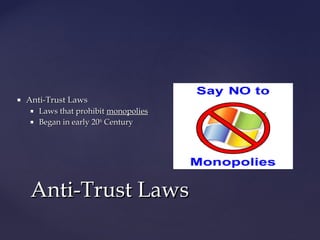
 Anti-Trust LawsAnti-Trust Laws
 Laws that prohibitLaws that prohibit monopoliesmonopolies
 Began in early 20Began in early 20thth
CenturyCentury
Anti-Trust LawsAnti-Trust Laws
 OligopolyOligopoly
 Oligopoly is the middle ground between monopoly andOligopoly is the middle ground between monopoly and
capitalism. An oligopoly is two or more businesses, thatcapitalism. An oligopoly is two or more businesses, that
control the market for a certain product or service.control the market for a certain product or service.
 Example: of OligopoliesExample: of Oligopolies
 Utility Companies (Name 1)Utility Companies (Name 1)
 Cellphone Companies (Name 5)Cellphone Companies (Name 5)
 Television (Name 3)Television (Name 3)
 Airlines (Name 4)Airlines (Name 4)
 Gas (Name 4)Gas (Name 4)
Monopolies & OligopoliesMonopolies & Oligopolies
1. What is competition in your words? (T1)1. What is competition in your words? (T1)
2. How is competition present in the United2. How is competition present in the United
States Economy? (T2)States Economy? (T2)
3. Describe a monopoly? (T3)3. Describe a monopoly? (T3)
4. What are pros and cons of a monopoly4. What are pros and cons of a monopoly
from the producers point of view and fromfrom the producers point of view and from
the consumer’s point of view? (T4)the consumer’s point of view? (T4)
5. How does prices affect Oligopolies? (T5)5. How does prices affect Oligopolies? (T5)
Focus QuestionsFocus Questions

11 1 market structures& competition

  • 1.
    {{ Market structures &Marketstructures & CompetitionCompetition 11-1 Notes11-1 Notes
  • 2.
    What do youthink of when youWhat do you think of when you hear competition?hear competition? SportsSports SchoolSchool StoresStores QuestionQuestion
  • 3.
    The activities ofcompaniesThe activities of companies that are trying to be morethat are trying to be more successful than others.successful than others. What is competition?What is competition?
  • 4.
     For aperfectly competitive market to exist, fourFor a perfectly competitive market to exist, four factors must be present:factors must be present:  Large number ofLarge number of buyers and sellersbuyers and sellers  Products must haveProducts must have the same qualitythe same quality  No majorNo major barriers to entering marketbarriers to entering market  Free exchange ofFree exchange of Price InformationPrice Information  Consumers must have access to what eachConsumers must have access to what each producer is charging for their goodsproducer is charging for their goods Competition in the MarketCompetition in the Market
  • 5.
     For eachcategory write down the name of places thatFor each category write down the name of places that are in competition with each other.are in competition with each other.  Food (Groceries)Food (Groceries)  Food (Restaurants)Food (Restaurants)  PharmaceuticalPharmaceutical  ElectronicsElectronics  GasGas  ClothesClothes  ShoesShoes Mini ActivityMini Activity
  • 6.
     No onecompany can control the market!No one company can control the market!  However there are situations where perfectHowever there are situations where perfect competition does not existcompetition does not exist  MonopoliesMonopolies  Market structure under which there is onlyMarket structure under which there is only one producer of a given good or serviceone producer of a given good or service and has complete control with NOand has complete control with NO competitioncompetition  Must be barriers that prevent otherMust be barriers that prevent other businesses or companies from enteringbusinesses or companies from entering the marketthe market MonopoliesMonopolies
  • 7.
     Because thereis no competition, monopolies canBecause there is no competition, monopolies can dictate prices by controlling productiondictate prices by controlling production  Characteristics of a MonopolyCharacteristics of a Monopoly  Charge higher pricesCharge higher prices  Produce less outputProduce less output  Provide less qualityProvide less quality  No Competition!No Competition!  The monopoly does not have to worry aboutThe monopoly does not have to worry about satisfying customerssatisfying customers!! MonopoliesMonopolies
  • 8.
    Make a T-Chartand write downMake a T-Chart and write down and the Pros and Cons of aand the Pros and Cons of a MonopolyMonopoly Mini ActivityMini Activity
  • 9.
     Carnegie dominatedtheCarnegie dominated the steel industry through asteel industry through a business practice knownbusiness practice known as vertical integration.as vertical integration.  Vertical Integration meansVertical Integration means that the company owns thethat the company owns the company and thecompany and the companies that providecompanies that provide the materials necessary forthe materials necessary for productionproduction.. Example in History: AndrewExample in History: Andrew CarnegieCarnegie
  • 10.
    He owns theHeowns the steelsteel mills, the rock andmills, the rock and minerals, and the coalminerals, and the coal minesmines. –COMPLETE. –COMPLETE CONTROLCONTROL Andrew CarnegieAndrew Carnegie began to functionbegan to function under aunder a monopolymonopoly.. Andrew Carnegie forms aAndrew Carnegie forms a monopolymonopoly
  • 11.
     Anti-Trust LawsAnti-TrustLaws  Laws that prohibitLaws that prohibit monopoliesmonopolies  Began in early 20Began in early 20thth CenturyCentury Anti-Trust LawsAnti-Trust Laws
  • 12.
     OligopolyOligopoly  Oligopolyis the middle ground between monopoly andOligopoly is the middle ground between monopoly and capitalism. An oligopoly is two or more businesses, thatcapitalism. An oligopoly is two or more businesses, that control the market for a certain product or service.control the market for a certain product or service.  Example: of OligopoliesExample: of Oligopolies  Utility Companies (Name 1)Utility Companies (Name 1)  Cellphone Companies (Name 5)Cellphone Companies (Name 5)  Television (Name 3)Television (Name 3)  Airlines (Name 4)Airlines (Name 4)  Gas (Name 4)Gas (Name 4) Monopolies & OligopoliesMonopolies & Oligopolies
  • 13.
    1. What iscompetition in your words? (T1)1. What is competition in your words? (T1) 2. How is competition present in the United2. How is competition present in the United States Economy? (T2)States Economy? (T2) 3. Describe a monopoly? (T3)3. Describe a monopoly? (T3) 4. What are pros and cons of a monopoly4. What are pros and cons of a monopoly from the producers point of view and fromfrom the producers point of view and from the consumer’s point of view? (T4)the consumer’s point of view? (T4) 5. How does prices affect Oligopolies? (T5)5. How does prices affect Oligopolies? (T5) Focus QuestionsFocus Questions