Made by  11 A  and  11 D (Arnab)
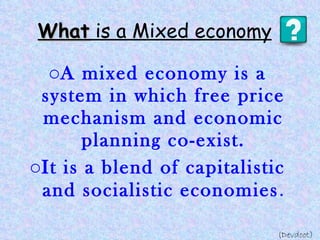
What  is a Mixed economy A mixed economy is a system in which free price mechanism and economic planning co-exist. It is a blend of capitalistic and socialistic economies . (Devdoot)
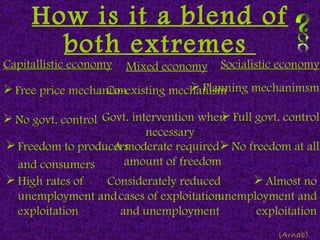
How is it a blend of both extremes  Capitallistic economy Socialistic economy Mixed economy Free price mechanism Planning mechanimsm Co-existing mechanism No govt. control Full govt. control Govt. intervention when necessary Freedom to producers and consumers No freedom at all A moderate required amount of freedom High rates of unemployment and exploitation Almost no unemployment and exploitation Considerately reduced cases of exploitation and unemployment (Arnab)
What are the Merits of the Indian mixed economy  Proper allocation of resources Economic stability Advantages of market system Rapid economic development Check on concentration of economic power Economic freedom to a great extent (Neetal)
A  detailed study since independence Since independence, India followed the mixed economy. Through MRTP, the government intended to check the monopoly of large business houses and prohibit restrictive trade practices. In practice this Act was proved to be ineffective in checking the concentration of monopoly houses with regard to their asset limit. In 1991, India met with economic crisis and govt. was not able to make repayments on its borrowings from abroad and foreign exchange reserves. All this led the govt. to introduce a new set of policy measures and liberalise MRTP act which changed the direction of our developmental strategies . India has been able to achieve growth in savings, diversified industrial sector, ensured food security etc. (Srishti)
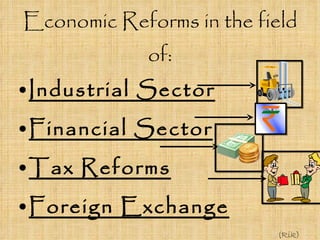
Economic Reforms in the field of: Industrial Sector Financial Sector Tax Reforms Foreign Exchange (Rik)
Regulatory mechanism were enforced in various ways:- Permission from govt. to start and close a firm. Private sector was not allowed in many industries. Some goods could be produced only in small scale industries. Controls on price fixation. Industrial licensing was abolished for products like alcohol, electronics etc. The only industries which are now reserved for public sector are railway, defense etc. (Srishti)
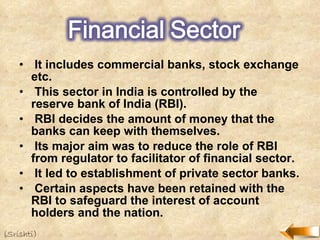
It includes commercial banks, stock exchange etc. This sector in India is controlled by the reserve bank of India (RBI). RBI decides the amount of money that the banks can keep with themselves. Its major aim was to reduce the role of RBI from regulator to facilitator of financial sector. It led to establishment of private sector banks. Certain aspects have been retained with the RBI to safeguard the interest of account holders and the nation. (Srishti)
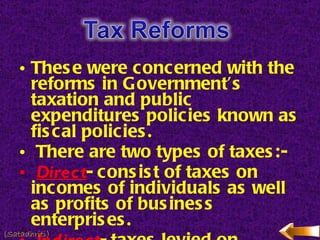
These were concerned with the reforms in Government’s taxation and public expenditures policies known as fiscal policies. There are two types of taxes:- Direct - consist of taxes on incomes of individuals as well as profits of business enterprises. Indirect - taxes levied on commodities to facilitate common national market for goods and commodities. (Satadhriti)
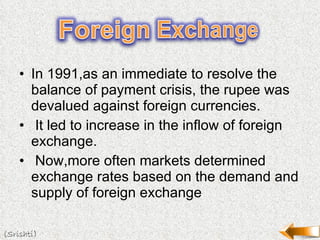
In 1991,as an immediate to resolve the balance of payment crisis, the rupee was devalued against foreign currencies. It led to increase in the inflow of foreign exchange. Now,more often markets determined exchange rates based on the demand and supply of foreign exchange (Srishti)
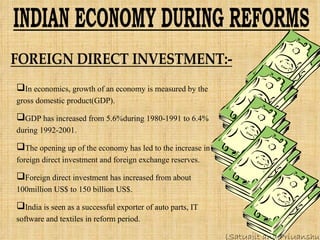
In economics, growth of an economy is measured by the gross domestic product(GDP). GDP has increased from 5.6%during 1980-1991 to 6.4% during 1992-2001. The opening up of the economy has led to the increase in foreign direct investment and foreign exchange reserves. Foreign direct investment has increased from about 100million US$ to 150 billion US$. India is seen as a successful exporter of auto parts, IT software and textiles in reform period. (Satyajit and Priyanshu)
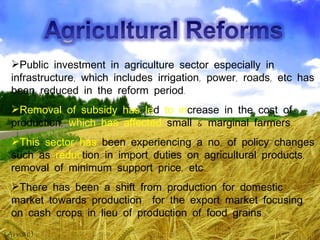
Public investment in agriculture sector especially in infrastructure, which includes irrigation, power, roads, etc has been reduced in the reform period. Removal of subsidy has le d  to in crease in the cost of production,  which has affected  small & marginal farmers. This sector has  been experiencing a no. of policy changes such as  reduc tion in import duties on agricultural products, removal of minimum support price, etc. There has been a shift from production for domestic market towards production  for the export market focusing on cash crops in lieu of production of food grains. (Arnab)
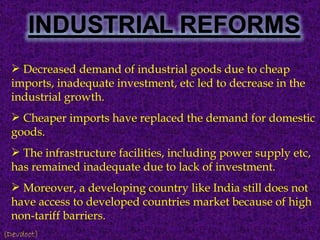
Decreased demand of industrial goods due to cheap imports, inadequate investment, etc led to decrease in the industrial growth. Cheaper imports have replaced the demand for domestic goods. The infrastructure facilities, including power supply etc, has remained inadequate due to lack of investment. Moreover, a developing country like India still does not have access to developed countries market because of high non-tariff barriers. (Devdoot)
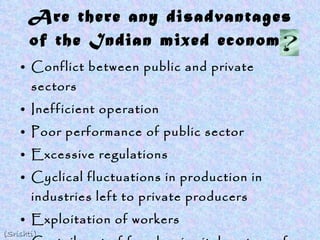
Are there any disadvantages of the Indian mixed economy Conflict between public and private sectors Inefficient operation Poor performance of public sector Excessive regulations Cyclical fluctuations in production in industries left to private producers Exploitation of workers Curtailment of freedom in vital sectors of the economy (Srishti)
Credits Animation, Visual Effects and Compilation Arnab Chakraborty Material Arnab Chakraborty (4 slides) Sristi Dutta Choudhury (4 slides) Satyajit Banerjee, Priyanshu (1 slide) Neetal Neel (2 slides) Rik Bhattacharjee (1 slide) Devdoot Ghosh (2 slides) Satadhriti Chakraborty (1 slide) Special Thanks Dr. Aziz Banerjee Dr. Debashish Mazumder (Author’s of ABS economics) (Arnab)

Project - Class XI D

  • 1.
    Made by 11 A and 11 D (Arnab)
  • 2.
    What isa Mixed economy A mixed economy is a system in which free price mechanism and economic planning co-exist. It is a blend of capitalistic and socialistic economies . (Devdoot)
  • 3.
    How is ita blend of both extremes Capitallistic economy Socialistic economy Mixed economy Free price mechanism Planning mechanimsm Co-existing mechanism No govt. control Full govt. control Govt. intervention when necessary Freedom to producers and consumers No freedom at all A moderate required amount of freedom High rates of unemployment and exploitation Almost no unemployment and exploitation Considerately reduced cases of exploitation and unemployment (Arnab)
  • 4.
    What are theMerits of the Indian mixed economy Proper allocation of resources Economic stability Advantages of market system Rapid economic development Check on concentration of economic power Economic freedom to a great extent (Neetal)
  • 5.
    A detailedstudy since independence Since independence, India followed the mixed economy. Through MRTP, the government intended to check the monopoly of large business houses and prohibit restrictive trade practices. In practice this Act was proved to be ineffective in checking the concentration of monopoly houses with regard to their asset limit. In 1991, India met with economic crisis and govt. was not able to make repayments on its borrowings from abroad and foreign exchange reserves. All this led the govt. to introduce a new set of policy measures and liberalise MRTP act which changed the direction of our developmental strategies . India has been able to achieve growth in savings, diversified industrial sector, ensured food security etc. (Srishti)
  • 6.
    Economic Reforms inthe field of: Industrial Sector Financial Sector Tax Reforms Foreign Exchange (Rik)
  • 7.
    Regulatory mechanism wereenforced in various ways:- Permission from govt. to start and close a firm. Private sector was not allowed in many industries. Some goods could be produced only in small scale industries. Controls on price fixation. Industrial licensing was abolished for products like alcohol, electronics etc. The only industries which are now reserved for public sector are railway, defense etc. (Srishti)
  • 8.
    It includes commercialbanks, stock exchange etc. This sector in India is controlled by the reserve bank of India (RBI). RBI decides the amount of money that the banks can keep with themselves. Its major aim was to reduce the role of RBI from regulator to facilitator of financial sector. It led to establishment of private sector banks. Certain aspects have been retained with the RBI to safeguard the interest of account holders and the nation. (Srishti)
  • 9.
    These were concernedwith the reforms in Government’s taxation and public expenditures policies known as fiscal policies. There are two types of taxes:- Direct - consist of taxes on incomes of individuals as well as profits of business enterprises. Indirect - taxes levied on commodities to facilitate common national market for goods and commodities. (Satadhriti)
  • 10.
    In 1991,as animmediate to resolve the balance of payment crisis, the rupee was devalued against foreign currencies. It led to increase in the inflow of foreign exchange. Now,more often markets determined exchange rates based on the demand and supply of foreign exchange (Srishti)
  • 11.
    In economics, growthof an economy is measured by the gross domestic product(GDP). GDP has increased from 5.6%during 1980-1991 to 6.4% during 1992-2001. The opening up of the economy has led to the increase in foreign direct investment and foreign exchange reserves. Foreign direct investment has increased from about 100million US$ to 150 billion US$. India is seen as a successful exporter of auto parts, IT software and textiles in reform period. (Satyajit and Priyanshu)
  • 12.
    Public investment inagriculture sector especially in infrastructure, which includes irrigation, power, roads, etc has been reduced in the reform period. Removal of subsidy has le d to in crease in the cost of production, which has affected small & marginal farmers. This sector has been experiencing a no. of policy changes such as reduc tion in import duties on agricultural products, removal of minimum support price, etc. There has been a shift from production for domestic market towards production for the export market focusing on cash crops in lieu of production of food grains. (Arnab)
  • 13.
    Decreased demand ofindustrial goods due to cheap imports, inadequate investment, etc led to decrease in the industrial growth. Cheaper imports have replaced the demand for domestic goods. The infrastructure facilities, including power supply etc, has remained inadequate due to lack of investment. Moreover, a developing country like India still does not have access to developed countries market because of high non-tariff barriers. (Devdoot)
  • 14.
    Are there anydisadvantages of the Indian mixed economy Conflict between public and private sectors Inefficient operation Poor performance of public sector Excessive regulations Cyclical fluctuations in production in industries left to private producers Exploitation of workers Curtailment of freedom in vital sectors of the economy (Srishti)
  • 15.
    Credits Animation, VisualEffects and Compilation Arnab Chakraborty Material Arnab Chakraborty (4 slides) Sristi Dutta Choudhury (4 slides) Satyajit Banerjee, Priyanshu (1 slide) Neetal Neel (2 slides) Rik Bhattacharjee (1 slide) Devdoot Ghosh (2 slides) Satadhriti Chakraborty (1 slide) Special Thanks Dr. Aziz Banerjee Dr. Debashish Mazumder (Author’s of ABS economics) (Arnab)