
405 ECONOMETRICS
Chapter # 13: AUTOCORRELATION: WHAT HAPPENS IF
THE ERROR TERMS ARE CORRELATED?
By Domodar N. Gujarati
Prof. M. El-SakkaProf. M. El-Sakka
Dept of Economics Kuwait UniversityDept of Economics Kuwait University
• In this chapter we take a critical look at the following questions:In this chapter we take a critical look at the following questions:
• 1. What is the nature of1. What is the nature of autocorrelationautocorrelation??
• 2. What are the theoretical and practical2. What are the theoretical and practical consequencesconsequences of autocorrelation?of autocorrelation?
• 3. Since the assumption of no autocorrelation relates to the3. Since the assumption of no autocorrelation relates to the unobservableunobservable
disturbancesdisturbances uutt,, how does one know that there is autocorrelation in anyhow does one know that there is autocorrelation in any givengiven
situation? Notice that we now use the subscriptsituation? Notice that we now use the subscript t to emphasize that wet to emphasize that we areare
dealing with time series data.dealing with time series data.
• 4. How does one4. How does one remedyremedy the problem of autocorrelation?the problem of autocorrelation?
• THE NATURE OF THE PROBLEMTHE NATURE OF THE PROBLEM
• Autocorrelation may be defined as “Autocorrelation may be defined as “correlation between members of series ofcorrelation between members of series of
observations ordered in timeobservations ordered in time [as in time series data] or[as in time series data] or spacespace [as in cross-[as in cross-
sectional data].’’ the CLRM assumes that:sectional data].’’ the CLRM assumes that:
• E(uE(uiiuujj ) = 0) = 0 i ≠ ji ≠ j (3.2.5)(3.2.5)
• Put simply, the classical model assumes that the disturbance term relatingPut simply, the classical model assumes that the disturbance term relating
to any observation is not influenced by the disturbance term relating to anyto any observation is not influenced by the disturbance term relating to any
other observation.other observation.
• For example, if we are dealing with quarterly time series data involving theFor example, if we are dealing with quarterly time series data involving the
regression ofregression of output on labor and capitaloutput on labor and capital inputs and if, say, there is a laborinputs and if, say, there is a labor
strike affecting output in one quarter, there is no reason to believe that thisstrike affecting output in one quarter, there is no reason to believe that this
disruption will be carried over to the next quarter. That is, if output is lowerdisruption will be carried over to the next quarter. That is, if output is lower
this quarter, there is no reason to expect it to be lower next quarter.this quarter, there is no reason to expect it to be lower next quarter.
Similarly, if we are dealing with cross-sectional data involving theSimilarly, if we are dealing with cross-sectional data involving the
regression ofregression of family consumptionfamily consumption expenditure on family income, the effect ofexpenditure on family income, the effect of
an increase of one family’s income on its consumption expenditure is notan increase of one family’s income on its consumption expenditure is not
expected to affect the consumption expenditure of another family.expected to affect the consumption expenditure of another family.
• However, if there is autocorrelation,However, if there is autocorrelation,
• E(uE(uiiuujj ) ≠ 0) ≠ 0 i ≠ ji ≠ j (12.1.1)(12.1.1)
• In this situation, the disruption caused by a strike this quarter may veryIn this situation, the disruption caused by a strike this quarter may very
well affect output next quarter, or the increases in the consumptionwell affect output next quarter, or the increases in the consumption
expenditure of one family may very well prompt another family to increaseexpenditure of one family may very well prompt another family to increase
its consumption expenditure.its consumption expenditure.
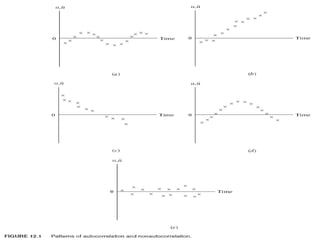
• In Figure 12.1. Figure 12.1In Figure 12.1. Figure 12.1a to d shows that therea to d shows that there is a discernible patternis a discernible pattern
among theamong the u’s. Figure 12.1a shows a cyclical pattern;u’s. Figure 12.1a shows a cyclical pattern; Figure 12.1Figure 12.1b and cb and c
suggests an upward or downward linear trend in the disturbances;suggests an upward or downward linear trend in the disturbances; whereaswhereas
Figure 12.1Figure 12.1d indicates that both linear and quadraticd indicates that both linear and quadratic trend terms are presenttrend terms are present
in the disturbances. Onlyin the disturbances. Only Figure 12.1e indicates no systematic patternFigure 12.1e indicates no systematic pattern,,
supporting the non-autocorrelation assumption of the classical linearsupporting the non-autocorrelation assumption of the classical linear
regression model.regression model.
• Why does serial correlation occurWhy does serial correlation occur? There are several reasons:? There are several reasons:
1. Inertia1. Inertia. As is well known, time series such as GNP, price indexes, production,. As is well known, time series such as GNP, price indexes, production,
employment, and unemployment exhibit (business) cycles. Starting at theemployment, and unemployment exhibit (business) cycles. Starting at the
bottom of the recession, when economic recovery starts, most of these seriesbottom of the recession, when economic recovery starts, most of these series
start moving upward. In this upswing, the value of a series at one point instart moving upward. In this upswing, the value of a series at one point in
time is greater than its previous value. Thus there is a momentum’’ builttime is greater than its previous value. Thus there is a momentum’’ built
into them, and it continues until something happens (e.g., increase ininto them, and it continues until something happens (e.g., increase in
interest rate or taxes or both) to slow them down.interest rate or taxes or both) to slow them down.
2. Specification Bias:2. Specification Bias: Excluded Variables CaseExcluded Variables Case. In empirical analysis the. In empirical analysis the
researcher often starts with a plausible regression model that may not beresearcher often starts with a plausible regression model that may not be
the most “perfect’’ one. For example, the researcher may plot the residualsthe most “perfect’’ one. For example, the researcher may plot the residuals
ˆˆuuii obtained from the fitted regression and may observe patternsobtained from the fitted regression and may observe patterns such as thosesuch as those
shown in Figure 12.1shown in Figure 12.1a to d. These residuals (which are proxiesa to d. These residuals (which are proxies forfor uuii) may) may
suggest that some variables that were originally candidates butsuggest that some variables that were originally candidates but were notwere not
included in the model for a variety of reasons should be included. Often theincluded in the model for a variety of reasons should be included. Often the
inclusion of such variables removes the correlation pattern observed amonginclusion of such variables removes the correlation pattern observed among
the residuals.the residuals.
• For example, suppose we have the following demand model:For example, suppose we have the following demand model:
• YYtt == ββ11 + β+ β22XX2t2t ++ ββ33XX3t3t ++ ββ44XX4t4t + u+ utt (12.1.2)(12.1.2)
• wherewhere Y = quantity of beef demanded, XY = quantity of beef demanded, X22 = price of beef, X= price of beef, X33 = consumer= consumer
• income,income, XX44 = price of poultry, and t = time. However, for some reason we run= price of poultry, and t = time. However, for some reason we run
• the following regression:the following regression:
• YYtt == ββ11 + β+ β22XX2t2t ++ ββ33XX3t3t + v+ vtt (12.1.3)(12.1.3)
• Now if (12.1.2) is the “correct’’ model or the “truth’’ or true relation,Now if (12.1.2) is the “correct’’ model or the “truth’’ or true relation,
running (12.1.3) is tantamount to lettingrunning (12.1.3) is tantamount to letting vvtt = β= β44XX4t4t + u+ utt. And to the extent the. And to the extent the
• price ofprice of poultrypoultry affects the consumption of beef, the error or disturbanceaffects the consumption of beef, the error or disturbance
termterm v will reflect a systematic pattern, thus creating (false) autocorrelationv will reflect a systematic pattern, thus creating (false) autocorrelation..
• A simple test of this would be to run both (12.1.2) and (12.1.3) and seeA simple test of this would be to run both (12.1.2) and (12.1.3) and see
whether autocorrelation, if any, observed in model (12.1.3) disappears whenwhether autocorrelation, if any, observed in model (12.1.3) disappears when
(12.1.2) is run.(12.1.2) is run.
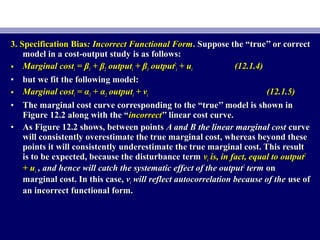
3. Specification Bias3. Specification Bias: Incorrect Functional Form: Incorrect Functional Form.. Suppose the “true’’ or correctSuppose the “true’’ or correct
model in a cost-output study is as follows:model in a cost-output study is as follows:
• Marginal costMarginal costii == ββ11 + β+ β22 outputoutputii ++ ββ33 outputoutput22
ii + u+ uii (12.1.4)(12.1.4)
• but we fit the following model:but we fit the following model:
• Marginal costMarginal costii = α= α11 + α+ α22 outputoutputii + v+ vii (12.1.5)(12.1.5)
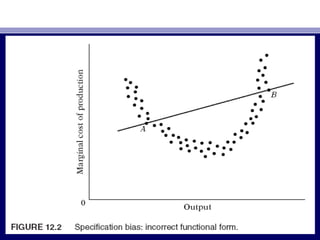
• The marginal cost curve corresponding to the “true’’ model is shown inThe marginal cost curve corresponding to the “true’’ model is shown in
Figure 12.2 along with the “Figure 12.2 along with the “incorrectincorrect’’ linear cost curve.’’ linear cost curve.
• As Figure 12.2 shows, between pointsAs Figure 12.2 shows, between points A and B the linear marginal costA and B the linear marginal cost curvecurve
will consistently overestimate the true marginal cost, whereas beyond thesewill consistently overestimate the true marginal cost, whereas beyond these
points it will consistently underestimate the true marginal cost. This resultpoints it will consistently underestimate the true marginal cost. This result
is to be expected, because the disturbance termis to be expected, because the disturbance term vvii is, in fact, equal to outputis, in fact, equal to output22
+ u+ uii , and hence will catch the systematic effect of the output, and hence will catch the systematic effect of the output22
termterm onon
marginal cost. In this case,marginal cost. In this case, vvii will reflect autocorrelation because of thewill reflect autocorrelation because of the use ofuse of
an incorrect functional form.an incorrect functional form.
4. Cobweb Phenomenon.4. Cobweb Phenomenon. The supply of many agricultural commodities reflectsThe supply of many agricultural commodities reflects
the so-called cobweb phenomenon, where supply reacts to price with a lagthe so-called cobweb phenomenon, where supply reacts to price with a lag
of one time period because supply decisions take time to implement (theof one time period because supply decisions take time to implement (the
gestation period). Thus, at the beginning of this year’s planting of crops,gestation period). Thus, at the beginning of this year’s planting of crops,
farmers are influenced by the price prevailing last year, so that their supplyfarmers are influenced by the price prevailing last year, so that their supply
function isfunction is
• SupplySupplytt = β= β11 + β+ β22PPt−1t−1 + u+ utt (12.1.6)(12.1.6)
• Suppose at the end of periodSuppose at the end of period t, price Pt, price Ptt turns out to be lower than Pturns out to be lower than Pt−1t−1..
Therefore, inTherefore, in periodperiodt+1t +1 farmers may very well decide to produce less thanfarmers may very well decide to produce less than theythey
did indid in period tperiod t. Obviously, in this situation the disturbances. Obviously, in this situation the disturbances uutt are notare not expectedexpected
to be random because if the farmers overproduce into be random because if the farmers overproduce in year tyear t, they, they are likely toare likely to
reduce theirreduce their production in t + 1production in t + 1, and so on, leading to a Cobweb, and so on, leading to a Cobweb pattern.pattern.
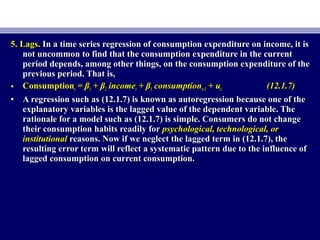
5. Lags.5. Lags. In a time series regression of consumption expenditure on income, it isIn a time series regression of consumption expenditure on income, it is
not uncommon to find that the consumption expenditure in the currentnot uncommon to find that the consumption expenditure in the current
period depends, among other things, on the consumption expenditure of theperiod depends, among other things, on the consumption expenditure of the
previous period. That is,previous period. That is,
• ConsumptionConsumptiontt == ββ11 + β+ β22 incomeincomett ++ ββ33 consumptionconsumptiont−1t−1 + u+ utt (12.1.7)(12.1.7)
• A regression such as (12.1.7) is known as autoregression because one of theA regression such as (12.1.7) is known as autoregression because one of the
explanatory variables is the lagged value of the dependent variable. Theexplanatory variables is the lagged value of the dependent variable. The
rationale for a model such as (12.1.7) is simple. Consumers do not changerationale for a model such as (12.1.7) is simple. Consumers do not change
their consumption habits readily fortheir consumption habits readily for psychological, technological, orpsychological, technological, or
institutionalinstitutional reasons. Now if we neglect the lagged term in (12.1.7), thereasons. Now if we neglect the lagged term in (12.1.7), the
resulting error term will reflect a systematic pattern due to the influence ofresulting error term will reflect a systematic pattern due to the influence of
lagged consumption on current consumption.lagged consumption on current consumption.
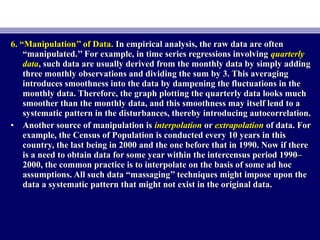
6. “Manipulation’’ of Data.6. “Manipulation’’ of Data. In empirical analysis, the raw data are oftenIn empirical analysis, the raw data are often
“manipulated.’’ For example, in time series regressions involving“manipulated.’’ For example, in time series regressions involving quarterlyquarterly
datadata, such data are usually derived from the monthly data by simply adding, such data are usually derived from the monthly data by simply adding
three monthly observations and dividing the sum by 3. This averagingthree monthly observations and dividing the sum by 3. This averaging
introduces smoothness into the data by dampening the fluctuations in theintroduces smoothness into the data by dampening the fluctuations in the
monthly data. Therefore, the graph plotting the quarterly data looks muchmonthly data. Therefore, the graph plotting the quarterly data looks much
smoother than the monthly data, and this smoothness may itself lend to asmoother than the monthly data, and this smoothness may itself lend to a
systematic pattern in the disturbances, thereby introducing autocorrelation.systematic pattern in the disturbances, thereby introducing autocorrelation.
• Another source of manipulation isAnother source of manipulation is interpolationinterpolation oror extrapolationextrapolation of data. Forof data. For
example, the Census of Population is conducted every 10 years in thisexample, the Census of Population is conducted every 10 years in this
country, the last being in 2000 and the one before that in 1990. Now if therecountry, the last being in 2000 and the one before that in 1990. Now if there
is a need to obtain data for some year within the intercensus period 1990–is a need to obtain data for some year within the intercensus period 1990–
2000, the common practice is to interpolate on the basis of some ad hoc2000, the common practice is to interpolate on the basis of some ad hoc
assumptions. All such data “massaging’’ techniques might impose upon theassumptions. All such data “massaging’’ techniques might impose upon the
data a systematic pattern that might not exist in the original data.data a systematic pattern that might not exist in the original data.
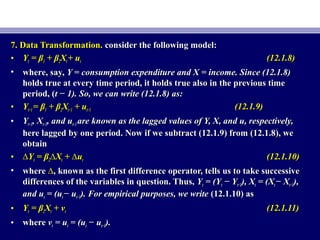
7. Data Transformation.7. Data Transformation. consider the following model:consider the following model:
• YYtt == ββ11 + β+ β22XXtt + u+ utt (12.1.8)(12.1.8)
• where, say,where, say, Y = consumption expenditure and X = income. Since (12.1.8)Y = consumption expenditure and X = income. Since (12.1.8)
holds true at every time period, it holds true also in the previous timeholds true at every time period, it holds true also in the previous time
period, (period, (t − 1). So, we can write (12.1.8) as:t − 1). So, we can write (12.1.8) as:
• YYt−1t−1 == ββ11 + β+ β22XXt−1t−1 + u+ ut−1t−1 (12.1.9)(12.1.9)
• YYt−1t−1, X, Xt−1t−1, and u, and ut−1t−1 are known as the lagged values of Y, X, and u, respectively,are known as the lagged values of Y, X, and u, respectively,
here lagged by one period. Now if we subtract (12.1.9) from (12.1.8), wehere lagged by one period. Now if we subtract (12.1.9) from (12.1.8), we
obtainobtain
• ∆∆YYtt == ββ22∆X∆Xtt + ∆u+ ∆utt (12.1.10)(12.1.10)
• wherewhere ∆∆, known as the first difference operator, tells us to take successive, known as the first difference operator, tells us to take successive
differences of the variables in question. Thus,differences of the variables in question. Thus, YYtt = (Y= (Ytt − Y− Yt−1t−1), X), Xtt = (X= (Xtt − X− Xt−1t−1),),
and uand utt = (u= (utt − u− ut−1t−1). For empirical purposes, we write). For empirical purposes, we write (12.1.10) as(12.1.10) as
• YYtt == ββ22XXtt + v+ vtt (12.1.11)(12.1.11)
• wherewhere vvtt = u= utt = (u= (utt − u− ut−1t−1).).
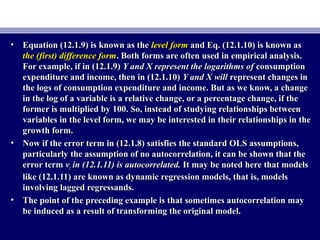
• Equation (12.1.9) is known as theEquation (12.1.9) is known as the level formlevel form and Eq. (12.1.10) is known asand Eq. (12.1.10) is known as
the (first) difference formthe (first) difference form. Both forms are often used in empirical analysis.. Both forms are often used in empirical analysis.
For example, if in (12.1.9)For example, if in (12.1.9) Y and X represent the logarithms ofY and X represent the logarithms of consumptionconsumption
expenditure and income, then in (12.1.10)expenditure and income, then in (12.1.10) Y and X willY and X will represent changes inrepresent changes in
the logs of consumption expenditure and income. But as we know, a changethe logs of consumption expenditure and income. But as we know, a change
in the log of a variable is a relative change, or a percentage change, if thein the log of a variable is a relative change, or a percentage change, if the
former is multiplied by 100. So, instead of studying relationships betweenformer is multiplied by 100. So, instead of studying relationships between
variables in the level form, we may be interested in their relationships in thevariables in the level form, we may be interested in their relationships in the
growth form.growth form.
• Now if the error term in (12.1.8) satisfies the standard OLS assumptions,Now if the error term in (12.1.8) satisfies the standard OLS assumptions,
particularly the assumption of no autocorrelation, it can be shown that theparticularly the assumption of no autocorrelation, it can be shown that the
error termerror term vvtt in (12.1.11) is autocorrelated.in (12.1.11) is autocorrelated. It may be noted here that modelsIt may be noted here that models
like (12.1.11) are known as dynamic regression models, that is, modelslike (12.1.11) are known as dynamic regression models, that is, models
involving lagged regressands.involving lagged regressands.
• The point of the preceding example is that sometimes autocorrelation mayThe point of the preceding example is that sometimes autocorrelation may
be induced as a result of transforming the original model.be induced as a result of transforming the original model.
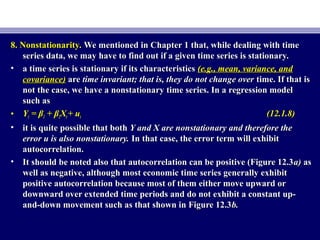
8. Nonstationarity.8. Nonstationarity. We mentioned in Chapter 1 that, while dealing with timeWe mentioned in Chapter 1 that, while dealing with time
series data, we may have to find out if a given time series is stationary.series data, we may have to find out if a given time series is stationary.
• a time series is stationary if its characteristicsa time series is stationary if its characteristics (e.g., mean, variance, and(e.g., mean, variance, and
covariance)covariance) areare time invariant; that is, they do not change overtime invariant; that is, they do not change over time. If that istime. If that is
not the case, we have a nonstationary time series. In a regression modelnot the case, we have a nonstationary time series. In a regression model
such assuch as
• YYtt == ββ11 + β+ β22XXtt + u+ utt (12.1.8)(12.1.8)
• it is quite possible that bothit is quite possible that both Y and X are nonstationary and therefore theY and X are nonstationary and therefore the
error u is also nonstationary.error u is also nonstationary. In that case, the error term will exhibitIn that case, the error term will exhibit
autocorrelation.autocorrelation.
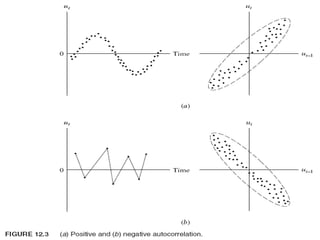
• It should be noted also that autocorrelation can be positive (Figure 12.3It should be noted also that autocorrelation can be positive (Figure 12.3a)a) asas
well as negative, although most economic time series generally exhibitwell as negative, although most economic time series generally exhibit
positive autocorrelation because most of them either move upward orpositive autocorrelation because most of them either move upward or
downward over extended time periods and do not exhibit a constant up-downward over extended time periods and do not exhibit a constant up-
and-down movement such as that shown in Figure 12.3and-down movement such as that shown in Figure 12.3b.b.
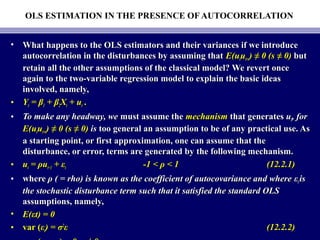
OLS ESTIMATION IN THE PRESENCE OF AUTOCORRELATION
• What happens to the OLS estimators and their variances if we introduceWhat happens to the OLS estimators and their variances if we introduce
autocorrelation in the disturbances by assuming thatautocorrelation in the disturbances by assuming that E(uE(uttuut+st+s)) ≠≠ 0 (s0 (s ≠≠ 0)0) butbut
retain all the other assumptions of the classical model? We revert onceretain all the other assumptions of the classical model? We revert once
again to the two-variable regression model to explain the basic ideasagain to the two-variable regression model to explain the basic ideas
involved, namely,involved, namely,
• YYtt = β= β11 + β+ β22XXtt + u+ utt ..
• To make any headway, weTo make any headway, we must assume themust assume the mechanismmechanism that generatesthat generates uutt, for, for
E(uE(uttuut+st+s)) ≠≠ 0 (s0 (s ≠≠ 0)0) isis too general an assumption to be of any practical use. Astoo general an assumption to be of any practical use. As
a starting point, or first approximation, one can assume that thea starting point, or first approximation, one can assume that the
disturbance, or error, terms are generated by the following mechanism.disturbance, or error, terms are generated by the following mechanism.
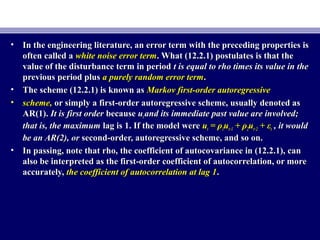
• uutt == ρρuut−1t−1 ++ εεtt -1 <-1 < ρ < 1ρ < 1 (12.2.1)(12.2.1)
• wherewhere ρ ( = rho) is known as the coefficient of autocovariance and whereρ ( = rho) is known as the coefficient of autocovariance and where εεtt isis
the stochastic disturbance term such that it satisfied the standard OLSthe stochastic disturbance term such that it satisfied the standard OLS
assumptions, namely,assumptions, namely,
• E(E(εεt) = 0t) = 0
• var (var (εεtt) =) = σσ22
εε (12.2.2)(12.2.2)
• In the engineering literature, an error term with the preceding properties isIn the engineering literature, an error term with the preceding properties is
often called aoften called a white noise error termwhite noise error term. What (12.2.1) postulates is that the. What (12.2.1) postulates is that the
value of the disturbance term in periodvalue of the disturbance term in period t is equal to rho times its value in thet is equal to rho times its value in the
previous period plusprevious period plus a purely random error terma purely random error term..
• The scheme (12.2.1) is known asThe scheme (12.2.1) is known as Markov first-order autoregressiveMarkov first-order autoregressive
• scheme,scheme, or simply a first-order autoregressive scheme, usually denoted asor simply a first-order autoregressive scheme, usually denoted as
AR(1).AR(1). It is first orderIt is first order becausebecause uutt and its immediate past value are involved;and its immediate past value are involved;
that is, the maximumthat is, the maximum lag is 1. If the model werelag is 1. If the model were uutt = ρ= ρ11uut−1t−1 + ρ+ ρ22uut−2t−2 + ε+ εtt , it would, it would
be an AR(2), orbe an AR(2), or second-order, autoregressive scheme, and so on.second-order, autoregressive scheme, and so on.
• In passing, note that rho, the coefficient of autocovariance in (12.2.1), canIn passing, note that rho, the coefficient of autocovariance in (12.2.1), can
also be interpreted as the first-order coefficient of autocorrelation, or morealso be interpreted as the first-order coefficient of autocorrelation, or more
accurately,accurately, the coefficient of autocorrelation at lag 1the coefficient of autocorrelation at lag 1..
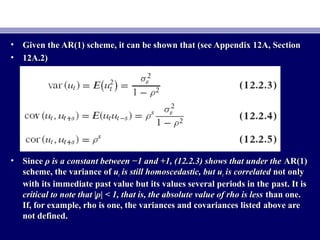
• Given the AR(1) scheme, it can be shown that (see Appendix 12A, SectionGiven the AR(1) scheme, it can be shown that (see Appendix 12A, Section
• 12A.2)12A.2)
• SinceSince ρ is a constant between −1 and +1, (12.2.3) shows that under theρ is a constant between −1 and +1, (12.2.3) shows that under the AR(1)AR(1)
scheme, the variance ofscheme, the variance of uutt is still homoscedastic, but uis still homoscedastic, but utt is correlatedis correlated not onlynot only
with its immediate past value but its values several periods in thewith its immediate past value but its values several periods in the past. It ispast. It is
critical to note that |ρ| < 1, that is, the absolute value of rho is lesscritical to note that |ρ| < 1, that is, the absolute value of rho is less than one.than one.
If, for example, rho is one, the variances and covariances listedIf, for example, rho is one, the variances and covariances listed above areabove are
not defined.not defined.
• If |If |ρ| < 1, we say that the AR(1) process given inρ| < 1, we say that the AR(1) process given in (12.2.1)(12.2.1) is stationaryis stationary; that is,; that is,
the mean, variance, and covariance of uthe mean, variance, and covariance of utt do notdo not change over time. If |change over time. If |ρ| is lessρ| is less
than one, then it is clear from (12.2.4) that thethan one, then it is clear from (12.2.4) that the value of the covariance willvalue of the covariance will
decline as we go into the distant past.decline as we go into the distant past.
• One reason we use the AR(1) process is not only because of its simplicityOne reason we use the AR(1) process is not only because of its simplicity
compared to higher-order AR schemes, but also because in manycompared to higher-order AR schemes, but also because in many
applications it has proved to be quite useful. Additionally, a considerableapplications it has proved to be quite useful. Additionally, a considerable
amount of theoretical and empirical work has been done on the AR(1)amount of theoretical and empirical work has been done on the AR(1)
scheme.scheme.
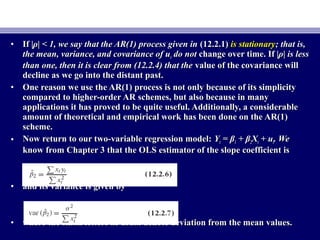
• Now return to our two-variable regression model:Now return to our two-variable regression model: YYtt = β= β11 + β+ β22XXtt + u+ utt. We. We
know from Chapter 3 that the OLS estimator of the slope coefficient isknow from Chapter 3 that the OLS estimator of the slope coefficient is
• and its variance is given byand its variance is given by
• where the small letters as usual denote deviation from the mean values.where the small letters as usual denote deviation from the mean values.
• Now under the AR(1) scheme, it can be shown that the variance of thisNow under the AR(1) scheme, it can be shown that the variance of this
estimator is:estimator is:
• A comparison of (12.2.8) with (12.2.7) shows the former is equal to the latterA comparison of (12.2.8) with (12.2.7) shows the former is equal to the latter
times a term that depends ontimes a term that depends on ρ as well as the sample autocorrelationsρ as well as the sample autocorrelations
between the values taken by the regressorbetween the values taken by the regressor X at various lags. And in generalX at various lags. And in general
we cannot foretell whether var (we cannot foretell whether var (βˆ2) is less than or greater than var (βˆ2)AR1βˆ2) is less than or greater than var (βˆ2)AR1
[but see Eq. (12.4.1) below]. Of course, if rho is zero, the two formulas will[but see Eq. (12.4.1) below]. Of course, if rho is zero, the two formulas will
coincide, as they should (why?). Also, if the correlations among thecoincide, as they should (why?). Also, if the correlations among the
successive values of the regressor are very small, the usual OLS variance ofsuccessive values of the regressor are very small, the usual OLS variance of
the slope estimator will not be seriously biased. But, as a general principle,the slope estimator will not be seriously biased. But, as a general principle,
the two variances will not be the same.the two variances will not be the same.
• To give some idea about the difference between the variances given inTo give some idea about the difference between the variances given in
(12.2.7) and (12.2.8), assume that the regressor(12.2.7) and (12.2.8), assume that the regressor X also follows the first-orderX also follows the first-order
autoregressive scheme with a coefficient of autocorrelation ofautoregressive scheme with a coefficient of autocorrelation of r. Then it canr. Then it can
be shown that (12.2.8) reduces to:be shown that (12.2.8) reduces to:
• var (var (βˆ2)βˆ2)AR(1) =AR(1) = σ2σ2 x2 t 1 + rx2 t 1 + rρρ 1 −1 − rrρ =ρ = var (var (βˆ2)βˆ2)OLS 1 + rOLS 1 + rρρ 1 −1 − rrρ (12.2.9)ρ (12.2.9)
• If, for example,If, for example, r = 0.6 and ρ = 0.8, using (12.2.9) we can check thatr = 0.6 and ρ = 0.8, using (12.2.9) we can check that varvar
((βˆ2)AR1 = 2.8461 var (βˆ2)OLS. To put it another way, var (βˆ2)OLS = 1βˆ2)AR1 = 2.8461 var (βˆ2)OLS. To put it another way, var (βˆ2)OLS = 1
22.8461var (βˆ2)AR1 = 0.3513 var (βˆ2)AR1 . That is, the usual OLS formula.8461var (βˆ2)AR1 = 0.3513 var (βˆ2)AR1 . That is, the usual OLS formula
[i.e.,[i.e., (12.2.7)] will underestimate the variance of ((12.2.7)] will underestimate the variance of (βˆ2)AR1 by about 65βˆ2)AR1 by about 65
percent. Aspercent. As you will realize, this answer is specific for the given values ofyou will realize, this answer is specific for the given values of rr
and ρ. But theand ρ. But the point of this exercise is to warn you that a blind applicationpoint of this exercise is to warn you that a blind application
of the usual OLS formulas to compute the variances and standard errors ofof the usual OLS formulas to compute the variances and standard errors of
the OLS estimators could give seriously misleading results.the OLS estimators could give seriously misleading results.
• WhatWhat now are the properties ofnow are the properties of βˆβˆ22? βˆ? βˆ22 is still linear andis still linear and unbiasedunbiased. Is βˆ. Is βˆ22 stillstill
BLUE? Unfortunately,BLUE? Unfortunately, it is not; in the class of linear unbiased estimators, itit is not; in the class of linear unbiased estimators, it
does not have minimum variance.does not have minimum variance.
RELATIONSHIP BETWEEN WAGES AND PRODUCTIVITY IN THE BUSINESS
SECTOR OF THE UNITED STATES, 1959–1998
• Now that we have discussed the consequences of autocorrelation, theNow that we have discussed the consequences of autocorrelation, the
obvious question is, How do we detect it and how do we correct for it?obvious question is, How do we detect it and how do we correct for it?
• Before we turn to these topics, it is useful to consider a concrete example.Before we turn to these topics, it is useful to consider a concrete example.
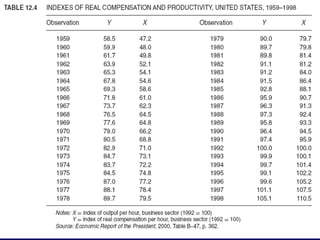
Table 12.4 gives data on indexes of real compensation per hour (Table 12.4 gives data on indexes of real compensation per hour (Y) andY) and
output per houroutput per hour ((X) in the business sector of the U.S. economy for the periodX) in the business sector of the U.S. economy for the period
1959–1998, the1959–1998, the base of the indexes being 1992 = 100.base of the indexes being 1992 = 100.
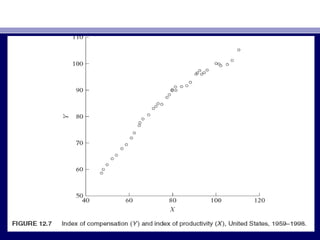
• First plotting the data onFirst plotting the data on Y and X, we obtain Figure 12.7. Since theY and X, we obtain Figure 12.7. Since the
relationshiprelationship between real compensation and labor productivity is expectedbetween real compensation and labor productivity is expected
to be positive, it is not surprising that the two variables are positivelyto be positive, it is not surprising that the two variables are positively
related. What is surprising is that the relationship between the two isrelated. What is surprising is that the relationship between the two is
almost linear, although there is some hint that at higher values ofalmost linear, although there is some hint that at higher values of
productivity the relationship between the two may be slightly nonlinear.productivity the relationship between the two may be slightly nonlinear.
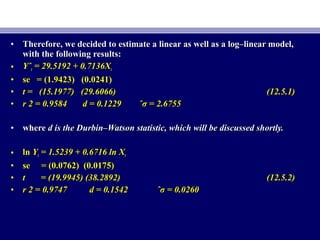
• Therefore, we decided to estimate a linear as well as a log–linear model,Therefore, we decided to estimate a linear as well as a log–linear model,
with the following results:with the following results:
• YˆYˆtt = 29.5192 + 0.7136X= 29.5192 + 0.7136Xtt
• se = (1.9423) (0.0241)se = (1.9423) (0.0241)
• t = (15.1977) (29.6066)t = (15.1977) (29.6066) (12.5.1)(12.5.1)
• r 2 = 0.9584 d = 0.1229 ˆσ = 2.6755r 2 = 0.9584 d = 0.1229 ˆσ = 2.6755
• wherewhere d is the Durbin–Watson statistic, which will be discussed shortly.d is the Durbin–Watson statistic, which will be discussed shortly.
• lnln YYtt = 1.5239 + 0.6716 ln X= 1.5239 + 0.6716 ln Xtt
• se = (0.0762) (0.0175)se = (0.0762) (0.0175)
• t = (19.9945) (38.2892)t = (19.9945) (38.2892) (12.5.2)(12.5.2)
• r 2 = 0.9747 d = 0.1542 ˆσ = 0.0260r 2 = 0.9747 d = 0.1542 ˆσ = 0.0260
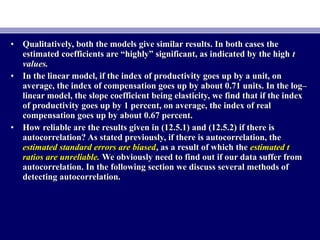
• Qualitatively, both the models give similar results. In both cases theQualitatively, both the models give similar results. In both cases the
estimated coefficients are “highly” significant, as indicated by the highestimated coefficients are “highly” significant, as indicated by the high tt
values.values.
• In the linear model, if the index of productivity goes up by a unit, onIn the linear model, if the index of productivity goes up by a unit, on
average, the index of compensation goes up by about 0.71 units. In the log–average, the index of compensation goes up by about 0.71 units. In the log–
linear model, the slope coefficient being elasticity, we find that if the indexlinear model, the slope coefficient being elasticity, we find that if the index
of productivity goes up by 1 percent, on average, the index of realof productivity goes up by 1 percent, on average, the index of real
compensation goes up by about 0.67 percent.compensation goes up by about 0.67 percent.
• How reliable are the results given in (12.5.1) and (12.5.2) if there isHow reliable are the results given in (12.5.1) and (12.5.2) if there is
autocorrelation? As stated previously, if there is autocorrelation, theautocorrelation? As stated previously, if there is autocorrelation, the
estimated standard errors are biasedestimated standard errors are biased, as a result of which the, as a result of which the estimated testimated t
ratios are unreliable.ratios are unreliable. We obviously need to find out if our data suffer fromWe obviously need to find out if our data suffer from
autocorrelation. In the following section we discuss several methods ofautocorrelation. In the following section we discuss several methods of
detecting autocorrelation.detecting autocorrelation.
DETECTING AUTOCORRELATION
• I. Graphical MethodI. Graphical Method
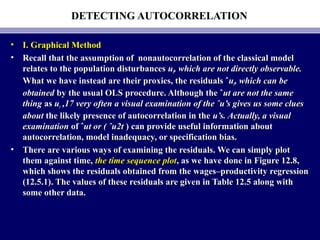
• Recall that the assumption of nonautocorrelation of the classical modelRecall that the assumption of nonautocorrelation of the classical model
relates to the population disturbancesrelates to the population disturbances uutt, which are not directly observable., which are not directly observable.
What we have instead are their proxies, the residuals ˆWhat we have instead are their proxies, the residuals ˆuutt, which can be, which can be
obtainedobtained by the usual OLS procedure. Although the ˆby the usual OLS procedure. Although the ˆut are not the sameut are not the same
thingthing asas uutt ,17 very often a visual examination of the ˆu’s gives us some clues,17 very often a visual examination of the ˆu’s gives us some clues
aboutabout the likely presence of autocorrelation in thethe likely presence of autocorrelation in the u’s. Actually, a visualu’s. Actually, a visual
examinationexamination of ˆof ˆut or ( ˆu2tut or ( ˆu2t ) can provide useful information about) can provide useful information about
autocorrelation, model inadequacy, or specification bias.autocorrelation, model inadequacy, or specification bias.
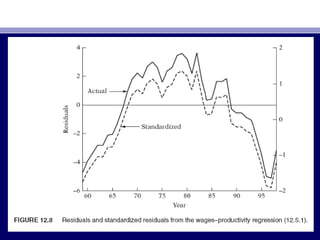
• There are various ways of examining the residuals. We can simply plotThere are various ways of examining the residuals. We can simply plot
them against time,them against time, the time sequence plotthe time sequence plot, as we have done in Figure 12.8,, as we have done in Figure 12.8,
which shows the residuals obtained from the wages–productivity regressionwhich shows the residuals obtained from the wages–productivity regression
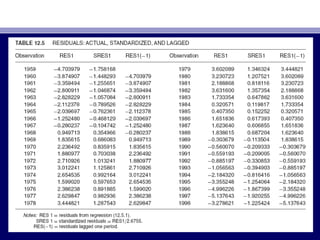
(12.5.1). The values of these residuals are given in Table 12.5 along with(12.5.1). The values of these residuals are given in Table 12.5 along with
some other data.some other data.
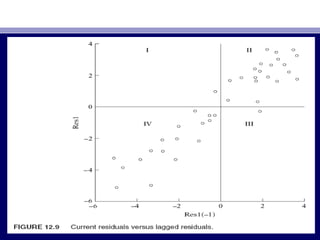
• To see this differently, we can plot ˆTo see this differently, we can plot ˆuutt against ˆagainst ˆut−1ut−1, that is, plot the residuals, that is, plot the residuals atat
timetime t against their value at time (t − 1), a kind of empirical test of thet against their value at time (t − 1), a kind of empirical test of the AR(1)AR(1)
scheme. If the residuals are nonrandom, we should obtain pictures similarscheme. If the residuals are nonrandom, we should obtain pictures similar
to those shown in Figure 12.3. This plot for our wages–productivityto those shown in Figure 12.3. This plot for our wages–productivity
regression is as shown in Figure 12.9; the underlying data are given inregression is as shown in Figure 12.9; the underlying data are given in
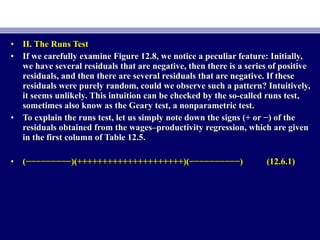
• II. The Runs TestII. The Runs Test
• If we carefully examine Figure 12.8, we notice a peculiar feature: Initially,If we carefully examine Figure 12.8, we notice a peculiar feature: Initially,
we have several residuals that are negative, then there is a series of positivewe have several residuals that are negative, then there is a series of positive
residuals, and then there are several residuals that are negative. If theseresiduals, and then there are several residuals that are negative. If these
residuals were purely random, could we observe such a pattern? Intuitively,residuals were purely random, could we observe such a pattern? Intuitively,
it seems unlikely. This intuition can be checked by the so-called runs test,it seems unlikely. This intuition can be checked by the so-called runs test,
sometimes also know as the Geary test, a nonparametric test.sometimes also know as the Geary test, a nonparametric test.
• To explain the runs test, let us simply note down the signs (+ or −) of theTo explain the runs test, let us simply note down the signs (+ or −) of the
residuals obtained from the wages–productivity regression, which are givenresiduals obtained from the wages–productivity regression, which are given
in the first column of Table 12.5.in the first column of Table 12.5.
• (−−−−−−−−−)(+++++++++++++++++++++)(−−−−−−−−−−)(−−−−−−−−−)(+++++++++++++++++++++)(−−−−−−−−−−) (12.6.1)(12.6.1)
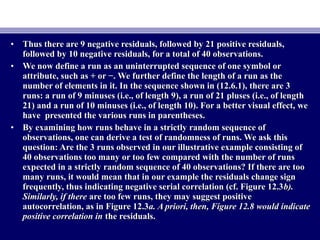
• Thus there are 9 negative residuals, followed by 21 positive residuals,Thus there are 9 negative residuals, followed by 21 positive residuals,
followed by 10 negative residuals, for a total of 40 observations.followed by 10 negative residuals, for a total of 40 observations.
• We now define a run as an uninterrupted sequence of one symbol orWe now define a run as an uninterrupted sequence of one symbol or
attribute, such as + or −. We further define the length of a run as theattribute, such as + or −. We further define the length of a run as the
number of elements in it. In the sequence shown in (12.6.1), there are 3number of elements in it. In the sequence shown in (12.6.1), there are 3
runs: a run of 9 minuses (i.e., of length 9), a run of 21 pluses (i.e., of lengthruns: a run of 9 minuses (i.e., of length 9), a run of 21 pluses (i.e., of length
21) and a run of 10 minuses (i.e., of length 10). For a better visual effect, we21) and a run of 10 minuses (i.e., of length 10). For a better visual effect, we
have presented the various runs in parentheses.have presented the various runs in parentheses.
• By examining how runs behave in a strictly random sequence ofBy examining how runs behave in a strictly random sequence of
observations, one can derive a test of randomness of runs. We ask thisobservations, one can derive a test of randomness of runs. We ask this
question: Are the 3 runs observed in our illustrative example consisting ofquestion: Are the 3 runs observed in our illustrative example consisting of
40 observations too many or too few compared with the number of runs40 observations too many or too few compared with the number of runs
expected in a strictly random sequence of 40 observations? If there are tooexpected in a strictly random sequence of 40 observations? If there are too
many runs, it would mean that in our example the residuals change signmany runs, it would mean that in our example the residuals change sign
frequently, thus indicating negative serial correlation (cf. Figure 12.3frequently, thus indicating negative serial correlation (cf. Figure 12.3b).b).
Similarly, if thereSimilarly, if there are too few runs, they may suggest positiveare too few runs, they may suggest positive
autocorrelation, as in Figure 12.3autocorrelation, as in Figure 12.3a. A priori, then, Figure 12.8 would indicatea. A priori, then, Figure 12.8 would indicate
positive correlation inpositive correlation in the residuals.the residuals.
• Now letNow let
• N = total number of observations = N1 + N2N = total number of observations = N1 + N2
• N1 = number of + symbols (i.e., + residuals)N1 = number of + symbols (i.e., + residuals)
• N2 = number of − symbols (i.e., − residuals)N2 = number of − symbols (i.e., − residuals)
• R = number of runsR = number of runs
• Note: N = N1 + N2.Note: N = N1 + N2.
• If the null hypothesis of randomness is sustainable, followingIf the null hypothesis of randomness is sustainable, following
the properties of the normal distribution, we should expect thatthe properties of the normal distribution, we should expect that
Prob [Prob [E(R) − 1.96σR ≤ R ≤ E(R) + 1.96σR] = 0.95E(R) − 1.96σR ≤ R ≤ E(R) + 1.96σR] = 0.95 (12.6.3)(12.6.3)
• Using the formulas given in (12.6.2), we obtainUsing the formulas given in (12.6.2), we obtain
• The 95% confidence interval forThe 95% confidence interval for R in our example is thus:R in our example is thus:
[10[10.975 ± 1.96(3.1134)] = (4.8728, 17.0722).975 ± 1.96(3.1134)] = (4.8728, 17.0722)
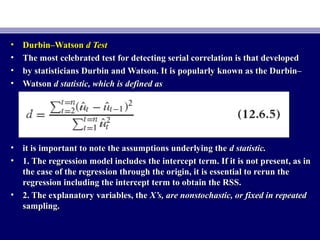
• Durbin–WatsonDurbin–Watson d Testd Test
• The most celebrated test for detecting serial correlation is that developedThe most celebrated test for detecting serial correlation is that developed
• by statisticians Durbin and Watson. It is popularly known as the Durbin–by statisticians Durbin and Watson. It is popularly known as the Durbin–
• WatsonWatson d statistic, which is defined asd statistic, which is defined as
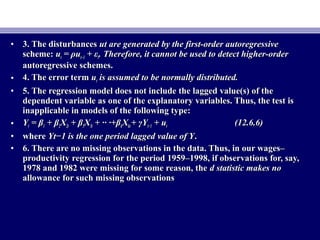
• it is important to note the assumptions underlying theit is important to note the assumptions underlying the d statistic.d statistic.
• 1. The regression model includes the intercept term. If it is not present, as in1. The regression model includes the intercept term. If it is not present, as in
the case of the regression through the origin, it is essential to rerun thethe case of the regression through the origin, it is essential to rerun the
regression including the intercept term to obtain the RSS.regression including the intercept term to obtain the RSS.
• 2. The explanatory variables, the2. The explanatory variables, the X’s, are nonstochastic, or fixed in repeatedX’s, are nonstochastic, or fixed in repeated
sampling.sampling.
• 3. The disturbances3. The disturbances ut are generated by the first-order autoregressiveut are generated by the first-order autoregressive
scheme:scheme: uutt = ρu= ρut−1t−1 + ε+ εtt. Therefore, it cannot be used to detect higher-order. Therefore, it cannot be used to detect higher-order
autoregressive schemes.autoregressive schemes.
• 4. The error term4. The error term uutt is assumed to be normally distributed.is assumed to be normally distributed.
• 5. The regression model does not include the lagged value(s) of the5. The regression model does not include the lagged value(s) of the
dependent variable as one of the explanatory variables. Thus, the test isdependent variable as one of the explanatory variables. Thus, the test is
inapplicable in models of the following type:inapplicable in models of the following type:
• YYtt == ββ11 + β+ β22XX2t2t ++ ββ33XX3t3t + ·· ·++ ·· ·+ββkkXXktkt ++ γγYYt−1t−1 + u+ utt (12.6.6)(12.6.6)
• wherewhere Yt−1 is the one period lagged value of YYt−1 is the one period lagged value of Y..
• 6. There are no missing observations in the data. Thus, in our wages–6. There are no missing observations in the data. Thus, in our wages–
productivity regression for the period 1959–1998, if observations for, say,productivity regression for the period 1959–1998, if observations for, say,
1978 and 1982 were missing for some reason, the1978 and 1982 were missing for some reason, the d statistic makes nod statistic makes no
allowance for such missing observationsallowance for such missing observations
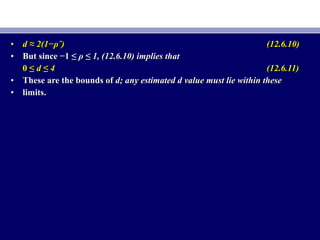
• d ≈ 2(1−d ≈ 2(1−ρˆ)ρˆ) (12.6.10)(12.6.10)
• But since −1 ≤But since −1 ≤ ρ ≤ 1, (12.6.10) implies thatρ ≤ 1, (12.6.10) implies that
0 ≤0 ≤ d ≤ 4d ≤ 4 (12.6.11)(12.6.11)
• These are the bounds ofThese are the bounds of d; any estimated d value must lie within thesed; any estimated d value must lie within these
• limits.limits.
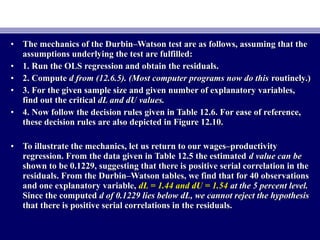
• The mechanics of the Durbin–Watson test are as follows, assuming that theThe mechanics of the Durbin–Watson test are as follows, assuming that the
assumptions underlying the test are fulfilled:assumptions underlying the test are fulfilled:
• 1. Run the OLS regression and obtain the residuals.1. Run the OLS regression and obtain the residuals.
• 2. Compute2. Compute d from (12.6.5). (Most computer programs now do thisd from (12.6.5). (Most computer programs now do this routinely.)routinely.)
• 3. For the given sample size and given number of explanatory variables,3. For the given sample size and given number of explanatory variables,
find out the criticalfind out the critical dL and dU values.dL and dU values.
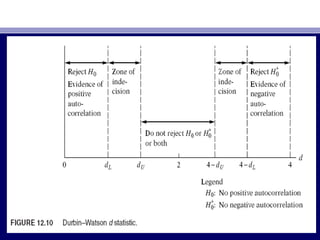
• 4. Now follow the decision rules given in Table 12.6. For ease of reference,4. Now follow the decision rules given in Table 12.6. For ease of reference,
these decision rules are also depicted in Figure 12.10.these decision rules are also depicted in Figure 12.10.
• To illustrate the mechanics, let us return to our wages–productivityTo illustrate the mechanics, let us return to our wages–productivity
regression. From the data given in Table 12.5 the estimatedregression. From the data given in Table 12.5 the estimated d value can bed value can be
shown to be 0.1229, suggesting that there is positive serial correlation in theshown to be 0.1229, suggesting that there is positive serial correlation in the
residuals. From the Durbin–Watson tables, we find that for 40 observationsresiduals. From the Durbin–Watson tables, we find that for 40 observations
and one explanatory variable,and one explanatory variable, dL = 1.44 and dU = 1.54dL = 1.44 and dU = 1.54 at the 5 percent level.at the 5 percent level.
Since the computedSince the computed d of 0.1229 lies below dL, we cannot reject the hypothesisd of 0.1229 lies below dL, we cannot reject the hypothesis
that there is positive serial correlations in the residuals.that there is positive serial correlations in the residuals.
Econometrics ch13
Econometrics ch13
Econometrics ch13
Econometrics ch13
Econometrics ch13

Econometrics ch13

  • 1.
    405 ECONOMETRICS Chapter #13: AUTOCORRELATION: WHAT HAPPENS IF THE ERROR TERMS ARE CORRELATED? By Domodar N. Gujarati Prof. M. El-SakkaProf. M. El-Sakka Dept of Economics Kuwait UniversityDept of Economics Kuwait University
  • 2.
    • In thischapter we take a critical look at the following questions:In this chapter we take a critical look at the following questions: • 1. What is the nature of1. What is the nature of autocorrelationautocorrelation?? • 2. What are the theoretical and practical2. What are the theoretical and practical consequencesconsequences of autocorrelation?of autocorrelation? • 3. Since the assumption of no autocorrelation relates to the3. Since the assumption of no autocorrelation relates to the unobservableunobservable disturbancesdisturbances uutt,, how does one know that there is autocorrelation in anyhow does one know that there is autocorrelation in any givengiven situation? Notice that we now use the subscriptsituation? Notice that we now use the subscript t to emphasize that wet to emphasize that we areare dealing with time series data.dealing with time series data. • 4. How does one4. How does one remedyremedy the problem of autocorrelation?the problem of autocorrelation?
  • 3.
    • THE NATUREOF THE PROBLEMTHE NATURE OF THE PROBLEM • Autocorrelation may be defined as “Autocorrelation may be defined as “correlation between members of series ofcorrelation between members of series of observations ordered in timeobservations ordered in time [as in time series data] or[as in time series data] or spacespace [as in cross-[as in cross- sectional data].’’ the CLRM assumes that:sectional data].’’ the CLRM assumes that: • E(uE(uiiuujj ) = 0) = 0 i ≠ ji ≠ j (3.2.5)(3.2.5) • Put simply, the classical model assumes that the disturbance term relatingPut simply, the classical model assumes that the disturbance term relating to any observation is not influenced by the disturbance term relating to anyto any observation is not influenced by the disturbance term relating to any other observation.other observation. • For example, if we are dealing with quarterly time series data involving theFor example, if we are dealing with quarterly time series data involving the regression ofregression of output on labor and capitaloutput on labor and capital inputs and if, say, there is a laborinputs and if, say, there is a labor strike affecting output in one quarter, there is no reason to believe that thisstrike affecting output in one quarter, there is no reason to believe that this disruption will be carried over to the next quarter. That is, if output is lowerdisruption will be carried over to the next quarter. That is, if output is lower this quarter, there is no reason to expect it to be lower next quarter.this quarter, there is no reason to expect it to be lower next quarter. Similarly, if we are dealing with cross-sectional data involving theSimilarly, if we are dealing with cross-sectional data involving the regression ofregression of family consumptionfamily consumption expenditure on family income, the effect ofexpenditure on family income, the effect of an increase of one family’s income on its consumption expenditure is notan increase of one family’s income on its consumption expenditure is not expected to affect the consumption expenditure of another family.expected to affect the consumption expenditure of another family.
  • 4.
    • However, ifthere is autocorrelation,However, if there is autocorrelation, • E(uE(uiiuujj ) ≠ 0) ≠ 0 i ≠ ji ≠ j (12.1.1)(12.1.1) • In this situation, the disruption caused by a strike this quarter may veryIn this situation, the disruption caused by a strike this quarter may very well affect output next quarter, or the increases in the consumptionwell affect output next quarter, or the increases in the consumption expenditure of one family may very well prompt another family to increaseexpenditure of one family may very well prompt another family to increase its consumption expenditure.its consumption expenditure. • In Figure 12.1. Figure 12.1In Figure 12.1. Figure 12.1a to d shows that therea to d shows that there is a discernible patternis a discernible pattern among theamong the u’s. Figure 12.1a shows a cyclical pattern;u’s. Figure 12.1a shows a cyclical pattern; Figure 12.1Figure 12.1b and cb and c suggests an upward or downward linear trend in the disturbances;suggests an upward or downward linear trend in the disturbances; whereaswhereas Figure 12.1Figure 12.1d indicates that both linear and quadraticd indicates that both linear and quadratic trend terms are presenttrend terms are present in the disturbances. Onlyin the disturbances. Only Figure 12.1e indicates no systematic patternFigure 12.1e indicates no systematic pattern,, supporting the non-autocorrelation assumption of the classical linearsupporting the non-autocorrelation assumption of the classical linear regression model.regression model.
  • 6.
    • Why doesserial correlation occurWhy does serial correlation occur? There are several reasons:? There are several reasons: 1. Inertia1. Inertia. As is well known, time series such as GNP, price indexes, production,. As is well known, time series such as GNP, price indexes, production, employment, and unemployment exhibit (business) cycles. Starting at theemployment, and unemployment exhibit (business) cycles. Starting at the bottom of the recession, when economic recovery starts, most of these seriesbottom of the recession, when economic recovery starts, most of these series start moving upward. In this upswing, the value of a series at one point instart moving upward. In this upswing, the value of a series at one point in time is greater than its previous value. Thus there is a momentum’’ builttime is greater than its previous value. Thus there is a momentum’’ built into them, and it continues until something happens (e.g., increase ininto them, and it continues until something happens (e.g., increase in interest rate or taxes or both) to slow them down.interest rate or taxes or both) to slow them down. 2. Specification Bias:2. Specification Bias: Excluded Variables CaseExcluded Variables Case. In empirical analysis the. In empirical analysis the researcher often starts with a plausible regression model that may not beresearcher often starts with a plausible regression model that may not be the most “perfect’’ one. For example, the researcher may plot the residualsthe most “perfect’’ one. For example, the researcher may plot the residuals ˆˆuuii obtained from the fitted regression and may observe patternsobtained from the fitted regression and may observe patterns such as thosesuch as those shown in Figure 12.1shown in Figure 12.1a to d. These residuals (which are proxiesa to d. These residuals (which are proxies forfor uuii) may) may suggest that some variables that were originally candidates butsuggest that some variables that were originally candidates but were notwere not included in the model for a variety of reasons should be included. Often theincluded in the model for a variety of reasons should be included. Often the inclusion of such variables removes the correlation pattern observed amonginclusion of such variables removes the correlation pattern observed among the residuals.the residuals.
  • 7.
    • For example,suppose we have the following demand model:For example, suppose we have the following demand model: • YYtt == ββ11 + β+ β22XX2t2t ++ ββ33XX3t3t ++ ββ44XX4t4t + u+ utt (12.1.2)(12.1.2) • wherewhere Y = quantity of beef demanded, XY = quantity of beef demanded, X22 = price of beef, X= price of beef, X33 = consumer= consumer • income,income, XX44 = price of poultry, and t = time. However, for some reason we run= price of poultry, and t = time. However, for some reason we run • the following regression:the following regression: • YYtt == ββ11 + β+ β22XX2t2t ++ ββ33XX3t3t + v+ vtt (12.1.3)(12.1.3) • Now if (12.1.2) is the “correct’’ model or the “truth’’ or true relation,Now if (12.1.2) is the “correct’’ model or the “truth’’ or true relation, running (12.1.3) is tantamount to lettingrunning (12.1.3) is tantamount to letting vvtt = β= β44XX4t4t + u+ utt. And to the extent the. And to the extent the • price ofprice of poultrypoultry affects the consumption of beef, the error or disturbanceaffects the consumption of beef, the error or disturbance termterm v will reflect a systematic pattern, thus creating (false) autocorrelationv will reflect a systematic pattern, thus creating (false) autocorrelation.. • A simple test of this would be to run both (12.1.2) and (12.1.3) and seeA simple test of this would be to run both (12.1.2) and (12.1.3) and see whether autocorrelation, if any, observed in model (12.1.3) disappears whenwhether autocorrelation, if any, observed in model (12.1.3) disappears when (12.1.2) is run.(12.1.2) is run.
  • 8.
    3. Specification Bias3.Specification Bias: Incorrect Functional Form: Incorrect Functional Form.. Suppose the “true’’ or correctSuppose the “true’’ or correct model in a cost-output study is as follows:model in a cost-output study is as follows: • Marginal costMarginal costii == ββ11 + β+ β22 outputoutputii ++ ββ33 outputoutput22 ii + u+ uii (12.1.4)(12.1.4) • but we fit the following model:but we fit the following model: • Marginal costMarginal costii = α= α11 + α+ α22 outputoutputii + v+ vii (12.1.5)(12.1.5) • The marginal cost curve corresponding to the “true’’ model is shown inThe marginal cost curve corresponding to the “true’’ model is shown in Figure 12.2 along with the “Figure 12.2 along with the “incorrectincorrect’’ linear cost curve.’’ linear cost curve. • As Figure 12.2 shows, between pointsAs Figure 12.2 shows, between points A and B the linear marginal costA and B the linear marginal cost curvecurve will consistently overestimate the true marginal cost, whereas beyond thesewill consistently overestimate the true marginal cost, whereas beyond these points it will consistently underestimate the true marginal cost. This resultpoints it will consistently underestimate the true marginal cost. This result is to be expected, because the disturbance termis to be expected, because the disturbance term vvii is, in fact, equal to outputis, in fact, equal to output22 + u+ uii , and hence will catch the systematic effect of the output, and hence will catch the systematic effect of the output22 termterm onon marginal cost. In this case,marginal cost. In this case, vvii will reflect autocorrelation because of thewill reflect autocorrelation because of the use ofuse of an incorrect functional form.an incorrect functional form.
  • 10.
    4. Cobweb Phenomenon.4.Cobweb Phenomenon. The supply of many agricultural commodities reflectsThe supply of many agricultural commodities reflects the so-called cobweb phenomenon, where supply reacts to price with a lagthe so-called cobweb phenomenon, where supply reacts to price with a lag of one time period because supply decisions take time to implement (theof one time period because supply decisions take time to implement (the gestation period). Thus, at the beginning of this year’s planting of crops,gestation period). Thus, at the beginning of this year’s planting of crops, farmers are influenced by the price prevailing last year, so that their supplyfarmers are influenced by the price prevailing last year, so that their supply function isfunction is • SupplySupplytt = β= β11 + β+ β22PPt−1t−1 + u+ utt (12.1.6)(12.1.6) • Suppose at the end of periodSuppose at the end of period t, price Pt, price Ptt turns out to be lower than Pturns out to be lower than Pt−1t−1.. Therefore, inTherefore, in periodperiodt+1t +1 farmers may very well decide to produce less thanfarmers may very well decide to produce less than theythey did indid in period tperiod t. Obviously, in this situation the disturbances. Obviously, in this situation the disturbances uutt are notare not expectedexpected to be random because if the farmers overproduce into be random because if the farmers overproduce in year tyear t, they, they are likely toare likely to reduce theirreduce their production in t + 1production in t + 1, and so on, leading to a Cobweb, and so on, leading to a Cobweb pattern.pattern.
  • 11.
    5. Lags.5. Lags.In a time series regression of consumption expenditure on income, it isIn a time series regression of consumption expenditure on income, it is not uncommon to find that the consumption expenditure in the currentnot uncommon to find that the consumption expenditure in the current period depends, among other things, on the consumption expenditure of theperiod depends, among other things, on the consumption expenditure of the previous period. That is,previous period. That is, • ConsumptionConsumptiontt == ββ11 + β+ β22 incomeincomett ++ ββ33 consumptionconsumptiont−1t−1 + u+ utt (12.1.7)(12.1.7) • A regression such as (12.1.7) is known as autoregression because one of theA regression such as (12.1.7) is known as autoregression because one of the explanatory variables is the lagged value of the dependent variable. Theexplanatory variables is the lagged value of the dependent variable. The rationale for a model such as (12.1.7) is simple. Consumers do not changerationale for a model such as (12.1.7) is simple. Consumers do not change their consumption habits readily fortheir consumption habits readily for psychological, technological, orpsychological, technological, or institutionalinstitutional reasons. Now if we neglect the lagged term in (12.1.7), thereasons. Now if we neglect the lagged term in (12.1.7), the resulting error term will reflect a systematic pattern due to the influence ofresulting error term will reflect a systematic pattern due to the influence of lagged consumption on current consumption.lagged consumption on current consumption.
  • 12.
    6. “Manipulation’’ ofData.6. “Manipulation’’ of Data. In empirical analysis, the raw data are oftenIn empirical analysis, the raw data are often “manipulated.’’ For example, in time series regressions involving“manipulated.’’ For example, in time series regressions involving quarterlyquarterly datadata, such data are usually derived from the monthly data by simply adding, such data are usually derived from the monthly data by simply adding three monthly observations and dividing the sum by 3. This averagingthree monthly observations and dividing the sum by 3. This averaging introduces smoothness into the data by dampening the fluctuations in theintroduces smoothness into the data by dampening the fluctuations in the monthly data. Therefore, the graph plotting the quarterly data looks muchmonthly data. Therefore, the graph plotting the quarterly data looks much smoother than the monthly data, and this smoothness may itself lend to asmoother than the monthly data, and this smoothness may itself lend to a systematic pattern in the disturbances, thereby introducing autocorrelation.systematic pattern in the disturbances, thereby introducing autocorrelation. • Another source of manipulation isAnother source of manipulation is interpolationinterpolation oror extrapolationextrapolation of data. Forof data. For example, the Census of Population is conducted every 10 years in thisexample, the Census of Population is conducted every 10 years in this country, the last being in 2000 and the one before that in 1990. Now if therecountry, the last being in 2000 and the one before that in 1990. Now if there is a need to obtain data for some year within the intercensus period 1990–is a need to obtain data for some year within the intercensus period 1990– 2000, the common practice is to interpolate on the basis of some ad hoc2000, the common practice is to interpolate on the basis of some ad hoc assumptions. All such data “massaging’’ techniques might impose upon theassumptions. All such data “massaging’’ techniques might impose upon the data a systematic pattern that might not exist in the original data.data a systematic pattern that might not exist in the original data.
  • 13.
    7. Data Transformation.7.Data Transformation. consider the following model:consider the following model: • YYtt == ββ11 + β+ β22XXtt + u+ utt (12.1.8)(12.1.8) • where, say,where, say, Y = consumption expenditure and X = income. Since (12.1.8)Y = consumption expenditure and X = income. Since (12.1.8) holds true at every time period, it holds true also in the previous timeholds true at every time period, it holds true also in the previous time period, (period, (t − 1). So, we can write (12.1.8) as:t − 1). So, we can write (12.1.8) as: • YYt−1t−1 == ββ11 + β+ β22XXt−1t−1 + u+ ut−1t−1 (12.1.9)(12.1.9) • YYt−1t−1, X, Xt−1t−1, and u, and ut−1t−1 are known as the lagged values of Y, X, and u, respectively,are known as the lagged values of Y, X, and u, respectively, here lagged by one period. Now if we subtract (12.1.9) from (12.1.8), wehere lagged by one period. Now if we subtract (12.1.9) from (12.1.8), we obtainobtain • ∆∆YYtt == ββ22∆X∆Xtt + ∆u+ ∆utt (12.1.10)(12.1.10) • wherewhere ∆∆, known as the first difference operator, tells us to take successive, known as the first difference operator, tells us to take successive differences of the variables in question. Thus,differences of the variables in question. Thus, YYtt = (Y= (Ytt − Y− Yt−1t−1), X), Xtt = (X= (Xtt − X− Xt−1t−1),), and uand utt = (u= (utt − u− ut−1t−1). For empirical purposes, we write). For empirical purposes, we write (12.1.10) as(12.1.10) as • YYtt == ββ22XXtt + v+ vtt (12.1.11)(12.1.11) • wherewhere vvtt = u= utt = (u= (utt − u− ut−1t−1).).
  • 14.
    • Equation (12.1.9)is known as theEquation (12.1.9) is known as the level formlevel form and Eq. (12.1.10) is known asand Eq. (12.1.10) is known as the (first) difference formthe (first) difference form. Both forms are often used in empirical analysis.. Both forms are often used in empirical analysis. For example, if in (12.1.9)For example, if in (12.1.9) Y and X represent the logarithms ofY and X represent the logarithms of consumptionconsumption expenditure and income, then in (12.1.10)expenditure and income, then in (12.1.10) Y and X willY and X will represent changes inrepresent changes in the logs of consumption expenditure and income. But as we know, a changethe logs of consumption expenditure and income. But as we know, a change in the log of a variable is a relative change, or a percentage change, if thein the log of a variable is a relative change, or a percentage change, if the former is multiplied by 100. So, instead of studying relationships betweenformer is multiplied by 100. So, instead of studying relationships between variables in the level form, we may be interested in their relationships in thevariables in the level form, we may be interested in their relationships in the growth form.growth form. • Now if the error term in (12.1.8) satisfies the standard OLS assumptions,Now if the error term in (12.1.8) satisfies the standard OLS assumptions, particularly the assumption of no autocorrelation, it can be shown that theparticularly the assumption of no autocorrelation, it can be shown that the error termerror term vvtt in (12.1.11) is autocorrelated.in (12.1.11) is autocorrelated. It may be noted here that modelsIt may be noted here that models like (12.1.11) are known as dynamic regression models, that is, modelslike (12.1.11) are known as dynamic regression models, that is, models involving lagged regressands.involving lagged regressands. • The point of the preceding example is that sometimes autocorrelation mayThe point of the preceding example is that sometimes autocorrelation may be induced as a result of transforming the original model.be induced as a result of transforming the original model.
  • 15.
    8. Nonstationarity.8. Nonstationarity.We mentioned in Chapter 1 that, while dealing with timeWe mentioned in Chapter 1 that, while dealing with time series data, we may have to find out if a given time series is stationary.series data, we may have to find out if a given time series is stationary. • a time series is stationary if its characteristicsa time series is stationary if its characteristics (e.g., mean, variance, and(e.g., mean, variance, and covariance)covariance) areare time invariant; that is, they do not change overtime invariant; that is, they do not change over time. If that istime. If that is not the case, we have a nonstationary time series. In a regression modelnot the case, we have a nonstationary time series. In a regression model such assuch as • YYtt == ββ11 + β+ β22XXtt + u+ utt (12.1.8)(12.1.8) • it is quite possible that bothit is quite possible that both Y and X are nonstationary and therefore theY and X are nonstationary and therefore the error u is also nonstationary.error u is also nonstationary. In that case, the error term will exhibitIn that case, the error term will exhibit autocorrelation.autocorrelation. • It should be noted also that autocorrelation can be positive (Figure 12.3It should be noted also that autocorrelation can be positive (Figure 12.3a)a) asas well as negative, although most economic time series generally exhibitwell as negative, although most economic time series generally exhibit positive autocorrelation because most of them either move upward orpositive autocorrelation because most of them either move upward or downward over extended time periods and do not exhibit a constant up-downward over extended time periods and do not exhibit a constant up- and-down movement such as that shown in Figure 12.3and-down movement such as that shown in Figure 12.3b.b.
  • 17.
    OLS ESTIMATION INTHE PRESENCE OF AUTOCORRELATION • What happens to the OLS estimators and their variances if we introduceWhat happens to the OLS estimators and their variances if we introduce autocorrelation in the disturbances by assuming thatautocorrelation in the disturbances by assuming that E(uE(uttuut+st+s)) ≠≠ 0 (s0 (s ≠≠ 0)0) butbut retain all the other assumptions of the classical model? We revert onceretain all the other assumptions of the classical model? We revert once again to the two-variable regression model to explain the basic ideasagain to the two-variable regression model to explain the basic ideas involved, namely,involved, namely, • YYtt = β= β11 + β+ β22XXtt + u+ utt .. • To make any headway, weTo make any headway, we must assume themust assume the mechanismmechanism that generatesthat generates uutt, for, for E(uE(uttuut+st+s)) ≠≠ 0 (s0 (s ≠≠ 0)0) isis too general an assumption to be of any practical use. Astoo general an assumption to be of any practical use. As a starting point, or first approximation, one can assume that thea starting point, or first approximation, one can assume that the disturbance, or error, terms are generated by the following mechanism.disturbance, or error, terms are generated by the following mechanism. • uutt == ρρuut−1t−1 ++ εεtt -1 <-1 < ρ < 1ρ < 1 (12.2.1)(12.2.1) • wherewhere ρ ( = rho) is known as the coefficient of autocovariance and whereρ ( = rho) is known as the coefficient of autocovariance and where εεtt isis the stochastic disturbance term such that it satisfied the standard OLSthe stochastic disturbance term such that it satisfied the standard OLS assumptions, namely,assumptions, namely, • E(E(εεt) = 0t) = 0 • var (var (εεtt) =) = σσ22 εε (12.2.2)(12.2.2)
  • 18.
    • In theengineering literature, an error term with the preceding properties isIn the engineering literature, an error term with the preceding properties is often called aoften called a white noise error termwhite noise error term. What (12.2.1) postulates is that the. What (12.2.1) postulates is that the value of the disturbance term in periodvalue of the disturbance term in period t is equal to rho times its value in thet is equal to rho times its value in the previous period plusprevious period plus a purely random error terma purely random error term.. • The scheme (12.2.1) is known asThe scheme (12.2.1) is known as Markov first-order autoregressiveMarkov first-order autoregressive • scheme,scheme, or simply a first-order autoregressive scheme, usually denoted asor simply a first-order autoregressive scheme, usually denoted as AR(1).AR(1). It is first orderIt is first order becausebecause uutt and its immediate past value are involved;and its immediate past value are involved; that is, the maximumthat is, the maximum lag is 1. If the model werelag is 1. If the model were uutt = ρ= ρ11uut−1t−1 + ρ+ ρ22uut−2t−2 + ε+ εtt , it would, it would be an AR(2), orbe an AR(2), or second-order, autoregressive scheme, and so on.second-order, autoregressive scheme, and so on. • In passing, note that rho, the coefficient of autocovariance in (12.2.1), canIn passing, note that rho, the coefficient of autocovariance in (12.2.1), can also be interpreted as the first-order coefficient of autocorrelation, or morealso be interpreted as the first-order coefficient of autocorrelation, or more accurately,accurately, the coefficient of autocorrelation at lag 1the coefficient of autocorrelation at lag 1..
  • 19.
    • Given theAR(1) scheme, it can be shown that (see Appendix 12A, SectionGiven the AR(1) scheme, it can be shown that (see Appendix 12A, Section • 12A.2)12A.2) • SinceSince ρ is a constant between −1 and +1, (12.2.3) shows that under theρ is a constant between −1 and +1, (12.2.3) shows that under the AR(1)AR(1) scheme, the variance ofscheme, the variance of uutt is still homoscedastic, but uis still homoscedastic, but utt is correlatedis correlated not onlynot only with its immediate past value but its values several periods in thewith its immediate past value but its values several periods in the past. It ispast. It is critical to note that |ρ| < 1, that is, the absolute value of rho is lesscritical to note that |ρ| < 1, that is, the absolute value of rho is less than one.than one. If, for example, rho is one, the variances and covariances listedIf, for example, rho is one, the variances and covariances listed above areabove are not defined.not defined.
  • 20.
    • If |If|ρ| < 1, we say that the AR(1) process given inρ| < 1, we say that the AR(1) process given in (12.2.1)(12.2.1) is stationaryis stationary; that is,; that is, the mean, variance, and covariance of uthe mean, variance, and covariance of utt do notdo not change over time. If |change over time. If |ρ| is lessρ| is less than one, then it is clear from (12.2.4) that thethan one, then it is clear from (12.2.4) that the value of the covariance willvalue of the covariance will decline as we go into the distant past.decline as we go into the distant past. • One reason we use the AR(1) process is not only because of its simplicityOne reason we use the AR(1) process is not only because of its simplicity compared to higher-order AR schemes, but also because in manycompared to higher-order AR schemes, but also because in many applications it has proved to be quite useful. Additionally, a considerableapplications it has proved to be quite useful. Additionally, a considerable amount of theoretical and empirical work has been done on the AR(1)amount of theoretical and empirical work has been done on the AR(1) scheme.scheme. • Now return to our two-variable regression model:Now return to our two-variable regression model: YYtt = β= β11 + β+ β22XXtt + u+ utt. We. We know from Chapter 3 that the OLS estimator of the slope coefficient isknow from Chapter 3 that the OLS estimator of the slope coefficient is • and its variance is given byand its variance is given by • where the small letters as usual denote deviation from the mean values.where the small letters as usual denote deviation from the mean values.
  • 21.
    • Now underthe AR(1) scheme, it can be shown that the variance of thisNow under the AR(1) scheme, it can be shown that the variance of this estimator is:estimator is: • A comparison of (12.2.8) with (12.2.7) shows the former is equal to the latterA comparison of (12.2.8) with (12.2.7) shows the former is equal to the latter times a term that depends ontimes a term that depends on ρ as well as the sample autocorrelationsρ as well as the sample autocorrelations between the values taken by the regressorbetween the values taken by the regressor X at various lags. And in generalX at various lags. And in general we cannot foretell whether var (we cannot foretell whether var (βˆ2) is less than or greater than var (βˆ2)AR1βˆ2) is less than or greater than var (βˆ2)AR1 [but see Eq. (12.4.1) below]. Of course, if rho is zero, the two formulas will[but see Eq. (12.4.1) below]. Of course, if rho is zero, the two formulas will coincide, as they should (why?). Also, if the correlations among thecoincide, as they should (why?). Also, if the correlations among the successive values of the regressor are very small, the usual OLS variance ofsuccessive values of the regressor are very small, the usual OLS variance of the slope estimator will not be seriously biased. But, as a general principle,the slope estimator will not be seriously biased. But, as a general principle, the two variances will not be the same.the two variances will not be the same.
  • 22.
    • To givesome idea about the difference between the variances given inTo give some idea about the difference between the variances given in (12.2.7) and (12.2.8), assume that the regressor(12.2.7) and (12.2.8), assume that the regressor X also follows the first-orderX also follows the first-order autoregressive scheme with a coefficient of autocorrelation ofautoregressive scheme with a coefficient of autocorrelation of r. Then it canr. Then it can be shown that (12.2.8) reduces to:be shown that (12.2.8) reduces to: • var (var (βˆ2)βˆ2)AR(1) =AR(1) = σ2σ2 x2 t 1 + rx2 t 1 + rρρ 1 −1 − rrρ =ρ = var (var (βˆ2)βˆ2)OLS 1 + rOLS 1 + rρρ 1 −1 − rrρ (12.2.9)ρ (12.2.9) • If, for example,If, for example, r = 0.6 and ρ = 0.8, using (12.2.9) we can check thatr = 0.6 and ρ = 0.8, using (12.2.9) we can check that varvar ((βˆ2)AR1 = 2.8461 var (βˆ2)OLS. To put it another way, var (βˆ2)OLS = 1βˆ2)AR1 = 2.8461 var (βˆ2)OLS. To put it another way, var (βˆ2)OLS = 1 22.8461var (βˆ2)AR1 = 0.3513 var (βˆ2)AR1 . That is, the usual OLS formula.8461var (βˆ2)AR1 = 0.3513 var (βˆ2)AR1 . That is, the usual OLS formula [i.e.,[i.e., (12.2.7)] will underestimate the variance of ((12.2.7)] will underestimate the variance of (βˆ2)AR1 by about 65βˆ2)AR1 by about 65 percent. Aspercent. As you will realize, this answer is specific for the given values ofyou will realize, this answer is specific for the given values of rr and ρ. But theand ρ. But the point of this exercise is to warn you that a blind applicationpoint of this exercise is to warn you that a blind application of the usual OLS formulas to compute the variances and standard errors ofof the usual OLS formulas to compute the variances and standard errors of the OLS estimators could give seriously misleading results.the OLS estimators could give seriously misleading results.
  • 23.
    • WhatWhat noware the properties ofnow are the properties of βˆβˆ22? βˆ? βˆ22 is still linear andis still linear and unbiasedunbiased. Is βˆ. Is βˆ22 stillstill BLUE? Unfortunately,BLUE? Unfortunately, it is not; in the class of linear unbiased estimators, itit is not; in the class of linear unbiased estimators, it does not have minimum variance.does not have minimum variance.
  • 24.
    RELATIONSHIP BETWEEN WAGESAND PRODUCTIVITY IN THE BUSINESS SECTOR OF THE UNITED STATES, 1959–1998 • Now that we have discussed the consequences of autocorrelation, theNow that we have discussed the consequences of autocorrelation, the obvious question is, How do we detect it and how do we correct for it?obvious question is, How do we detect it and how do we correct for it? • Before we turn to these topics, it is useful to consider a concrete example.Before we turn to these topics, it is useful to consider a concrete example. Table 12.4 gives data on indexes of real compensation per hour (Table 12.4 gives data on indexes of real compensation per hour (Y) andY) and output per houroutput per hour ((X) in the business sector of the U.S. economy for the periodX) in the business sector of the U.S. economy for the period 1959–1998, the1959–1998, the base of the indexes being 1992 = 100.base of the indexes being 1992 = 100. • First plotting the data onFirst plotting the data on Y and X, we obtain Figure 12.7. Since theY and X, we obtain Figure 12.7. Since the relationshiprelationship between real compensation and labor productivity is expectedbetween real compensation and labor productivity is expected to be positive, it is not surprising that the two variables are positivelyto be positive, it is not surprising that the two variables are positively related. What is surprising is that the relationship between the two isrelated. What is surprising is that the relationship between the two is almost linear, although there is some hint that at higher values ofalmost linear, although there is some hint that at higher values of productivity the relationship between the two may be slightly nonlinear.productivity the relationship between the two may be slightly nonlinear.
  • 27.
    • Therefore, wedecided to estimate a linear as well as a log–linear model,Therefore, we decided to estimate a linear as well as a log–linear model, with the following results:with the following results: • YˆYˆtt = 29.5192 + 0.7136X= 29.5192 + 0.7136Xtt • se = (1.9423) (0.0241)se = (1.9423) (0.0241) • t = (15.1977) (29.6066)t = (15.1977) (29.6066) (12.5.1)(12.5.1) • r 2 = 0.9584 d = 0.1229 ˆσ = 2.6755r 2 = 0.9584 d = 0.1229 ˆσ = 2.6755 • wherewhere d is the Durbin–Watson statistic, which will be discussed shortly.d is the Durbin–Watson statistic, which will be discussed shortly. • lnln YYtt = 1.5239 + 0.6716 ln X= 1.5239 + 0.6716 ln Xtt • se = (0.0762) (0.0175)se = (0.0762) (0.0175) • t = (19.9945) (38.2892)t = (19.9945) (38.2892) (12.5.2)(12.5.2) • r 2 = 0.9747 d = 0.1542 ˆσ = 0.0260r 2 = 0.9747 d = 0.1542 ˆσ = 0.0260
  • 28.
    • Qualitatively, boththe models give similar results. In both cases theQualitatively, both the models give similar results. In both cases the estimated coefficients are “highly” significant, as indicated by the highestimated coefficients are “highly” significant, as indicated by the high tt values.values. • In the linear model, if the index of productivity goes up by a unit, onIn the linear model, if the index of productivity goes up by a unit, on average, the index of compensation goes up by about 0.71 units. In the log–average, the index of compensation goes up by about 0.71 units. In the log– linear model, the slope coefficient being elasticity, we find that if the indexlinear model, the slope coefficient being elasticity, we find that if the index of productivity goes up by 1 percent, on average, the index of realof productivity goes up by 1 percent, on average, the index of real compensation goes up by about 0.67 percent.compensation goes up by about 0.67 percent. • How reliable are the results given in (12.5.1) and (12.5.2) if there isHow reliable are the results given in (12.5.1) and (12.5.2) if there is autocorrelation? As stated previously, if there is autocorrelation, theautocorrelation? As stated previously, if there is autocorrelation, the estimated standard errors are biasedestimated standard errors are biased, as a result of which the, as a result of which the estimated testimated t ratios are unreliable.ratios are unreliable. We obviously need to find out if our data suffer fromWe obviously need to find out if our data suffer from autocorrelation. In the following section we discuss several methods ofautocorrelation. In the following section we discuss several methods of detecting autocorrelation.detecting autocorrelation.
  • 29.
    DETECTING AUTOCORRELATION • I.Graphical MethodI. Graphical Method • Recall that the assumption of nonautocorrelation of the classical modelRecall that the assumption of nonautocorrelation of the classical model relates to the population disturbancesrelates to the population disturbances uutt, which are not directly observable., which are not directly observable. What we have instead are their proxies, the residuals ˆWhat we have instead are their proxies, the residuals ˆuutt, which can be, which can be obtainedobtained by the usual OLS procedure. Although the ˆby the usual OLS procedure. Although the ˆut are not the sameut are not the same thingthing asas uutt ,17 very often a visual examination of the ˆu’s gives us some clues,17 very often a visual examination of the ˆu’s gives us some clues aboutabout the likely presence of autocorrelation in thethe likely presence of autocorrelation in the u’s. Actually, a visualu’s. Actually, a visual examinationexamination of ˆof ˆut or ( ˆu2tut or ( ˆu2t ) can provide useful information about) can provide useful information about autocorrelation, model inadequacy, or specification bias.autocorrelation, model inadequacy, or specification bias. • There are various ways of examining the residuals. We can simply plotThere are various ways of examining the residuals. We can simply plot them against time,them against time, the time sequence plotthe time sequence plot, as we have done in Figure 12.8,, as we have done in Figure 12.8, which shows the residuals obtained from the wages–productivity regressionwhich shows the residuals obtained from the wages–productivity regression (12.5.1). The values of these residuals are given in Table 12.5 along with(12.5.1). The values of these residuals are given in Table 12.5 along with some other data.some other data.
  • 32.
    • To seethis differently, we can plot ˆTo see this differently, we can plot ˆuutt against ˆagainst ˆut−1ut−1, that is, plot the residuals, that is, plot the residuals atat timetime t against their value at time (t − 1), a kind of empirical test of thet against their value at time (t − 1), a kind of empirical test of the AR(1)AR(1) scheme. If the residuals are nonrandom, we should obtain pictures similarscheme. If the residuals are nonrandom, we should obtain pictures similar to those shown in Figure 12.3. This plot for our wages–productivityto those shown in Figure 12.3. This plot for our wages–productivity regression is as shown in Figure 12.9; the underlying data are given inregression is as shown in Figure 12.9; the underlying data are given in
  • 34.
    • II. TheRuns TestII. The Runs Test • If we carefully examine Figure 12.8, we notice a peculiar feature: Initially,If we carefully examine Figure 12.8, we notice a peculiar feature: Initially, we have several residuals that are negative, then there is a series of positivewe have several residuals that are negative, then there is a series of positive residuals, and then there are several residuals that are negative. If theseresiduals, and then there are several residuals that are negative. If these residuals were purely random, could we observe such a pattern? Intuitively,residuals were purely random, could we observe such a pattern? Intuitively, it seems unlikely. This intuition can be checked by the so-called runs test,it seems unlikely. This intuition can be checked by the so-called runs test, sometimes also know as the Geary test, a nonparametric test.sometimes also know as the Geary test, a nonparametric test. • To explain the runs test, let us simply note down the signs (+ or −) of theTo explain the runs test, let us simply note down the signs (+ or −) of the residuals obtained from the wages–productivity regression, which are givenresiduals obtained from the wages–productivity regression, which are given in the first column of Table 12.5.in the first column of Table 12.5. • (−−−−−−−−−)(+++++++++++++++++++++)(−−−−−−−−−−)(−−−−−−−−−)(+++++++++++++++++++++)(−−−−−−−−−−) (12.6.1)(12.6.1)
  • 35.
    • Thus thereare 9 negative residuals, followed by 21 positive residuals,Thus there are 9 negative residuals, followed by 21 positive residuals, followed by 10 negative residuals, for a total of 40 observations.followed by 10 negative residuals, for a total of 40 observations. • We now define a run as an uninterrupted sequence of one symbol orWe now define a run as an uninterrupted sequence of one symbol or attribute, such as + or −. We further define the length of a run as theattribute, such as + or −. We further define the length of a run as the number of elements in it. In the sequence shown in (12.6.1), there are 3number of elements in it. In the sequence shown in (12.6.1), there are 3 runs: a run of 9 minuses (i.e., of length 9), a run of 21 pluses (i.e., of lengthruns: a run of 9 minuses (i.e., of length 9), a run of 21 pluses (i.e., of length 21) and a run of 10 minuses (i.e., of length 10). For a better visual effect, we21) and a run of 10 minuses (i.e., of length 10). For a better visual effect, we have presented the various runs in parentheses.have presented the various runs in parentheses. • By examining how runs behave in a strictly random sequence ofBy examining how runs behave in a strictly random sequence of observations, one can derive a test of randomness of runs. We ask thisobservations, one can derive a test of randomness of runs. We ask this question: Are the 3 runs observed in our illustrative example consisting ofquestion: Are the 3 runs observed in our illustrative example consisting of 40 observations too many or too few compared with the number of runs40 observations too many or too few compared with the number of runs expected in a strictly random sequence of 40 observations? If there are tooexpected in a strictly random sequence of 40 observations? If there are too many runs, it would mean that in our example the residuals change signmany runs, it would mean that in our example the residuals change sign frequently, thus indicating negative serial correlation (cf. Figure 12.3frequently, thus indicating negative serial correlation (cf. Figure 12.3b).b). Similarly, if thereSimilarly, if there are too few runs, they may suggest positiveare too few runs, they may suggest positive autocorrelation, as in Figure 12.3autocorrelation, as in Figure 12.3a. A priori, then, Figure 12.8 would indicatea. A priori, then, Figure 12.8 would indicate positive correlation inpositive correlation in the residuals.the residuals.
  • 36.
    • Now letNowlet • N = total number of observations = N1 + N2N = total number of observations = N1 + N2 • N1 = number of + symbols (i.e., + residuals)N1 = number of + symbols (i.e., + residuals) • N2 = number of − symbols (i.e., − residuals)N2 = number of − symbols (i.e., − residuals) • R = number of runsR = number of runs • Note: N = N1 + N2.Note: N = N1 + N2. • If the null hypothesis of randomness is sustainable, followingIf the null hypothesis of randomness is sustainable, following the properties of the normal distribution, we should expect thatthe properties of the normal distribution, we should expect that Prob [Prob [E(R) − 1.96σR ≤ R ≤ E(R) + 1.96σR] = 0.95E(R) − 1.96σR ≤ R ≤ E(R) + 1.96σR] = 0.95 (12.6.3)(12.6.3)
  • 37.
    • Using theformulas given in (12.6.2), we obtainUsing the formulas given in (12.6.2), we obtain • The 95% confidence interval forThe 95% confidence interval for R in our example is thus:R in our example is thus: [10[10.975 ± 1.96(3.1134)] = (4.8728, 17.0722).975 ± 1.96(3.1134)] = (4.8728, 17.0722)
  • 38.
    • Durbin–WatsonDurbin–Watson dTestd Test • The most celebrated test for detecting serial correlation is that developedThe most celebrated test for detecting serial correlation is that developed • by statisticians Durbin and Watson. It is popularly known as the Durbin–by statisticians Durbin and Watson. It is popularly known as the Durbin– • WatsonWatson d statistic, which is defined asd statistic, which is defined as • it is important to note the assumptions underlying theit is important to note the assumptions underlying the d statistic.d statistic. • 1. The regression model includes the intercept term. If it is not present, as in1. The regression model includes the intercept term. If it is not present, as in the case of the regression through the origin, it is essential to rerun thethe case of the regression through the origin, it is essential to rerun the regression including the intercept term to obtain the RSS.regression including the intercept term to obtain the RSS. • 2. The explanatory variables, the2. The explanatory variables, the X’s, are nonstochastic, or fixed in repeatedX’s, are nonstochastic, or fixed in repeated sampling.sampling.
  • 39.
    • 3. Thedisturbances3. The disturbances ut are generated by the first-order autoregressiveut are generated by the first-order autoregressive scheme:scheme: uutt = ρu= ρut−1t−1 + ε+ εtt. Therefore, it cannot be used to detect higher-order. Therefore, it cannot be used to detect higher-order autoregressive schemes.autoregressive schemes. • 4. The error term4. The error term uutt is assumed to be normally distributed.is assumed to be normally distributed. • 5. The regression model does not include the lagged value(s) of the5. The regression model does not include the lagged value(s) of the dependent variable as one of the explanatory variables. Thus, the test isdependent variable as one of the explanatory variables. Thus, the test is inapplicable in models of the following type:inapplicable in models of the following type: • YYtt == ββ11 + β+ β22XX2t2t ++ ββ33XX3t3t + ·· ·++ ·· ·+ββkkXXktkt ++ γγYYt−1t−1 + u+ utt (12.6.6)(12.6.6) • wherewhere Yt−1 is the one period lagged value of YYt−1 is the one period lagged value of Y.. • 6. There are no missing observations in the data. Thus, in our wages–6. There are no missing observations in the data. Thus, in our wages– productivity regression for the period 1959–1998, if observations for, say,productivity regression for the period 1959–1998, if observations for, say, 1978 and 1982 were missing for some reason, the1978 and 1982 were missing for some reason, the d statistic makes nod statistic makes no allowance for such missing observationsallowance for such missing observations
  • 40.
    • d ≈2(1−d ≈ 2(1−ρˆ)ρˆ) (12.6.10)(12.6.10) • But since −1 ≤But since −1 ≤ ρ ≤ 1, (12.6.10) implies thatρ ≤ 1, (12.6.10) implies that 0 ≤0 ≤ d ≤ 4d ≤ 4 (12.6.11)(12.6.11) • These are the bounds ofThese are the bounds of d; any estimated d value must lie within thesed; any estimated d value must lie within these • limits.limits.
  • 42.
    • The mechanicsof the Durbin–Watson test are as follows, assuming that theThe mechanics of the Durbin–Watson test are as follows, assuming that the assumptions underlying the test are fulfilled:assumptions underlying the test are fulfilled: • 1. Run the OLS regression and obtain the residuals.1. Run the OLS regression and obtain the residuals. • 2. Compute2. Compute d from (12.6.5). (Most computer programs now do thisd from (12.6.5). (Most computer programs now do this routinely.)routinely.) • 3. For the given sample size and given number of explanatory variables,3. For the given sample size and given number of explanatory variables, find out the criticalfind out the critical dL and dU values.dL and dU values. • 4. Now follow the decision rules given in Table 12.6. For ease of reference,4. Now follow the decision rules given in Table 12.6. For ease of reference, these decision rules are also depicted in Figure 12.10.these decision rules are also depicted in Figure 12.10. • To illustrate the mechanics, let us return to our wages–productivityTo illustrate the mechanics, let us return to our wages–productivity regression. From the data given in Table 12.5 the estimatedregression. From the data given in Table 12.5 the estimated d value can bed value can be shown to be 0.1229, suggesting that there is positive serial correlation in theshown to be 0.1229, suggesting that there is positive serial correlation in the residuals. From the Durbin–Watson tables, we find that for 40 observationsresiduals. From the Durbin–Watson tables, we find that for 40 observations and one explanatory variable,and one explanatory variable, dL = 1.44 and dU = 1.54dL = 1.44 and dU = 1.54 at the 5 percent level.at the 5 percent level. Since the computedSince the computed d of 0.1229 lies below dL, we cannot reject the hypothesisd of 0.1229 lies below dL, we cannot reject the hypothesis that there is positive serial correlations in the residuals.that there is positive serial correlations in the residuals.