Lecture # 19

SECURITY
THE E-COMMERCE SECURITY ENVIRONMENT:
THE SCOPE OF THE PROBLEM
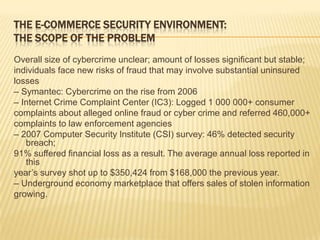
Overall size of cybercrime unclear; amount of losses significant but stable;
individuals face new risks of fraud that may involve substantial uninsured
losses
– Symantec: Cybercrime on the rise from 2006
– Internet Crime Complaint Center (IC3): Logged 1 000 000+ consumer
complaints about alleged online fraud or cyber crime and referred 460,000+
complaints to law enforcement agencies
– 2007 Computer Security Institute (CSI) survey: 46% detected security
   breach;
91% suffered financial loss as a result. The average annual loss reported in
   this
year’s survey shot up to $350,424 from $168,000 the previous year.
– Underground economy marketplace that offers sales of stolen information
growing.
THE DIFFERENT DIMENSIONS OF E-COMMERCE
SECURITY
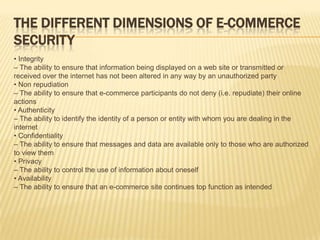
• Integrity
– The ability to ensure that information being displayed on a web site or transmitted or
received over the internet has not been altered in any way by an unauthorized party
• Non repudiation
– The ability to ensure that e-commerce participants do not deny (i.e. repudiate) their online
actions
• Authenticity
– The ability to identify the identity of a person or entity with whom you are dealing in the
internet
• Confidentiality
– The ability to ensure that messages and data are available only to those who are authorized
to view them
• Privacy
– The ability to control the use of information about oneself
• Availability
– The ability to ensure that an e-commerce site continues top function as intended
SECURITY THREATS IN THE E-COMMERCE
ENVIRONMENT
Three key points of vulnerability:
– Client
– Server
– Communications channel
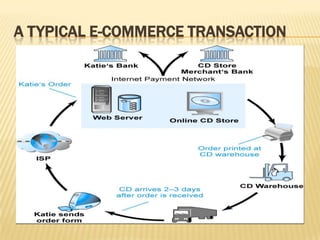
A TYPICAL E-COMMERCE TRANSACTION
MALICIOUS CODE
• Viruses:
– Have ability to replicate and spread to other files; most also deliver
   a “payload” of some sort (destructive or benign); include macro
   viruses, file-infecting viruses, and script viruses
• Worms:
– Designed to spread from computer to computer
• Trojan horse:
– Appears to be benign, but then does something other than
   expected
• Bots:
– Can be covertly installed on computer; responds to external
   commands sent by the attacker
UNWANTED PROGRAMS

Installed without the user’s informed consent
– Browser parasites: Can monitor and change
  settings of a user’s browser.
– Adware: Calls for unwanted pop-up ads
– Spyware: Can be used to obtain
  information, such as a user’s keystrokes, e-
  mail, IMs, etc.
PHISHING AND IDENTITY THEFT

Any deceptive, online attempt by a third party
  to obtain confidential information for financial
  gain
– Most popular type: e-mail scam letter
– One of fastest growing forms of e-commerce
  crime
HACKING AND CYBERVANDALISM
• Hacker: Individual who intends to gain
   unauthorized access to computer systems
• Cracker: Hacker with criminal intent (two terms
   often used interchangeably)
• Cyber vandalism: Intentionally disrupting,
   defacing or destroying a Web site
• Types of hackers include:
– White hats
– Black hats
– Grey hats
CREDIT CARD FRAUD

Fear that credit card information will be stolen
  deters online purchases
• Hackers target credit card files and other
  customer information files on merchant
  servers; use stolen data to establish credit
  under false identity
• One solution: New identity verification
  mechanisms
SPOOFING (PHARMING) AND SPAM (JUNK) WEB
SITES
Spoofing (Pharming)
– Misrepresenting oneself by using fake e-mail
  addresses or masquerading as someone
  else
– Threatens integrity of site; authenticity
Spam (Junk) Web sites
– Use domain names similar to legitimate
  one, redirect traffic to spammer redirection
  domains
DOS AND DDOS ATTACKS

Denial of service (DoS) attack
– Hackers flood Web site with useless traffic to
  inundate and overwhelm network
• Distributed denial of service (DDoS) attack
– Hackers use numerous computers to attack
  target network from numerous launch points
OTHER SECURITY THREATS
Sniffing: Type of eavesdropping program that
   monitors information traveling over a
   network; enables hackers to steal proprietary
   information from anywhere on a network
• Insider jobs: Single largest financial threat
• Poorly designed server and client software:
   Increase in complexity of software programs
   has contributed to increase is vulnerabilities
   that hackers can exploit
TECHNOLOGY SOLUTIONS

• Protecting Internet communications
  (encryption)
• Securing channels of communication
  (SSL, S-HTTP, VPNs)
• Protecting networks (firewalls)
• Protecting servers and clients
PROTECTING INTERNET COMMUNICATIONS:
ENCRYPTION
Encryption:
– Process of transforming plain text or data into cipher
   text that cannot be read by anyone other than the
   sender and receiver
• Purpose:
– Secure stored information and information
   transmission
• Provides:
– Message integrity
– Nonrepudiation
– Authentication
– Confidentiality

Important Notes

  • 1.
  • 2.
    THE E-COMMERCE SECURITYENVIRONMENT: THE SCOPE OF THE PROBLEM Overall size of cybercrime unclear; amount of losses significant but stable; individuals face new risks of fraud that may involve substantial uninsured losses – Symantec: Cybercrime on the rise from 2006 – Internet Crime Complaint Center (IC3): Logged 1 000 000+ consumer complaints about alleged online fraud or cyber crime and referred 460,000+ complaints to law enforcement agencies – 2007 Computer Security Institute (CSI) survey: 46% detected security breach; 91% suffered financial loss as a result. The average annual loss reported in this year’s survey shot up to $350,424 from $168,000 the previous year. – Underground economy marketplace that offers sales of stolen information growing.
  • 5.
    THE DIFFERENT DIMENSIONSOF E-COMMERCE SECURITY • Integrity – The ability to ensure that information being displayed on a web site or transmitted or received over the internet has not been altered in any way by an unauthorized party • Non repudiation – The ability to ensure that e-commerce participants do not deny (i.e. repudiate) their online actions • Authenticity – The ability to identify the identity of a person or entity with whom you are dealing in the internet • Confidentiality – The ability to ensure that messages and data are available only to those who are authorized to view them • Privacy – The ability to control the use of information about oneself • Availability – The ability to ensure that an e-commerce site continues top function as intended
  • 6.
    SECURITY THREATS INTHE E-COMMERCE ENVIRONMENT Three key points of vulnerability: – Client – Server – Communications channel
  • 7.
  • 8.
    MALICIOUS CODE • Viruses: –Have ability to replicate and spread to other files; most also deliver a “payload” of some sort (destructive or benign); include macro viruses, file-infecting viruses, and script viruses • Worms: – Designed to spread from computer to computer • Trojan horse: – Appears to be benign, but then does something other than expected • Bots: – Can be covertly installed on computer; responds to external commands sent by the attacker
  • 9.
    UNWANTED PROGRAMS Installed withoutthe user’s informed consent – Browser parasites: Can monitor and change settings of a user’s browser. – Adware: Calls for unwanted pop-up ads – Spyware: Can be used to obtain information, such as a user’s keystrokes, e- mail, IMs, etc.
  • 10.
    PHISHING AND IDENTITYTHEFT Any deceptive, online attempt by a third party to obtain confidential information for financial gain – Most popular type: e-mail scam letter – One of fastest growing forms of e-commerce crime
  • 11.
    HACKING AND CYBERVANDALISM •Hacker: Individual who intends to gain unauthorized access to computer systems • Cracker: Hacker with criminal intent (two terms often used interchangeably) • Cyber vandalism: Intentionally disrupting, defacing or destroying a Web site • Types of hackers include: – White hats – Black hats – Grey hats
  • 12.
    CREDIT CARD FRAUD Fearthat credit card information will be stolen deters online purchases • Hackers target credit card files and other customer information files on merchant servers; use stolen data to establish credit under false identity • One solution: New identity verification mechanisms
  • 13.
    SPOOFING (PHARMING) ANDSPAM (JUNK) WEB SITES Spoofing (Pharming) – Misrepresenting oneself by using fake e-mail addresses or masquerading as someone else – Threatens integrity of site; authenticity Spam (Junk) Web sites – Use domain names similar to legitimate one, redirect traffic to spammer redirection domains
  • 14.
    DOS AND DDOSATTACKS Denial of service (DoS) attack – Hackers flood Web site with useless traffic to inundate and overwhelm network • Distributed denial of service (DDoS) attack – Hackers use numerous computers to attack target network from numerous launch points
  • 15.
    OTHER SECURITY THREATS Sniffing:Type of eavesdropping program that monitors information traveling over a network; enables hackers to steal proprietary information from anywhere on a network • Insider jobs: Single largest financial threat • Poorly designed server and client software: Increase in complexity of software programs has contributed to increase is vulnerabilities that hackers can exploit
  • 16.
    TECHNOLOGY SOLUTIONS • ProtectingInternet communications (encryption) • Securing channels of communication (SSL, S-HTTP, VPNs) • Protecting networks (firewalls) • Protecting servers and clients
  • 17.
    PROTECTING INTERNET COMMUNICATIONS: ENCRYPTION Encryption: –Process of transforming plain text or data into cipher text that cannot be read by anyone other than the sender and receiver • Purpose: – Secure stored information and information transmission • Provides: – Message integrity – Nonrepudiation – Authentication – Confidentiality