Presidency School of Management & Comp.Sc.
Affiliated to Osmania University
Approved by All India Council for Technical Education –AICTE-New Delhi
Dept of Business Management -MBA-III-Semester
Sub: E-Global Business Paper Code: MB 302
Prepared by
Dr. Syed Valiullah Bakhtiyari
Professor-Business Management
https://www.academia.edu/126082786/E_Global_Business_Final_Notes
Course Objectives
1. To understand the fundamentals of e-commerce and its impact on global business.
1. To explore the challenges and opportunities associated with conducting
business in a digital environment.
2. To analyze the strategies and technologies used in e-global business.
2. To develop critical thinking and problem-solving skills in the context of e-global
business.
Learning Outcomes:
By the end of this course, students will be able to:
1. Identify and explain the key concepts and principles of e-global business.
1. Evaluate the impact of e-commerce on global business operations.
2. Analyze and develop strategies for conducting business in a digital environment.
3. Apply critical thinking skills to solve problems and make informed decisions related to e-
global business
Unit-I
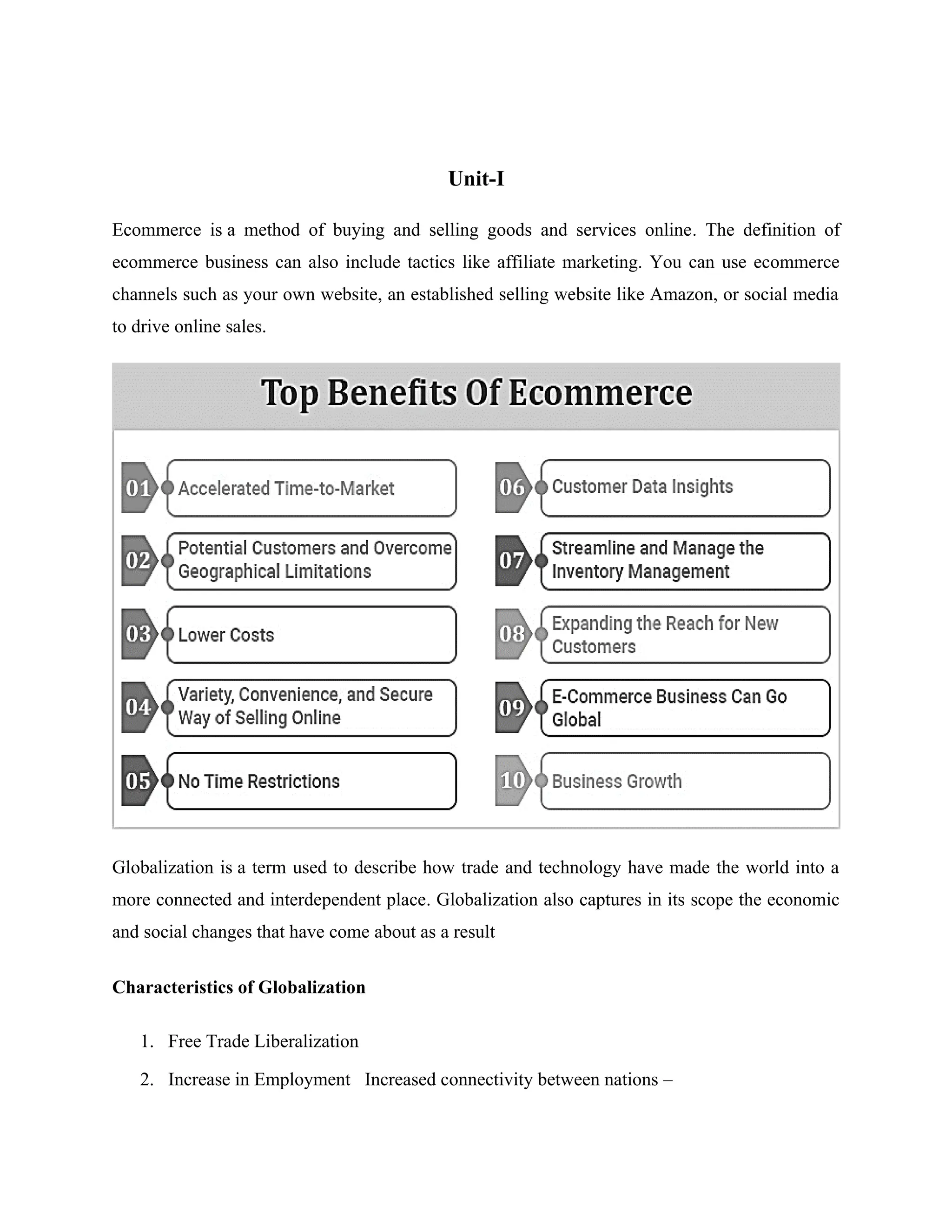
Ecommerce is a method of buying and selling goods and services online. The definition of
ecommerce business can also include tactics like affiliate marketing. You can use ecommerce
channels such as your own website, an established selling website like Amazon, or social media
to drive online sales.
Globalization is a term used to describe how trade and technology have made the world into a
more connected and interdependent place. Globalization also captures in its scope the economic
and social changes that have come about as a result
Characteristics of Globalization
1. Free Trade Liberalization
2. Increase in Employment Increased connectivity between nations –
3. Interdependence – CulturalExchange.
4. Urbanization Standard of Living Outsourcing
The digital economy is the worldwide network of economic activities, commercial
transactions and professional interactions that are enabled by information and
communications technologies (ICT). It can be succinctly summed up as the economy based
on digital technologies
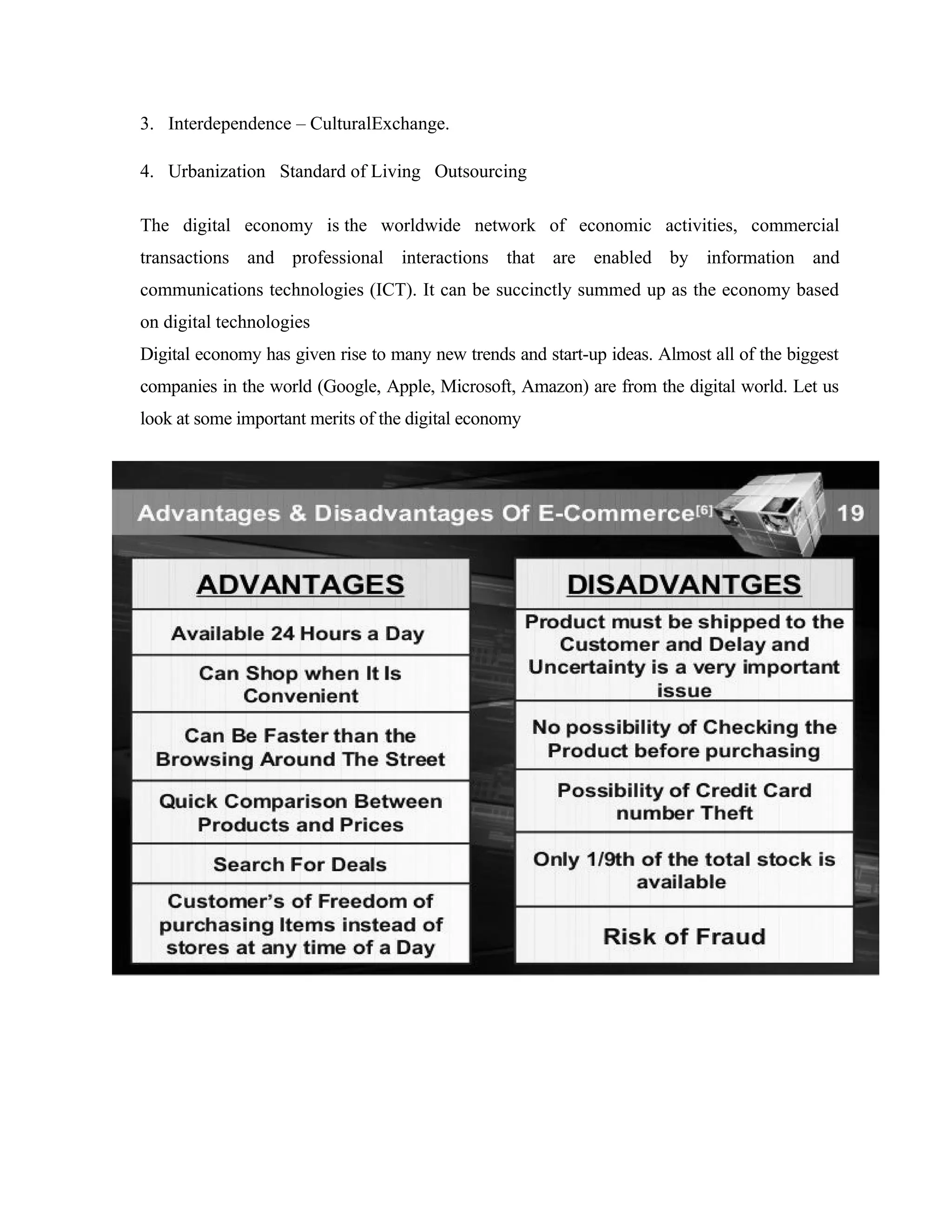
Digital economy has given rise to many new trends and start-up ideas. Almost all of the biggest
companies in the world (Google, Apple, Microsoft, Amazon) are from the digital world. Let us
look at some important merits of the digital economy
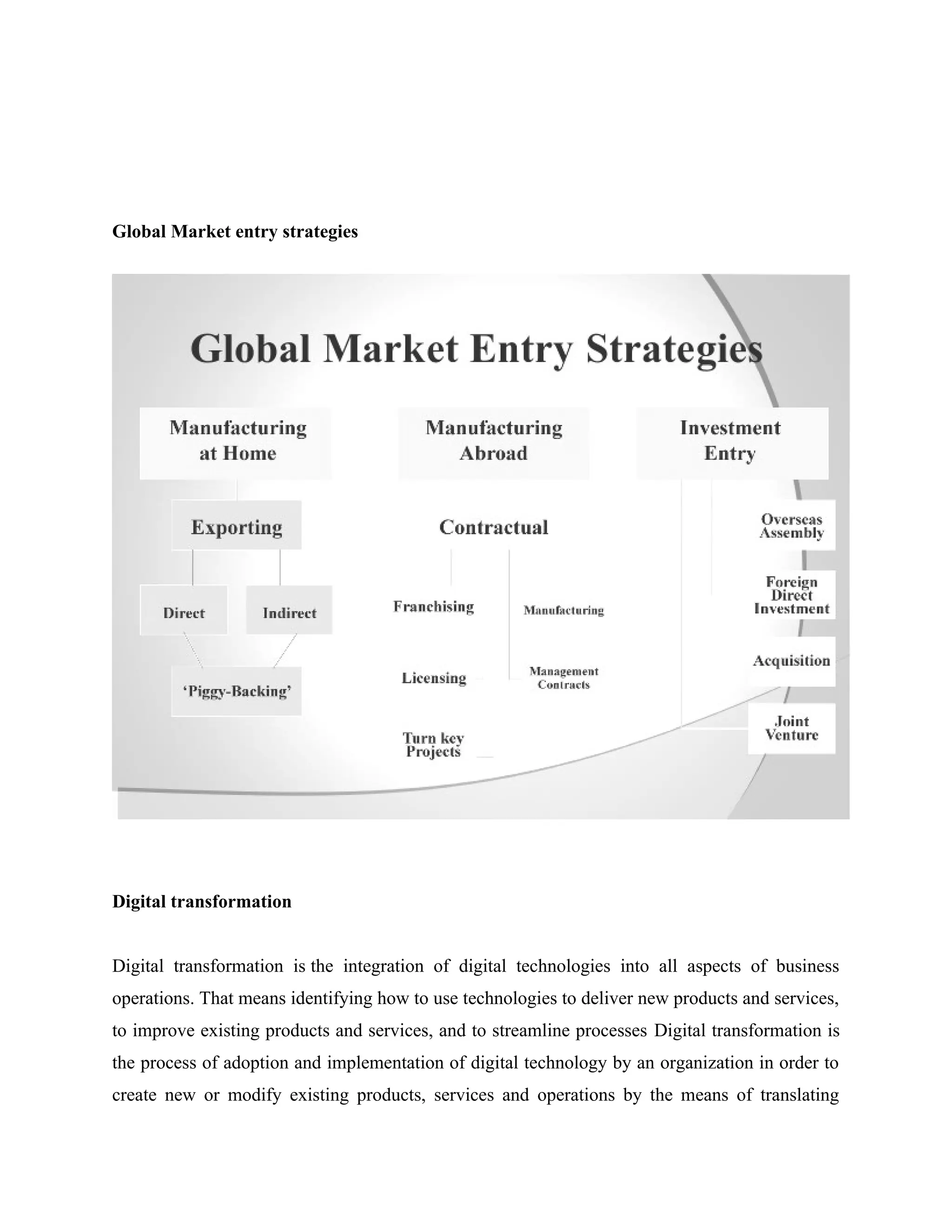
Global Market entry strategies
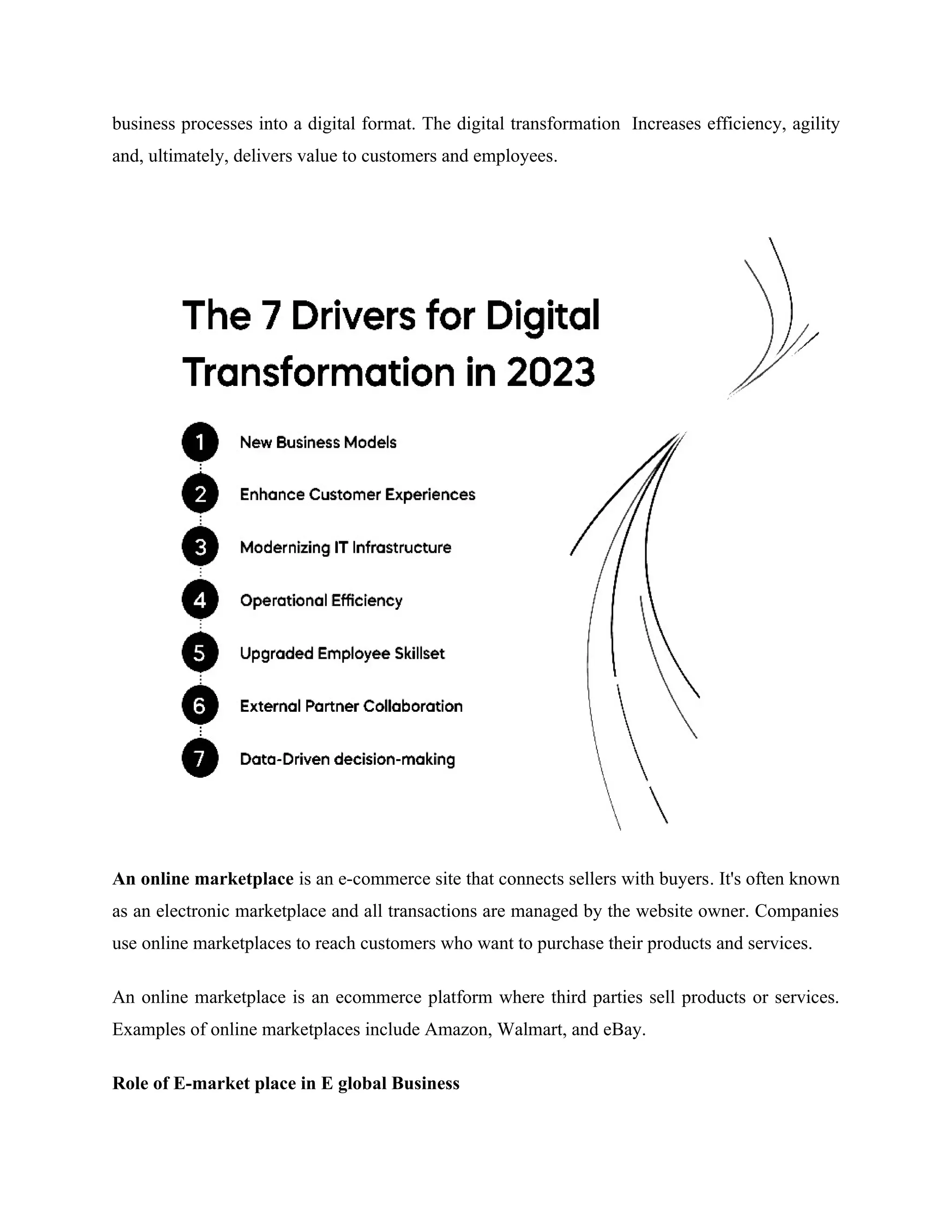
Digital transformation
Digital transformation is the integration of digital technologies into all aspects of business
operations. That means identifying how to use technologies to deliver new products and services,
to improve existing products and services, and to streamline processes Digital transformation is
the process of adoption and implementation of digital technology by an organization in order to
create new or modify existing products, services and operations by the means of translating
business processes into a digital format. The digital transformation Increases efficiency, agility
and, ultimately, delivers value to customers and employees.
An online marketplace is an e-commerce site that connects sellers with buyers. It's often known
as an electronic marketplace and all transactions are managed by the website owner. Companies
use online marketplaces to reach customers who want to purchase their products and services.
An online marketplace is an ecommerce platform where third parties sell products or services.
Examples of online marketplaces include Amazon, Walmart, and eBay.
Role of E-market place in E global Business
Through electronic marketplaces, firms can collaborate effectively, forecast demand, and share
strategic information across companies. If firms want to participate in electronic marketplaces
fully, they must initially integrate internal and external supply chain activities
Role of artificial intelligence in e business
 Artificial intelligence
What is artificial intelligence? Artificial intelligence (AI) is the ability of a computer or a robot
controlled by a computer to do tasks that are usually done by humans because they require
human intelligence and discernment
AI plays a crucial role in e-commerce by enabling businesses to analyze and understand
customer behavior patterns, enhance the shopping experience, and streamline various processes.
AI can help in product recommendations, chatbots, personalized promotions, fraud detection,
and more.
Legal Requirements of E-commerce business in India
 Company or LLP Registration-[Limited liability partnership]
Every business is required to get registered with the Ministry of Corporate Affairs under the
applicable laws. Such a business shall either be incorporated under the (Indian) Companies Act,
2013 or a foreign company or an office, branch or an agency outside India and necessarily be
owned or controlled by an Indian resident. Such registration ensures that the bank account is
opened in the name of the company/ LLP which in return shall make the process of GST
registration convenient and quicker.
 2. GST Registration
For a successful establishment of an E-commerce business, GST registration is mandatory. Every
E-commerce business irrespective of its turnover is required to be compulsorily registered under
the Central Goods & Service Tax (CGST) Act.
 3. Bank Account
Opening a bank account in the name of the business is a convenient process. In case of a
Proprietorship firm, the first step is to obtain a GST registration in the name of the business in
order to open a bank account. An active bank account is the bare minimum requirement to be
able to list a business on an E-commerce marketplace or to obtain a payment gateway for a
proprietary E-commerce website
 4. Payment Gateway
A payment gateway is mandatory for a proprietary E-commerce website to process the payments.
It allows the website to accept payments through credit card(s), debit card(s), net banking,
internet banking from multiple banks.
5. Legal Documents
If any business operates through online marketplaces, then the marketplace provides the seller
with a legal document or sellers’ agreement and the seller must abide by the sellers’ agreement.
It is important for any business to go through the sellers’ agreement(s) in detail before the
execution as it is the legal binding agreement between the seller and the marketplace.
Compliances for E-commerce business in India
The trend of E-commerce has been rapidly increasing since the last decade. Many players with
new business ideas have entered the market, be it Zomato/Swiggy delivering food from various
restaurants or Flipkart/Amazon delivering products or Grofers delivering groceries.
The scenario is such that you name the service and there is an E-commerce platform for it
available at the doorstep. The swift development of the E-commerce industry has called for the
attention of the government towards forming regulations and policies with respect to the same.
India has various laws that monitor E-commerce business in terms of data privacy, security of
consumers, settlement transaction safety, quality of products etc.
 2. Information Technologies Act, 2000
The E-commerce sellers conduct business in the same manner as the physical sellers with the
only distinction of non-availability of the physical body in order to sell things. Through E-
commerce, the vendors are required to generate bills, file returns, pay taxes, prepare ledgers and
maintain records. They must perform all the same on the online platform.
The Information Technology Act, 2000 (IT Act) is the primary legislation that governs the use of
the internet, cybercrime as well as the digital business in India. The IT Act governs online
behavior and related aspects of E-commerce and recognizes electronic contracts and digital
signatures. The Information Technology Act, 2000 is based on the Model Law of E-commerce
adopted by the United Nations Commission on International Trade Law (UNCITRAL) and acts
as a developing E-commerce enabling legislation in India. The Act targets regulating the use of
the internet by punishing the person for publishing any obscene information or hacking or
altering the data from devices of another person. The salient features of the Act are:
 E-contracts
 Transaction Security
 Digital signature
3. Payment and Settlements Systems Act, 2007
As per the Payment and Settlements Systems Act, the E-commerce business shall succeed as a
payment system if it follows the Rules specified by RBI, it is compulsory for an intermediary
that is receiving payments through digital modes to have an active account
4. Consumer Protection Act, 2019
The E-commerce industry is also monitored by the Consumer Protection Act . In order to
safeguard the consumers from unfair trade practices and solve their problems, the Ministry of
Consumer Affairs, Food and Public Distribution on May 17, 2021, has notified the Consumer
Protection (E-Commerce) Rules, 2021.
Innovations in E-Commerce
1. Real-Time Location-Based Mobile Selling
Real-time location-based selling technology allows retailers to target customers based on their
precise location and deliver personalized messages and offers in real time.
2. Super-Fast Delivery and Instant Pickup Counter
3. AI-Powered Personalization Leads generated by AI are boosting sales by 50%. Top-rated
firms tailor their advertising with AI 28% of the time. Here are some benefits of AI.
4. Voice-Powered Shopping
Voice-powered shopping is an emerging trend in e-commerce. According to a study, 51% of
mobile buyers look up things using their voice assistants. Here’s how it can be advantageous –
5. Shopping using AR Technology-[Augmented Reality]
 Enables customers to visualize products using their smartphones or tablets in a real-world
environment.
 Shopping using AR technology is an emerging trend in e-commerce that has the potential
to revolutionize the way customers shop and interact with retailers.
6. Blockchain Blockchain is a shared, immutable ledger that facilitates the process of recording
transactions and tracking assets in a business network. An asset can be tangible or intangible
8. Chatbots
A chatbot is a software application or web interface that aims to mimic human conversation
through text or voice interactions
9. Social Commerce
Social commerce (a subset of ecommerce) is the use of social media platforms like Facebook and
Instagram to market and sell products and services. This type of selling model lets customers
11. Remarketing
Remarketing is a powerful tool for e-commerce innovation that allows you to target customers
who have previously shown interest in your products or services.
12. Website Analytics
Web analytics is the collection, reporting, and analysis of website data.
13. E-wallet
E-wallet stands for electronic wallet. It is a type of electronic card which is used for transactions
made online through a computer or a Smartphone.
Digital entrepreneurs
An Internet entrepreneur is an owner, founder or manager of an Internet-based business. This list
includes Internet company founders and people brought on to companies for their general
business or accounting acumen, as is the case with some CEOs hired by companies started by
entrepreneurs. Digital entrepreneurs rely on digital technologies to establish and run their
businesses. They set up online storefronts to sell their goods, use social media platforms such as
Facebook to advertise, and monitor customer trends using tools such as Google Analytics. The
digital entrepreneur must understand the five pillars they are content, technology,user
experience, process, and organization. Digitalization improves productivity and efficiency,
lowering the cost of economic transactions.
Digital Startup
The revolution in mobile and internet opens the door for digital startups. If you have an awesome
idea convert it into mobile app or website, you will be a digital startup. Many digital startups are
playing to role of facilitator between two parties or helping hand for some services.Digital
startups are characterized by strong, fast, and scalable growth. It exploit the maximum potential
of digital marketing strategies and tools.
Digital startup process
 Assess the viability of your new business idea
 Develop a business plan and name it
 Take care of all the legal tasks
 Build your website and choose affiliate
 Develop and implement marketing strategies
 Launch your new business
Cyber Security
Computer security, cyber security, digital security or information technology security (IT
security) is the protection of computer systems, mobile and networks from attacks by malicious
actors that may result in unauthorized information disclosure, theft of, or damage
to hardware, software, or data, as well as from the disruption or misdirection of the services they
provide.
Types of cyber threats and challenges
1. Cybercrime includes single actors or groups targeting systems for financial gain
2. Cyber-attack often involves politically motivated information gathering.
3. Cyber terrorism is intended to undermine electronic systems to cause panic or fear.
4. Malware Malware means malicious software. One of the most common cyber threats,
malware is software that a cybercriminal or hacker has created to disrupt or damage a legitimate
user’s computer.
5. Virus: A self-replicating program that attaches itself to clean file and spreads throughout a
computer system, infecting files with malicious code.
6. Trojans: A type of malware that is disguised as legitimate software
7. Spyware: A program that secretly records what a user does, so that cybercriminals can make
use of this information. For example, spyware could capture credit card details.
8. Ransomware: Malware which locks down a user’s files and data
9. Adware: Advertising software which can be used to spread malware.·
10.BotnetsNetworks of malware infected computers which cybercriminals use to perform tasks
online without the user’s permission.
Types of Cyber security soft wares
 Network security is the practice of securing a computer network from intruder
 Application security focuses on keeping software and devices free of threats
 ·Information security protects the integrity and privacy of data,
 ·Operational security includes the processes and decisions for handling and protecting
data assets.
Protect Yourself from Cyber Crime
1. Ensure your system is Up-to-date. ...
2. Use a Secure Internet Connection. ...
3. Use Strong Password. , Be Aware of Pop-ups and Fraudulent Emails. ...
4. Protect yourself from identity threats, Manage Your Social Media Settings. ...
5. Get Right Cyber Insurance Policy.
Impact of social media on global business
Social media refers to the means of interactions among people in which they create, share, and/or
exchange information and ideas in virtual communities and networks. The Office of
Communications and Marketing manages the main Facebook, Twitter, Instagram, LinkedIn and
YouTube accounts.
The Impacts are as follows
 Allows Businesses to Become Omni-Present
 Increases Personalization
 Generates More Loyalty
 Increases Industry Collaboration
 Adds Credibility
 Increases Referrals
 Helps You Build a Personal Brand
 Helps You get Audience Feedback
 Brand-loyalty, Easy-communication, Increased-customer-power
 Attract-bigger-audience, Creates-word-of-mouth
 Reducing-marketing-and-promotional-costs
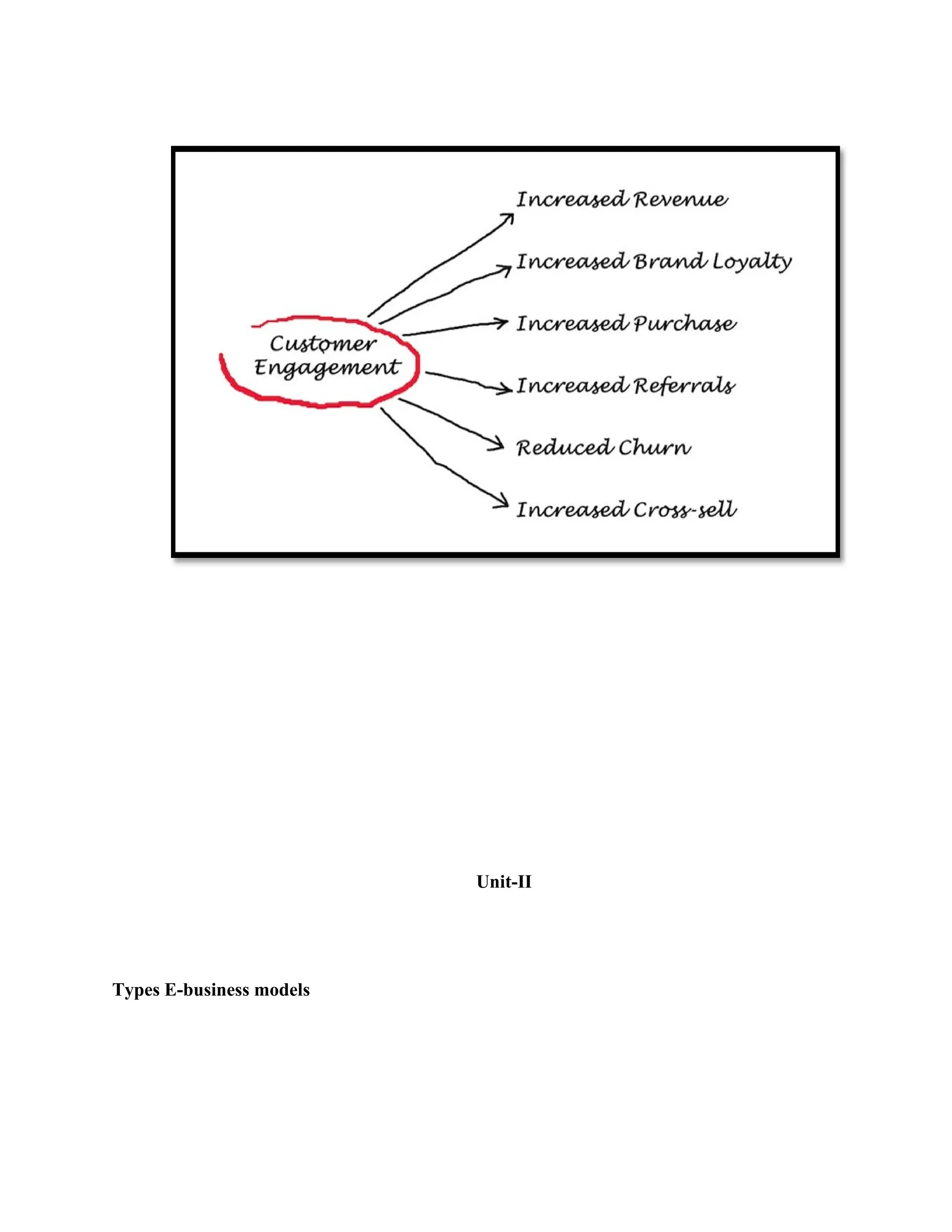
Customer engagement
Customer engagement is the way a company creates a relationship with its customer base to
foster brand loyalty and awareness. This can be accomplished via marketing campaigns and web
content as well as outreach using social media, mobile devices and wearable devices. The
purpose of customer engagement is improving customer experience and satisfaction, building
customer loyalty and trust, and harnessing the power of customer feedback and insights, which
ultimately decreases the customer migration.
Unit-II
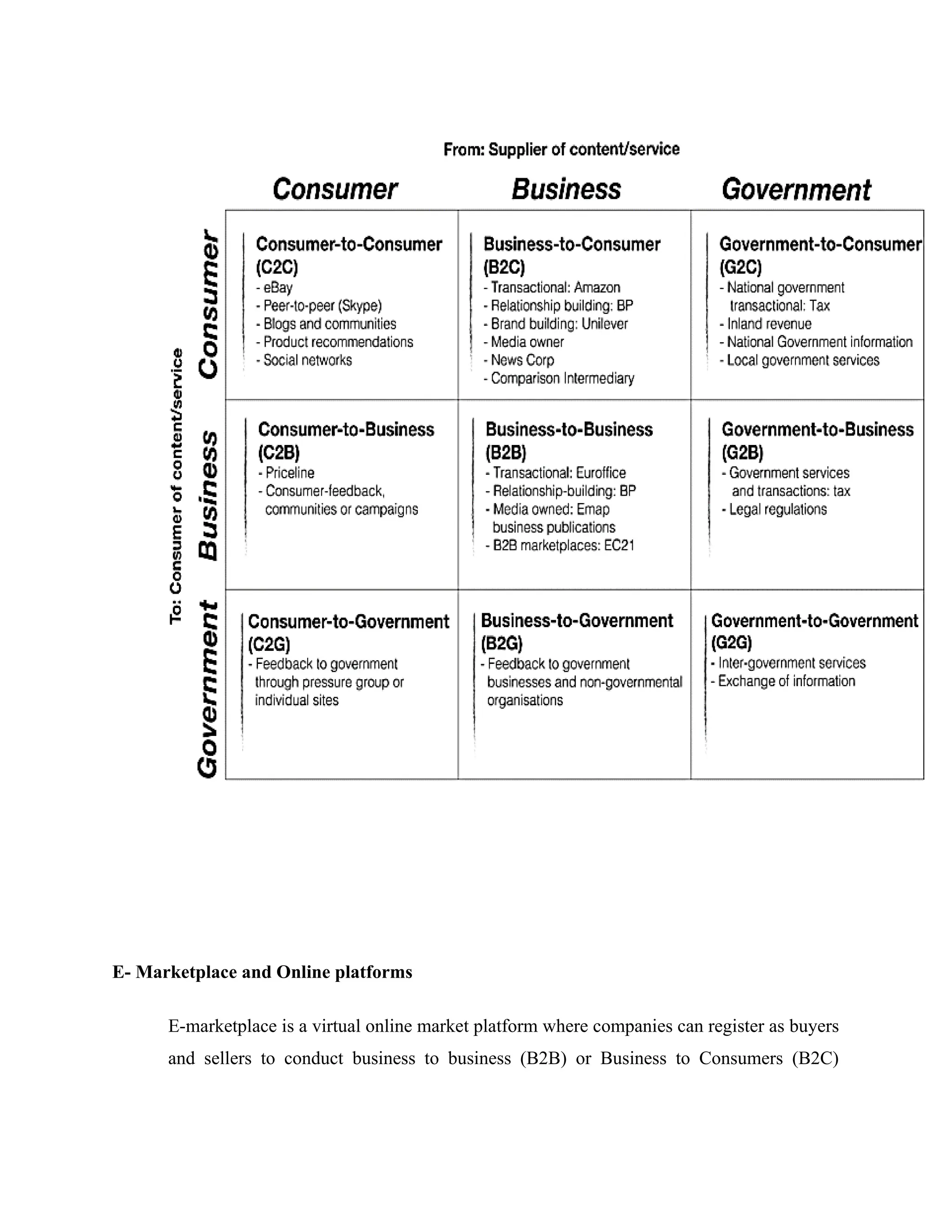
Types E-business models
E- Marketplace and Online platforms
E-marketplace is a virtual online market platform where companies can register as buyers
and sellers to conduct business to business (B2B) or Business to Consumers (B2C)
transactions over the internet. It enables the buyers to compare various products and
services by different measures like performance, quality, price etc.
Famous e-Commerce marketplaces
 Amazon, eBay, Walmart , Decathlon , Flipkart , Meesho
 Myntra, Snapdeal, ShopClues, Limeroad
Types of E-market Places
 Business-to-business (B2B): In this marketplace, one business offers its services and
products to other businesses. The aim is not to find as many clients as possible but to
create robust supply chains and long-term relationships. Examples of such marketplaces
are Justdial.com and Indiamart.com.
 Business-to-customer (B2C): B2C marketplaces deal directly with the end customers.
Here, the main goal is to acquire as many customers as they can to generate sales.
Examples are Amazon.com, eBay.com, and Aliexpress.com.
 Customer-to-customer (C2C): This marketplace connects the seller directly with the
buyer and lets them negotiate for the products or services. An example of a C2C
marketplace is Semexe.com.
Challenges for e-market places
 Data security: Online marketplaces hold the personal data of millions of customers,
which are susceptible to cyber-attacks. Marketplaces need robust security systems to
avoid data breaches through brute force attacks.
 Customer loyalty: It is difficult and expensive to acquire customers, but it is easy to lose
them if you lack a retention strategy. With a bunch of choices available, it is a buyer’s
market.
 Price competition: Marketplaces not only have to compete with other marketplaces but
also provide the right balance of price so that they can serve both the supplier and the
customer appropriately.
 Inventory management: Businesses must forecast the demand in real time to prevent
shortfall or overstocking products in their warehouses.
 Return, refunds, and fulfilment: Fulfilment is just the first step. Managing refunds and
returns and taking care of possible fraud is another. Marketplaces need technology to
track returns and refunds and avoid fraud.
Digital marketing and Customer relationship Management
Digital marketing, also called online marketing, is the promotion of brands to connect
with potential customers using the internet and other forms of digital communication.
This includes not only email, social media, and web-based advertising, but also text and
multimedia messages as a marketing channel
7 C's of digital marketing
The 7 Cs- customer, content, context, community, convenience, cohesion, conversion.
Various types of digital marketing
Digital marketing can be broadly classified into eight main categories
1. Affiliate marketing, 2.content marketing, 3.email marketing, 4.marketing analytics,
5.mobile marketing, 6.pay-per-click, 7.search engine optimization and 8.social media
marketing.
CRM in digital marketing
Customer Relationship Management (CRM) is a strategy that companies use to manage
interactions with customers and potential customers. CRM helps organizations streamline
processes, build customer relationships, increase sales, improve customer service, and
increase profitability, the application of digitization in CRM helps in targeting only
potential customers, saving time and effort and improving marketing campaign
efficiency.
Benefits of using CRM in Digital Marketing
1. Personalization, Increased
2. ROI ,Improved customer engagement.
3. Additional data for sales
4. Attribution –Revenue by sales and marketing teams
5. Marketing Automation - Automate some of your marketing tasks to focus on the things
that matter.
E-commerce Payment System in Global Business
A List of E-commerce Payment Systems
Debit--Card
A debit card is a card with unique credentials and is linked to the customer’s bank account. A
debit card deducts money from the user's bank account instantly at the time of the transaction
Credit--Cards
Credit cards are the most popular form of payment for e-commerce transactions. Enabling credit
card payments on your website can enable customers to shop without having to worry about
paying upfront.
E-Wallet
The E-Wallet can be thought of as a prepaid account that enables users to store a variety of debit
cards, credit cards, and other payment methods in a safe environment without having to enter
their credentials each time they wish to make a purchase
Smart—Card It has the ability to store money as well as a person's personal and professional
information. Faster processing is possible with smart cards at lower rates.
Online—banking Customers can conveniently make purchases by paying with a bank account
directly.
Mobile—Payment Customers may easily and quickly use mobile payment to make purchases
using their smartphones. A user only needs to download a mobile payment app from the
applications store.
Subscription based business models
A subscription business model is a recurring revenue model in which customers pay a weekly,
monthly, or yearly fee in exchange for your products or services. Customers can renew their
subscription after a certain period of time. The fees paid for subscriptions is called as recurring
revenues for the company
Benefits of a subscription business model
o Predictable revenue stream
o Recurring revenue
o Stronger & long-term customer relationships
o Lower customer retention spend
o Easier demand forecasting
Examples
Netflix and Spotify, Adobe and Microsoft, Magazine subscriptions, Zomato, Uber, Swiggyetc
Recurring Revenue
Recurring revenues through billing is an amount usually fixed for a product or service regularly.
The billing cycle frequency can be monthly, quarterly, or annually or more
Recurring revenue Strategies
 Predetermined Service Charges over a Specific Period
 Automatic Renewal of Subscriptions
 Scheduled Billing Based on Product Usage
 Per-User Billing Model
 Free Lifetime Access to Basic Product or Service Plan
Collaborative consumption or sharing economy
 Collaborative consumption is considered part of the sharing economy, Collaborative
consumption is the shared use of a good or service by a group. Collaborative
consumption differs from conventional consumption in that resources, goods, or services
are shared by a group rather than individuals. Ex: Airbnb, Airbnb,[Air Bed and
Breakfast,” is a service that lets property owners rent out their spaces to travelers looking
for a place to stay]and ride-sharing applications, car pooling
Benefits of the collaborative economy
 Greater supply: Individuals who market goods and services increase options for people
looking to travel or buy items like household appliances, clothing and bicycles.
 Savings: The items we find in collaborative consumption businesses are usually cheaper.
 Sustainability: This exchange between consumers increases the useful life of the items
we buy. Because we reuse them, there’s no need to manufacture new things.
 Care for the environment: Choosing services like collaborative transport and giving
new life to used items to prevent overproduction and use finite resources more efficiently
helps us care for the environment.
Digital marketing
Digital marketing, also called online marketing, is the promotion of brands to connect with
potential customers using the internet and other forms of digital communication. This includes
not only email, social media, and web-based advertising, but also text and multimedia messages
as a marketing channel.
Digital marketing strategies
Search engine optimization
Defines it as “the art and science of making web pages attractive to search engines.” the most
important elements to consider when optimizing a web page for search engines include:
 Quality of content Level of user engagement Mobile-friendliness Number and
quality of inbound links
Content marketing
A strategy based on the distribution of relevant and valuable content to a target audience, the
goal of content marketing is to attract leads that ultimately convert into customers. Blog posts
 E-books Newsletters Video or audio transcripts
Social media marketing
Social media marketing means driving traffic and brand awareness by engaging people in
discussion online. The most popular digital platforms for social media marketing are Face book,
Twitter, and Instagram, with LinkedIn and YouTube not far behind.
Pay-per-click marketing
Pay-per-click, or PPC, is a form of digital marketing in which you pay a fee every time someone
clicks on your digital ads. So, instead of paying a set amount to constantly run targeted ads on
online channels, you only pay for the ads individuals interact with.
Affiliate marketing
Affiliate marketing is a digital marketing tactic that lets someone make money by promoting
another person's business. You could be either the promoter or the business who works with the
promoter, but the process is the same in either case.
Influencer marketing
Like affiliate marketing, influencer marketing relies on working with an influencer–an individual
with a large following, such as a celebrity
Marketing automation
Marketing automation uses software to power digital marketing campaigns, improving the
efficiency and relevance of advertising.
Email marketing
The concept of email marketing is simple—you send a promotional message and hope that your
prospect clicks on it. However, the execution is much more complex.
Mobile marketing
Mobile marketing is a digital marketing strategy that allows you to engage with your target
audience on their mobile devices, such as smart phones and tablets. This can be via SMS and
MMS messages, social media notifications, mobile app alerts, and more.
The benefits of digital marketing
Strategies for online communities to drive customers’ loyalty
Online communities have become a necessary business asset that contributes to the agile growth
of an organization. They serve as a major source of information for all participants. Through this
network, businesses can easily address their customers’ queries, acknowledge their inputs, and
receive constructive feedback. The online communities can increase customer satisfaction,
retention, and lifetime value by creating a sense of belonging, recognition, and reward.
Moreover, it can generate positive word-of-mouth, referrals, and testimonials by encouraging
customers to share their experiences.
 Invest in curating engaging content:
 Be responsive to change
 Be a part of the customer’s journey
 Reward your customers (gamification
 Encourage self-support
Unit –III Unit
Supply chain management in a digital environment
It is interdisciplinary approach which involves application of digital technologies for leveraging
the tasks of supply chain management in e-global business. The application enhances the
performance level by multifold which results in not only attraction of customers but retain the
customers which in turn provides sustainability for business.
Various digital applications on supply chain management
 Internet of things Applied in the manufacturing facilities of SCMO
 Artificial intelligence Used to tracks the customer data base and read market trends
 Inventory visibility To endure buffer stock and plan the inventory replenishment cycle
 Automation ; Used in the packaging, labelling and shipment units of scm
 Demand forecasting ; Various software used for predictive analytics of market
 Enterprise resource planning software : widely used digital application helps in proper
planning from procurements to production to shipments
 Integrated supply chain : Helps in obtaining seamless supply chain and ensure un-
interrupted supply of information, products and cash
 RFID It is used mainly for the process of tracking the shipments and transportation fleet
to endure no abnormalities in supply chain
 Order fulfilment ; This will help in maintaining zero back order and reduces lead time
 Warehouse management systems : It helps in proper utilization of warehouse space and
also in categorizing the inventories into various categories and ensure proper safety of
inventory
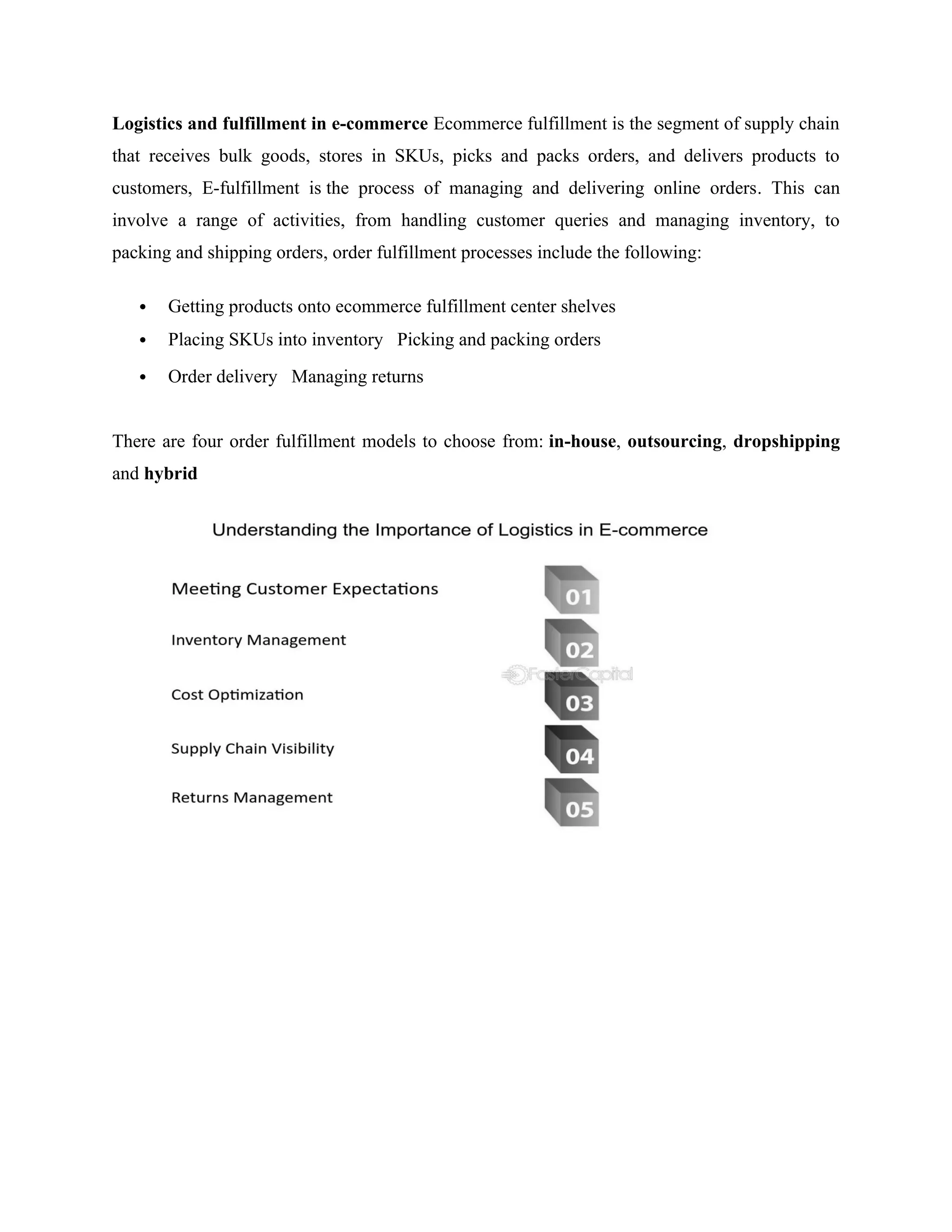
Logistics and fulfillment in e-commerce Ecommerce fulfillment is the segment of supply chain
that receives bulk goods, stores in SKUs, picks and packs orders, and delivers products to
customers, E-fulfillment is the process of managing and delivering online orders. This can
involve a range of activities, from handling customer queries and managing inventory, to
packing and shipping orders, order fulfillment processes include the following:
 Getting products onto ecommerce fulfillment center shelves
 Placing SKUs into inventory Picking and packing orders
 Order delivery Managing returns
There are four order fulfillment models to choose from: in-house, outsourcing, dropshipping
and hybrid
Cross-culture management is the process of managing and leading individuals from different
cultural backgrounds in a way that respects and leverages the unique perspectives and values of
each culture. It involves understanding and appreciating the cultural differences among team
members and using this knowledge to communicate effectively, make decisions, and resolve
conflicts.
Cross-culture management includes understanding and managing cultural differences in
communication styles, decision-making processes, leadership styles, and work-related values and
norms. It also involves understanding the impact of culture on business practices, such as
negotiation styles and approaches to risk.
Cross-cultural management is the art of recognizing, comprehending and navigating cultural
differences within the business world. It requires an in-depth exploration of the complex network
of beliefs, values, behavioral norms, communication styles, and business customs across
different cultures.Cultural diversity in customer service allows businesses to understand and
respect the differences among customers. Each culture has its unique values, customs, traditions,
and communication styles. Businesses can train their customer service representatives to be
aware of these differences.
Benefits Of Cross Culture Management
1. Increased Creativity And Innovation
2. Enhanced Understanding Of Global Markets
3. Greater Adaptability And Flexibility
4. Improved Relationships And Teamwork
5. Greater Ability To Attract And Retain Top Talent
6. Improved Problem-Solving And Decision-Making
Warehouse automation and robotics in e-commerce fulfilment,
Warehouse automation refers to using technology to automate tasks and processes in a
warehouse or distribution center. By integrating cutting-edge technologies such as robotics,
artificial intelligence (AI), and data analytics, automation makes warehouses and fulfillment
centers work better and faster.Warehouse automation can encompass a wide range of functions,
including inventory management, picking and packing, sorting, loading, and unloading, and even
transportation within the warehouse. It optimizes operations, reduces manual labor, and enhances
productivity.
Types of warehouse automation used in E-commerce fulfillment
 Order Picking Automation
 Autonomous Mobile Robots (AMRs)
 Fixed Automation
 Sorting
 Packing automation
 Replenishment
Reverse logistics and managing returns in e global business?
The reverse logistics process comprises processing, tracking, and transporting the return,
storing it, and handling disposal options. AI, automation, big data, and IoT can enable
organizations to reduce the costs associated with returns processing and optimize the
process
Types of reverse logistics
 Returns management. ...
 Remanufacturing or refurbishment. ...
 Packaging management. ...
 Unsold goods. ...
 Delivery failure. ...
 Rental equipment. ...
 Repairs and maintenance. ...
 End of life.
Intellectual property rights and protection in digital transactions
Intellectual property (IP) rights represent one of the most significant legal frameworks in the
modern world, safeguarding the creations of the mind, from literary works and inventions to
brand names and designs. Within this vast domain of IP rights, copyright emerges as a
specific category focused primarily on protecting creative works. With the rise of digital
technology and the proliferation of online content, the relationship between copyright and
digital intellectual property rights has become increasingly intertwined and, at times,
complex. The significance of digital intellectual property rights are as follows
 Fostering Creativity and Innovation: DIPR provides a safety net for creators and
innovators. By ensuring that they have exclusive rights to their creations,
 Economic Incentives and Growth: Digital creations drive a significant portion of
today’s economy. Apps, digital media, e-commerce platforms, and online services
generate billions in revenue.
 Establishing Trust in Digital Transactions
 Protecting Consumer Rights
 Facilitating Global Collaboration
Customer data privacy and compliance with data protection regulations
Customer data protection is a strategy businesses use to keep customer data safe from
cybercriminals, internal negligence, and other breaches. This can involve network security,
password protection, and data encryption procedures.
Data privacy defines who has access to data, while data protection provides tools and policies to
actually restrict access to the data. Compliance regulations help ensure that user's privacy
requests are carried out by companies, and companies are responsible to take measures to protect
private user data.
Implement strong passwords, MFA(Multi factor authentication) and RBAC(role based access
control) to prevent unauthorized access. Encrypt data at rest and in transit to protect it from
unauthorized access or manipulation. Apply patches and updates promptly to ensure database
software is up-to-date and secure against known vulnerabilities.
General Data Protection Regulation GDPR
GDPR stands for General Data Protection Legislation. It is a European Union (EU) law that
came into effect on 25th May 2018. GDPR governs the way in which we can use, process, and
store personal data (information about an identifiable, living person).
Principles of GDPR
 Lawfulness
 fairness, and transparency;
 Purpose limitation;
 Data minimization;
 Accuracy;
 Storage limitation;
 Integrity and confidentiality; and ▪ Accountability.
Cloud computing and its role
Cloud computing is the on-demand delivery of computing services such as servers, storage,
databases, networking, software, and analytics. Cloud-based storage makes it possible to save
files to a remote source. Cloud data storage platforms include Google Drive, Dropbox,
OneDrive,
The 4 types of cloud computing are private clouds, public clouds, hybrid clouds, and multi-
clouds. There are also 3 types of cloud computing services: Infrastructure-as-a-Service (IaaS),
Platforms-as-a-Service (PaaS), and Software-as-a-Service (SaaS)
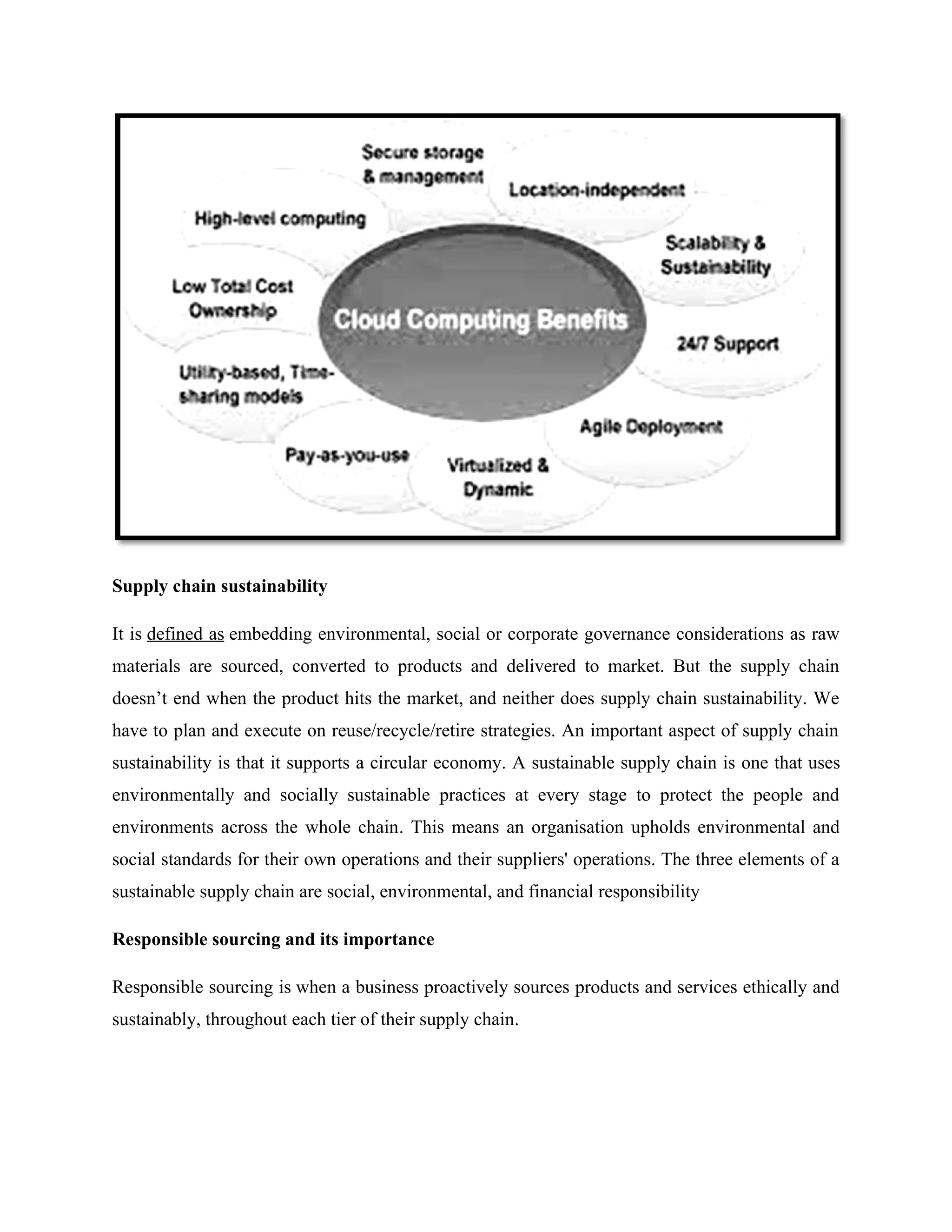
Role of Cloud computing in E global Business
Supply chain sustainability
It is defined as embedding environmental, social or corporate governance considerations as raw
materials are sourced, converted to products and delivered to market. But the supply chain
doesn’t end when the product hits the market, and neither does supply chain sustainability. We
have to plan and execute on reuse/recycle/retire strategies. An important aspect of supply chain
sustainability is that it supports a circular economy. A sustainable supply chain is one that uses
environmentally and socially sustainable practices at every stage to protect the people and
environments across the whole chain. This means an organisation upholds environmental and
social standards for their own operations and their suppliers' operations. The three elements of a
sustainable supply chain are social, environmental, and financial responsibility
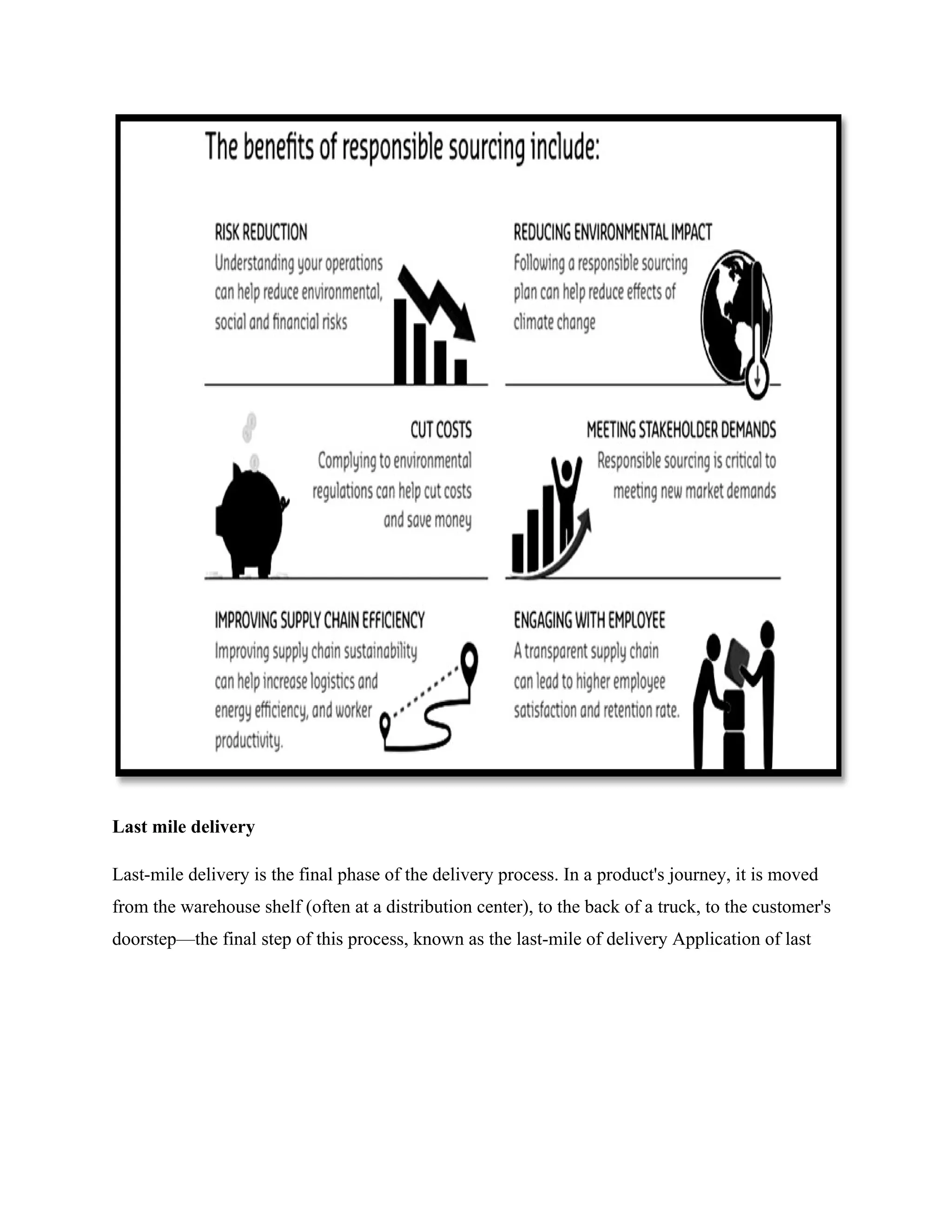
Responsible sourcing and its importance
Responsible sourcing is when a business proactively sources products and services ethically and
sustainably, throughout each tier of their supply chain.
Last mile delivery
Last-mile delivery is the final phase of the delivery process. In a product's journey, it is moved
from the warehouse shelf (often at a distribution center), to the back of a truck, to the customer's
doorstep—the final step of this process, known as the last-mile of delivery Application of last
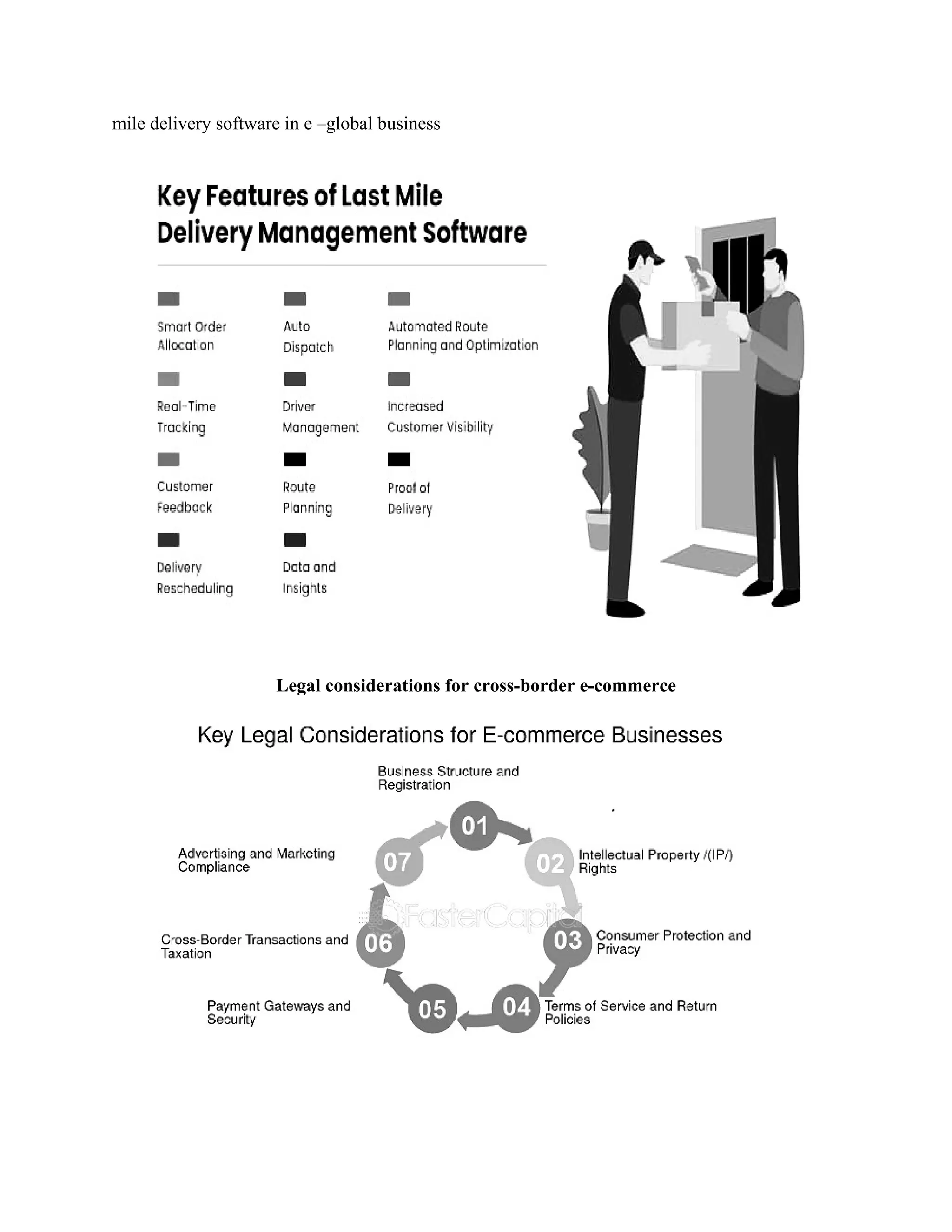
mile delivery software in e –global business
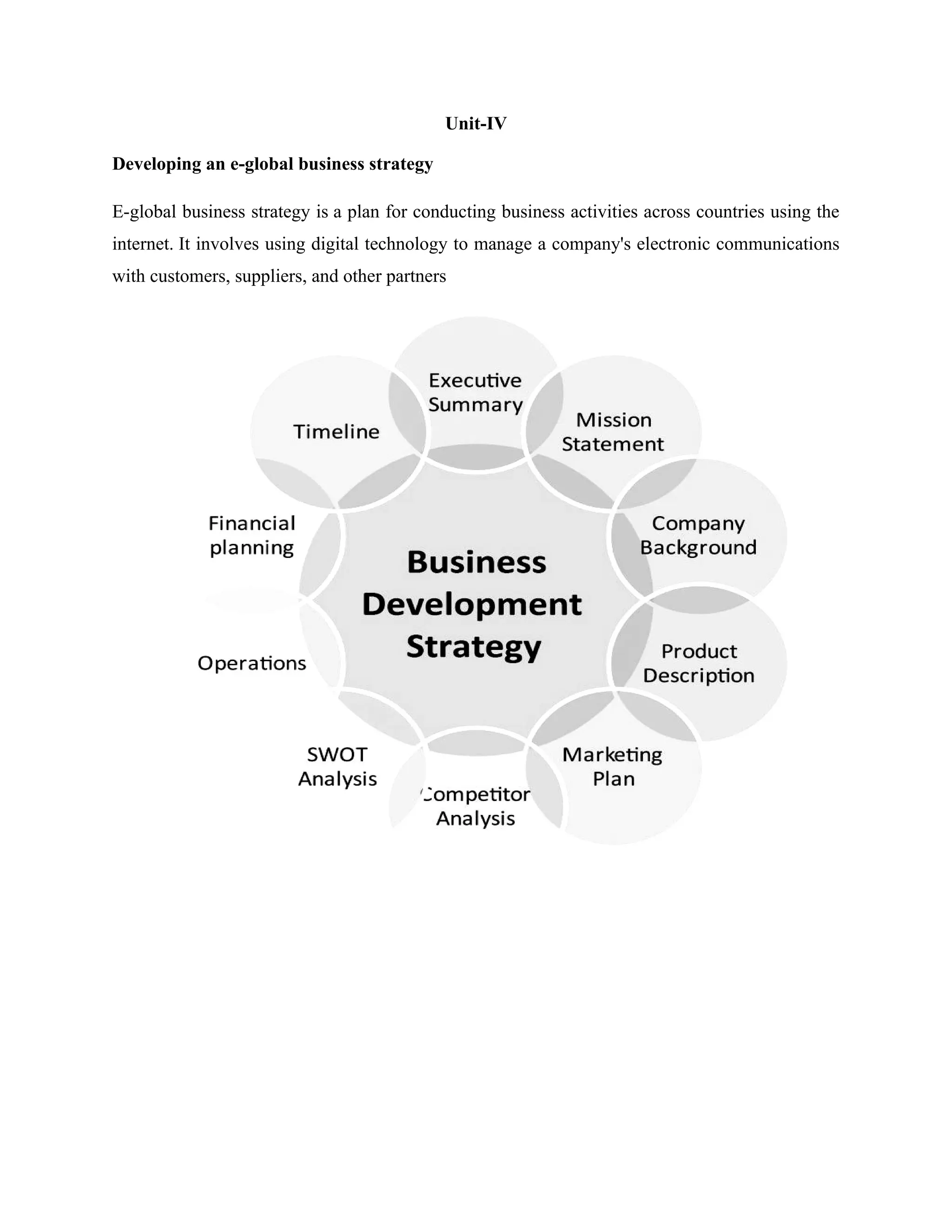
Legal considerations for cross-border e-commerce
Risk management in e-business
Risk management is the systematic process of identifying, assessing, and mitigating threats or
uncertainties that can affect your organization. It involves analyzing risks' likelihood and impact,
developing strategies to minimize harm, and monitoring measures' effectiveness
Types of e-business risks
Transaction risks, Data storage and transmission risks, Risks to Intellectual Property
and Privacy, Security Breaches, Refunds and client disputes, Low SEO ranking, DDOS
attacks "Distributed Denial-of-Service (DDoS) Attack, Inadequate authentication methods
Unit-IV
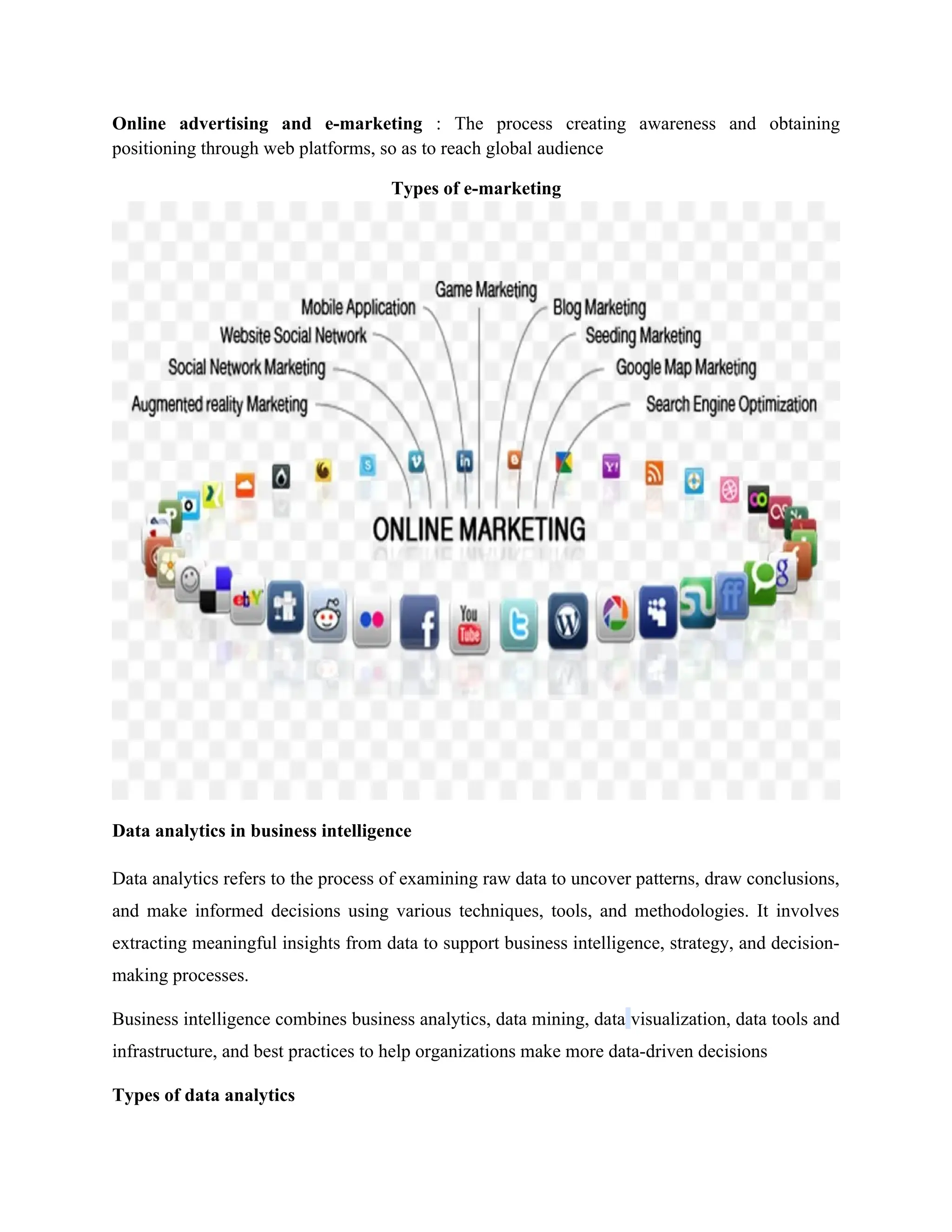
Developing an e-global business strategy
E-global business strategy is a plan for conducting business activities across countries using the
internet. It involves using digital technology to manage a company's electronic communications
with customers, suppliers, and other partners
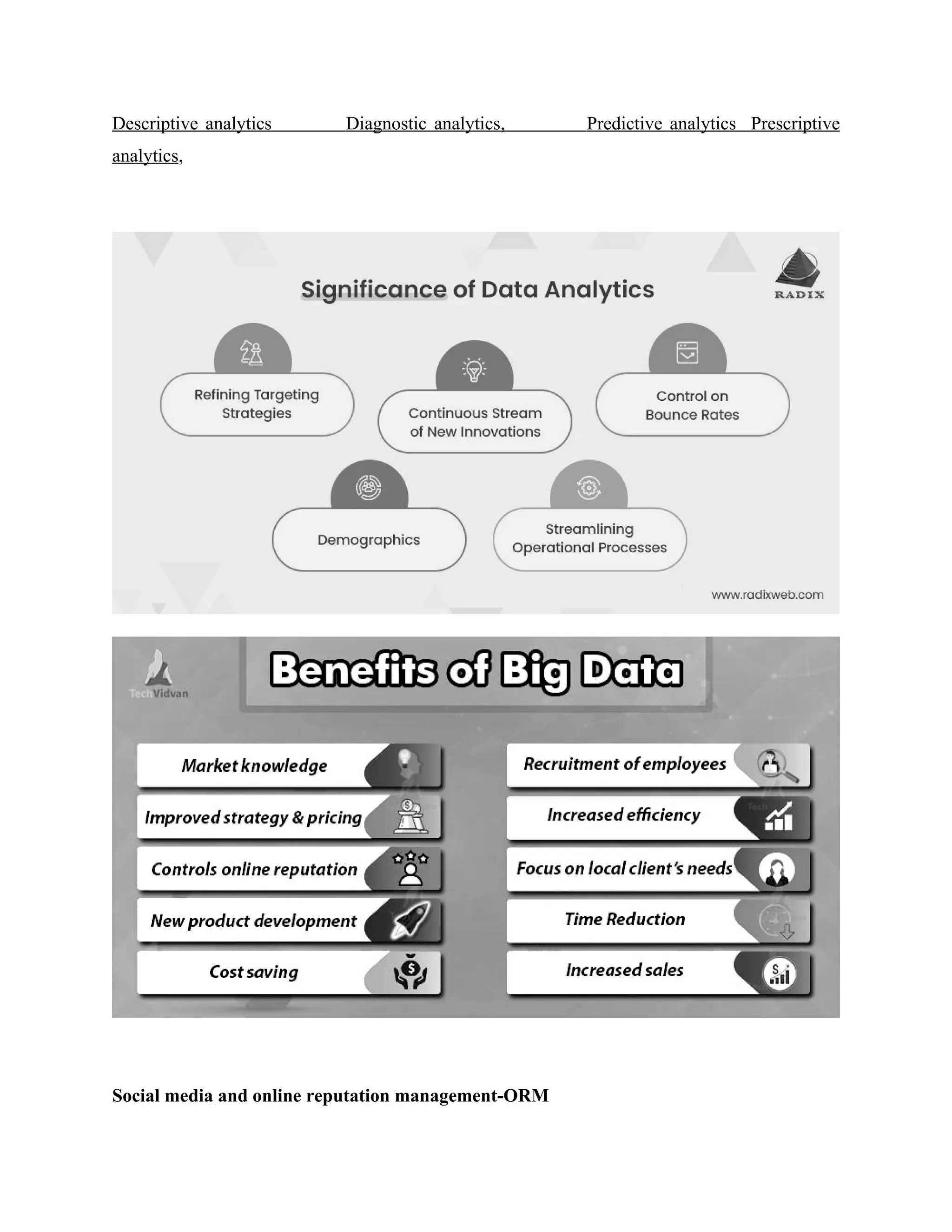
Online advertising and e-marketing : The process creating awareness and obtaining
positioning through web platforms, so as to reach global audience
Types of e-marketing
Data analytics in business intelligence
Data analytics refers to the process of examining raw data to uncover patterns, draw conclusions,
and make informed decisions using various techniques, tools, and methodologies. It involves
extracting meaningful insights from data to support business intelligence, strategy, and decision-
making processes.
Business intelligence combines business analytics, data mining, data visualization, data tools and
infrastructure, and best practices to help organizations make more data-driven decisions
Types of data analytics
Descriptive analytics Diagnostic analytics, Predictive analytics Prescriptive
analytics,
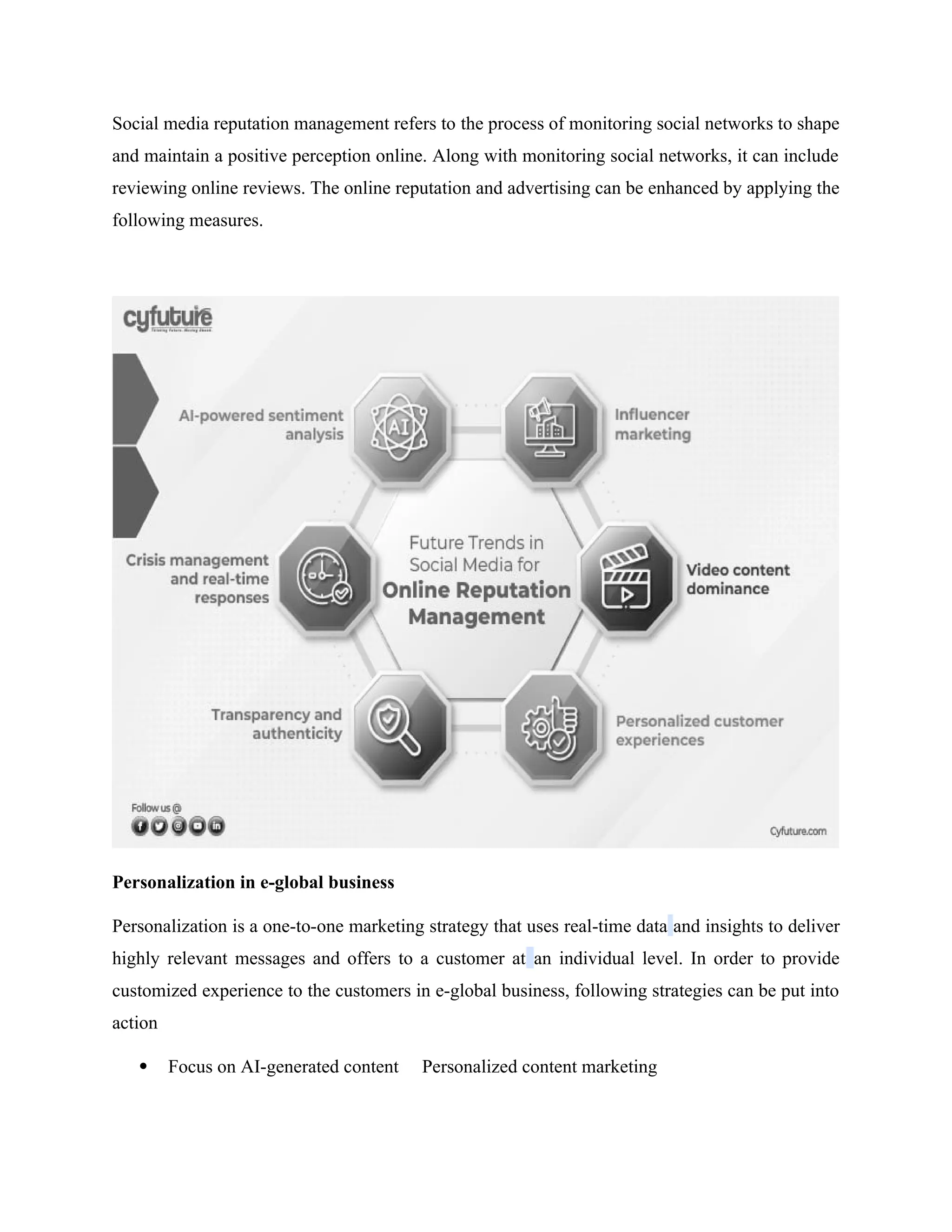
Social media and online reputation management-ORM
Social media reputation management refers to the process of monitoring social networks to shape
and maintain a positive perception online. Along with monitoring social networks, it can include
reviewing online reviews. The online reputation and advertising can be enhanced by applying the
following measures.
Personalization in e-global business
Personalization is a one-to-one marketing strategy that uses real-time data and insights to deliver
highly relevant messages and offers to a customer at an individual level. In order to provide
customized experience to the customers in e-global business, following strategies can be put into
action
 Focus on AI-generated content Personalized content marketing
 Behavioral targeting Product recommendations Customized email marketing
 Targeted discounts Geo-targeting Loyalty programs Omni channel personalization
 Leverage customer data effectively Chat-bots and virtual assistants Display recently
viewed items
User experience (UX) design and its role in enhancing online conversions
(UX) is the practice of creating a seamless, enjoyable shopping experience in an online store. It
involves designing a website, optimizing navigation and search functionality, and streamlining
the checkout process so that customer needs are anticipated.
Techniques to improve user experience
 Simplify the web design.
 Optimize website speed
 Enhance mobile responsiveness
 Improve website accessibility and navigation
 Conduct user research for feedback
 Provide relevant and engaging content
 Incorporate social proof
 Implement a user-friendly checkout process
 Continuously test and innovate the updates
Conversion rate optimization (CRO) techniques for e-global business
Conversion rate optimization (CRO) is the process of increasing the percentage of conversions
from a website or mobile app through desired action. It involves: Generating ideas for improving
site/app elements Conversion rate optimization is the practice of increasing the percentage of
users who perform a desired action on a website. Like clicking 'add to cart', or filling out a form,
expected to purchase in near future etc
Various tools for conversion rate optimization-CRO
1. Google Analytics
 Google Analytics is the most popular web analytics tool, installed on over 33 million
websites GA4 helps you track traffic patterns, traffic sources, and goal conversion rates
in real time.
2. Adobe Analytics
 Adobe Analytics tracks real-time multichannel analytical data across various sources
(your website, email marketing, kiosks, apps, and more).
3. Heap
 Heap is another real-time web analytics tool that gives you in-depth information about
users’ interactions on your website and app.
4. Hotjar
 Hotjar helps in identifying pain points a customer experiences on website like website
bugs a confusing design, or broken links and elements.
7. Optimizely
 Optimizely is a digital experience platform that lets you create content and run tests and
experiments to improve conversions.
8. Instapage
 Instapage is a landing page builder that focuses on personalization and behavioral
targeting
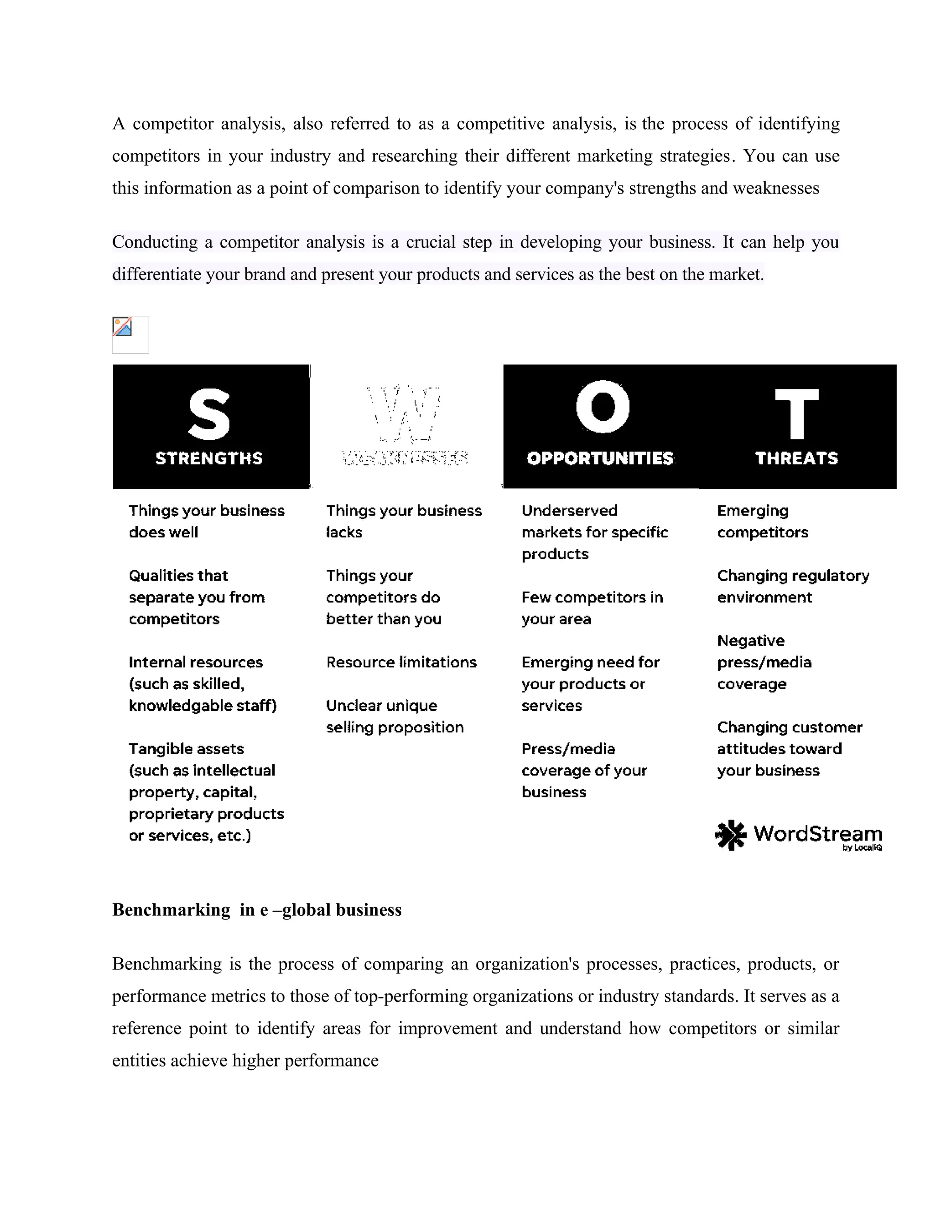
Competitive analysis and benchmarking in the digital marketplace
A competitor analysis, also referred to as a competitive analysis, is the process of identifying
competitors in your industry and researching their different marketing strategies. You can use
this information as a point of comparison to identify your company's strengths and weaknesses
Conducting a competitor analysis is a crucial step in developing your business. It can help you
differentiate your brand and present your products and services as the best on the market.
Benchmarking in e –global business
Benchmarking is the process of comparing an organization's processes, practices, products, or
performance metrics to those of top-performing organizations or industry standards. It serves as a
reference point to identify areas for improvement and understand how competitors or similar
entities achieve higher performance
Overall Performance improvement Setting Standards Innovating Improving Customer
Satisfaction Cost Efficiency Identify Crucial E-Commerce Benchmarks Conversion Rate
Average Order Value (AOV) Cart Abandonment Rate Customer Acquisition Cost (CAC)
Customer Lifetime Value (CLV) Site Traffic Bounce Rate Retention Rate Churn Rate
Revenue Per Visitor (RPV) Mobile vs. Desktop Sales Page Load Time. Email Click-Through
Rate (CTR)Customer Support Response Time
Personalization through machine learning and recommendation systems
Personalized recommendation systems use various machine learning (ML) algorithms to analyze
user behavior and preferences, offering tailored suggestions. The choice of algorithm depends on
the specific application, data characteristics, and desired outcome.
Personalization is the way to match the right types of services, products, or content to the right
users. When approached appropriately, it helps improve user engagement — any interactions
people have with a product, website, app, etc.
Recommender systems, also known as recommender engines, are information filtering systems
that provide individual recommendations in real-time. As powerful personalization tools,
recommendation systems leverage machine learning algorithms and techniques to give the
most relevant suggestions to particular users by learning data (e.g., past behaviors) and
predicting current interests and preferences.
These systems may provide such recommendations as:
 product recommendations
 content recommendations
 content-based filtering,
 collaborative filtering
Benefits of Using Machine Learning Algorithms for Recommendation System
Personalization
Machine learning algorithms can analyze large volumes of data about a user’s past behavior,
such as their purchase history, search queries, and ratings, to model their preferences and
interests.
Increased Accuracy
Enables recommendation systems to make more accurate and relevant recommendations,
increasing users’ likelihood of engaging with the recommended products or services.
Scalability
Machine learning algorithms can analyze large volumes of data quickly and efficiently,
making it possible to provide real-time recommendations to millions of users.
Continuous Improvement
Machine learning algorithms can learn and improve based on user feedback and data. This
enables recommendation systems to adapt to changing user preferences and provide relevant
recommendations.
Cost-Effectiveness
Machine learning algorithms can automate many of the tasks involved in recommendation
systems, reducing the need for human intervention and making the system more cost-effective
to operate.
Social commerce and the integration of e-commerce with social media hat Is Social Com
Social commerce is a fusion between social media and e-Commerce, where social interactions,
user-generated content and online shopping converge seamlessly. Social commerce leverages the
social nature of various online platforms to facilitate product discovery, decision-making and
purchases. Social commerce is a branch of e-Commerce which is more convenient and offers a
more interactive shopping experience.
 Influence and Trust, Discovery and Personalization
 Increased User Engagement and Broader Target Audience
 Seamless Shopping Experience, Influencer Marketing Opportunities
 Real-time Customer Interaction and Feedback .
 Informed Decisions Based on Customer Data
Types of Social Commerce
Based on the company’s goals and budget, brands can explore multiple aspects of social
commerce as follows:
 Marketplaces or digital stores within social platforms where customers can explore and
buy products. Social media channels support shopping features such as product catalogues or
in-app checkouts. Examples include Facebook Shops and Instagram checkout.
 Conversational Commerce is where brands implement direct messaging or voice
support features and contact consumers with offers.
 Live streaming Commerce, often hosted by influencers or brands, allow viewers to
interact in real-time and make purchases directly from the live stream. Usually, these live
streams include offers, discounts and promotions.
 Influencer Commerce is where influencers and content creators collaborate with brands
and promote their products and services on social media. They drive direct sales through their
posts and content.
 Augmented Reality (AR) Commerce uses features like AR filters, allowing consumers
to try on items in a virtual environment.
 Gaming Commerce allows brands to create virtual worlds where potential customers
can interact with and purchase the products.
 Community Commerce refers to online communities or groups on social platforms that
focus on shopping-related discussions, recommendations, and deals. Members can share
product reviews, buying advice, and collaborate on finding the best deals.
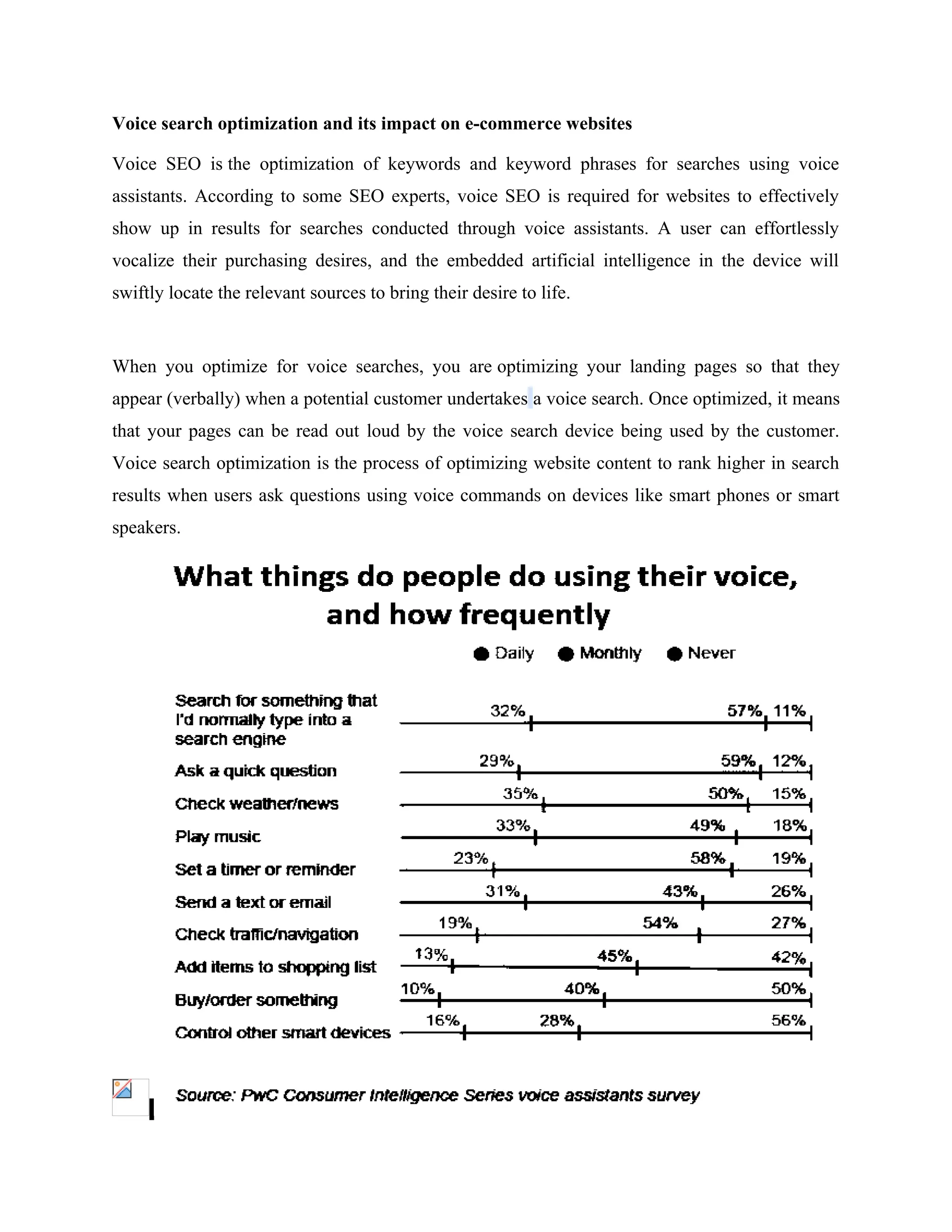
Voice search optimization and its impact on e-commerce websites
Voice SEO is the optimization of keywords and keyword phrases for searches using voice
assistants. According to some SEO experts, voice SEO is required for websites to effectively
show up in results for searches conducted through voice assistants. A user can effortlessly
vocalize their purchasing desires, and the embedded artificial intelligence in the device will
swiftly locate the relevant sources to bring their desire to life.
When you optimize for voice searches, you are optimizing your landing pages so that they
appear (verbally) when a potential customer undertakes a voice search. Once optimized, it means
that your pages can be read out loud by the voice search device being used by the customer.
Voice search optimization is the process of optimizing website content to rank higher in search
results when users ask questions using voice commands on devices like smart phones or smart
speakers.
Gamification strategies for enhancing customer engagement and retention
It is the strategic use of game elements to enhance the learning experience. It involves integrating
features like points, badges, and leaderboards into online courses to motivate and engage
learners. No more dull, passive courses. Instead with gamified elements, your elearning is
transformed into an interactive and enjoyable learning experience. Ecommerce gamification
refers to the strategic integration of game-like elements and mechanics into online shopping
platforms. When you use gamification on an ecommerce site, you’re creating an engaging,
interactive shopping experience for your visitors.
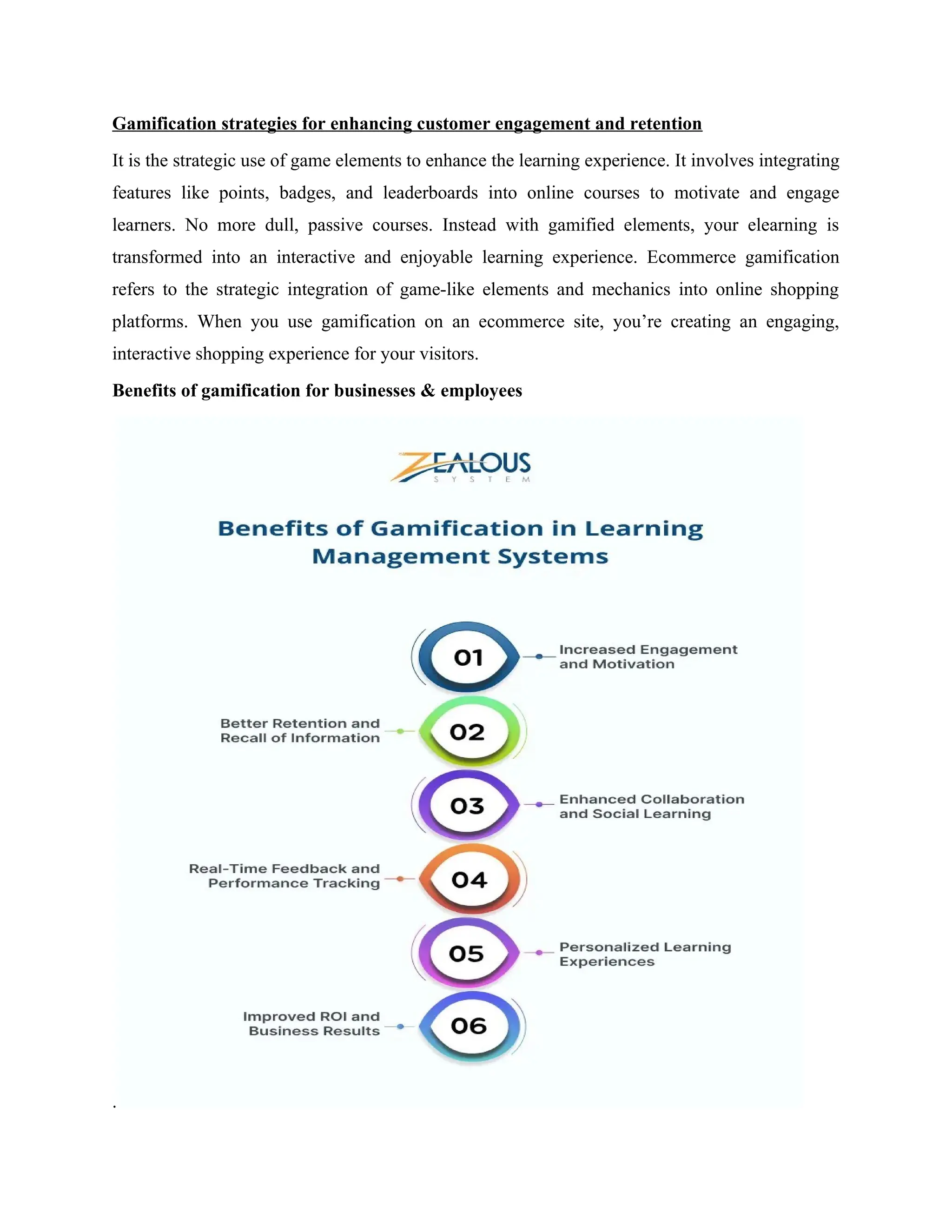
Benefits of gamification for businesses & employees
.
Ex:
Loyalty points Product quizzes Nike Run Club Referral contests Competitions
Spin the wheel Personalized recommendations
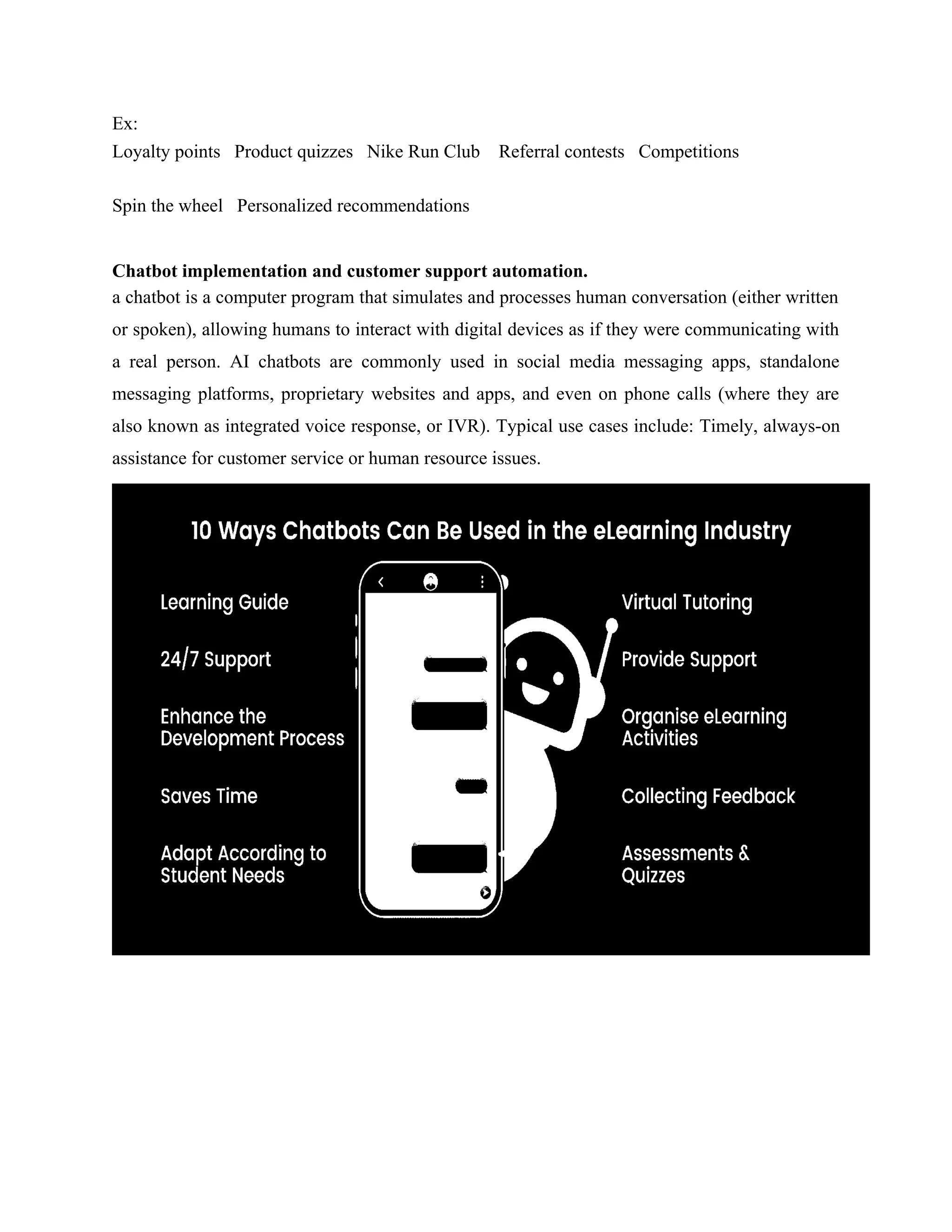
Chatbot implementation and customer support automation.
a chatbot is a computer program that simulates and processes human conversation (either written
or spoken), allowing humans to interact with digital devices as if they were communicating with
a real person. AI chatbots are commonly used in social media messaging apps, standalone
messaging platforms, proprietary websites and apps, and even on phone calls (where they are
also known as integrated voice response, or IVR). Typical use cases include: Timely, always-on
assistance for customer service or human resource issues.
Unit-V
Mobile commerce
M-commerce (mobile commerce) is the buying and selling of goods and services through
wireless handheld devices such as smart phones and tablets. M-commerce is a form of e-
commerce that enables users to access online shopping platforms without the use of a desktop
computer.
1. Accelerated buyer journey Wider reach and accessibility Reaching customers at the
right time New marketing opportunities Valuable customer data Better customer
experience Direct communication Personalized content Geolocation free
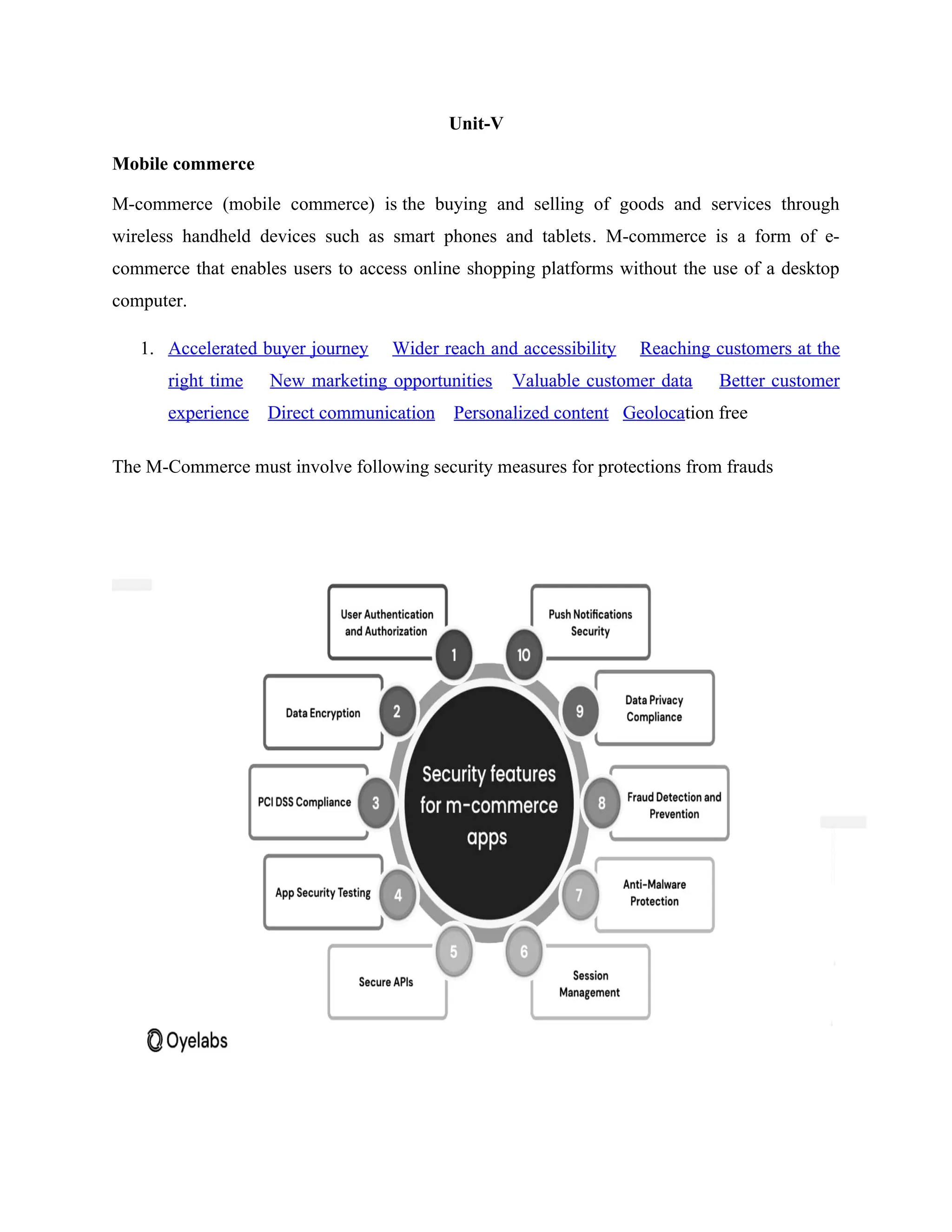
The M-Commerce must involve following security measures for protections from frauds
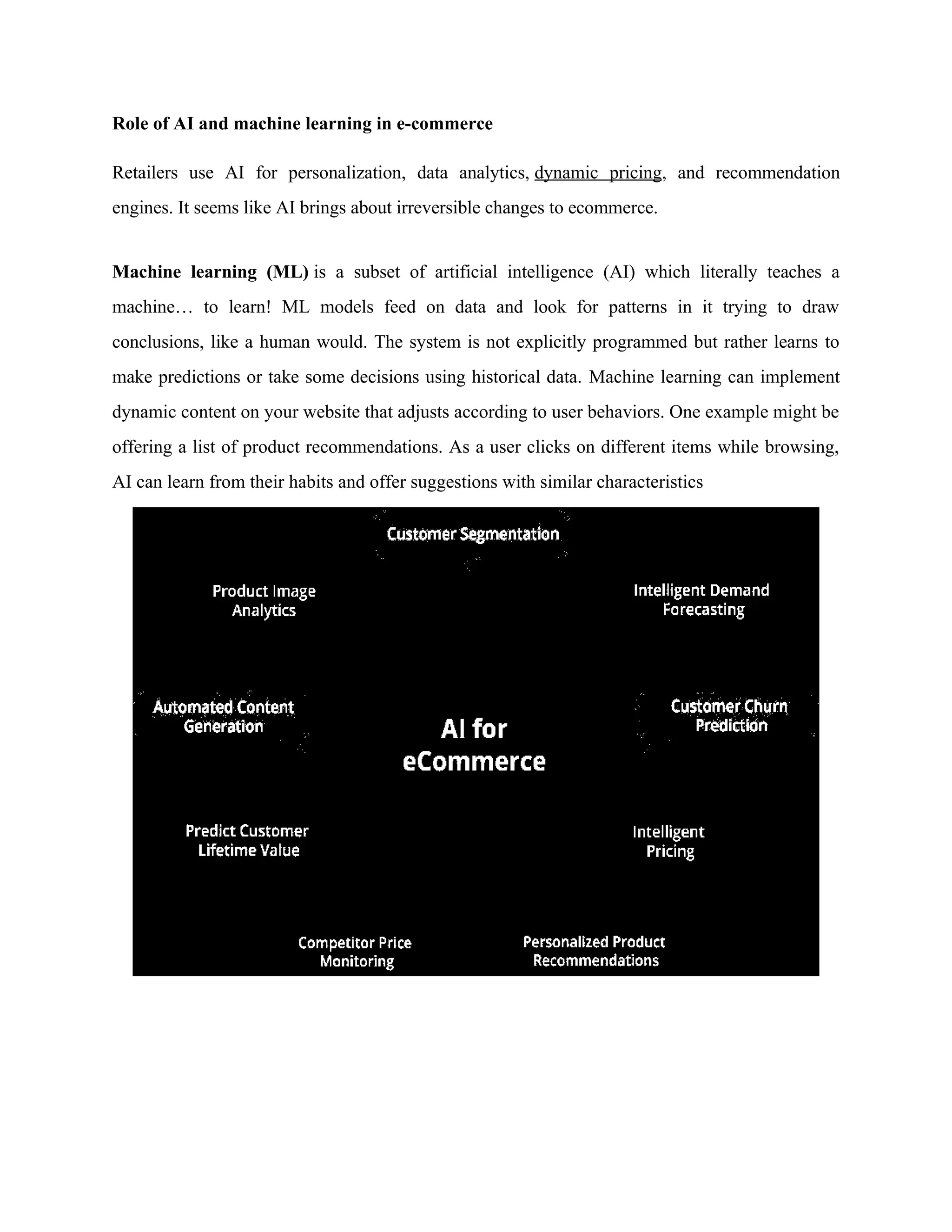
Role of AI and machine learning in e-commerce
Retailers use AI for personalization, data analytics, dynamic pricing, and recommendation
engines. It seems like AI brings about irreversible changes to ecommerce.
Machine learning (ML) is a subset of artificial intelligence (AI) which literally teaches a
machine… to learn! ML models feed on data and look for patterns in it trying to draw
conclusions, like a human would. The system is not explicitly programmed but rather learns ‌
to
make predictions or take some decisions using historical data. Machine learning can implement
dynamic content on your website that adjusts according to user behaviors. One example might be
offering a list of product recommendations. As a user clicks on different items while browsing,
AI can learn from their habits and offer suggestions with similar characteristics
The use of AI and ML in E-global business has wide applications like
Higher ROI Targeted marketing and advertising Informed business decisions Optimized logistics and
inventory management Higher customer conversions Pricing strategy Visual search Customer
sentiment analysis Customer support Product recommendations. Smart business operations.
Sharp personalization
Blockchain and its application
Blockchain is a decentralized ledger at its core that consists of a chain of blocks and each block
contains a set of data. The blocks are linked together using cryptographic techniques and form a
chronological chain of information. Blockchain technology is an advanced database mechanism
that allows transparent information sharing within a business network. A blockchain database
stores data in blocks that are linked together in a chain
Features of Blockchain technology
 Distributed Ledger: The blockchain is a distributed ledger that exists on multiple
computers simultaneously in a peer-to-peer network.
 Immutability: Once data is written to the blockchain, it is extremely difficult to alter it
retroactively. Cryptographic hashes help achieve this which improves security and trust.
 Secured: Cryptography through hashing and digital signatures secures the blockchain
network. It also provides participant identity protection through private/public keys.
 Consensus-Based: For a transaction to be valid and added to the blockchain, all nodes
must agree to its validity based on the existing rules of the network through a consensus
mechanism.
 Decentralized: No single entity or computer controls the network. Full copies of the
blockchain reside on multiple computers in a decentralized manner.
 Faster: Disintermediation of third parties enables faster direct peer-to-peer transactions
without lengthy delays.
Ethical and sustainability issues in e-global business
Ethical Issues In e-Commerce
 Online Piracy: Maintaining the information of user confidential
 Vulnerable Data: Possibility of personal data usage by others
 Web Tracking: Monitoring/Hacking of webpage
 Cyber-Squatting:
domain squatting (also known as domain squatting) is the abusive practice of
registering and using an internet domain name that is identical or similar to
trademarks, service marks, personal names or company names with the bad faith
intent of hijacking traffic for financial profit, delivering malware
 Web Spoofing:
The act of disguising a communication from an unknown source as being from a known,
trusted source. Spoofing can apply to emails, phone calls, and websites
 Email Spamming:
Spam email is unsolicited and unwanted junk email sent out in bulk to an indiscriminate
recipient list. Typically, spam is sent for commercial purposes.
 Counterfeit Products
 Unreliable Customer Service
Suitability issues in E-Global Business
It involves online stores adopting environmentally and socially responsible practices, such as
reducing packaging, utilizing renewable energy, and avoiding high shipping emissions.
Reduce carbon footprint Circular economy Social responsibility‍ Transparency and
accountability. Going digital Optimizing Inventory Management AI and Machine
Learning for Predictive Logistics Reduce waste. Cost reduction. Increased consumer
satisfaction.
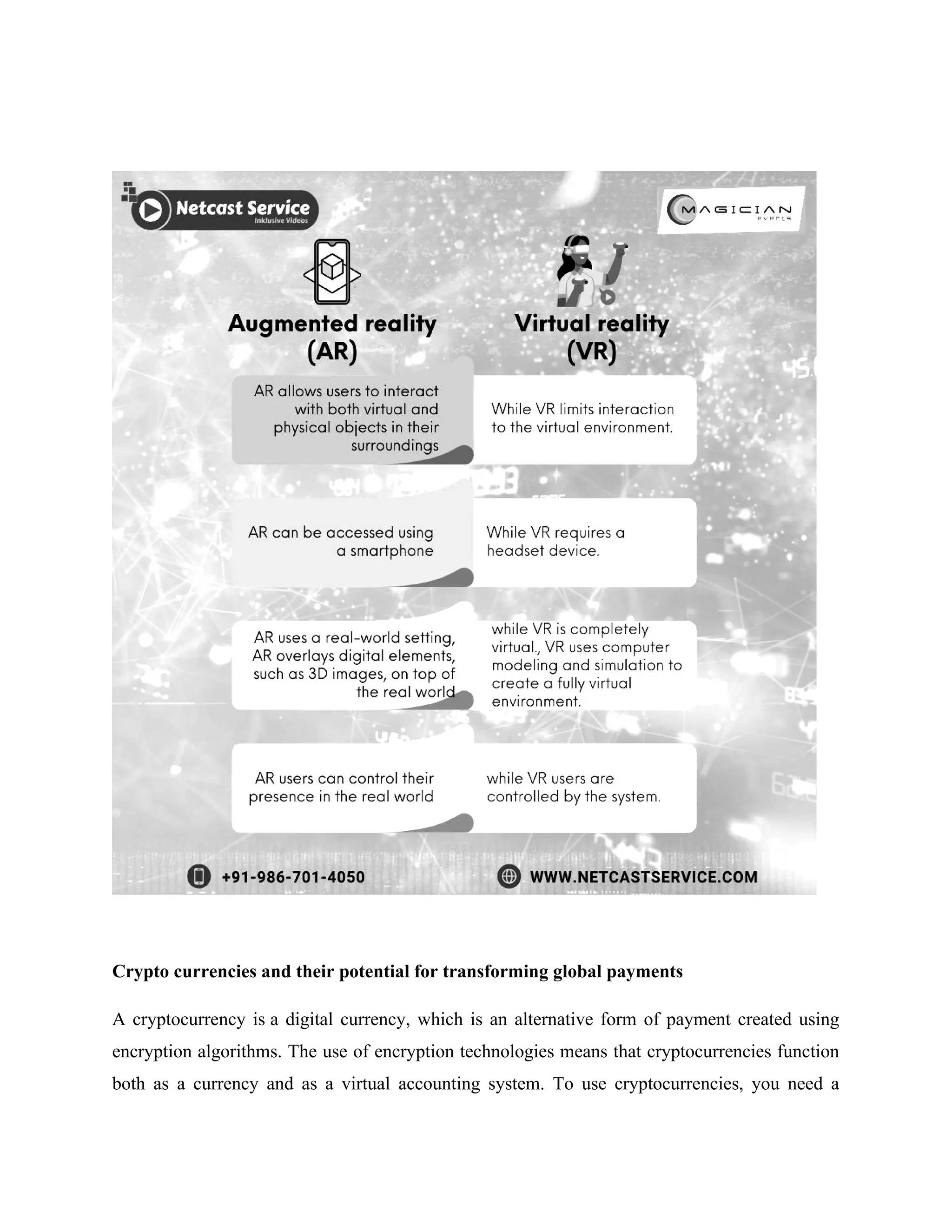
Virtual reality (VR) and Augmented reality (AR)
Virtual Reality (VR) is a computer-generated environment with scenes and objects that appear to
be real, making the user feel they are immersed in their surroundings.
With VR in e-commerce, businesses have started offering their customers immersive learning
experiences. Interactive product manuals allow customers to virtually interact with the products,
know more about their features, and understand their functionality in a 3D environment.
Application of VR in e-Global Business
 Product visualization: Customers can interact with products in 3D, allowing them to
explore products in detail and make more informed buying decisions.
 Virtual try-ons: Customers can virtually try on products, such as clothing.
 Personalized shopping: VR can create personalized shopping environments based on a
customer's preferences, browsing history, and behavior.
 Product demonstrations: Customers can interact with products through virtual
demonstrations.
 Reduced returns: Customers are less likely to return products if they can experience them
virtually.
 Brand engagement: VR can help customers build a stronger connection with a brand by
allowing them to experience the brand's products and spaces.
 Cross-selling and up selling: VR can open up new opportunities for cross-selling and
upselling.
 Customer engagement
 Marketing and promotion
 Shopping experience enhanced
Augmented reality - AR
Augmented reality is an interactive experience that enhances the real world with computer-
generated perceptual information. Using software, apps, and hardware such as AR glasses,
augmented reality overlays digital content onto real-life environments and objects
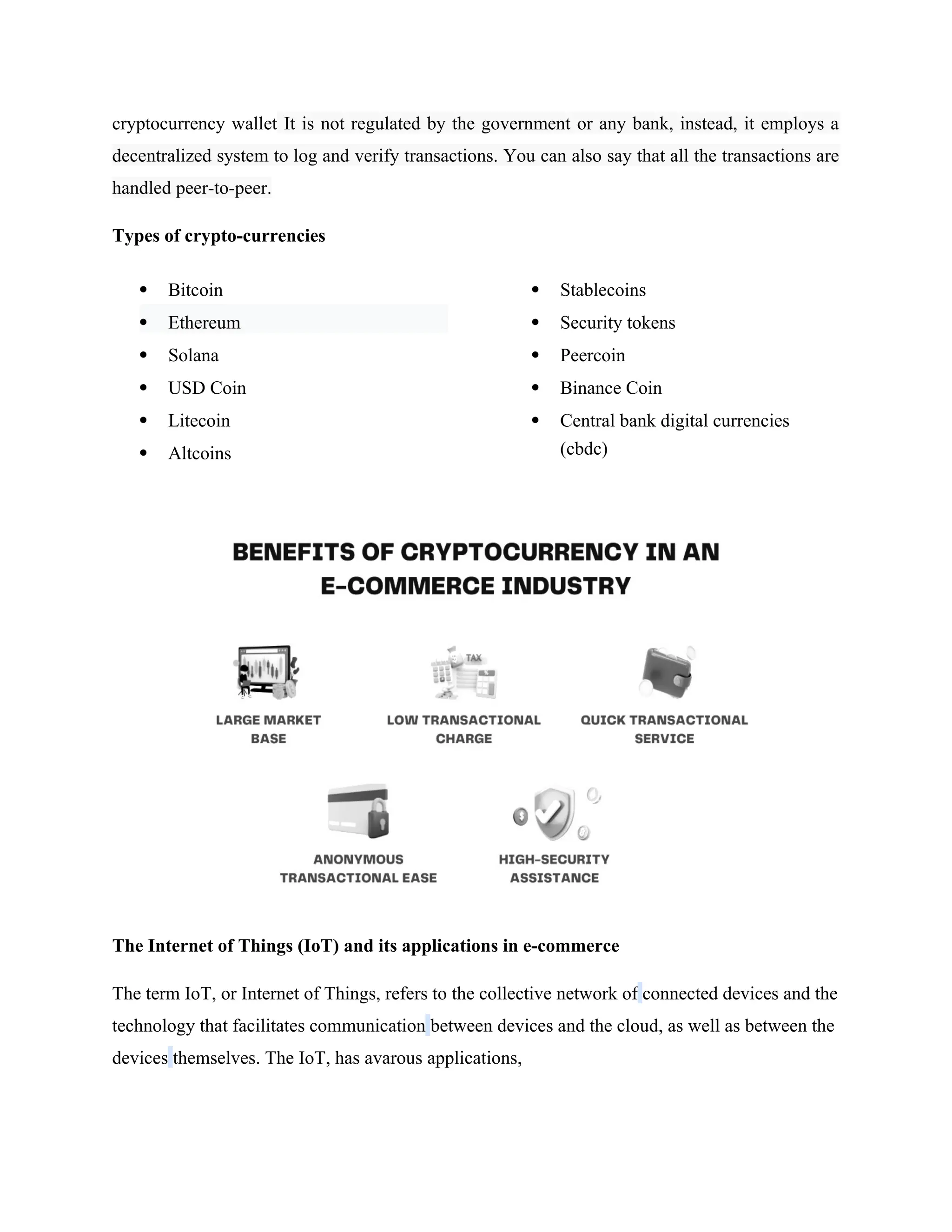
Crypto currencies and their potential for transforming global payments
A cryptocurrency is a digital currency, which is an alternative form of payment created using
encryption algorithms. The use of encryption technologies means that cryptocurrencies function
both as a currency and as a virtual accounting system. To use cryptocurrencies, you need a
cryptocurrency wallet It is not regulated by the government or any bank, instead, it employs a
decentralized system to log and verify transactions. You can also say that all the transactions are
handled peer-to-peer.
Types of crypto-currencies
 Bitcoin
 Ethereum
 Solana
 USD Coin
 Litecoin
 Altcoins
 Stablecoins
 Security tokens
 Peercoin
 Binance Coin
 Central bank digital currencies
(cbdc)
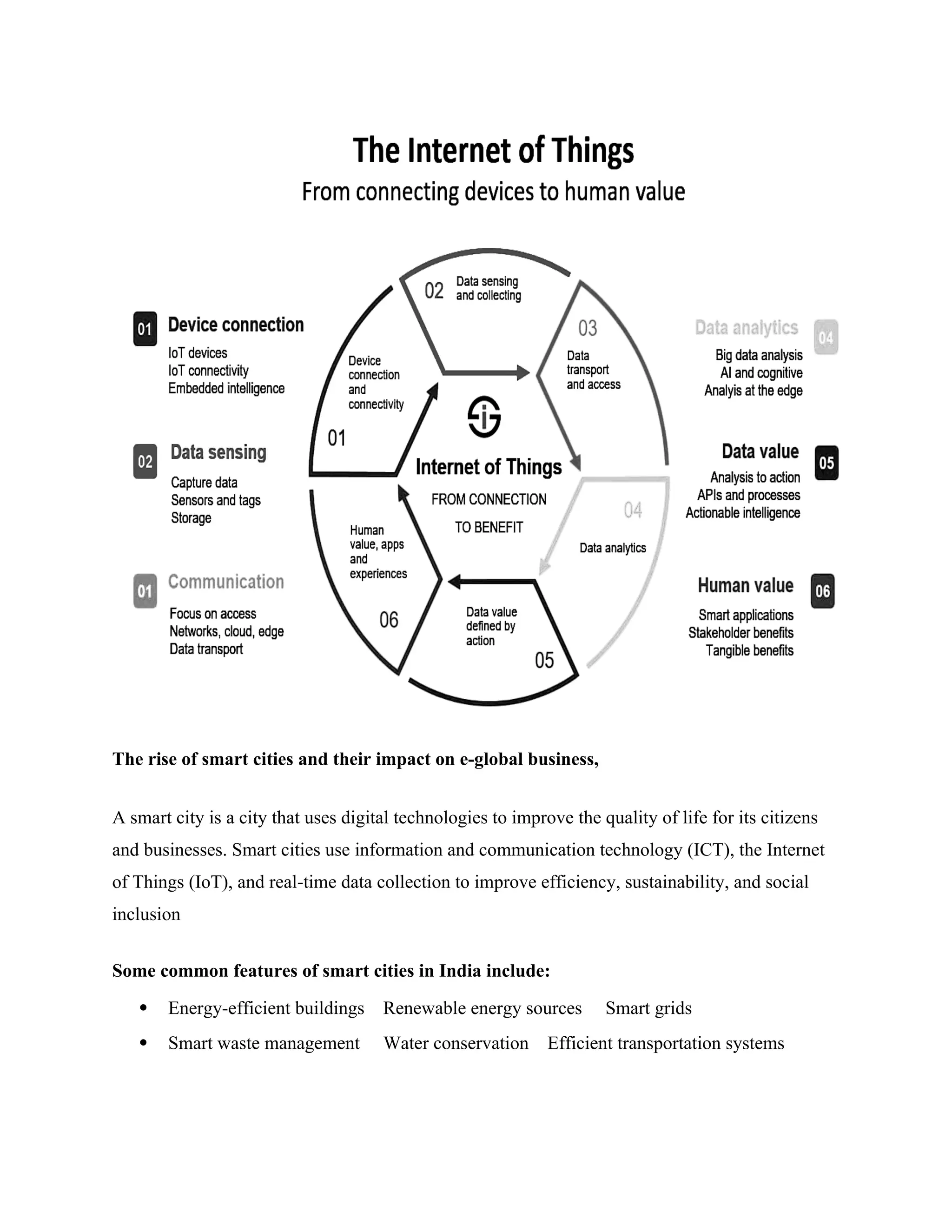
The Internet of Things (IoT) and its applications in e-commerce
The term IoT, or Internet of Things, refers to the collective network of connected devices and the
technology that facilitates communication between devices and the cloud, as well as between the
devices themselves. The IoT, has avarous applications,
The rise of smart cities and their impact on e-global business,
A smart city is a city that uses digital technologies to improve the quality of life for its citizens
and businesses. Smart cities use information and communication technology (ICT), the Internet
of Things (IoT), and real-time data collection to improve efficiency, sustainability, and social
inclusion
Some common features of smart cities in India include:
 Energy-efficient buildings Renewable energy sources Smart grids
 Smart waste management Water conservation Efficient transportation systems
Top 10 Smart Cities in India
1. Bhubaneshwar, Odisha:
2. Indore, Madhya Pradesh:
3. Pune, Maharashtra:
4. Ahmedabad, Gujarat:
5. Coimbatore, Tamil Nadu:
6. Kochi, Kerala:
7. Hyderabad, Telangana:
8. Jaipur, Rajasthan:
9. Surat, Gujarat:
10. Lucknow, Uttar Pradesh:
Impact of smart cities on E-Global Business
On a global scale, smart cities improve productivity, facilitate market expansion, foster
international collaboration, and promote sustainability. As urban areas continue to evolve, the
development and implementation of smart city initiatives will be crucial for achieving
comprehensive and sustainable economic growth. Important implications of smart city on e
global business are as follows
 E-commerce growth Digital services Knowledge exchange
 Technology transfer Entrepreneurship Talent pool Data generation
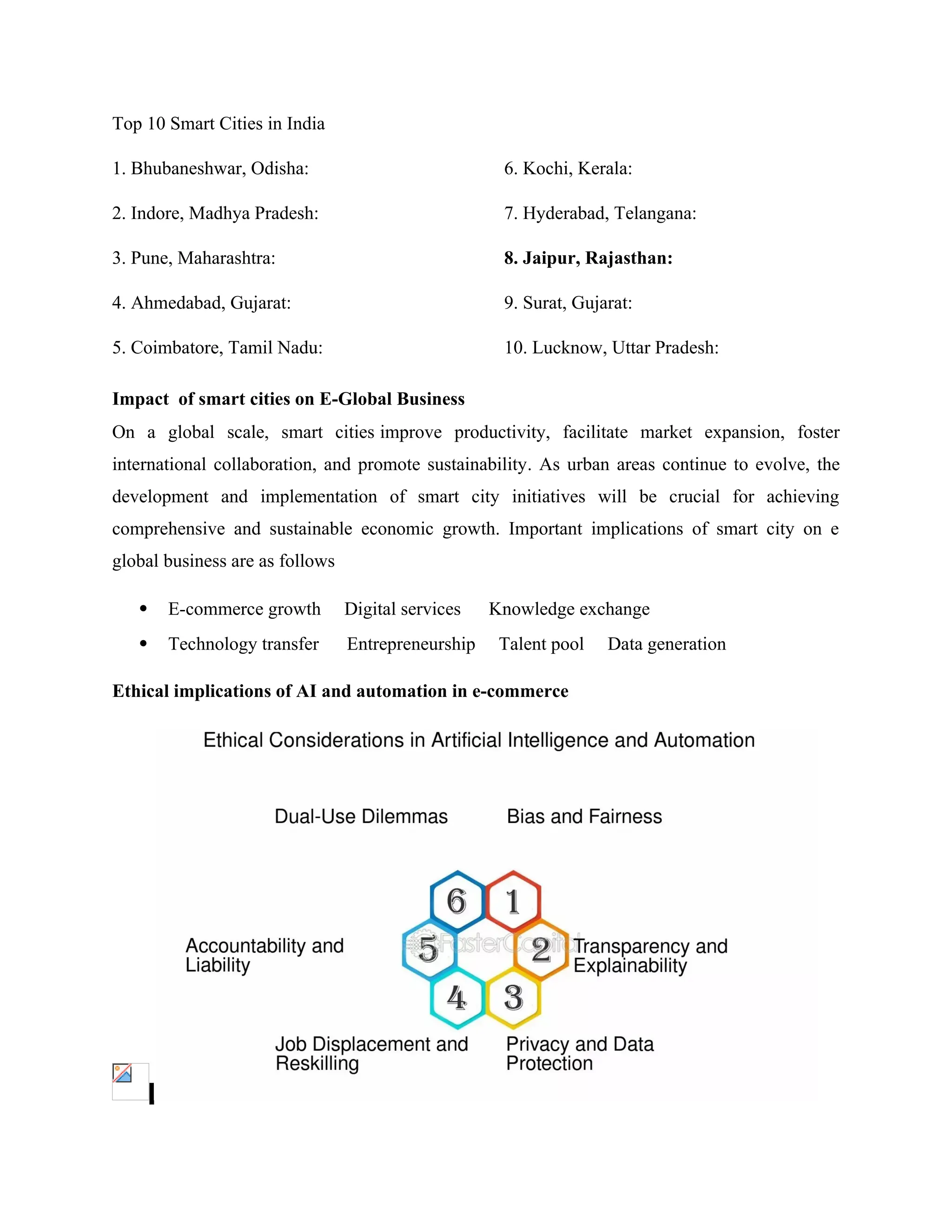
Ethical implications of AI and automation in e-commerce
Predictive analytics in e-global business
Predictive analytics is a process that uses data analysis, machine learning, and statistical models
to forecast future outcomes, Predictive analytics is a branch of advanced analytics that uses data
to predict future events, behaviors, and outcomes. It can be used to forecast trends and
behaviors seconds, days, or years into the future
Application of predictive analysis in e-Global Business
 Customer understanding
 Pricing strategy
 Inventory management
 Logistics
 Marketing
 Customer retention
 Fraud detection
 Anticipate customer needs
 Optimize supply chain operations

Lecture notes for the subject of E-Global Business

  • 1.
    Presidency School ofManagement & Comp.Sc. Affiliated to Osmania University Approved by All India Council for Technical Education –AICTE-New Delhi Dept of Business Management -MBA-III-Semester Sub: E-Global Business Paper Code: MB 302 Prepared by Dr. Syed Valiullah Bakhtiyari Professor-Business Management https://www.academia.edu/126082786/E_Global_Business_Final_Notes
  • 2.
    Course Objectives 1. Tounderstand the fundamentals of e-commerce and its impact on global business. 1. To explore the challenges and opportunities associated with conducting business in a digital environment. 2. To analyze the strategies and technologies used in e-global business. 2. To develop critical thinking and problem-solving skills in the context of e-global business. Learning Outcomes: By the end of this course, students will be able to: 1. Identify and explain the key concepts and principles of e-global business. 1. Evaluate the impact of e-commerce on global business operations. 2. Analyze and develop strategies for conducting business in a digital environment. 3. Apply critical thinking skills to solve problems and make informed decisions related to e- global business
  • 3.
    Unit-I Ecommerce is amethod of buying and selling goods and services online. The definition of ecommerce business can also include tactics like affiliate marketing. You can use ecommerce channels such as your own website, an established selling website like Amazon, or social media to drive online sales. Globalization is a term used to describe how trade and technology have made the world into a more connected and interdependent place. Globalization also captures in its scope the economic and social changes that have come about as a result Characteristics of Globalization 1. Free Trade Liberalization 2. Increase in Employment Increased connectivity between nations –
  • 4.
    3. Interdependence –CulturalExchange. 4. Urbanization Standard of Living Outsourcing The digital economy is the worldwide network of economic activities, commercial transactions and professional interactions that are enabled by information and communications technologies (ICT). It can be succinctly summed up as the economy based on digital technologies Digital economy has given rise to many new trends and start-up ideas. Almost all of the biggest companies in the world (Google, Apple, Microsoft, Amazon) are from the digital world. Let us look at some important merits of the digital economy
  • 5.
    Global Market entrystrategies Digital transformation Digital transformation is the integration of digital technologies into all aspects of business operations. That means identifying how to use technologies to deliver new products and services, to improve existing products and services, and to streamline processes Digital transformation is the process of adoption and implementation of digital technology by an organization in order to create new or modify existing products, services and operations by the means of translating
  • 6.
    business processes intoa digital format. The digital transformation Increases efficiency, agility and, ultimately, delivers value to customers and employees. An online marketplace is an e-commerce site that connects sellers with buyers. It's often known as an electronic marketplace and all transactions are managed by the website owner. Companies use online marketplaces to reach customers who want to purchase their products and services. An online marketplace is an ecommerce platform where third parties sell products or services. Examples of online marketplaces include Amazon, Walmart, and eBay. Role of E-market place in E global Business
  • 7.
    Through electronic marketplaces,firms can collaborate effectively, forecast demand, and share strategic information across companies. If firms want to participate in electronic marketplaces fully, they must initially integrate internal and external supply chain activities Role of artificial intelligence in e business  Artificial intelligence What is artificial intelligence? Artificial intelligence (AI) is the ability of a computer or a robot controlled by a computer to do tasks that are usually done by humans because they require human intelligence and discernment AI plays a crucial role in e-commerce by enabling businesses to analyze and understand customer behavior patterns, enhance the shopping experience, and streamline various processes. AI can help in product recommendations, chatbots, personalized promotions, fraud detection, and more. Legal Requirements of E-commerce business in India  Company or LLP Registration-[Limited liability partnership] Every business is required to get registered with the Ministry of Corporate Affairs under the applicable laws. Such a business shall either be incorporated under the (Indian) Companies Act, 2013 or a foreign company or an office, branch or an agency outside India and necessarily be owned or controlled by an Indian resident. Such registration ensures that the bank account is opened in the name of the company/ LLP which in return shall make the process of GST registration convenient and quicker.  2. GST Registration For a successful establishment of an E-commerce business, GST registration is mandatory. Every E-commerce business irrespective of its turnover is required to be compulsorily registered under the Central Goods & Service Tax (CGST) Act.  3. Bank Account Opening a bank account in the name of the business is a convenient process. In case of a Proprietorship firm, the first step is to obtain a GST registration in the name of the business in
  • 8.
    order to opena bank account. An active bank account is the bare minimum requirement to be able to list a business on an E-commerce marketplace or to obtain a payment gateway for a proprietary E-commerce website  4. Payment Gateway A payment gateway is mandatory for a proprietary E-commerce website to process the payments. It allows the website to accept payments through credit card(s), debit card(s), net banking, internet banking from multiple banks. 5. Legal Documents If any business operates through online marketplaces, then the marketplace provides the seller with a legal document or sellers’ agreement and the seller must abide by the sellers’ agreement. It is important for any business to go through the sellers’ agreement(s) in detail before the execution as it is the legal binding agreement between the seller and the marketplace. Compliances for E-commerce business in India The trend of E-commerce has been rapidly increasing since the last decade. Many players with new business ideas have entered the market, be it Zomato/Swiggy delivering food from various restaurants or Flipkart/Amazon delivering products or Grofers delivering groceries. The scenario is such that you name the service and there is an E-commerce platform for it available at the doorstep. The swift development of the E-commerce industry has called for the attention of the government towards forming regulations and policies with respect to the same. India has various laws that monitor E-commerce business in terms of data privacy, security of consumers, settlement transaction safety, quality of products etc.  2. Information Technologies Act, 2000 The E-commerce sellers conduct business in the same manner as the physical sellers with the only distinction of non-availability of the physical body in order to sell things. Through E- commerce, the vendors are required to generate bills, file returns, pay taxes, prepare ledgers and maintain records. They must perform all the same on the online platform.
  • 9.
    The Information TechnologyAct, 2000 (IT Act) is the primary legislation that governs the use of the internet, cybercrime as well as the digital business in India. The IT Act governs online behavior and related aspects of E-commerce and recognizes electronic contracts and digital signatures. The Information Technology Act, 2000 is based on the Model Law of E-commerce adopted by the United Nations Commission on International Trade Law (UNCITRAL) and acts as a developing E-commerce enabling legislation in India. The Act targets regulating the use of the internet by punishing the person for publishing any obscene information or hacking or altering the data from devices of another person. The salient features of the Act are:  E-contracts  Transaction Security  Digital signature 3. Payment and Settlements Systems Act, 2007 As per the Payment and Settlements Systems Act, the E-commerce business shall succeed as a payment system if it follows the Rules specified by RBI, it is compulsory for an intermediary that is receiving payments through digital modes to have an active account 4. Consumer Protection Act, 2019 The E-commerce industry is also monitored by the Consumer Protection Act . In order to safeguard the consumers from unfair trade practices and solve their problems, the Ministry of Consumer Affairs, Food and Public Distribution on May 17, 2021, has notified the Consumer Protection (E-Commerce) Rules, 2021. Innovations in E-Commerce 1. Real-Time Location-Based Mobile Selling Real-time location-based selling technology allows retailers to target customers based on their precise location and deliver personalized messages and offers in real time. 2. Super-Fast Delivery and Instant Pickup Counter
  • 10.
    3. AI-Powered PersonalizationLeads generated by AI are boosting sales by 50%. Top-rated firms tailor their advertising with AI 28% of the time. Here are some benefits of AI. 4. Voice-Powered Shopping Voice-powered shopping is an emerging trend in e-commerce. According to a study, 51% of mobile buyers look up things using their voice assistants. Here’s how it can be advantageous – 5. Shopping using AR Technology-[Augmented Reality]  Enables customers to visualize products using their smartphones or tablets in a real-world environment.  Shopping using AR technology is an emerging trend in e-commerce that has the potential to revolutionize the way customers shop and interact with retailers. 6. Blockchain Blockchain is a shared, immutable ledger that facilitates the process of recording transactions and tracking assets in a business network. An asset can be tangible or intangible 8. Chatbots A chatbot is a software application or web interface that aims to mimic human conversation through text or voice interactions 9. Social Commerce Social commerce (a subset of ecommerce) is the use of social media platforms like Facebook and Instagram to market and sell products and services. This type of selling model lets customers 11. Remarketing Remarketing is a powerful tool for e-commerce innovation that allows you to target customers who have previously shown interest in your products or services. 12. Website Analytics Web analytics is the collection, reporting, and analysis of website data. 13. E-wallet
  • 11.
    E-wallet stands forelectronic wallet. It is a type of electronic card which is used for transactions made online through a computer or a Smartphone. Digital entrepreneurs An Internet entrepreneur is an owner, founder or manager of an Internet-based business. This list includes Internet company founders and people brought on to companies for their general business or accounting acumen, as is the case with some CEOs hired by companies started by entrepreneurs. Digital entrepreneurs rely on digital technologies to establish and run their businesses. They set up online storefronts to sell their goods, use social media platforms such as Facebook to advertise, and monitor customer trends using tools such as Google Analytics. The digital entrepreneur must understand the five pillars they are content, technology,user experience, process, and organization. Digitalization improves productivity and efficiency, lowering the cost of economic transactions. Digital Startup The revolution in mobile and internet opens the door for digital startups. If you have an awesome idea convert it into mobile app or website, you will be a digital startup. Many digital startups are playing to role of facilitator between two parties or helping hand for some services.Digital startups are characterized by strong, fast, and scalable growth. It exploit the maximum potential of digital marketing strategies and tools. Digital startup process  Assess the viability of your new business idea  Develop a business plan and name it  Take care of all the legal tasks  Build your website and choose affiliate  Develop and implement marketing strategies  Launch your new business Cyber Security
  • 12.
    Computer security, cybersecurity, digital security or information technology security (IT security) is the protection of computer systems, mobile and networks from attacks by malicious actors that may result in unauthorized information disclosure, theft of, or damage to hardware, software, or data, as well as from the disruption or misdirection of the services they provide. Types of cyber threats and challenges 1. Cybercrime includes single actors or groups targeting systems for financial gain 2. Cyber-attack often involves politically motivated information gathering. 3. Cyber terrorism is intended to undermine electronic systems to cause panic or fear. 4. Malware Malware means malicious software. One of the most common cyber threats, malware is software that a cybercriminal or hacker has created to disrupt or damage a legitimate user’s computer. 5. Virus: A self-replicating program that attaches itself to clean file and spreads throughout a computer system, infecting files with malicious code. 6. Trojans: A type of malware that is disguised as legitimate software 7. Spyware: A program that secretly records what a user does, so that cybercriminals can make use of this information. For example, spyware could capture credit card details. 8. Ransomware: Malware which locks down a user’s files and data 9. Adware: Advertising software which can be used to spread malware.· 10.BotnetsNetworks of malware infected computers which cybercriminals use to perform tasks online without the user’s permission. Types of Cyber security soft wares
  • 13.
     Network securityis the practice of securing a computer network from intruder  Application security focuses on keeping software and devices free of threats  ·Information security protects the integrity and privacy of data,  ·Operational security includes the processes and decisions for handling and protecting data assets. Protect Yourself from Cyber Crime 1. Ensure your system is Up-to-date. ... 2. Use a Secure Internet Connection. ... 3. Use Strong Password. , Be Aware of Pop-ups and Fraudulent Emails. ... 4. Protect yourself from identity threats, Manage Your Social Media Settings. ... 5. Get Right Cyber Insurance Policy. Impact of social media on global business Social media refers to the means of interactions among people in which they create, share, and/or exchange information and ideas in virtual communities and networks. The Office of Communications and Marketing manages the main Facebook, Twitter, Instagram, LinkedIn and YouTube accounts. The Impacts are as follows  Allows Businesses to Become Omni-Present  Increases Personalization  Generates More Loyalty  Increases Industry Collaboration  Adds Credibility  Increases Referrals
  • 14.
     Helps YouBuild a Personal Brand  Helps You get Audience Feedback  Brand-loyalty, Easy-communication, Increased-customer-power  Attract-bigger-audience, Creates-word-of-mouth  Reducing-marketing-and-promotional-costs Customer engagement Customer engagement is the way a company creates a relationship with its customer base to foster brand loyalty and awareness. This can be accomplished via marketing campaigns and web content as well as outreach using social media, mobile devices and wearable devices. The purpose of customer engagement is improving customer experience and satisfaction, building customer loyalty and trust, and harnessing the power of customer feedback and insights, which ultimately decreases the customer migration.
  • 15.
  • 16.
    E- Marketplace andOnline platforms E-marketplace is a virtual online market platform where companies can register as buyers and sellers to conduct business to business (B2B) or Business to Consumers (B2C)
  • 17.
    transactions over theinternet. It enables the buyers to compare various products and services by different measures like performance, quality, price etc. Famous e-Commerce marketplaces  Amazon, eBay, Walmart , Decathlon , Flipkart , Meesho  Myntra, Snapdeal, ShopClues, Limeroad Types of E-market Places  Business-to-business (B2B): In this marketplace, one business offers its services and products to other businesses. The aim is not to find as many clients as possible but to create robust supply chains and long-term relationships. Examples of such marketplaces are Justdial.com and Indiamart.com.  Business-to-customer (B2C): B2C marketplaces deal directly with the end customers. Here, the main goal is to acquire as many customers as they can to generate sales. Examples are Amazon.com, eBay.com, and Aliexpress.com.  Customer-to-customer (C2C): This marketplace connects the seller directly with the buyer and lets them negotiate for the products or services. An example of a C2C marketplace is Semexe.com. Challenges for e-market places  Data security: Online marketplaces hold the personal data of millions of customers, which are susceptible to cyber-attacks. Marketplaces need robust security systems to avoid data breaches through brute force attacks.  Customer loyalty: It is difficult and expensive to acquire customers, but it is easy to lose them if you lack a retention strategy. With a bunch of choices available, it is a buyer’s market.  Price competition: Marketplaces not only have to compete with other marketplaces but also provide the right balance of price so that they can serve both the supplier and the customer appropriately.
  • 18.
     Inventory management:Businesses must forecast the demand in real time to prevent shortfall or overstocking products in their warehouses.  Return, refunds, and fulfilment: Fulfilment is just the first step. Managing refunds and returns and taking care of possible fraud is another. Marketplaces need technology to track returns and refunds and avoid fraud. Digital marketing and Customer relationship Management Digital marketing, also called online marketing, is the promotion of brands to connect with potential customers using the internet and other forms of digital communication. This includes not only email, social media, and web-based advertising, but also text and multimedia messages as a marketing channel 7 C's of digital marketing The 7 Cs- customer, content, context, community, convenience, cohesion, conversion. Various types of digital marketing Digital marketing can be broadly classified into eight main categories 1. Affiliate marketing, 2.content marketing, 3.email marketing, 4.marketing analytics, 5.mobile marketing, 6.pay-per-click, 7.search engine optimization and 8.social media marketing. CRM in digital marketing Customer Relationship Management (CRM) is a strategy that companies use to manage interactions with customers and potential customers. CRM helps organizations streamline processes, build customer relationships, increase sales, improve customer service, and increase profitability, the application of digitization in CRM helps in targeting only potential customers, saving time and effort and improving marketing campaign efficiency.
  • 19.
    Benefits of usingCRM in Digital Marketing 1. Personalization, Increased 2. ROI ,Improved customer engagement. 3. Additional data for sales 4. Attribution –Revenue by sales and marketing teams 5. Marketing Automation - Automate some of your marketing tasks to focus on the things that matter. E-commerce Payment System in Global Business A List of E-commerce Payment Systems Debit--Card A debit card is a card with unique credentials and is linked to the customer’s bank account. A debit card deducts money from the user's bank account instantly at the time of the transaction Credit--Cards Credit cards are the most popular form of payment for e-commerce transactions. Enabling credit card payments on your website can enable customers to shop without having to worry about paying upfront. E-Wallet The E-Wallet can be thought of as a prepaid account that enables users to store a variety of debit cards, credit cards, and other payment methods in a safe environment without having to enter their credentials each time they wish to make a purchase
  • 20.
    Smart—Card It hasthe ability to store money as well as a person's personal and professional information. Faster processing is possible with smart cards at lower rates. Online—banking Customers can conveniently make purchases by paying with a bank account directly. Mobile—Payment Customers may easily and quickly use mobile payment to make purchases using their smartphones. A user only needs to download a mobile payment app from the applications store.
  • 21.
    Subscription based businessmodels A subscription business model is a recurring revenue model in which customers pay a weekly, monthly, or yearly fee in exchange for your products or services. Customers can renew their subscription after a certain period of time. The fees paid for subscriptions is called as recurring revenues for the company Benefits of a subscription business model o Predictable revenue stream o Recurring revenue o Stronger & long-term customer relationships o Lower customer retention spend o Easier demand forecasting Examples Netflix and Spotify, Adobe and Microsoft, Magazine subscriptions, Zomato, Uber, Swiggyetc Recurring Revenue Recurring revenues through billing is an amount usually fixed for a product or service regularly. The billing cycle frequency can be monthly, quarterly, or annually or more Recurring revenue Strategies  Predetermined Service Charges over a Specific Period  Automatic Renewal of Subscriptions  Scheduled Billing Based on Product Usage  Per-User Billing Model
  • 22.
     Free LifetimeAccess to Basic Product or Service Plan Collaborative consumption or sharing economy  Collaborative consumption is considered part of the sharing economy, Collaborative consumption is the shared use of a good or service by a group. Collaborative consumption differs from conventional consumption in that resources, goods, or services are shared by a group rather than individuals. Ex: Airbnb, Airbnb,[Air Bed and Breakfast,” is a service that lets property owners rent out their spaces to travelers looking for a place to stay]and ride-sharing applications, car pooling Benefits of the collaborative economy  Greater supply: Individuals who market goods and services increase options for people looking to travel or buy items like household appliances, clothing and bicycles.  Savings: The items we find in collaborative consumption businesses are usually cheaper.  Sustainability: This exchange between consumers increases the useful life of the items we buy. Because we reuse them, there’s no need to manufacture new things.  Care for the environment: Choosing services like collaborative transport and giving new life to used items to prevent overproduction and use finite resources more efficiently helps us care for the environment. Digital marketing Digital marketing, also called online marketing, is the promotion of brands to connect with potential customers using the internet and other forms of digital communication. This includes not only email, social media, and web-based advertising, but also text and multimedia messages as a marketing channel. Digital marketing strategies
  • 23.
    Search engine optimization Definesit as “the art and science of making web pages attractive to search engines.” the most important elements to consider when optimizing a web page for search engines include:  Quality of content Level of user engagement Mobile-friendliness Number and quality of inbound links Content marketing A strategy based on the distribution of relevant and valuable content to a target audience, the goal of content marketing is to attract leads that ultimately convert into customers. Blog posts  E-books Newsletters Video or audio transcripts Social media marketing Social media marketing means driving traffic and brand awareness by engaging people in discussion online. The most popular digital platforms for social media marketing are Face book, Twitter, and Instagram, with LinkedIn and YouTube not far behind. Pay-per-click marketing Pay-per-click, or PPC, is a form of digital marketing in which you pay a fee every time someone clicks on your digital ads. So, instead of paying a set amount to constantly run targeted ads on online channels, you only pay for the ads individuals interact with. Affiliate marketing Affiliate marketing is a digital marketing tactic that lets someone make money by promoting another person's business. You could be either the promoter or the business who works with the promoter, but the process is the same in either case. Influencer marketing Like affiliate marketing, influencer marketing relies on working with an influencer–an individual with a large following, such as a celebrity
  • 24.
    Marketing automation Marketing automationuses software to power digital marketing campaigns, improving the efficiency and relevance of advertising. Email marketing The concept of email marketing is simple—you send a promotional message and hope that your prospect clicks on it. However, the execution is much more complex. Mobile marketing Mobile marketing is a digital marketing strategy that allows you to engage with your target audience on their mobile devices, such as smart phones and tablets. This can be via SMS and MMS messages, social media notifications, mobile app alerts, and more. The benefits of digital marketing Strategies for online communities to drive customers’ loyalty Online communities have become a necessary business asset that contributes to the agile growth of an organization. They serve as a major source of information for all participants. Through this network, businesses can easily address their customers’ queries, acknowledge their inputs, and receive constructive feedback. The online communities can increase customer satisfaction,
  • 25.
    retention, and lifetimevalue by creating a sense of belonging, recognition, and reward. Moreover, it can generate positive word-of-mouth, referrals, and testimonials by encouraging customers to share their experiences.  Invest in curating engaging content:  Be responsive to change  Be a part of the customer’s journey  Reward your customers (gamification  Encourage self-support
  • 26.
    Unit –III Unit Supplychain management in a digital environment It is interdisciplinary approach which involves application of digital technologies for leveraging the tasks of supply chain management in e-global business. The application enhances the performance level by multifold which results in not only attraction of customers but retain the customers which in turn provides sustainability for business. Various digital applications on supply chain management  Internet of things Applied in the manufacturing facilities of SCMO  Artificial intelligence Used to tracks the customer data base and read market trends  Inventory visibility To endure buffer stock and plan the inventory replenishment cycle  Automation ; Used in the packaging, labelling and shipment units of scm  Demand forecasting ; Various software used for predictive analytics of market  Enterprise resource planning software : widely used digital application helps in proper planning from procurements to production to shipments  Integrated supply chain : Helps in obtaining seamless supply chain and ensure un- interrupted supply of information, products and cash  RFID It is used mainly for the process of tracking the shipments and transportation fleet to endure no abnormalities in supply chain  Order fulfilment ; This will help in maintaining zero back order and reduces lead time  Warehouse management systems : It helps in proper utilization of warehouse space and also in categorizing the inventories into various categories and ensure proper safety of inventory
  • 27.
    Logistics and fulfillmentin e-commerce Ecommerce fulfillment is the segment of supply chain that receives bulk goods, stores in SKUs, picks and packs orders, and delivers products to customers, E-fulfillment is the process of managing and delivering online orders. This can involve a range of activities, from handling customer queries and managing inventory, to packing and shipping orders, order fulfillment processes include the following:  Getting products onto ecommerce fulfillment center shelves  Placing SKUs into inventory Picking and packing orders  Order delivery Managing returns There are four order fulfillment models to choose from: in-house, outsourcing, dropshipping and hybrid
  • 28.
    Cross-culture management isthe process of managing and leading individuals from different cultural backgrounds in a way that respects and leverages the unique perspectives and values of each culture. It involves understanding and appreciating the cultural differences among team members and using this knowledge to communicate effectively, make decisions, and resolve conflicts. Cross-culture management includes understanding and managing cultural differences in communication styles, decision-making processes, leadership styles, and work-related values and norms. It also involves understanding the impact of culture on business practices, such as negotiation styles and approaches to risk. Cross-cultural management is the art of recognizing, comprehending and navigating cultural differences within the business world. It requires an in-depth exploration of the complex network of beliefs, values, behavioral norms, communication styles, and business customs across different cultures.Cultural diversity in customer service allows businesses to understand and respect the differences among customers. Each culture has its unique values, customs, traditions,
  • 29.
    and communication styles.Businesses can train their customer service representatives to be aware of these differences. Benefits Of Cross Culture Management 1. Increased Creativity And Innovation 2. Enhanced Understanding Of Global Markets 3. Greater Adaptability And Flexibility 4. Improved Relationships And Teamwork 5. Greater Ability To Attract And Retain Top Talent 6. Improved Problem-Solving And Decision-Making Warehouse automation and robotics in e-commerce fulfilment, Warehouse automation refers to using technology to automate tasks and processes in a warehouse or distribution center. By integrating cutting-edge technologies such as robotics, artificial intelligence (AI), and data analytics, automation makes warehouses and fulfillment centers work better and faster.Warehouse automation can encompass a wide range of functions, including inventory management, picking and packing, sorting, loading, and unloading, and even transportation within the warehouse. It optimizes operations, reduces manual labor, and enhances productivity. Types of warehouse automation used in E-commerce fulfillment  Order Picking Automation  Autonomous Mobile Robots (AMRs)  Fixed Automation  Sorting  Packing automation  Replenishment
  • 30.
    Reverse logistics andmanaging returns in e global business? The reverse logistics process comprises processing, tracking, and transporting the return, storing it, and handling disposal options. AI, automation, big data, and IoT can enable organizations to reduce the costs associated with returns processing and optimize the process Types of reverse logistics  Returns management. ...  Remanufacturing or refurbishment. ...  Packaging management. ...  Unsold goods. ...  Delivery failure. ...  Rental equipment. ...  Repairs and maintenance. ...  End of life. Intellectual property rights and protection in digital transactions Intellectual property (IP) rights represent one of the most significant legal frameworks in the modern world, safeguarding the creations of the mind, from literary works and inventions to brand names and designs. Within this vast domain of IP rights, copyright emerges as a specific category focused primarily on protecting creative works. With the rise of digital technology and the proliferation of online content, the relationship between copyright and digital intellectual property rights has become increasingly intertwined and, at times, complex. The significance of digital intellectual property rights are as follows  Fostering Creativity and Innovation: DIPR provides a safety net for creators and innovators. By ensuring that they have exclusive rights to their creations,
  • 31.
     Economic Incentivesand Growth: Digital creations drive a significant portion of today’s economy. Apps, digital media, e-commerce platforms, and online services generate billions in revenue.  Establishing Trust in Digital Transactions  Protecting Consumer Rights  Facilitating Global Collaboration Customer data privacy and compliance with data protection regulations Customer data protection is a strategy businesses use to keep customer data safe from cybercriminals, internal negligence, and other breaches. This can involve network security, password protection, and data encryption procedures. Data privacy defines who has access to data, while data protection provides tools and policies to actually restrict access to the data. Compliance regulations help ensure that user's privacy requests are carried out by companies, and companies are responsible to take measures to protect private user data. Implement strong passwords, MFA(Multi factor authentication) and RBAC(role based access control) to prevent unauthorized access. Encrypt data at rest and in transit to protect it from unauthorized access or manipulation. Apply patches and updates promptly to ensure database software is up-to-date and secure against known vulnerabilities. General Data Protection Regulation GDPR GDPR stands for General Data Protection Legislation. It is a European Union (EU) law that came into effect on 25th May 2018. GDPR governs the way in which we can use, process, and store personal data (information about an identifiable, living person). Principles of GDPR  Lawfulness  fairness, and transparency;  Purpose limitation;  Data minimization;
  • 32.
     Accuracy;  Storagelimitation;  Integrity and confidentiality; and ▪ Accountability. Cloud computing and its role Cloud computing is the on-demand delivery of computing services such as servers, storage, databases, networking, software, and analytics. Cloud-based storage makes it possible to save files to a remote source. Cloud data storage platforms include Google Drive, Dropbox, OneDrive, The 4 types of cloud computing are private clouds, public clouds, hybrid clouds, and multi- clouds. There are also 3 types of cloud computing services: Infrastructure-as-a-Service (IaaS), Platforms-as-a-Service (PaaS), and Software-as-a-Service (SaaS) Role of Cloud computing in E global Business
  • 33.
    Supply chain sustainability Itis defined as embedding environmental, social or corporate governance considerations as raw materials are sourced, converted to products and delivered to market. But the supply chain doesn’t end when the product hits the market, and neither does supply chain sustainability. We have to plan and execute on reuse/recycle/retire strategies. An important aspect of supply chain sustainability is that it supports a circular economy. A sustainable supply chain is one that uses environmentally and socially sustainable practices at every stage to protect the people and environments across the whole chain. This means an organisation upholds environmental and social standards for their own operations and their suppliers' operations. The three elements of a sustainable supply chain are social, environmental, and financial responsibility Responsible sourcing and its importance Responsible sourcing is when a business proactively sources products and services ethically and sustainably, throughout each tier of their supply chain.
  • 34.
    Last mile delivery Last-miledelivery is the final phase of the delivery process. In a product's journey, it is moved from the warehouse shelf (often at a distribution center), to the back of a truck, to the customer's doorstep—the final step of this process, known as the last-mile of delivery Application of last
  • 35.
    mile delivery softwarein e –global business Legal considerations for cross-border e-commerce
  • 36.
    Risk management ine-business Risk management is the systematic process of identifying, assessing, and mitigating threats or uncertainties that can affect your organization. It involves analyzing risks' likelihood and impact, developing strategies to minimize harm, and monitoring measures' effectiveness Types of e-business risks Transaction risks, Data storage and transmission risks, Risks to Intellectual Property and Privacy, Security Breaches, Refunds and client disputes, Low SEO ranking, DDOS attacks "Distributed Denial-of-Service (DDoS) Attack, Inadequate authentication methods
  • 37.
    Unit-IV Developing an e-globalbusiness strategy E-global business strategy is a plan for conducting business activities across countries using the internet. It involves using digital technology to manage a company's electronic communications with customers, suppliers, and other partners
  • 38.
    Online advertising ande-marketing : The process creating awareness and obtaining positioning through web platforms, so as to reach global audience Types of e-marketing Data analytics in business intelligence Data analytics refers to the process of examining raw data to uncover patterns, draw conclusions, and make informed decisions using various techniques, tools, and methodologies. It involves extracting meaningful insights from data to support business intelligence, strategy, and decision- making processes. Business intelligence combines business analytics, data mining, data visualization, data tools and infrastructure, and best practices to help organizations make more data-driven decisions Types of data analytics
  • 39.
    Descriptive analytics Diagnosticanalytics, Predictive analytics Prescriptive analytics, Social media and online reputation management-ORM
  • 40.
    Social media reputationmanagement refers to the process of monitoring social networks to shape and maintain a positive perception online. Along with monitoring social networks, it can include reviewing online reviews. The online reputation and advertising can be enhanced by applying the following measures. Personalization in e-global business Personalization is a one-to-one marketing strategy that uses real-time data and insights to deliver highly relevant messages and offers to a customer at an individual level. In order to provide customized experience to the customers in e-global business, following strategies can be put into action  Focus on AI-generated content Personalized content marketing
  • 41.
     Behavioral targetingProduct recommendations Customized email marketing  Targeted discounts Geo-targeting Loyalty programs Omni channel personalization  Leverage customer data effectively Chat-bots and virtual assistants Display recently viewed items User experience (UX) design and its role in enhancing online conversions (UX) is the practice of creating a seamless, enjoyable shopping experience in an online store. It involves designing a website, optimizing navigation and search functionality, and streamlining the checkout process so that customer needs are anticipated. Techniques to improve user experience  Simplify the web design.  Optimize website speed  Enhance mobile responsiveness  Improve website accessibility and navigation  Conduct user research for feedback  Provide relevant and engaging content  Incorporate social proof  Implement a user-friendly checkout process  Continuously test and innovate the updates Conversion rate optimization (CRO) techniques for e-global business Conversion rate optimization (CRO) is the process of increasing the percentage of conversions from a website or mobile app through desired action. It involves: Generating ideas for improving site/app elements Conversion rate optimization is the practice of increasing the percentage of users who perform a desired action on a website. Like clicking 'add to cart', or filling out a form, expected to purchase in near future etc
  • 42.
    Various tools forconversion rate optimization-CRO 1. Google Analytics  Google Analytics is the most popular web analytics tool, installed on over 33 million websites GA4 helps you track traffic patterns, traffic sources, and goal conversion rates in real time. 2. Adobe Analytics  Adobe Analytics tracks real-time multichannel analytical data across various sources (your website, email marketing, kiosks, apps, and more). 3. Heap  Heap is another real-time web analytics tool that gives you in-depth information about users’ interactions on your website and app. 4. Hotjar  Hotjar helps in identifying pain points a customer experiences on website like website bugs a confusing design, or broken links and elements. 7. Optimizely  Optimizely is a digital experience platform that lets you create content and run tests and experiments to improve conversions. 8. Instapage  Instapage is a landing page builder that focuses on personalization and behavioral targeting Competitive analysis and benchmarking in the digital marketplace
  • 43.
    A competitor analysis,also referred to as a competitive analysis, is the process of identifying competitors in your industry and researching their different marketing strategies. You can use this information as a point of comparison to identify your company's strengths and weaknesses Conducting a competitor analysis is a crucial step in developing your business. It can help you differentiate your brand and present your products and services as the best on the market. Benchmarking in e –global business Benchmarking is the process of comparing an organization's processes, practices, products, or performance metrics to those of top-performing organizations or industry standards. It serves as a reference point to identify areas for improvement and understand how competitors or similar entities achieve higher performance
  • 44.
    Overall Performance improvementSetting Standards Innovating Improving Customer Satisfaction Cost Efficiency Identify Crucial E-Commerce Benchmarks Conversion Rate Average Order Value (AOV) Cart Abandonment Rate Customer Acquisition Cost (CAC) Customer Lifetime Value (CLV) Site Traffic Bounce Rate Retention Rate Churn Rate Revenue Per Visitor (RPV) Mobile vs. Desktop Sales Page Load Time. Email Click-Through Rate (CTR)Customer Support Response Time Personalization through machine learning and recommendation systems Personalized recommendation systems use various machine learning (ML) algorithms to analyze user behavior and preferences, offering tailored suggestions. The choice of algorithm depends on the specific application, data characteristics, and desired outcome. Personalization is the way to match the right types of services, products, or content to the right users. When approached appropriately, it helps improve user engagement — any interactions people have with a product, website, app, etc. Recommender systems, also known as recommender engines, are information filtering systems that provide individual recommendations in real-time. As powerful personalization tools, recommendation systems leverage machine learning algorithms and techniques to give the most relevant suggestions to particular users by learning data (e.g., past behaviors) and predicting current interests and preferences. These systems may provide such recommendations as:  product recommendations  content recommendations  content-based filtering,  collaborative filtering
  • 45.
    Benefits of UsingMachine Learning Algorithms for Recommendation System Personalization Machine learning algorithms can analyze large volumes of data about a user’s past behavior, such as their purchase history, search queries, and ratings, to model their preferences and interests. Increased Accuracy Enables recommendation systems to make more accurate and relevant recommendations, increasing users’ likelihood of engaging with the recommended products or services. Scalability Machine learning algorithms can analyze large volumes of data quickly and efficiently, making it possible to provide real-time recommendations to millions of users. Continuous Improvement Machine learning algorithms can learn and improve based on user feedback and data. This enables recommendation systems to adapt to changing user preferences and provide relevant recommendations. Cost-Effectiveness Machine learning algorithms can automate many of the tasks involved in recommendation systems, reducing the need for human intervention and making the system more cost-effective to operate. Social commerce and the integration of e-commerce with social media hat Is Social Com Social commerce is a fusion between social media and e-Commerce, where social interactions, user-generated content and online shopping converge seamlessly. Social commerce leverages the social nature of various online platforms to facilitate product discovery, decision-making and purchases. Social commerce is a branch of e-Commerce which is more convenient and offers a more interactive shopping experience.
  • 46.
     Influence andTrust, Discovery and Personalization  Increased User Engagement and Broader Target Audience  Seamless Shopping Experience, Influencer Marketing Opportunities  Real-time Customer Interaction and Feedback .  Informed Decisions Based on Customer Data Types of Social Commerce Based on the company’s goals and budget, brands can explore multiple aspects of social commerce as follows:  Marketplaces or digital stores within social platforms where customers can explore and buy products. Social media channels support shopping features such as product catalogues or in-app checkouts. Examples include Facebook Shops and Instagram checkout.  Conversational Commerce is where brands implement direct messaging or voice support features and contact consumers with offers.  Live streaming Commerce, often hosted by influencers or brands, allow viewers to interact in real-time and make purchases directly from the live stream. Usually, these live streams include offers, discounts and promotions.  Influencer Commerce is where influencers and content creators collaborate with brands and promote their products and services on social media. They drive direct sales through their posts and content.  Augmented Reality (AR) Commerce uses features like AR filters, allowing consumers to try on items in a virtual environment.  Gaming Commerce allows brands to create virtual worlds where potential customers can interact with and purchase the products.  Community Commerce refers to online communities or groups on social platforms that focus on shopping-related discussions, recommendations, and deals. Members can share product reviews, buying advice, and collaborate on finding the best deals.
  • 47.
    Voice search optimizationand its impact on e-commerce websites Voice SEO is the optimization of keywords and keyword phrases for searches using voice assistants. According to some SEO experts, voice SEO is required for websites to effectively show up in results for searches conducted through voice assistants. A user can effortlessly vocalize their purchasing desires, and the embedded artificial intelligence in the device will swiftly locate the relevant sources to bring their desire to life. When you optimize for voice searches, you are optimizing your landing pages so that they appear (verbally) when a potential customer undertakes a voice search. Once optimized, it means that your pages can be read out loud by the voice search device being used by the customer. Voice search optimization is the process of optimizing website content to rank higher in search results when users ask questions using voice commands on devices like smart phones or smart speakers.
  • 48.
    Gamification strategies forenhancing customer engagement and retention It is the strategic use of game elements to enhance the learning experience. It involves integrating features like points, badges, and leaderboards into online courses to motivate and engage learners. No more dull, passive courses. Instead with gamified elements, your elearning is transformed into an interactive and enjoyable learning experience. Ecommerce gamification refers to the strategic integration of game-like elements and mechanics into online shopping platforms. When you use gamification on an ecommerce site, you’re creating an engaging, interactive shopping experience for your visitors. Benefits of gamification for businesses & employees .
  • 49.
    Ex: Loyalty points Productquizzes Nike Run Club Referral contests Competitions Spin the wheel Personalized recommendations Chatbot implementation and customer support automation. a chatbot is a computer program that simulates and processes human conversation (either written or spoken), allowing humans to interact with digital devices as if they were communicating with a real person. AI chatbots are commonly used in social media messaging apps, standalone messaging platforms, proprietary websites and apps, and even on phone calls (where they are also known as integrated voice response, or IVR). Typical use cases include: Timely, always-on assistance for customer service or human resource issues.
  • 50.
    Unit-V Mobile commerce M-commerce (mobilecommerce) is the buying and selling of goods and services through wireless handheld devices such as smart phones and tablets. M-commerce is a form of e- commerce that enables users to access online shopping platforms without the use of a desktop computer. 1. Accelerated buyer journey Wider reach and accessibility Reaching customers at the right time New marketing opportunities Valuable customer data Better customer experience Direct communication Personalized content Geolocation free The M-Commerce must involve following security measures for protections from frauds
  • 51.
    Role of AIand machine learning in e-commerce Retailers use AI for personalization, data analytics, dynamic pricing, and recommendation engines. It seems like AI brings about irreversible changes to ecommerce. Machine learning (ML) is a subset of artificial intelligence (AI) which literally teaches a machine… to learn! ML models feed on data and look for patterns in it trying to draw conclusions, like a human would. The system is not explicitly programmed but rather learns ‌ to make predictions or take some decisions using historical data. Machine learning can implement dynamic content on your website that adjusts according to user behaviors. One example might be offering a list of product recommendations. As a user clicks on different items while browsing, AI can learn from their habits and offer suggestions with similar characteristics
  • 52.
    The use ofAI and ML in E-global business has wide applications like Higher ROI Targeted marketing and advertising Informed business decisions Optimized logistics and inventory management Higher customer conversions Pricing strategy Visual search Customer sentiment analysis Customer support Product recommendations. Smart business operations. Sharp personalization Blockchain and its application Blockchain is a decentralized ledger at its core that consists of a chain of blocks and each block contains a set of data. The blocks are linked together using cryptographic techniques and form a chronological chain of information. Blockchain technology is an advanced database mechanism that allows transparent information sharing within a business network. A blockchain database stores data in blocks that are linked together in a chain Features of Blockchain technology  Distributed Ledger: The blockchain is a distributed ledger that exists on multiple computers simultaneously in a peer-to-peer network.  Immutability: Once data is written to the blockchain, it is extremely difficult to alter it retroactively. Cryptographic hashes help achieve this which improves security and trust.  Secured: Cryptography through hashing and digital signatures secures the blockchain network. It also provides participant identity protection through private/public keys.  Consensus-Based: For a transaction to be valid and added to the blockchain, all nodes must agree to its validity based on the existing rules of the network through a consensus mechanism.  Decentralized: No single entity or computer controls the network. Full copies of the blockchain reside on multiple computers in a decentralized manner.  Faster: Disintermediation of third parties enables faster direct peer-to-peer transactions without lengthy delays.
  • 53.
    Ethical and sustainabilityissues in e-global business Ethical Issues In e-Commerce  Online Piracy: Maintaining the information of user confidential  Vulnerable Data: Possibility of personal data usage by others  Web Tracking: Monitoring/Hacking of webpage  Cyber-Squatting: domain squatting (also known as domain squatting) is the abusive practice of registering and using an internet domain name that is identical or similar to trademarks, service marks, personal names or company names with the bad faith intent of hijacking traffic for financial profit, delivering malware  Web Spoofing: The act of disguising a communication from an unknown source as being from a known, trusted source. Spoofing can apply to emails, phone calls, and websites  Email Spamming: Spam email is unsolicited and unwanted junk email sent out in bulk to an indiscriminate recipient list. Typically, spam is sent for commercial purposes.  Counterfeit Products  Unreliable Customer Service Suitability issues in E-Global Business It involves online stores adopting environmentally and socially responsible practices, such as reducing packaging, utilizing renewable energy, and avoiding high shipping emissions. Reduce carbon footprint Circular economy Social responsibility‍ Transparency and accountability. Going digital Optimizing Inventory Management AI and Machine Learning for Predictive Logistics Reduce waste. Cost reduction. Increased consumer satisfaction.
  • 54.
    Virtual reality (VR)and Augmented reality (AR) Virtual Reality (VR) is a computer-generated environment with scenes and objects that appear to be real, making the user feel they are immersed in their surroundings. With VR in e-commerce, businesses have started offering their customers immersive learning experiences. Interactive product manuals allow customers to virtually interact with the products, know more about their features, and understand their functionality in a 3D environment. Application of VR in e-Global Business  Product visualization: Customers can interact with products in 3D, allowing them to explore products in detail and make more informed buying decisions.  Virtual try-ons: Customers can virtually try on products, such as clothing.  Personalized shopping: VR can create personalized shopping environments based on a customer's preferences, browsing history, and behavior.  Product demonstrations: Customers can interact with products through virtual demonstrations.  Reduced returns: Customers are less likely to return products if they can experience them virtually.  Brand engagement: VR can help customers build a stronger connection with a brand by allowing them to experience the brand's products and spaces.  Cross-selling and up selling: VR can open up new opportunities for cross-selling and upselling.  Customer engagement  Marketing and promotion  Shopping experience enhanced Augmented reality - AR Augmented reality is an interactive experience that enhances the real world with computer- generated perceptual information. Using software, apps, and hardware such as AR glasses, augmented reality overlays digital content onto real-life environments and objects
  • 55.
    Crypto currencies andtheir potential for transforming global payments A cryptocurrency is a digital currency, which is an alternative form of payment created using encryption algorithms. The use of encryption technologies means that cryptocurrencies function both as a currency and as a virtual accounting system. To use cryptocurrencies, you need a
  • 56.
    cryptocurrency wallet Itis not regulated by the government or any bank, instead, it employs a decentralized system to log and verify transactions. You can also say that all the transactions are handled peer-to-peer. Types of crypto-currencies  Bitcoin  Ethereum  Solana  USD Coin  Litecoin  Altcoins  Stablecoins  Security tokens  Peercoin  Binance Coin  Central bank digital currencies (cbdc) The Internet of Things (IoT) and its applications in e-commerce The term IoT, or Internet of Things, refers to the collective network of connected devices and the technology that facilitates communication between devices and the cloud, as well as between the devices themselves. The IoT, has avarous applications,
  • 57.
    The rise ofsmart cities and their impact on e-global business, A smart city is a city that uses digital technologies to improve the quality of life for its citizens and businesses. Smart cities use information and communication technology (ICT), the Internet of Things (IoT), and real-time data collection to improve efficiency, sustainability, and social inclusion Some common features of smart cities in India include:  Energy-efficient buildings Renewable energy sources Smart grids  Smart waste management Water conservation Efficient transportation systems
  • 58.
    Top 10 SmartCities in India 1. Bhubaneshwar, Odisha: 2. Indore, Madhya Pradesh: 3. Pune, Maharashtra: 4. Ahmedabad, Gujarat: 5. Coimbatore, Tamil Nadu: 6. Kochi, Kerala: 7. Hyderabad, Telangana: 8. Jaipur, Rajasthan: 9. Surat, Gujarat: 10. Lucknow, Uttar Pradesh: Impact of smart cities on E-Global Business On a global scale, smart cities improve productivity, facilitate market expansion, foster international collaboration, and promote sustainability. As urban areas continue to evolve, the development and implementation of smart city initiatives will be crucial for achieving comprehensive and sustainable economic growth. Important implications of smart city on e global business are as follows  E-commerce growth Digital services Knowledge exchange  Technology transfer Entrepreneurship Talent pool Data generation Ethical implications of AI and automation in e-commerce
  • 59.
    Predictive analytics ine-global business Predictive analytics is a process that uses data analysis, machine learning, and statistical models to forecast future outcomes, Predictive analytics is a branch of advanced analytics that uses data to predict future events, behaviors, and outcomes. It can be used to forecast trends and behaviors seconds, days, or years into the future Application of predictive analysis in e-Global Business  Customer understanding  Pricing strategy  Inventory management  Logistics  Marketing  Customer retention  Fraud detection  Anticipate customer needs  Optimize supply chain operations