E-Commerce and Marketing
Presentation on
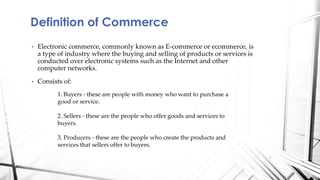
• Electronic commerce, commonly known as E-commerce or ecommerce, is
a type of industry where the buying and selling of products or services is
conducted over electronic systems such as the Internet and other
computer networks.
• Consists of:
Definition of Commerce
1. Buyers - these are people with money who want to purchase a
good or service.
2. Sellers - these are the people who offer goods and services to
buyers.
3. Producers - these are the people who create the products and
services that sellers offer to buyers.
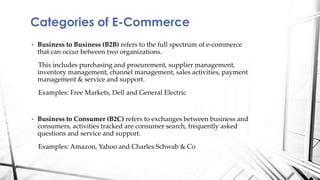
• Business to Business (B2B) refers to the full spectrum of e-commerce
that can occur between two organizations.
This includes purchasing and procurement, supplier management,
inventory management, channel management, sales activities, payment
management & service and support.
Examples: Free Markets, Dell and General Electric
• Business to Consumer (B2C) refers to exchanges between business and
consumers, activities tracked are consumer search, frequently asked
questions and service and support.
Examples: Amazon, Yahoo and Charles Schwab & Co
Categories of E-Commerce
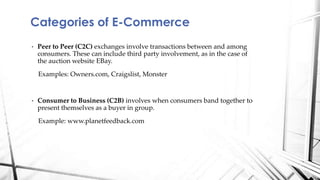
• Peer to Peer (C2C) exchanges involve transactions between and among
consumers. These can include third party involvement, as in the case of
the auction website EBay.
Examples: Owners.com, Craigslist, Monster
• Consumer to Business (C2B) involves when consumers band together to
present themselves as a buyer in group.
Example: www.planetfeedback.com
Categories of E-Commerce
Model of an Electronic Exchange
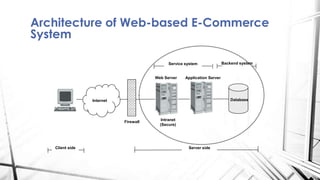
Architecture of Web-based E-Commerce
System
Backend system
Firewall
Internet
Server side
Intranet
(Secure)
Web Server Application Server
Database
Service system
Client side
• Digital certificate: an attachment to an e-mail message or data
embedded in a Web page that verifies the identity of a sender or a Web
site
• Certificate authority (CA): a trusted third party that issues digital
certificates
• Secure Sockets Layer (SSL): a communications protocol used to secure
sensitive data
• Electronic cash: an amount of money that is computerized, stored, and
used as cash for e-commerce transactions
Electronic Payment Systems
• Electronic wallet: a computerized stored value that holds credit card
information, electronic cash, owner identification, and address
information
• Credit card
• Charge card
• Debit card
• Smart card
Electronic Payment Systems (Cont.)
• Lower transaction costs - if an e-commerce site is implemented well, the web can
significantly lower both order-taking costs up front and customer service costs
• Larger purchases per transaction - Amazon offers a feature that no normal store
offers
• Integration into the business cycle
• People can shop in different ways. The ability to build an order over several days
• The ability to configure products and see actual prices
• The ability to easily build complicated custom orders
• The ability to compare prices between multiple vendors easily
• The ability to search large catalogs easily
• Larger catalogs
• Improved customer interactions - company.
Appeal of E-commerce
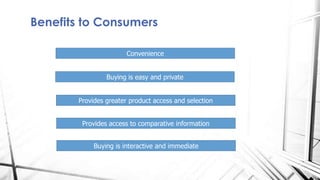
Benefits to Consumers
Convenience
Buying is easy and private
Provides greater product access and selection
Provides access to comparative information
Buying is interactive and immediate
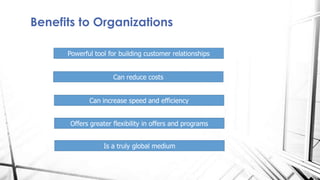
Benefits to Organizations
Powerful tool for building customer relationships
Can reduce costs
Can increase speed and efficiency
Offers greater flexibility in offers and programs
Is a truly global medium
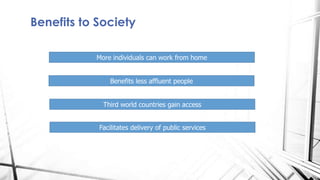
Benefits to Society
More individuals can work from home
Benefits less affluent people
Third world countries gain access
Facilitates delivery of public services
• To organizations: lack of security, reliability, standards, changing
technology, pressure to innovate, competition, old vs. new technology
• To consumers: equipment costs, access costs, knowledge, lack of privacy
for personal data, relationship replacement
• To society: less human interaction, social division, reliance on
technology, wasted resources, JIT manufacturing
Limitations of E-commerce
• E- and m-commerce incidents
• Theft of intellectual property
• Intellectual property: music, books, inventions, paintings, and other special
items protected by patents, copyrights, or trademarks
• Patents on business processes
Threats to E-Commerce
• Phishing: bogus messages purportedly from a legitimate institution to
pry personal information from customers by convincing them to go to a
“spoof” Web site
• Online auction fraud
• Spam: e-mail sent to a wide range of people and Usenet groups
indiscriminately
Fraud
• Online profiling: the practice of Web advertisers’ recording online
behavior to produce targeted advertising
• Clickstream data: data gathered based on the Web sites visited and the
items clicked on
• Safe harbor principles: principles that address the e-commerce data
privacy issues of notice, choice, and access
Invasion of Consumer Privacy

E-Commerce Basics

  • 1.
  • 2.
    • Electronic commerce,commonly known as E-commerce or ecommerce, is a type of industry where the buying and selling of products or services is conducted over electronic systems such as the Internet and other computer networks. • Consists of: Definition of Commerce 1. Buyers - these are people with money who want to purchase a good or service. 2. Sellers - these are the people who offer goods and services to buyers. 3. Producers - these are the people who create the products and services that sellers offer to buyers.
  • 3.
    • Business toBusiness (B2B) refers to the full spectrum of e-commerce that can occur between two organizations. This includes purchasing and procurement, supplier management, inventory management, channel management, sales activities, payment management & service and support. Examples: Free Markets, Dell and General Electric • Business to Consumer (B2C) refers to exchanges between business and consumers, activities tracked are consumer search, frequently asked questions and service and support. Examples: Amazon, Yahoo and Charles Schwab & Co Categories of E-Commerce
  • 4.
    • Peer toPeer (C2C) exchanges involve transactions between and among consumers. These can include third party involvement, as in the case of the auction website EBay. Examples: Owners.com, Craigslist, Monster • Consumer to Business (C2B) involves when consumers band together to present themselves as a buyer in group. Example: www.planetfeedback.com Categories of E-Commerce
  • 5.
    Model of anElectronic Exchange
  • 6.
    Architecture of Web-basedE-Commerce System Backend system Firewall Internet Server side Intranet (Secure) Web Server Application Server Database Service system Client side
  • 7.
    • Digital certificate:an attachment to an e-mail message or data embedded in a Web page that verifies the identity of a sender or a Web site • Certificate authority (CA): a trusted third party that issues digital certificates • Secure Sockets Layer (SSL): a communications protocol used to secure sensitive data • Electronic cash: an amount of money that is computerized, stored, and used as cash for e-commerce transactions Electronic Payment Systems
  • 8.
    • Electronic wallet:a computerized stored value that holds credit card information, electronic cash, owner identification, and address information • Credit card • Charge card • Debit card • Smart card Electronic Payment Systems (Cont.)
  • 9.
    • Lower transactioncosts - if an e-commerce site is implemented well, the web can significantly lower both order-taking costs up front and customer service costs • Larger purchases per transaction - Amazon offers a feature that no normal store offers • Integration into the business cycle • People can shop in different ways. The ability to build an order over several days • The ability to configure products and see actual prices • The ability to easily build complicated custom orders • The ability to compare prices between multiple vendors easily • The ability to search large catalogs easily • Larger catalogs • Improved customer interactions - company. Appeal of E-commerce
  • 10.
    Benefits to Consumers Convenience Buyingis easy and private Provides greater product access and selection Provides access to comparative information Buying is interactive and immediate
  • 11.
    Benefits to Organizations Powerfultool for building customer relationships Can reduce costs Can increase speed and efficiency Offers greater flexibility in offers and programs Is a truly global medium
  • 12.
    Benefits to Society Moreindividuals can work from home Benefits less affluent people Third world countries gain access Facilitates delivery of public services
  • 13.
    • To organizations:lack of security, reliability, standards, changing technology, pressure to innovate, competition, old vs. new technology • To consumers: equipment costs, access costs, knowledge, lack of privacy for personal data, relationship replacement • To society: less human interaction, social division, reliance on technology, wasted resources, JIT manufacturing Limitations of E-commerce
  • 14.
    • E- andm-commerce incidents • Theft of intellectual property • Intellectual property: music, books, inventions, paintings, and other special items protected by patents, copyrights, or trademarks • Patents on business processes Threats to E-Commerce
  • 15.
    • Phishing: bogusmessages purportedly from a legitimate institution to pry personal information from customers by convincing them to go to a “spoof” Web site • Online auction fraud • Spam: e-mail sent to a wide range of people and Usenet groups indiscriminately Fraud
  • 16.
    • Online profiling:the practice of Web advertisers’ recording online behavior to produce targeted advertising • Clickstream data: data gathered based on the Web sites visited and the items clicked on • Safe harbor principles: principles that address the e-commerce data privacy issues of notice, choice, and access Invasion of Consumer Privacy