Robert DC. Reyes,  MCP [email_address] www.bobreyes.com
 
Microsoft Certified Professional (MCP)  since 2002 General Manager & Chief Technology Officer at TurfSite Computing, Inc. 2003 Lecturer at DLS-CSB Multimedia Arts Program (handling web development subjects) since 2004 Hobby Blogger at  http://www.bobreyes.com  since 2003
What is Commerce? Merriam-Webster's Collegiate Dictionary defines commerce as follows: com.merce n [MF, fr. L commercium, fr. com- + merc-, merx merchandise] (1537)  1: the exchange or buying and selling of commodities on a large scale involving transportation from place to place
Buyers   these are people with  money  who want to  purchase  a good or service. Sellers   these are the people who  offer  goods and services to buyers. Sellers are generally recognized in two different forms:  retailers  who sell directly to consumers and  wholesalers  or distributors who sell to retailers and other businesses. Producers   these are the people who  create  the products and services that sellers offer to buyers. A producer is always, by necessity, a seller as well. The producer sells the products produced to wholesalers, retailers or directly to the consumer.
Product or Service Place / Venue Marketing Orders Money Billing & Collection Fulfillment / Delivery Returns Customer Service or Technical Support
Advantages of eCommerce: Lower transaction cost Larger purchases per transaction Integration into business cycle People can shop in different ways Larger catalogs Improved customer interactions
Getting traffic to come to your website Getting traffic to return to your website a second time Differentiating yourself from the competition Getting people to buy something from your web site. Having people look at your site is one thing. Getting them to actually type in their credit card numbers is another. Integrating an e-commerce web site with existing business data (if applicable)
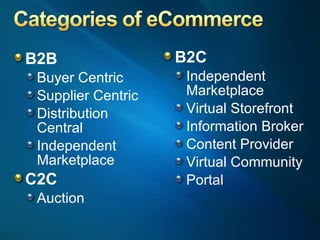
B2B Buyer Centric Supplier Centric Distribution Central Independent Marketplace C2C Auction B2C Independent Marketplace Virtual Storefront Information Broker Content Provider Virtual Community Portal
 
Make a powerful impression … Establish professionalism and start building trust … Generate the interest of your target audience … Begin downloading your value proposition & to initiate a compelling sales pitch! www.webmasterbase.com/article/863
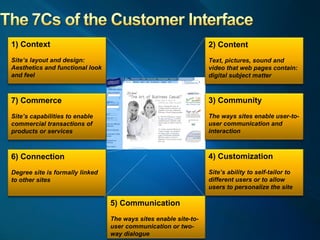
1) Context Site’s layout and design: Aesthetics and functional look and feel 7) Commerce Site’s capabilities to enable commercial transactions of products or services 6) Connection Degree site is formally linked to other sites 5) Communication The ways sites enable site-to-user communication or two-way dialogue 4) Customization Site’s ability to self-tailor to different users or to allow users to personalize the site 3) Community The ways sites enable user-to-user communication and interaction 2) Content Text, pictures, sound and video that web pages contain: digital subject matter
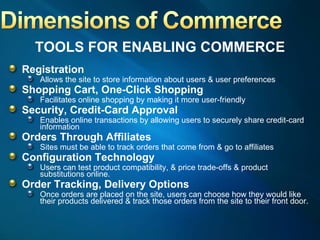
TOOLS FOR ENABLING COMMERCE Registration Allows the site to store information about users & user preferences Shopping Cart, One-Click Shopping Facilitates online shopping by making it more user-friendly Security, Credit-Card Approval Enables online transactions by allowing users to securely share credit-card information Orders Through Affiliates Sites must be able to track orders that come from & go to affiliates Configuration Technology Users can test product compatibility, & price trade-offs & product substitutions online. Order Tracking, Delivery Options Once orders are placed on the site, users can choose how they would like their products delivered & track those orders from the site to their front door.


Information security is important both to companies & consumers that participate in online business.  Many consumers are hesitant to purchase items over the Internet because they do not trust that their personal information will remain private.  Encryption is the primary method for implementing privacy policies.
Some companies that do business online recently have been caught giving away or selling information about their customers.  Several of these companies provide guarantees on their websites, claiming that customer information will remain private.  Some companies that purchase customer information offer the option for individuals to have their information removed from the database, also known as opting out.
However, many customers are unaware if & when their information is being shared, & are unable to stop the transfer of their information between companies if such activity occurs. Another major security concern that consumers have with eCommerce merchants is whether or not they will receive exactly what they purchase.
Online merchants have attempted to address this concern by investing in and building strong consumer brands (e.g., Amazon.com, eBay, Overstock.com), & by leveraging merchant/feedback rating systems & eCommerce bonding solutions.  All of these solutions attempt to assure consumers that their transactions will be free of problems because the merchants can be trusted to provide reliable products & services.
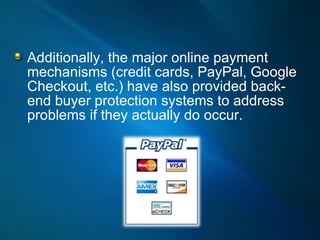
Additionally, the major online payment mechanisms (credit cards, PayPal, Google Checkout, etc.) have also provided back-end buyer protection systems to address problems if they actually do occur.
 

Setting-up an Online Store (DLS-CSB iTalk)

  • 1.
    Robert DC. Reyes, MCP [email_address] www.bobreyes.com
  • 2.
  • 3.
    Microsoft Certified Professional(MCP) since 2002 General Manager & Chief Technology Officer at TurfSite Computing, Inc. 2003 Lecturer at DLS-CSB Multimedia Arts Program (handling web development subjects) since 2004 Hobby Blogger at http://www.bobreyes.com since 2003
  • 4.
    What is Commerce?Merriam-Webster's Collegiate Dictionary defines commerce as follows: com.merce n [MF, fr. L commercium, fr. com- + merc-, merx merchandise] (1537) 1: the exchange or buying and selling of commodities on a large scale involving transportation from place to place
  • 5.
    Buyers these are people with money who want to purchase a good or service. Sellers these are the people who offer goods and services to buyers. Sellers are generally recognized in two different forms: retailers who sell directly to consumers and wholesalers or distributors who sell to retailers and other businesses. Producers these are the people who create the products and services that sellers offer to buyers. A producer is always, by necessity, a seller as well. The producer sells the products produced to wholesalers, retailers or directly to the consumer.
  • 6.
    Product or ServicePlace / Venue Marketing Orders Money Billing & Collection Fulfillment / Delivery Returns Customer Service or Technical Support
  • 7.
    Advantages of eCommerce:Lower transaction cost Larger purchases per transaction Integration into business cycle People can shop in different ways Larger catalogs Improved customer interactions
  • 8.
    Getting traffic tocome to your website Getting traffic to return to your website a second time Differentiating yourself from the competition Getting people to buy something from your web site. Having people look at your site is one thing. Getting them to actually type in their credit card numbers is another. Integrating an e-commerce web site with existing business data (if applicable)
  • 9.
    B2B Buyer CentricSupplier Centric Distribution Central Independent Marketplace C2C Auction B2C Independent Marketplace Virtual Storefront Information Broker Content Provider Virtual Community Portal
  • 10.
  • 11.
    Make a powerfulimpression … Establish professionalism and start building trust … Generate the interest of your target audience … Begin downloading your value proposition & to initiate a compelling sales pitch! www.webmasterbase.com/article/863
  • 12.
    1) Context Site’slayout and design: Aesthetics and functional look and feel 7) Commerce Site’s capabilities to enable commercial transactions of products or services 6) Connection Degree site is formally linked to other sites 5) Communication The ways sites enable site-to-user communication or two-way dialogue 4) Customization Site’s ability to self-tailor to different users or to allow users to personalize the site 3) Community The ways sites enable user-to-user communication and interaction 2) Content Text, pictures, sound and video that web pages contain: digital subject matter
  • 13.
    TOOLS FOR ENABLINGCOMMERCE Registration Allows the site to store information about users & user preferences Shopping Cart, One-Click Shopping Facilitates online shopping by making it more user-friendly Security, Credit-Card Approval Enables online transactions by allowing users to securely share credit-card information Orders Through Affiliates Sites must be able to track orders that come from & go to affiliates Configuration Technology Users can test product compatibility, & price trade-offs & product substitutions online. Order Tracking, Delivery Options Once orders are placed on the site, users can choose how they would like their products delivered & track those orders from the site to their front door.
  • 14.
  • 15.
  • 16.
  • 17.
  • 18.
    Information security isimportant both to companies & consumers that participate in online business. Many consumers are hesitant to purchase items over the Internet because they do not trust that their personal information will remain private. Encryption is the primary method for implementing privacy policies.
  • 19.
    Some companies thatdo business online recently have been caught giving away or selling information about their customers. Several of these companies provide guarantees on their websites, claiming that customer information will remain private. Some companies that purchase customer information offer the option for individuals to have their information removed from the database, also known as opting out.
  • 20.
    However, many customersare unaware if & when their information is being shared, & are unable to stop the transfer of their information between companies if such activity occurs. Another major security concern that consumers have with eCommerce merchants is whether or not they will receive exactly what they purchase.
  • 21.
    Online merchants haveattempted to address this concern by investing in and building strong consumer brands (e.g., Amazon.com, eBay, Overstock.com), & by leveraging merchant/feedback rating systems & eCommerce bonding solutions. All of these solutions attempt to assure consumers that their transactions will be free of problems because the merchants can be trusted to provide reliable products & services.
  • 22.
    Additionally, the majoronline payment mechanisms (credit cards, PayPal, Google Checkout, etc.) have also provided back-end buyer protection systems to address problems if they actually do occur.
  • 23.

Editor's Notes

  • #2 01/26/11 23:57 © 2007 Microsoft Corporation. All rights reserved. Microsoft, Windows, Windows Vista and other product names are or may be registered trademarks and/or trademarks in the U.S. and/or other countries. The information herein is for informational purposes only and represents the current view of Microsoft Corporation as of the date of this presentation. Because Microsoft must respond to changing market conditions, it should not be interpreted to be a commitment on the part of Microsoft, and Microsoft cannot guarantee the accuracy of any information provided after the date of this presentation. MICROSOFT MAKES NO WARRANTIES, EXPRESS, IMPLIED OR STATUTORY, AS TO THE INFORMATION IN THIS PRESENTATION.
  • #13 01/26/11  23:57 © 2003-2004 Microsoft Corporation. All rights reserved. This presentation is for informational purposes only. Microsoft makes no warranties, express or implied, in this summary.