BY:-
Ashik Tp
Srikant Ahir
Niyati Mehta
Pooja Solanki
Bhavini Tandel
Siddharth Thorat
North
American
Free
Trade
Agreement
Highlights
• NAFTA –Introduction
• Formation
• Objectives
• Members of NAFTA
• Pros
• Cons
• Conclusion
North American Free Trade Agreement
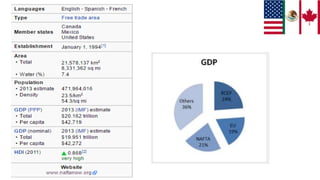
• It is an agreement signed by Canada, Mexico, and the United States,
creating a trilateral rules-based trade bloc in North America.
• NAFTA is a trilateral free-trade deal that came into force in January 1994.
• Signed by U.S. president Bill Clinton, Mexican president Carlos Salinas,
and Canadian prime minister Jean Chrétien.
• Purpose: encourage economic activity between the U.S., Mexico, Canada
• Headquarters: Ottawa (Canada), Mexico City (Mexico), and Washington
D.C(U.S)
WHY NAFTA WAS
FORMATION??
• It was made to make trade less
restrictive.
• It eliminated most tariffs on North
American exports.
• Reduced trading costs and increased
business investments.
• Also helps North America to be more
competitive in the global market
place.
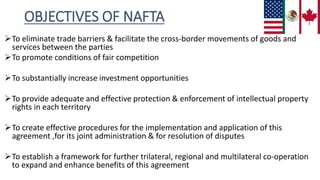
OBJECTIVES OF NAFTA
To eliminate trade barriers & facilitate the cross-border movements of goods and
services between the parties
To promote conditions of fair competition
To substantially increase investment opportunities
To provide adequate and effective protection & enforcement of intellectual property
rights in each territory
To create effective procedures for the implementation and application of this
agreement ,for its joint administration & for resolution of disputes
To establish a framework for further trilateral, regional and multilateral co-operation
to expand and enhance benefits of this agreement
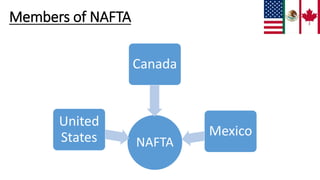
NAFTA
United
States
Canada
Mexico
Members of NAFTA
Canada
• The 1989 US-Canada Free Trade Agreement (FTA) and the 1994 North American
Free Trade Agreement (NAFTA) (which includes Mexico) touched off a dramatic
increase in trade and economic integration with the US, its principal trading
partner.
• Canada enjoys a substantial trade surplus with the US, which absorbs about
three-fourths of Canadian merchandise exports each year.
• Canada is the US's largest foreign supplier of energy, including oil, gas, and
electric power, and a top source of US uranium imports
CANADA’s Export and Import
 EXPORT :
• Commodities: motor vehicles and parts, industrial machinery, aircraft,
telecommunications equipment; chemicals, plastics, fertilizers; wood pulp,
timber, crude petroleum, natural gas, electricity, aluminum
• partner: US
 IMPORT :
• Commodities: machinery and equipment, motor vehicles and parts, crude oil,
chemicals, electricity, durable consumer goods
• partners: US , China , Mexico
• The largest and most diversified economy in the world.
• The United States is a market economy whose businesses are world
leaders in the manufacturing and high-tech sectors, especially computers,
medical equipment, and aerospace, and in services, including financial
services and telecommunications, and in agriculture.
The United States
USA’s export and import
 EXPORT :
Commodities: agricultural products (soybeans, fruit, corn) ,industrial supplies
(organic chemicals) , capital goods (transistors, aircraft, motor vehicle parts,
computers, telecommunications equipment) , consumer goods (automobiles,
medicines)
partner: Canada 19.2%, Mexico 14.8%, China 7.6%, Japan
 IMPORT :
Commodities: industrial supplies ,crude oil ,computers, telecommunications
equipment, motor vehicle parts, office machines, electric power machinery
,automobiles, clothing, medicines, furniture, toys
partners:China 19.9%, Canada 14.8%, Mexico 12.5%, Japan 5.7%, Germany
5.3
Mexico
• Mexico's $2.2 trillion economy has become increasingly oriented toward manufacturing in the
22 years since the North American Free Trade Agreement (NAFTA) entered into force.
• Per capita income is roughly one-third that of the US; income distribution remains highly
unequal
• Mexico has become the United States' second-largest export market and third-largest source
of imports.
• In 2014, two-way trade in goods and services exceeded $590 billion.
• Mexico has free trade agreements with 46 countries, putting more than 90% of trade under
free trade agreements.
• In 2012, Mexico formally joined the Trans-Pacific Partnership negotiations and formed the
Pacific Alliance with Peru, Colombia and Chile.
MEXICO’s Exports And Imports
 EXPORT :
• Commodities: manufactured goods, oil and oil products, silver, fruits,
vegetables, coffee, cotton
• partner: US 80.2%
 IMPORT :
• Commodities: metalworking machines, steel mill products, agricultural
machinery, electrical equipment, automobile parts for assembly and repair,
aircraft, aircraft parts
• partners:US 48.8%, China 16.6%, Japan 4.4%
NAFTA agreement
• The North American Free Trade Agreement (NAFTA) is a comprehensive agreement that sets the rules
for international trade and investment between Canada, the United States, and Mexico. The Agreement
is a complex and lengthy document that includes eight sections, 22 chapters, and some 2,000 pages.
Some of the most important provisions are highlighted below.
Market Access for Goods
• The elimination of duties on thousands of goods crossing borders within North America.
• Phased-in tariff reductions – now complete – and special rules for agricultural, automotive, and textile
and apparel products.
• Important rights for NAFTA services providers and users across a broad spectrum of sectors.
• Special commitments regarding telecommunications and financial services.
• Formal dispute resolution processes that help resolve differences that arise in the interpretation or
application of NAFTA’s rules.
Protection for Foreign Investment
• Commitment to treat each others’ investors and their investments in the territory of the host NAFTA
country no less favorably than their own domestic investors.
• Commitment to provide NAFTA investors with the best treatment given to foreign investors from
beyond North America.
• A transparent and binding dispute resolution mechanism specially designed to deal with investment.
Protection for Intellectual Property
• Adequate and effective protection and enforcement of a broad range of intellectual
property rights (including through patents, trademarks, copyrights, and industrial
designs), while ensuring that the measures that enforce these rights do not themselves
become barriers to legitimate trade.
Easier Access for Business Travelers
• Easier access for business professionals in hundreds of different professions so that they
can travel for business throughout the continent.
Access to Government Procurement
• Access to government procurement opportunities at the federal levels in Canada,
Mexico, and the United States.
Rules of Origin
• NAFTA rules of origin are used to determine whether a good is eligible for preferential
treatment under NAFTA.
• At various times since NAFTA came into effect, the partners have implemented
measures to liberalize or expand the list of products that qualify for preferential
treatment.
PROS
• Benefit’s the importers by reduced or duty free goods.
• Can make the exporter more competitive then other non-participating countries
• There has been great increase in trade among the three countries and market
access within each country also increased considerably.
• Mexico’s poverty rate decreased and real income increased, even after economic
crisis 1994-1995
• NAFTA had been beneficial to business owners and elites in all three countries
• Free trade increases sales and profits for Mexico, Canada and the U.S.A.,
thus strengthening their economies.
• Lack of tariffs has allowed Mexico to sell its goods in the USA and Canada
at lower prices. This makes Mexican products more competitive in these
markets and increases Mexico’s profits as it tries to develop its economy.
• Free trade is an opportunity for the U.S. to provide financial help to Mexico
by making jobs available in factories located there.
Cons
 It has negative impacts on farmers in Mexico who saw food prices fall based
on cheap imports from U.S. agribusiness
 Free trade has caused more U.S. jobs losses than gains, especially for higher-
wage jobs.
 It has negative impacts on U.S. workers in manufacturing and assembly
industries who lost jobs.
 Critics also argue that NAFTA has contributed to the rising levels of
inequality in both the U.S. and Mexico.
 Some economists believe that NAFTA has not been enough (or worked fast
enough) to produce an economic convergence, nor to substantially reduce
poverty rates
CONCLUSION
• NAFTA has played an important role in the overall development of the three nations
• - the progressive elimination of tariffs & trade barriers,
• Dispute resolution
• Commitment to intellectual property & environment legislation
• Mutual entry into governmental bidding & the financial and other service sector
• The North American Free Trade Agreement (NAFTA) revolutionized trade and
investment in North America, helping to unlock our region’s economic potential.
• It has provided North American businesses with better access to materials,
technologies, investment capital, and talent available across North America.
• It has proven that trade liberalization plays an important role in promoting
transparency, economic growth, and legal certainty.
Naf ta

Naf ta

  • 1.
    BY:- Ashik Tp Srikant Ahir NiyatiMehta Pooja Solanki Bhavini Tandel Siddharth Thorat North American Free Trade Agreement
  • 2.
    Highlights • NAFTA –Introduction •Formation • Objectives • Members of NAFTA • Pros • Cons • Conclusion
  • 3.
    North American FreeTrade Agreement • It is an agreement signed by Canada, Mexico, and the United States, creating a trilateral rules-based trade bloc in North America. • NAFTA is a trilateral free-trade deal that came into force in January 1994. • Signed by U.S. president Bill Clinton, Mexican president Carlos Salinas, and Canadian prime minister Jean Chrétien. • Purpose: encourage economic activity between the U.S., Mexico, Canada • Headquarters: Ottawa (Canada), Mexico City (Mexico), and Washington D.C(U.S)
  • 5.
    WHY NAFTA WAS FORMATION?? •It was made to make trade less restrictive. • It eliminated most tariffs on North American exports. • Reduced trading costs and increased business investments. • Also helps North America to be more competitive in the global market place.
  • 6.
    OBJECTIVES OF NAFTA Toeliminate trade barriers & facilitate the cross-border movements of goods and services between the parties To promote conditions of fair competition To substantially increase investment opportunities To provide adequate and effective protection & enforcement of intellectual property rights in each territory To create effective procedures for the implementation and application of this agreement ,for its joint administration & for resolution of disputes To establish a framework for further trilateral, regional and multilateral co-operation to expand and enhance benefits of this agreement
  • 7.
  • 8.
    Canada • The 1989US-Canada Free Trade Agreement (FTA) and the 1994 North American Free Trade Agreement (NAFTA) (which includes Mexico) touched off a dramatic increase in trade and economic integration with the US, its principal trading partner. • Canada enjoys a substantial trade surplus with the US, which absorbs about three-fourths of Canadian merchandise exports each year. • Canada is the US's largest foreign supplier of energy, including oil, gas, and electric power, and a top source of US uranium imports
  • 9.
    CANADA’s Export andImport  EXPORT : • Commodities: motor vehicles and parts, industrial machinery, aircraft, telecommunications equipment; chemicals, plastics, fertilizers; wood pulp, timber, crude petroleum, natural gas, electricity, aluminum • partner: US  IMPORT : • Commodities: machinery and equipment, motor vehicles and parts, crude oil, chemicals, electricity, durable consumer goods • partners: US , China , Mexico
  • 10.
    • The largestand most diversified economy in the world. • The United States is a market economy whose businesses are world leaders in the manufacturing and high-tech sectors, especially computers, medical equipment, and aerospace, and in services, including financial services and telecommunications, and in agriculture. The United States
  • 11.
    USA’s export andimport  EXPORT : Commodities: agricultural products (soybeans, fruit, corn) ,industrial supplies (organic chemicals) , capital goods (transistors, aircraft, motor vehicle parts, computers, telecommunications equipment) , consumer goods (automobiles, medicines) partner: Canada 19.2%, Mexico 14.8%, China 7.6%, Japan  IMPORT : Commodities: industrial supplies ,crude oil ,computers, telecommunications equipment, motor vehicle parts, office machines, electric power machinery ,automobiles, clothing, medicines, furniture, toys partners:China 19.9%, Canada 14.8%, Mexico 12.5%, Japan 5.7%, Germany 5.3
  • 12.
    Mexico • Mexico's $2.2trillion economy has become increasingly oriented toward manufacturing in the 22 years since the North American Free Trade Agreement (NAFTA) entered into force. • Per capita income is roughly one-third that of the US; income distribution remains highly unequal • Mexico has become the United States' second-largest export market and third-largest source of imports. • In 2014, two-way trade in goods and services exceeded $590 billion. • Mexico has free trade agreements with 46 countries, putting more than 90% of trade under free trade agreements. • In 2012, Mexico formally joined the Trans-Pacific Partnership negotiations and formed the Pacific Alliance with Peru, Colombia and Chile.
  • 13.
    MEXICO’s Exports AndImports  EXPORT : • Commodities: manufactured goods, oil and oil products, silver, fruits, vegetables, coffee, cotton • partner: US 80.2%  IMPORT : • Commodities: metalworking machines, steel mill products, agricultural machinery, electrical equipment, automobile parts for assembly and repair, aircraft, aircraft parts • partners:US 48.8%, China 16.6%, Japan 4.4%
  • 14.
    NAFTA agreement • TheNorth American Free Trade Agreement (NAFTA) is a comprehensive agreement that sets the rules for international trade and investment between Canada, the United States, and Mexico. The Agreement is a complex and lengthy document that includes eight sections, 22 chapters, and some 2,000 pages. Some of the most important provisions are highlighted below. Market Access for Goods • The elimination of duties on thousands of goods crossing borders within North America. • Phased-in tariff reductions – now complete – and special rules for agricultural, automotive, and textile and apparel products. • Important rights for NAFTA services providers and users across a broad spectrum of sectors. • Special commitments regarding telecommunications and financial services. • Formal dispute resolution processes that help resolve differences that arise in the interpretation or application of NAFTA’s rules. Protection for Foreign Investment • Commitment to treat each others’ investors and their investments in the territory of the host NAFTA country no less favorably than their own domestic investors. • Commitment to provide NAFTA investors with the best treatment given to foreign investors from beyond North America. • A transparent and binding dispute resolution mechanism specially designed to deal with investment.
  • 15.
    Protection for IntellectualProperty • Adequate and effective protection and enforcement of a broad range of intellectual property rights (including through patents, trademarks, copyrights, and industrial designs), while ensuring that the measures that enforce these rights do not themselves become barriers to legitimate trade. Easier Access for Business Travelers • Easier access for business professionals in hundreds of different professions so that they can travel for business throughout the continent. Access to Government Procurement • Access to government procurement opportunities at the federal levels in Canada, Mexico, and the United States. Rules of Origin • NAFTA rules of origin are used to determine whether a good is eligible for preferential treatment under NAFTA. • At various times since NAFTA came into effect, the partners have implemented measures to liberalize or expand the list of products that qualify for preferential treatment.
  • 16.
    PROS • Benefit’s theimporters by reduced or duty free goods. • Can make the exporter more competitive then other non-participating countries • There has been great increase in trade among the three countries and market access within each country also increased considerably. • Mexico’s poverty rate decreased and real income increased, even after economic crisis 1994-1995 • NAFTA had been beneficial to business owners and elites in all three countries • Free trade increases sales and profits for Mexico, Canada and the U.S.A., thus strengthening their economies. • Lack of tariffs has allowed Mexico to sell its goods in the USA and Canada at lower prices. This makes Mexican products more competitive in these markets and increases Mexico’s profits as it tries to develop its economy. • Free trade is an opportunity for the U.S. to provide financial help to Mexico by making jobs available in factories located there.
  • 17.
    Cons  It hasnegative impacts on farmers in Mexico who saw food prices fall based on cheap imports from U.S. agribusiness  Free trade has caused more U.S. jobs losses than gains, especially for higher- wage jobs.  It has negative impacts on U.S. workers in manufacturing and assembly industries who lost jobs.  Critics also argue that NAFTA has contributed to the rising levels of inequality in both the U.S. and Mexico.  Some economists believe that NAFTA has not been enough (or worked fast enough) to produce an economic convergence, nor to substantially reduce poverty rates
  • 18.
    CONCLUSION • NAFTA hasplayed an important role in the overall development of the three nations • - the progressive elimination of tariffs & trade barriers, • Dispute resolution • Commitment to intellectual property & environment legislation • Mutual entry into governmental bidding & the financial and other service sector • The North American Free Trade Agreement (NAFTA) revolutionized trade and investment in North America, helping to unlock our region’s economic potential. • It has provided North American businesses with better access to materials, technologies, investment capital, and talent available across North America. • It has proven that trade liberalization plays an important role in promoting transparency, economic growth, and legal certainty.