The Climate ChangeThe Climate Change
Agenda in 2009Agenda in 2009
December 17, 2008
Kevin M. Dempsey
2
Two Track Agenda on Climate ChangeTwo Track Agenda on Climate Change
• Cap and Trade Legislation
 Obama commitment: reduce emissions to 1990 levels by
2020 and 80% below 1990 levels by 2050
 U.S. emissions in 2007 were 16.7% above 1990 levels
 Appointments of energy/climate czar and Energy Secretary
show priority of climate change agenda
 EPA rulemaking under Clean Air Act remains underway
• Copenhagen Conference in December 2009
 Treaty to replace Kyoto Protocol in 2013
 Major issues unresolved at Poznan conference
 World waiting for new U.S. Administration
3
U.S. Climate Change LegislationU.S. Climate Change Legislation
• Cap and Trade vs. Carbon Tax
 Cap and trade approach most favored on the Hill
 Waxman, Dingell, Markey, Boxer, Lieberman, Bingaman
 CBO and many economists favor carbon tax as more
economically efficient
• Advantages of Cap and Trade Approach
 Environmental certainty on level of emissions
 Easier to grant subsidies through free allowances
 Linkage with rest of world
 Kyoto Protocol endorsed emissions trading
 EU, Australia, New Zealand pursuing cap and trade
4
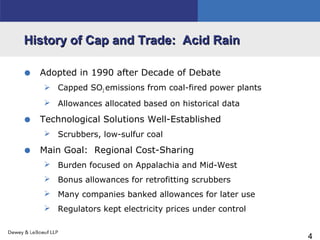
History of Cap and Trade: Acid RainHistory of Cap and Trade: Acid Rain
• Adopted in 1990 after Decade of Debate
 Capped SO2 emissions from coal-fired power plants
 Allowances allocated based on historical data
• Technological Solutions Well-Established
 Scrubbers, low-sulfur coal
• Main Goal: Regional Cost-Sharing
 Burden focused on Appalachia and Mid-West
 Bonus allowances for retrofitting scrubbers
 Many companies banked allowances for later use
 Regulators kept electricity prices under control
5
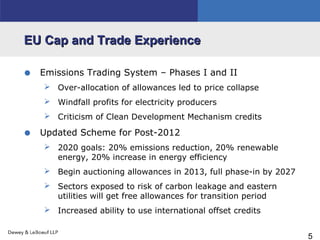
EU Cap and Trade ExperienceEU Cap and Trade Experience
• Emissions Trading System – Phases I and II
 Over-allocation of allowances led to price collapse
 Windfall profits for electricity producers
 Criticism of Clean Development Mechanism credits
• Updated Scheme for Post-2012
 2020 goals: 20% emissions reduction, 20% renewable
energy, 20% increase in energy efficiency
 Begin auctioning allowances in 2013, full phase-in by 2027
 Sectors exposed to risk of carbon leakage and eastern
utilities will get free allowances for transition period
 Increased ability to use international offset credits
6
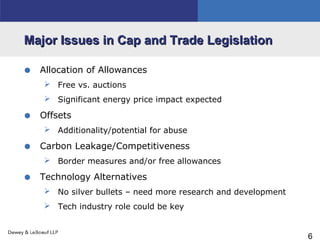
Major Issues in Cap and Trade LegislationMajor Issues in Cap and Trade Legislation
• Allocation of Allowances
 Free vs. auctions
 Significant energy price impact expected
• Offsets
 Additionality/potential for abuse
• Carbon Leakage/Competitiveness
 Border measures and/or free allowances
• Technology Alternatives
 No silver bullets – need more research and development
 Tech industry role could be key
7
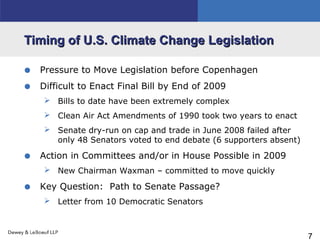
Timing of U.S. Climate Change LegislationTiming of U.S. Climate Change Legislation
• Pressure to Move Legislation before Copenhagen
• Difficult to Enact Final Bill by End of 2009
 Bills to date have been extremely complex
 Clean Air Act Amendments of 1990 took two years to enact
 Senate dry-run on cap and trade in June 2008 failed after
only 48 Senators voted to end debate (6 supporters absent)
• Action in Committees and/or in House Possible in 2009
 New Chairman Waxman – committed to move quickly
• Key Question: Path to Senate Passage?
 Letter from 10 Democratic Senators
8
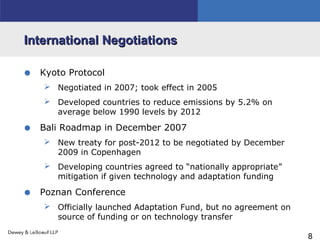
International NegotiationsInternational Negotiations
• Kyoto Protocol
 Negotiated in 2007; took effect in 2005
 Developed countries to reduce emissions by 5.2% on
average below 1990 levels by 2012
• Bali Roadmap in December 2007
 New treaty for post-2012 to be negotiated by December
2009 in Copenhagen
 Developing countries agreed to “nationally appropriate”
mitigation if given technology and adaptation funding
• Poznan Conference
 Officially launched Adaptation Fund, but no agreement on
source of funding or on technology transfer
9
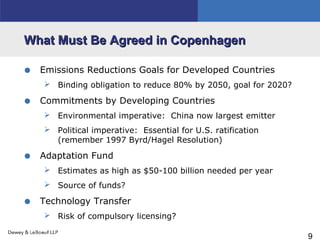
What Must Be Agreed in CopenhagenWhat Must Be Agreed in Copenhagen
• Emissions Reductions Goals for Developed Countries
 Binding obligation to reduce 80% by 2050, goal for 2020?
• Commitments by Developing Countries
 Environmental imperative: China now largest emitter
 Political imperative: Essential for U.S. ratification
(remember 1997 Byrd/Hagel Resolution)
• Adaptation Fund
 Estimates as high as $50-100 billion needed per year
 Source of funds?
• Technology Transfer
 Risk of compulsory licensing?
10
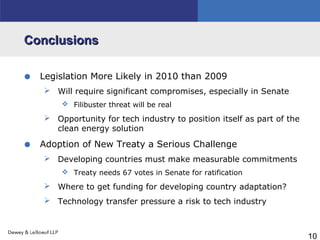
ConclusionsConclusions
• Legislation More Likely in 2010 than 2009
 Will require significant compromises, especially in Senate
 Filibuster threat will be real
 Opportunity for tech industry to position itself as part of the
clean energy solution
• Adoption of New Treaty a Serious Challenge
 Developing countries must make measurable commitments
 Treaty needs 67 votes in Senate for ratification
 Where to get funding for developing country adaptation?
 Technology transfer pressure a risk to tech industry
11
Thank youThank you
For additional information, please contact:
Kevin M. Dempsey
Dewey & LeBoeuf LLP
kdempsey@dl.com
(202) 346-7997

Dec08 Climate Change Presentation

  • 1.
    The Climate ChangeTheClimate Change Agenda in 2009Agenda in 2009 December 17, 2008 Kevin M. Dempsey
  • 2.
    2 Two Track Agendaon Climate ChangeTwo Track Agenda on Climate Change • Cap and Trade Legislation  Obama commitment: reduce emissions to 1990 levels by 2020 and 80% below 1990 levels by 2050  U.S. emissions in 2007 were 16.7% above 1990 levels  Appointments of energy/climate czar and Energy Secretary show priority of climate change agenda  EPA rulemaking under Clean Air Act remains underway • Copenhagen Conference in December 2009  Treaty to replace Kyoto Protocol in 2013  Major issues unresolved at Poznan conference  World waiting for new U.S. Administration
  • 3.
    3 U.S. Climate ChangeLegislationU.S. Climate Change Legislation • Cap and Trade vs. Carbon Tax  Cap and trade approach most favored on the Hill  Waxman, Dingell, Markey, Boxer, Lieberman, Bingaman  CBO and many economists favor carbon tax as more economically efficient • Advantages of Cap and Trade Approach  Environmental certainty on level of emissions  Easier to grant subsidies through free allowances  Linkage with rest of world  Kyoto Protocol endorsed emissions trading  EU, Australia, New Zealand pursuing cap and trade
  • 4.
    4 History of Capand Trade: Acid RainHistory of Cap and Trade: Acid Rain • Adopted in 1990 after Decade of Debate  Capped SO2 emissions from coal-fired power plants  Allowances allocated based on historical data • Technological Solutions Well-Established  Scrubbers, low-sulfur coal • Main Goal: Regional Cost-Sharing  Burden focused on Appalachia and Mid-West  Bonus allowances for retrofitting scrubbers  Many companies banked allowances for later use  Regulators kept electricity prices under control
  • 5.
    5 EU Cap andTrade ExperienceEU Cap and Trade Experience • Emissions Trading System – Phases I and II  Over-allocation of allowances led to price collapse  Windfall profits for electricity producers  Criticism of Clean Development Mechanism credits • Updated Scheme for Post-2012  2020 goals: 20% emissions reduction, 20% renewable energy, 20% increase in energy efficiency  Begin auctioning allowances in 2013, full phase-in by 2027  Sectors exposed to risk of carbon leakage and eastern utilities will get free allowances for transition period  Increased ability to use international offset credits
  • 6.
    6 Major Issues inCap and Trade LegislationMajor Issues in Cap and Trade Legislation • Allocation of Allowances  Free vs. auctions  Significant energy price impact expected • Offsets  Additionality/potential for abuse • Carbon Leakage/Competitiveness  Border measures and/or free allowances • Technology Alternatives  No silver bullets – need more research and development  Tech industry role could be key
  • 7.
    7 Timing of U.S.Climate Change LegislationTiming of U.S. Climate Change Legislation • Pressure to Move Legislation before Copenhagen • Difficult to Enact Final Bill by End of 2009  Bills to date have been extremely complex  Clean Air Act Amendments of 1990 took two years to enact  Senate dry-run on cap and trade in June 2008 failed after only 48 Senators voted to end debate (6 supporters absent) • Action in Committees and/or in House Possible in 2009  New Chairman Waxman – committed to move quickly • Key Question: Path to Senate Passage?  Letter from 10 Democratic Senators
  • 8.
    8 International NegotiationsInternational Negotiations •Kyoto Protocol  Negotiated in 2007; took effect in 2005  Developed countries to reduce emissions by 5.2% on average below 1990 levels by 2012 • Bali Roadmap in December 2007  New treaty for post-2012 to be negotiated by December 2009 in Copenhagen  Developing countries agreed to “nationally appropriate” mitigation if given technology and adaptation funding • Poznan Conference  Officially launched Adaptation Fund, but no agreement on source of funding or on technology transfer
  • 9.
    9 What Must BeAgreed in CopenhagenWhat Must Be Agreed in Copenhagen • Emissions Reductions Goals for Developed Countries  Binding obligation to reduce 80% by 2050, goal for 2020? • Commitments by Developing Countries  Environmental imperative: China now largest emitter  Political imperative: Essential for U.S. ratification (remember 1997 Byrd/Hagel Resolution) • Adaptation Fund  Estimates as high as $50-100 billion needed per year  Source of funds? • Technology Transfer  Risk of compulsory licensing?
  • 10.
    10 ConclusionsConclusions • Legislation MoreLikely in 2010 than 2009  Will require significant compromises, especially in Senate  Filibuster threat will be real  Opportunity for tech industry to position itself as part of the clean energy solution • Adoption of New Treaty a Serious Challenge  Developing countries must make measurable commitments  Treaty needs 67 votes in Senate for ratification  Where to get funding for developing country adaptation?  Technology transfer pressure a risk to tech industry
  • 11.
    11 Thank youThank you Foradditional information, please contact: Kevin M. Dempsey Dewey & LeBoeuf LLP kdempsey@dl.com (202) 346-7997