LATERAL EARTH PRESSURE THEORIES
Introduction
Stable Slopes: Soil mass is stable when its surface slope is flatter than a certain safe slope.
Limited Space Challenges: In constrained areas, achieving a flat slope might not be possible. In such cases,
retaining structures are needed to support soil at steeper slopes.
Function of Retaining Walls: Retaining walls maintain soil at different elevations on each side, preventing
higher side soil from sliding and ensuring stability.
Determining Lateral Earth Pressure: Designing retaining structures involves calculating lateral earth
pressure. This pressure depends on factors like wall movement mode, wall flexibility, soil properties, and
drainage conditions.
Soil-Structure Interaction: Earth pressure theories consider the interaction between soil and structure.
While advanced theories exist, for simplicity, rigid wall assumptions are often made, neglecting soil-structure
interaction effects.

Classical Theories: Lateral earth pressure is typically computed using classical theories proposed by Coulomb
(1773) and Rankine (1857). These provide basic but effective calculations.

General Wedge Theory: Terzaghi (1941) introduced a more comprehensive theory, the general wedge
theory, improving upon earlier ones. However, it's more complex.
Types of Retaining Walls: Design approaches differ for rigid walls and flexible ones like sheet pile walls and
bulkheads.
Types Of Lateral Earth Pressure
• At-rest Pressure:
• Occurs when the soil mass is moving laterally.
• The retaining wall is firmly fixed at its top and cannot rotate or move.
• Example: Basement retaining walls restrained by a basement slab or bridge abutment walls restrained
by a bridge slab.
• Also known as elastic equilibrium, as no part of the soil mass has failed or reached plastic equilibrium.
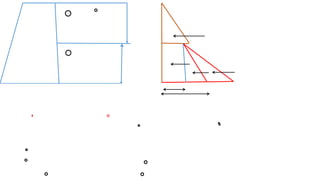
• Active Pressure:
• Occurs when the soil mass yields in a way that it stretches horizontally.
• Represents a state of plastic equilibrium, where the soil mass is on the brink of failure.
• Happens when the retaining wall moves away from the backfill, causing the soil to stretch.
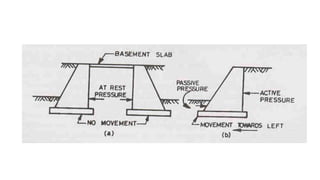
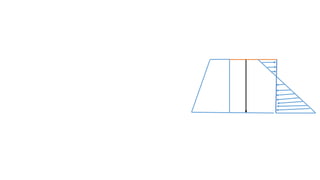
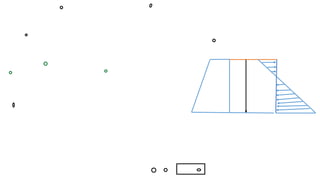
• Example: Active pressure develops on the right-hand side when the wall moves towards the left.
• Passive Pressure:
• Occurs when the movement of the wall causes the soil to compress horizontally.
• Happens when the retaining wall moves towards the backfill, causing the soil to compress.
• Example: Passive pressure develops on the left side of the wall below ground level, as the soil
compresses when the wall moves to the left.
• Another example is the pressure acting on an anchor block.
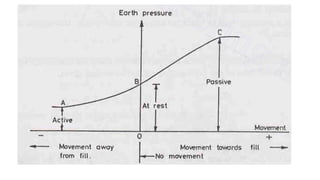
Variation of Pressure
• At-rest Pressure (Point B):
• No movement of the wall.
• Represents the at-rest pressure where soil is not yielding or moving laterally.
• Active Pressure (Point A):
• Wall moves away from the backfill.
• Soil behind the wall tends to break away, forming a wedge-shaped failure portion that moves
downward and outward.
• Lateral earth pressure exerted on the wall is minimal as soil is at the verge of failure due to decreased
lateral stress.
• Requires a very small horizontal strain (about 0.5% in dense sand) to reach the active state.
• Passive Pressure (Point C):
• Wall moves towards the backfill.
• Earth pressure increases as the failure wedge moves upward and inward.
• Maximum value of earth pressure is the passive earth pressure.
• Soil is at the verge of failure due to increased lateral stress.
• Similar to active pressure, requires minimal horizontal strain (about 0.5%) to reach the passive state.
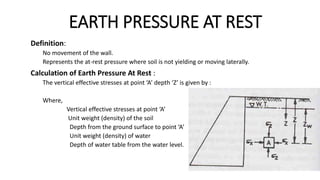
EARTH PRESSURE AT REST
Definition:
No movement of the wall.
Represents the at-rest pressure where soil is not yielding or moving laterally.
Calculation of Earth Pressure At Rest :
The vertical effective stresses at point ‘A’ depth ‘Z’ is given by :
Where,
Vertical effective stresses at point ‘A’
Unit weight (density) of the soil
Depth from the ground surface to point ‘A’
Unit weight (density) of water
Depth of water table from the water level.
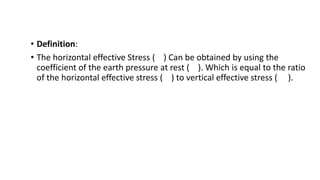
• Definition:
• The horizontal effective Stress ( ) Can be obtained by using the
coefficient of the earth pressure at rest ( ). Which is equal to the ratio
of the horizontal effective stress ( ) to vertical effective stress ( ).
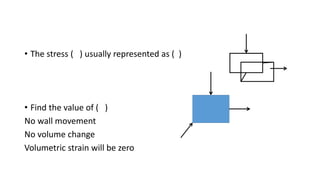
• The stress ( ) usually represented as ( )
• Find the value of ( )
No wall movement
No volume change
Volumetric strain will be zero
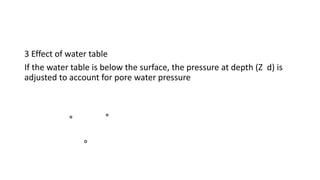
3 Effect of water table
If the water table is below the surface, the pressure at depth (Z d) is
adjusted to account for pore water pressure
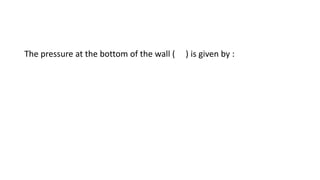
The pressure at the bottom of the wall ( ) is given by :
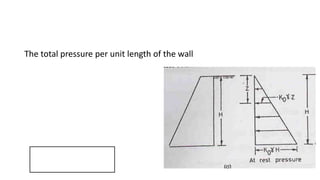
The total pressure per unit length of the wall
Rankine's Earth Pressure Theory
• Rankine's Earth Pressure Theory, proposed in 1857, Rankine wanted to understand how the
forces within a small piece of soil interacted with each other and with the surrounding soil
mass when the surface around it was flat. This analysis helps in understanding how soil
behaves and exerts pressure on retaining structures like walls or foundations.. Here's a
breakdown of the assumptions and key points of Rankine's theory:
• Homogeneous and Semi-Infinite Soil:
• Rankine assumed that the soil mass is uniform and extends indefinitely in all directions.
• Dry and Cohesionless Soil:
• Rankine considered soil without water and cohesion, simplifying the analysis.
• Plane Ground Surface:
• The ground surface is assumed to be flat, whether horizontal or inclined, for ease of calculation.
• Smooth and Vertical Retaining Wall:
• The back of the retaining wall is assumed to be smooth (frictionless) and perfectly vertical.
• State of Plastic Equilibrium:
• Rankine analyzed the soil element at the verge of failure, known as plastic equilibrium
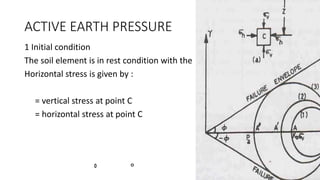
ACTIVE EARTH PRESSURE
1 Initial condition
The soil element is in rest condition with the
Horizontal stress is given by :
= vertical stress at point C
= horizontal stress at point C
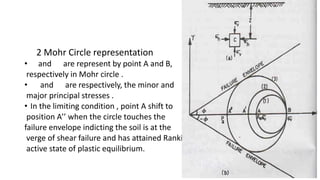
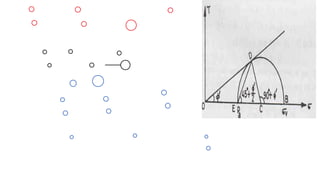
2 Mohr Circle representation
• and are represent by point A and B,
respectively in Mohr circle .
• and are respectively, the minor and
major principal stresses .
• In the limiting condition , point A shift to
position A’’ when the circle touches the
failure envelope indicting the soil is at the
verge of shear failure and has attained Rankine’s
active state of plastic equilibrium.
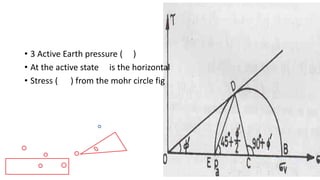
• 3 Active Earth pressure ( )
• At the active state is the horizontal
• Stress ( ) from the mohr circle fig
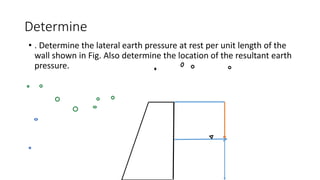
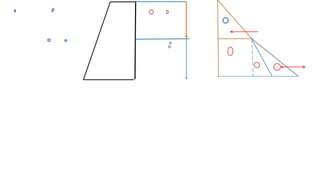
Determine
• . Determine the lateral earth pressure at rest per unit length of the
wall shown in Fig. Also determine the location of the resultant earth
pressure.
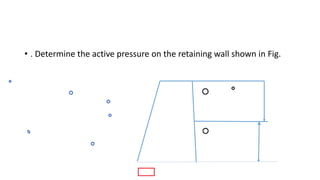
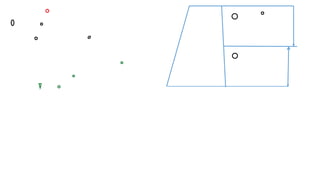
• . Determine the active pressure on the retaining wall shown in Fig.
Passive Earth Pressure
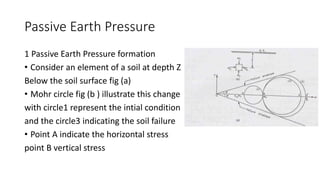
1 Passive Earth Pressure formation
• Consider an element of a soil at depth Z
Below the soil surface fig (a)
• Mohr circle fig (b ) illustrate this change
with circle1 represent the intial condition
and the circle3 indicating the soil failure
• Point A indicate the horizontal stress
point B vertical stress
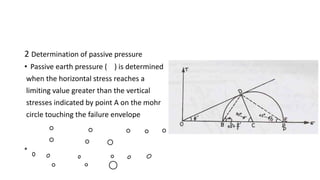
2 Determination of passive pressure
• Passive earth pressure ( ) is determined
when the horizontal stress reaches a
limiting value greater than the vertical
stresses indicated by point A on the mohr
circle touching the failure envelope
Rankine’s Earth Pressure In Cohesive Soil
• Introduction of cohesion
Rankine’s Original theories was for cohesion less soil, but Resal (1910) and
Bell (1915) extended it for Cohesive soil.
The primary difference is that the failure envelope soils bas cohesion
intercept c' unlike cohesionless soil where its zero0
Active Case
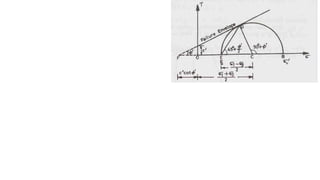
In fig depicts the Mohrs circle, with point 'E' representing the active
pressure.
The failure envelope is tangential to the circle.
An expression for the relationship between active pressure ( ) and vertical
stress ( ) is drived from triangle FCD
LATERAL EARTH PRASSURE THEORIES-3.pptx d

LATERAL EARTH PRASSURE THEORIES-3.pptx d

  • 1.
    LATERAL EARTH PRESSURETHEORIES Introduction Stable Slopes: Soil mass is stable when its surface slope is flatter than a certain safe slope. Limited Space Challenges: In constrained areas, achieving a flat slope might not be possible. In such cases, retaining structures are needed to support soil at steeper slopes. Function of Retaining Walls: Retaining walls maintain soil at different elevations on each side, preventing higher side soil from sliding and ensuring stability. Determining Lateral Earth Pressure: Designing retaining structures involves calculating lateral earth pressure. This pressure depends on factors like wall movement mode, wall flexibility, soil properties, and drainage conditions. Soil-Structure Interaction: Earth pressure theories consider the interaction between soil and structure. While advanced theories exist, for simplicity, rigid wall assumptions are often made, neglecting soil-structure interaction effects. Classical Theories: Lateral earth pressure is typically computed using classical theories proposed by Coulomb (1773) and Rankine (1857). These provide basic but effective calculations. General Wedge Theory: Terzaghi (1941) introduced a more comprehensive theory, the general wedge theory, improving upon earlier ones. However, it's more complex. Types of Retaining Walls: Design approaches differ for rigid walls and flexible ones like sheet pile walls and bulkheads.
  • 2.
    Types Of LateralEarth Pressure • At-rest Pressure: • Occurs when the soil mass is moving laterally. • The retaining wall is firmly fixed at its top and cannot rotate or move. • Example: Basement retaining walls restrained by a basement slab or bridge abutment walls restrained by a bridge slab. • Also known as elastic equilibrium, as no part of the soil mass has failed or reached plastic equilibrium. • Active Pressure: • Occurs when the soil mass yields in a way that it stretches horizontally. • Represents a state of plastic equilibrium, where the soil mass is on the brink of failure. • Happens when the retaining wall moves away from the backfill, causing the soil to stretch. • Example: Active pressure develops on the right-hand side when the wall moves towards the left. • Passive Pressure: • Occurs when the movement of the wall causes the soil to compress horizontally. • Happens when the retaining wall moves towards the backfill, causing the soil to compress. • Example: Passive pressure develops on the left side of the wall below ground level, as the soil compresses when the wall moves to the left. • Another example is the pressure acting on an anchor block.
  • 4.
    Variation of Pressure •At-rest Pressure (Point B): • No movement of the wall. • Represents the at-rest pressure where soil is not yielding or moving laterally. • Active Pressure (Point A): • Wall moves away from the backfill. • Soil behind the wall tends to break away, forming a wedge-shaped failure portion that moves downward and outward. • Lateral earth pressure exerted on the wall is minimal as soil is at the verge of failure due to decreased lateral stress. • Requires a very small horizontal strain (about 0.5% in dense sand) to reach the active state. • Passive Pressure (Point C): • Wall moves towards the backfill. • Earth pressure increases as the failure wedge moves upward and inward. • Maximum value of earth pressure is the passive earth pressure. • Soil is at the verge of failure due to increased lateral stress. • Similar to active pressure, requires minimal horizontal strain (about 0.5%) to reach the passive state.
  • 6.
    EARTH PRESSURE ATREST Definition: No movement of the wall. Represents the at-rest pressure where soil is not yielding or moving laterally. Calculation of Earth Pressure At Rest : The vertical effective stresses at point ‘A’ depth ‘Z’ is given by : Where, Vertical effective stresses at point ‘A’ Unit weight (density) of the soil Depth from the ground surface to point ‘A’ Unit weight (density) of water Depth of water table from the water level.
  • 7.
    • Definition: • Thehorizontal effective Stress ( ) Can be obtained by using the coefficient of the earth pressure at rest ( ). Which is equal to the ratio of the horizontal effective stress ( ) to vertical effective stress ( ).
  • 8.
    • The stress( ) usually represented as ( ) • Find the value of ( ) No wall movement No volume change Volumetric strain will be zero
  • 11.
    3 Effect ofwater table If the water table is below the surface, the pressure at depth (Z d) is adjusted to account for pore water pressure
  • 12.
    The pressure atthe bottom of the wall ( ) is given by :
  • 13.
    The total pressureper unit length of the wall
  • 14.
    Rankine's Earth PressureTheory • Rankine's Earth Pressure Theory, proposed in 1857, Rankine wanted to understand how the forces within a small piece of soil interacted with each other and with the surrounding soil mass when the surface around it was flat. This analysis helps in understanding how soil behaves and exerts pressure on retaining structures like walls or foundations.. Here's a breakdown of the assumptions and key points of Rankine's theory: • Homogeneous and Semi-Infinite Soil: • Rankine assumed that the soil mass is uniform and extends indefinitely in all directions. • Dry and Cohesionless Soil: • Rankine considered soil without water and cohesion, simplifying the analysis. • Plane Ground Surface: • The ground surface is assumed to be flat, whether horizontal or inclined, for ease of calculation. • Smooth and Vertical Retaining Wall: • The back of the retaining wall is assumed to be smooth (frictionless) and perfectly vertical. • State of Plastic Equilibrium: • Rankine analyzed the soil element at the verge of failure, known as plastic equilibrium
  • 15.
    ACTIVE EARTH PRESSURE 1Initial condition The soil element is in rest condition with the Horizontal stress is given by : = vertical stress at point C = horizontal stress at point C
  • 16.
    2 Mohr Circlerepresentation • and are represent by point A and B, respectively in Mohr circle . • and are respectively, the minor and major principal stresses . • In the limiting condition , point A shift to position A’’ when the circle touches the failure envelope indicting the soil is at the verge of shear failure and has attained Rankine’s active state of plastic equilibrium.
  • 17.
    • 3 ActiveEarth pressure ( ) • At the active state is the horizontal • Stress ( ) from the mohr circle fig
  • 18.
    Determine • . Determinethe lateral earth pressure at rest per unit length of the wall shown in Fig. Also determine the location of the resultant earth pressure.
  • 21.
    • . Determinethe active pressure on the retaining wall shown in Fig.
  • 27.
    Passive Earth Pressure 1Passive Earth Pressure formation • Consider an element of a soil at depth Z Below the soil surface fig (a) • Mohr circle fig (b ) illustrate this change with circle1 represent the intial condition and the circle3 indicating the soil failure • Point A indicate the horizontal stress point B vertical stress
  • 28.
    2 Determination ofpassive pressure • Passive earth pressure ( ) is determined when the horizontal stress reaches a limiting value greater than the vertical stresses indicated by point A on the mohr circle touching the failure envelope
  • 30.
    Rankine’s Earth PressureIn Cohesive Soil • Introduction of cohesion Rankine’s Original theories was for cohesion less soil, but Resal (1910) and Bell (1915) extended it for Cohesive soil. The primary difference is that the failure envelope soils bas cohesion intercept c' unlike cohesionless soil where its zero0 Active Case In fig depicts the Mohrs circle, with point 'E' representing the active pressure. The failure envelope is tangential to the circle. An expression for the relationship between active pressure ( ) and vertical stress ( ) is drived from triangle FCD