KNOWLEDGE OF ELECTROCARDIOGRAM INVENTORY

Gender:___________                     Year Level: ________

Number of Exposure: 0-1 ____ 2-3____             4-5_____         6 times and more_____

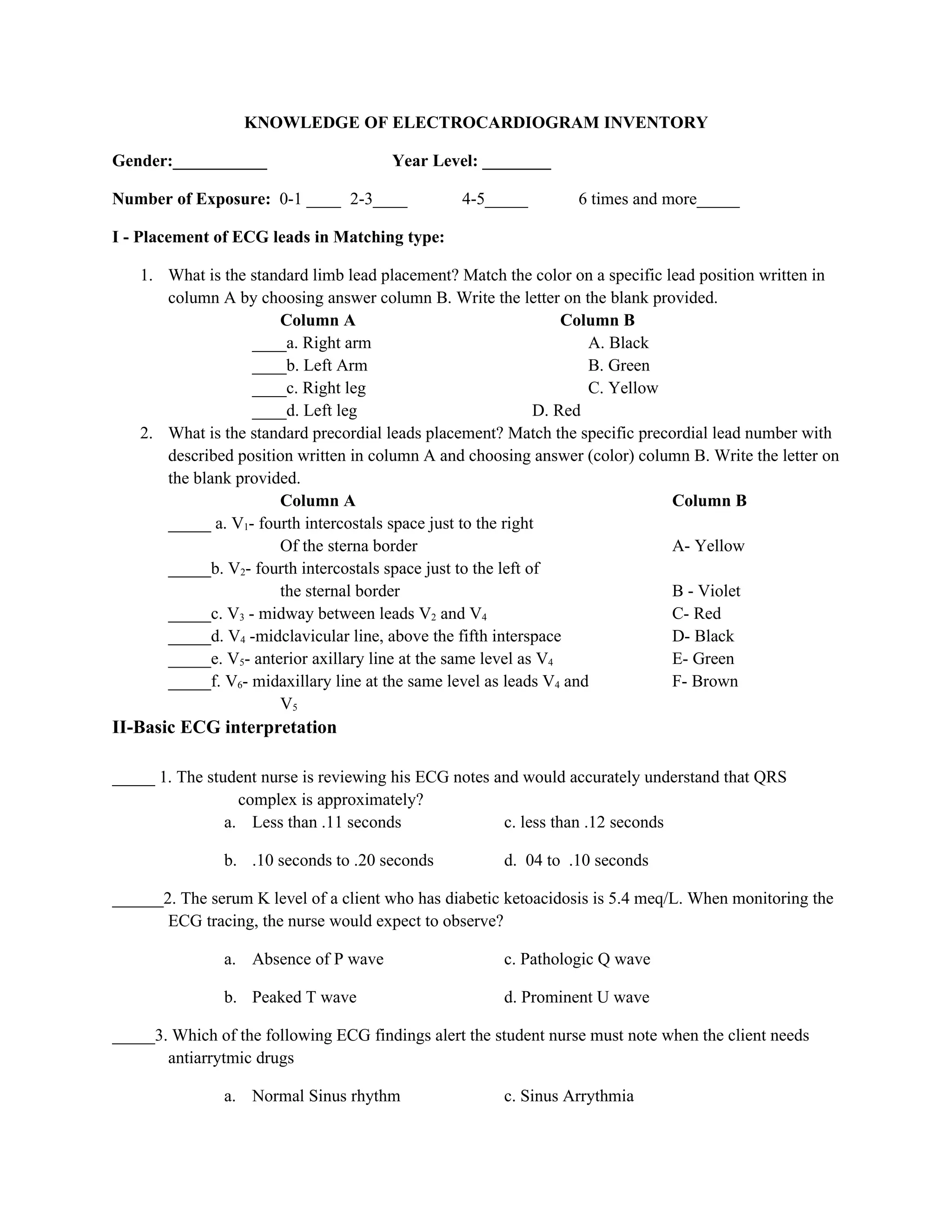
I - Placement of ECG leads in Matching type:

   1. What is the standard limb lead placement? Match the color on a specific lead position written in
      column A by choosing answer column B. Write the letter on the blank provided.
                      Column A                                    Column B
                  ____a. Right arm                                   A. Black
                  ____b. Left Arm                                    B. Green
                  ____c. Right leg                                   C. Yellow
                  ____d. Left leg                             D. Red
   2. What is the standard precordial leads placement? Match the specific precordial lead number with
      described position written in column A and choosing answer (color) column B. Write the letter on
      the blank provided.
                      Column A                                                 Column B
      _____ a. V1- fourth intercostals space just to the right
                      Of the sterna border                                     A- Yellow
      _____b. V2- fourth intercostals space just to the left of
                      the sternal border                                       B - Violet
      _____c. V3 - midway between leads V2 and V4                              C- Red
      _____d. V4 -midclavicular line, above the fifth interspace               D- Black
      _____e. V5- anterior axillary line at the same level as V4               E- Green
      _____f. V6- midaxillary line at the same level as leads V4 and           F- Brown
                      V5
II-Basic ECG interpretation

_____ 1. The student nurse is reviewing his ECG notes and would accurately understand that QRS
                  complex is approximately?
                a. Less than .11 seconds               c. less than .12 seconds

               b. .10 seconds to .20 seconds           d. 04 to .10 seconds

______2. The serum K level of a client who has diabetic ketoacidosis is 5.4 meq/L. When monitoring the
       ECG tracing, the nurse would expect to observe?

               a. Absence of P wave                    c. Pathologic Q wave

               b. Peaked T wave                        d. Prominent U wave

_____3. Which of the following ECG findings alert the student nurse must note when the client needs
       antiarrytmic drugs

               a. Normal Sinus rhythm                  c. Sinus Arrythmia
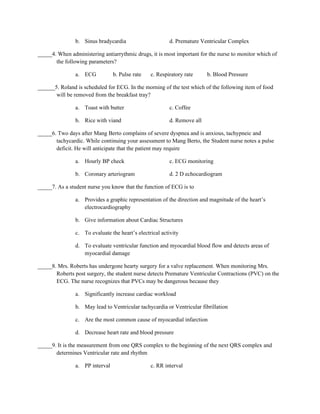
b. Sinus bradycardia                     d. Premature Ventricular Complex

_____4. When administering antiarrythmic drugs, it is most important for the nurse to monitor which of
       the following parameters?

                a. ECG           b. Pulse rate   c. Respiratory rate     b. Blood Pressure

______5. Roland is scheduled for ECG. In the morning of the test which of the following item of food
       will be removed from the breakfast tray?

                a. Toast with butter                     c. Coffee

                b. Rice with viand                       d. Remove all

_____6. Two days after Mang Berto complains of severe dyspnea and is anxious, tachypneic and
       tachycardic. While continuing your assessment to Mang Berto, the Student nurse notes a pulse
       deficit. He will anticipate that the patient may require

                a. Hourly BP check                       c. ECG monitoring

                b. Coronary arteriogram                  d. 2 D echocardiogram

_____7. As a student nurse you know that the function of ECG is to

                a. Provides a graphic representation of the direction and magnitude of the heart’s
                   electrocardiography

                b. Give information about Cardiac Structures

                c. To evaluate the heart’s electrical activity

                d. To evaluate ventricular function and myocardial blood flow and detects areas of
                   myocardial damage

_____8. Mrs. Roberts has undergone hearty surgery for a valve replacement. When monitoring Mrs.
       Roberts post surgery, the student nurse detects Premature Ventricular Contractions (PVC) on the
       ECG. The nurse recognizes that PVCs may be dangerous because they

                a. Significantly increase cardiac workload

                b. May lead to Ventricular tachycardia or Ventricular fibrillation

                c. Are the most common cause of myocardial infarction

                d. Decrease heart rate and blood pressure

_____9. It is the measurement from one QRS complex to the beginning of the next QRS complex and
       determines Ventricular rate and rhythm

                a. PP interval                   c. RR interval
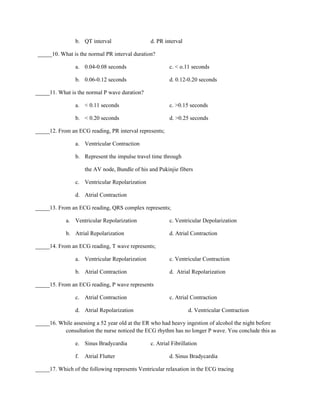
b. QT interval                   d. PR interval

_____10. What is the normal PR interval duration?

                a. 0.04-0.08 seconds                     c. < o.11 seconds

                b. 0.06-0.12 seconds                     d. 0.12-0.20 seconds

_____11. What is the normal P wave duration?

                a. < 0.11 seconds                        c. >0.15 seconds

                b. < 0.20 seconds                        d. >0.25 seconds

_____12. From an ECG reading, PR interval represents;

                a. Ventricular Contraction

                b. Represent the impulse travel time through

                     the AV node, Bundle of his and Pukinjie fibers

                c. Ventricular Repolarization

                d. Atrial Contraction

_____13. From an ECG reading, QRS complex represents;

            a. Ventricular Repolarization                c. Ventricular Depolarization

            b. Atrial Repolarization                     d. Atrial Contraction

_____14. From an ECG reading, T wave represents;

                a. Ventricular Repolarization            c. Ventricular Contraction

                b. Atrial Contraction                    d. Atrial Repolarization

_____15. From an ECG reading, P wave represents

                c. Atrial Contraction                    c. Atrial Contraction

                d. Atrial Repolarization                          d. Ventricular Contraction

_____16. While assessing a 52 year old at the ER who had heavy ingestion of alcohol the night before
           consultation the nurse noticed the ECG rhythm has no longer P wave. You conclude this as

                e. Sinus Bradycardia             c. Atrial Fibrillation

                f.   Atrial Flutter                      d. Sinus Bradycardia

_____17. Which of the following represents Ventricular relaxation in the ECG tracing
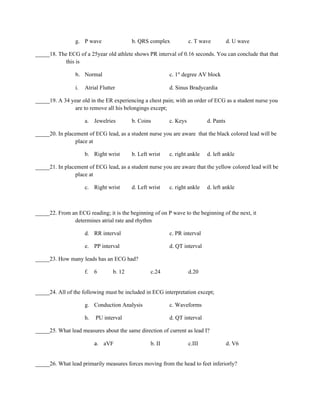
g. P wave                 b. QRS complex            c. T wave          d. U wave

_____18. The ECG of a 25year old athlete shows PR interval of 0.16 seconds. You can conclude that that
           this is

                 h. Normal                                 c. 1st degree AV block

                 i.   Atrial Flutter                       d. Sinus Bradycardia

_____19. A 34 year old in the ER experiencing a chest pain; with an order of ECG as a student nurse you
                are to remove all his belongings except;

                      a. Jewelries         b. Coins        c. Keys           d. Pants

_____20. In placement of ECG lead, as a student nurse you are aware that the black colored lead will be
                place at

                      b. Right wrist       b. Left wrist   c. right ankle    d. left ankle

_____21. In placement of ECG lead, as a student nurse you are aware that the yellow colored lead will be
                place at

                      c. Right wrist       d. Left wrist   c. right ankle    d. left ankle


_____22. From an ECG reading; it is the beginning of on P wave to the beginning of the next, it
               determines atrial rate and rhythm

                      d. RR interval                       c. PR interval

                      e. PP interval                       d. QT interval

_____23. How many leads has an ECG had?

                      f.   6       b. 12           c.24              d.20


_____24. All of the following must be included in ECG interpretation except;

                      g. Conduction Analysis               c. Waveforms

                      h.   PU interval                     d. QT interval

_____25. What lead measures about the same direction of current as lead I?

                           a. aVF                  b. II             c.III              d. V6


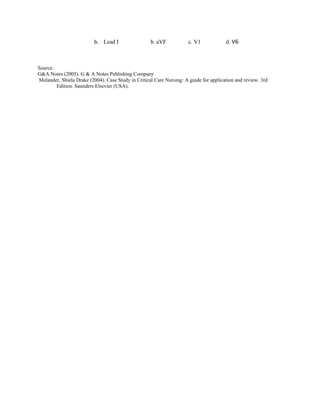
_____26. What lead primarily measures forces moving from the head to feet inferiorly?
b. Lead I                 b. aVF            c. V1            d. V6


Source:
G&A Notes (2005). G & A Notes Publishing Company
Melander, Shiela Drake (2004). Case Study in Critical Care Nursing: A guide for application and review. 3rd
        Edition. Saunders Elsevier (USA).

ECG 12 LEADS QUESTIONNAIRE

  • 1.
    KNOWLEDGE OF ELECTROCARDIOGRAMINVENTORY Gender:___________ Year Level: ________ Number of Exposure: 0-1 ____ 2-3____ 4-5_____ 6 times and more_____ I - Placement of ECG leads in Matching type: 1. What is the standard limb lead placement? Match the color on a specific lead position written in column A by choosing answer column B. Write the letter on the blank provided. Column A Column B ____a. Right arm A. Black ____b. Left Arm B. Green ____c. Right leg C. Yellow ____d. Left leg D. Red 2. What is the standard precordial leads placement? Match the specific precordial lead number with described position written in column A and choosing answer (color) column B. Write the letter on the blank provided. Column A Column B _____ a. V1- fourth intercostals space just to the right Of the sterna border A- Yellow _____b. V2- fourth intercostals space just to the left of the sternal border B - Violet _____c. V3 - midway between leads V2 and V4 C- Red _____d. V4 -midclavicular line, above the fifth interspace D- Black _____e. V5- anterior axillary line at the same level as V4 E- Green _____f. V6- midaxillary line at the same level as leads V4 and F- Brown V5 II-Basic ECG interpretation _____ 1. The student nurse is reviewing his ECG notes and would accurately understand that QRS complex is approximately? a. Less than .11 seconds c. less than .12 seconds b. .10 seconds to .20 seconds d. 04 to .10 seconds ______2. The serum K level of a client who has diabetic ketoacidosis is 5.4 meq/L. When monitoring the ECG tracing, the nurse would expect to observe? a. Absence of P wave c. Pathologic Q wave b. Peaked T wave d. Prominent U wave _____3. Which of the following ECG findings alert the student nurse must note when the client needs antiarrytmic drugs a. Normal Sinus rhythm c. Sinus Arrythmia
  • 2.
    b. Sinus bradycardia d. Premature Ventricular Complex _____4. When administering antiarrythmic drugs, it is most important for the nurse to monitor which of the following parameters? a. ECG b. Pulse rate c. Respiratory rate b. Blood Pressure ______5. Roland is scheduled for ECG. In the morning of the test which of the following item of food will be removed from the breakfast tray? a. Toast with butter c. Coffee b. Rice with viand d. Remove all _____6. Two days after Mang Berto complains of severe dyspnea and is anxious, tachypneic and tachycardic. While continuing your assessment to Mang Berto, the Student nurse notes a pulse deficit. He will anticipate that the patient may require a. Hourly BP check c. ECG monitoring b. Coronary arteriogram d. 2 D echocardiogram _____7. As a student nurse you know that the function of ECG is to a. Provides a graphic representation of the direction and magnitude of the heart’s electrocardiography b. Give information about Cardiac Structures c. To evaluate the heart’s electrical activity d. To evaluate ventricular function and myocardial blood flow and detects areas of myocardial damage _____8. Mrs. Roberts has undergone hearty surgery for a valve replacement. When monitoring Mrs. Roberts post surgery, the student nurse detects Premature Ventricular Contractions (PVC) on the ECG. The nurse recognizes that PVCs may be dangerous because they a. Significantly increase cardiac workload b. May lead to Ventricular tachycardia or Ventricular fibrillation c. Are the most common cause of myocardial infarction d. Decrease heart rate and blood pressure _____9. It is the measurement from one QRS complex to the beginning of the next QRS complex and determines Ventricular rate and rhythm a. PP interval c. RR interval
  • 3.
    b. QT interval d. PR interval _____10. What is the normal PR interval duration? a. 0.04-0.08 seconds c. < o.11 seconds b. 0.06-0.12 seconds d. 0.12-0.20 seconds _____11. What is the normal P wave duration? a. < 0.11 seconds c. >0.15 seconds b. < 0.20 seconds d. >0.25 seconds _____12. From an ECG reading, PR interval represents; a. Ventricular Contraction b. Represent the impulse travel time through the AV node, Bundle of his and Pukinjie fibers c. Ventricular Repolarization d. Atrial Contraction _____13. From an ECG reading, QRS complex represents; a. Ventricular Repolarization c. Ventricular Depolarization b. Atrial Repolarization d. Atrial Contraction _____14. From an ECG reading, T wave represents; a. Ventricular Repolarization c. Ventricular Contraction b. Atrial Contraction d. Atrial Repolarization _____15. From an ECG reading, P wave represents c. Atrial Contraction c. Atrial Contraction d. Atrial Repolarization d. Ventricular Contraction _____16. While assessing a 52 year old at the ER who had heavy ingestion of alcohol the night before consultation the nurse noticed the ECG rhythm has no longer P wave. You conclude this as e. Sinus Bradycardia c. Atrial Fibrillation f. Atrial Flutter d. Sinus Bradycardia _____17. Which of the following represents Ventricular relaxation in the ECG tracing
  • 4.
    g. P wave b. QRS complex c. T wave d. U wave _____18. The ECG of a 25year old athlete shows PR interval of 0.16 seconds. You can conclude that that this is h. Normal c. 1st degree AV block i. Atrial Flutter d. Sinus Bradycardia _____19. A 34 year old in the ER experiencing a chest pain; with an order of ECG as a student nurse you are to remove all his belongings except; a. Jewelries b. Coins c. Keys d. Pants _____20. In placement of ECG lead, as a student nurse you are aware that the black colored lead will be place at b. Right wrist b. Left wrist c. right ankle d. left ankle _____21. In placement of ECG lead, as a student nurse you are aware that the yellow colored lead will be place at c. Right wrist d. Left wrist c. right ankle d. left ankle _____22. From an ECG reading; it is the beginning of on P wave to the beginning of the next, it determines atrial rate and rhythm d. RR interval c. PR interval e. PP interval d. QT interval _____23. How many leads has an ECG had? f. 6 b. 12 c.24 d.20 _____24. All of the following must be included in ECG interpretation except; g. Conduction Analysis c. Waveforms h. PU interval d. QT interval _____25. What lead measures about the same direction of current as lead I? a. aVF b. II c.III d. V6 _____26. What lead primarily measures forces moving from the head to feet inferiorly?
  • 5.
    b. Lead I b. aVF c. V1 d. V6 Source: G&A Notes (2005). G & A Notes Publishing Company Melander, Shiela Drake (2004). Case Study in Critical Care Nursing: A guide for application and review. 3rd Edition. Saunders Elsevier (USA).