ELEMENTS OF CIVIL ENGINEERING
AND
ENGINEERING MECHANICS
Mr. SACHIN H R
ASSISTANT PROFESSOR
DEPARTMENT OF CIVIL ENGINEERING
SJCIT, Chickballapur
Email: sachinrcgowda@gmail.com
VARIOUS FIELDS OF CIVIL ENGINEERING
1. Surveying
2. Geotechnical engineering
3. Structural engineering
4. Transportation engineering
5. Environmental engineering
6. Hydraulics
7. Water resource and irrigation engineering
8. Building materials
9. Construction technology
SURVEYING
• Map making
• Relative positions of objects
• Elevations
• Soil property
• Moisture content
• Safe bearing capacity
• Ground improvement techniques
for roads, tunnels, dams, canals etc
GEOTECHNICAL ENGINEERING
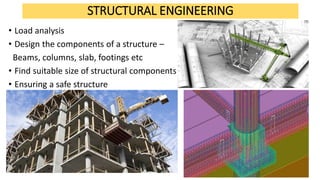
STRUCTURAL ENGINEERING
• Load analysis
• Design the components of a structure –
Beams, columns, slab, footings etc
• Find suitable size of structural components
• Ensuring a safe structure
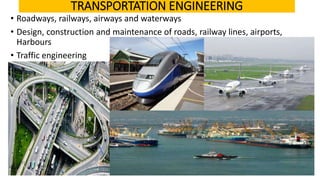
TRANSPORTATION ENGINEERING
• Roadways, railways, airways and waterways
• Design, construction and maintenance of roads, railway lines, airports,
Harbours
• Traffic engineering
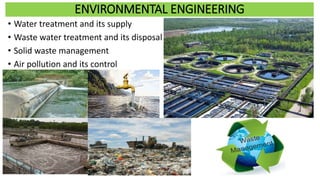
ENVIRONMENTAL ENGINEERING
• Water treatment and its supply
• Waste water treatment and its disposal
• Solid waste management
• Air pollution and its control
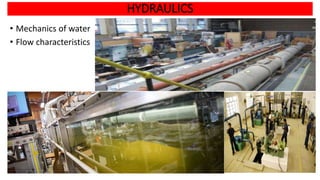
HYDRAULICS
• Mechanics of water
• Flow characteristics
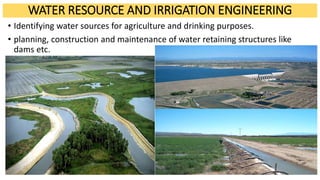
WATER RESOURCE AND IRRIGATION ENGINEERING
• Identifying water sources for agriculture and drinking purposes.
• planning, construction and maintenance of water retaining structures like
dams etc.
BUILDING MATERIALS
• Stones, bricks, cement, sand, timber, lime, tiles, steel, aluminium, POP, paints,
varnishes etc
CONSTRUCTION TECHNOLOGY
• Economical and speedy construction
• Low cost materials
• Modern construction methods and
equipment's
ROLE OF CIVIL ENGINEER IN INFRASTRUCTURE
DEVELOPMENT
• Town and city planning
• Build structures for rural and urban areas
• Build dams, tanks to exploit water resources
• Build water treatment plants and supply systems
• Build waste water treatment plants and drainage facilities
• Provide roads, railways, harbours and airport facilities
• Monitor land, water and air pollution and to control them.
EFFECT OF INFRASTRUCTURE FACILITIES
• Production centre to market centres
• Employment
• Imports and exports
• Industrial and agricultural production
• Education and health care
• Natural calamities assistance
• Defence system
• Improved life style of people
• Control of anti-social activities
INTRODUCTION TO MECHANICS
BASIC IDEALIZATIONS
• Particle (only mass, no size. Ex: aeroplane in sky, ship on sea)
• Continuum (continuous distribution of matter)
• Rigid body (no change in relative positions of any two particle)
• Point force (weight of body is considered as a single force, ignoring the area of
contact)
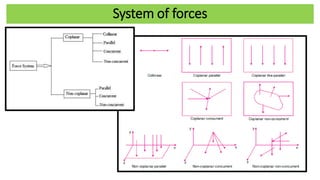
Force & System of forces
A force is an agency which tries to change state of rest or state of uniform
motion of the body
Elements of a force:
• Magnitude
• Point of application
• Line of action
• Direction
System of forces
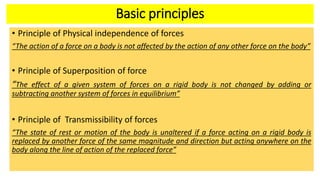
Basic principles
• Principle of Physical independence of forces
“The action of a force on a body is not affected by the action of any other force on the body”
• Principle of Superposition of force
“The effect of a given system of forces on a rigid body is not changed by adding or
subtracting another system of forces in equilibrium”
• Principle of Transmissibility of forces
“The state of rest or motion of the body is unaltered if a force acting on a rigid body is
replaced by another force of the same magnitude and direction but acting anywhere on the
body along the line of action of the replaced force”
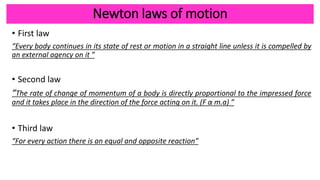
Newton laws of motion
• First law
“Every body continues in its state of rest or motion in a straight line unless it is compelled by
an external agency on it ”
• Second law
“The rate of change of momentum of a body is directly proportional to the impressed force
and it takes place in the direction of the force acting on it. (F α m.a) ”
• Third law
“For every action there is an equal and opposite reaction”
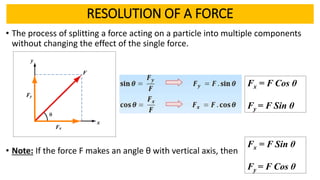
RESOLUTION OF A FORCE
• The process of splitting a force acting on a particle into multiple components
without changing the effect of the single force.
• Note: If the force F makes an angle θ with vertical axis, then
Fx = F Sin θ
Fy = F Cos θ
Fx = F Cos θ
Fy = F Sin θ
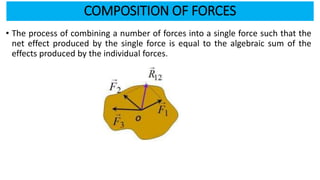
COMPOSITION OF FORCES
• The process of combining a number of forces into a single force such that the
net effect produced by the single force is equal to the algebraic sum of the
effects produced by the individual forces.
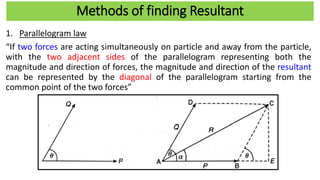
Methods of finding Resultant
1. Parallelogram law
“If two forces are acting simultaneously on particle and away from the particle,
with the two adjacent sides of the parallelogram representing both the
magnitude and direction of forces, the magnitude and direction of the resultant
can be represented by the diagonal of the parallelogram starting from the
common point of the two forces”
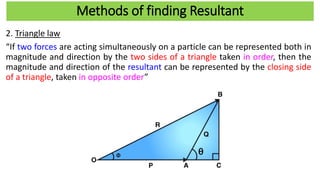
Methods of finding Resultant
2. Triangle law
“If two forces are acting simultaneously on a particle can be represented both in
magnitude and direction by the two sides of a triangle taken in order, then the
magnitude and direction of the resultant can be represented by the closing side
of a triangle, taken in opposite order”
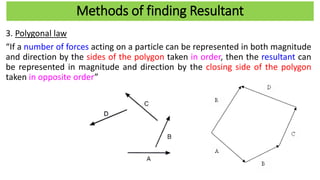
Methods of finding Resultant
3. Polygonal law
“If a number of forces acting on a particle can be represented in both magnitude
and direction by the sides of the polygon taken in order, then the resultant can
be represented in magnitude and direction by the closing side of the polygon
taken in opposite order”
Moment of a force
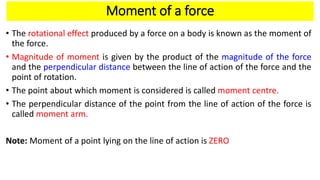
• The rotational effect produced by a force on a body is known as the moment of
the force.
• Magnitude of moment is given by the product of the magnitude of the force
and the perpendicular distance between the line of action of the force and the
point of rotation.
• The point about which moment is considered is called moment centre.
• The perpendicular distance of the point from the line of action of the force is
called moment arm.
Note: Moment of a point lying on the line of action is ZERO
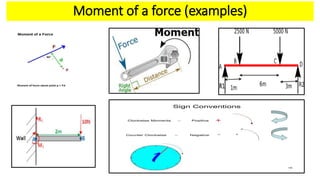
Moment of a force (examples)
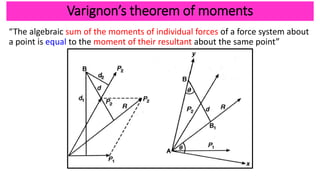
Varignon’s theorem of moments
“The algebraic sum of the moments of individual forces of a force system about
a point is equal to the moment of their resultant about the same point”
COUPLE
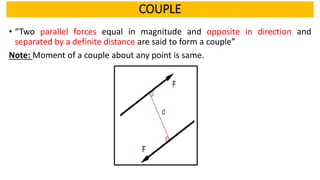
• “Two parallel forces equal in magnitude and opposite in direction and
separated by a definite distance are said to form a couple”
Note: Moment of a couple about any point is same.
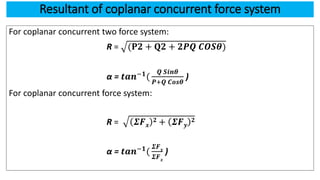
Resultant of coplanar concurrent force system
For coplanar concurrent two force system:
R = (𝐏𝟐 + 𝐐𝟐 + 𝟐𝑷𝑸 𝑪𝑶𝑺𝜽)
α = 𝒕𝒂𝒏−𝟏(
𝑸 𝑺𝒊𝒏𝜽
𝑷+𝑸 𝑪𝒐𝒔𝜽
)
For coplanar concurrent force system:
R = 𝜮𝑭 𝒙
𝟐 + 𝜮𝑭 𝒚
𝟐
α = 𝒕𝒂𝒏−𝟏
(
𝜮𝑭 𝒚
𝜮𝑭 𝒙
)

ELEMENTS OF CIVIL ENGINEERING AND ENGINEERING MECHANICS PART-1

  • 1.
    ELEMENTS OF CIVILENGINEERING AND ENGINEERING MECHANICS Mr. SACHIN H R ASSISTANT PROFESSOR DEPARTMENT OF CIVIL ENGINEERING SJCIT, Chickballapur Email: sachinrcgowda@gmail.com
  • 2.
    VARIOUS FIELDS OFCIVIL ENGINEERING 1. Surveying 2. Geotechnical engineering 3. Structural engineering 4. Transportation engineering 5. Environmental engineering 6. Hydraulics 7. Water resource and irrigation engineering 8. Building materials 9. Construction technology
  • 3.
    SURVEYING • Map making •Relative positions of objects • Elevations
  • 4.
    • Soil property •Moisture content • Safe bearing capacity • Ground improvement techniques for roads, tunnels, dams, canals etc GEOTECHNICAL ENGINEERING
  • 5.
    STRUCTURAL ENGINEERING • Loadanalysis • Design the components of a structure – Beams, columns, slab, footings etc • Find suitable size of structural components • Ensuring a safe structure
  • 6.
    TRANSPORTATION ENGINEERING • Roadways,railways, airways and waterways • Design, construction and maintenance of roads, railway lines, airports, Harbours • Traffic engineering
  • 7.
    ENVIRONMENTAL ENGINEERING • Watertreatment and its supply • Waste water treatment and its disposal • Solid waste management • Air pollution and its control
  • 8.
    HYDRAULICS • Mechanics ofwater • Flow characteristics
  • 9.
    WATER RESOURCE ANDIRRIGATION ENGINEERING • Identifying water sources for agriculture and drinking purposes. • planning, construction and maintenance of water retaining structures like dams etc.
  • 10.
    BUILDING MATERIALS • Stones,bricks, cement, sand, timber, lime, tiles, steel, aluminium, POP, paints, varnishes etc
  • 11.
    CONSTRUCTION TECHNOLOGY • Economicaland speedy construction • Low cost materials • Modern construction methods and equipment's
  • 12.
    ROLE OF CIVILENGINEER IN INFRASTRUCTURE DEVELOPMENT • Town and city planning • Build structures for rural and urban areas • Build dams, tanks to exploit water resources • Build water treatment plants and supply systems • Build waste water treatment plants and drainage facilities • Provide roads, railways, harbours and airport facilities • Monitor land, water and air pollution and to control them.
  • 13.
    EFFECT OF INFRASTRUCTUREFACILITIES • Production centre to market centres • Employment • Imports and exports • Industrial and agricultural production • Education and health care • Natural calamities assistance • Defence system • Improved life style of people • Control of anti-social activities
  • 14.
  • 15.
    BASIC IDEALIZATIONS • Particle(only mass, no size. Ex: aeroplane in sky, ship on sea) • Continuum (continuous distribution of matter) • Rigid body (no change in relative positions of any two particle) • Point force (weight of body is considered as a single force, ignoring the area of contact)
  • 16.
    Force & Systemof forces A force is an agency which tries to change state of rest or state of uniform motion of the body Elements of a force: • Magnitude • Point of application • Line of action • Direction
  • 17.
  • 18.
    Basic principles • Principleof Physical independence of forces “The action of a force on a body is not affected by the action of any other force on the body” • Principle of Superposition of force “The effect of a given system of forces on a rigid body is not changed by adding or subtracting another system of forces in equilibrium” • Principle of Transmissibility of forces “The state of rest or motion of the body is unaltered if a force acting on a rigid body is replaced by another force of the same magnitude and direction but acting anywhere on the body along the line of action of the replaced force”
  • 19.
    Newton laws ofmotion • First law “Every body continues in its state of rest or motion in a straight line unless it is compelled by an external agency on it ” • Second law “The rate of change of momentum of a body is directly proportional to the impressed force and it takes place in the direction of the force acting on it. (F α m.a) ” • Third law “For every action there is an equal and opposite reaction”
  • 20.
    RESOLUTION OF AFORCE • The process of splitting a force acting on a particle into multiple components without changing the effect of the single force. • Note: If the force F makes an angle θ with vertical axis, then Fx = F Sin θ Fy = F Cos θ Fx = F Cos θ Fy = F Sin θ
  • 21.
    COMPOSITION OF FORCES •The process of combining a number of forces into a single force such that the net effect produced by the single force is equal to the algebraic sum of the effects produced by the individual forces.
  • 22.
    Methods of findingResultant 1. Parallelogram law “If two forces are acting simultaneously on particle and away from the particle, with the two adjacent sides of the parallelogram representing both the magnitude and direction of forces, the magnitude and direction of the resultant can be represented by the diagonal of the parallelogram starting from the common point of the two forces”
  • 23.
    Methods of findingResultant 2. Triangle law “If two forces are acting simultaneously on a particle can be represented both in magnitude and direction by the two sides of a triangle taken in order, then the magnitude and direction of the resultant can be represented by the closing side of a triangle, taken in opposite order”
  • 24.
    Methods of findingResultant 3. Polygonal law “If a number of forces acting on a particle can be represented in both magnitude and direction by the sides of the polygon taken in order, then the resultant can be represented in magnitude and direction by the closing side of the polygon taken in opposite order”
  • 25.
    Moment of aforce • The rotational effect produced by a force on a body is known as the moment of the force. • Magnitude of moment is given by the product of the magnitude of the force and the perpendicular distance between the line of action of the force and the point of rotation. • The point about which moment is considered is called moment centre. • The perpendicular distance of the point from the line of action of the force is called moment arm. Note: Moment of a point lying on the line of action is ZERO
  • 26.
    Moment of aforce (examples)
  • 27.
    Varignon’s theorem ofmoments “The algebraic sum of the moments of individual forces of a force system about a point is equal to the moment of their resultant about the same point”
  • 28.
    COUPLE • “Two parallelforces equal in magnitude and opposite in direction and separated by a definite distance are said to form a couple” Note: Moment of a couple about any point is same.
  • 29.
    Resultant of coplanarconcurrent force system For coplanar concurrent two force system: R = (𝐏𝟐 + 𝐐𝟐 + 𝟐𝑷𝑸 𝑪𝑶𝑺𝜽) α = 𝒕𝒂𝒏−𝟏( 𝑸 𝑺𝒊𝒏𝜽 𝑷+𝑸 𝑪𝒐𝒔𝜽 ) For coplanar concurrent force system: R = 𝜮𝑭 𝒙 𝟐 + 𝜮𝑭 𝒚 𝟐 α = 𝒕𝒂𝒏−𝟏 ( 𝜮𝑭 𝒚 𝜮𝑭 𝒙 )