AGENT DISCOVRY IN MOBILE IP
AGENT DISCOVERY
 A mobile node uses a method known as agent discovery to determine
the following information.
 When the node has moved from one network to another
 Whether the network is the node’s home or a foreign network
 What is the foreign agent care-of-address offered by each foreign agent on that
network
 Mobility agents transmit agent advertisement to advertise their
services on a network. In the absence of agent advertisements, a
mobile node can solicit advertisements. This is known as agent
solicitation.
Agent Advertisement
 HA and FA periodically send advertisement messages into their physical
subnets
 Usually, the FA periodically broadcast the IRDP (Internet Router
Discovery Protocol) message in its own network to let the visited MN
know the FA is here and what services the FA provides (Agent
Advertisement).
 MN listens to these messages and detects, if it is in the home or a foreign
network (standard case for home network)
 MN reads a COA from the FA advertisement messages
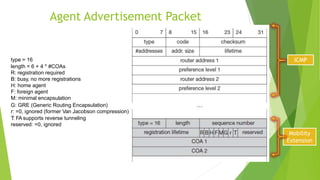
Agent Advertisement Packet
ICMP
Mobility
Extension
type = 16
length = 6 + 4 * #COAs
R: registration required
B: busy, no more registrations
H: home agent
F: foreign agent
M: minimal encapsulation
G: GRE (Generic Routing Encapsulation)
r: =0, ignored (former Van Jacobson compression)
T
: FA supports reverse tunneling
reserved: =0, ignored
 Type  set to 9,
 Code  0 if the agent also routes traffic from non-mobile nodes or else 16
 Checksum  simple error detection mechanism to determine the integrity of the data
transmitted over network
 #addresses  The number of router addresses advertised in this message
 Addr. Size  The number of 32-bit words of information per each router address
 Lifetime  length of time this advertisement is valid.
 Router Address [i = 1, 2 ,3…]  The sending router’s IP address on the ith
interface from which this message is sent
 Preference levels  each address help a node to choose the router that is the most
eager one to get a new node.
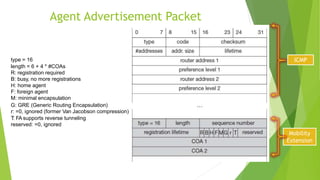
Agent Advertisement Packet
ICMP
Mobility
Extension
type = 16
length = 6 + 4 * #COAs
R: registration required
B: busy, no more registrations
H: home agent
F: foreign agent
M: minimal encapsulation
G: GRE (Generic Routing Encapsulation)
r: =0, ignored (former Van Jacobson compression)
T
: FA supports reverse tunneling
reserved: =0, ignored
 Sequence number  The count of agent advertisement messages sent since the agent
was initialized.
 Registration lifetime  maximum lifetime in seconds a node can request during
registration
 R bit (registration) shows, if a registration with this agent is required even when using
a colocated COA at the MN.
 If the agent is currently too busy to accept new registrations it can set the B bit.
 The following two bits denote if the agent offers services as a home agent (H) or
foreign agent (F) on the link where the advertisement has been sent.
 Bits M and G specify the method of encapsulation, M can specify minimal
encapsulation and G generic routing encapsulation.
 The new field T indicates that reverse tunneling is supported by the FA
 A foreign agent setting the F bit must advertise at least one COA.
Agent Solicitation
 If no agent advertisements are present or the inter-arrival time is too high, and an MN
has not received a COA by other means, the mobile node must send agent solicitations.
 Care must be taken to ensure that these solicitation messages do not flood the network
 Typically, a mobile node can send out three solicitations, one per second, as soon as it
enters a new network.
 If a node does not receive an answer to its solicitations it must decrease the rate of
solicitations exponentially to avoid flooding the network until it reaches a maximum
interval between solicitations (typically one minute).
 After these steps of advertisements or solicitations the MN can now receive a COA,
either one for an FA or a co-located COA.
 The MN knows its location (home network or foreign network) and the capabilities of
the agent (if needed).

Ec8004 wireless networks unit 2 agent discovery

  • 1.
  • 2.
    AGENT DISCOVERY  Amobile node uses a method known as agent discovery to determine the following information.  When the node has moved from one network to another  Whether the network is the node’s home or a foreign network  What is the foreign agent care-of-address offered by each foreign agent on that network  Mobility agents transmit agent advertisement to advertise their services on a network. In the absence of agent advertisements, a mobile node can solicit advertisements. This is known as agent solicitation.
  • 3.
    Agent Advertisement  HAand FA periodically send advertisement messages into their physical subnets  Usually, the FA periodically broadcast the IRDP (Internet Router Discovery Protocol) message in its own network to let the visited MN know the FA is here and what services the FA provides (Agent Advertisement).  MN listens to these messages and detects, if it is in the home or a foreign network (standard case for home network)  MN reads a COA from the FA advertisement messages
  • 4.
    Agent Advertisement Packet ICMP Mobility Extension type= 16 length = 6 + 4 * #COAs R: registration required B: busy, no more registrations H: home agent F: foreign agent M: minimal encapsulation G: GRE (Generic Routing Encapsulation) r: =0, ignored (former Van Jacobson compression) T : FA supports reverse tunneling reserved: =0, ignored
  • 5.
     Type set to 9,  Code  0 if the agent also routes traffic from non-mobile nodes or else 16  Checksum  simple error detection mechanism to determine the integrity of the data transmitted over network  #addresses  The number of router addresses advertised in this message  Addr. Size  The number of 32-bit words of information per each router address  Lifetime  length of time this advertisement is valid.  Router Address [i = 1, 2 ,3…]  The sending router’s IP address on the ith interface from which this message is sent  Preference levels  each address help a node to choose the router that is the most eager one to get a new node.
  • 6.
    Agent Advertisement Packet ICMP Mobility Extension type= 16 length = 6 + 4 * #COAs R: registration required B: busy, no more registrations H: home agent F: foreign agent M: minimal encapsulation G: GRE (Generic Routing Encapsulation) r: =0, ignored (former Van Jacobson compression) T : FA supports reverse tunneling reserved: =0, ignored
  • 7.
     Sequence number The count of agent advertisement messages sent since the agent was initialized.  Registration lifetime  maximum lifetime in seconds a node can request during registration  R bit (registration) shows, if a registration with this agent is required even when using a colocated COA at the MN.  If the agent is currently too busy to accept new registrations it can set the B bit.  The following two bits denote if the agent offers services as a home agent (H) or foreign agent (F) on the link where the advertisement has been sent.  Bits M and G specify the method of encapsulation, M can specify minimal encapsulation and G generic routing encapsulation.  The new field T indicates that reverse tunneling is supported by the FA  A foreign agent setting the F bit must advertise at least one COA.
  • 8.
    Agent Solicitation  Ifno agent advertisements are present or the inter-arrival time is too high, and an MN has not received a COA by other means, the mobile node must send agent solicitations.  Care must be taken to ensure that these solicitation messages do not flood the network  Typically, a mobile node can send out three solicitations, one per second, as soon as it enters a new network.  If a node does not receive an answer to its solicitations it must decrease the rate of solicitations exponentially to avoid flooding the network until it reaches a maximum interval between solicitations (typically one minute).  After these steps of advertisements or solicitations the MN can now receive a COA, either one for an FA or a co-located COA.  The MN knows its location (home network or foreign network) and the capabilities of the agent (if needed).