BLUETOOTH
IEEE 802.15.1
BLUETOOTH
 Universal radio interface for ad-hoc wireless connectivity.
 Short range (10 m), low power consumption, license-free 2.45 GHz
ISM band.
 Voice and data transmission, approx. 1 Mbit/s gross data rate.
 Wireless Personal Area Network (WPAN)
 FHSS and TDD
 Frequency hopping with 1600 hops/s
 Hopping sequence in a pseudo random fashion, determined by a
master
 Time division duplex for send/receive separation
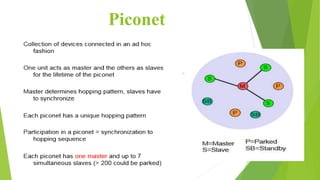
Piconet
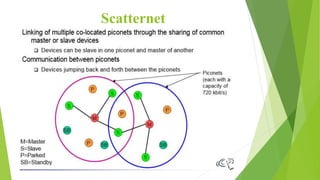
Scatternet
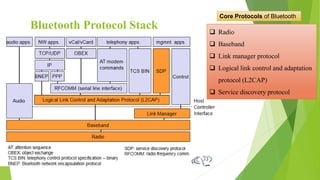
Bluetooth Protocol Stack  Radio
 Baseband
 Link manager protocol
 Logical link control and adaptation
protocol (L2CAP)
 Service discovery protocol
Core Protocols of Bluetooth
RADIO LAYER
 It only defines the carrier frequencies and output power.
 A frequency-hopping/time-division duplex scheme is used for transmission,
with a fast hopping rate of 1,600 hops per second.
 The time between two hops is called a slot, which is an interval of 625 μs.
 Each slot uses a different frequency.
 Bluetooth uses 79 hop carriers equally spaced with 1 MHz.
 Bluetooth transceivers use Gaussian FSK for modulation.
BASEBAND LAYER
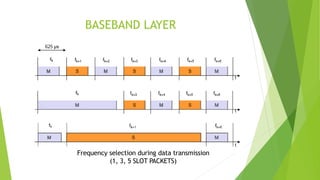
Frequency selection during data transmission
(1, 3, 5 SLOT PACKETS)
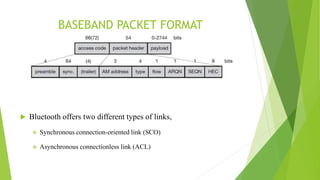
BASEBAND PACKET FORMAT
 Bluetooth offers two different types of links,
 Synchronous connection-oriented link (SCO)
 Asynchronous connectionless link (ACL)
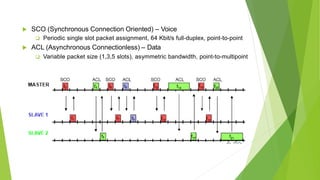
 SCO (Synchronous Connection Oriented) – Voice
 Periodic single slot packet assignment, 64 Kbit/s full-duplex, point-to-point
 ACL (Asynchronous Connectionless) – Data
 Variable packet size (1,3,5 slots), asymmetric bandwidth, point-to-multipoint
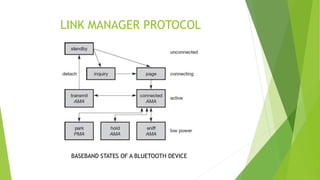
LINK MANAGER PROTOCOL
BASEBAND STATES OF A BLUETOOTH DEVICE
LOGICAL LINK CONTROL AND
ADAPTATION PROTOCOL (L2CAP)
 Simple data link protocol on top of baseband
 Connection oriented, connectionless, and signaling channels
 Protocol multiplexing
 Segmentation & reassembly
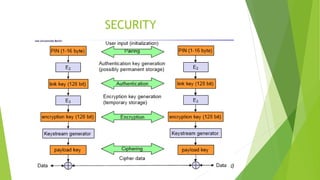
SECURITY

Ec8004 wireless networks unit 1 bluetooth

  • 1.
  • 2.
    BLUETOOTH  Universal radiointerface for ad-hoc wireless connectivity.  Short range (10 m), low power consumption, license-free 2.45 GHz ISM band.  Voice and data transmission, approx. 1 Mbit/s gross data rate.  Wireless Personal Area Network (WPAN)  FHSS and TDD  Frequency hopping with 1600 hops/s  Hopping sequence in a pseudo random fashion, determined by a master  Time division duplex for send/receive separation
  • 3.
  • 4.
  • 5.
    Bluetooth Protocol Stack Radio  Baseband  Link manager protocol  Logical link control and adaptation protocol (L2CAP)  Service discovery protocol Core Protocols of Bluetooth
  • 6.
    RADIO LAYER  Itonly defines the carrier frequencies and output power.  A frequency-hopping/time-division duplex scheme is used for transmission, with a fast hopping rate of 1,600 hops per second.  The time between two hops is called a slot, which is an interval of 625 μs.  Each slot uses a different frequency.  Bluetooth uses 79 hop carriers equally spaced with 1 MHz.  Bluetooth transceivers use Gaussian FSK for modulation.
  • 7.
    BASEBAND LAYER Frequency selectionduring data transmission (1, 3, 5 SLOT PACKETS)
  • 8.
    BASEBAND PACKET FORMAT Bluetooth offers two different types of links,  Synchronous connection-oriented link (SCO)  Asynchronous connectionless link (ACL)
  • 9.
     SCO (SynchronousConnection Oriented) – Voice  Periodic single slot packet assignment, 64 Kbit/s full-duplex, point-to-point  ACL (Asynchronous Connectionless) – Data  Variable packet size (1,3,5 slots), asymmetric bandwidth, point-to-multipoint
  • 10.
    LINK MANAGER PROTOCOL BASEBANDSTATES OF A BLUETOOTH DEVICE
  • 11.
    LOGICAL LINK CONTROLAND ADAPTATION PROTOCOL (L2CAP)  Simple data link protocol on top of baseband  Connection oriented, connectionless, and signaling channels  Protocol multiplexing  Segmentation & reassembly
  • 12.